A Look at Distant Cousin “Diamond-Tooth Charlie” and His Work in Establishing USC’s College of Physicians and Surgeons and the Angelus Hospital
Chasing History: Exploring My Ancestral Roots - Blog Post #63
By Tonya Graham McQuade
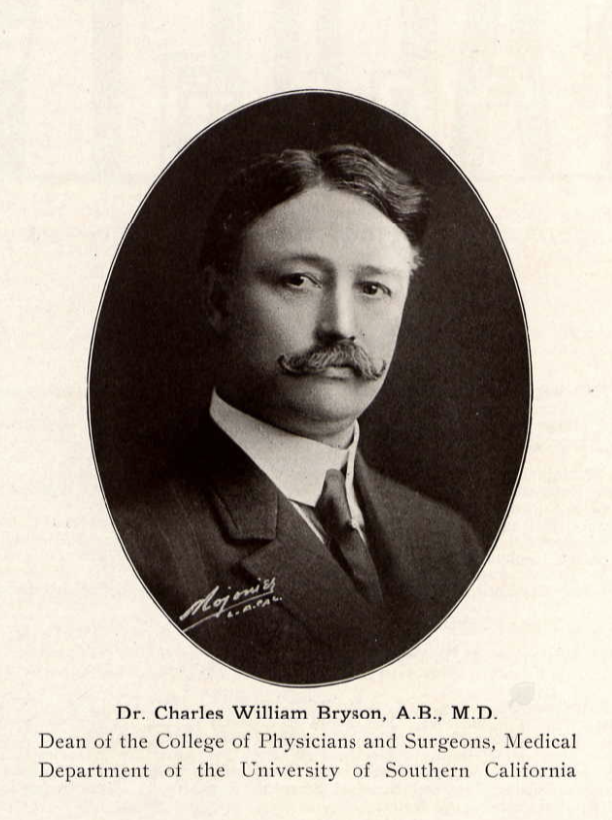
Dr. W. F. Traughber’s cousin, known around Los Angeles as “Diamond-Tooth Charlie,” played a big role in encouraging his move to California to attend USC’s College of Physicians and Surgeons. Photo from 1911 USC Yearbook, El Rodeo.
As I mention in my new book about my great grandparents, Frank and Nora’s Historic Honeymoon Adventure, at the end of their 4,500-mile honeymoon, Frank and Nora settled down in Mexico, Missouri, where Dr. William Francis “Frank” Traughber had an established medical practice as an Osteopath. He had graduated from the College of Osteopathy at A.T. Still University in Kirksville, Missouri, in 1901 (see this previous blog post for more details), then returned to his hometown of Centralia (next to Mexico) to start his practice. In a short time, he had risen in the ranks to become one of the leading Osteopaths in the state of Missouri.
Within two years, however, of settling in Mexico, Frank and Nora made the decision to uproot their family, which now included one-year-old son Frank, and move across the country to Los Angeles. I’m not certain what drove this decision, but I believe that one person who played a big role in encouraging the move and setting him on the path to becoming a surgeon was Frank’s cousin, Dr. Charles William Bryson. So, let me tell you a bit about “Diamond-Tooth Charlie.”
Charles W. Bryson was the son of Zedok and Marguerite Via Bryson of Boone County, Missouri. Zedok, the older brother of Frank’s mother Mariah “Marnie” Bryson Traughber, was killed in May 1863 during the Civil War, so he never got to meet his son Charles, who would not be born until December. Charles’s mother remarried in 1865, and Charles grew up with a stepfather (Morgan Elliott) and three half siblings, according to the 1880 U.S. Census. That same Census lists him as being 17 and a student.
Charles earned his A.B. degree in 1880 from Harris College, then made his way to Iowa, where he earned his medical degree from the College of Physicians and Surgeons in Keokuk, graduating in February 1882. [1] At the time, Keokuk was a significant center for medical education in the Midwest, and the college was one of the oldest medical schools in the region. After receiving his degree, Dr. C. W. Bryson set up his medical practice in Falls City, Nebraska. There, he married Susie Martha Goldsberry in April 1885.
In late 1886, the two moved to the burgeoning community of Los Angeles, where Bryson began a private practice as an abdominal surgeon and gynecologist. He received patients at an office on Spring Street and had a residence at South Olive Street, according to the following advertisement that he placed in the Los Angeles Herald in November. The ad also mentioned that he specialized in “medical and surgical diseases of women and children.”
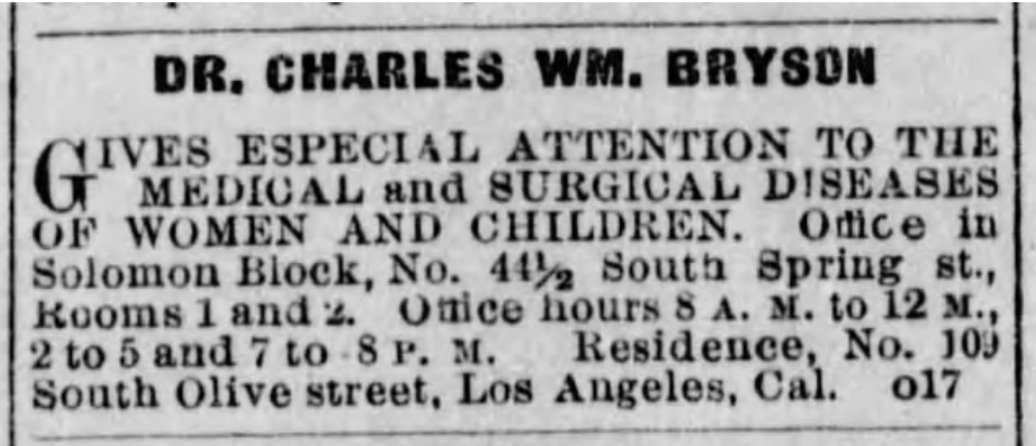
This ad appeared in the Los Angeles Herald in November 1886. [2]
Los Angeles in the 1880s was growing rapidly. The Southern Pacific Railroad had reached Los Angeles in 1876, and the Santa Fe Railroad followed in 1885, fueling a competitive rate war. The population exploded from roughly 11,000 in 1880 to over 50,000 by 1890, transforming the city from a small town into a developing urban center. The medical community was undergoing a massive transformation as well from a small, informal group of frontier practitioners into a professional urban network, with calls for more standardization in healthcare and medical education. As it turned out, Dr. Bryson would play a big role in that transformation.
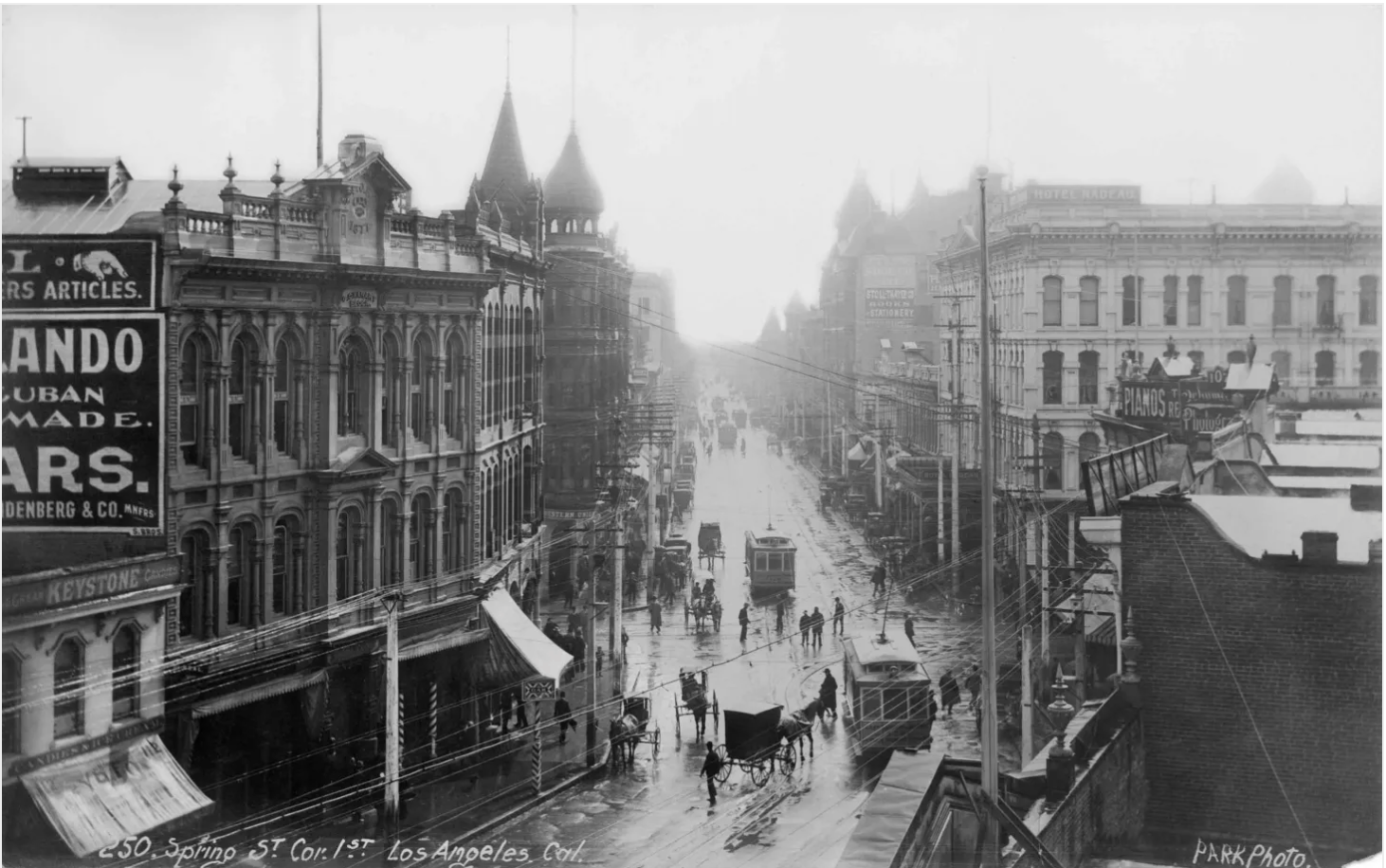
A view of Spring Street in the 1890s, near where Dr. Bryson set up his first office [3]
According to a 1993 article (yes, 1993!) in the Los Angeles Times, “Diamond Tooth Charlie,” who had an actual diamond implanted in one of his front teeth, “attracted notice from the start. He was a handsome man with a stylish mustache that he waxed and curled at the ends – and the diamond set in his tooth, which flashed wickedly in the sunshine. He made his rounds with a matched pair of white horses harnessed to a fancy rig with no top, a sort of early California convertible.” [4] And wouldn’t you know, Frank and Nora’s album includes a photo of Dr. Bryson’s swanky coachman, rig, and horses!
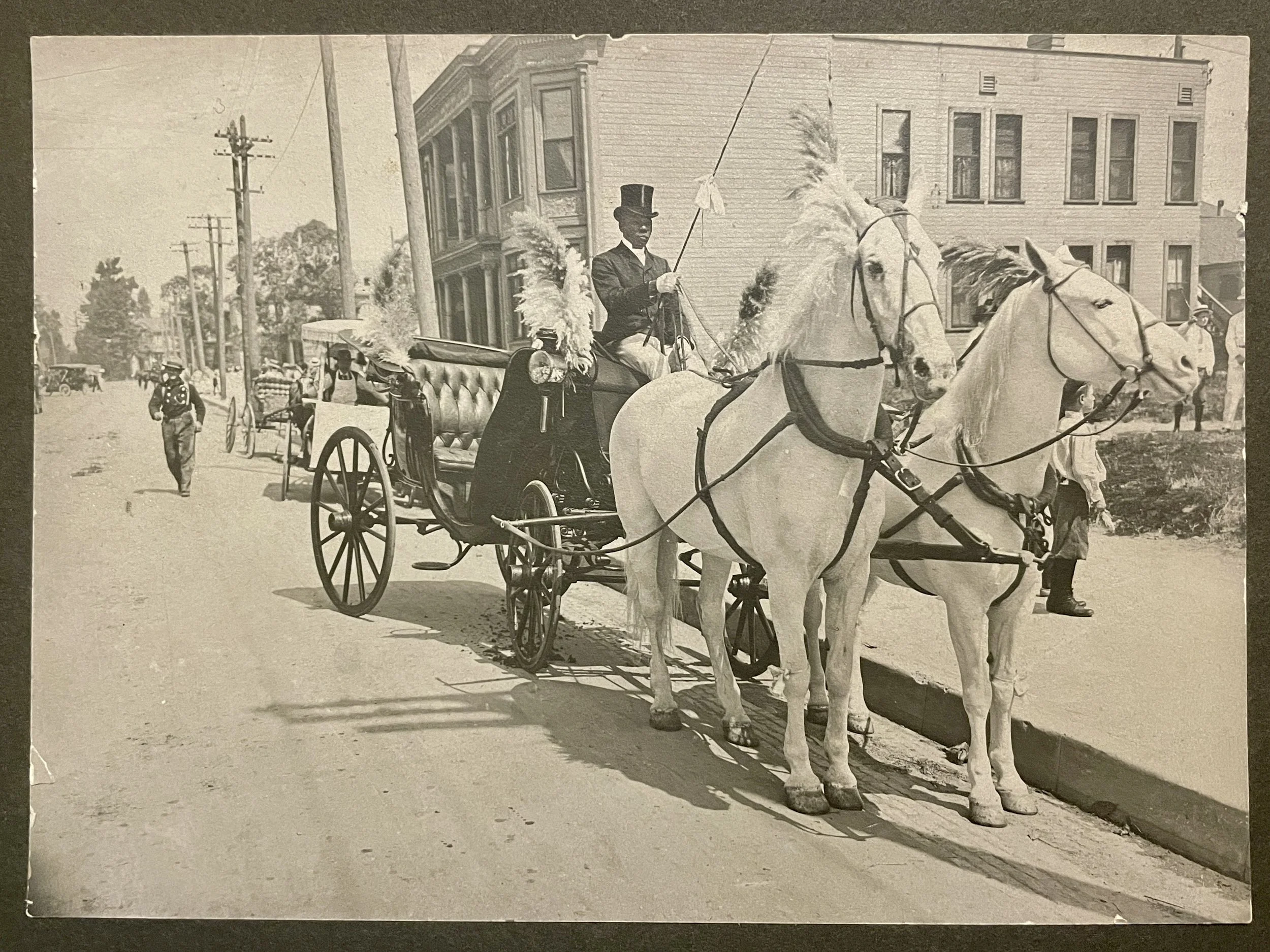
Dr. C. W. Bryson must have created quite a spectacle as he was driven around Los Angeles in this rig. Traughber Family Collection.
A year before Bryson arrived in Los Angeles, USC’s College of Medicine had been established, becoming the first medical training program in Southern California. Prior to that, the nearest medical schools were in the San Francisco area. The College of Medicine had also formed a formal partnership with the Los Angeles County Hospital in 1885, creating the clinical training model that Bryson would later lead. The College of Medicine was first housed in an old winery on Aliso Street; then later, in a larger, three-story building on Buena Vista Street starting in 1890. [5]
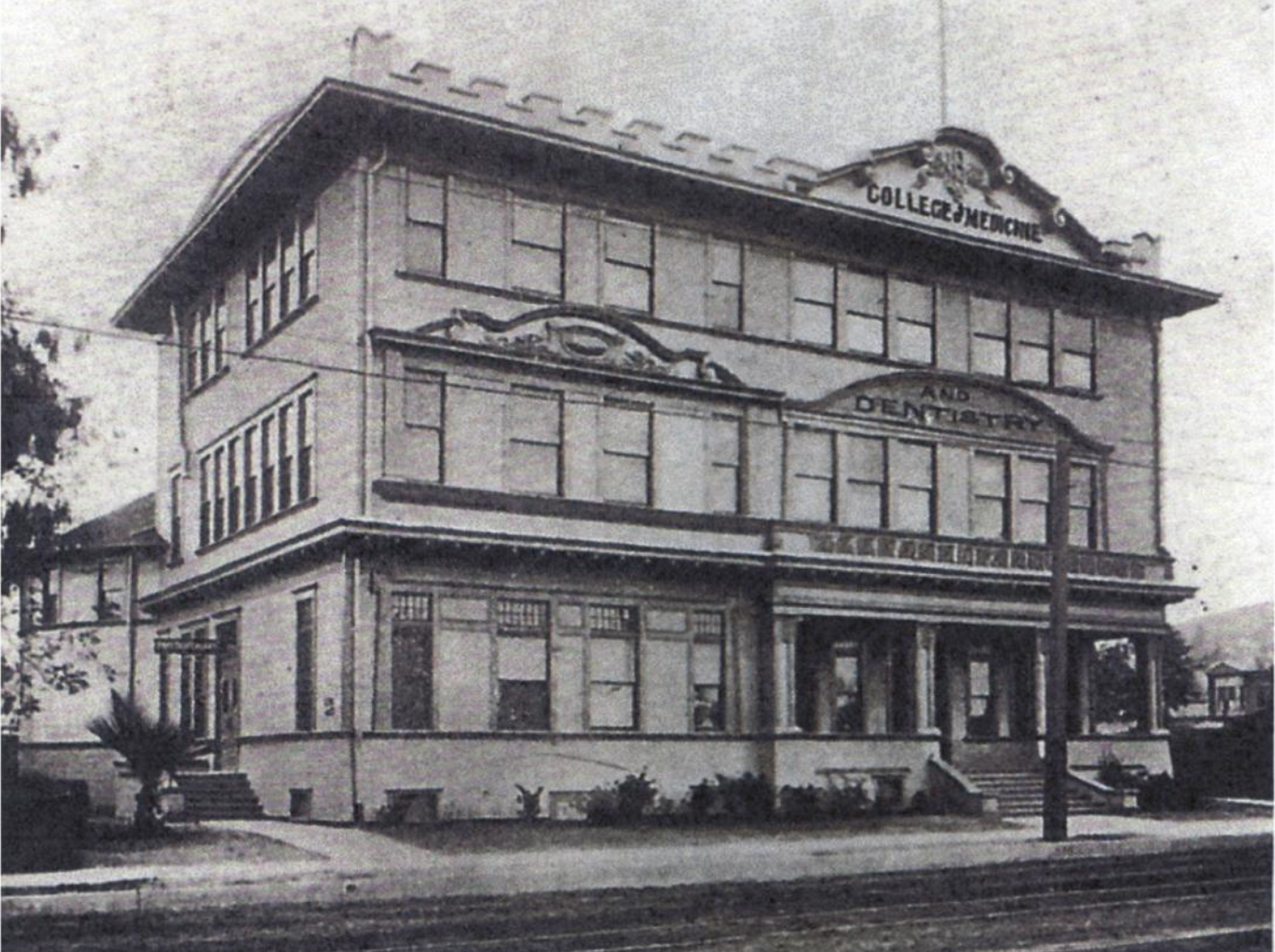
USC’s College of Medicine and Dentistry on Buena Vista Street, 1898 [6]
The College of Medicine had been founded by Dr. Joseph Pomeroy Widney, whose brother, Judge Robert Maclay Widney, had founded USC five years earlier in 1880. Dr. Widney had also been a key figure in founding the Los Angeles County Medical Association in 1871. At the time, “a small group of Los Angeles physicians gathered not out of convenience, but out of necessity. They didn’t come together to form another association — they came together to protect a calling. Medicine, in its truest form, has always been a sacred trust between doctor and patient. But even then, that trust was under siege — by bureaucracies, by misinformation, by systems that too often made healing harder than it needed to be. These early physicians saw the writing on the walls: If they didn’t stand together, they’d stand alone. So they built something greater than themselves — a collective voice, a shared backbone, and a relentless advocate for those who had none.” [7]
By 1908, USC’s College of Medicine, which was funded strictly by faculty contributions and student tuition, was facing financial difficulties. It terminated its affiliation with USC, instead becoming the Los Angeles Medical Department of the University of California. As a result, USC sought a new affiliation for its medical students, and here is where Dr. Bryson comes into the picture.
Dr. Bryson had certainly been making a name for himself. In December 1900, he was elected vice president of the Academy of Medicine of Los Angeles; the following month, he was appointed to the newly-created Board of Health by Los Angeles Mayor Meredith Snyder. [8] He had also, by 1900, had a daughter named Beryl (born in July 1887); divorced his wife (January 1895); and become very involved with the racing scene at the Los Angeles Driving Club (which involved horse racing). Here, though, I will keep the focus on his medical career. Those details might involve writing a Part II.
In 1904, in one of his most significant actions, Dr. Bryson helped to found the College of Physicians and Surgeons on W. Washington Street. A 1903 Los Angeles Evening Express article announced that “plans [were] well underway for a new medical college and hospital to be established near the business center of the city,” and Dr. Bryson was one of the doctors backing the enterprise, “which [was] said to be backed by ample capital.” [9]
As the article explained: “Architects are still at work on plans for the building, which will cost about $25,000 and will be equipped with the latest appliances for medical and surgical research. The first floor will be devoted to clinics, and it is the intention of the founders of the institution to place the best attendance within the reach of the poor as well as the rich. The hospital probably will furnish a few free beds and a free medical dispensary for those unable to pay is contemplated. Two large amphitheaters for lectures and demonstrations will occupy the second floor. Laboratories and the anatomical museum will be placed on the third floor.
“Dr. C.W. Bryson, one of the original promoters of the enterprise, said today: ‘It is our intention to found a high-grade college, one that will be hard to get into, and hard to get out of. Men of the highest professional standing will be placed on our faculty. We have ample means assured to build and equip a modern college, and a hospital will follow in due time. We want to afford a place where the poor can have the same treatment afforded the rich. We shall be ready to begin the work of instruction with the opening of the fall term next year. Our president has not yet been selected, but he will be a man who will command the respect of the professional and the general community.’” [10]
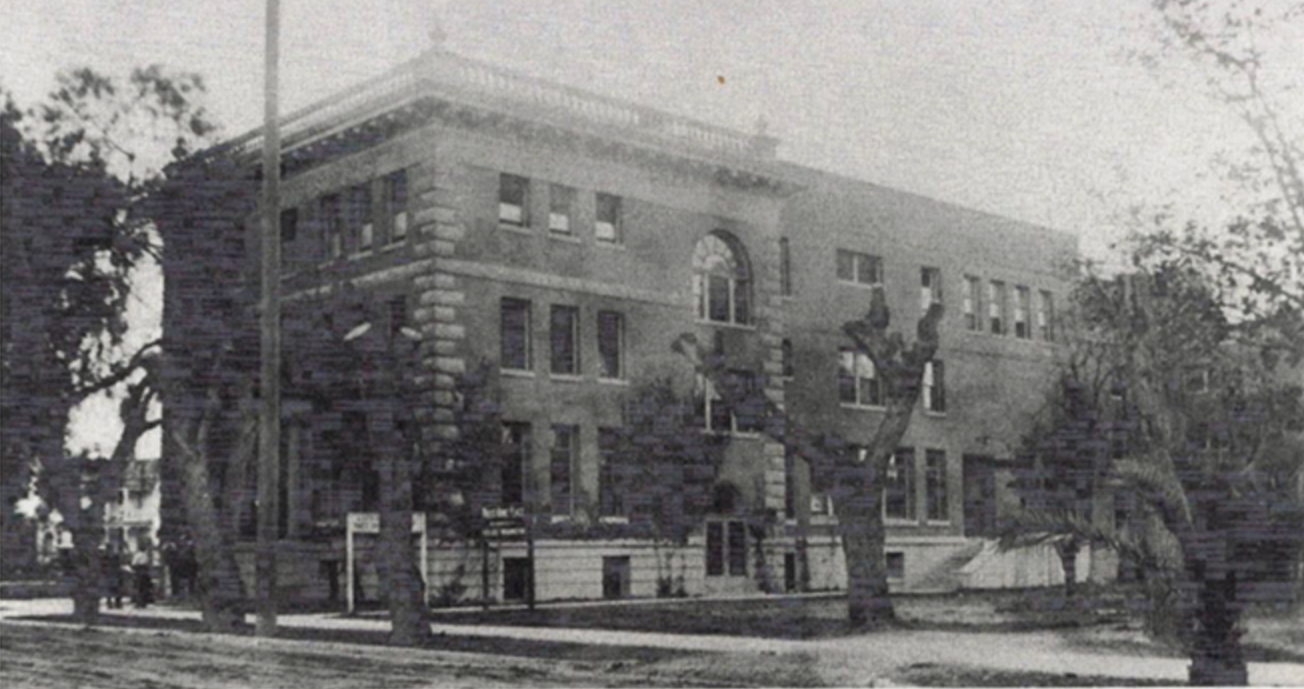
The College of Physicians and Surgeons, 516 Washington Street, 1904 [11]
The new college, which opened in Fall 1904 as anticipated, offered courses leading to three degrees: Doctor of Medicine, Doctor of Surgery, and Doctor of Dental Surgery. It was proclaimed to be “one of the most perfect on the Pacific coast” and was acclaimed for embracing “commodious amphitheaters, a large dissecting room, lecture rooms, a chemical laboratory with all conveniences known to modern teaching of chemistry, and separate bacteriological, histological and pathological laboratories.” [12]
The first class of 1905 featured six graduates and approximately 30 students; the next class had three graduates, including the Japanese-American Rokuro Koharu, a student from the University of Tokyo doing post-graduate work at the college. Starting in 1906, Bryson served as dean of the college.
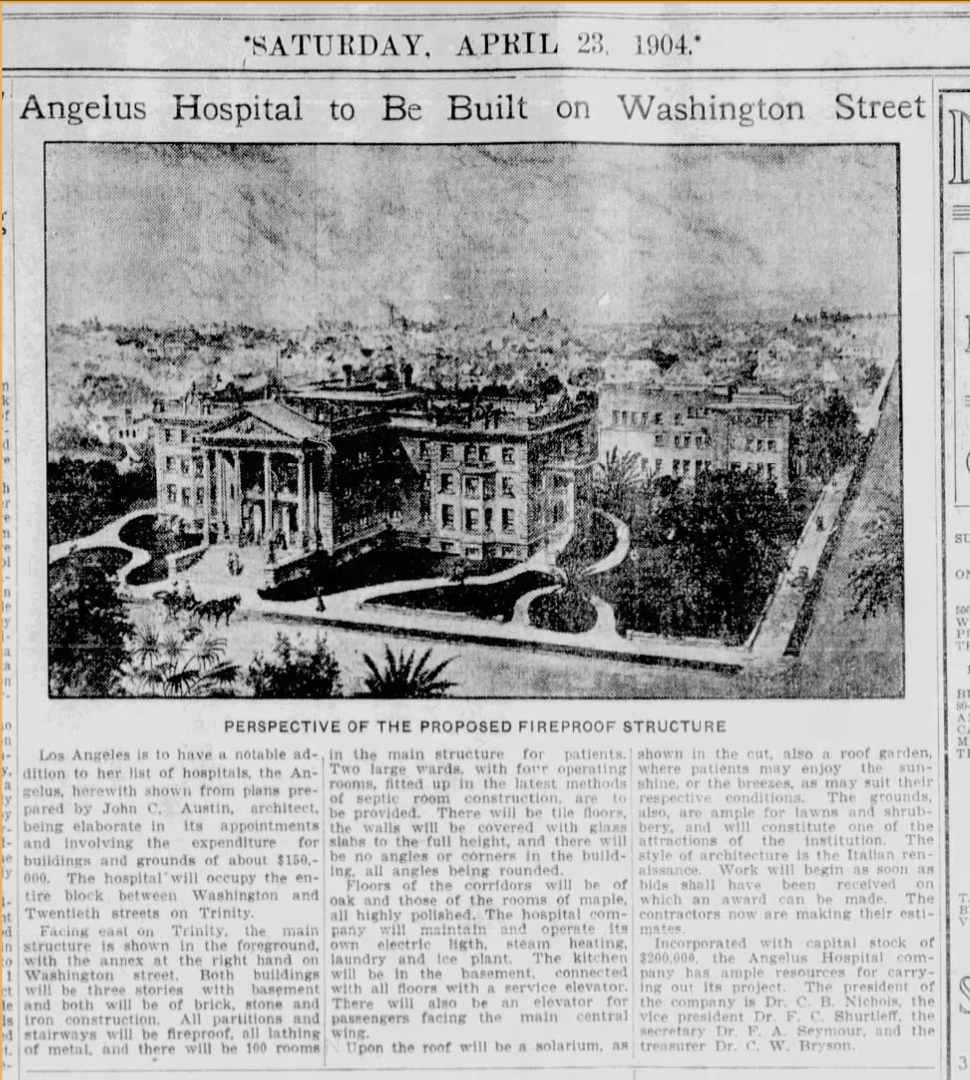
This article presented a “perspective of the proposed fireproof structure” for the Angelus Hospital that would be built on Washington Street. [13]
The planned hospital would take two more years. As this Los Angeles Evening Express article announced in April 1904: “Los Angeles is to have a notable addition to her list of hospitals, the Angelus, herewith shown from plans prepared by John C. Austin, architect, being elaborate in its appointments and involving the expenditure for buildings and grounds of about $150,000. The hospital will occupy the entire block between Washington and Twentieth streets on Trinity.” [14]
The article states that the building would be of an Italian Renaissance style and constructed with brick, stone, and iron. It also describes many features the hospital would possess, including 100 rooms in the main structure for patients; two large wards with four operating rooms, fitted up in the latest methods of septic room construction; rounded corners; floors with tile and polished oak and maple; electric lights; steam heating; a laundry; an ice plant; a kitchen connected to all the floors by a service elevator; a solarium on the roof; a rooftop garden for patients to enjoy the sun and breeze; and landscaped grounds.
Again a driving force, Dr. Bryson served as treasurer of the Angelus Hospital Company, which funded the hospital’s construction (which came in at closer to $200,000). He was there to celebrate its opening in May 1906, along with about 2,000 visitors who came to inspect the new facility and marvel at its features. As one article noted, “If all hospitals were as pleasantly arranged and as thoroughly equipped as the new Angelus hospital at Washington and Trinity streets is, those unfortunates who spend many days as invalids would have pleasant recollections of bright, airy rooms with everything that would be wished for in the days which they spent in hospitals.” [15]
The hospital, which had a staff of sixty, could accommodate 120 patients and was viewed as a “badly needed sanctuary for the sick, injured and dying a few blocks south of downtown.” [16] It was also right next to the College of Physicians and Surgeons, which Bryson’s group had built two years earlier. As a result, the College’s medical students “spent part of their studies working as interns in the hospital next door. The tuition for the medical training course was about $500.” [17]
Soon, Frank Traughber would join their ranks. He and Nora set up their residence near the USC campus. By 1908 they were listed as living at 1312 W. 9th St. in the Los Angeles City Directory, and their album includes several photos in front of the house. It was also while they were living there that my grandmother, Margaret Ruth Traughber, was born in February 1909. Later in 1909, they moved to 857 E. Adams Street (City Directories; 1910 U.S. Census). In both houses, Frank advertised himself as an “Osteopath,” so he must have continued being able to earn money while going to school.
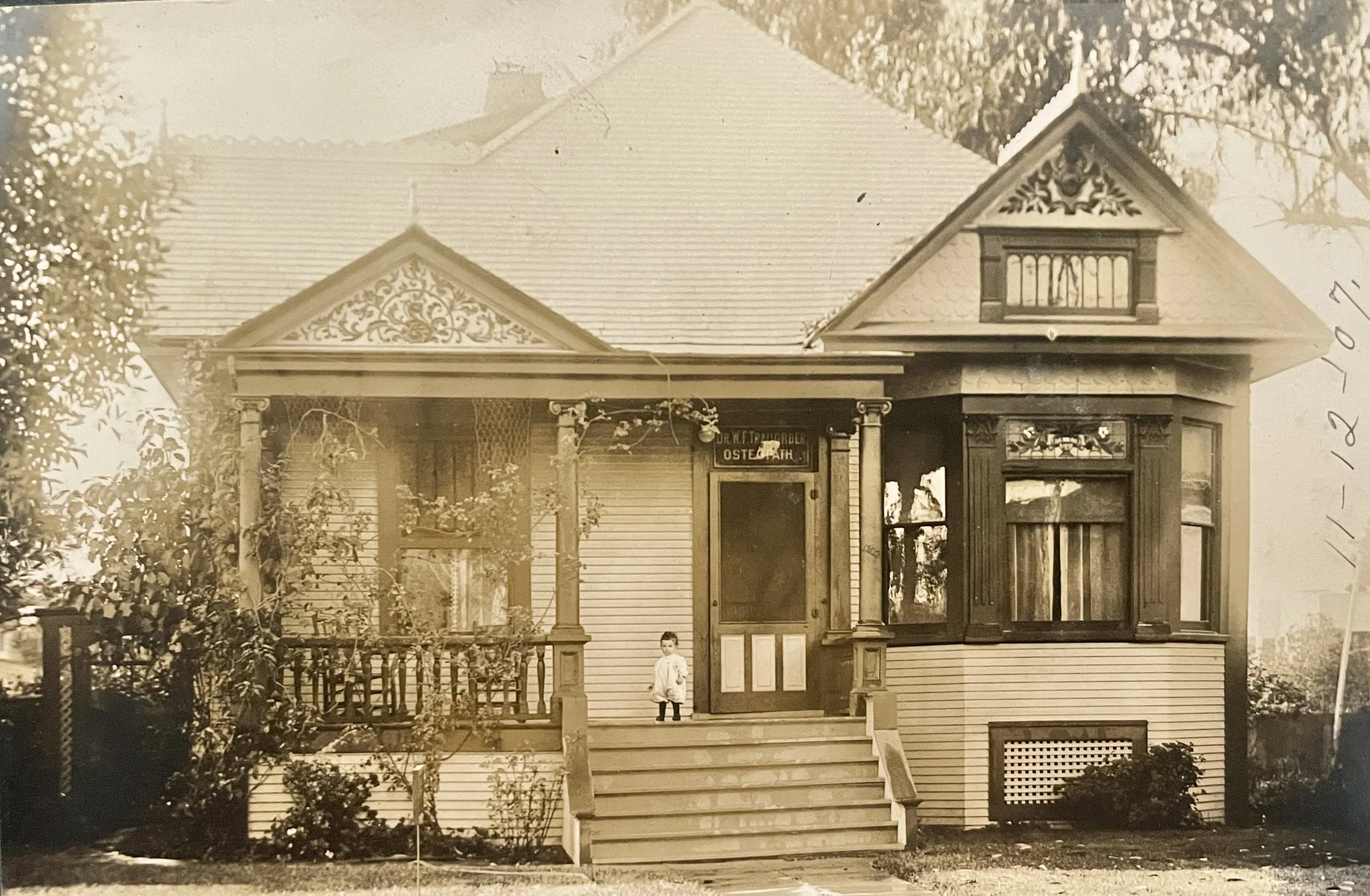
Frank and Nora lived in this house located at 1312 W. 9th Street for about two years; their son Frank (age 16 months) is standing on the porch, and you can see a sign saying, “Dr. W. F. Traughber, Osteopath” above the door. Traughber Family Collection.
Something else very significant happened in 1909. When USC lost its original medical department to the University of California system, the university turned to Dr. Bryson's established college to fill the void. As explained on USC’s Keck School of Medicine website: “In 1909, the College of Physicians and Surgeons, a second medical school established in Los Angeles in 1904, became affiliated with the University of Southern California. The merger was facilitated by USC President George Finley Bovard, a graduate of USC’s first class. Once the trustees agreed, the new College of Physicians and Surgeons, Medical Department of USC was ready for the fall term. The school location was moved to the College of Medicine headquarters, 516 E. Washington Street. The dean of the USC Medical School was Charles W. Bryson, MD.” [18]
Bryson remained the dean of USC’s College of Physicians and Surgeons, as well as a Professor of Abdominal Surgery and Gynecology, from 1909 until 1920. After negotiating the transfer of his college's properties and financial responsibilities to USC, he focused on transforming a private, "proprietary" medical school into a modern, academically rigorous institution. Under his leadership, the school maintained a four-year medical program with a heavy emphasis on clinical exposure at the Los Angeles County Hospital, including roughly 60 hours of clinical instruction in specialized fields like Otology, Rhinology, and Laryngology during their final two years. By 1915, his faculty and students were treating over 1,200 patients per month at the hospital.
During the time Frank Traughber was a student there, tuition was $150 per year, with room and board listed as $20 per month for students who lived on campus. [19] He also had the opportunity to work with a very diverse population – something he continued to do throughout his medical career. At the Los Angeles County Hospital (now Los Angeles General Medical Center), students worked primarily with the city's indigent and uninsured residents, gaining exposure to a wide range of pathologies that were less common in private practice. They also rotated through specialized wards that were rapidly expanding at the time, including surgery, maternity, and infectious diseases. In an era before antibiotics, students were on the front lines of managing communicable diseases like tuberculosis and plague, which were significant public health threats in early Los Angeles.
Frank appears in the 1911 USC Yearbook, where it mentions that he was President of his class. It also says of him: “With such true breeding of a gentleman, / You never could divine his real thought.” I’m not sure if not knowing what someone is thinking is always a good thing, but perhaps it worked well for him as a doctor.
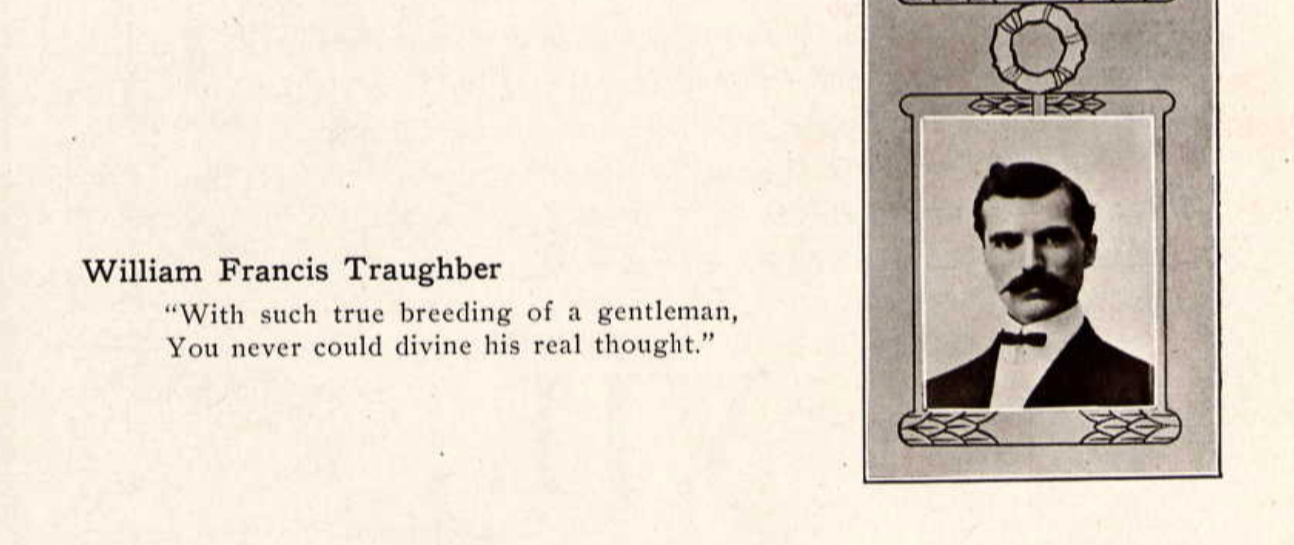
William Francis Traughber’s photo as it appeared in the USC Yearbook, El Rodeo 1911 [20]
I have to wonder what it was like for Frank to have his cousin Charles, eleven years his senior, as both his dean and his professor – and what it was like for other students in the class. Were they aware of the relationship between them? Perhaps not. As I have discovered, Dr. Bryson kept much about his past hidden and, in some cases, even lied about it. When you do lots of genealogy research, you can discover some family secrets. But, again, I think that belongs in a “Part II” at some future date.
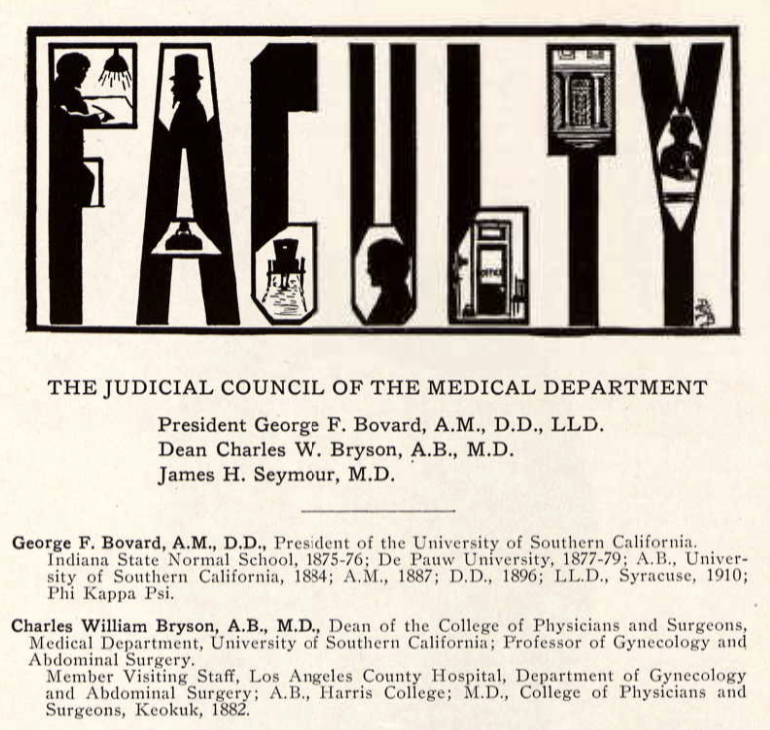
This page the 1911 yearbook lists Charles W. Bryson as both Dean of the College of Physicians and Surgeons and Professor of Gynecology and Abdominal Surgery. [21]
I also really have to wonder what it was like for Frank when, on Christmas Day of 1908, he walked his sister Myrtle Francis Traughber down the aisle at Immanuel Presbyterian Church to marry Dr. C.W. Bryson. Yes, Dr. Bryson married his first cousin – his father’s sister’s daughter. And yes, that was apparently legal at the time in California and – as I learned – is still legal in California, though many other states now have laws against such an act. I assume it was a joyous occasion for all involved.
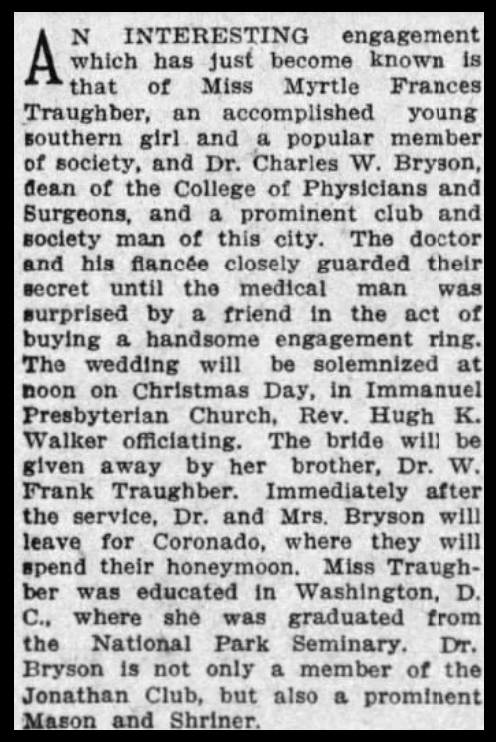
This article announces the engagement of Dr. C. W. Bryson to Frank’s sister, Myrtle Traughber. [22]
Charles and Myrtle Bryson never had children, and perhaps that was intentional. My aunt at one point told me it was because they were first cousins. It took a LOT of detective work on my part to work out how they were cousins because he listed false dates and locations for his birth, as well as a false name for his father on his marriage certificate. It’s certainly likely he and Myrtle did not spend much time together prior to their decision to marry since he was 19 years her senior, and when she was born, he was graduating from medical school in Iowa and preparing to move to Nebraska. He may not have spent much time with Frank, either, since Charles’s father died before he was born, his mother remarried, and his new family lived about twenty miles from the Traughbers. Frank was six when Charles graduated with a B.A. from Harris College in 1880 and headed off to medical school.
Whatever the case, I think Charles and Myrtle must have connected when he returned to Centralia in 1906 to rebury his father at the Centralia Cemetery. I’m saving that story, though, for Part II. It’s definitely an interesting one.
Mr. and Mrs. C. W. Bryson honeymooned at the Hotel Coronado in San Diego and set up their first home in the Hotel Lankershim, a luxurious apartment complex on South Broadway in downtown Los Angeles. Over the years, news articles mention her joining him at various banquets and university functions. They enjoyed almost twenty years of marriage before Dr. Bryson died of a heart attack on Nov. 1, 1928, at the Darby Hotel, another luxurious complex where they had moved around 1913. He was 65, though his obituary said he was 60, and was buried at Forest Lawn Memorial Park in Glendale, CA. Myrtle would live another 54 years, dying in 1981 at age 99.
The College of Physicians and Surgeons Dr. Bryson had established and guided for so many years closed in 1920 due to pressures brought on by World War I and the changing landscape of medical education. It would not reopen again until 1928, the same year that Dr. Bryson died; but in its new form, it would become what is today USC’s pioneering, transformative, and top-rated Keck School of Medicine. He helped lay that groundwork, and the Angelus Hospital he helped build served many thousands of patients over the years. I’d say “Diamond-Tooth Charlie” left quite a legacy.
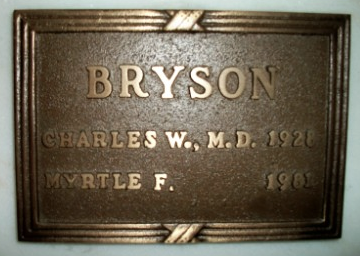
Charles W., M.D. and Myrtle F. Bryson are buried at Forest Lawn Memorial Park in Glendale, CA.
As for my great grandfather Frank, he graduated from USC’s College of Physicians and Surgeons on June 15, 1911. Soon after that, he and his family moved to their new home at 1359 N. La Brea Avenue in Hollywood, which I wrote about in a previous post. He worked as a doctor in Los Angeles until 1945, when he finally retired. I’ll have a bit more to say about his career and specifically his work with the Coleman House in a future post. This one is quite long enough!
If you’ve enjoyed this blog post, I hope you’ll hit the “subscribe” button at the bottom of my webpage (tonyagrahammcquade.com) to receive my quarterly newsletter with updates on my books, blog posts, and scheduled book talks. I also hope you’ll check out my new book, Frank and Nora’s Historic Honeymoon Adventure: A Travelogue through the West with a “Time Travel” Twist, that tells more about Dr. William Francis “Frank” Traughber and his wife, Nora Petree Traughber.
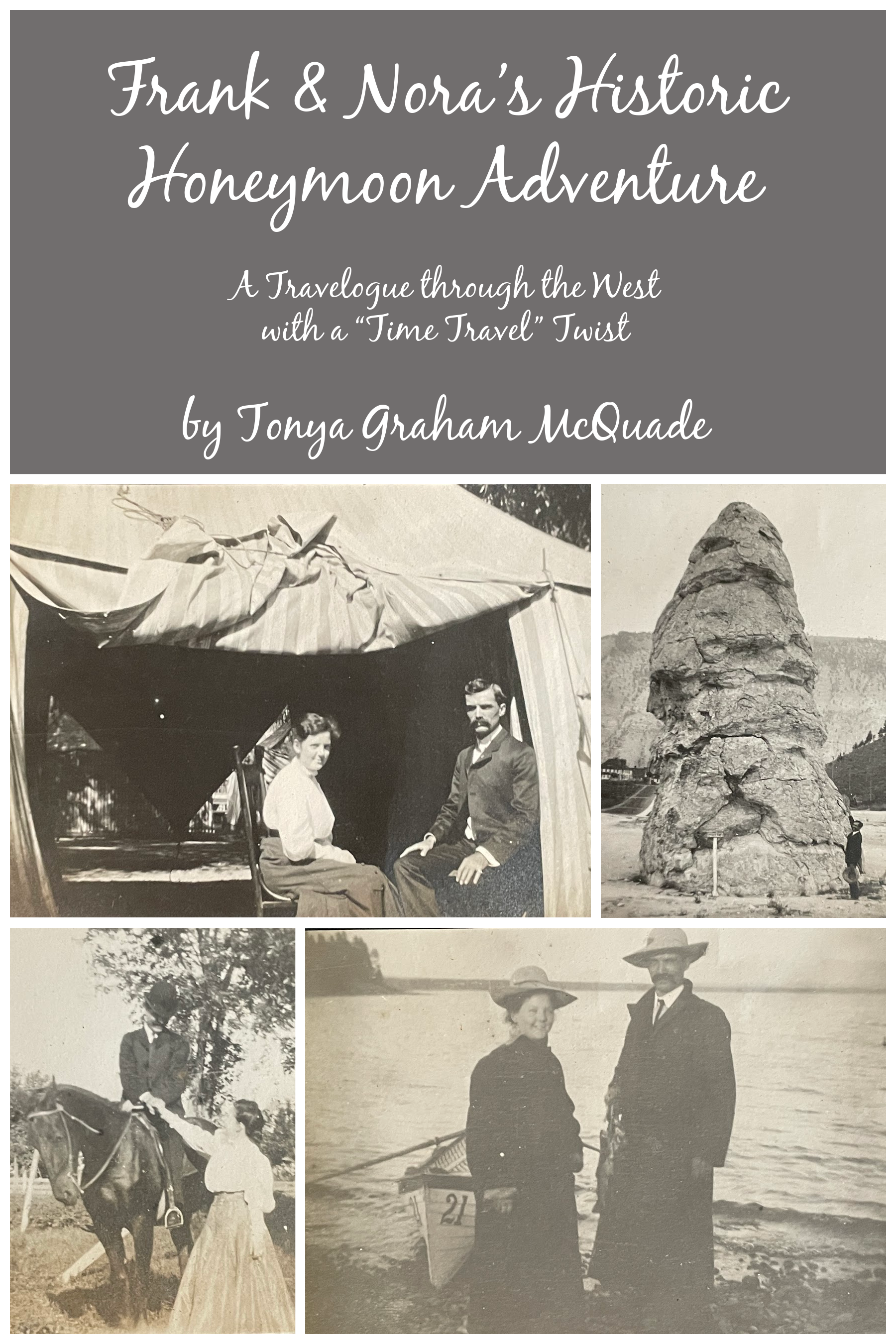
The book about my great grandparents, Frank and Nora Traughber, is now available on Amazon.
Endnotes:
Directory of Physicians and Surgeons, Osteopaths, Drugless Practitioners, Chiropodists, Midwives. Board of Medical Examiners of the State of California, California State Printing Office, Sacramento, 10 Apr 1919, https://library.sfgenealogy.org/books/california/Directory_of_Physicians_and_Surgeons_1919%20(Google).pdf.
“Dr. Charles Wm. Bryson - Ad.” Los Angeles Herald, Los Angeles, CA, 17 Nov 1886, https://www.newspapers.com/clip/103239693/dr-charles-bryson-ad-1886/?xid=637.
Stoneman, George B., M.D. “Otolaryngology - Department History - Early 1900s.” Keck School of Medicine of USC, University of Southern California, 2026, https://keck.usc.edu/otolaryngology/department-history/.
Rasmussen, Cecilia. “Diamond-Tooth Charlie would have appreciated what’s become ...” Los Angeles Times Archives, Los Angeles, CA, 24 May 1993, https://www.latimes.com/archives/la-xpm-1993-05-24-me-39211-story.html.
Stoneman, George B., M.D. “Otolaryngology - Department History - Early 1900s.” Keck School of Medicine of USC, University of Southern California, 2026, https://keck.usc.edu/otolaryngology/department-history/.
“College of Medicine and Dentistry, USC.” 1898. USC: University Archives Image Collection, University of Southern California, https://wacohistory.org/files/show/3116.
“The Origin Story of Los Angeles County Medical Association.” LACMA, 2026, https://www.lacmamembers.com/post/the-origin-story-of-the-los-angeles-county-medical-association.
“A New Health Board: Doctors to be Appointed by Mayor Snyder Will Favor Health Officer Powers.” Newspapers.com, Los Angeles Evening Post-Record, Los Angeles, CA, 5 Jan 1901, https://www.newspapers.com/article/los-angeles-evening-post-record-a-new-he/193185717/.
“Found Medical College - Enterprise Incorporated by Local Physicians.” Newspapers.com, Los Angeles Evening Express, Los Angeles, CA, 24 Nov 1903, https://www.newspapers.com/article/los-angeles-evening-express-found-medica/193182279/?xid=637.
Ibid.
Stoneman, George B., M.D. “Otolaryngology - Department History - Early 1900s.” Keck School of Medicine of USC, University of Southern California, 2026, https://keck.usc.edu/otolaryngology/department-history/.
“New Medical College Will Be One of the Most Perfect.” Newspapers.com, Los Angeles Evening Post-Record, Los Angeles, California, 13 Aug 1904, https://www.newspapers.com/article/los-angeles-evening-post-record-new-medi/193181649/?xid=637
“Angelus Hospital to be Built on Washington Street.” Newspapers.com, Los Angeles Evening Express, Los Angeles, CA, 23 Apr 1904, https://www.newspapers.com/article/los-angeles-evening-express-angelus-hosp/193186480/?xid=637.
Ibid.
“Angelus Hospital is Open for Inspection.” Newspapers.com, Los Angeles Herald, Los Angeles, CA, 15 May 1906, https://www.newspapers.com/image/78271889/.
Rasmussen, Cecilia. “Diamond-Tooth Charlie would have appreciated what’s become ...” Los Angeles Times Archives, Los Angeles, CA, 24 May 1993, https://www.latimes.com/archives/la-xpm-1993-05-24-me-39211-story.html.
Ibid.
Stoneman, George B., M.D. “Otolaryngology - Department History - Early 1900s.” Keck School of Medicine of USC, University of Southern California, 2026, https://keck.usc.edu/otolaryngology/department-history/.
Ibid.
El Rodeo 1911, Vol 5. University of Southern California, Los Angeles, CA, Published for the Junior Class by Samuel F. Dick, 1910, Ancestry.com, U.S., School Yearbooks, 1900-2016 Collections, https://www.ancestry.com/search/collections/1265/records/242270726.
Ibid.
“Myrtle Francis Traughber Bryson - An Interesting Engagement.” Unknown Newspaper Source, Findagrave, 22 Feb 2012, https://www.findagrave.com/memorial/85357543/myrtle-frances-bryson.