Exploring the History of Hollywood High School - the Traughber Family’s Alma Mater
Chasing History: Exploring My Ancestral Roots - Blog Post #62
By Tonya Graham McQuade
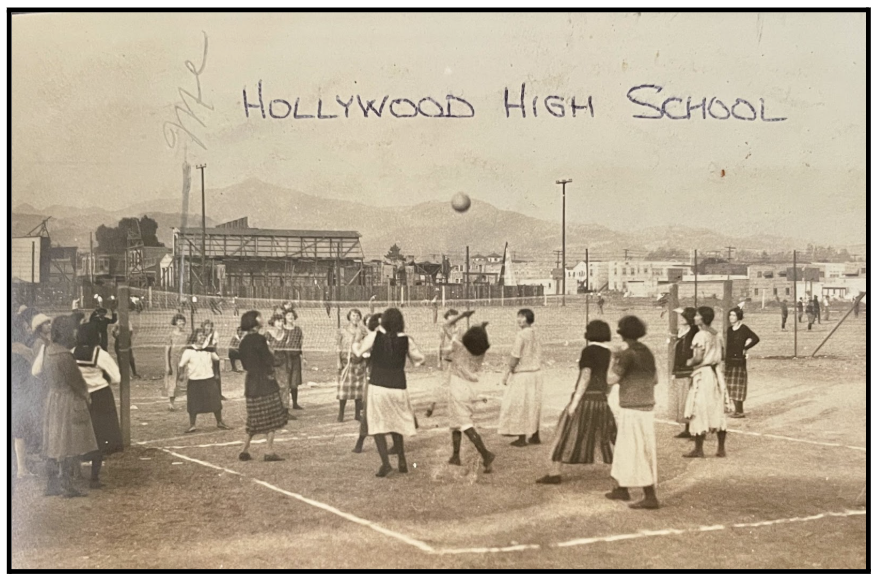
A photo of my grandmother playing volleyball when she was a student at Hollywood High School, c. 1927 - Traughber Family Collection.
When my grandmother, Margaret Ruth Traughber, moved into her family’s new house at 1359 N. La Brea Avenue in Hollywood, she was just two years old. Her brother Frank was five; her brother William, one. Brother Robert wouldn’t come along until 1913. All of them, though, would go on to graduate from Hollywood High School, which was just a few blocks from their house.
The above photo appears in the collection of family photos my father passed along to me. The “Me” written at the top refers to Margaret, who is seen here playing volleyball on the school’s athletic field. The Hollywood High School of the 1920’s, however, when she and her siblings were there, looked a lot different from the Hollywood High School of today.
By the time Margaret graduated in 1927, the school had been around in various forms for 24 years. When it got its start in September 1903, however, the students met in an empty storeroom on the second floor of a Masonic Temple on Highland Avenue, north of Hollywood Boulevard (then Prospect Avenue). The two-room schoolhouse, which boasted 24 students at the start of the school year, was the first school to serve the newly incorporated city of Hollywood and the second public high school in Los Angeles.
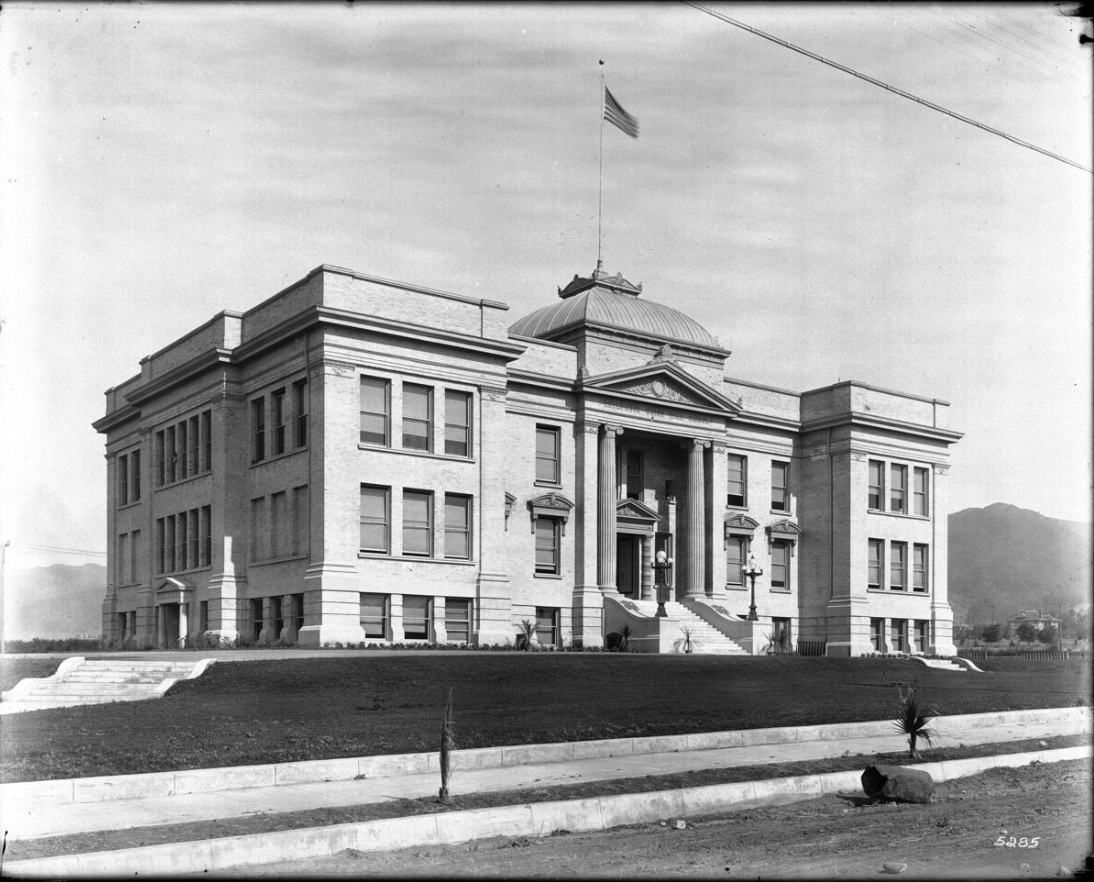
Exterior view of the Hollywood Union High School, ca. 1905 [1]
By 1905, to meet the growing population, the first official school building was completed at the intersection of Sunset and Highland: a two-story building intended to hold 400 students. Designed by architectural partners Franklin Pierce Burnham and William John Bliesner, Jr., it served the consolidated school districts of Hollywood City, Laurel, Coldwater, Lankershim, Los Feliz, Cahuenga, and The Pass.
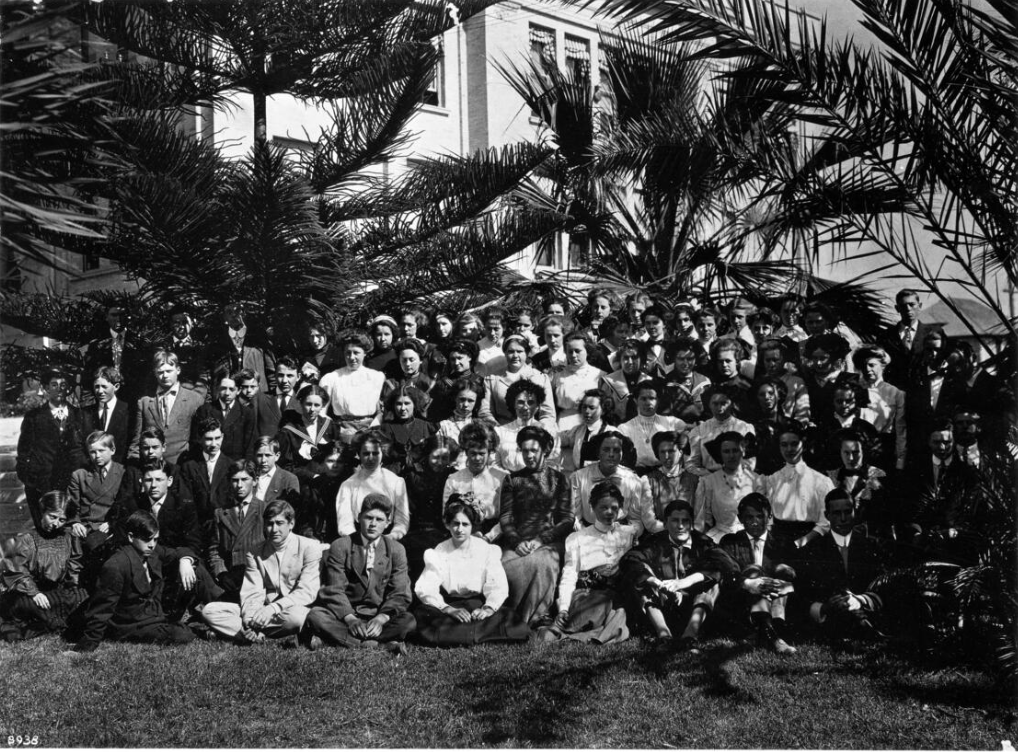
Hollywood High School graduating class, ca.1912 [2]
Initially, the decision to build a school in this location, amidst farms, citrus groves, and vineyards, was “criticized for taking up valuable farmland.” [3] Soon, however, those groves and vineyards would be replaced by studios, houses, roads, and other buildings. By 1912, the number of graduates had grown to about 60 (at least that’s how many I count in the photo above - I could not find an actual number listed online). That would have been the first graduating class after the Traughbers moved into their new home.
By 1924, another high school would be needed – Fairfax High School – located in West Hollywood at the intersection of Fairfax Avenue and Melrose Avenue. That same year, Hollywood High School would graduate a class of 377 students. Margaret’s older brother, Frank, was one of those graduates of the Class of 1924 – but we’ll get back to him in a moment.
The school’s first building is described this way online: “The three-story building has a tall portico supported by proto-ionic columns where inside is a smaller portico supported by two Doric order columns. Both porticos have decorated pediments. ‘Hollywood Union High School’ is displayed below the pediment of the large portico. The façade of the building is symmetric. Two lampposts flank the stairs leading to the front entrance. A flagpole stands on top of the dome-like roof above the porticos in the center of the building. The lawn around the building is well manicured. Newly planted palm trees line the dirt portion of the sidewalk. Rocks and a large boulder lay on the dirt road in the foreground.” [4]

Here’s another view, this one from a hand-painted postcard, c. 1905. [5]
That looks very different from the Hollywood High School of today – the one my family saw during a visit to Hollywood in April 2014. So, I decided to look into the school’s history a bit, made easier by the fact that my father gave me his mother Margaret’s senior yearbook from 1927. So, here’s a brief look at those early years of Hollywood High School, before the 1933 Long Beach earthquake decimated the old buildings and the Works Project Administration (WPA) stepped in with completely new designs. This is the school Margaret and her three brothers and their fellow alumni knew.
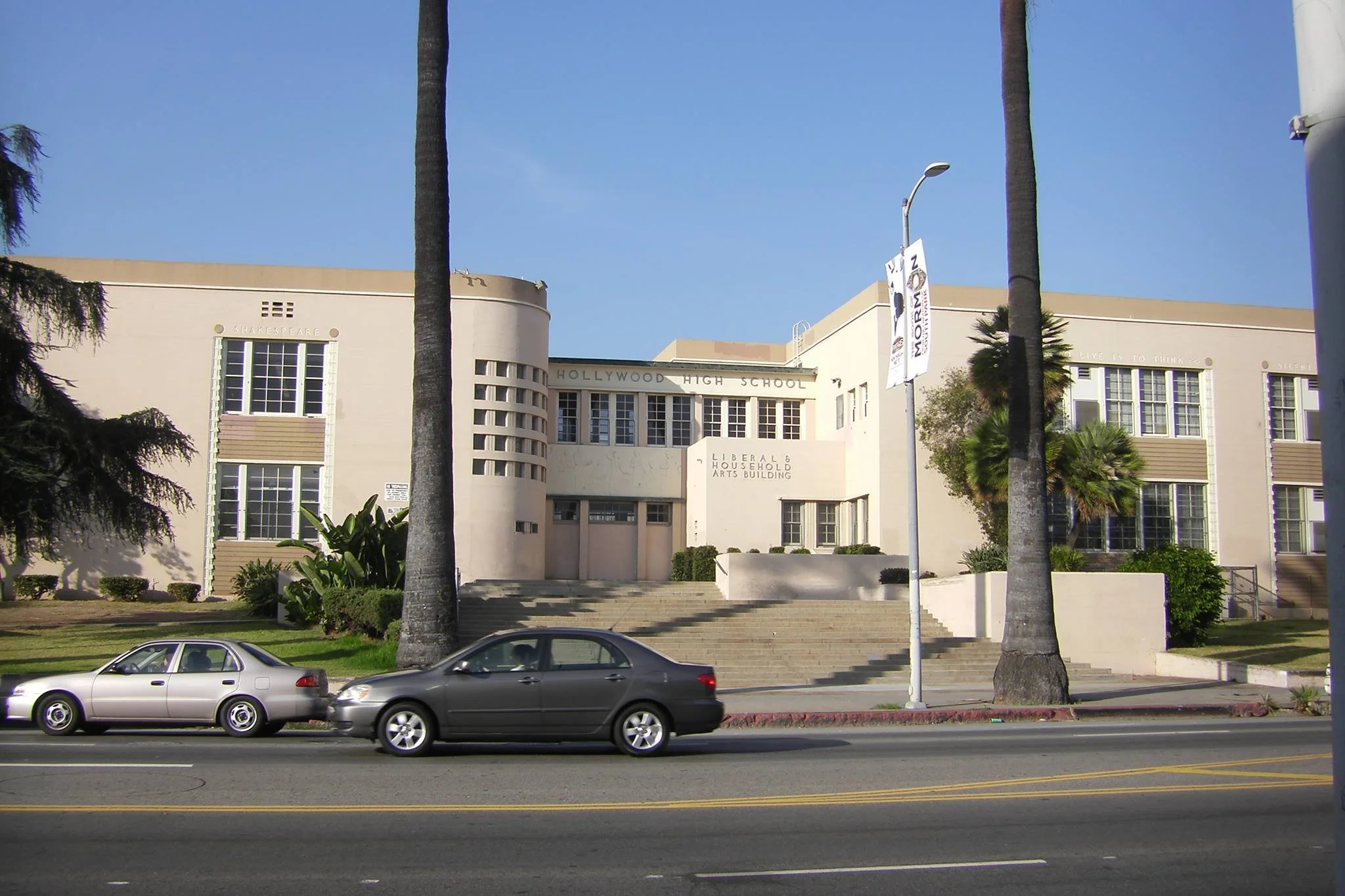
Here’s what the school looked like when we drove by in April 2014. Photograph by Tonya McQuade.
Margaret’s yearbook shows a large number of buildings that make up the school campus. As the number of students continued growing, so did the number of buildings. (I’d love to know when these various buildings were built — add a comment if you know the answer.) Here are some of the photos in her yearbook that depict the campus’s original look. All are identified as being taken by a photographer named William Clarke, who was a prominent architectural photographer at the time.
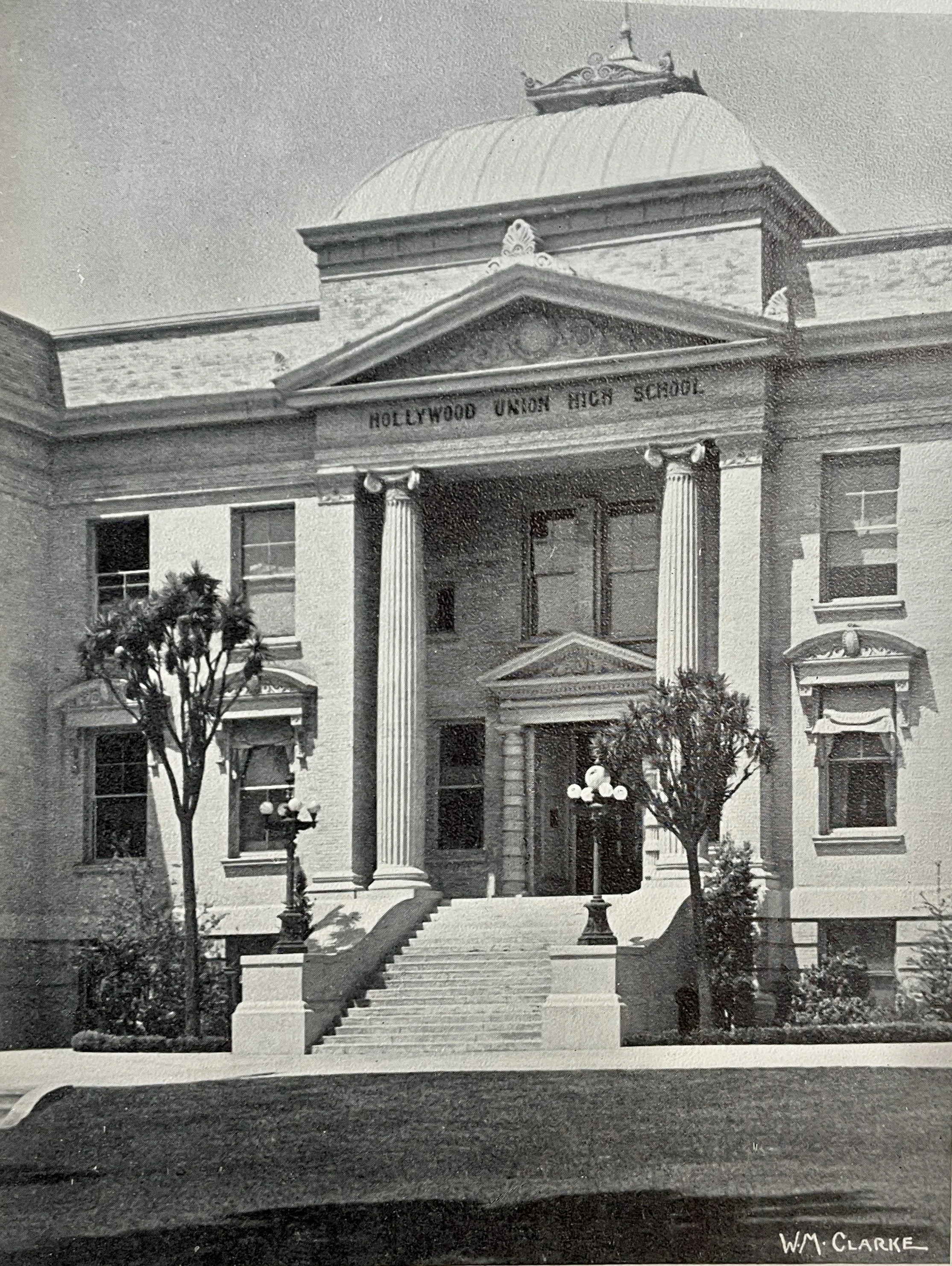
This is the entrance to what was then called Hollywood Union High School, as it appears in the school’s 1927 “Poinsettia” yearbook [6]
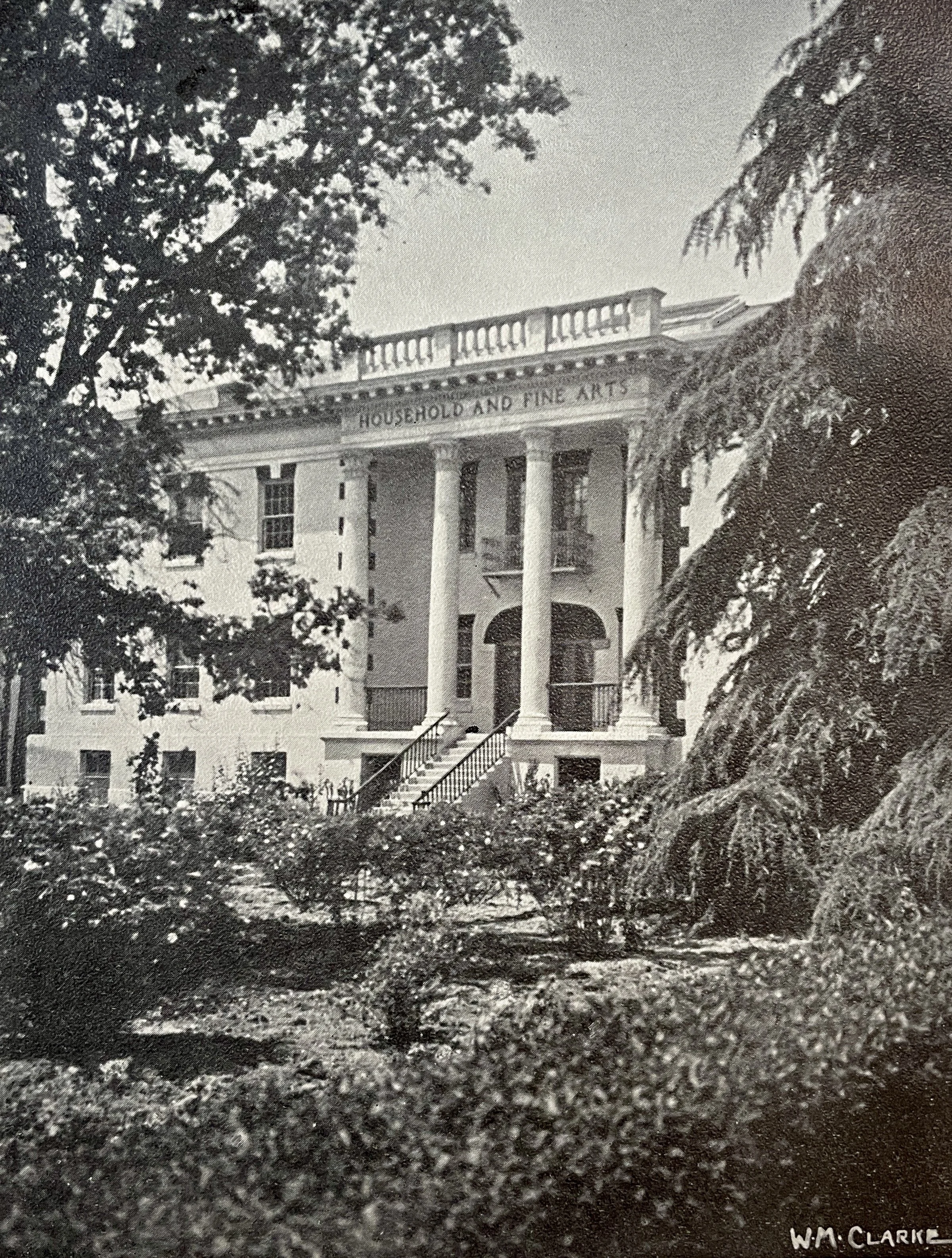
Household and Fine Arts Building
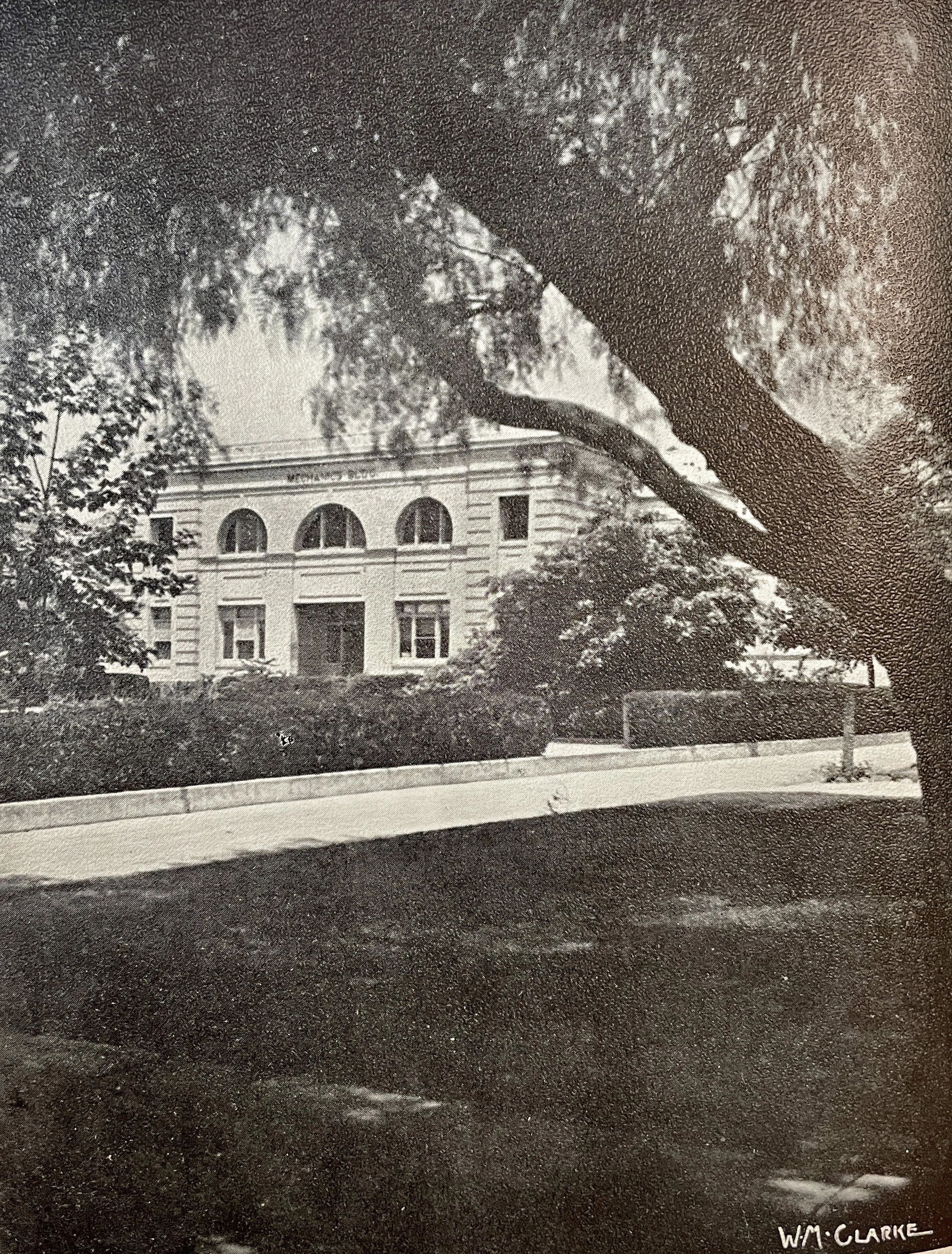
Mechanics Building
As can be surmised from the previous two photos, “In the early days, Hollywood High offered vocational programs that trained students to work in new fields such as the automotive and film industries. By the mid-1920s, hundreds of students had enrolled in the bustling campus, many studying drama and behind-the-scenes stagecraft in anticipation of working in Hollywood.” [7]
Today, Hollywood High School offers four academies, each with a different focus: a Teaching Career Academy, which is “dedicated to instructing and supporting students interested in teaching”; the Performing Arts Magnet, which “enables its students to study the arts and to realize the value of the role that the arts play in the human experience”; the New Media Academy Magnet, which “will prepare students for a productive future in the competitive global marketplace”; and the School for Advanced Study, which is “part of a district-wide program designed to increase educational options and to support the development of gifted and talented youth.” [8]
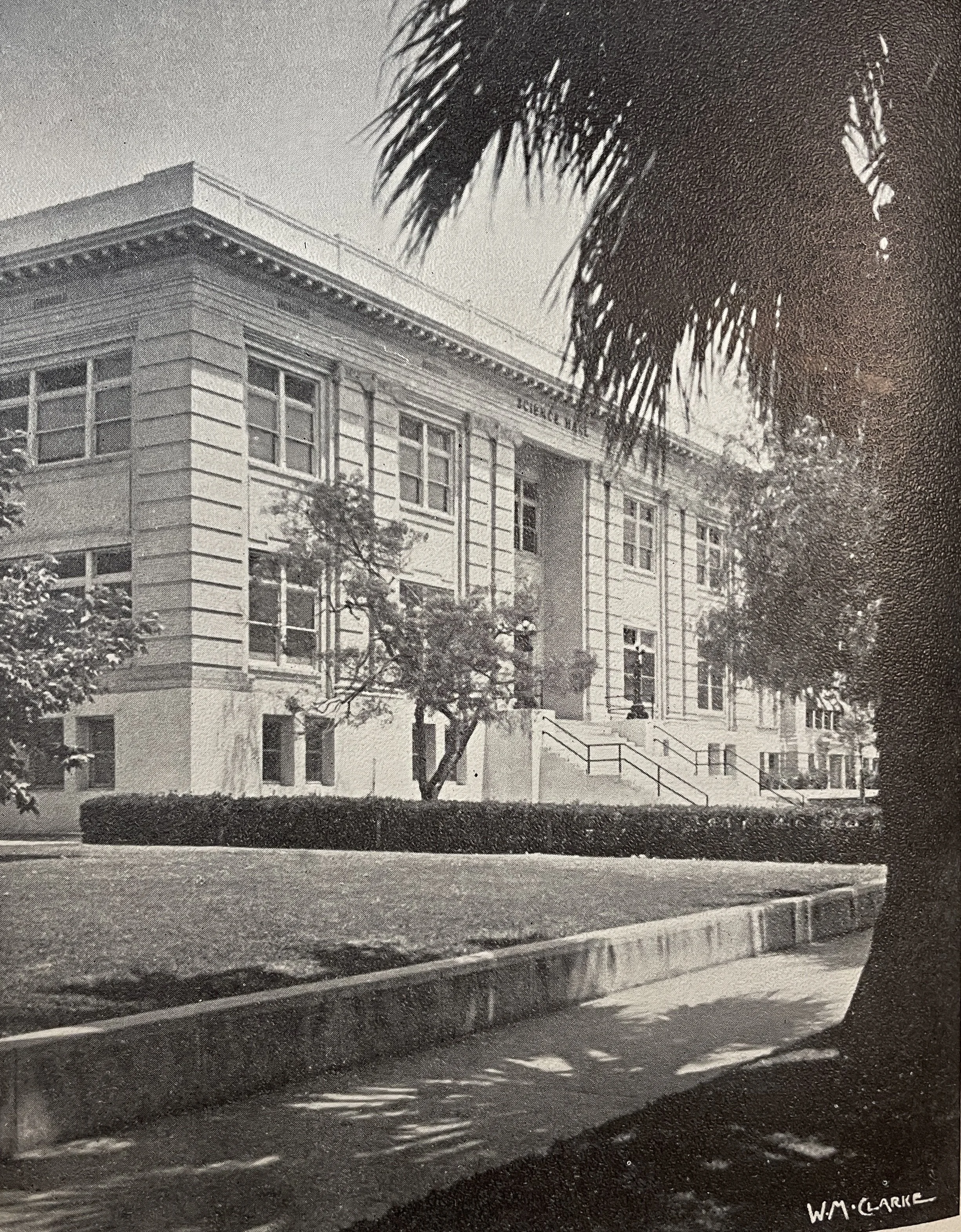
Science Hall
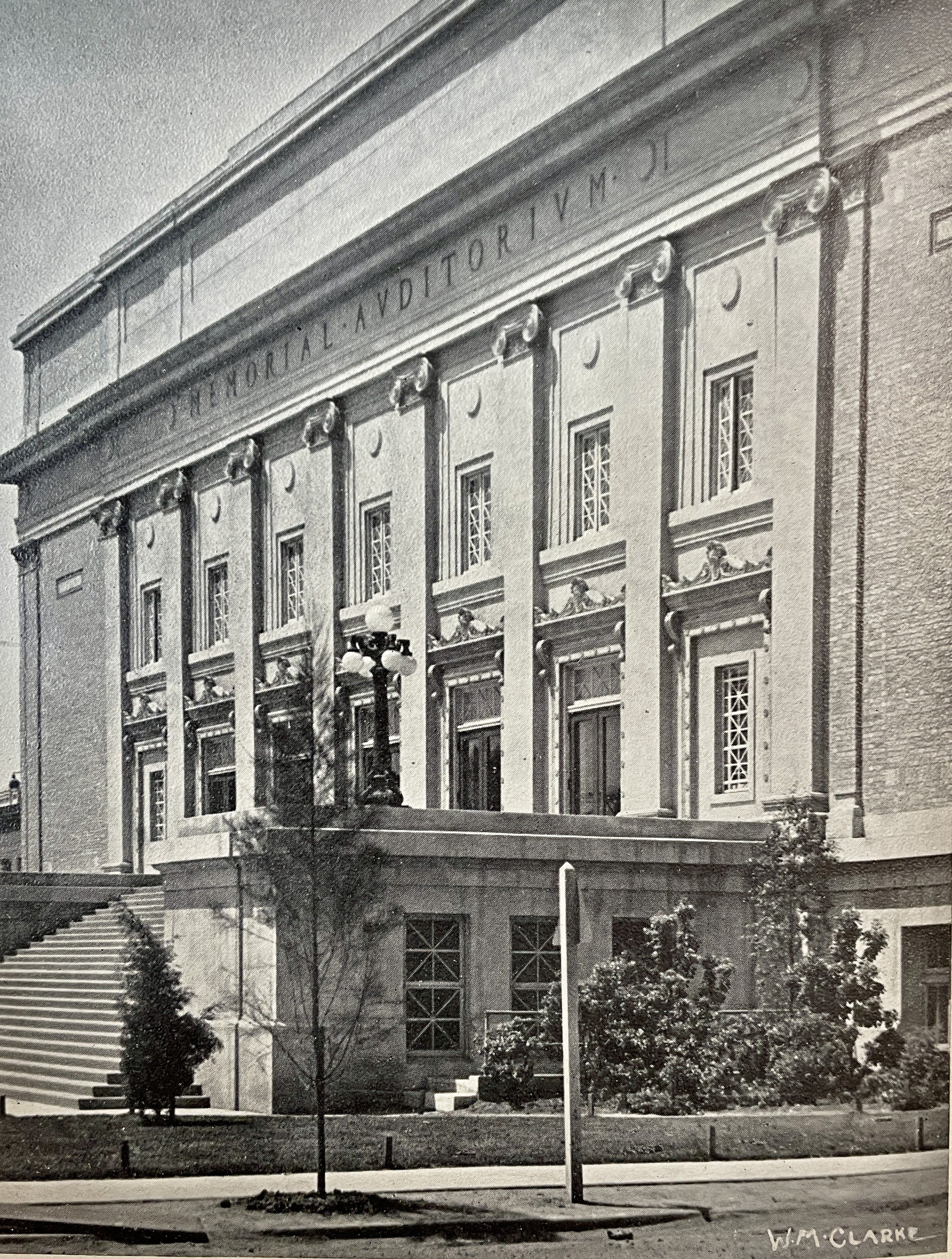
The Memorial Auditorium opened in early 1924.
The only building I can say with any certainty as to when it opened is the Memorial Auditorium, shown in the previous photo. That is because a Los Angeles Evening Citizen News article dated June 19, 1924, states: “Next Thursday evening will mark an occasion of double significance in the new Memorial Auditorium of the Hollywood high school when 377 seniors will be graduated at the first exercise to be held in the building, to be followed by a service when the edifice will be formally dedicated to the memory of the students of the school who paid the supreme sacrifice in the World War…. Dr. William H. Snyder, principal of the school, will present the class while C.E. Toberman will award the debating pins and rings to the students who have been chosen for the Ephebian Society, an honor club of the school.” [9]
Frank was part of that graduating class – along with two people who later became very well known for their horror movie roles: Lon Chaney, Jr. (aka. Creighton Tull Chaney) and Vina Fay Wray. Chaney acted in over 170 films and was famous for playing “all of the big four creatures, the Wolfman, Dracula, Frankenstein, and the Mummy.” [10] Wray is best known for playing blonde captive Anne Darrow in 1933’s King Kong. Though her acting career spanned six decades, she “attained international recognition as an actress in horror films … [and] has been dubbed the first "scream queen." [11]
It was the Class of 1924 that gifted the school with a large “Opus 481” pipe organ using class funds. Described online as having “3-manuals ("keyboards"), 39 ranks with chimes, and … over 2,600 pipes housed high above the auditorium stage on both sides,” the organ is also mentioned in the “Music” section in Margaret’s 1927 yearbook, as seen in the following screenshot. [12]
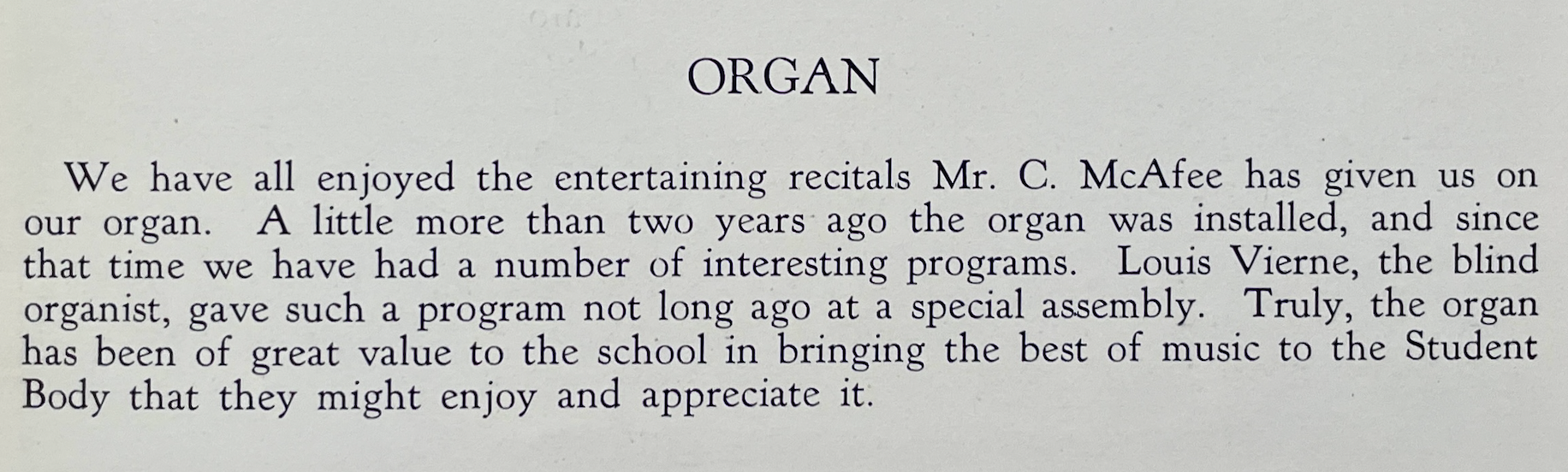
This description of the ORGAN appears in the 1927 Poinsettia yearbook.
The organ, which was restored in 2002 after suffering severe water damage from the Northridge earthquake in 1994, will soon be used to put on a show once again. According to what I read online, “Hollywood High School will celebrate its 125th anniversary in 2028, which the school’s principal said will be a momentous occasion. The plan calls for Hollywood High, one of the only schools in the world with a pipe organ in its auditorium, to hold special community screenings of The Sheik with accompanying live organ music, just like during the silent film era. [Principal Sam] Dovlatian also plans to create a new “Sheik” mural on campus using Valentino as inspiration and will hold a competition among artists.” [13]
The Sheik is a 1921 American silent film and romantic drama starring Rudolph Valentino and Agnes Ayres, directed by George Melford, and is considered the movie that made Valentino a star. So, why show The Sheik as part of the school’s anniversary celebration? It is also the movie that inspired the school’s mascot name: the Sheiks (though I saw no reference to “the Sheiks” in the 1927 yearbook, with the Foreword instead referring to them as the “Foothillers” and the “Crimson”).
As Dovlatian explained, “There was a newspaper journalist who tagged the [Hollywood High School] football team as ‘The Sheiks’ after the movie’s popularity and Rudolph Valentino, a tall, handsome guy with international fame, and it stuck. It was easy to remember and a tribute to the movie itself and a tribute to the entertainment industry. The school was born along with the movie industry itself, so it was a fitting tribute.” Dovlatian wants “to show the movie just as it would have been shown…. There is so much history at the school, and we want to share it with the community.” [14]
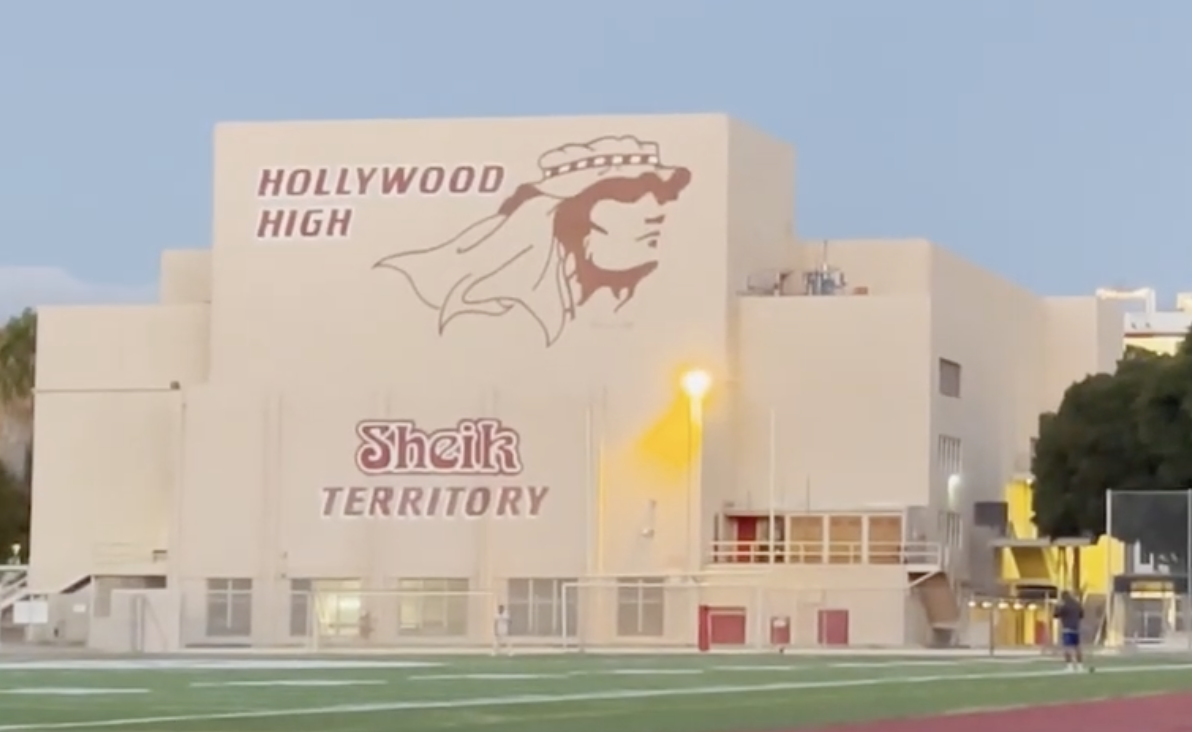
This more recent photo shows a mural on the side of the Gym that says, “Hollywood High - Sheik Territory.” [15]
Another part of the school’s history involves numerous aerial shots over the years that show the changing landscape of and around Hollywood High School. Since this photo is from March 1927, it shows what the school would have looked like when Margaret Traughber was a senior, just months before she graduated. The original building is the first large white building you see on the southeast corner, in the middle of the photo. Palm trees line the campus on Sunset and Highland. To the northwest, you can see the large athletic field that appears in the photo at the beginning of this post in which Margaret was playing volleyball.
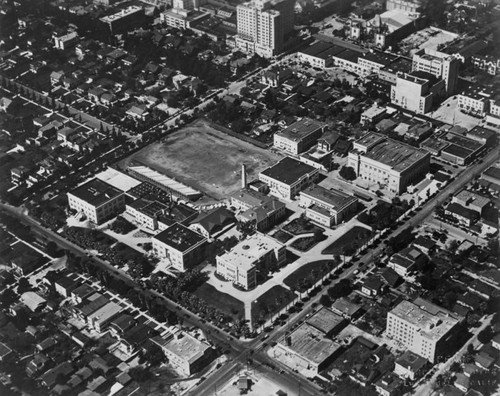
An aerial view of Hollywood High School from the southeast, dated Mar. 11, 1927 [16]
The volleyball photo must have been for a physical education class, but it got me wondering what athletic options girls at the school had at this time. It was actually a larger selection than I would have thought. Volleyball, Basketball, Baseball, Track, Tennis, Golf, Hiking, Rifle, Folk Dancing (Clogging), Riding, and Swimming are all listed in the yearbook. Boys had the options of Football, Basketball, Track, Cross Country, Baseball, Water Polo, Swimming, Golf, Gymnastics, and Tennis (and there were many more pages in the yearbook devoted to coverage of boys sports - that did not surprise me).
Margaret did not participate on any sports teams, at least not her senior year. I don’t have yearbooks for her earlier years. She was, however, a member of the Editorial Staff for the Hollywood High School News both her junior and senior year. This photo of her shows up in the 1927 yearbook, and a news article I discovered from 1926 mentions her being involved her junior year.
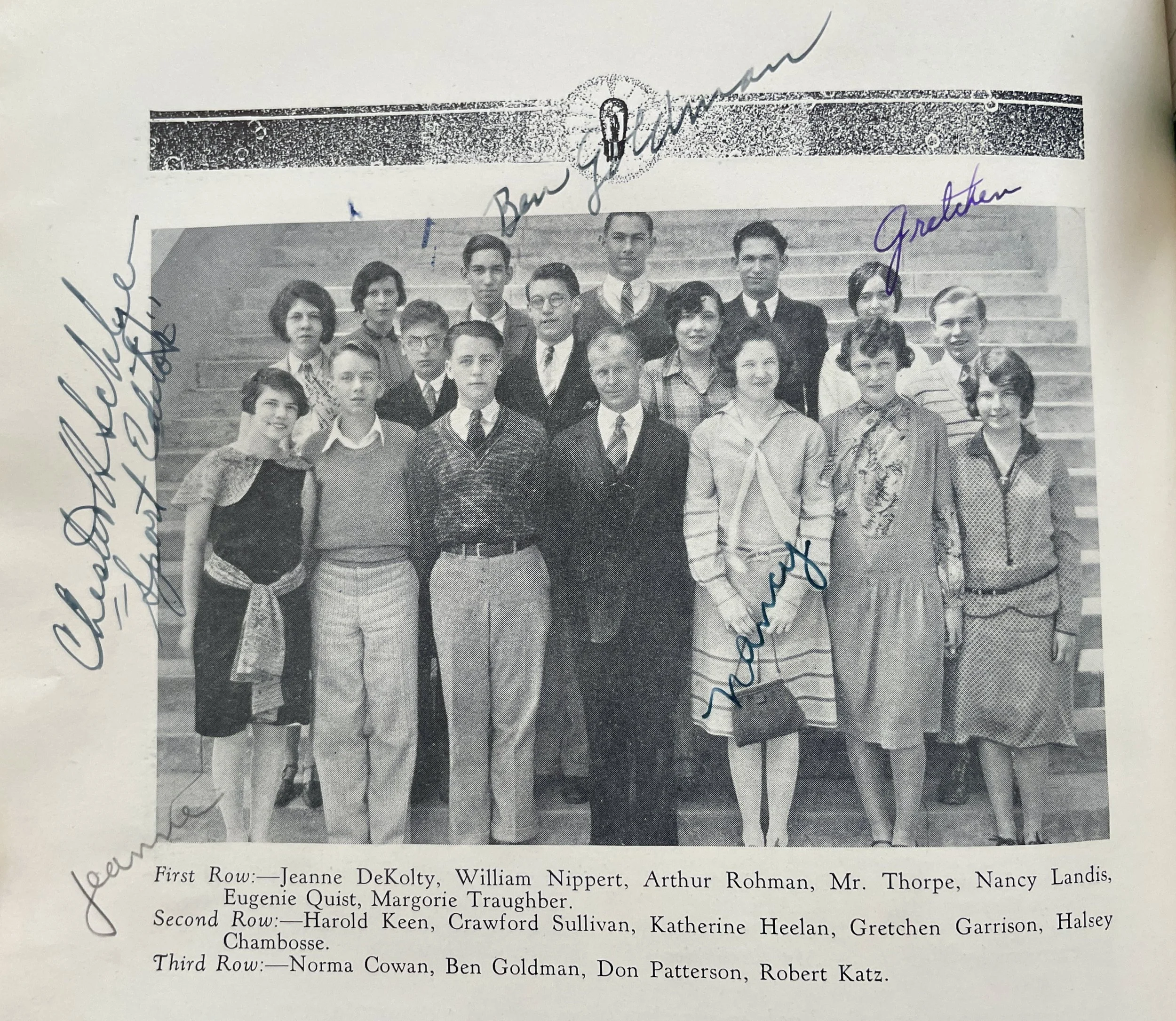
Margaret appears in the group shot in the front row, far right - yes, the short one!
I had to laugh when I saw the headline for the news article: “Girl to Edit School Paper: Margaret Sawyer Heads Staff of Hollywood High News.” This article was dated February 1, 1926. Margaret Traughber’s name comes up in the third paragraph as one of “twenty-four students who will take up the study of journalism, preparatory to reporting.” [17] According to the article, the school newspaper had “been judged for the last two consecutive years the second best high school paper in Southern California.” I’m not sure which school had the best.
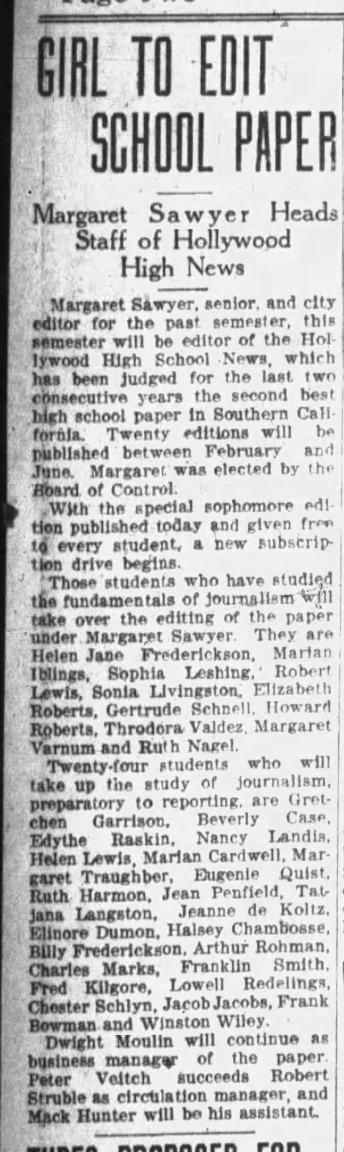
This article appeared Feb. 1, 1926, in the Los Angeles Evening Citizen News.
The above photo identifies my grandmother as “Margorie Traughber,” which I had never heard before in reference to her. However, her photo in the yearbook mentions “Marge” being her nickname. It also mentions she was in the Art Club, was considered to be artistic, and wanted to be an artist. I have a couple sketches she drew in letters to me when I was young, as well as a plate she painted; but she did not apparently become the artist she wanted to be. She became a teacher, a mother, and a grandmother.
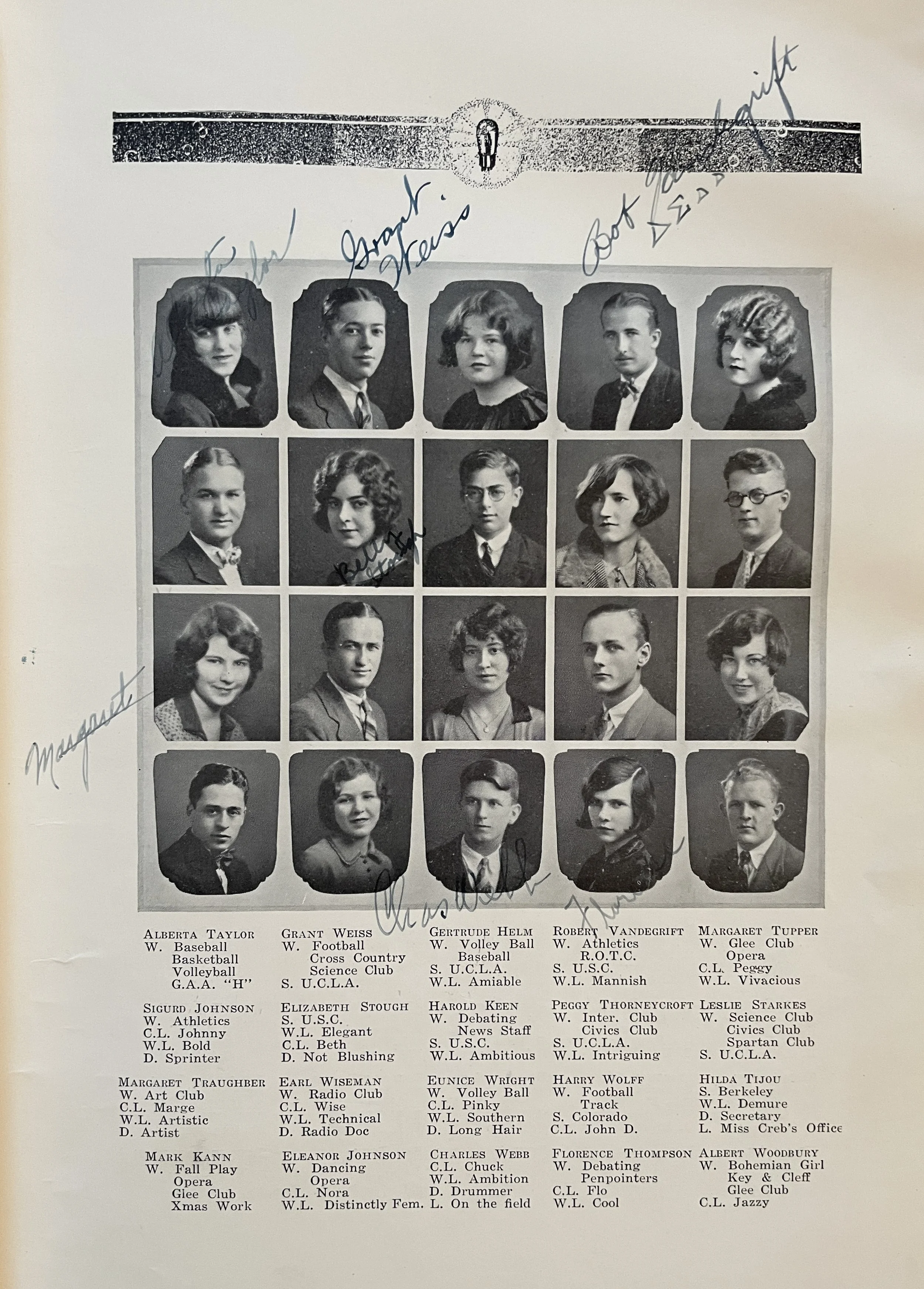
This description appears below Margaret’s picture: “W. Art Club (she was involved with this, but I don’t see a photo) / C.L. Marge / W.L. Artistic / D. Artist.
I was initially confused by the letters listed under the students’ names, then I found this “Radio Log” to help clarify the descriptions. Radios were apparently a big thing that year – just coming into their own. The yearbook’s opening pages had an interesting description of their growing impact. In the 1930 U.S. Census, one of the questions asked of each family was whether they had a radio. The Traughber family answered, “Yes.”
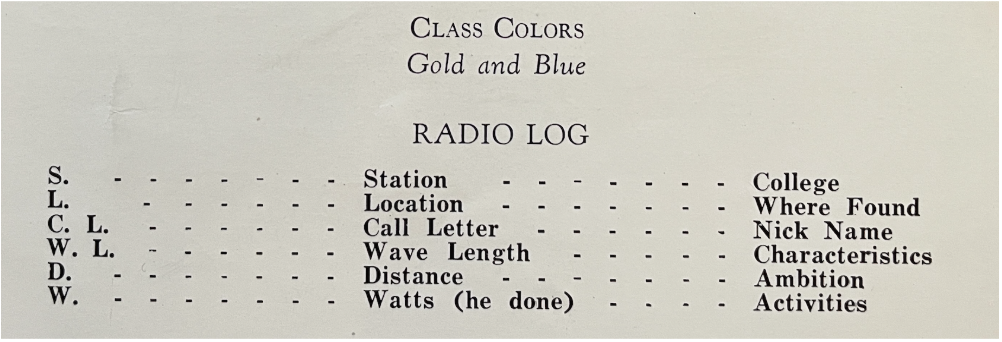
This “Radio Log” explains what the various letters mean under each student’s name.
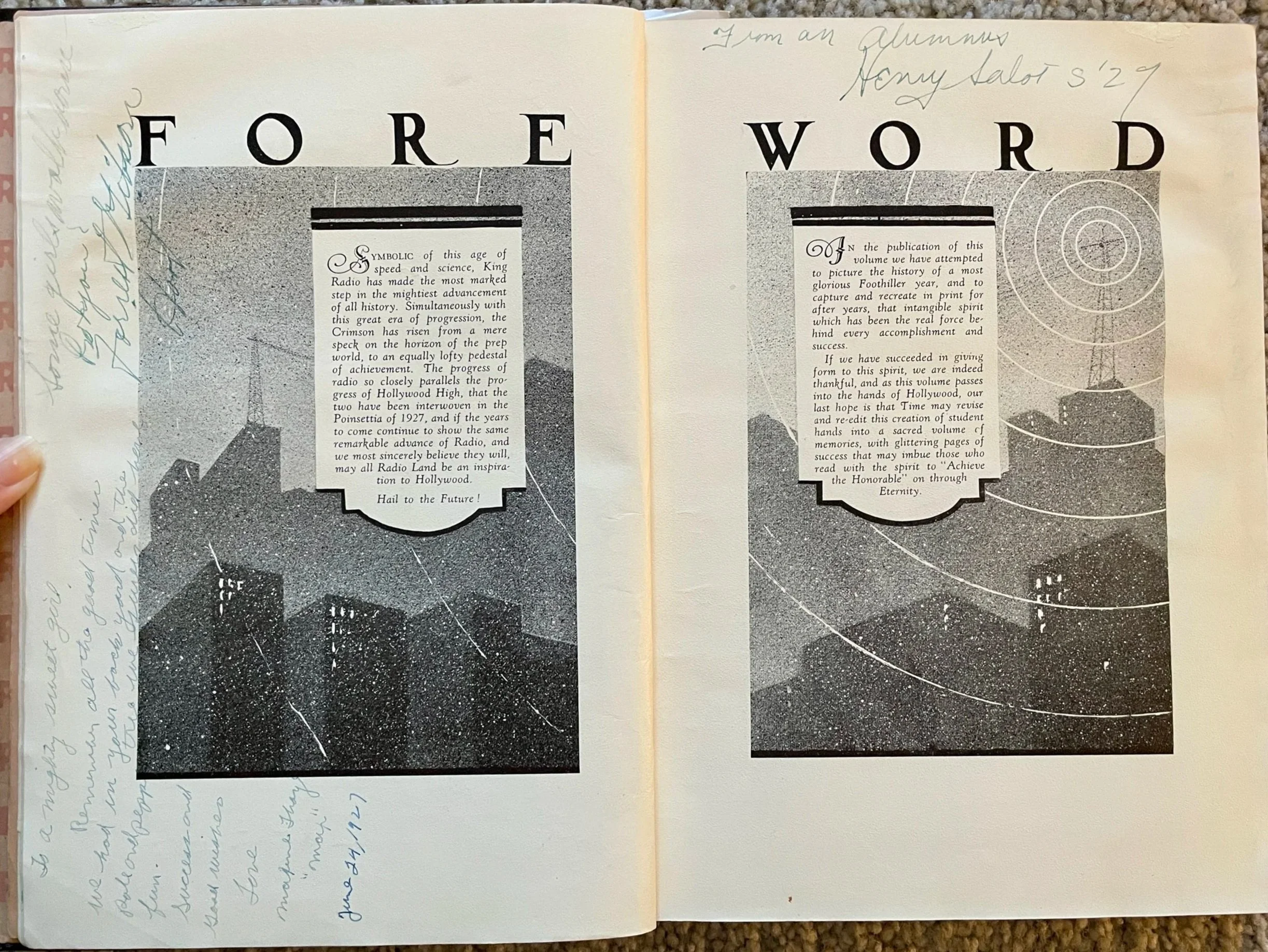
The “Foreword” at the beginning of the yearbook makes reference to the growth of radios in society.
The following words appear in the “FOREWORD” at the beginning of the 1927 Poinsettia yearbook: “Symbolic of this age of speed and science, King Radio has made the most marked step in the mightiest advancement of all history. Simultaneously with this great era of progression, the Crimson has risen from a mere speck on the horizon of the prep world, to an equally lofty pedestal of achievement. The progress of radio so closely parallels the progress of Hollywood High, that the two have been interwoven in the Poinsettia of 1927, and if the years to come continue to show the same remarkable advance of Radio, and we most sincerely believe they will, may all Radio Land be an inspiration to Hollywood. Hail to the Future!
“In the publication of this volume we have attempted to picture this history of a most glorious Foothiller year, and to capture and recreate in print for after years, that intangible spirit which has been the real force behind every accomplishment and success. If we have succeeded in giving form to this spirit, we are indeed thankful, and as this volume passes into the hands of Hollywood, our last hope is that Time may revise and re-edit this creation of student hands into a sacred volume of memories, with glittering pages of success that may imbue those who read with the spirit to ‘Achieve the Honorable’ on through Eternity.” [18]
I have to wonder if one of Margaret’s fellow graduates, William Shockley, who served on the yearbook staff, was responsible for this radio description. His senior photo appears on the right side page below and describes him as being studious, on the Annual Staff, and liking to hang out in the Staff Room, with plans to attend U.C. Berkeley. Ultimately, Shockley actually attended the California Institute of Technology, where he earned his B.S. degree in 1932; then the Massachusetts Institute of Technology, where he obtained his Ph.D. in 1936, submitting a thesis on the energy band structure of sodium chloride. [19] He was awarded the Nobel Prize in Physics in 1956 for his research on semiconductors and his discovery of the transistor effect. You can read his Biographical Description on the Nobel Prize website HERE.
He also had a connection to where I live now: Silicon Valley. According to Wikipedia, “Partly as a result of Shockley's attempts to commercialize a new transistor design in the 1950s and 1960s, California's Silicon Valley became a hotbed of electronics innovation. He recruited brilliant employees, but quickly alienated them with his autocratic and erratic management; they left and founded major companies in the industry.” [20]
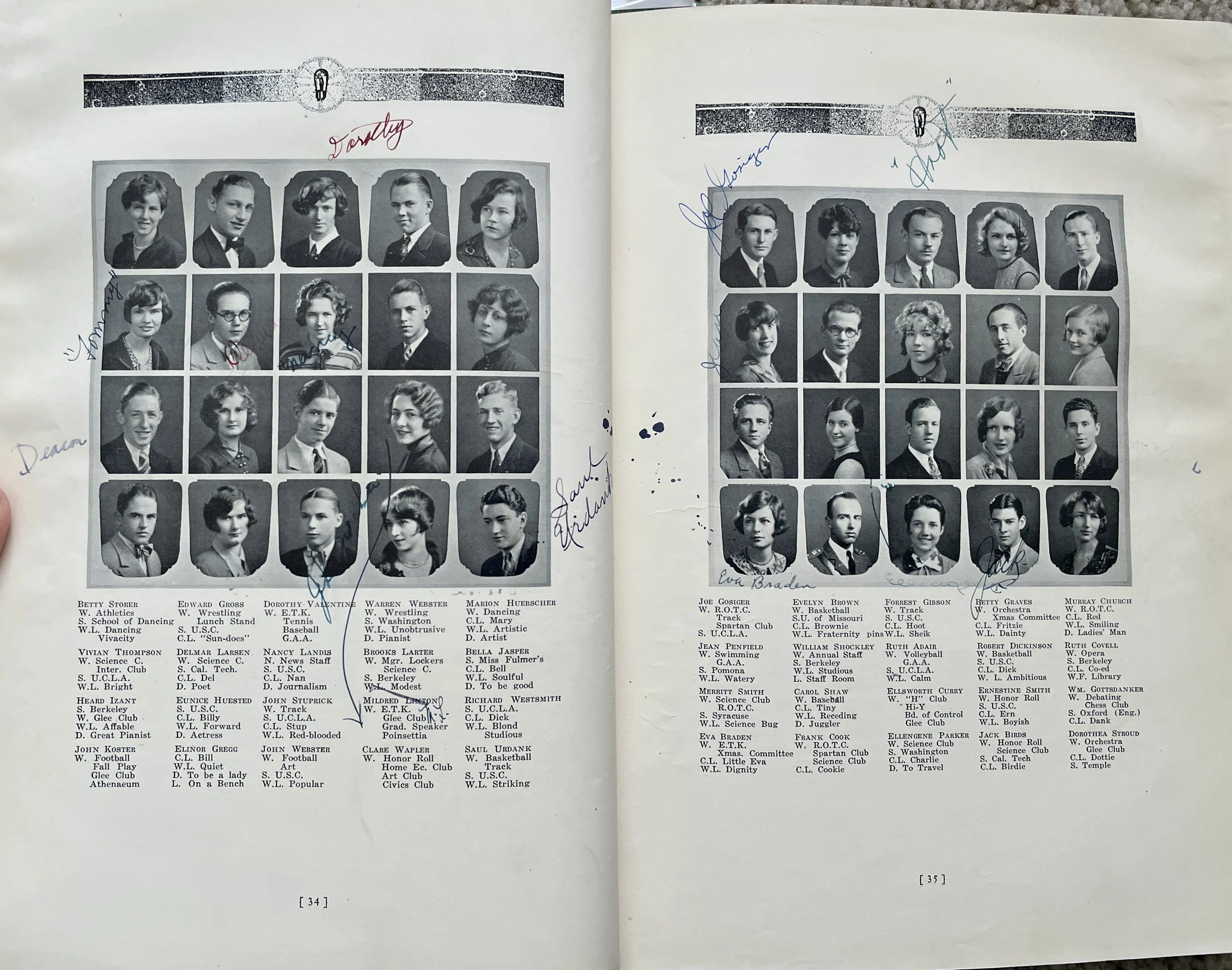
Margaret’s classmates, future actress Karen Morley (then known as Mildred Linton) and future Nobel Laureate William Shockley, appear on these pages; Mildred also signed the page and drew an arrow to her name.
Another of her fellow graduates was the actress Karen Morley, who at this time was going by her original name, Mildred Linton. She appears on the left page above, and her descriptions mention her being involved in the E.T.K. (Epsilon Tau Kappa, the school’s honor society), Glee Club, Poinsettia (yearbook), and serving as the Graduation Speaker. Mildred signed Margaret’s yearbook in two places, and her name shows up throughout the book. She was definitely an active woman on campus! She was named one of the school’s ten “Ephebians,” which the yearbook says is “the highest honor that can be bestowed upon a member of the graduating class, for the choice is made from those students who have best distinguished themselves in scholarship, leadership, and character.”
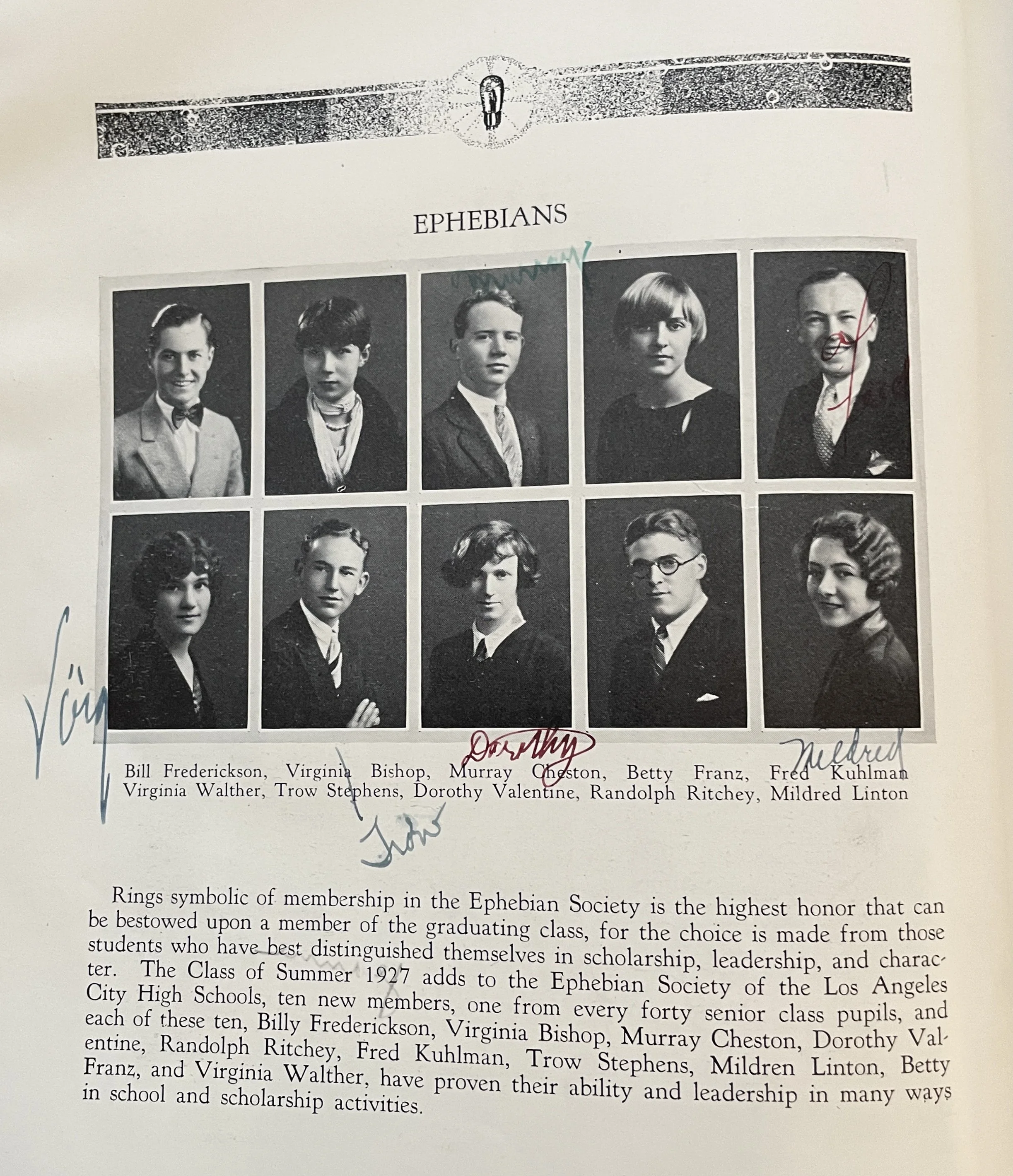
Mildred Linton, who would later be known as actress Karen Morley, was chosen as one of the Ephebians.
I looked to see if Linton performed in the school’s Fall Play, “The Boomerang,” but she did not. Apparently 250 people tried out for 11 parts. Talk about competitive! Linton did, however, appear in the school’s opera production of “The Firefly.” (Yes, opera!)
As for her later acting career, Linton changed her name to Karen Morley and “began her film career as a stand-in for Greta Garbo but soon moved into small walk-in roles and bit parts. Her most famous parts include playing a gangster girl in ‘Scarface’ (1932), as Sonia alongside the Barrymore brothers in ‘Arsene Lupin’ (1932) and as Charlotte Lucas in an early film adaption of ‘Pride and Prejudice’ (1940). However, her life took a wrong turn in 1947 when she was forced to testify before the House Un-American Activities Committee and refused to answer questions about her involvement with the Communist Party. Her career never recovered and she continued her interest in politics – even unsuccessfully running for Lieutenant Governor of New York in 1954 – until her death in 2003.” [21]
The only movie of hers that I have seen, and it was a long time ago, is the 1940 version of “Pride and Prejudice.” I cannot specifically remember her as Charlotte Lucas, but perhaps I’ll have to try to watch that version again – as well as some of her other movies. It’s so sad to realize how many in Hollywood suffered by being black-listed during the Red Scare. I just wrote about Charlie Chaplin in my last post. He, too, suffered for his alleged Communist sympathies. In his case, however, as a British citizen, he was banned from returning to the United States.
Hollywood High School produced many “notable graduates” over the years. I found this list on the school’s website. Some famous alumni – including Dorothy Dandridge, Brandy Norwood, Lana Turner, Laurence Fishburne, Carol Burnett, Cher, Ricky Nelson, Judy Garland, and John Ritter – are depicted on a large mural at the school. Two other especially well-known ones whom Margaret’s older brother Frank may have encountered were John Huston (film director, screenwriter, actor) and Carole Lombard (actress), who graduated in 1923, one year before him.
The yearbook’s “Foreword” shown earlier also mentions the school’s motto, “Achieve the Honorable, which was penned by then Principal William Snyder, who served as the school’s principal from 1909-1929. A page in the yearbook offers him high praise, stating: “A principal of a high school must have power in order that everything which is done may be done in a powerful way. He must have individuality in order to be a strong influence for right in the lives of the students. He must have the ability to get cooperation. Inspiration must be his. In other words, he must have a tremendous personality. Every institution is the lengthened shadow of some great man. It must be so, otherwise the institution would not and could not survive. Thus is the Hollywood High School proud to claim Dr. Wm. H. Snyder, a true friend to every Hollywood pupil and a great leader in education. Dr. Snyder not only answers every requirement of a successful principal, but he has, as well, been the power behind every accomplishment and glory the school can claim. He is tremendous.” [22] That’s quite a commendation!
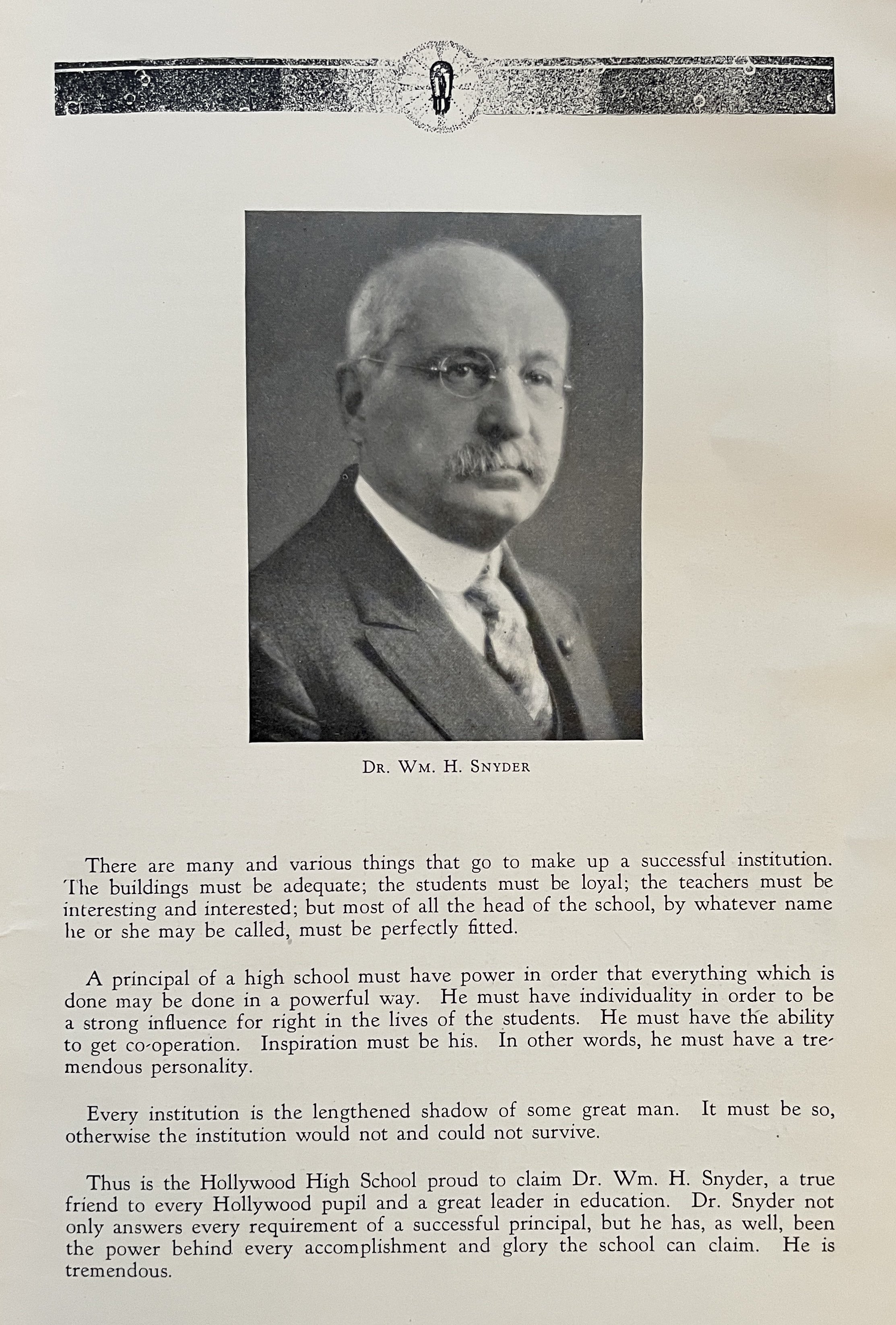
This yearbook page describes Dr. William H. Snyder, who served as Hollywood High School Principal from 1909-1929.
In 1927, Hollywood High graduated “a class of 390 boys and girls,” with Dr. R.C. Denison of Pomona College presenting the graduation address. The following year, Margaret’s brother, William “Bill” Traughber would also graduate. Brother Robert “Bob” Traughber, born in 1913, most likely graduated a few years after that, though I can find no specific records to verify which year. [23]
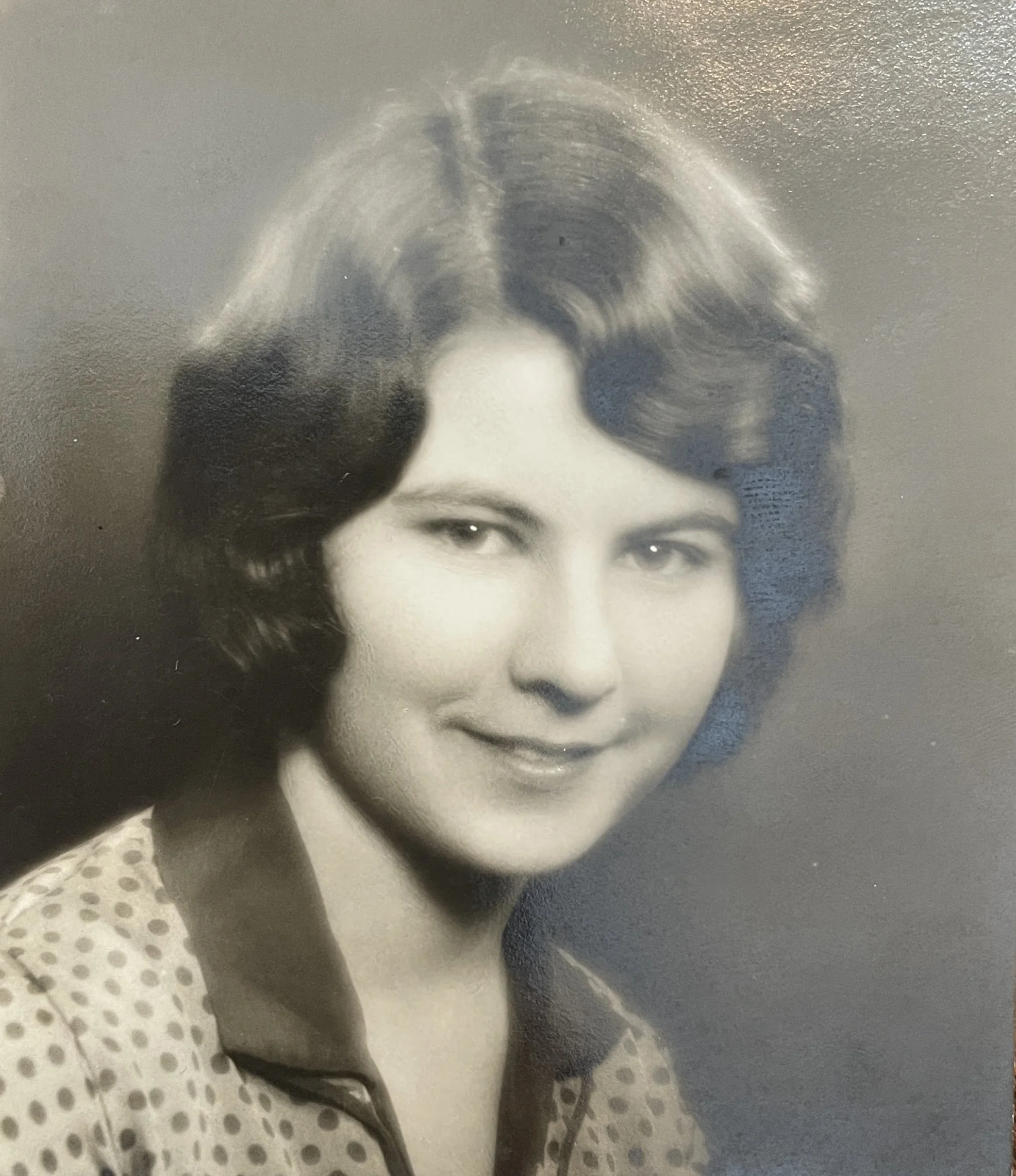
Margaret Ruth Traughber’s senior portrait, 1927
The following page shows Margaret’s brother William, aka. Bill, and says he was involved in R.O.T.C. (Reserve Officers’ Training Corps), the Science Club, and the Spartan Club, with hopes of attending U.C.L.A. His brother Frank was currently a student at U.C.L.A., and sister Margaret would join Frank there in Fall 1927.
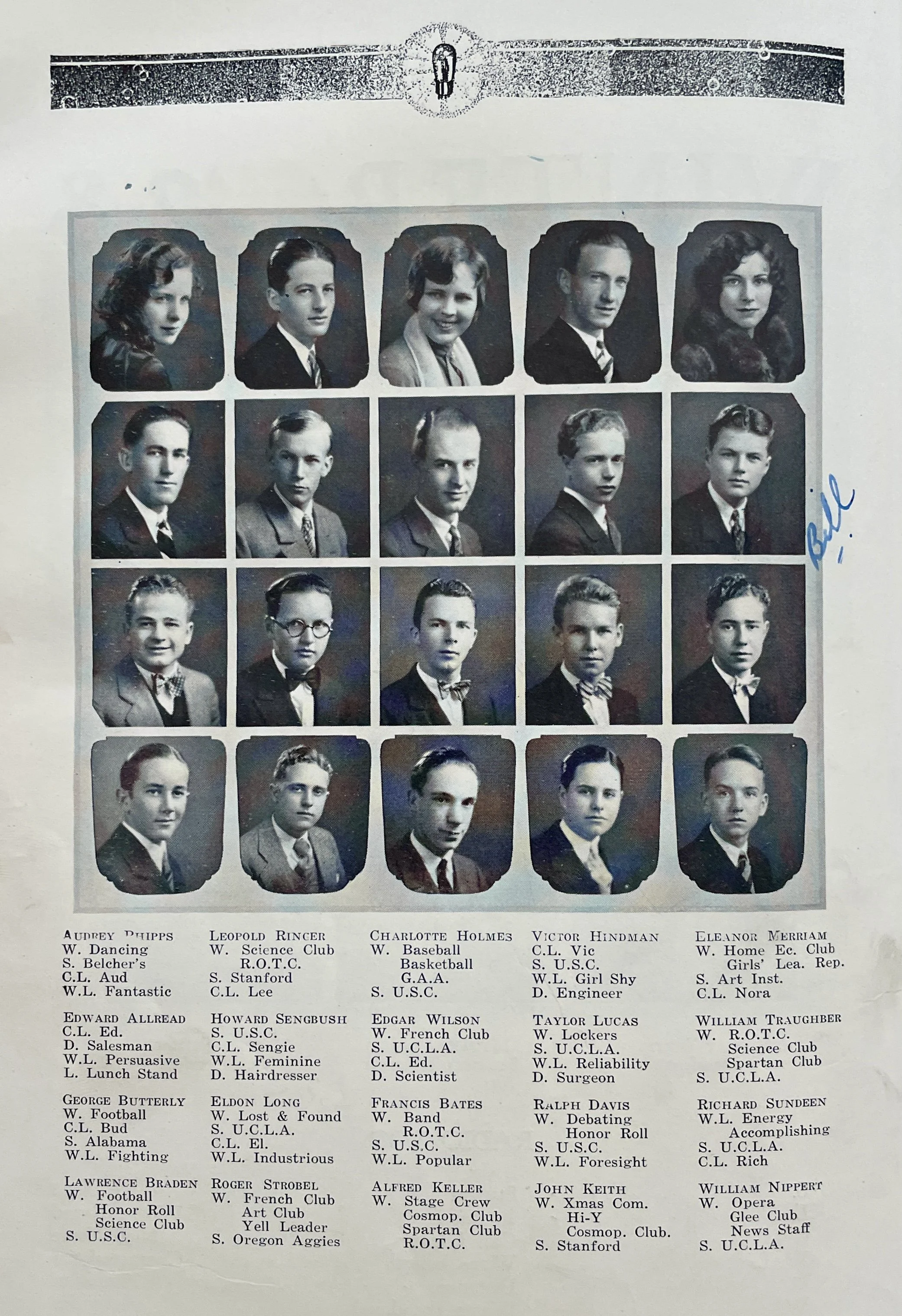
Bill Traughber, aka. William, appears on this page; he is described as being active in R.O.T.C., Science Club, and Spartan Club, with a desire to attend U.C.L.A. in the future.
The R.O.T.C. section takes up six pages in the yearbook. The following description appears, along with several photos: “Following the World War, and especially during the last few years, militarism in America has gradually lost in interest until now it is at its lowest ebb since 1919. Likewise, the R.O.T.C. units of the country have been conspicuous in their decreasing enrollment, and now, few City High School units have an enrollment large enough to warrant their competing in the National R.O.T.C. Honor School Contest. Of these few, Hollywood still proudly claims leadership, with four consecutive years of Honor School awards, a remarkable record considering the fact that a maximum of eleven schools in the country can receive this honor. Yet, Hollywood’s success lies not in the fact that she is militaristically inclined, but rather in the efforts of Major Cheston, Sergeant Ward, and the Spartan Club. In fact, the local unit is no longer a prime militaristic movement, but an organization for personal development and attainment.
“Major Cheston and Sergeant Ward have worked for the development of gentlemen, capable, strong, obedient, courteous, and trustworthy products of manhood, and not confirmed fighters. Their efforts have been manifest in the accomplishments of the unit and in the respect and admiration every member of the corps holds for them. The Spartan Club has provided the outlet for the natural spirit and sporting blood of the men, with inter-company football encounters, track meets, and baseball games.” [24]
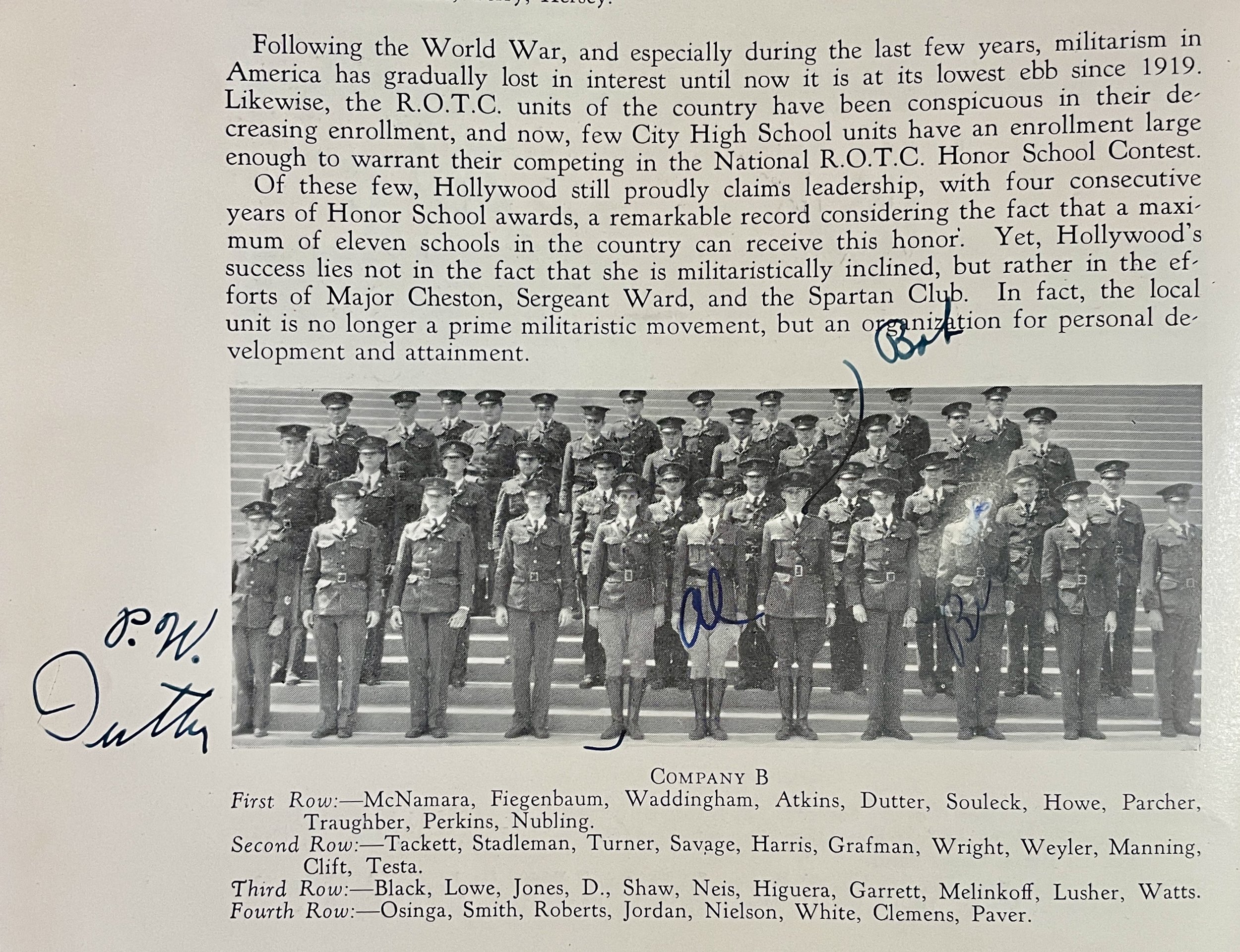
Bill Traughber appears in the front row, third from right, in this R.O.T.C., Company B, photo. His great grandfather, James Calaway Hale, would be proud of him! (see this link for my book about James C. Hale)
This excerpt mentions the Spartan Club, of which Bill was also a member, though he does not appear in the club photo (perhaps that was reserved for seniors). According to the yearbook description, the Spartan Club was a relatively new club on campus, having existed for only two years, but had quickly become “one of the leading organizations in Hollywood.” [25] Its membership was “limited to officers and non-commissioned officers of the local unit and with the purpose of fostering greater cooperation and efficiency within the Hollywood R.O.T.C.”
The yearbook does not mention Bill being involved in the “Boys’ League,” which sought “(1) to encourage interest and assist in all activities sanctioned by the Hollywood High School, (2) to encourage clean sportsmanship, clean habit and clean speech at all times, (3) and to work for the benefits of this organization and the best interests of the Hollywood High School.” However, I feel pretty confident that he and his father attended the Father and Son Banquet the league began hosting that year since his father, Dr. W. F. Traughber, was very involved in community events.
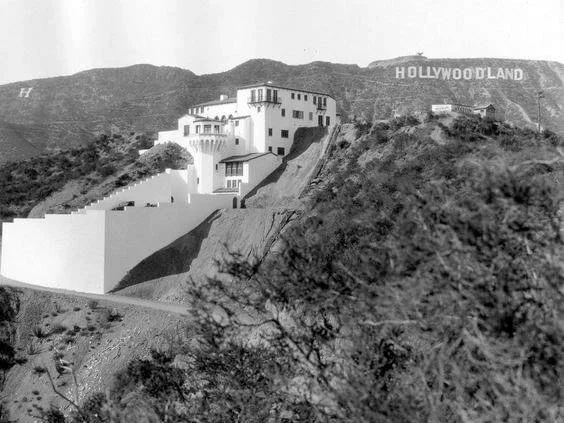
The Boys’ League had the task of maintaining the “H” that appears on the left of this photo. [26]
Another job of the Boys’ League was “the annual task of repairing and redecorating the ‘H’ on Camel’s Back,” which appears in the above photo, to the left of the 20,000 square foot, 32-room Castilla del Lago, built in 1926 by oil baron Patrick Longden, and the 1923 “Hollywoodland” sign. That “H” first appeared a year before the “Hollywoodland” sign, in January 1922, when “students proved their school spirit by erecting a massive wood-and-tin white ‘H’ atop Mount Cahuenga, just west of Mount Lee,” to represent Hollywood High School. [27]
Students quickly learned that, due to both vandalism and the elements, ongoing repairs would be needed, As a result, “In October 1924, fifty boys took as many sheets of metal from the Hollywoodland subdivision to the ‘H’ during a repair effort. Every year, a group hiked up to Mount Cahuenga, the highest summit in Griffith Park, to give it a fresh coat of white paint. By 1927, maintenance had become such a chore, students organized ‘a movement to shoulder the responsibility.’ Not long after, the “H” vanished from the Hollywood Hills skyline.” [28]
A funny mention of this task comes up in the yearbook’s “Calendar” section on April 8, where it says: “H” Fixed. As the event is laid out there:
(Boys’ League President Fred] KUHLMAN: “How many boys pledge to stand by the school and fix the “H”? Fifteen hundred? Fine! You’re the fellows that win. Hollywood’s proud of you.”
“KUHLMAN: (The morning of the undertaking, coming late, finds about fifteen fellows gathered.) “Er- hello, Fellows — is this all? (Cheerfully) What a fine turnout. About fourteen more than last year. At this rate the “H” may actually be finished about 1945.”
LOL. I guess that wasn’t the most fun task for a teenage boy in Hollywood!
So, now for an important question. Why do so many of the old school buildings shown above no longer exist? That question led me down another big rabbit hole as I learned about the 1933 Long Beach earthquake. Measuring 6.4 on the Richter scale, the quake hit on March 10 at 5:54 p.m. and was centered on the 46-mile-long Newport-Inglewood fault just south of Long Beach. It killed about 118 people, injured thousands, and caused about $50 million in property damage – the equivalent of about $1 billion today. Compton, Long Beach, and Bellflower were left a mass of ruins, while Los Angeles (including Hollywood) was badly damaged.
As I scrolled through a large number of Getty Photos, I saw people waiting in lines at Lincoln Park (which served as relief headquarters) for food, clothing, bedding, and medical care; families sleeping in cars and in tents in front of homes to avoid aftershocks; an interim post office operating on the sidewalk and people reading news on bulletin boards; people sleeping in the Armory in Long Beach, where children were being cared for and read to by National Guardsmen while their parents sought help; cars destroyed by falling bricks; roads closed to keep highways open for relief work; victims who had lost everything searching through salvaged clothing and bedding for items they might use; people using emergency telephone stations and emergency Western Union telegraph stations to contact loved ones; sailors called from the U.S. fleet to stand guard over bodies in a vacant lot and to protect damaged stores from looting; a public address system installed to issue orders and provide information; and volunteers searching for victims in the rubble on Long Beach’s main street.
Very significantly, about 230 schools in Southern California were destroyed, heavily damaged, or judged unsafe to occupy, including much of Hollywood High School. The unreinforced masonry (brick-and-mortar) buildings that were common in school construction at the time could not hold up to large tremblors. If the earthquake had happened during school hours, it’s possible that thousands or young people would have been killed. Records show that the 1933 earthquake was so severe at Hollywood High that every building on campus was eventually demolished, with the sole exceptions of the Library and the Auditorium.
In an article written on the 75th anniversary of the quake, Los Angeles Times reporter Molly Hennessy-Fiske explained: “The great quake of 1933 helped define the region's reputation as ‘earthquake country.’ It was the first destructive quake to occur in the region after a period of rapid growth in the early 20th century. The violent shaking traumatized newcomers — many of them transplants from the less seismically active Midwest — and caught government unaware. In the end, the 1933 quake changed the landscape, leading to improved school construction standards and a heightened awareness of earthquake risks….
“California legislators also reacted swiftly. Within a month of the earthquake, they passed the Field Act, legislation that would become the earthquake’s major legacy. The Field Act required tougher building standards for new schools, from elementary schools through community colleges, and retrofitting for older schools. As a result, subsequent earthquakes have caused fewer deaths, even compared with other countries with stringent building standards such as Japan.” [29]
During those reconstruction years, many students attended schools in makeshift “temporary campuses,” utilizing large tents or wooden bungalows and barracks. In the weeks immediately after the earthquake, many simply met in open parks or behind damaged buildings to avoid the risk of falling debris. Those campuses that could still utilize certain buildings (often gymnasiums and auditoriums that had been built using more modern techniques) crowded students into surviving structures whenever possible. At Hollywood High School, students were housed in temporary wooden structures, according to what I read online, but I have not been able to find any photos.
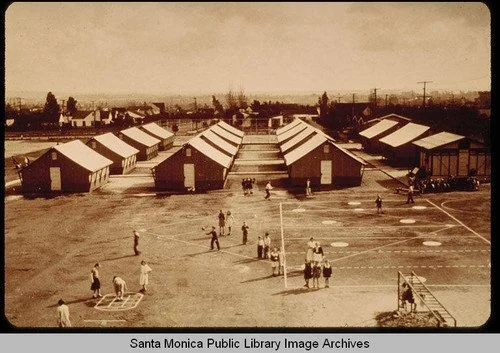
This photo shows the temporary “tent” campus at Santa Monica High School after the 1933 earthquake. [30]
The current Hollywood High School campus with its “Streamline Moderne” buildings was constructed between 1935 and 1937, funded partly by the New Deal-era Works Project Administration (WPA) and designed by the architectural firm of Marsh, Smith and Powell (see this link for more details). The school’s Library is the oldest building on campus. Originally constructed in a Beaux Arts-style in 1910 to be the school’s Auditorium, it was refigured as the Library after the newer and larger Memorial Auditorium was completed in 1924. The Library’s exterior was significantly modified in 1935 to modernize its look so it would better match the new buildings on campus; the Memorial Auditorium’s exterior was similarly remodeled in 1956. Those two buildings, along with three others, were listed on the National Register of Historic Places in 2012. [31]
Next time I’m in Hollywood, I definitely plan to take a closer look at this historic school and to check out its murals. For those who want some more views of the campus and some discussion of its more modern-day history, check out this video titled “The History of Hollywood High School,” posted March 28, 2025 on Youtube.
If you’ve enjoyed this blog post, I hope you’ll hit the “subscribe” button at the bottom of my webpage (tonyagrahammcquade.com) to receive my quarterly newsletter with updates on my books, blog posts, and scheduled book talks. I also hope you’ll check out my new book, Frank and Nora’s Historic Honeymoon Adventure: A Travelogue through the West with a “Time Travel” Twist, that tells more about Dr. William Francis “Frank” Traughber, and his wife, Nora Petree Traughber, who are the parents of all the Traughber children mentioned in this post.
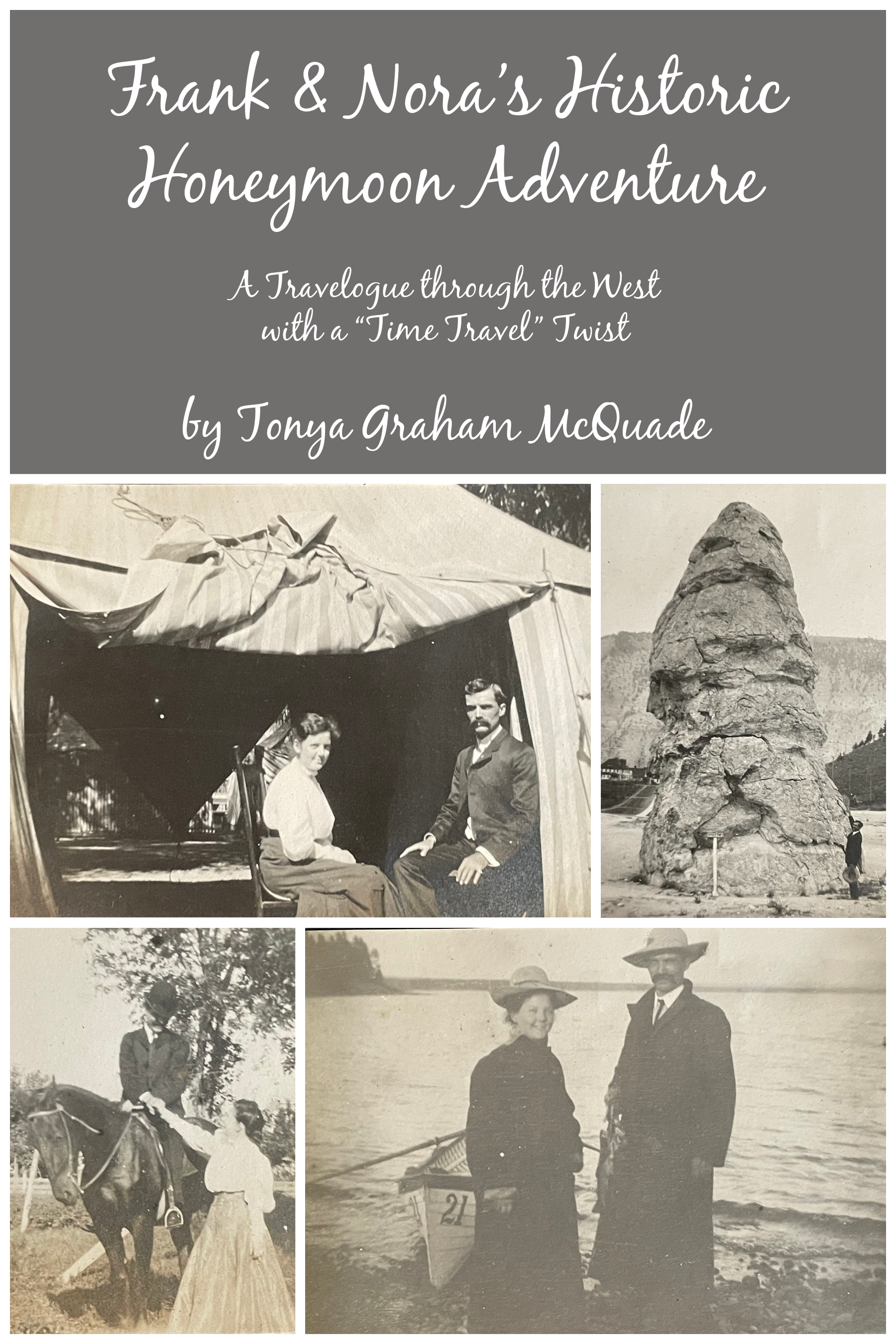
This book, which is about my great grandparents Frank and Nora Traugher, is now available on Amazon.
Endnotes:
Pierce, C.C. “Exterior view of the Hollywood Union High School, ca. 1905.” California Historical Society,California Historical Society Collection, 1860-1960 (collection), University of Southern California Libraries, Title Insurance and Trust, and C.C. Pierce Photography Collection, 1860-1960 (subcollection), https://doi.org/10.25549/chs-m3342.
Pierce, C.C. “Hollywood High School graduating class, ca. 1912.” California Historical Society, California Historical Society Collection, 1860-1960 (collection), University of Southern California Libraries, Title Insurance and Trust, and C.C. Pierce Photography Collection, 1860-1960 (subcollection), https://doi.org/10.25549/chs-m18895.
Folven, Edwin. “Hooray for Hollywood High!” Beverly Press Park La Brea News, 24 Sept 2025, https://beverlypress.com/2025/09/hooray-for-hollywood-high/.
Pierce, C.C. “Exterior view of the Hollywood Union High School, ca. 1905.” California Historical Society, California Historical Society Collection, 1860-1960 (collection), University of Southern California Libraries, Title Insurance and Trust, and C.C. Pierce Photography Collection, 1860-1960 (subcollection), https://doi.org/10.25549/chs-m3342.
“Hollywood High School, c. 1905.” Los Angeles Public Library Photo Collection, Los Angeles Public Library, Calisphere, https://calisphere.org/item/31fb3edaa0f2ee18edf0df0e820df9cc/.
Poinsettia Nineteen-Twenty-Seven, Vol. 22. Hollywood High School, Hollywood, California, Frederick Karl Kuhlman and William Frederickson, Jr., 1927.
Folven, Edwin. “Hooray for Hollywood High!” Beverly Press Park La Brea News, 24 Sept 2025, https://beverlypress.com/2025/09/hooray-for-hollywood-high/.
“HHS Small Learning Communities.” Hollywood High School: Home of the Sheiks, 2026, https://www.hollywoodhighschool.net/.
“377 To Be Graduated By High School Here.” Los Angeles Evening Citizen News, 19 Jun 1924, https://www.newspapers.com/image/682824895/.
“Chaney, Lon, Jr.” The Encyclopedia of Oklahoma History and Culture, Oklahoma Historical Society, https://www.okhistory.org/publications/enc/entry?entry=CH004.
“Fay Wray.” Wikipedia, https://en.wikipedia.org/wiki/Fay_Wray]
“Hollywood High Pipe Organ, Op. 481 (Skinner).” Added by John Reed Swinford, 28 Feb 2022, Hollywood High Alumni Association, https://hhsalumnicommunity.ning.com/photo/hollywood-high-pipe-organ-op-481-skinner?overrideMobileRedirect=1.
Folven, Edwin. “Hooray for Hollywood High!” Beverly Press Park La Brea News, 24 Sept 2025, https://beverlypress.com/2025/09/hooray-for-hollywood-high/.
Ibid.
Smith, Galen, “Hollywood High School.” Youtube, 7 Apr 2008, https://en.wikipedia.org/wiki/Hollywood_High_School#/media/File:HollywoodHighSchool.jpg.
“Hollywood High School - an aerial view from the southeast.” Mar. 11, 1927, Los Angeles Public Library Photo Collection, Los Angeles Public Library, Calisphere, https://calisphere.org/item/7e362b3c4ed230be80979efd8a307b82/.
“Girl to Edit School Paper.” Los Angeles Evening Citizen News, 1 Feb 1926, https://www.newspapers.com/article/los-angeles-evening-citizen-news-girl-to/192319599/?xid=637.
“Foreword.” Poinsettia Nineteen-Twenty-Seven, Vol. 22. Hollywood High School, Hollywood, California, Frederick Karl Kuhlman and William Frederickson, Jr., 1927.
“William B. Shockley - Biographical.” The Nobel Foundation, 1956, Nobelprize.org, https://www.nobelprize.org/prizes/physics/1956/shockley/biographical/.
“William Shockley.” Wikipedia, 28 Feb 2026, https://en.wikipedia.org/wiki/William_Shockley
“Karen Morley.” Wikipedia, https://en.wikipedia.org/wiki/Karen_Morley.
“Dr. Wm. H. Snyder.” Poinsettia Nineteen-Twenty-Seven, Vol. 22. Hollywood High School, Hollywood, California, Frederick Karl Kuhlman and William Frederickson, Jr., 1927, pg. 17.
“Graduations - Nearly 400 at Hollywood.” Los Angeles Times, 23 Jun 1927, https://www.newspapers.com/article/the-los-angeles-times-nearly-400-at-holl/192322365/.
“R.O.T.C.” Poinsettia Nineteen-Twenty-Seven, Vol. 22. Hollywood High School, Hollywood, California, Frederick Karl Kuhlman and William Frederickson, Jr., 1927, pgs. 90-91.
“The Spartan Club.” Poinsettia Nineteen-Twenty-Seven, Vol. 22. Hollywood High School, Hollywood, California, Frederick Karl Kuhlman and William Frederickson, Jr., 1927, pg. 96.
“View showing the very large Mediterranean-style Castillo del Lago in the Hollywood Hills. The Hollywoodland Sign can be seen in the distance at upper-right. Another large letter H appears at upper-left, ca. 1926. ” Posted by Los Angeles Historic, Facebook, 4 Oct 2019, https://www.facebook.com/thehistoryoflosangeles/photos/ca-1926-view-showing-the-very-large-mediterranean-style-castillo-del-lago-in-the/3033950763346720/.
Perricone, Kathleen. “Mysterious “H” in the Hollywood Hills Explained: A year before the Hollywoodland sign, there was another “H” in the hills … for Hollywood High School.” Before the 101, 16 Jun 2025, https://www.beforethe101.com/post/hollywoodland-h-sign-hollywood-hills.
Ibid.
Hennessy-Fiske, Molly. “‘33 quake is still a powerful reminder.” Los Angeles Times, Los Angeles, CA, 10 Mar 2008, https://www.latimes.com/archives/la-xpm-2008-mar-10-me-lbquake10-story.html.
“Tents in the schoolyard at Santa Monica High School after the 1933 earthquake.” Santa Monica Image Archives, Santa Monica Public Library, Calisphere, https://calisphere.org/item/09a6204496dfcf4036e7502fc216ba3f/.
Library at Hollywood High School, c. 1939.” Los Angeles Public Library Photo Collection, Los Angeles Public Library, Calisphere, https://calisphere.org/item/c3202a125b1b6f1bae28577d5e7cad4e/.