Living Across from Charlie Chaplin Studio: The Traughbers’ First-Hand View of the Hollywood Movie Industry (and a Look at Charlie Chaplin)
Chasing History: Exploring My Ancestral Roots - Blog Post #61
By Tonya Graham McQuade
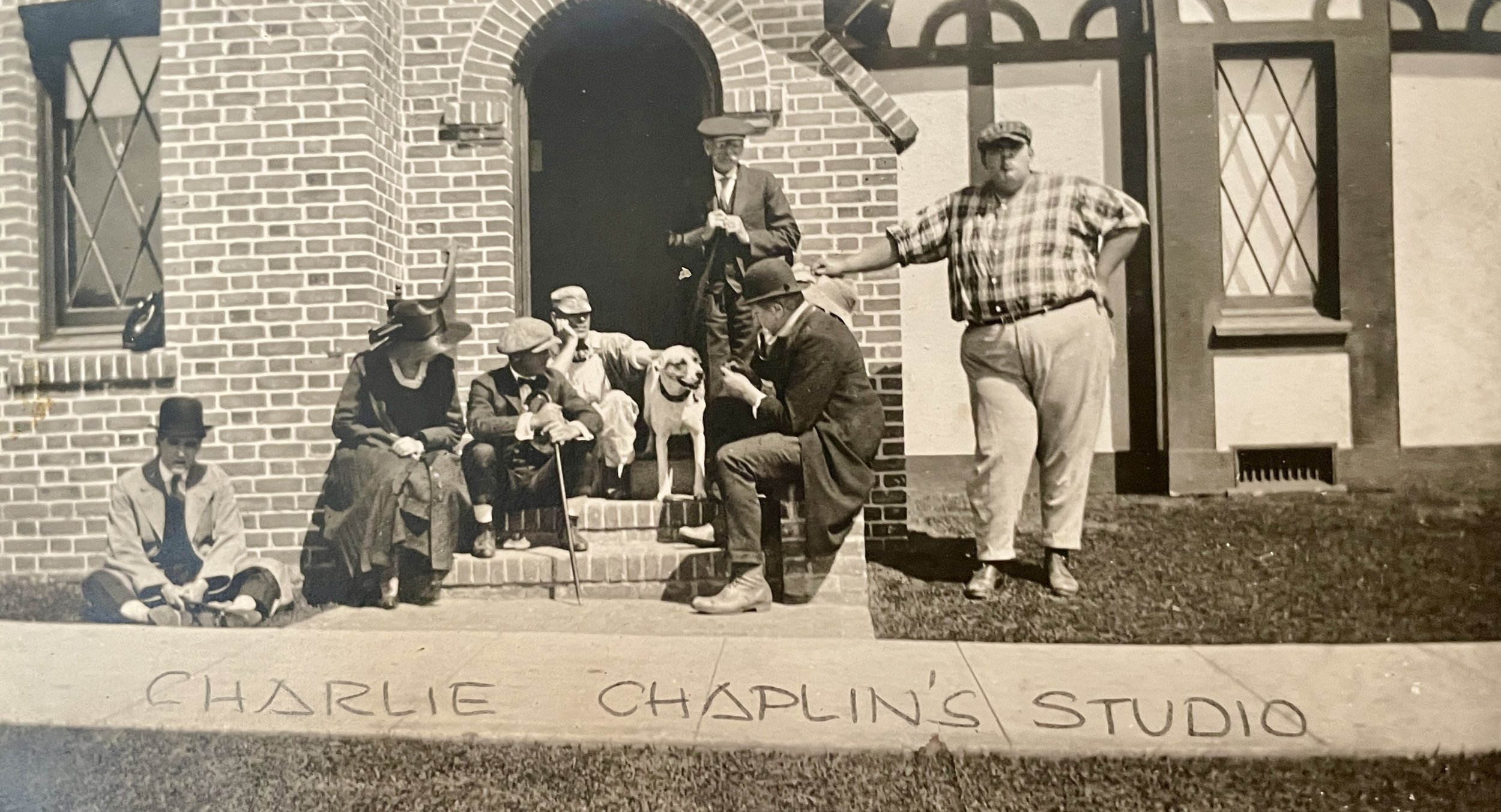
A group of actors, including (I think) Charlie Chaplin and Edna Purviance, sit outside the Charlie Chaplin Studio on N. La Brea Avenue in Hollywood, CA. Traughber Family Collection.
My grandmother, Margaret Ruth Traughber, grew up across the street from Charlie Chaplin’s Studio. That, to me, has always seemed rather remarkable, but the more I’ve learned, the more fascinated I have become by this reality. The above photo appears in the scrapbook I inherited from my great grandparents, Dr. William Francis “Frank” Traughber and Nora Petree Traughber. It shows Charlie Chaplin, Edna Purviance (I think), and other actors taking a break in front of the studio on La Brea Avenue. Pretty cool, huh? And you’ve got to love the hats!
When Margaret’s family moved into their new home at 1359 N. La Brea Avenue in 1911 (see my previous post about the house), she was two years old and had a five-year-old brother named Frank and a one-year-old brother named William. The movie industry at that time was just getting started. The first film partially shot in Hollywood was The Count of Monte Cristo in 1908, followed by the first short filmed entirely in Hollywood, In Old California, which was directed by D.W. Griffith in 1910. In 1911, the first dedicated film studio opened on Sunset Boulevard: Nestor Studios. But no one could foresee what Hollywood would become in just a matter of years.
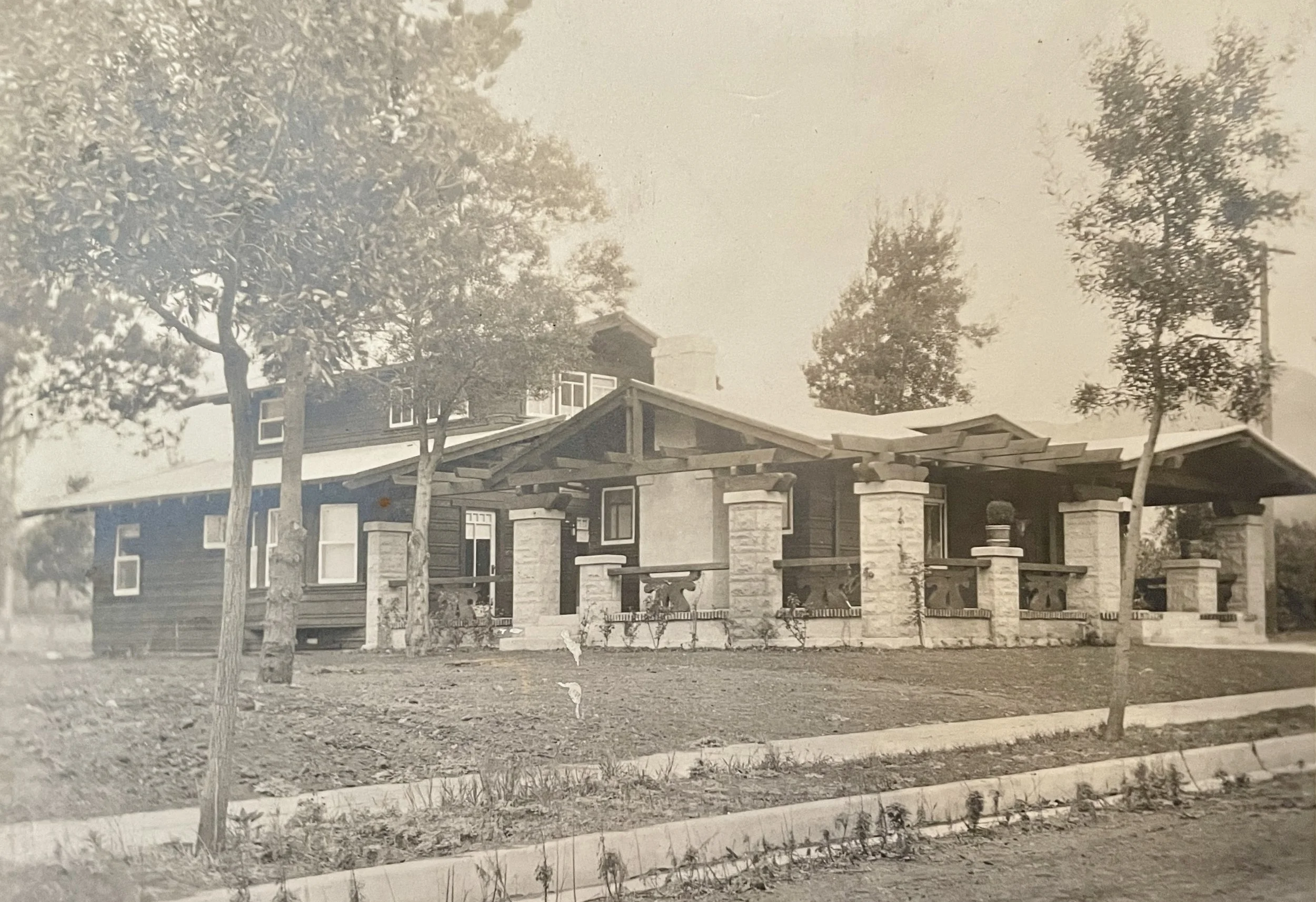
The house where the Traughber family lived at 1359 N. La Brea Avenue from 1911-1944; the house still stands today — the last single-family home in the neighborhood
I discovered many social media posts about their house during my research. In response to one 2024 post in the “Lost Angeles” Facebook group that included a photo of the house, someone wrote: “The history that this house has seen. 114 years old. Hollywood was a city / WeHo [West Hollywood] was the town of Sherman/ the Bowl hadn’t been built / Hollywood Blvd was still Prospect Avenue / the movies hadn’t taken over Hollywood yet / Daida Wilcox was still living in her home / the stars that would create Hollywood’s Golden Era were just being born/ Beverly Hills was still a bean farm / the Hollywoodland real estate sign had not been constructed / and this craftsman home was most likely purchased from a Sears catalogue. This could make a great museum.” [1]
Someone in another Facebook group named “Los Angeles Historic” posted a picture of the house as it appeared just two weeks ago and wrote: “Just had to check on old 1359 LaBrea on my weekly Hollywood night cruise. 115 years and still standing. Built when it was one of the few structures in the vicinity and horse drawn vehicles were still transportation. Unpaved roads were common. My guess whomever owned this house had something to do with the orange groves that surrounded this structure at the time of construction.” [2]
To this, someone responded, “Would make a pretty rad coffee shop, chairs on the porch, little bookstore or art gallery upstairs. What a relic, should really be preserved.” Someone else said, “Have always loved this little airplane bungalow. Have suggested it to be moved to Altadena, it has been empty since I first moved to LA in 1991. There was a dude who sold rugs and flags on the property in the mid 90’s. He stored the items in the house and he let me walk through it. I have photos somewhere.” [3]
Those posts are wrong on a couple points. The house was not a “Sears catalog” house but one of approximately 220 houses designed by Arthur and Alfred Heineman, as I discussed in my previous post. And the Traughbers didn’t have anything to do with the Orange groves – though I’m sure they enjoyed eating some of those oranges, lemons, and peaches that grew nearby.
However, the descriptions these posts paint are otherwise quite accurate. The Traughber family lived here during a time of huge growth in Hollywood. They watched as cars became the norm; as fruit tree groves were cut down to make room for new buildings; as La Brea Avenue was widened by 15 feet to accommodate increased traffic; and as the population of Los Angeles (of which Hollywood became a part in 1910) grew from 300,000 in 1910 to over 1.5 million by 1940 (according to U.S. Census records).
What must they have thought when Charlie Chaplin decided to move in across the street? It was in 1917 that Chaplin purchased the five-acre property on the corner of Sunset and La Brea, which included a ten-room house and five acres of lemon, orange, and peach trees. The lot had 300 feet of frontage on Sunset and 600 feet on La Brea, and it extended south to De Longpre. Chaplin’s studio sat on the northeast corner of La Brea and De Longpre, and the Traughbers’ house, on the southwest corner.
At the time Chaplin began building his studio, my grandmother Margaret was eight years old. She and her three brothers must have been excited to watch the construction going on. I wonder if they had, at this point, ever seen any Charlie Chaplin movies. He had already made more than 60 films, mostly short comedies, including one of his most iconic shorts, The Tramp (1915), and his first feature-length film, Tillie’s Punctured Romance (1914). His primary leading lady, Edna Purviance, appeared in many of those early movies with him.
Both Chaplin and Roscoe Conkling “Fatty” Arbuckle are credited with helping to refine slapstick: “They reduced the usual frenetic pace of [Mack] Sennett’s [Keystone Company] films to give the audience a chance to appreciate the subtlety and finesse of their movement, and the cleverness of their gags. By 1917 Chaplin was also introducing more dramatic plot into his films and mixing the comedy with sentiment.” [4]
By 1917, “Chaplin was seeking more independence and greater creative license over his films which he believed were becoming too stagnant and predictable. His relationship with Mutual [Film Corporation] ended amicably, and he signed an eight-film contract with First National. His years with First National would prove to be some of the most important in his career. Both Chaplin’s and Mary Pickford’s contracts with First National were the first million dollar contracts in cinematic history.” [5]
The riches Chaplin gained from that contract allowed him to build his own studio, where he would make all his films and employ a full-time staff. His contract with First National was “unprecedented in the history of entertainment…. Chaplin was guaranteed $1 million for eight films, with complete creative control, half the profits, ownership of his work after five years, and a personal studio that would become his kingdom. It was the culmination of a short period in which he went from a small-time vaudevillian to a cultural icon–his films massively popular around the world, and his ‘Little Tramp’ character the subject of toys, books, comic strips, costumes, and songs.” [6]
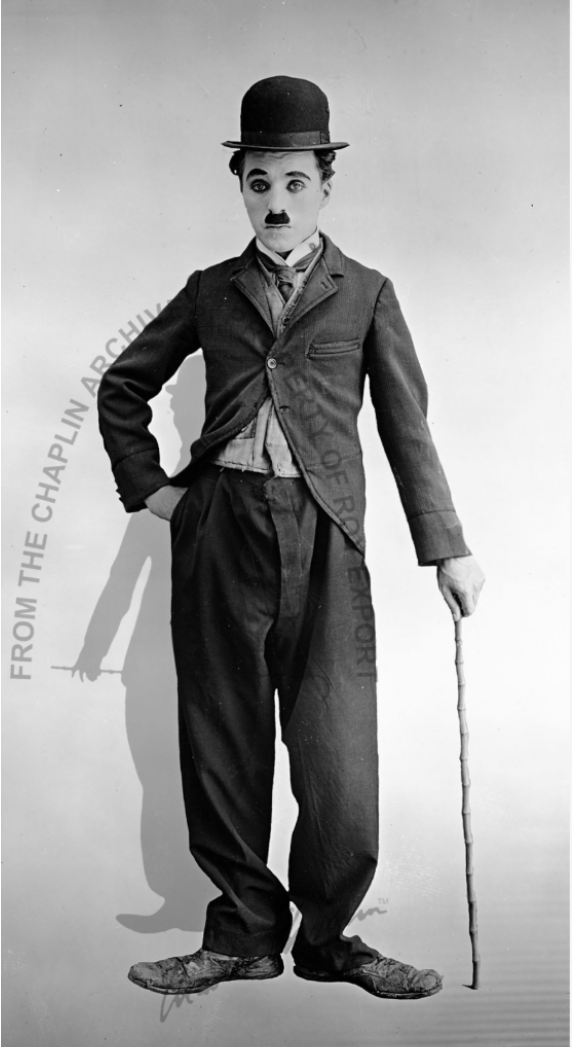
Charlie Chaplin as the Tramp, 1915 [7]
It was while getting his start in 1914 at Keystone Film Company that Chaplin’s famous look was born, for it was there that he “went to the Keystone wardrobe and quickly threw together what would become the most famous costume in film history: tight jacket, baggy pants, derby hat, trick cane, and toothbrush mustache (big enough to make him look older, but small enough not to hide his facial expressions).” [8]
He described his character this way: “You know, this fellow is many-sided, a tramp, a gentleman, a poet, a dreamer, a lonely fellow, always hopeful of romance and adventure. He would have you believe he is a scientist, a musician, a duke, a polo-player. However, he is not above picking up cigarette-butts or robbing a baby of its candy. And, of course, if the occasion warrants it, he will kick a lady in the rear–but only in extreme anger!” [9]
I’m guessing that, when Frank and Nora Traughber learned of Chaplin’s plan to build a studio across from their house, they had to wonder what it was going to mean for their previously quiet, peaceful neighborhood. According to what I read online, many families living on North La Brea opposed the construction, arguing that a film studio was unsuitable for a residential neighborhood so close to Hollywood High School. However, the proposed studio was approved. I have no idea whether Frank and Nora Traughber were among those who fought this decision, but what I do know is that they had a front row view to what happened next.
Over the coming months, Chaplin’s studio at 1416 N. La Brea Avenue began to take shape. It was designed in a charming English cottage/Tudor style, featuring whitewashed walls, peaked roofs, and rustic gardens, with a false front that ran along La Brea Avenue to make the buildings look like an “Olde English Village.” The complex included a main studio building, two large open-air stages, dressing rooms, a garage, a carpenter’s shop, a scene dock, and a film vault, as well as a pool and tennis courts.
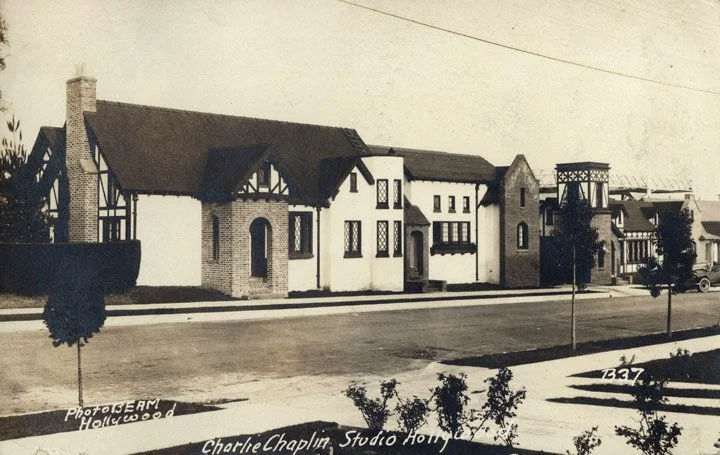
Charlie Chaplin Studio Hollywood, 1922 Postcard [10]
In 1918, soon after completing his studio, Chaplin made a film titled How to Make Movies (13:24) that provides an inside look at his studio. The film opens with the camera panning over the surrounding area, covered in orange and lemon groves, from the corner of La Brea Avenue and De Longpre. Chaplin stands with his back to the camera, looking at the trees. Then, poof, a genie appears, along with the words, “A Dream comes true. His Own Studio.” [11]
As I read online, “[Chaplin’s] cameraman Roland Totheroh had recorded the construction of the studio, filming at intervals from the same position so that the film could subsequently be assembled to give an illusion of speeded-up action. Chaplin had the idea of combining this material with documentary shots of the studio at work, to make a film to be called How to Make Movies. It was never finished or released, presumably because the distributors, First National, did not think that such a casual documentary of this kind would be an adequate replacement for one of the comedies with which Chaplin was contracted to supply them. Although Chaplin used some of the material in The Chaplin Revue in 1959, it was not seen in its entirety until 1982, when Kevin Brownlow and David Gill edited the whole film together as originally intended, following the continuity provided by a surviving title list.” [12]
Besides his studio, Chaplin took on another major enterprise in February 1919: he, along with three of the other biggest stars of the day – Mary Pickford, Douglas Fairbanks, and filmmaker D.W. Griffith – banded together to form United Artists. Seen as “an unprecedented declaration of independence by Hollywood’s top talent … rooted in artistic idealism,” the partners “hoped the new enterprise would guarantee them both artistic control and improved profits.” [13]
A comparison of the following historic photos shows clearly how much Hollywood grew in the ensuing years – and Frank and Nora Traughber’s house is visible (barely) in each. In both, La Brea Avenue is the road running northwest from the bottom, middle right. De Longpre crosses it at the bottom, then Sunset Blvd. crosses it further north, right before La Brea starts to bend a bit to the left.
Frank and Nora’s house appears on the corner in the bottom middle, with a row of trees directly across the street. Chaplin’s studio sits across the street to the northeast, stretching the full block between De Longpre and Sunset Blvd. In the upper right corner, you can see Hollywood High School (which I will write more about in my next post). That’s Hollywood Blvd. at the very top of the photo, running parallel to Sunset Blvd. Grauman’s Chinese Theater would not be built there until 1926, and construction on Hollywood’s Walk of Fame would not begin until 1960.
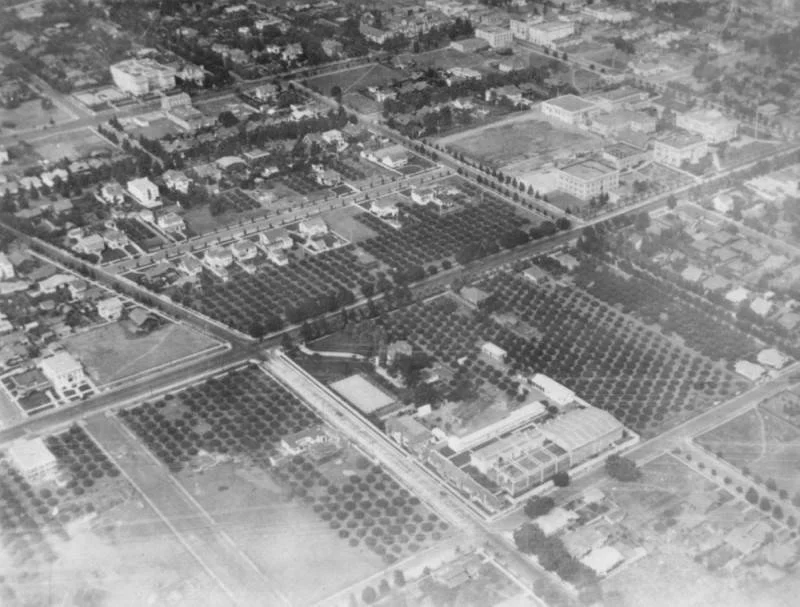
Aerial view of the Charlie Chaplin Studios in 1919 [14]
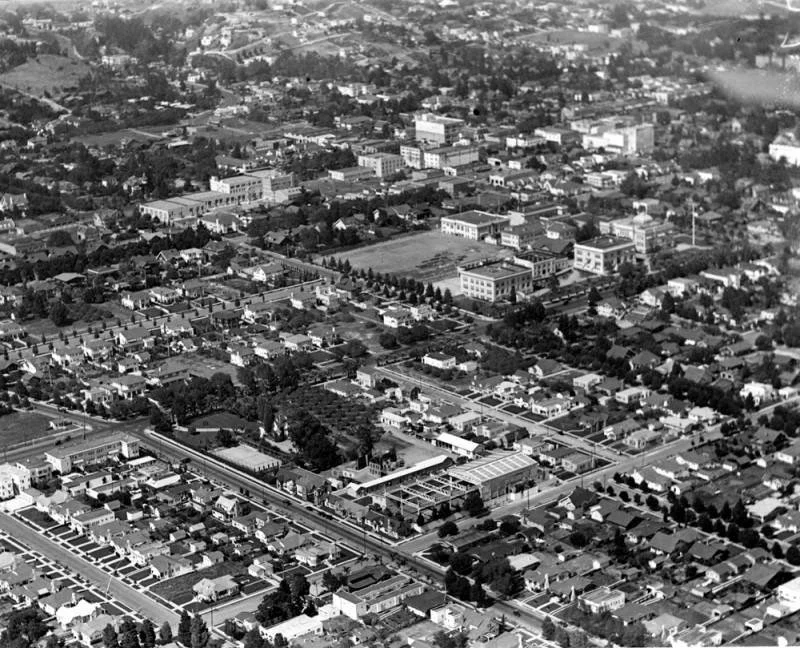
Aerial view of the Charlie Chaplin Studios in 1922 [15]
Here is the caption that appears online with the 1922 photo: “The buildings on the front street are administrative offices, fashioned after the pattern of English cottages. The stages are visible at lower right with dressing rooms for the players across the lawn in the long white building that runs through the center. To the left, the tennis court and grounds are visible, surrounding Chaplin's former residence. This view is looking northeast towards Hollywood High School.” [16]
Those are the same tennis courts my grandma said she and her brothers snuck in to play on! I don’t know if they ever tried to sneak a swim in the pool. I wonder if they ever got caught? They must have tried to sneak peeks at some of the famous people who came to visit the studio! In the photo below, Margaret is standing in front of her house with her brother William, sometime in the 1920s, beside one of the palm trees that used to grow there, with Charlie Chaplin’s studio in the background.
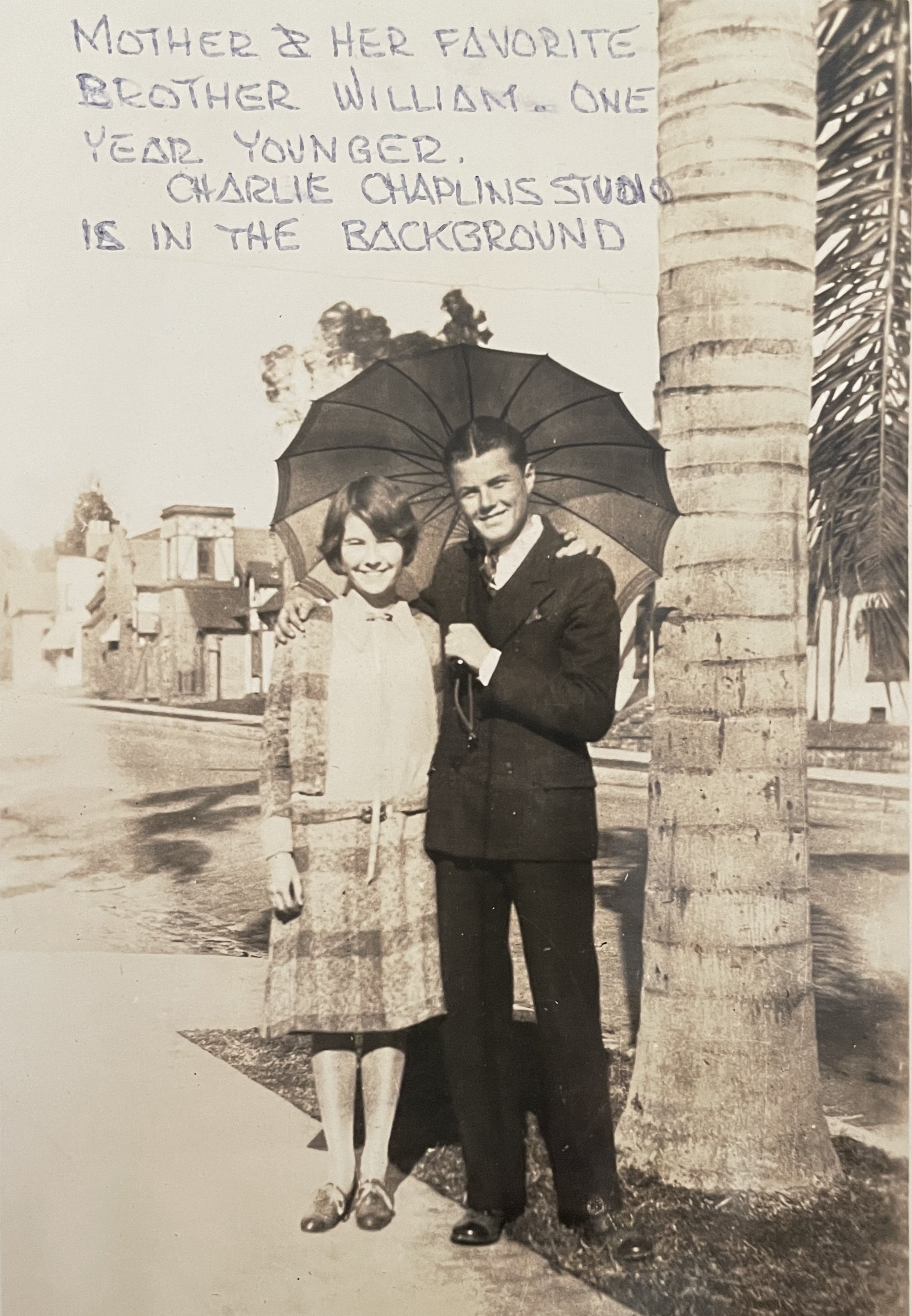
My father wrote this caption: “Mother (Margaret Ruth Traughber) and her favorite brother William - one year younger. Charlie Chaplin’s Studio in the background.” Traughber Family Collection.
My aunt Donna, Margaret’s daughter and my father’s sister, says she remembers her mother showing her a box of old movie star photos signed “To Margaret.” Neither of us, unfortunately, knows what happened to that box — a very sad loss. Margaret must have met many stars, though, over the years. She sometimes helped her father, Dr. Traughber, as his nurse, and he had many patients who were movie stars.
Margaret’s brother Frank worked for Charlie Chaplin when he was young. My father had heard that he was his “fill-in chauffeur,” which is all we knew — until I learned TODAY of the existence of a letter Frank wrote that detailed his work for Chaplin. (Thanks SO MUCH to the friend who made this discovery for me!) Two different auctions sites hosted sales tied to Frank’s letter and his Chaplin mementos: one was selling a photo signed to Frank by Chaplin; the other, a photo and a hand-drawn portrait.
In his letter, written Nov. 29, 1973, Frank says he worked as an “office boy at the studio” from 1919-1920, when he was 13. As he recalls, “Many nights I waited outside your dressing room talking to Toraichi Kono, your chauffeur, awaiting your arrival. After a greeting, I raced you in your LOCOMOBILE for about a half a block south on La Brea, you won.”
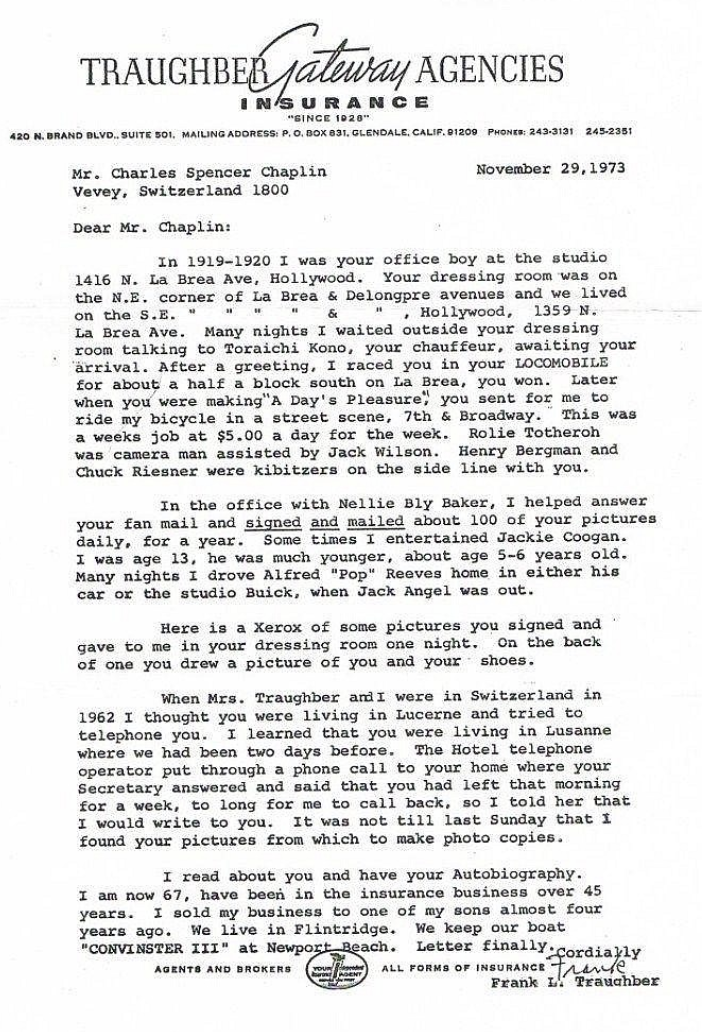
This is the letter Frank Traughber wrote to Charlie Chaplin in 1973, as posted on the Invaluable website [17]
Later, Frank says, Chaplin “sent for [him] to ride [his] bicycle in a street scene” in the film A Days Pleasure (1919), and he earned $5 a day for one week of work. Of course, after learning this, I watched the film to see if I could spot him, and I think this must be him, appearing at 15:15 (it’s the only scene involving a bicycle). Then, I think he appears in the background standing by a pole, wearing his dark pants, white shirt, and newsboy cap, watching as Chaplin fights two policemen while stuck in the tar, beginning at 18:55. What fun he must have had!
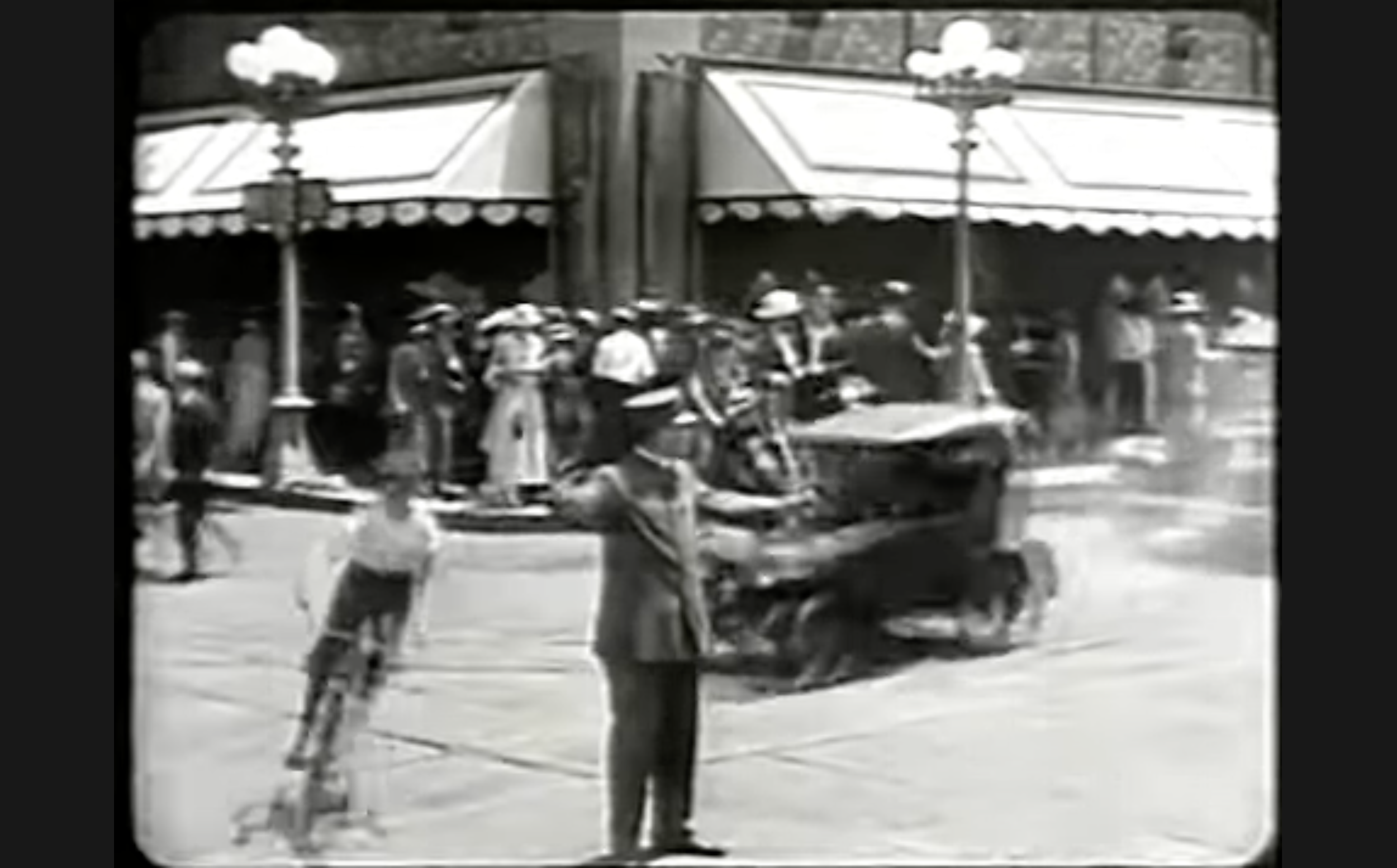
Frank Traughber appeared as an extra in Chaplin’s film A Day’s Pleasure (1919) [18]
He also wrote that, while working as an office boy, he “helped answer [Chaplin’s] fan mail and signed and mailed about 100 of [his] pictures daily, for a year.” He must have mastered Chaplin’s signature! How many people think they have a “collectible photo” signed by Chaplin, and it was actually signed by 13-year-old Frank? I also loved this tidbit: “Sometimes I entertained Jackie Coogan [who starred in The Kid]. I was age 13, he was much younger, about 5-6 years old.” That’s the same age Frank’s brother Robert would have been. I wonder if he introduced Jackie and Robert? Koogan later starred in many other movies that I haven’t seen, but I definitely remember him as Uncle Fester in the original Addams Family TV show!
Frank mentions signing pictures for others, but he got at least two special photos of his own — as well as some hand-drawn sketches. Along with his letter in 1973, he sent xerox copies of these photos to Chaplin, and someone must have later reached out to him (or to the family after he died in 1996) to see if he wanted to sell these items. Below you can see one of the photos, which appeared on the Invaluable auction site and was apparently sold in 2013.
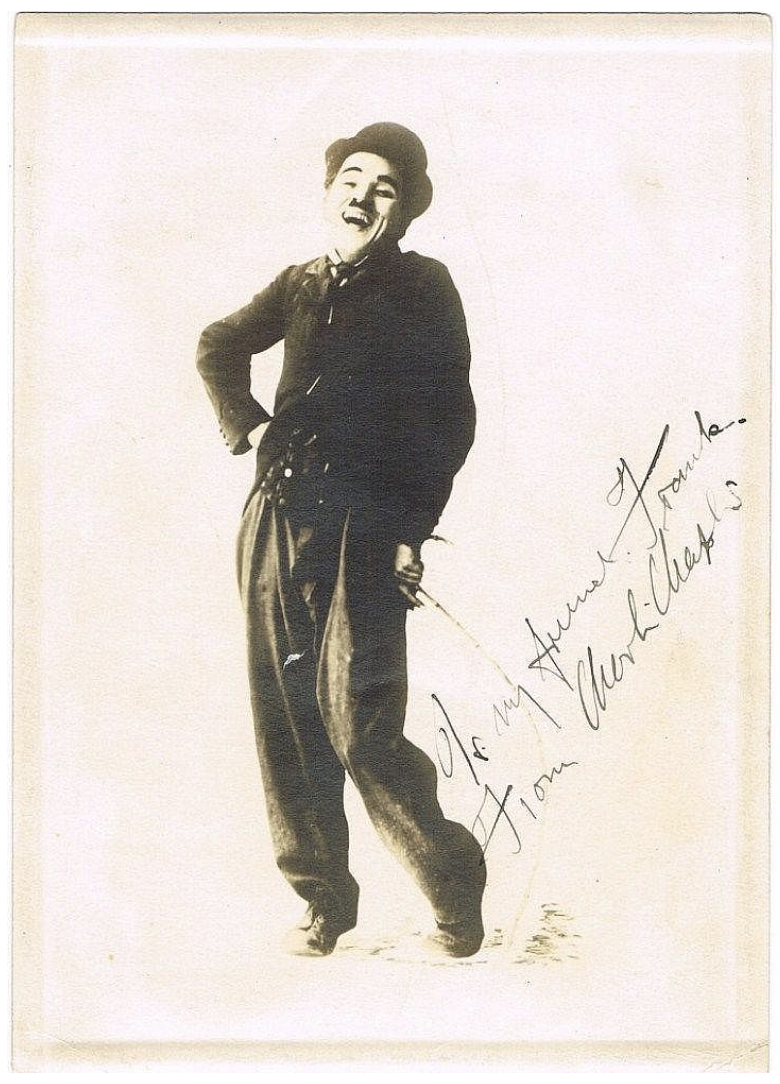
Caption: “To my friend Frank. From Charlie Chaplin.” [19]
The other auction items, which appeared on the Paul Fraser Collectibles website (date unknown), were even more incredible: a signed photo, as well as a signed self-portrait sketch by Chaplin, with images of Chaplin as the Tramp and Chaplin’s famous shoes. When I told my dad about this auction item, he was ready to buy it! Unfortunately, it turned out it had already been sold. Boo.
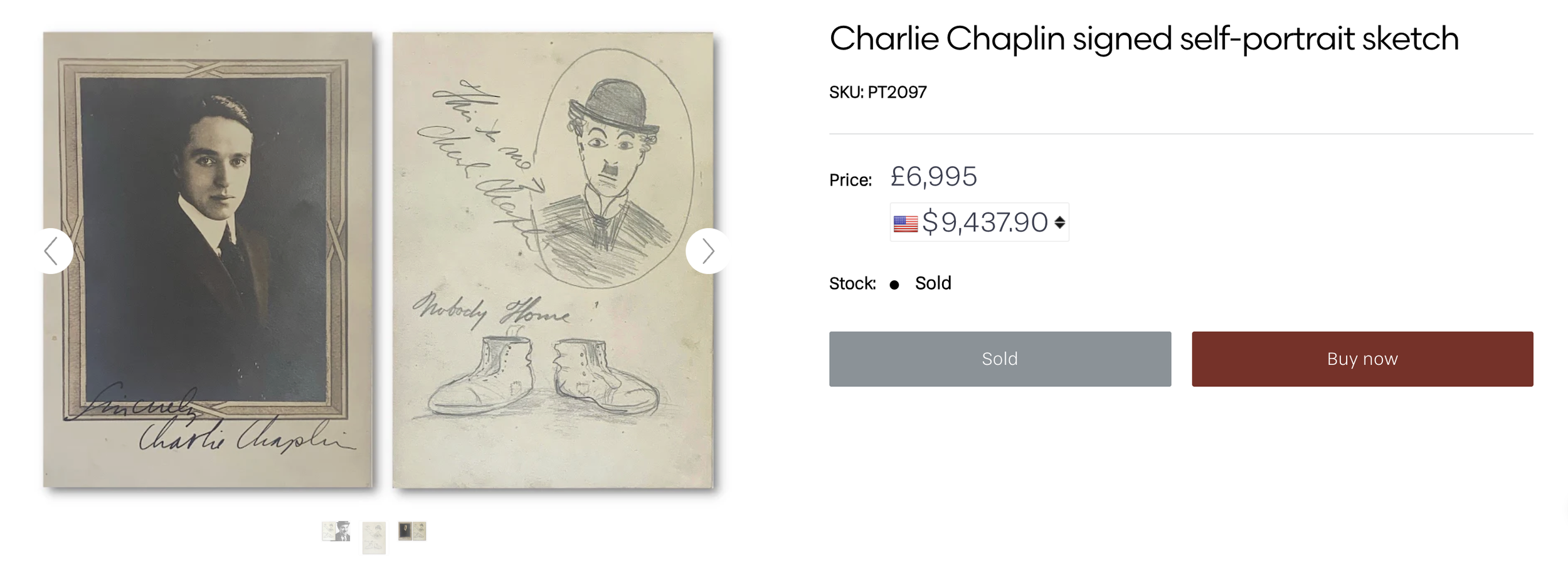
Captions: “Sincerely, Charlie Chaplin” and “This is me —> Charlie Chaplin / Nobody home.” [20]
I don’t know whether Frank ever worked for Chaplin in his later years, but here is in a family photo of Frank from sometime in the 1920s, showing off his old Ford.
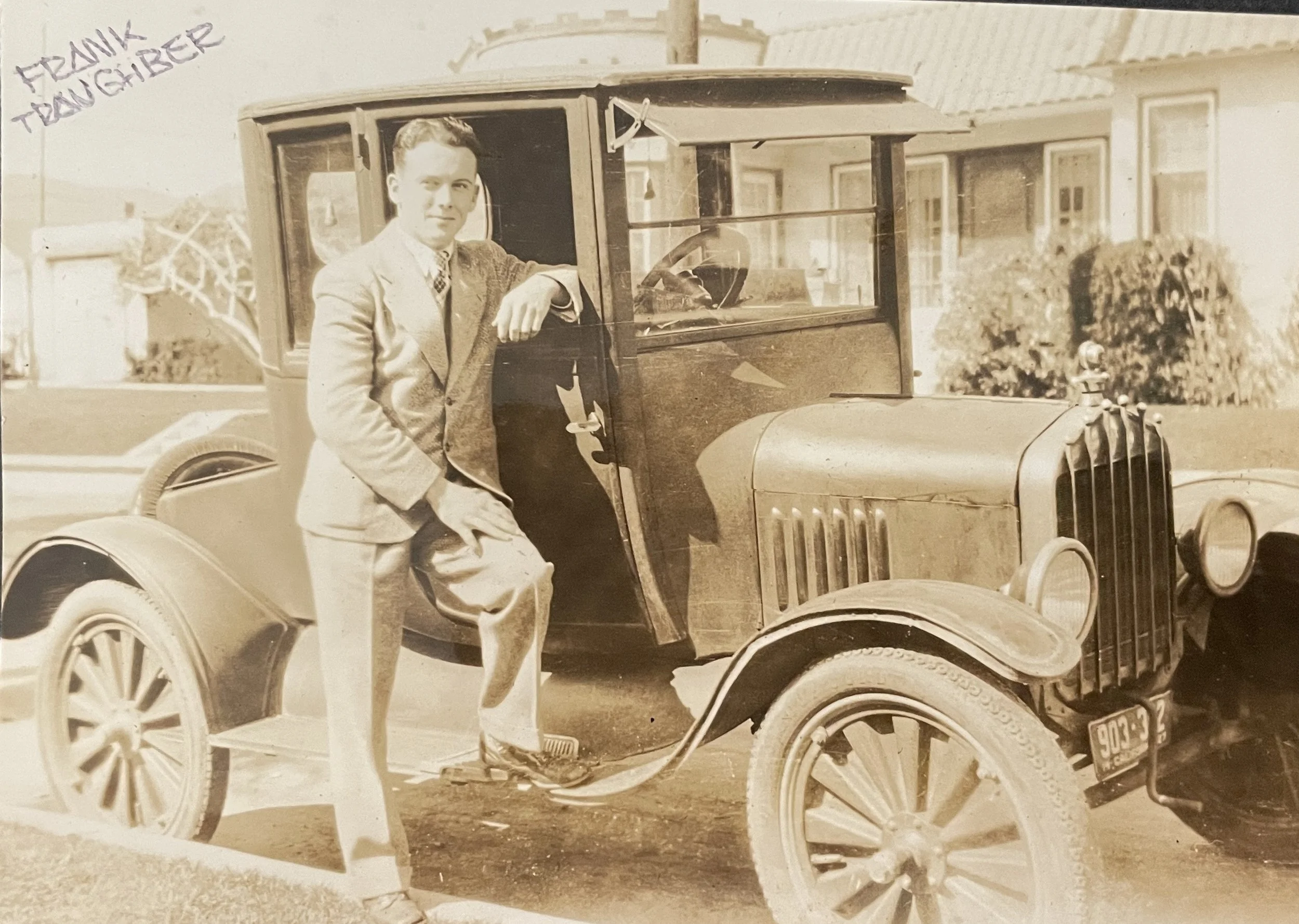
Frank Traughber with his Ford, c. early 1920s. Traughber Family Collection.
Chaplin produced more than 30 movies at his studio between 1918-1952, including classics such as The Kid (1921), The Gold Rush (1925), Modern Times (1936), and The Great Dictator (1939). I have not watched all of them, but I just watched The Kid (in which Jackie Coogan appears) and really enjoyed it. Most of his movies, it seems, are available to watch for free on Youtube. While writing this blog, I watched Chaplin’s famous speech at the end of The Great Dictator for the first time, and I definitely think it is worth taking the time to watch. Sadly, the speech still seems all too relevant today.
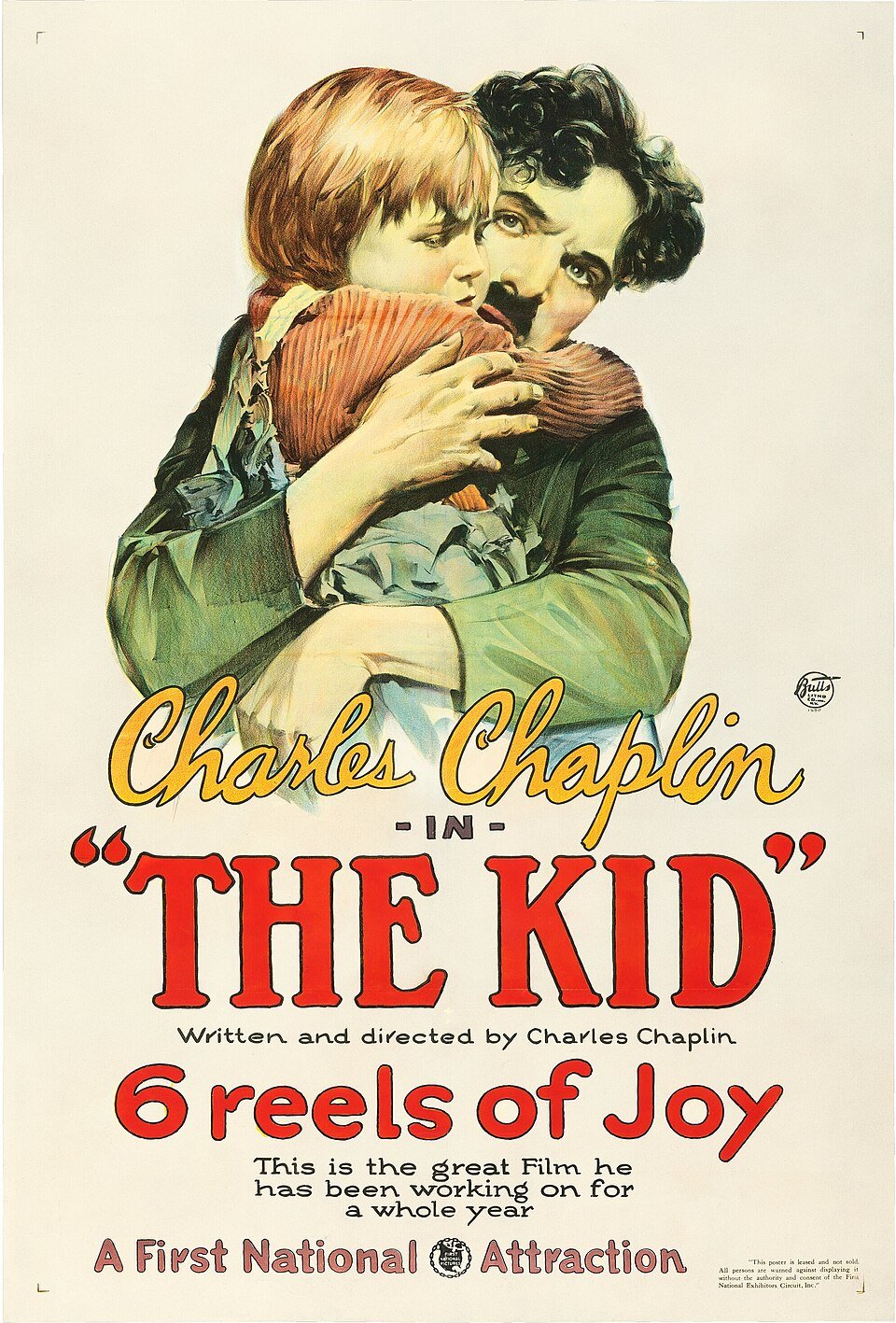
Movie poster for The Kid (1921), describing it as “the great film he has been working on for a whole year” [21]
Chaplin, a British citizen, sold his studio in 1953 after being forced out of the United States in September 1952 when the U.S. government revoked his re-entry permit. At the time, he was traveling with his wife and children to London for the premiere of his film Limelight. Chaplin was targeted during the McCarthy-era Red Scare due to his liberal political views, his alleged communist sympathies, and his “scandalous” personal life. He was barred from returning to the U.S., despite having lived here for nearly 40 years.
It was his fourth wife, Oona O’Neill Chaplin, the daughter of famous playwright Eugene O'Neill, that returned to the U.S. to pack up their home, as well as his life’s work at the studio, and to transfer Chaplin’s assets to European bank accounts. The couple had married in June 1943 when she was 18 and he was 54. They went on to have eight children together, including the actress Geraldine Chaplin, who played “Tonya” in the 1965 movie Dr. Zhivago (which is where my parents got my name).
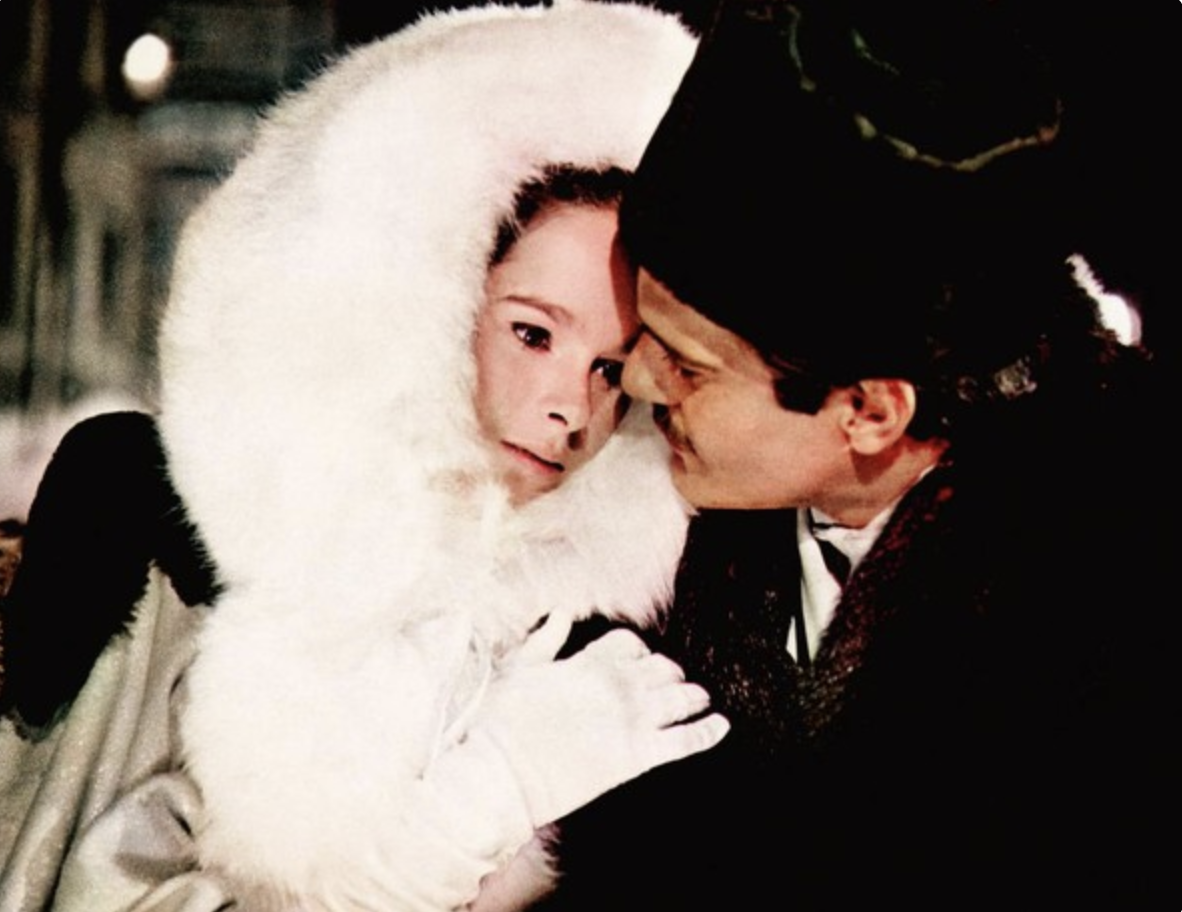
Charlie Chaplin’s daughter, Geraldine Chaplin, appeared with Omar Shariff in the 1965 film Dr. Zhivago. [22]
In early January 1953, the Chaplins moved to their new home, a 35-acre estate in the rural village of Corsier-sur-Vevey in Switzerland. There, Chaplin created a special film vault to store his work, and which is now the main source for all of Chaplin's copyrighted films. [23]
Chaplin only returned once to the U.S., and that was to receive an honorary Academy Award at the 44th Academy Awards on April 10, 1972. Chaplin had feared returning, worried that people might have forgotten his work or view him negatively, but his wife Oona convinced him to go. “When he received the Oscar that night, he had Oona by his side, like she was from the start of their marriage … it was Oona that made it possible for him to be there that night. Oona gave him strength, where his was failing.” [24]
Academy President Daniel Taradash gave the opening remarks (which are definitely worth listening to). As he said, “‘Humor heightens our sense of survival and preserves our sanity.’ These are the words of Charlie Chaplin. So are these, written over thirty years ago: ‘We think too much and feel too little. More than machinery, we need humanity. More than cleverness, we need kindness and gentleness. Without these qualities, life will be violent, and all will be lost.’ [from Chaplin’s speech at the end of The Great Dictator]
“Humor and humanity: the abiding elements of Chaplin’s artistic conscience and his unparalleled talent as actor, writer, director, producer, composer, and – to quote W.C. Fields – ‘the greatest ballet dancer that ever lived.’ Chaplin made more people laugh than anyone in history, yet always, just beneath the hilarity, were the fears and sorrows of every man…. The inscription [on the award] reads, ‘To Charles Chaplin, for the incalculable effect he has had in making motion pictures the art form of the century.’... Anyone who has ever even seen a movie is in his debt.” [25]
He then invited Chaplin to the stage. The crowd gave him a 12-minute standing ovation – the longest in Academy Awards history.
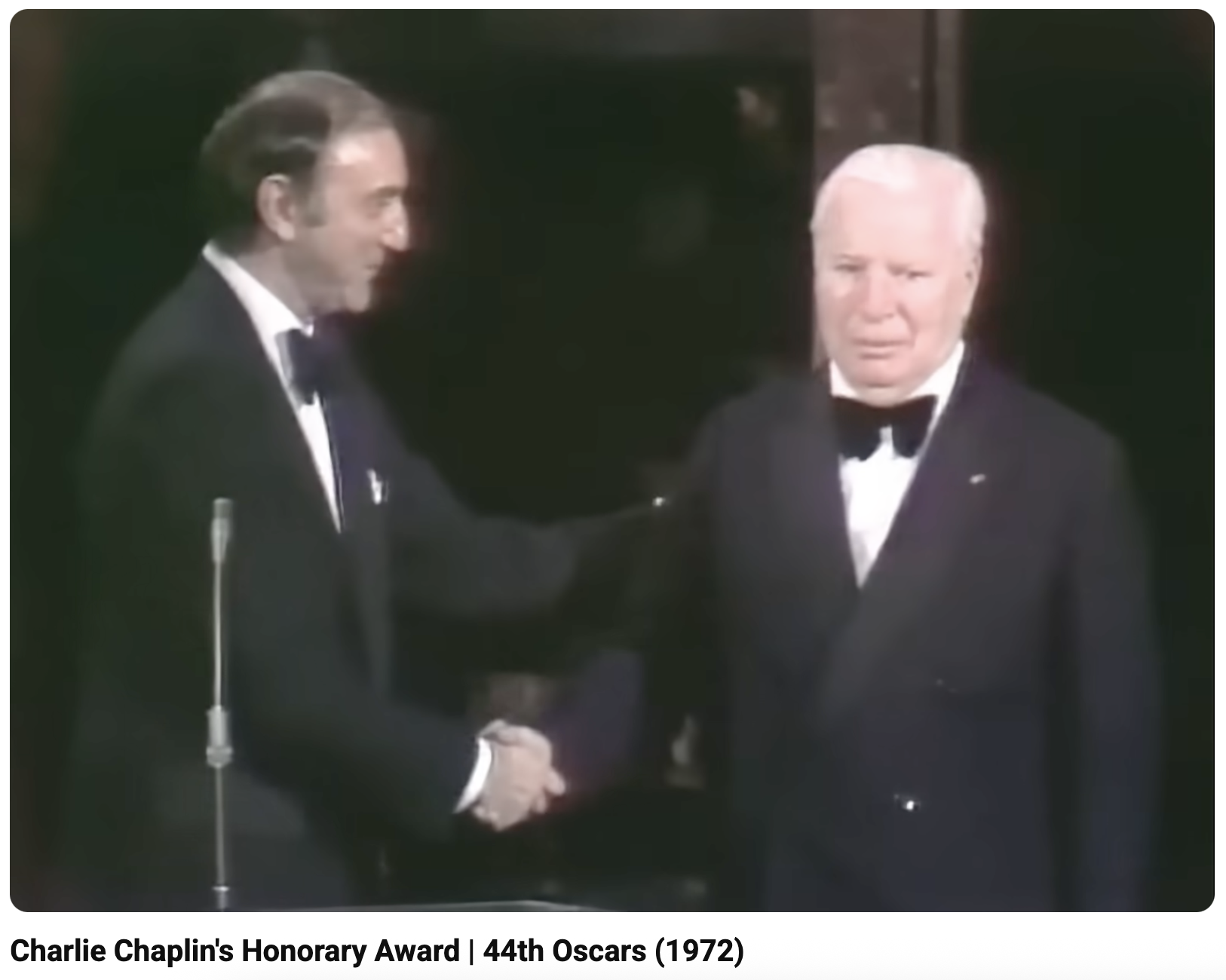
This is a screenshot I took from the Youtube video mentioned above, showing Academy President Daniel Taradash presenting Charlie Chaplin with his honorary Academy Award.
“The U.S. trip was a very emotional trip for both. So emotional for Chaplin, he couldn't bear to walk on his old Chaplin Film Studio grounds again. He went to the studio on a Sunday and stopped by the original gate entry. He looked in from the gates, but the memories must have been many. All his wives and his first close love, Edna, were all there in the 34 years he worked there, but that time was gone. All that was left was the building and memories he created on film. That was the last time Chaplin saw his studio.” [26]
Chaplin died in Corsier-sur-Vevey, Switzerland, in 1977 at the age of 88. Both he and Oona, who died in 1991, are buried there in the village cemetery. It is also there that, in 2016, “Chaplin’s World” opened. Set on the Manoir de Ban estate where the Chaplins lived, Chaplin's World is “an interactive museum showcasing the life and works of Charlie Chaplin,” and is described by son Michael Chaplin as "a museum in movement … not static. It is like the character to whom it pays tribute.” [27]
That museum is the only museum in the world devoted to Charlie Chaplin. There is no such museum in the United States. But, guess what? I know the perfect place for such a museum. Wouldn’t it be cool if someone with the money to do it took on that project and converted the old Traughber house at 1359 N. La Brea Avenue into a Charlie Chaplin Studio Museum? I already wrote a letter suggesting just that to the studio’s new owners, singer John Mayer and filmmaker and producer McG (aka. Joseph McGinty Nichol), who just finalized their purchase of the studio last month and have decided to rename it Chaplin Studio.
I did make a very surprising discovery, though: while there is no stand-alone museum in the U.S. dedicated exclusively to Charlie Chaplin, the primary location for Chaplin history in the U.S. is the Niles Essanay Silent Film Museum in Fremont, California – a 36-minute drive from my house! Who knew? Guess where Mike and I are going soon? LOL.
As I read online: “The Niles Essanay Silent Film Museum is located in what is now the Niles district in the city of Fremont, California. The museum is housed in the Edison Theater building, a century-old Nickelodeon movie theater, just half a block from the former site of the Niles Essanay Studios, where Broncho Billy and Charlie Chaplin made films in the 1910s. It is dedicated to preserving and showing silent films and their history. The museum houses a large collection of Motion Picture equipment and related artifacts, as well as about 10,000 Silent Films in their archive.” [28]
But back to the Charlie Chaplin Studio. As stated in a January 2026 Billboard article announcing the purchase of the studio by Mayer and McG, “There’s plenty of history to mine at the 80,000-square-foot lot just south of the intersection of Sunset Boulevard and La Brea Avenue, starting with the silent-film legend in 1917 and continuing with episodes of The Red Skelton Show, The Adventures of Superman and Perry Mason in the 1950s and ’60s, before taking a major musical pivot in 1966 when Herb Alpert and Jerry Moss purchased the lot to become the headquarters of A&M Records. In the label’s newly created recording studios (A&M left one Chaplin-era soundstage untouched in their renovations, among other original buildings), the list of classic productions created there is mind-boggling, from Joni Mitchell’s Blue and Carole King’s Tapestry to the all-time greatest gathering of musical A-listers for the 1985 USA for Africa charity single ‘We Are the World.’ In 2000, Jim Henson’s children purchased the lot to be the new home of The Jim Henson Company, continuing the location’s longtime journey of TV and film production, as well as an active music recording space.” [29]
Wow! That’s a lot of amazing history. I know I would love to be able to visit a museum to learn more about that history and see some of the many mementos and artifacts that must exist from those various iterations of the studio.
In 1969, the Historical Charlie Chaplin Studio site was designated a Los Angeles Historic- Cultural Monument. For many years, while the studio served as the Jim Henson Company Lot, a statue of Kermit the Frog dressed as Chaplin's "The Tramp" stood at the entrance, as seen in the photo below.
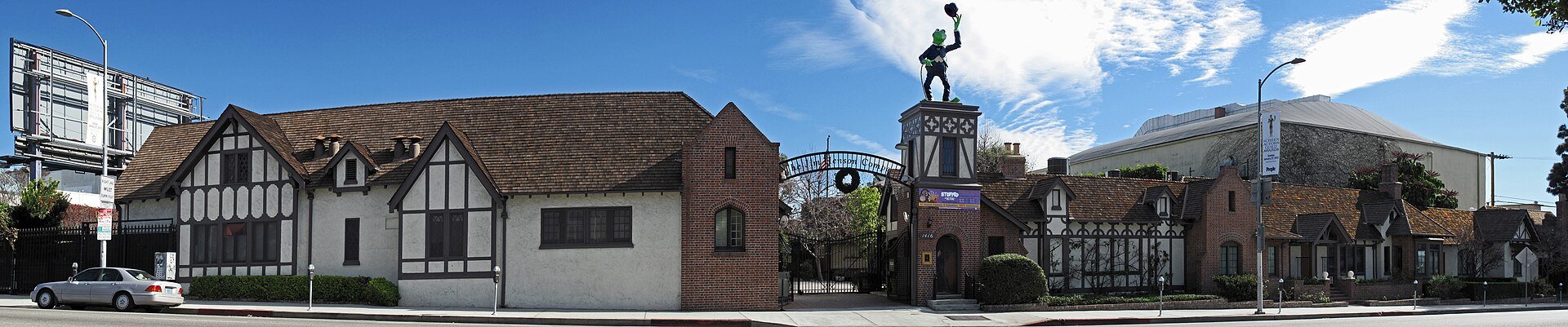
Photo of Jim Henson Company Lot, formerly Charlie Chapin Studio, with Kermit dressed as Chaplin’s The Tramp [30]
When I visited with my family in April 2014, we took our photo in front of the door near the entrance, where Charlie Chaplin’s image had been painted. The plaque declaring the studio “Historic-Cultural Monument No. 58” can be seen in the background.
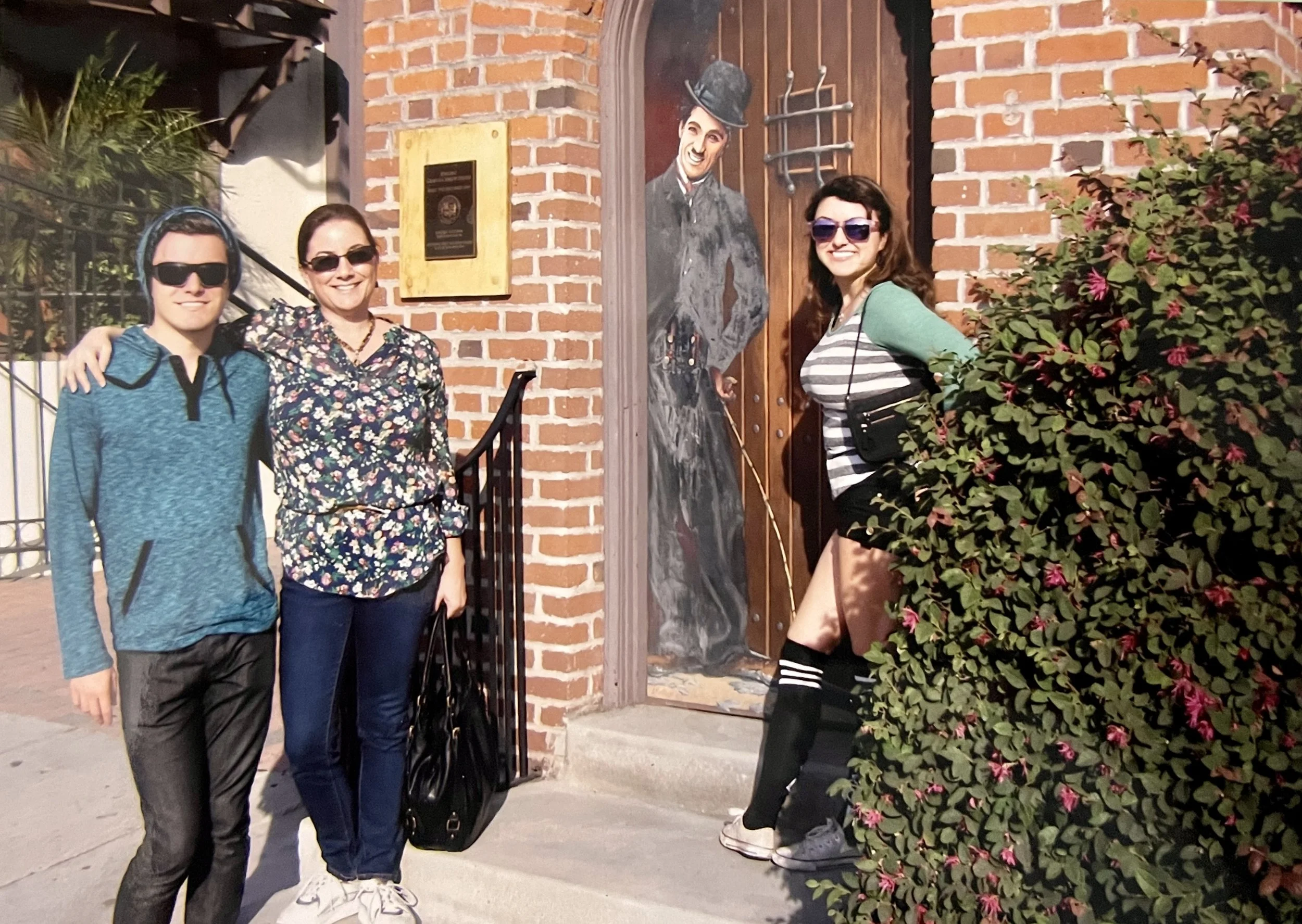
Here I am with my son Aaron and daughter Anna in front of Charlie Chaplin Studio in April 2014. Photo by Michael McQuade.
My husband and I were surprised to run into Charlie Chaplin again when we were touring the Ring of Kerry in Ireland. As it turns out, for many years starting in 1959, Chaplin and his family would vacation regularly in Waterville in County Kerry, and they later honored him with a large bronze statue. The statue is located along the promenade overlooking Ballinskelligs Bay, which is an inlet of the Atlantic Ocean.
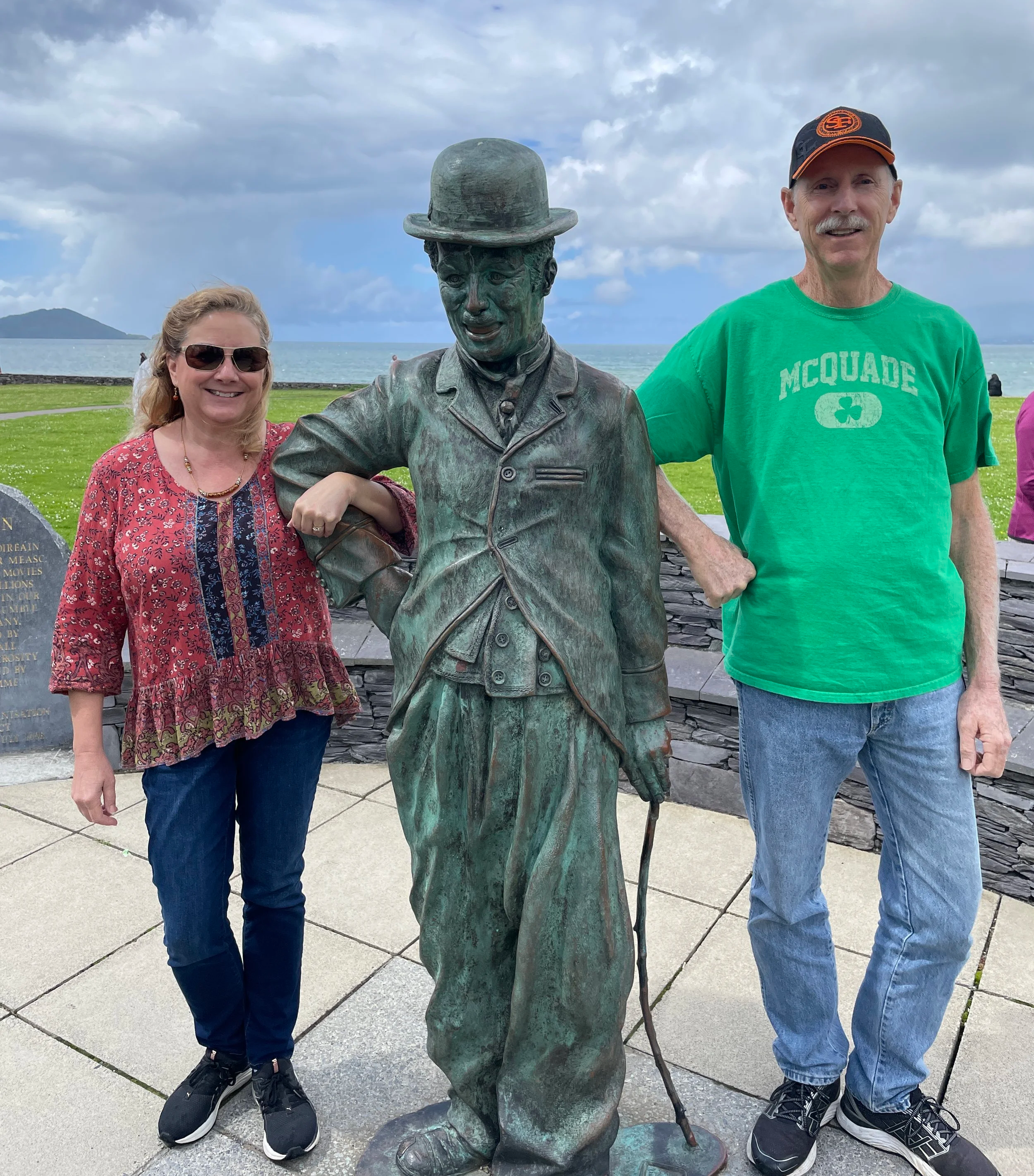
Here my husband and I stand with the Charlie Chaplin statue in Waterville, County Kerry, Ireland, in July 2023.
“Staying at the large Butler Arms Hotel in Waterville Chaplin brought his family to the Irish coastal town on vacation every year for over ten years beginning in 1959. Despite not being Irish, setting any of his films in Ireland, or ever portraying an Irish character, the actor became so beloved by the community during his brief stays, that they finally erected a permanent bronze statue of the man. The statue is even accompanied by a gushing plaque thanking Chaplin for his humble presence. In addition to the statue, the small town now holds a Chaplin film festival each year which has been endorsed by the Chaplin estate. Not a bad remembrance for years of vacations.” [31]
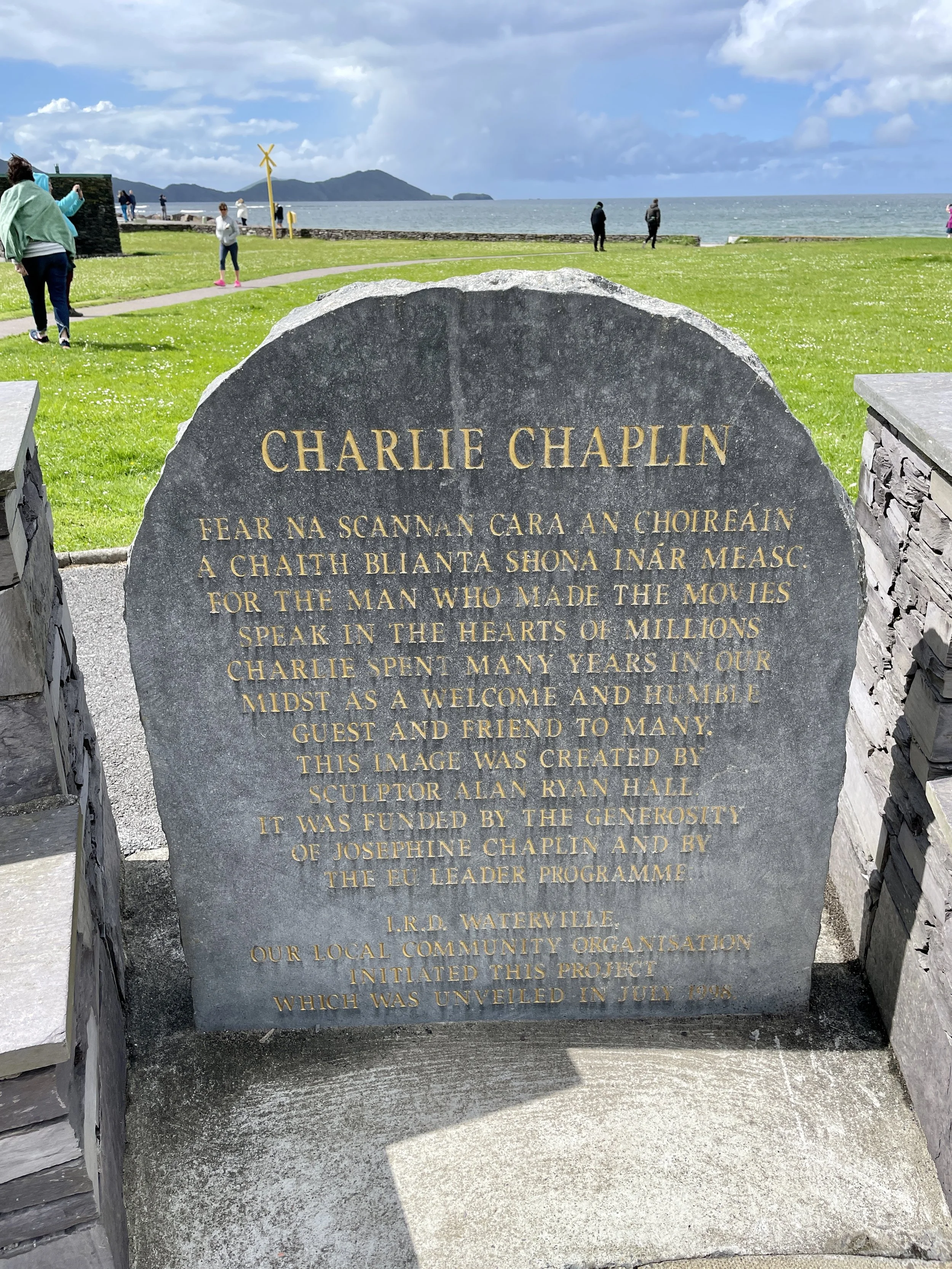
This stone commemorating Charlie Chaplin was erected in July 1998 by Waterville’s Local Community Organization. Photo by Tonya McQuade.
The inscription reads: “Charlie Chaplin / Fear na scannan cara an choireain a chaith blianta shona inar measc / For the man who made the movies speak in the hearts of millions / Charlie spent many years in our midst as a welcome and humble guest and friend to many. This image was created by the sculptor Alan Ryan Hall. It was funded by the generosity of Josephine Chaplin and by the EU Leader Programme.”
I came across four famous statements made by Charlie Chaplin, and they seem a great way to sum up his thought on the importance of resilience, finding joy, and healthy living:
"Nothing is forever in this world, not even our problems."
"I love walking in the rain because no one can see my tears.”
"The most lost day in life is the day we don't laugh."
"The six best doctors in the world: sun, rest, exercise, diet, self-respect, and friends.”
What great words to live by!
I love that John Mayer and McG announced last month (Jan. 5, 2026) that they have decided to rename the studio Chaplin Studios. An article in Deadline reports, “The property will continue to operate as a fully staffed, fully functioning production and recording facility — open immediately and actively booking projects across music, film, television, and digital media.” [32]
“This studio has stood at the center of Hollywood’s history for generations, and it’s a privilege to help shepherd it into its next chapter,” Mayer said in the interview with Deadline. “Beyond its film legacy, the musical history here is extraordinary — from the A&M years and being home to A&M Records to landmark albums recorded on this campus to ‘We Are the World’ being captured inside Studio A. The Chaplin lot has given the world some of its most enduring art, and our goal is to honor that legacy by keeping it working, open, and accessible to the creative community.” [33]
McG added, “You can feel the spirit of Hollywood’s past the moment you set foot on this lot. From Chaplin to Superman, to Soul Train, this place is a cornerstone of our industry’s history. John and I are committed to respecting that heritage while ensuring the studios remain a vibrant, fully operational home for filmmakers, musicians, and creators. We want artists to walk through these gates and immediately feel that spark of possibility.” [34]
The old Traughber house has also “stood at the center of Hollywood’s history for generations.” I would LOVE to see the house preserved, as would many other people (based on the comments I have read online). The house is now very dilapidated and would require a LOT of restoration work. Still, if the right person would come along …
I’ve sent my letters to John Mayer and McG. I have some other people I’m going to reach out to as well (and yes, Geraldine Chaplin is on my list!). If anyone reading this has any ideas as to who might be interested in taking on such a project, feel free to step in. This is not my project. Let’s see what we can do!
If you like this post, be sure to subscribe to future posts on my website, tonyagrahammcquade.com. And stay tuned for my next post, which will focus on Hollywood High School.
Endnotes:
Lesniak, Matthew. “1359 N. La Brea Ave - Facebook Post by Bíæ Cháo Bélla.” LOST ANGELES, Facebook, 5 Feb 2024, https://www.facebook.com/groups/lostmarket/posts/1621959955244726/.
“Los Angeles Historic.” Facebook, 2 Feb 2026, https://www.facebook.com/photo/?fbid=886300924044691&set=a.182261074448683&comment_id=4430744707154311¬if_id=1771480975316171¬if_t=feedback_reaction_generic&ref=notif
Ibid.
“History of Film - Film Art.” Wikipedia, https://en.wikipedia.org/wiki/History_of_film
“Charlie Chaplin’s First National Films (1917-1918) Review.” Great Books Guy, 5 Jul 2019, https://greatbooksguy.com/2019/07/05/charlie-chaplins-first-national-films/.
Sloan, Will. “The Only and Original: How Billy West nearly out-Chaplined Chaplin.” Partisan, 22 July 2015, https://www.partisanmagazine.com/blog/2015/6/5/the-only-and-original.
“Charlie Chaplin as The Tramp, 1915.” Charlie Chaplin Archive, https://www.charliechaplinarchive.org/en/collection/cerca/charles-chaplin-nei-panni-del-vagabondo-ecci00028796.
Ibid.
Ibid.
Charlie Chaplin Studio Hollywood.” Postcard, Wikipedia, 1922, https://en.wikipedia.org/wiki/Chaplin_Studios#/media/File:Chaplin_Studios_postcard.jpg.
“Charlie Chaplin - How to Make Movies.” Roy Export Company Limited, Youtube, 11 Sep 2018, https://www.youtube.com/watch?v=rZshz5rysgQ.
Ibid.
Studlar, Gaylyn. “Artists, United: The Radical Origin of a Film Corporation.” Washington University, Center for the Humanities, St. Louis, MO, 8 Apr 2019, https://humanities.wustl.edu/news/artists-united-radical-origin-film-corporation.
“Charlie Chaplin Studios, aerial view.” Calisphere, Los Angeles Public Library Photo Collection, Los Angeles Public Library, 1919, https://calisphere.org/item/c62c18a7fb8f0e9734a8c108c86b6496/.
“Charlie Chaplin Studios, aerial view.” Calisphere, Los Angeles Public Library Photo Collection, Los Angeles Public Library, 1922, https://calisphere.org/item/d76738fa62a76d109c11f887606a0e7c/.
Ibid.
17 - “Lot 31: Chaplin, Charlie: Autographed photograph, signed.” PFC Auctions, St. Peter Port, United Kingdom, 12 Dec 2013, Invaluable, https://www.invaluable.com/auction-lot/chaplin-charlie-autographed-photograph-signed-31-c-b7634f220a..
“A Day’s Pleasure (1921) - Charlie Chaplin’s Disastrous Family Trip.” Uploaded by Screen Prism, Youtube, 9 Oct 2024, https://www.youtube.com/watch?v=nxQGuDZHkVQ.
“Lot 31: Chaplin, Charlie: Autographed photograph, signed.” PFC Auctions, St. Peter Port, United Kingdom, 12 Dec 2013, Invaluable, https://www.invaluable.com/auction-lot/chaplin-charlie-autographed-photograph-signed-31-c-b7634f220a..
“Charlie Chaplin signed self-portrait sketch.” SKU: PT2097, Paul Fraser Collectibles, https://www.paulfrasercollectibles.com/products/charlie-chaplin-signed-self-portrait-sketch.
“Charlie Chaplin - The Kid (1921) movie poster.” First National, 1921, Wikipedia, https://en.wikipedia.org/wiki/The_Kid_(1921_film.
“Geraldine Chaplin Photos - 22/110.” Rotten Tomatoes, https://www.rottentomatoes.com/celebrity/geraldine_chaplin/pictures.
Wada, Linda. “Charlie Chaplin’s Wives - Oona (O’Neill) Chaplin.” Edna Purviance: Welcome to Paradise, WadaWorks, 2016, https://www.ednapurviance.org/chaplininfo/chaplinwives.html.
Ibid.
“Charlie Chaplin's Honorary Award | 44th Oscars (1972).” Youtube, 19 Feb 2008, https://www.youtube.com/watch?v=J3Pl-qvA1X8.
Wada, Linda. “Charlie Chaplin’s Wives - Oona (O’Neill) Chaplin.” Edna Purviance: Welcome to Paradise, WadaWorks, 2016, https://www.ednapurviance.org/chaplininfo/chaplinwives.html.
Poullain-Majchrzak, Ania. “Chaplin’s World museum opens its doors in Switzerland.” Reuters, 18 Apr 2016, https://www.reuters.com/article/lifestyle/chaplins-world-museum-opens-its-doors-in-switzerland-idUSKCN0XF212/.
“Niles Essanay Silent Film Museum.” Wikipedia, 8 Dec 2025, https://en.wikipedia.org/wiki/Niles_Essanay_Silent_Film_Museum.
Atkinson, Katie. “John Mayer & McG Talk Rebranding Chaplin Studios, But Knowing What to Leave Untouched: ‘There’s Just Something About Tapestries & String Lights That Make People Want to Write Songs’: The musician-director duo discuss the "arranged marriage" that brought them together as co-owners of the historic former Henson/A&M lot.” Billboard, 5 Jan 2026, https://www.billboard.com/music/music-news/john-mayer-interview-chaplin-studios-mcg-new-music-1236148690/.
“A&M Record Studio (Original Charlie Chaplin Studio), now home of the Jim Henson Company - 1416 N La Brea Ave, Los Angeles.” Uploaded by Downtowngal, Wikipedia Commons, 27 Dec 2012, https://commons.wikimedia.org/wiki/File:1416_N_La_Brea_Ave,_Los_Angeles.jpg
“Charlie Chaplin's Vacation Statue.” Atlas Obscura, https://www.atlasobscura.com/places/charlie-chaplin-s-vacation-statue.
Tapp, Tom, and Anthony D’Alessandro. “John Mayer And McG Finalize Purchase Of Jim Henson Lot, Rename It Chaplin Studios.” Deadline, 5 Jan 2026, https://deadline.com/2026/01/john-mayer-mcg-final-purchase-henson-chaplin-studios-1236664794/.
Ibid.
Ibid.