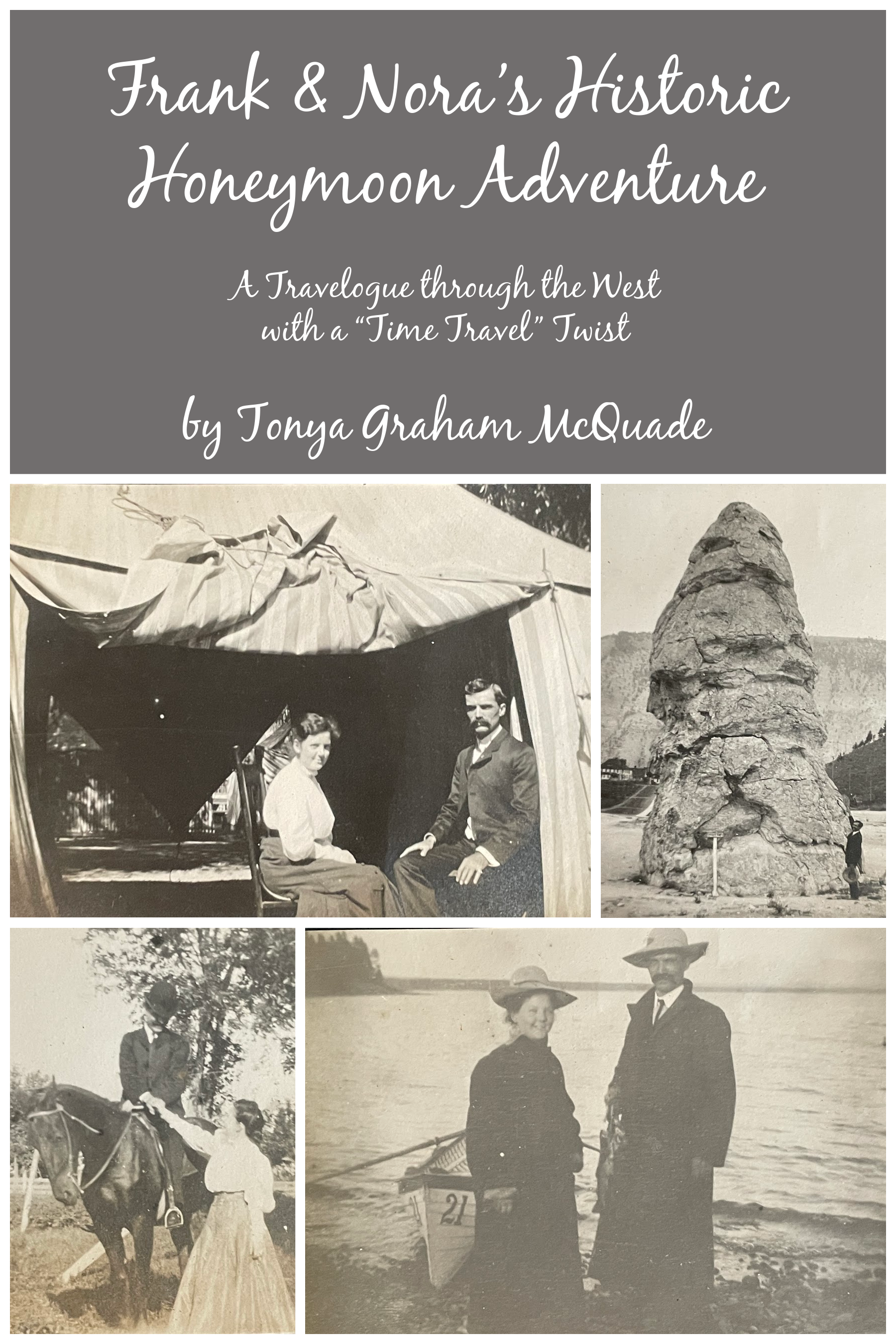
A Tour of the Hotel Del Monte in Monterey - the Starting Point for Frank and Nora’s Historic Honeymoon Adventure
Chasing History: Exploring My Ancestral Roots - Post #66
by Tonya Graham McQuade
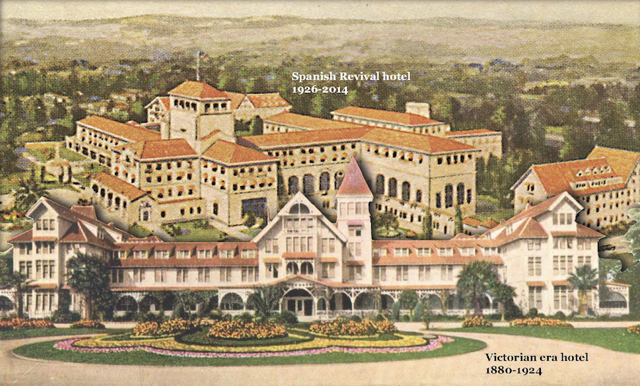
This images shows both the Victorian era Hotel Del Monte as it appeared in 1905 when Frank and Nora visited, as well as the Spanish Revival version that was built after the 1924 fire.
So, this weekend I got to do something that made me really happy: I was able to tour the Hotel Del Monte in Monterey. Why was this such a big deal, you ask? Well, that was the starting point for my great grandparents’ amazing four-week, 4,500 mile honeymoon about which I recently wrote a book, and – despite being touted at the time as one of the most luxurious hotels in the world – it now serves as the Naval Postgraduate School (NPS) and is no longer open to the public.
How, then, did I get to tour the hotel? For that, I have Laurent to thank. I attended the “Seldom Heard History” Civil War Conference in Monterey this past weekend, and the organizer, David Woodbury, said I could set up a book table. I told him about my new book and how a lot of it related to Monterey and the surrounding area. I also mentioned that I really wanted to tour the Hotel Del Monte and asked if he had any “Navy connections” since that is the only way you can get in. He introduced me to his friend Laurent from San Diego, who was attending the conference, and voilà! I got my tour during our lunch break on Saturday!
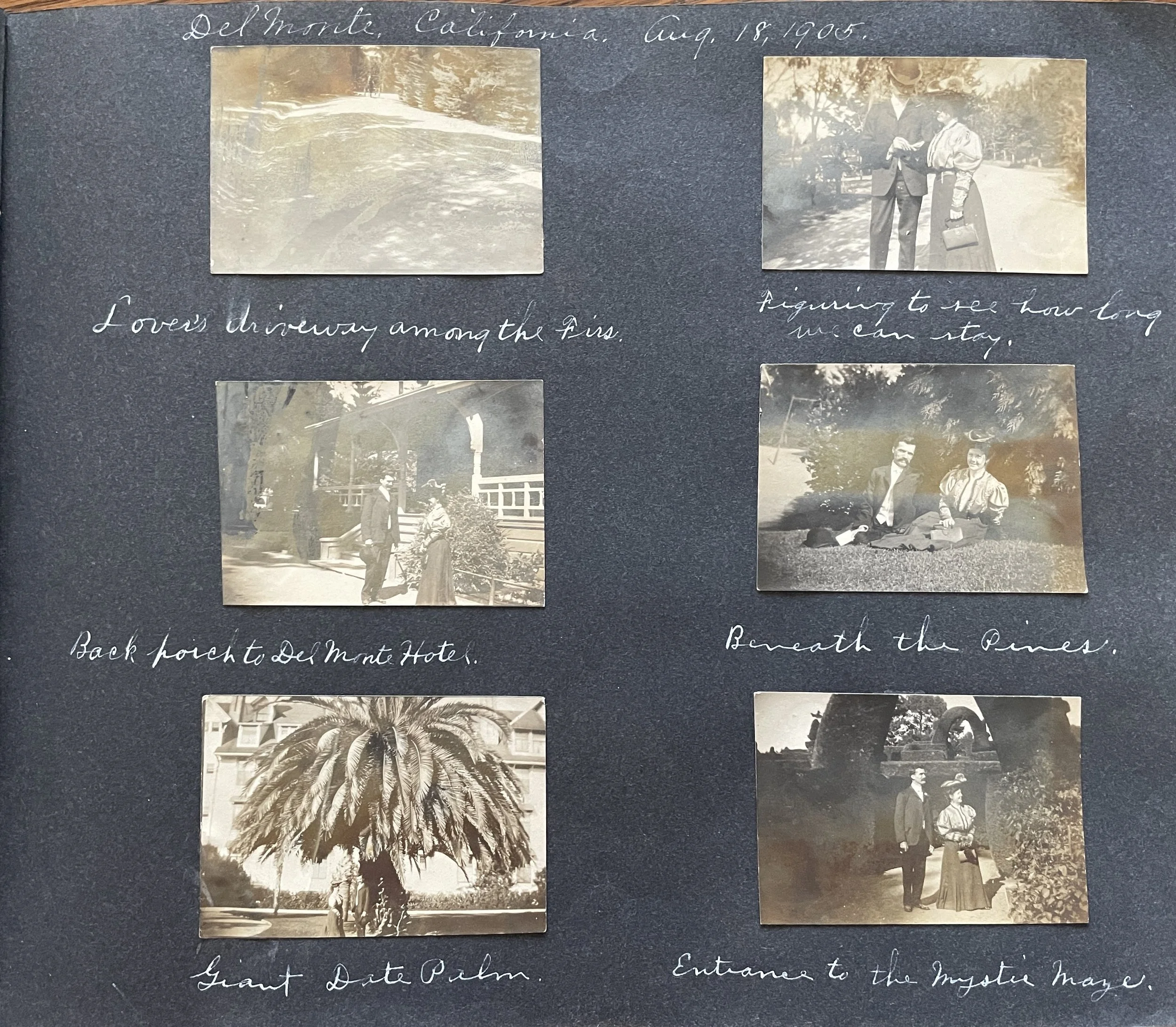
This shows the first page in Frank and Nora’s album, with photos and captions from their first day at Hotel Del Monte on August 18, 1905, the day after they were married in San Jose.
The “Frank and Nora” of my book are my great grandparents, William Francis Traughber and Nora Petree Traughber, who were married on August 17, 1905, in San Jose. After their wedding, they set out on the “historic honeymoon adventure” I describe in my book, which took them to such iconic places as Catalina, pre-earthquake San Francisco, Portland’s “Lewis and Clark Centennial” World’s Fair, and Yellowstone National Park, with their first stop being the Hotel Del Monte. I share many of their 1905 photos in my book. I wrote about the Hotel Del Monte in this previous blog post back in September 2024, so I won’t write a lot about its history in this post. Here, I will share photos – and some descriptions – from my recent tour.
From our conference at the Stanton Center near Fisherman’s Wharf in Monterey, it was a quick drive down Del Monte Avenue to get to the Naval Postgraduate School. Frank and Nora would have arrived by carriage after disembarking from the train at Del Monte Station. That station is now a parking lot across from the school, but the old Monterey Station closer to the wharf still exists. Now, though, it serves as Dust Bowl Brew House (where I had dinner and drinks with a couple other conference attendees later that day).
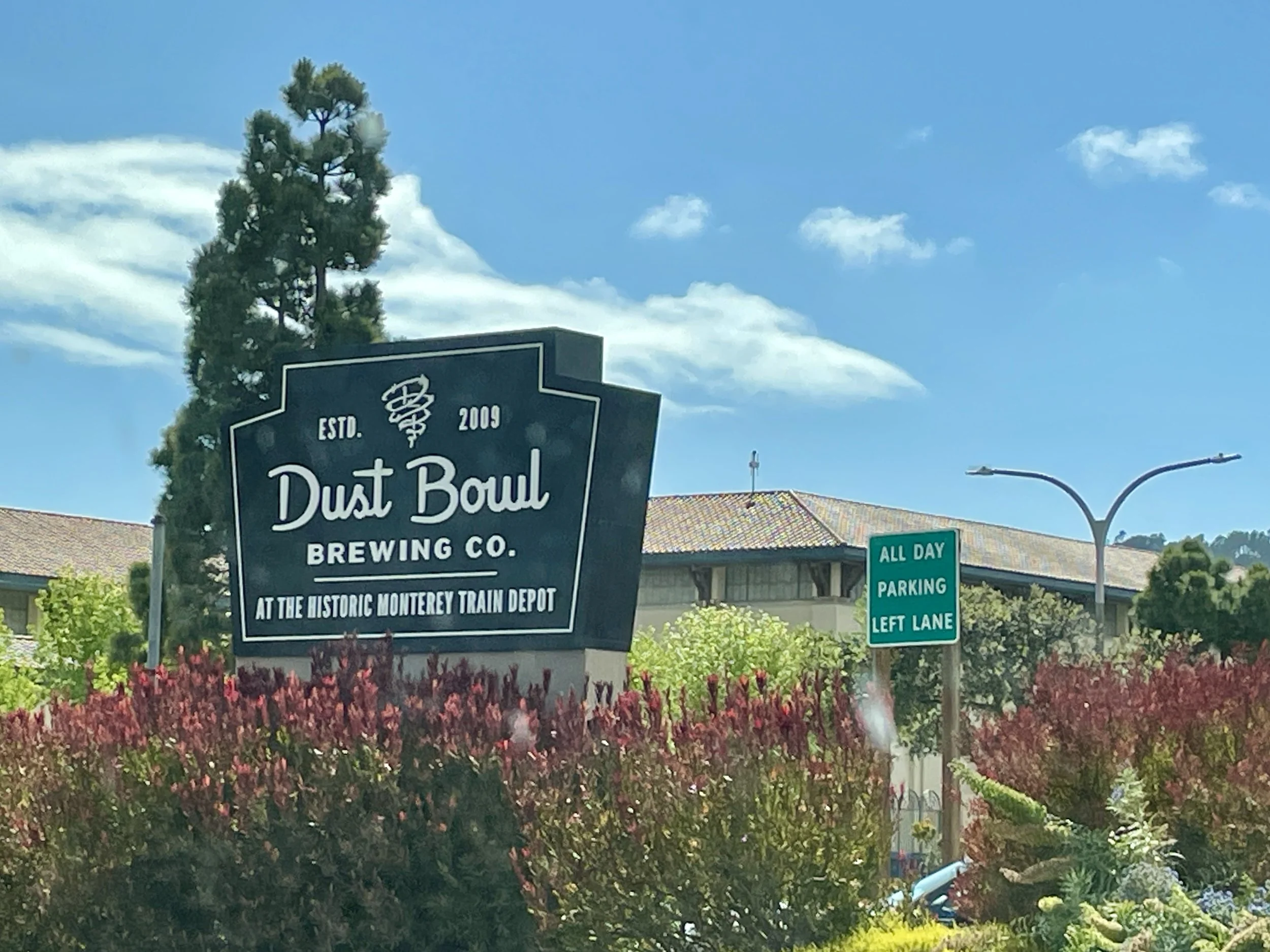
The Dust Bowl Brewing Co., which takes its name from The Grapes of Wrath by John Steinbeck (who is very much associated with Monterey), now occupies the old Monterey train station.
The Naval Postgraduate School includes the original Hotel Del Monte and many of its surrounding structures, as well as other more modern buildings that are used for classrooms, research labs, recreational facilities, and campus housing. The entire 627-acre property is surrounded by a fence. Fortunately, once Laurent flashed his badge and I showed by driver’s license, we were able to drive inside.
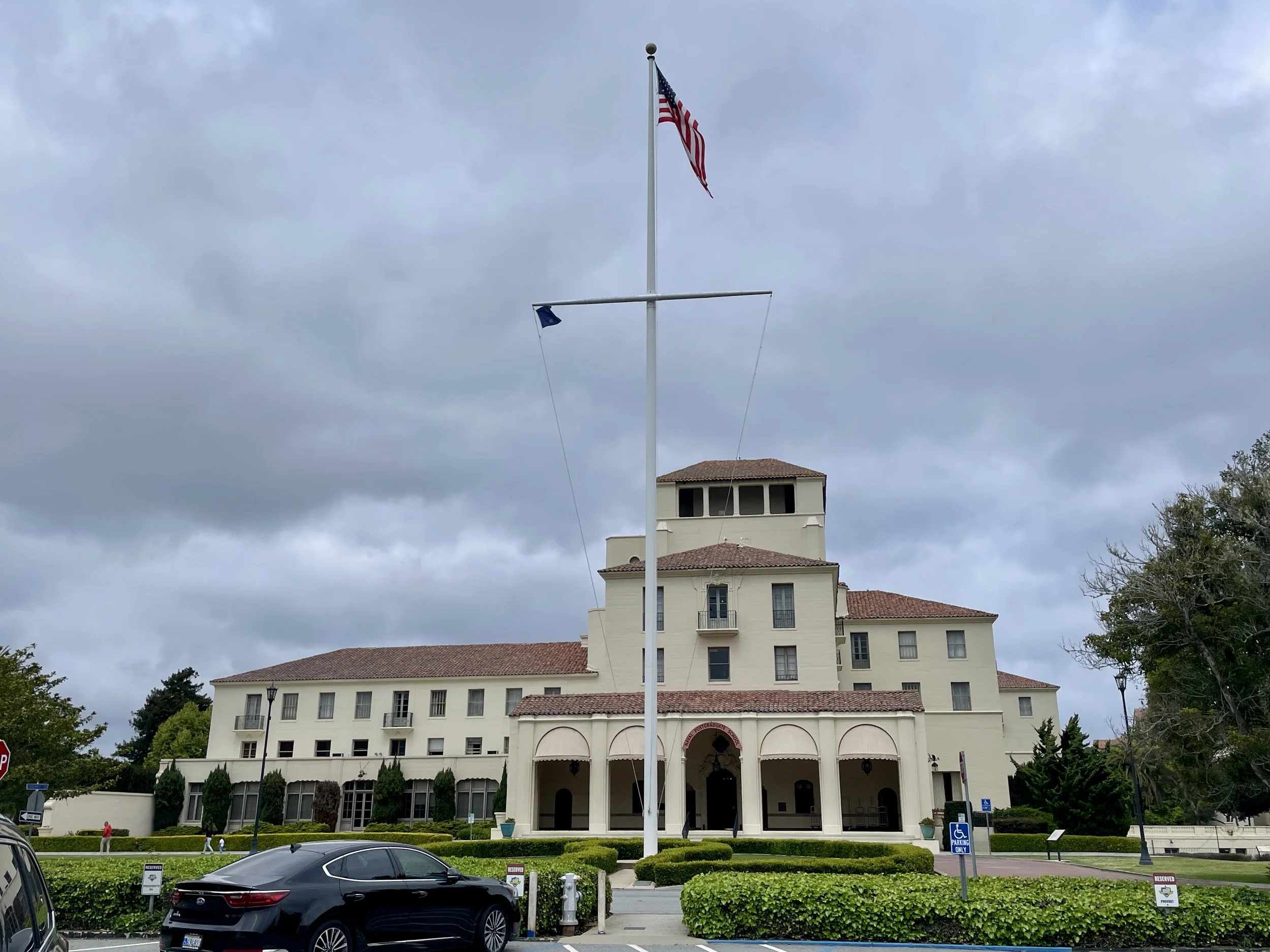
This building, now called Herrmann Hall, served as the entrance to the old Hotel Del Monte.
The first building we approached upon our arrival served as the main building for the Hotel Del Monte. However, this was not the original structure – the old Victorian era building Frank and Nora would have seen burned down in 1924, though some of the other structures (including the two outer wings with hotel rooms) survived. I was also excited to see a Giant Date Palm as we approached since they were an important feature of the original hotel. Frank and Nora posed beneath one in the photos above.
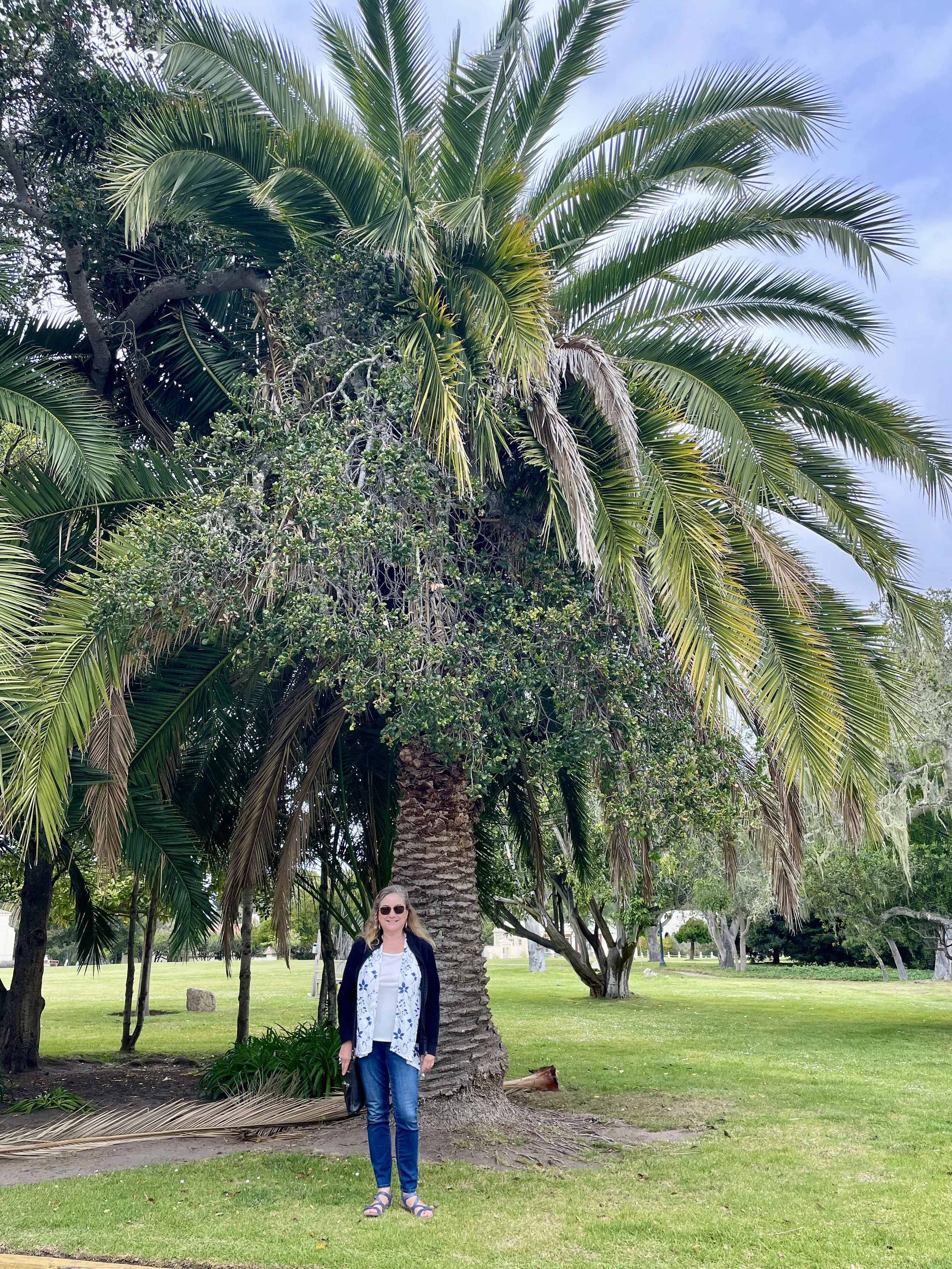
Here I am standing beneath one of the nearby giant date palms.
We spent a good amount of time exploring the various floors of the main building, now known as Herrmann Hall. Guests would have entered the hotel at these front steps, and it was from these steps that they would embark on the original 17-mile drive, which began and ended at the hotel.
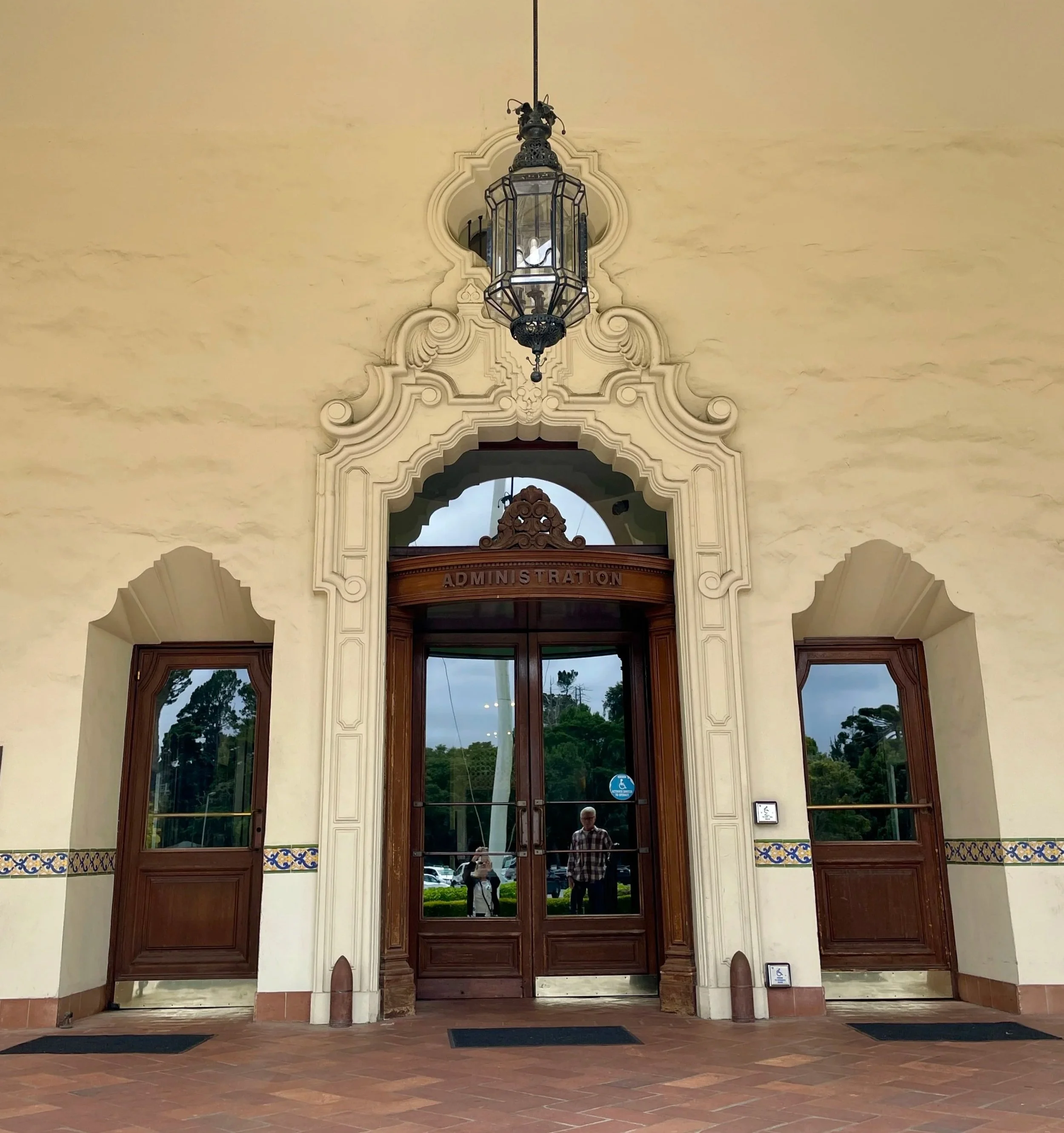
The front steps lead to these doors, which now serve as the entrance to the Naval Postgraduate School’s Administration Building.
The Entrance Vestibule is definitely striking with its large mahogany doors, red tile floors, and elegant iron work. Below you can see our view as we stepped inside, looking through the Lobby toward the McNitt Ballroom at the back.
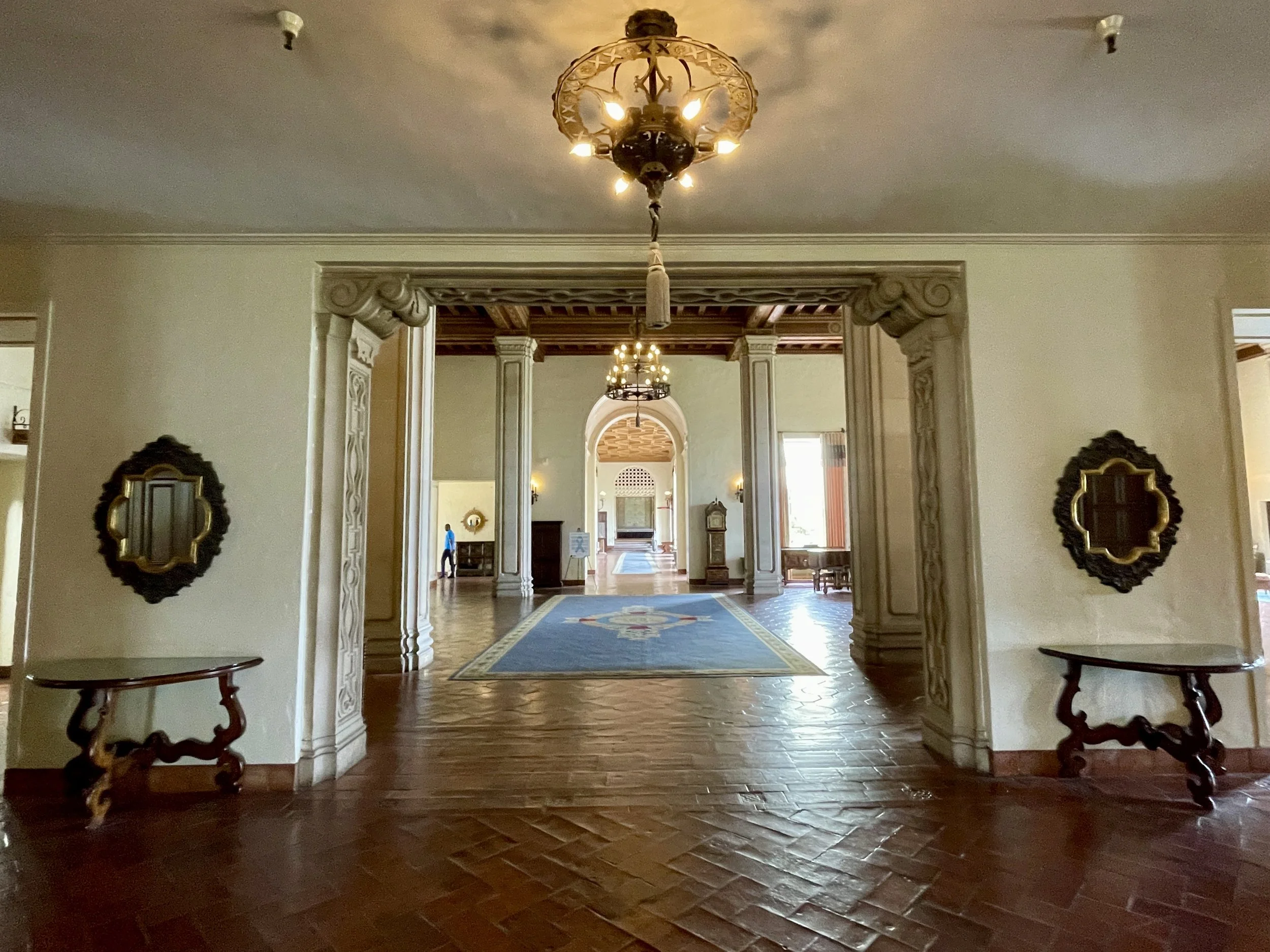
This was our view from Herrmann Hall’s Entrance Vestibule.
As soon as we were inside, my eyes were immediately drawn to the small room on the left that serves as a museum across from the Welcome Center. There, we listened to a video and read signs that talked about Hotel Del Monte’s history, saw some of its original furnishings, and read the names of some of the famous guests who had visited the resort in its heyday.
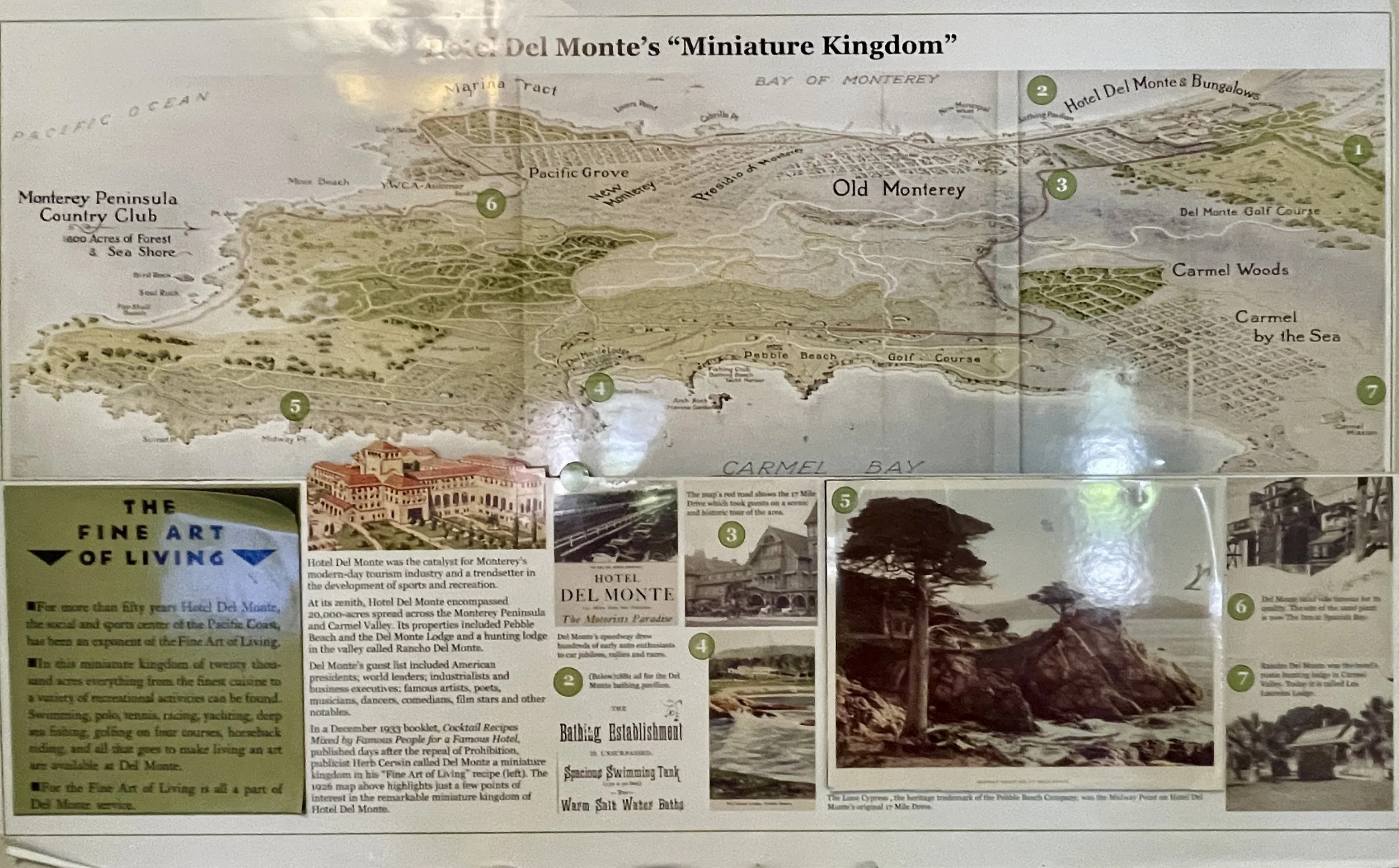
This large photo shows a map of “Del Monte’s Miniature Kingdom,” which was “the catalyst for Monterey’s modern-day tourism industry and a trendsetter in the development of sports and recreation.”
As this sign explains, “At its zenith, Hotel Del Monte encompassed 20,000 acres spread across the Monterey Peninsula and Carmel Valley. Its properties included Pebble Beach and the Del Monte Lodge and a hunting lodge in the valley called Rancho Del Monte. Del Monte’s guest list included American presidents; world leaders; industrialists and business executives; famous artists, poets, musicians, dancers, comedians, film stars and other notables.” AND, of course, Frank and Nora Traughber!
Under “The Fine Art of Living” section, it states: “In this miniature kingdom of twenty thousand acres everything from the finest cuisine to a variety of recreational activities can be found. Swimming, polo, tennis, racing, yachting, deep sea fishing, golfing on four courses, horseback riding, and all that goes to make living an art are available at Del Monte.”
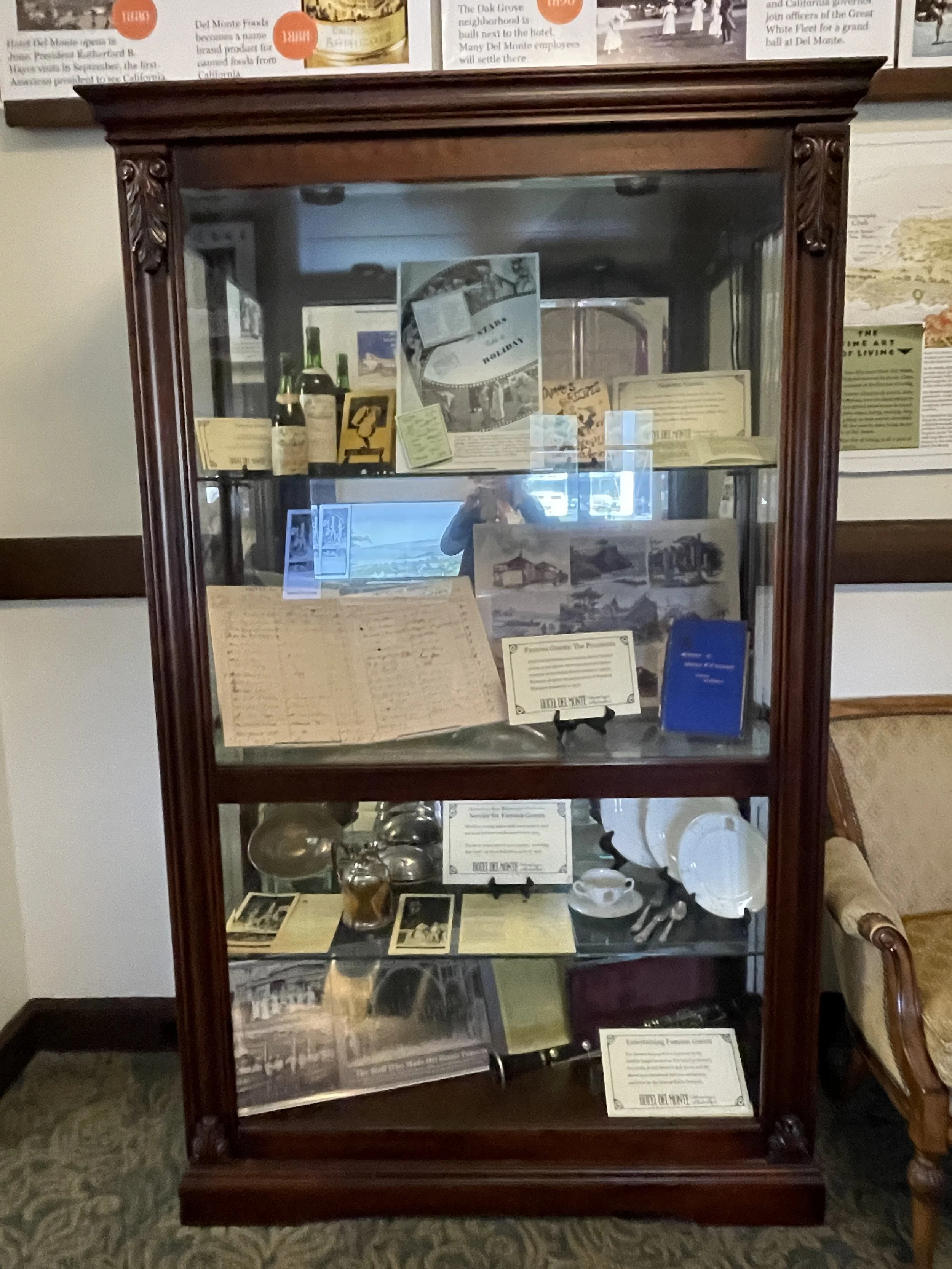
This display case houses many original items from the Hotel Del Monte.
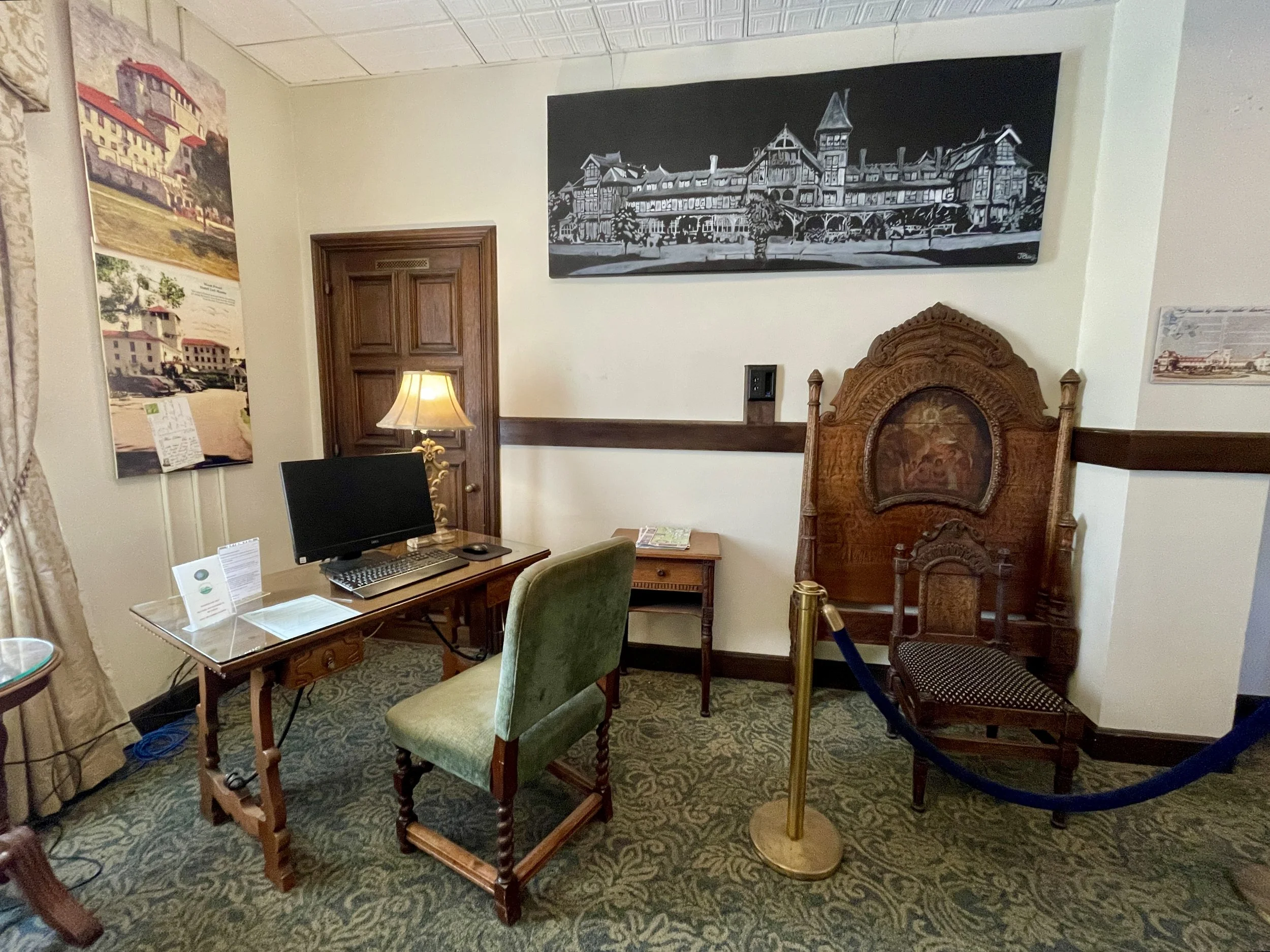
I’m pretty sure the computer is not an original hotel item - lol - but Navy personnel sometime sit here to do work or research.
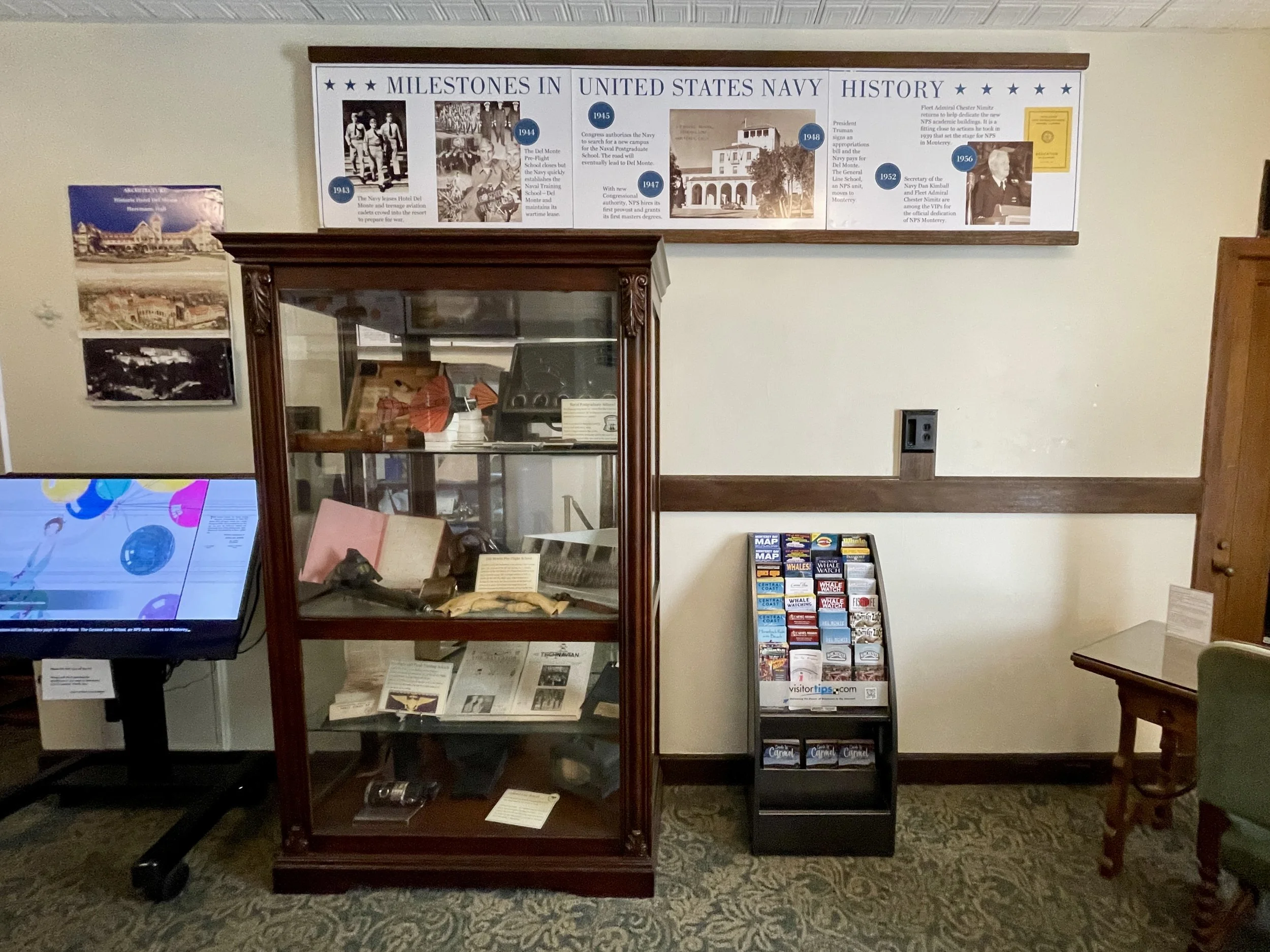
The small museum also highlights Milestones in United States Navy History.
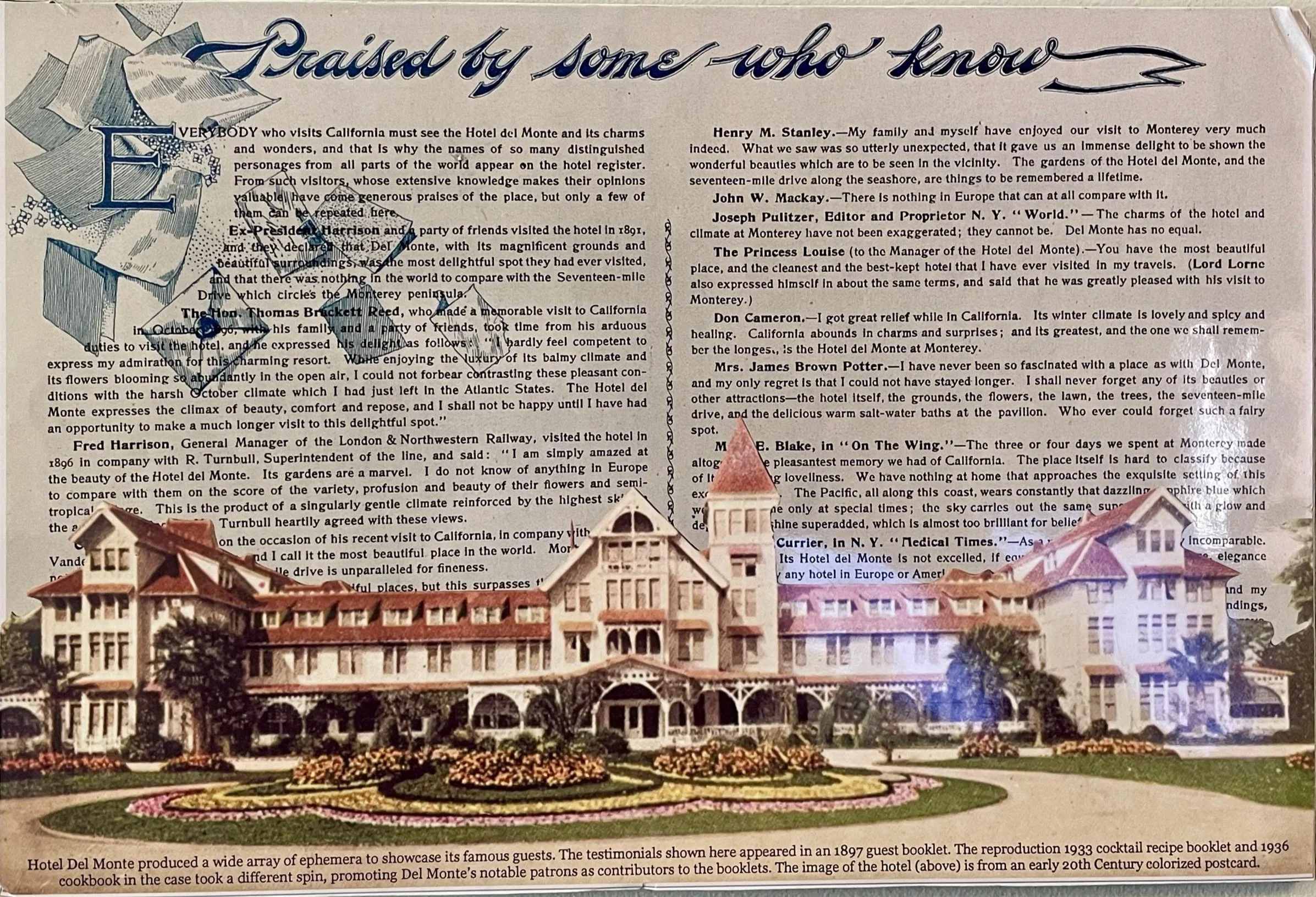
As stated above: “Ex-President Harrison and a party of friends visited the hotel in 1891, and they declared that Del Monte, with its magnificent grounds and beautiful surroundings, was the most delightful spot they ever visited, and that there was nothing in the world to compare with the Seventeen-mile Drive which circles the Monterey peninsula.”
At the Welcome Center, one of the attendants also showed us some historical artifacts, including a cocktail recipe book, an original guest brochure, and lots of historic postcards. I wish we’d had more time to read through all of those items, but since we had to get back to the conference in an hour, we continued on our quest to explore the property.
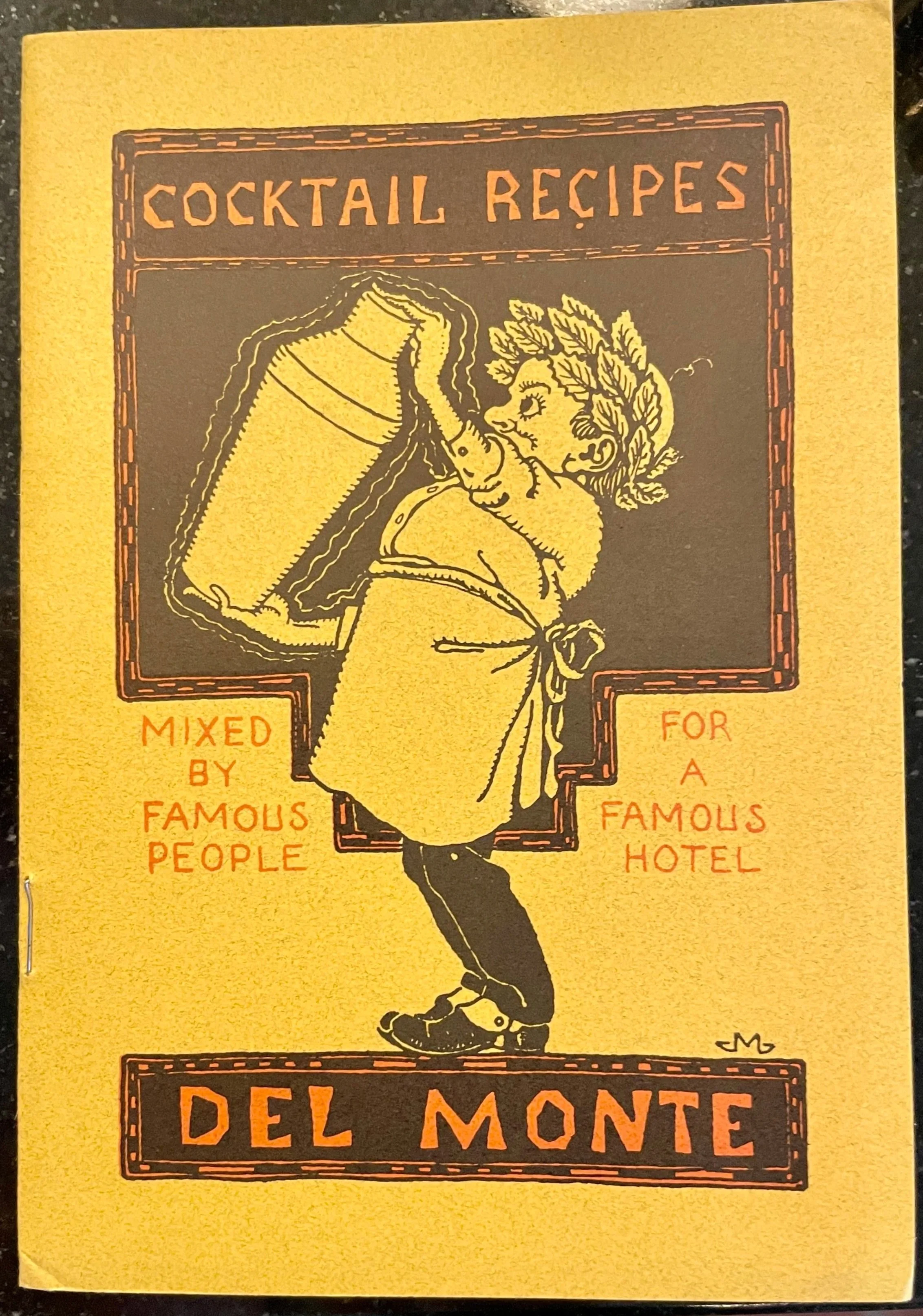
I wish I’d had time to look through these recipes!
Many of the descriptions that follow come from the Pocket Tour Guide we received at the Welcome Center. From there, we headed to the Lobby (now called the Quarterdeck), which features “painted ceilings by Julian Ellsworth Garnsey and two magnificent murals by Francis McComas [that] create warmth and a unique sense of place for hotel guests.” Yes, guests can still stay at the hotel, but they must be Navy-affiliated.
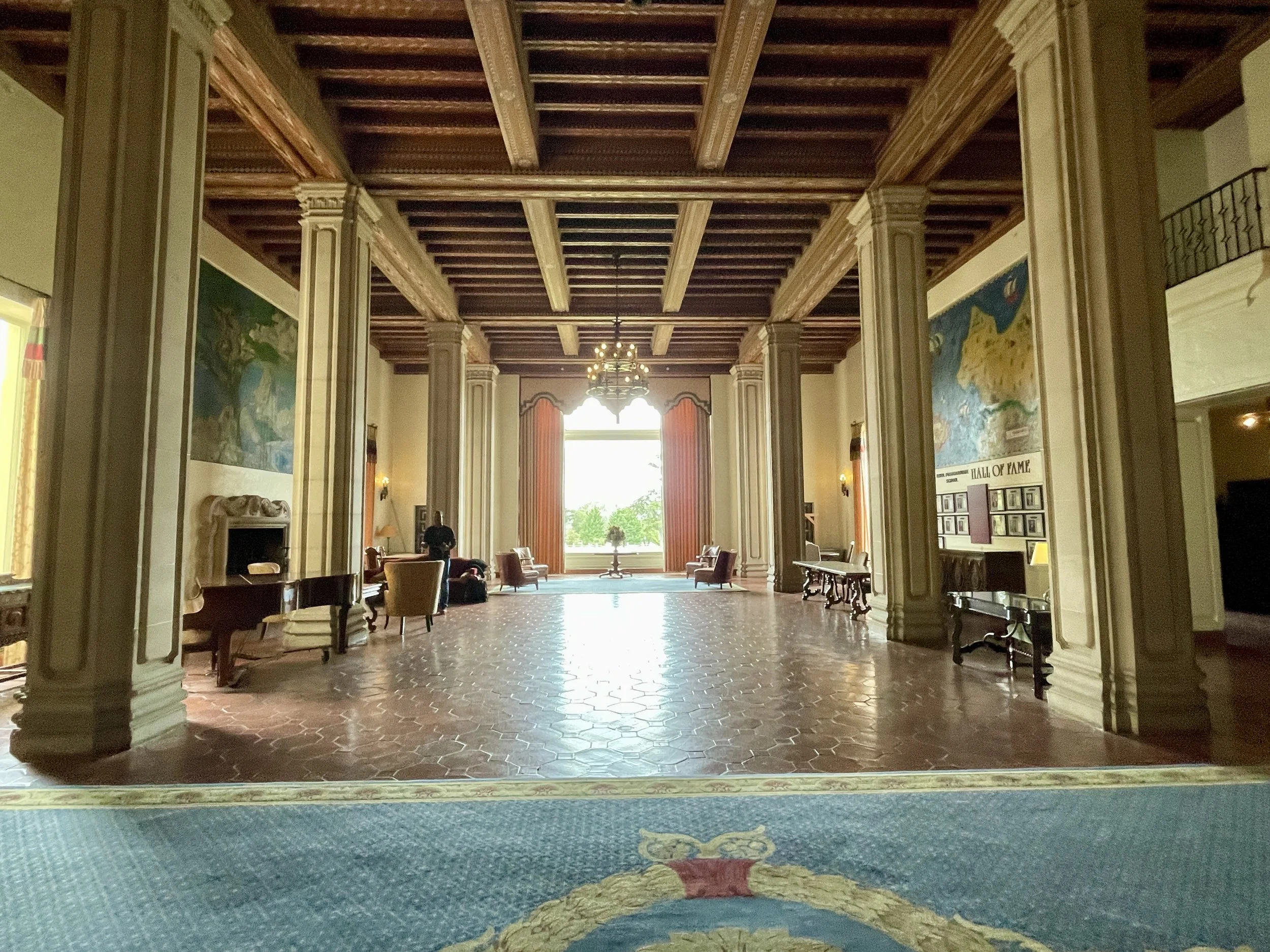
Here you can get a glimpse of the Lobby, with its beautifully painted ceiling and large murals on either side.
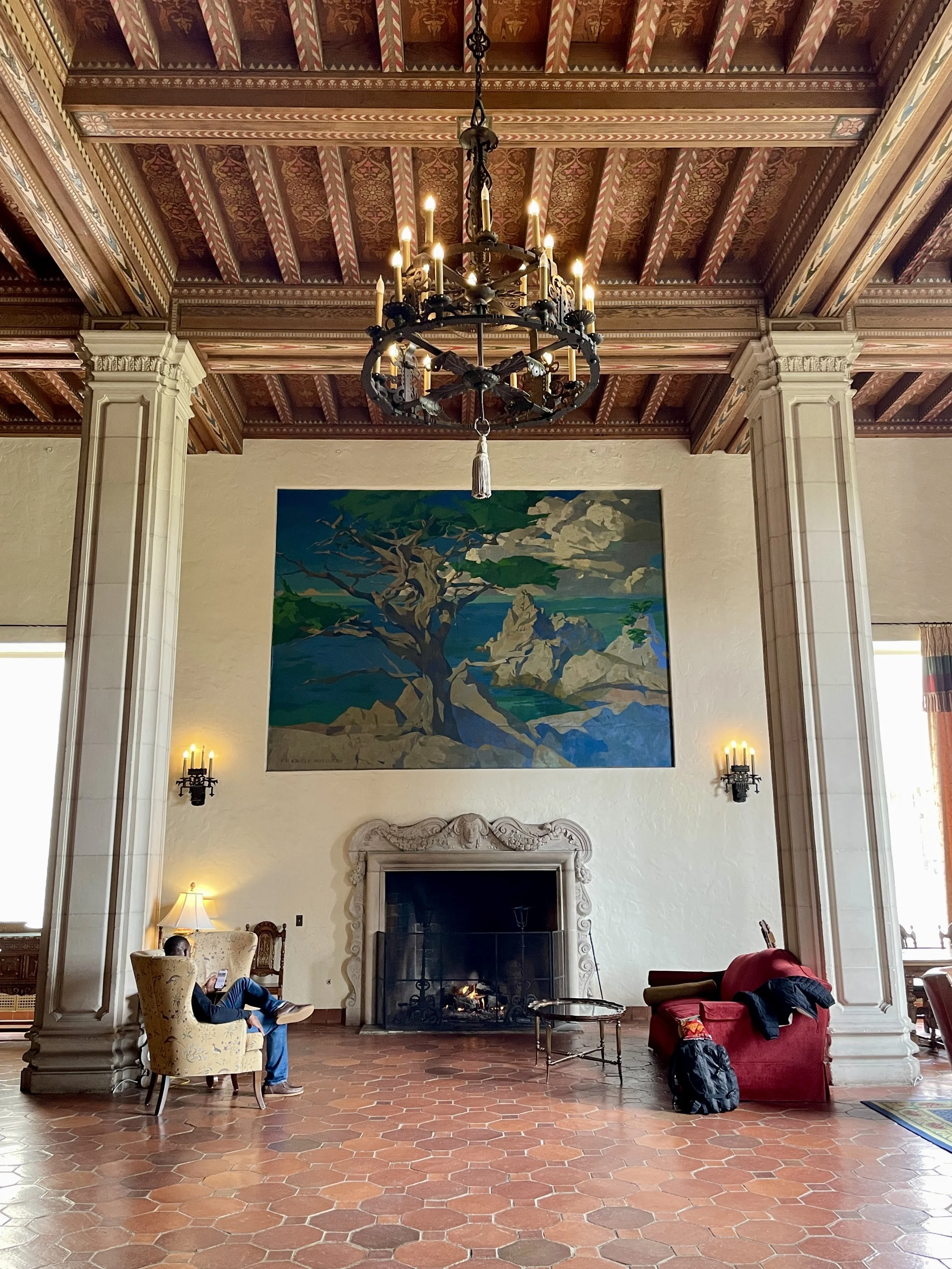
I especially liked this painting of the Lone Cypress, which served as the midway point for the original 17-mile drive.
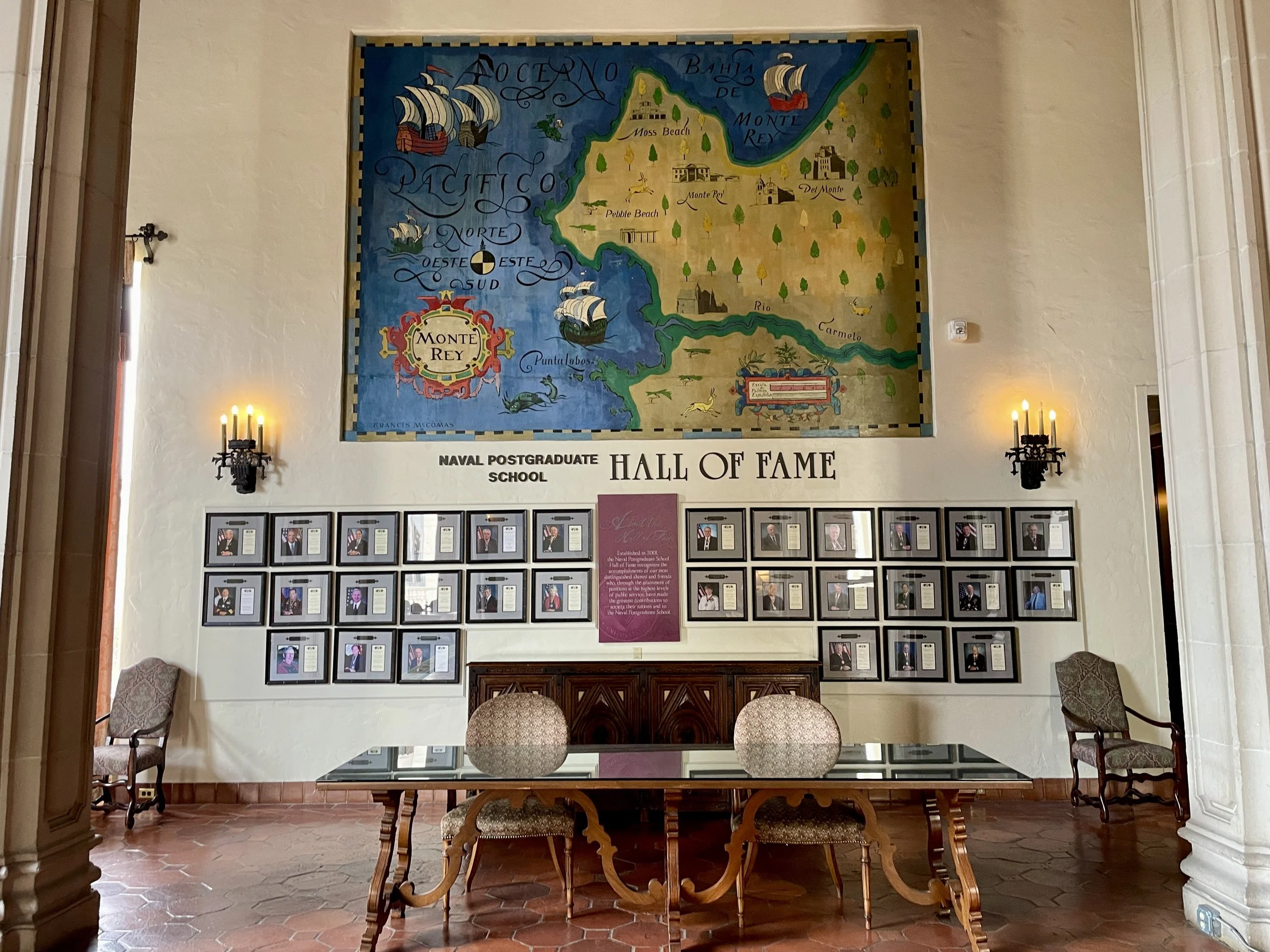
The painting on the opposite wall features this map of Monterey, with the NPS Hall of Fame below it.
The Main Floor also includes various offices that occupy former hotel shops, as well as the magnificent McNitt Ballroom, which was originally Hotel Del Monte’s main dining room. At 210 feet long and 49 wide with a 27-foot high ceiling, it is certainly an amazing space for special events.
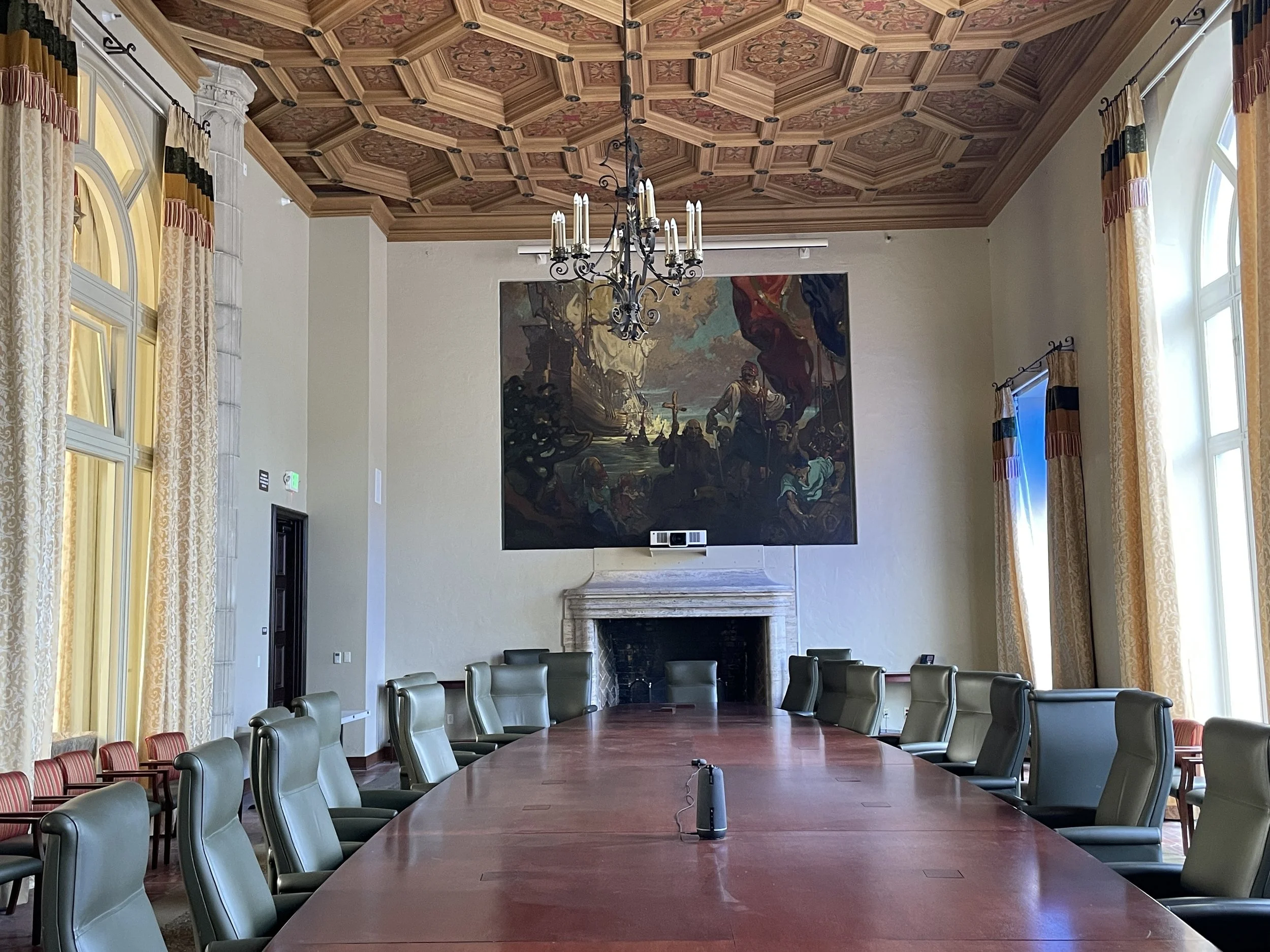
This “office space” features extremely decorated ceilings and a painting by Daniel Sayre Groesbeck titled “The Landing of the Cross” that used to hang in the hotel’s Guest Lounge.
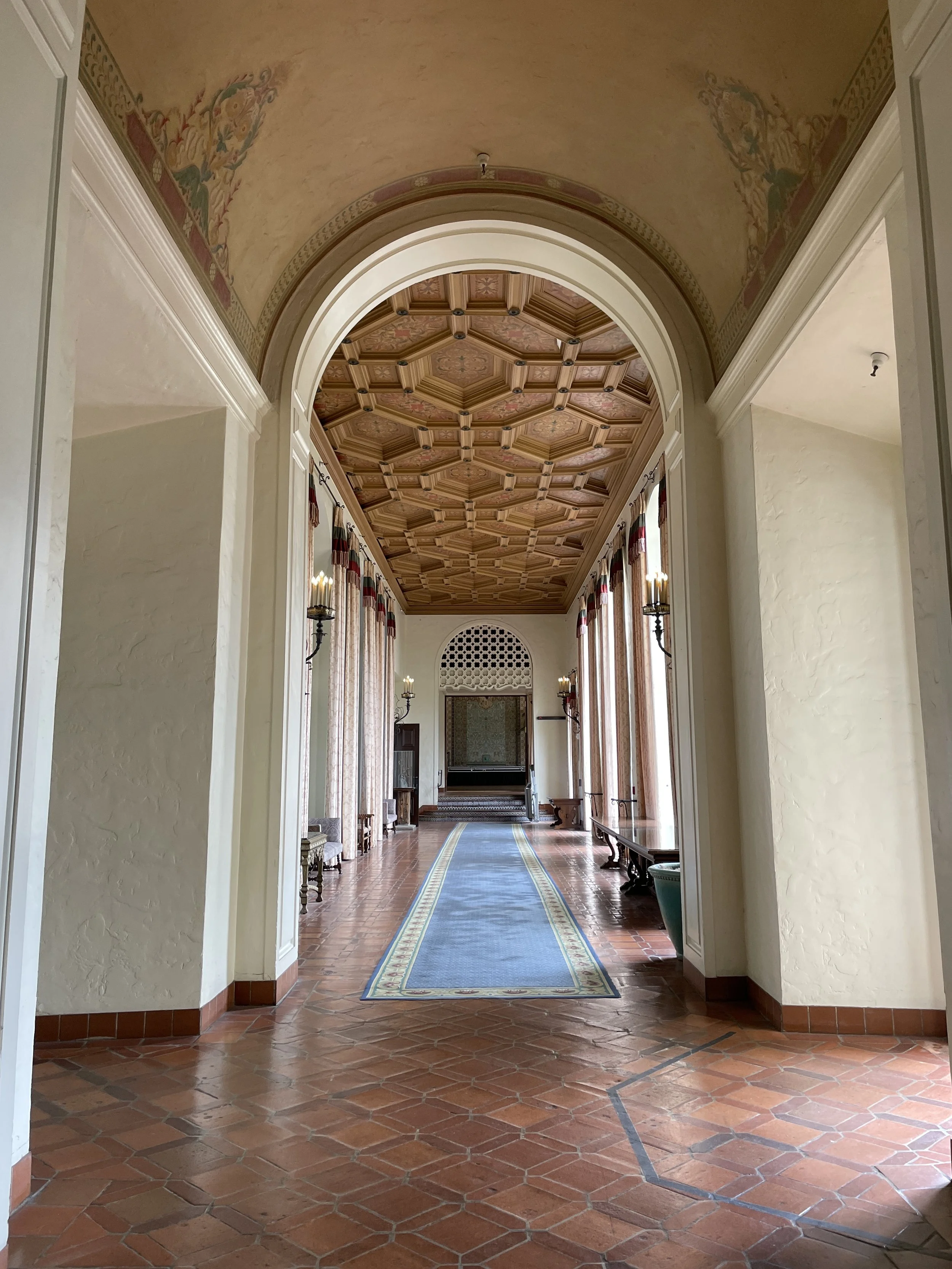
This hall that leads to the McNitt Ballroom (formerly the Guest Dining Room) used to be part of a luxurious guest lounge and anteroom, centrally located between the lobby and dining room.
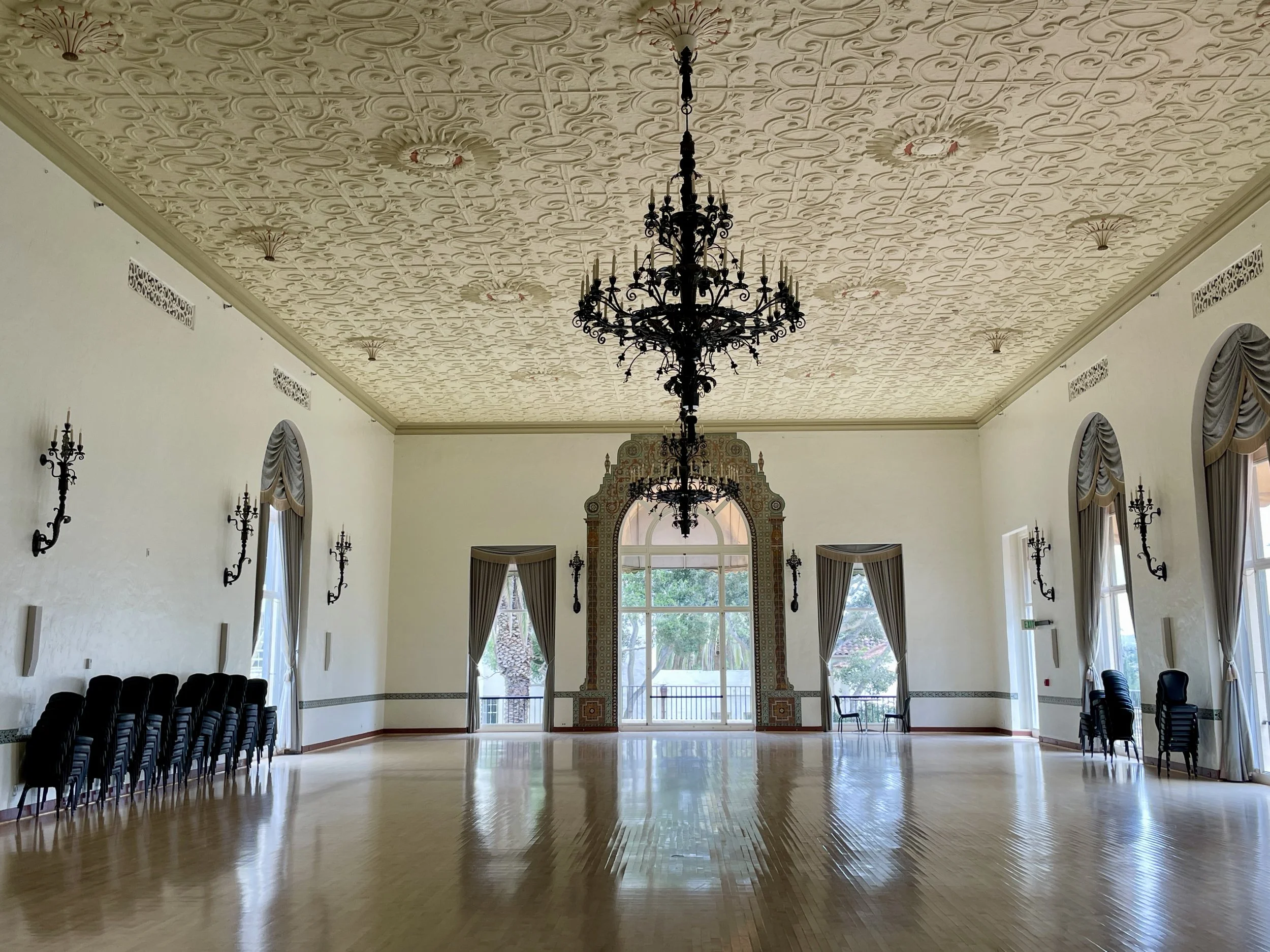
Here you get a view inside the McNitt Ballroom, which was originally Hotel Del Monte’s main dining room.
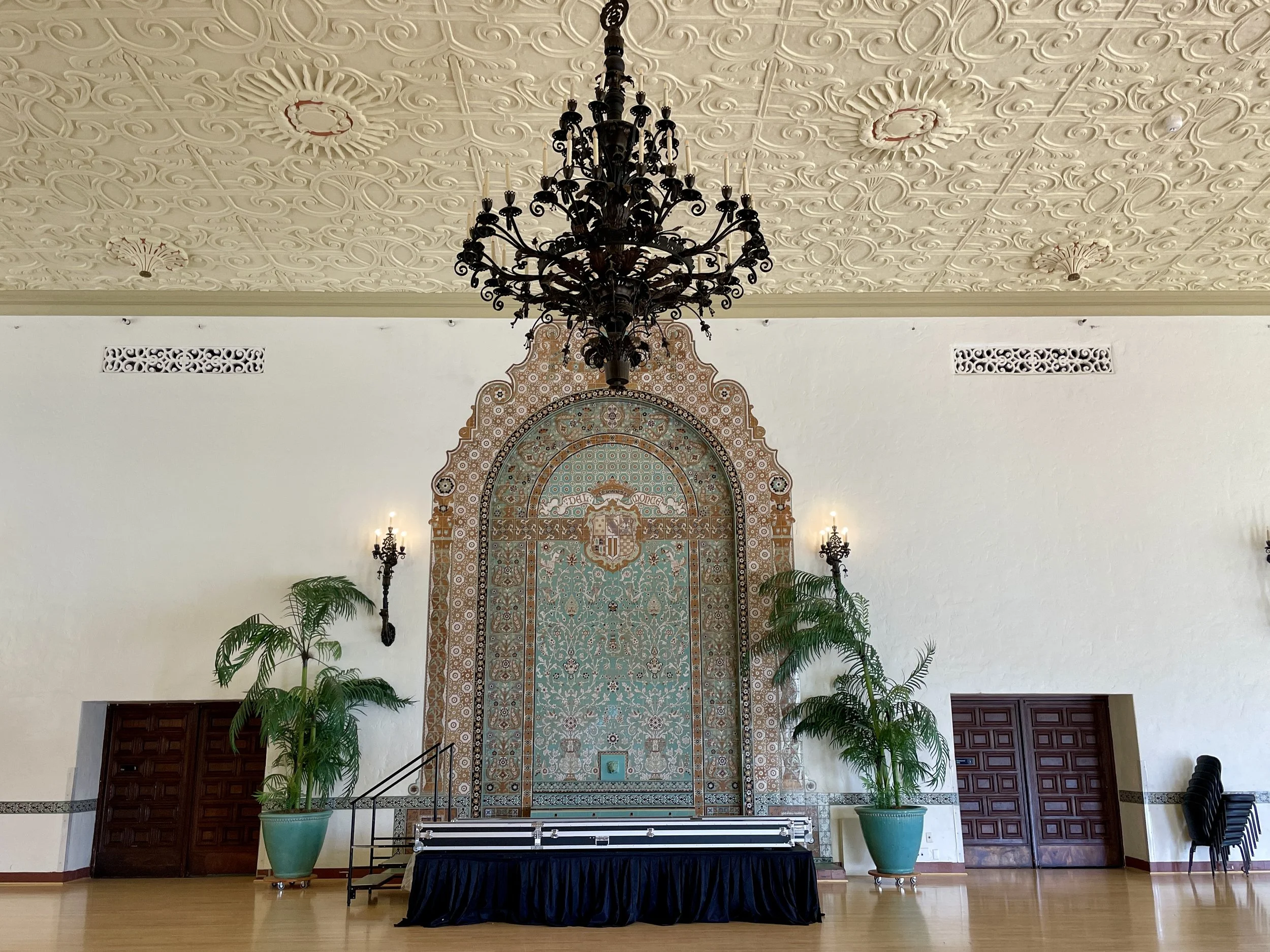
I was definitely impressed by this tile work on the side wall of the ballroom - and since you can see the doors on the side, that gives you an idea of how large this is!
We next headed downstairs to the Ground Floor, which “once included a brokerage firm, railway office, news stand, cigar shop, soda fountain, drug store, barber shop, Turkish bath, shops, a game room, post office auditorium, banquet and party rooms, and a tap room.” We certainly did not see all of that, but we got a quick peek at the Trident Room, which was formerly the tap room, before they told us they were not open and closed the doors on us. The Trident Room now has dozens of mugs hanging from the ceiling and looks like a fun place to hang out and have a drink.
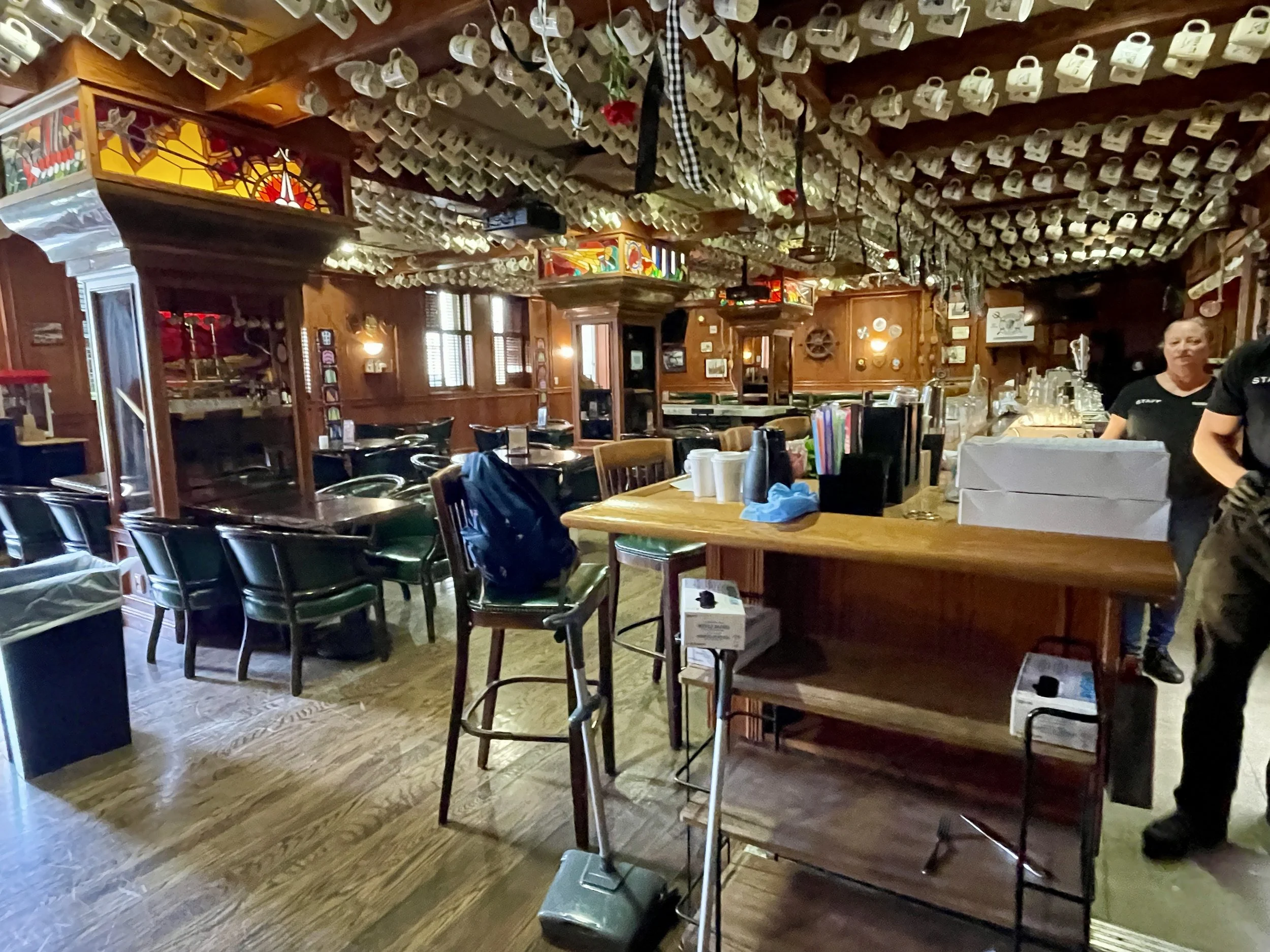
The Trident Room was not open for business, but we fortunately got a quick peek before they closed the doors on us.
The Ground Floor also houses the “El Prado” Room, which now serves as a cafeteria but was once Hotel Del Monte’s main party room. Called the Bali Room, “big band performances were broadcast nationally via Mutual Radio Network and special event parties were held [there] frequently.” The “La Novia” Room sits nearby, and when we opened the doors to sneak a peek, we found ourselves looking at a pair of stormtroopers! LOL. There were also some cut-out Star Wars figures, ready for the “Galactic Gathering” that was scheduled for May 4.
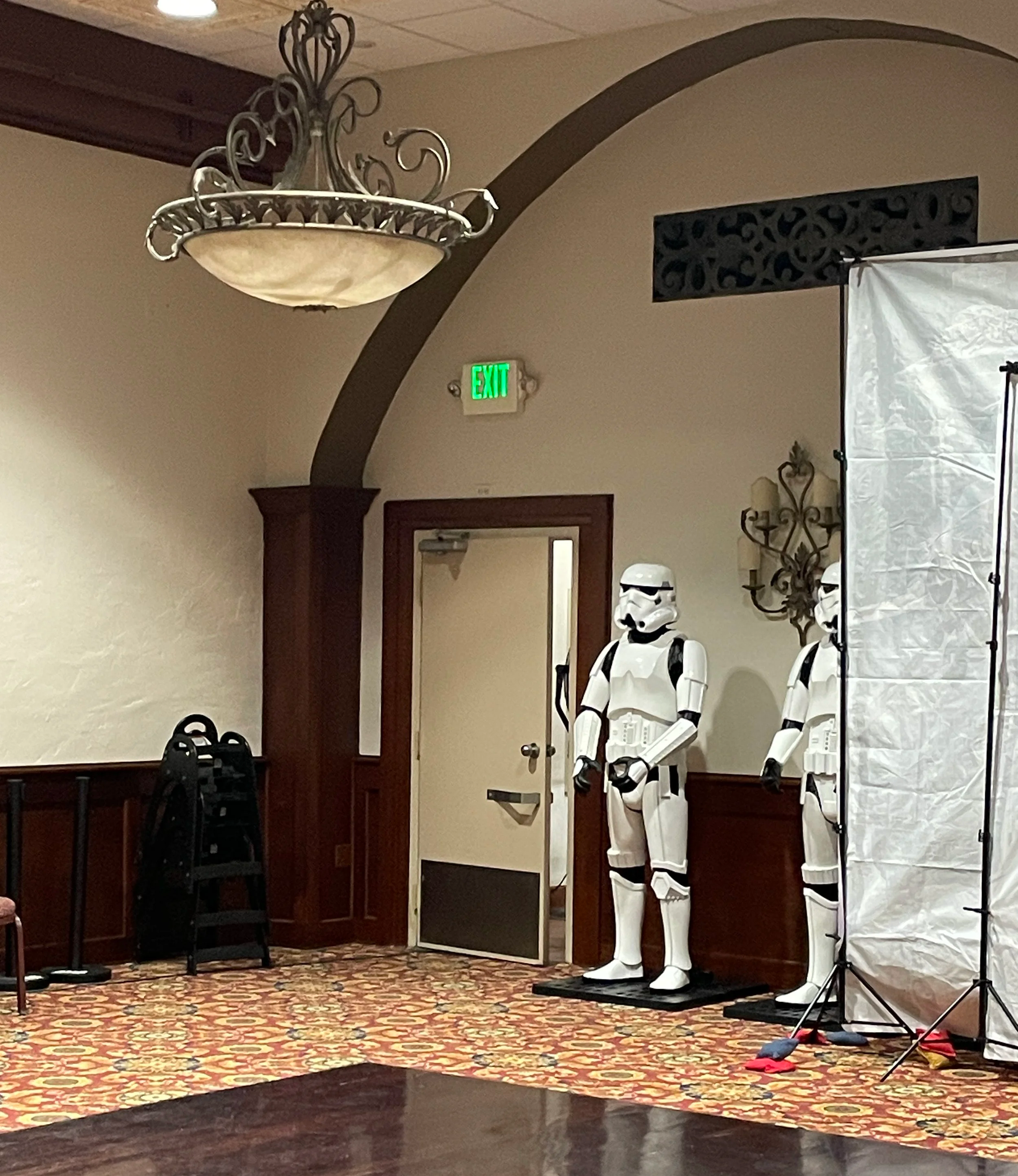
We were surprised to see these storm troopers standing guard in the La Novia Room! LOL.
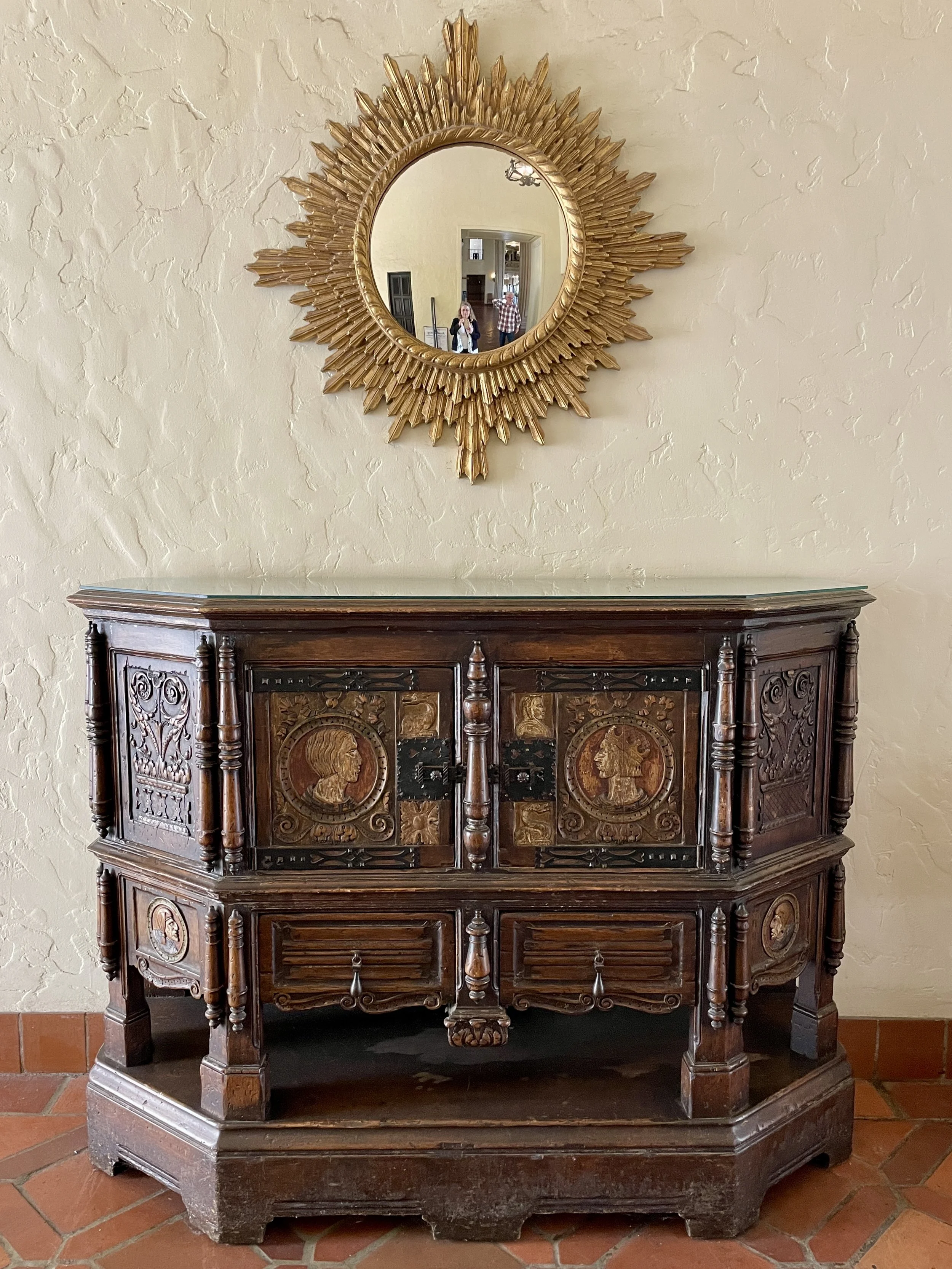
We passed this elaborate mirror and cabinet as we wandered through the halls.
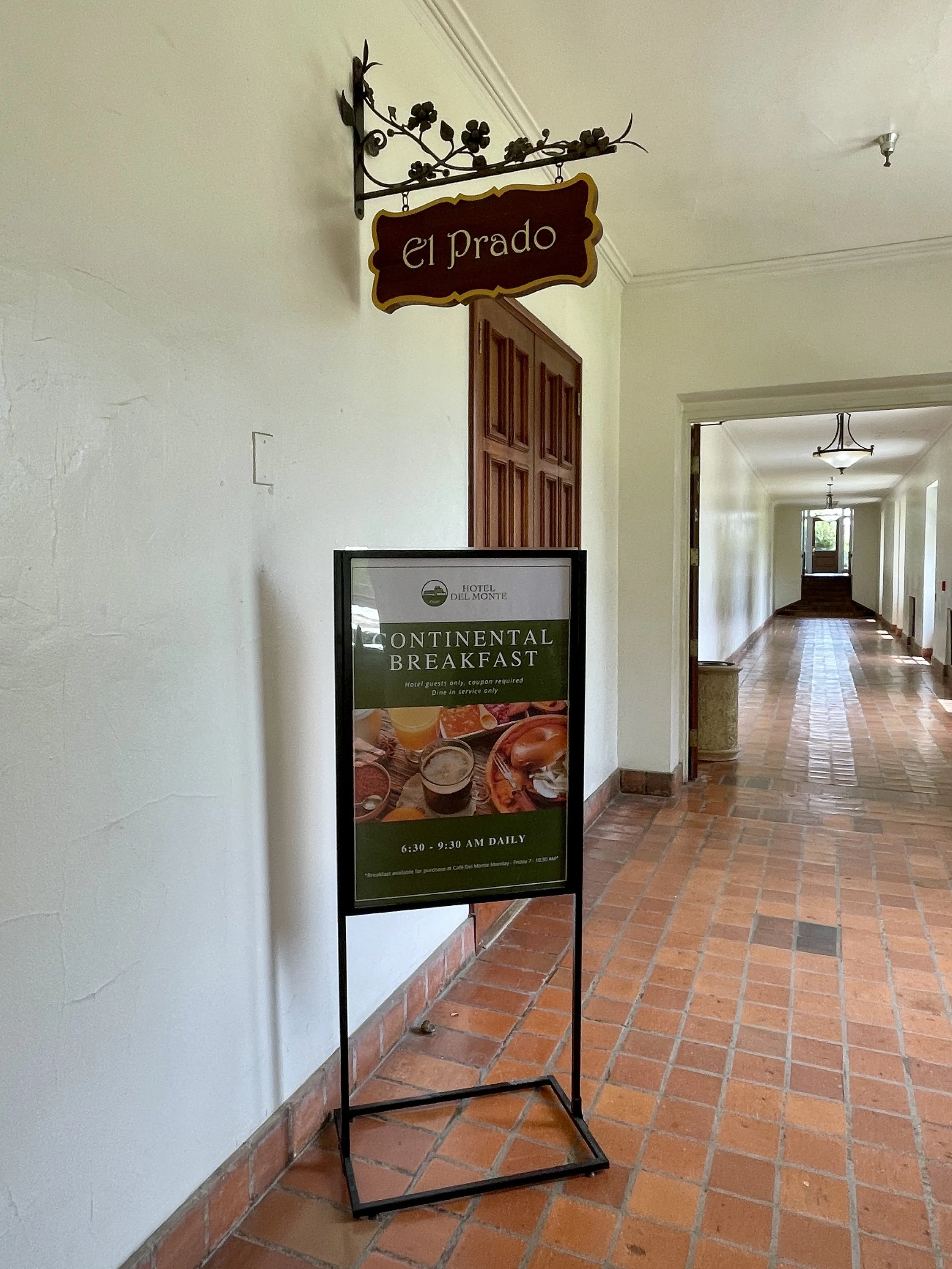
My “tour guide” Laurent said he had eaten here in the “El Prado” Room in the past when he was here for a special event.
The Ballroom overlooks a beautiful garden area, so we stepped outside for some quick views before heading upstairs. This section reminded me a bit of the “Mystic Maze” that used to be a famous feature at the hotel — one that Frank and Nora explored when they were here.
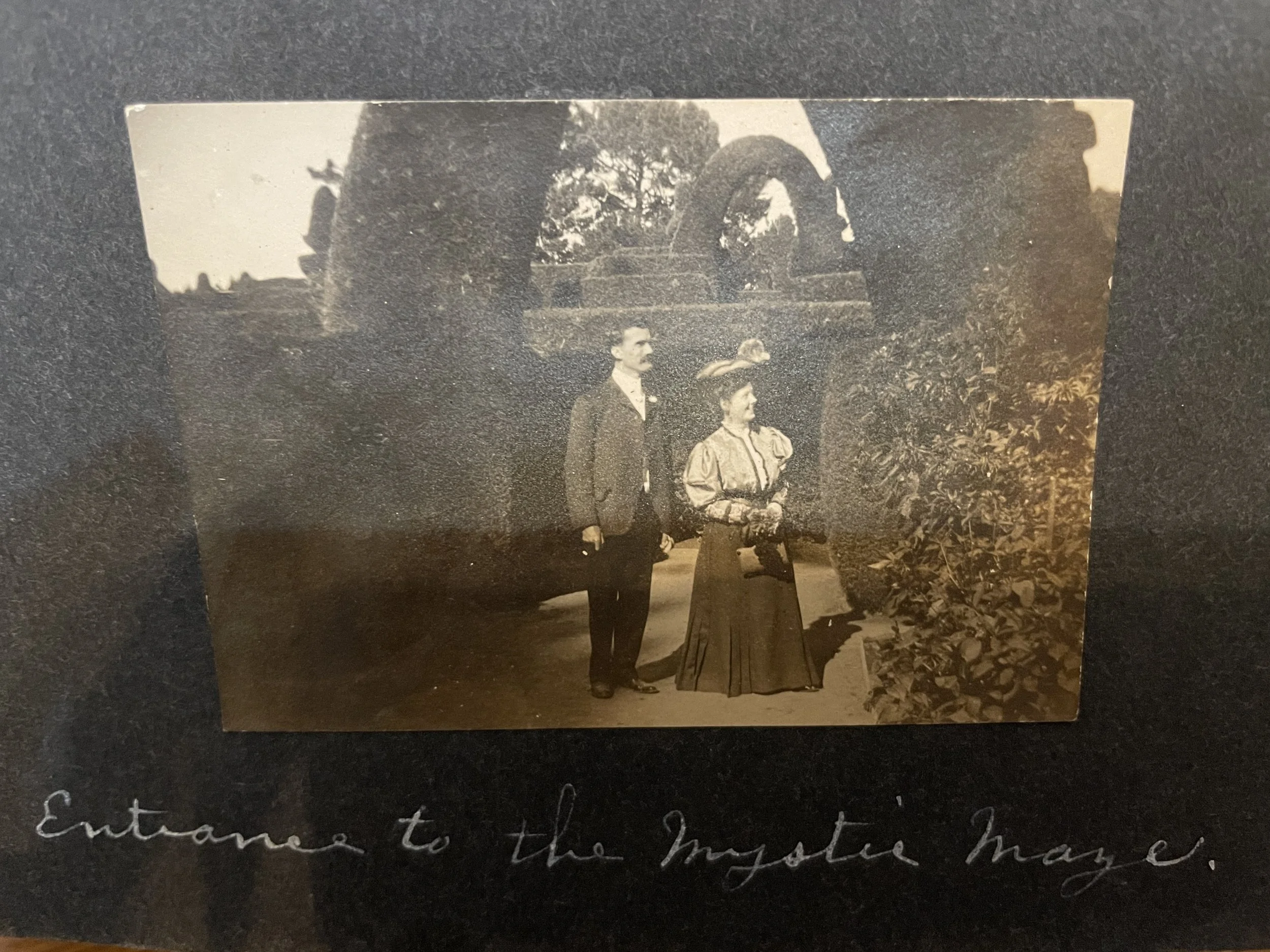
Here is a photo of Frank and Nora at the “Entrance to the Mystic Maze” in 1905.
The Mystic Maze was a half-mile-long, trapezoidal labyrinth of Monterey Cypress trees in which guests often got lost or disoriented. It was removed in the 1920’s. In describing the maze, a hotel pamphlet stated, “Like marriage it is very enticing, but a good deal easier to get into than out of.”
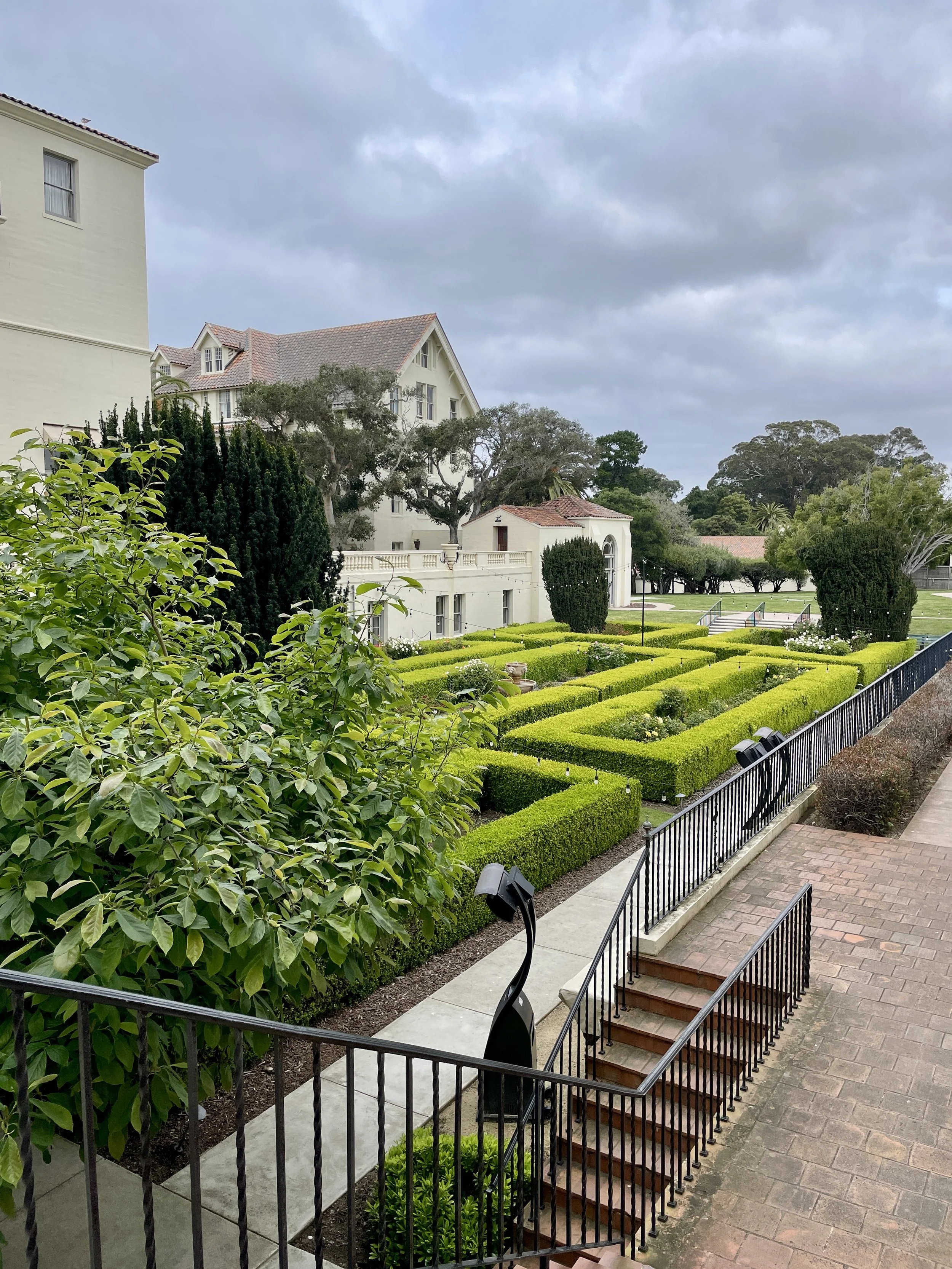
Definitely not the “Mystic Maze of the past, but still a pretty garden area, with a “porch” area for sitting.
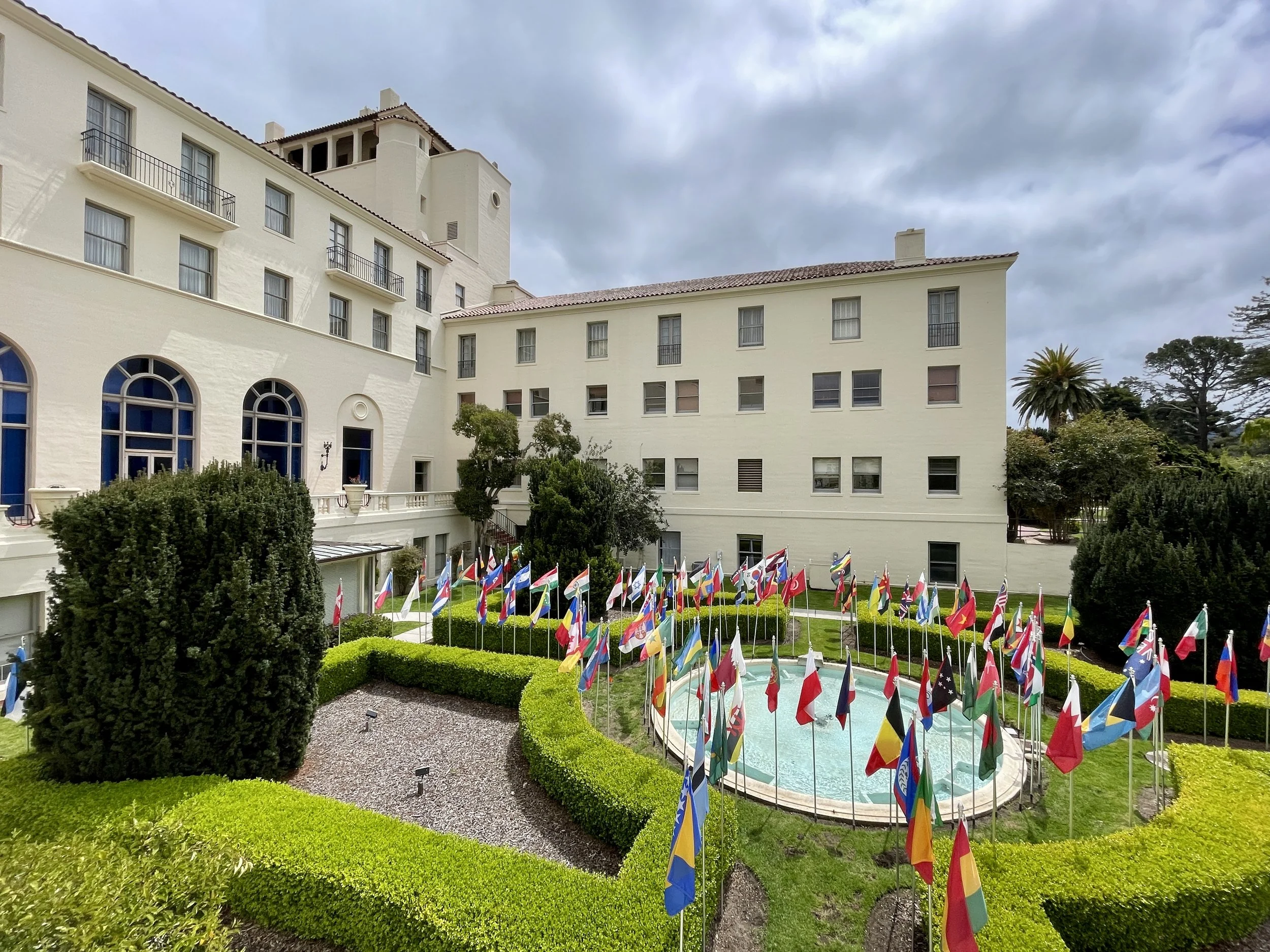
This garden and fountain appear on a different side of the hotel, but in both this photo and the one below, you can see the “Tower Room” where we headed next.
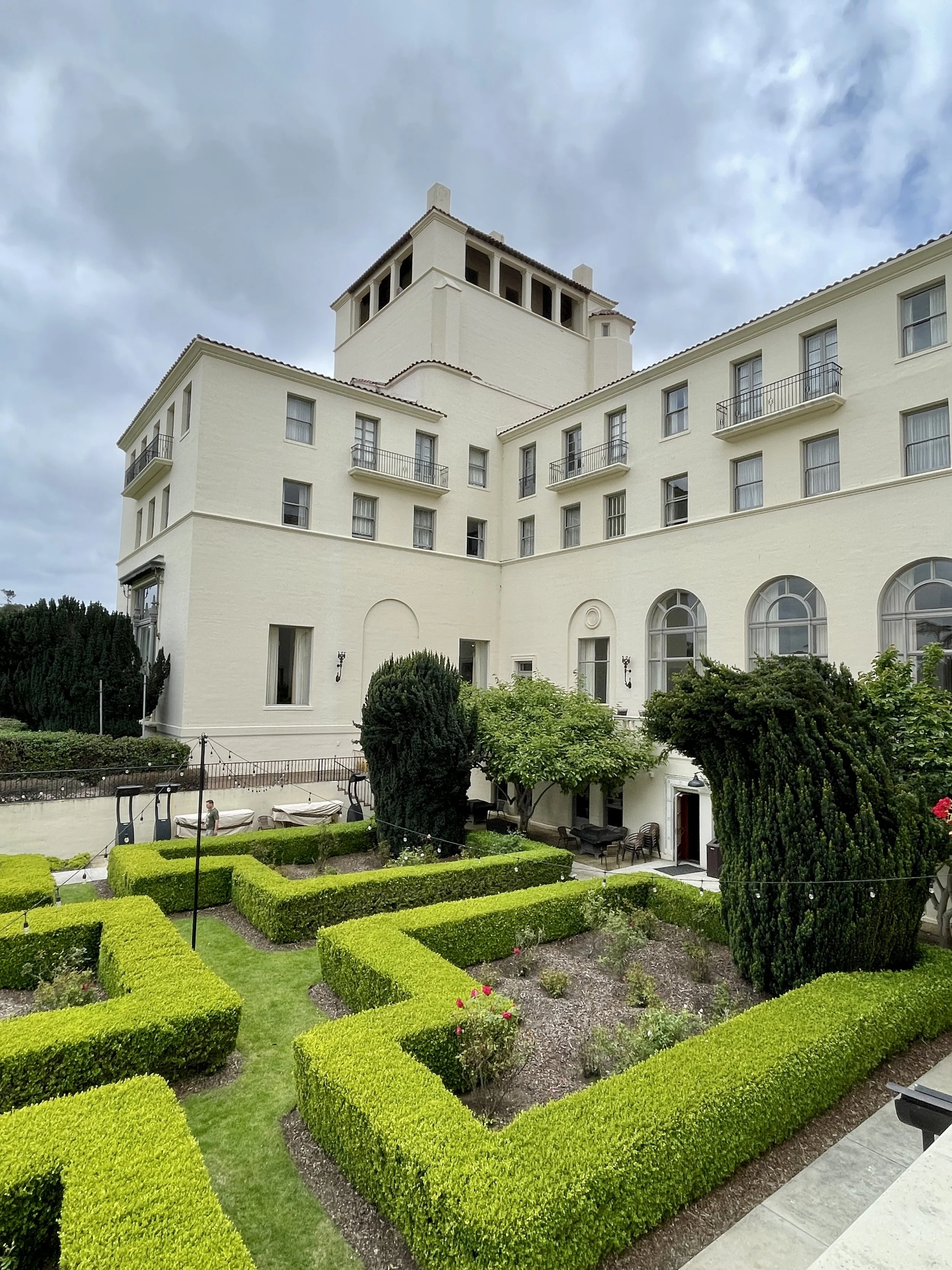
Here you can get a good view of where we headed next - the Tower Room and Sun Terrace.
We next made our way upstairs to the Tower Room on the Fourth Floor, then outside to the “Sun Terrace” viewing decks to take in some panoramic views of the property, including the original Hotel Del Monte Roman Plunge and Solarium, Del Monte Lake (formerly known as Laguna del Rey), and Monterey Bay in the distance. The Tower Room was used as a small banquet room – “it is distinguished by its fresco of the Witch Tree on 17-Mile Drive. Once more famous than today’s Lone Cypress Tree, the Witch Tree collapsed during a 1964 storm.”
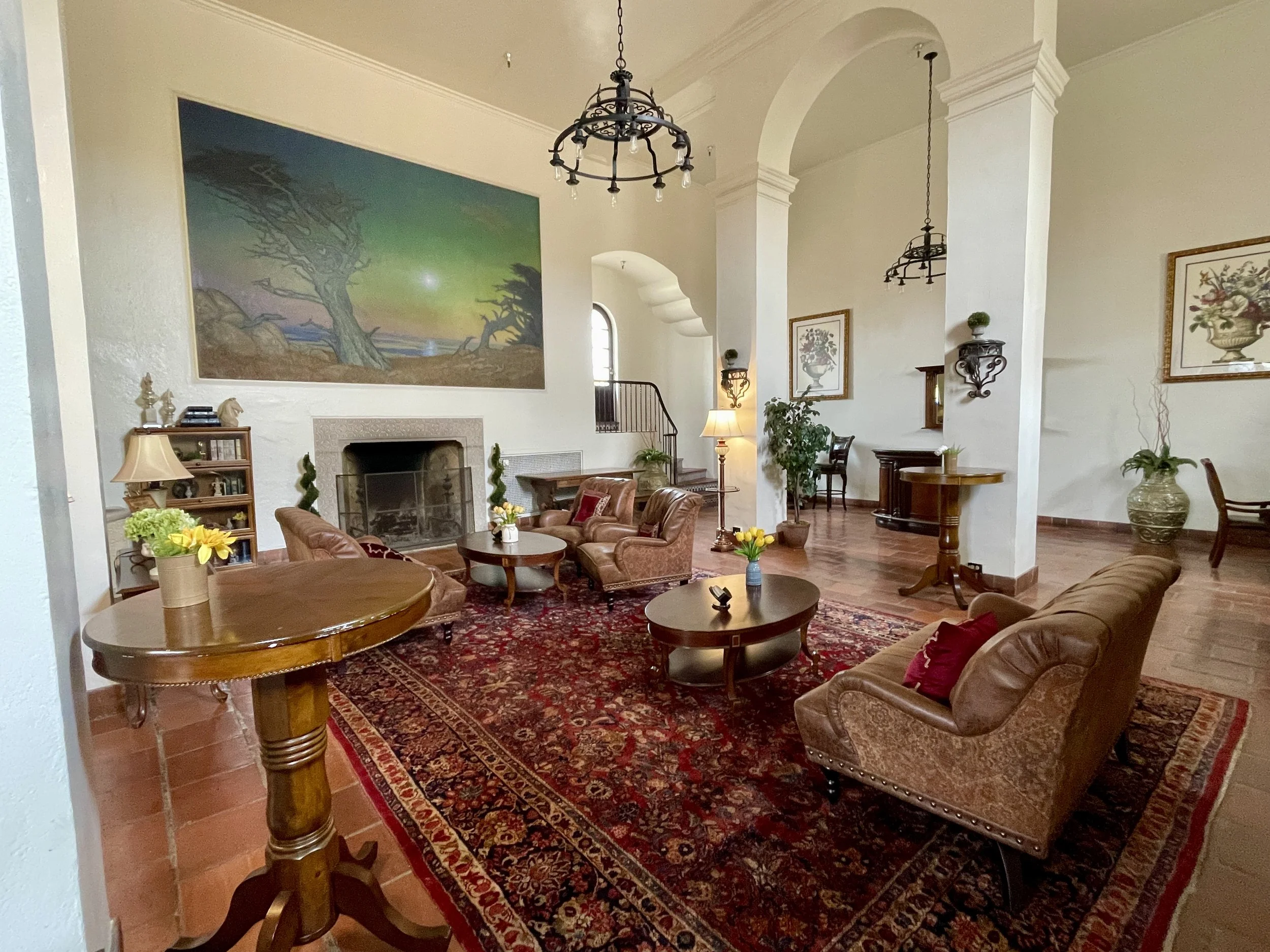
The Tower Room features of painting of the “Witch Tree,” which used to be a famous sight on the 17-mile drive until it collapsed in 1964.
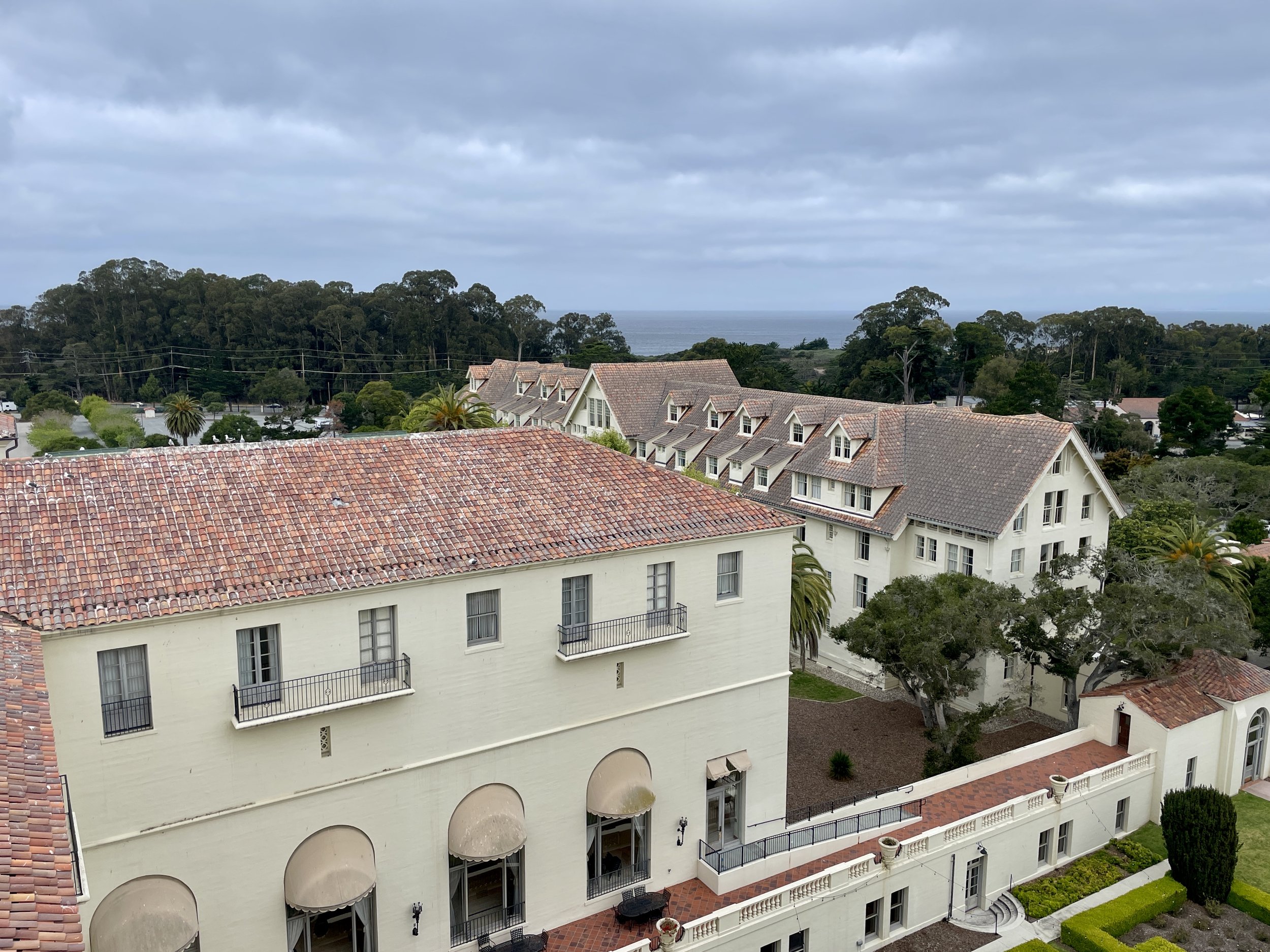
A view from outside the Tower Room, looking out toward Monterey Bay; the rooms you can see mostly function as hotel rooms for Navy guests.
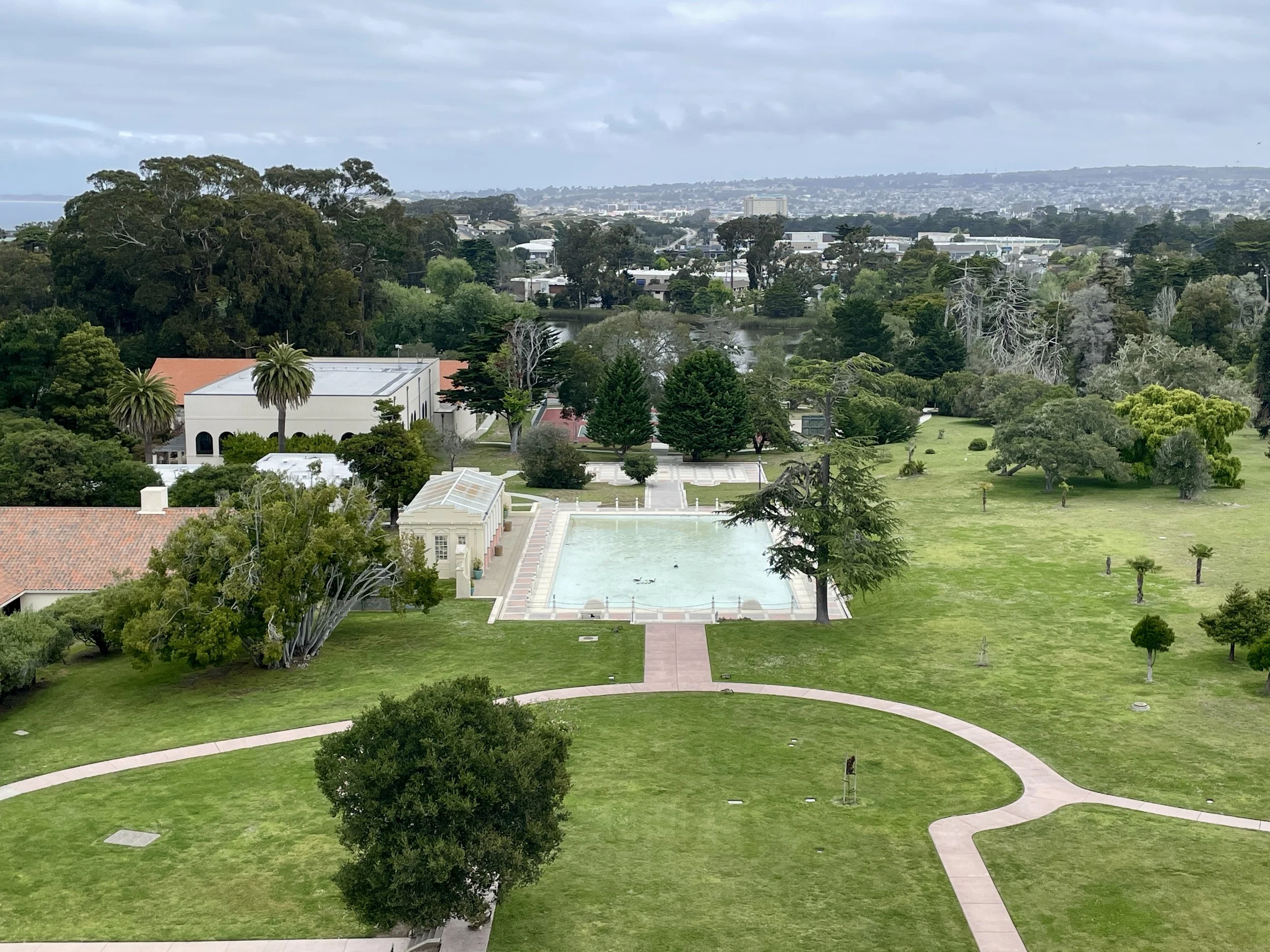
From this vantage point you can see the “Roman Plunge” Pool and Solarium, the Tennis Courts, and Del Monte Lake.
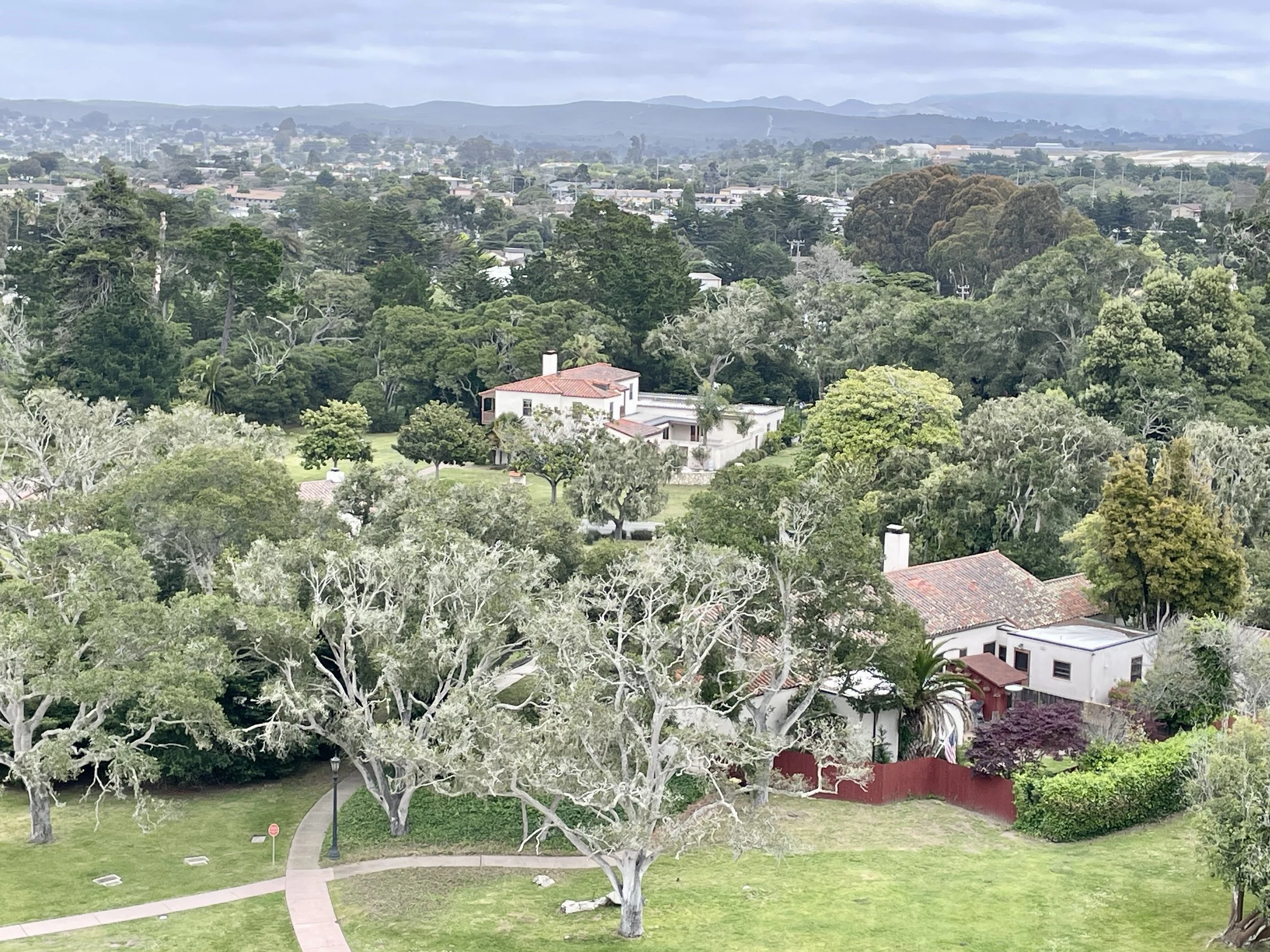
Here you can see some of the original walking trails that guests could follow through the Hotel Del Monte’s landscaped gardens, as well as some of the “Cottages” that served as private luxury accommodations, but which now serve as offices and residences for NPS leaders.
With time running out, we headed outside to get a closer-up view of the Roman Plunge, Solarium, and lake. I have a photo of Frank and Nora in a boat on the lake, but the Roman Plunge and Solarium were not built until 1915, ten years after they were there. Bits and pieces of the old Arizona Garden and Del Monte Botanical Garden still remain, but nothing like when Frank and Nora were there. They took quite a few photos in the gardens, which then featured giant saguaro cacti, other rare desert plants, and a 125-acre botanical garden, all designed by Rudolf Ulrich.
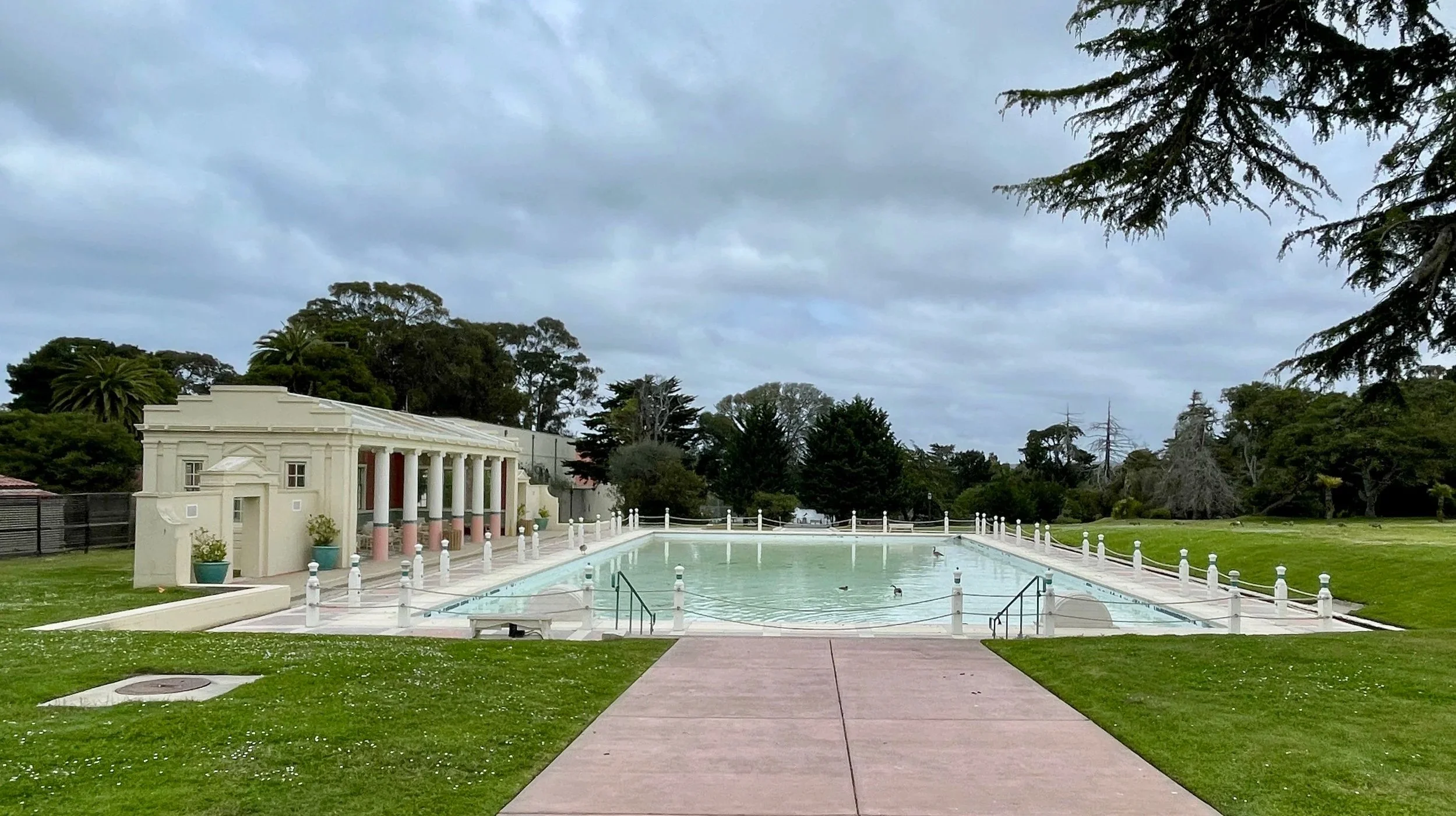
The Roman Plunge and Solarium, now being enjoyed by geese, was a favorite swimming pool for celebrity guests, including American Olympic swimmer, water polo player, and actor Johnny Weismuller, who played Tarzan in many films.
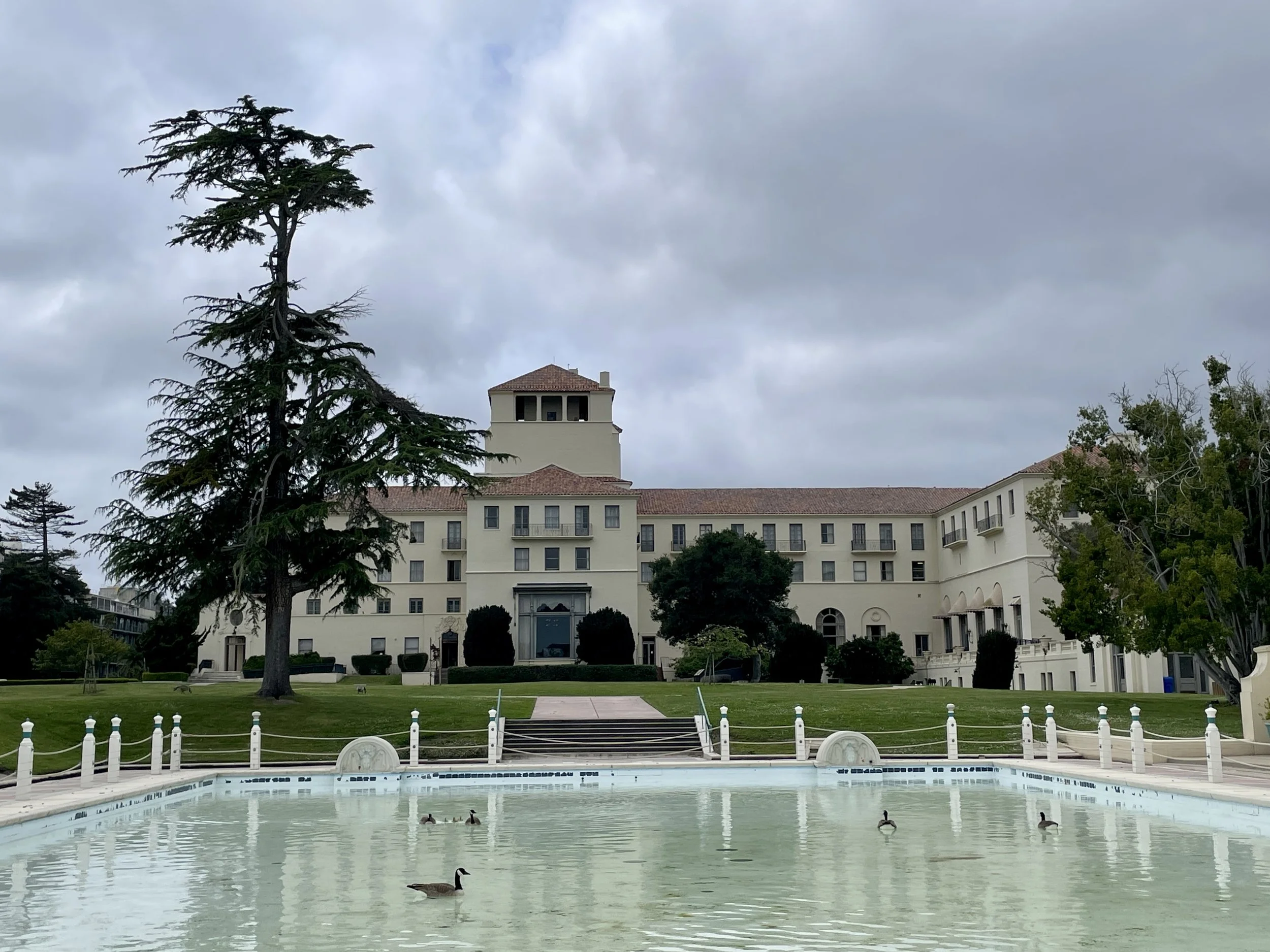
Here is a look back at the hotel from across the pool.
Just past the Roman Plunge, we came across the tennis courts and a sign that explained more about Hotel Del Monte’s recreational offerings. As it stated:
HOTEL DEL MONTE HISTORIC DISTRICT
Established in 1880 by the Pacific Improvement Company (PIC), the Hotel Del Monte rivaled lavish resorts in the eastern United States. Rudolph Ulrich, horticulturist and landscape designer for the PIC, designed the 7,000-acre landscape for the leisure of the Hotel Del Monte guests. The immediate grounds consisted of 125 acres of manicured gardens and recreational facilities, where guests could swim in oceanfront tanks, take carriage rides through the forest, and play lawn tennis and croquet. The Laguna Del Rey (today's Del Monte Lake) and the picturesque 17-mile drive stood out as scenic gems offering adventure and enjoyment to guests venturing outside the lush grounds of the hotel property.
Under Ulrich’s direction, laborers dredged a natural marsh to create the 15-acre Laguna Del Rey, which Ulrich bordered with a winding drive, branching pathways, and brightly colored flowers and plants. Ulrich raised tiny islands in the lake for avian nesting grounds and created shady nooks aside the lake for picnicking. The original 17-Mile Drive was a scenic roadway that began and ended in front of the hotel and traversed the Hotel Del Monte Park Reservation (today's Pebble Beach). Built and advertised by the PIC as the "grandest drive on the continent," the roadway allowed trekkers to explore local historical sites amid dramatic forest scenes and magnificent ocean views.
As one of the earliest sporting venues in the state, the Hotel Del Monte offered competition as entertainment. Hotel Del Monte staged regular polo, tennis, and golf tournaments. In the 1880s, the hotel promoted a dirt track for horse and automobile racing and blue grass championship polo fields. In 1897, the PIC built the 9-hole Del Monte Golf Links. Once praised as the best golf course in the West, it is now the oldest. Hosting the Del Monte Cup in 1898, the PIC expanded the course to 18 holes in 1903. British golf architect W. Herbert Fowler redesigned the Hotel Del Monte's golf course in 1920, and it is still in operation today.
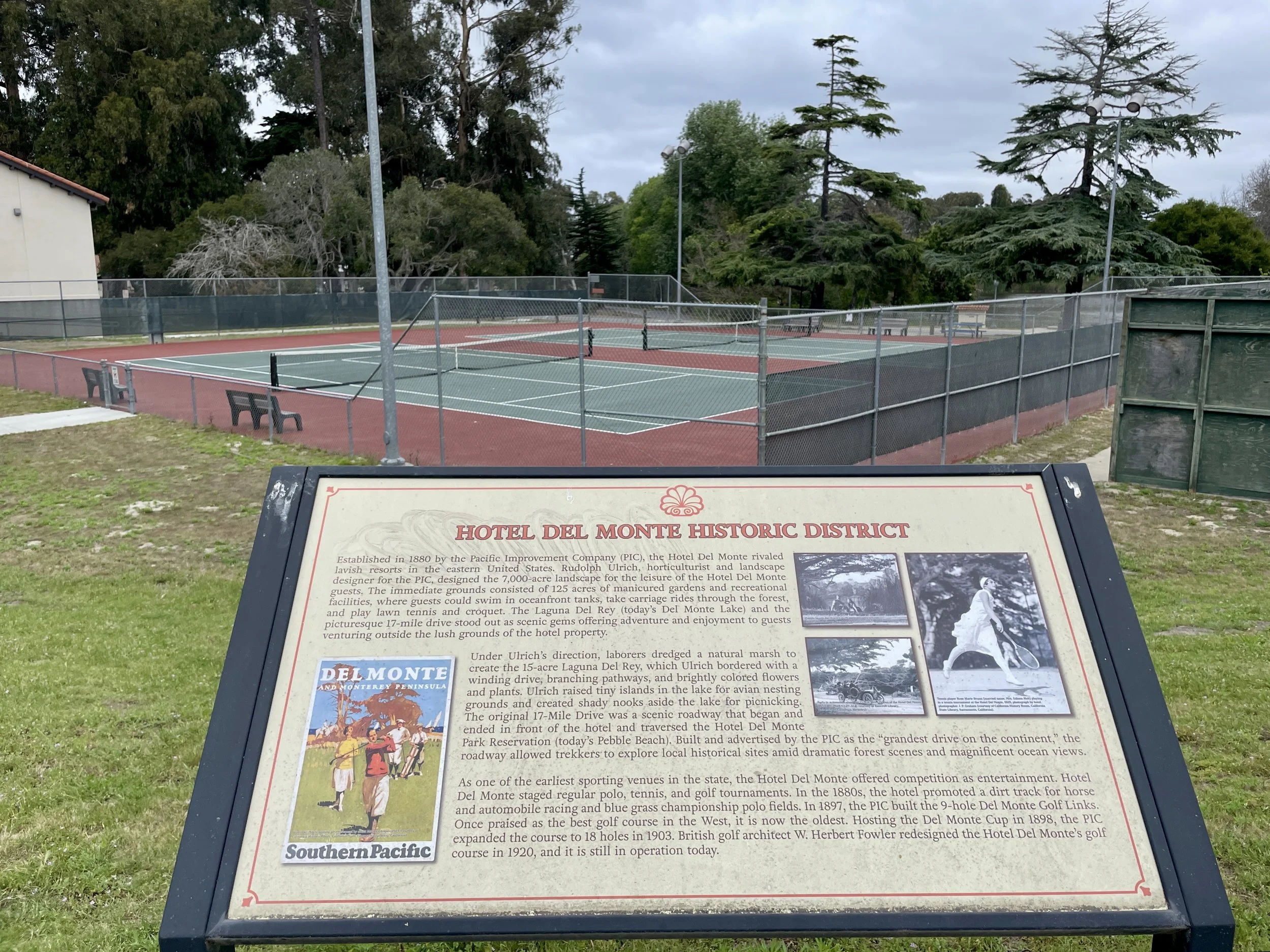
This sign details many of the recreational offerings at the Hotel Del Monte, including golf and polo tournaments, oceanfront tanks for swimming, carriage rides through the forest on the original 17-mile drive, lawn tennis and croquet, horse and automobile racing, and boating and bird watching on the Laguna Del Rey (today's Del Monte Lake).
As stated on NPS’s Dudley Knox Library website: “Guests arriving at Del Monte in the 1880's often had their first glimpse of Hotel Del Monte from the train. Laguna Del Rey, today's Lake Del Monte, was a prominent feature. The terraced garden leading from the hotel to the lake was always filled with intricate flower beds. And the walkway around the lake added to the charms of the hotel.” Frank and Nora clearly enjoyed exploring these walkways and taking in views of the lake.
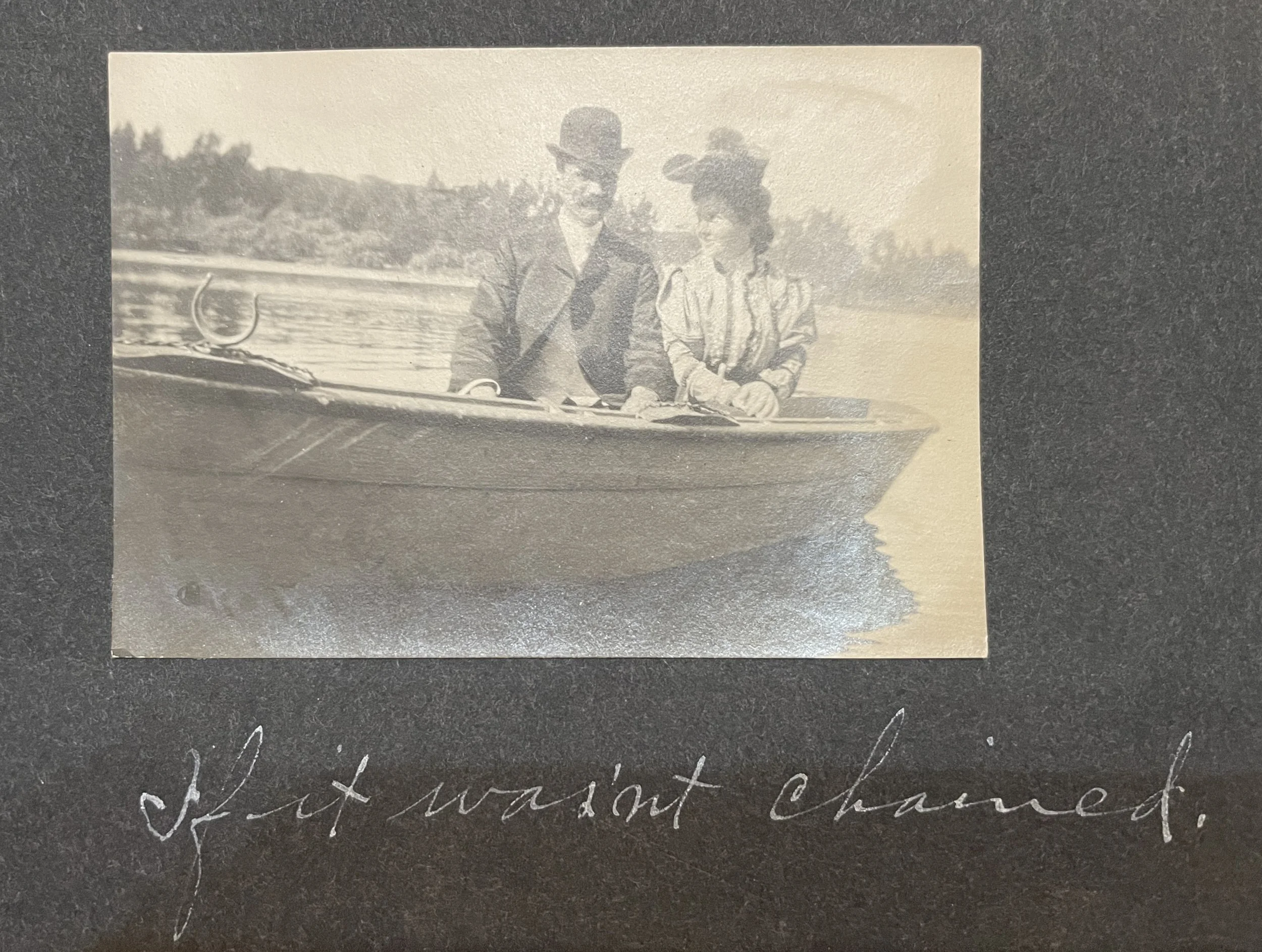
Frank and Nora on Laguna del Rey, scheming to go out in the boat “if it wasn’t chained.”
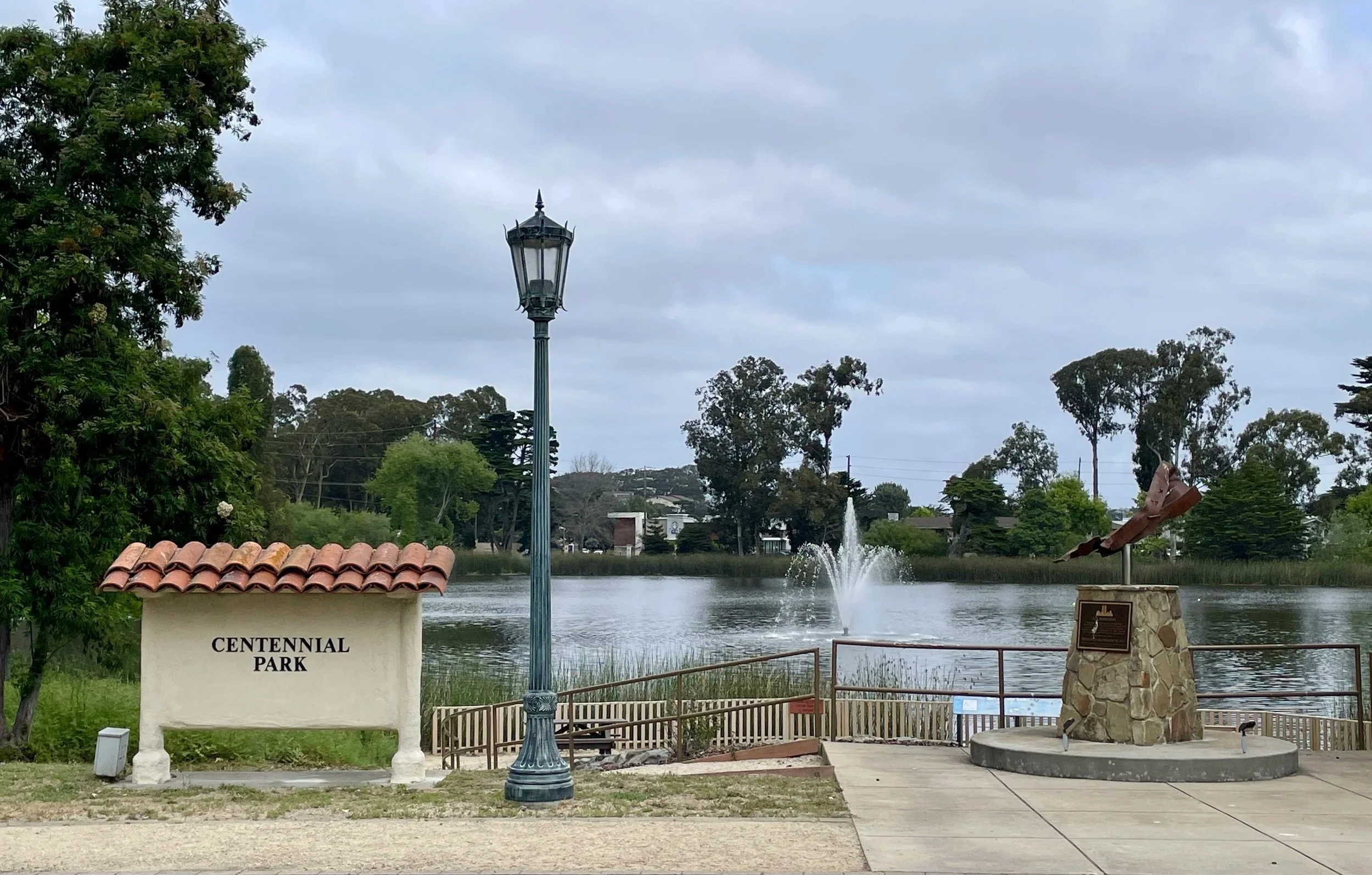
This view of the lake, now part of “Centennial Park,” also provides a look at the NPS’s 9/11 Memorial on the right, which includes steel salvaged from the rubble of the World Trade Center Towers.
Here’s a final photo, taken beside Del Monte Lake. I didn’t see any boats that I could sit in to capture a similar image to that taken by Frank and Nora, but I did enjoy seeing all the birds, the trees, and the glistening water.
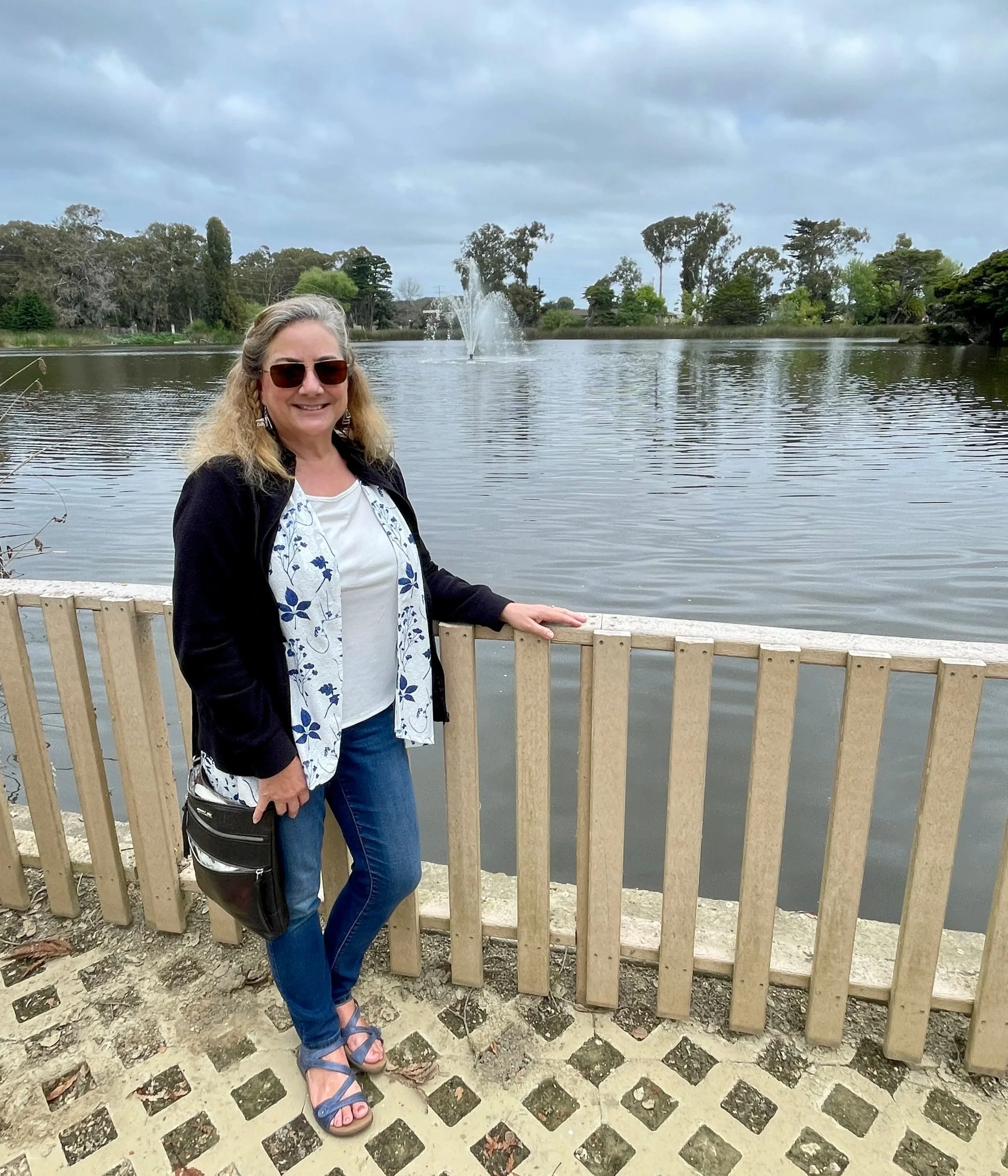
Here I am, standing beside Del Monte Lake (formerly Laguna del Rey) and feeling very thankful to Laurent for giving me this special tour of the old Hotel Del Monte.
I’m definitely glad I now have recent photos of the Hotel Del Monte for the “then and now” comparisons I will be presenting in my book talk at the Los Gatos Library on May 27 at 4 p.m. You can read more about my talk HERE if you would like to attend. For my local friends, I’d love to see you there! Books will be for sale after the talk and are also available on Amazon at THIS LINK.