An Early Look at Paso Robles – one of our Favorite Places to Visit – through my Great Grandmother Nora’s Letters and the Pioneer Historical Park & Museum
Chasing History: Exploring My Ancestral Roots - Blog Post #65
By Tonya Graham McQuade
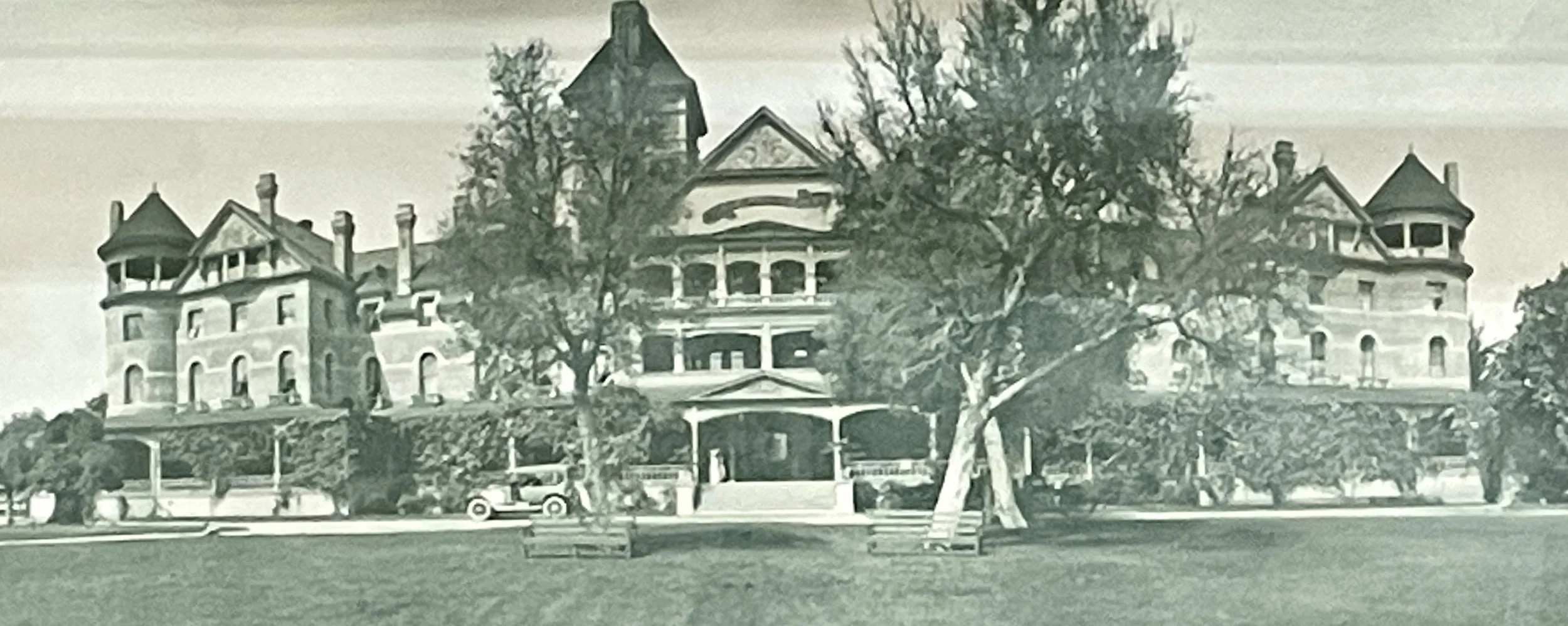
Early photo of the El Paso de Robles Hotel on display at the Pioneer Museum, located at 2010 Riverside Drive in Paso Robles
Those of you who know Mike and me know that we love to visit Paso Robles, which lies about 150 miles south of San Jose. Our first “get away” after we started dating included a stop at Paso Robles, at which time I was introduced to Tobin James Winery (where we have now been members for more than twenty years). On our next visit, we discovered how much we loved Peachy Canyon Winery and Castoro Winery (where we also became members).
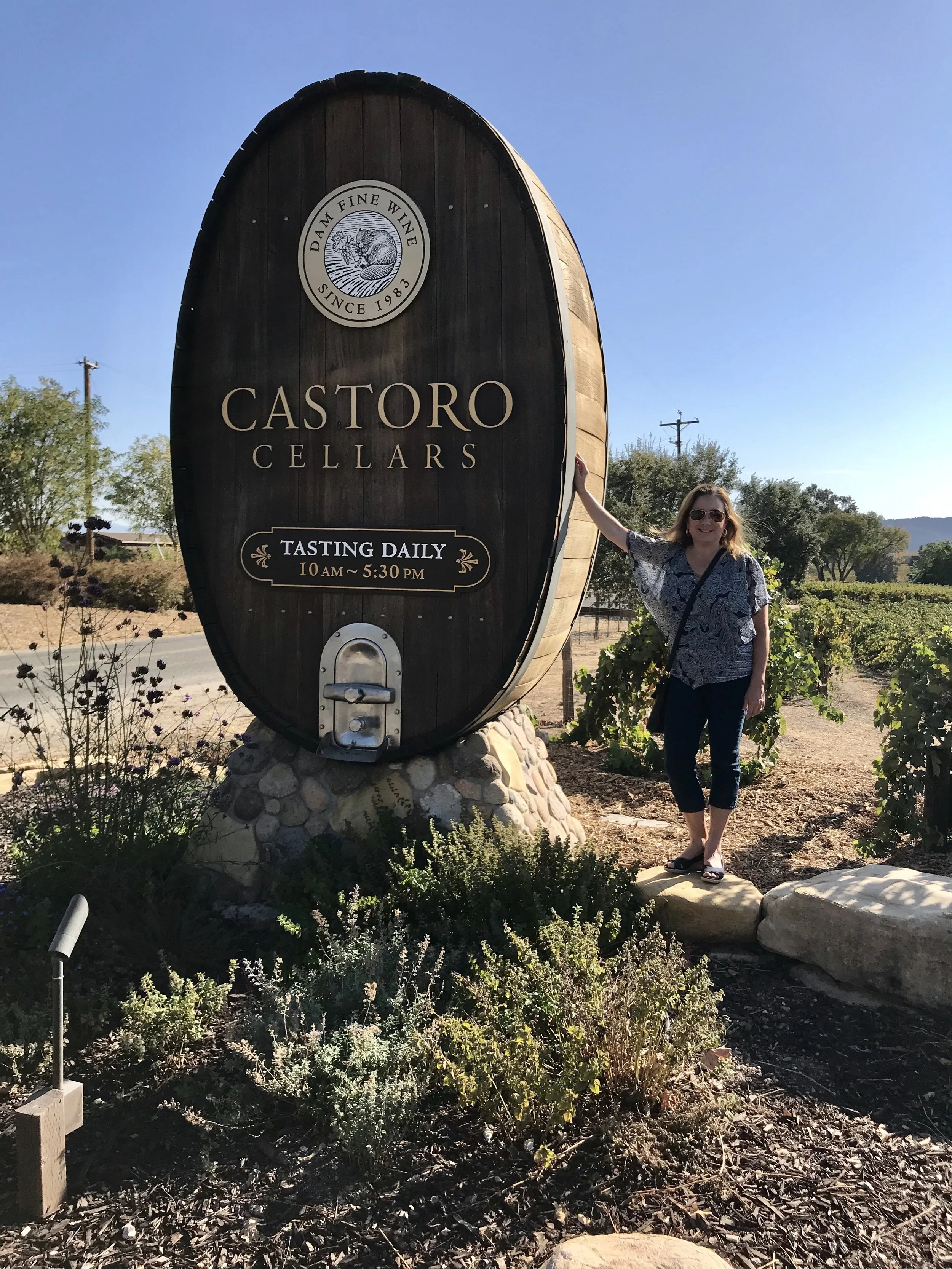
At the entrance to Castoro Cellars Vineyards & Winery, where we have been members for many years
On yet another visit, in April 2003, Mike proposed to me at Eberle Winery as we sat on the large back deck, looking out over the beautiful vineyards, feasting on our picnic lunch after going on a cave tour with “Bruce.” We have enjoyed many fun “wine tasting weekends” in the Paso Robles region with friends over the years, including two weeks ago, when we finally made it to the “James Gang Festival” party on March 20. What a wild and fun time that was!
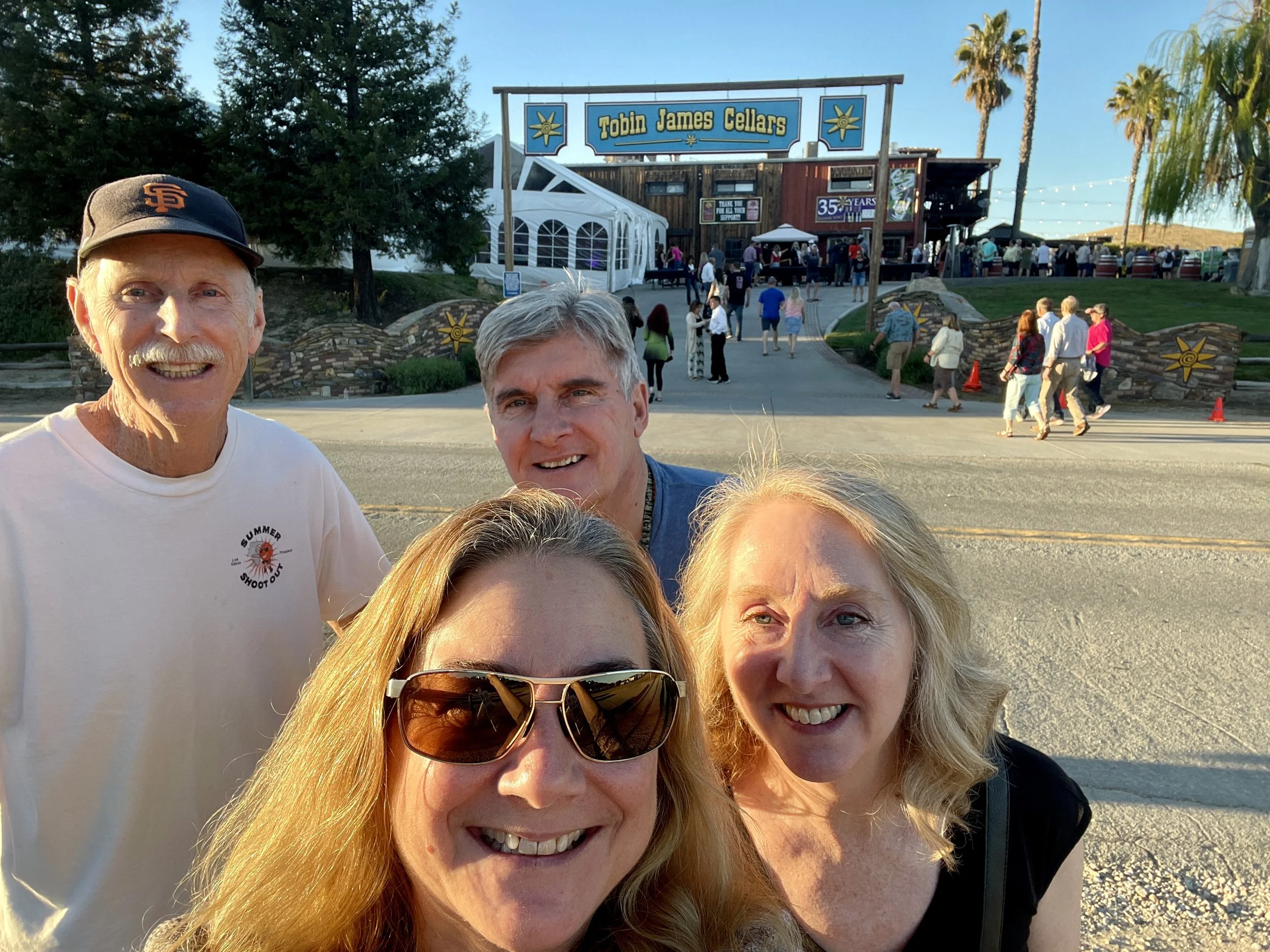
On our way to the “James Gang Festival” party at Tobin James Winery with Dan and Kathleen
So, you can imagine how excited I was when, reading through my great grandma Nora’s old letters, I discovered one in which she wrote about visiting Paso Robles. She was not there to wine taste, though – she was there to immerse herself in the sulphur baths that helped to make the place famous. Back then, doctors prescribed "taking the waters" at resorts like Paso Robles to treat everything from chronic pain to internal organ diseases, and Nora seems to have taken full advantage of those “curative powers” while she was there.
In a letter from Paso Robles, dated August 26, 1939, Nora wrote to her sister Lettie: “[Mattie and I] wish you were with us as we sojourn here at the hot springs and enjoy the benefits we are experiencing from a good rest and series of sulphur baths, massages, etc. I have had a good many bad headaches, back aches, spells of indigestion and what not in recent months and do not seem to get my old vim back…. I packed my suitcase and planned to be dropped off at Paso Robles…. We are having a fine time and are enjoying each other’s company and we are both being so lazy we can scarcely believe that we are ourselves. One night I slept 10 hrs. straight through. It is easier for Mattie to relax than for me to do so, and I am trying hard to take 10 days of real relaxation…. It is nearly time for me (us) to go to the Hot Springs and take my (our) bath, sweat, and massage. We should be clean at least after a week of this.”
Reading Nora’s descriptions made me want to know more about this “old” Paso Robles, and I was happy we finally got to do that during our recent sojourn, before the party at Tobin James, when we visited the Paso Robles Pioneer Museum. First, though, a few more words about both the benefits — and the problems sometimes caused by — sulphur (or sulfur, which I learned is the preferred scientific spelling) …
Mike’s and my only experience of the “sulfur” was when we were in Paso Robles back in late December 2003, soon after the magnitude-6.5 San Simeon Earthquake, which fractured underground rock layers and opened a geothermal spring next to the Civic Center. The fracture resulted in a stinking, steaming hot mud spring that created both a sensation and a stench around town. Mike and I found our dinner on the city square much less appetizing as the breeze wafted the rotten egg smell our way, but many in the past turned to those sulphur springs for their healing effects.
Besides releasing hydrogen sulfide gas in the City Hall parking lot and opening up what became known locally as "The Hole From Hell,” the earthquake caused significant damage to many of the unreinforced masonry buildings in Paso Robles’ historic downtown area. The 1892 Acorn “Clocktower” Building collapsed, trapping and killing two people parked in a car beneath its heavy brick debris. When we arrived on that Winter Break visit, rocks were still piled high in the street, and many buildings were closed or roped off. Our favorite breakfast location, “Joe’s Place,” had to serve people in a different section of the building in which they were then located due to safety concerns about their previous serving area (they have since moved). Wineries, too, suffered damage, with many broken bottles and barrels reported. Highway 46, which leads to many of those wineries, experienced cracks and shifts.
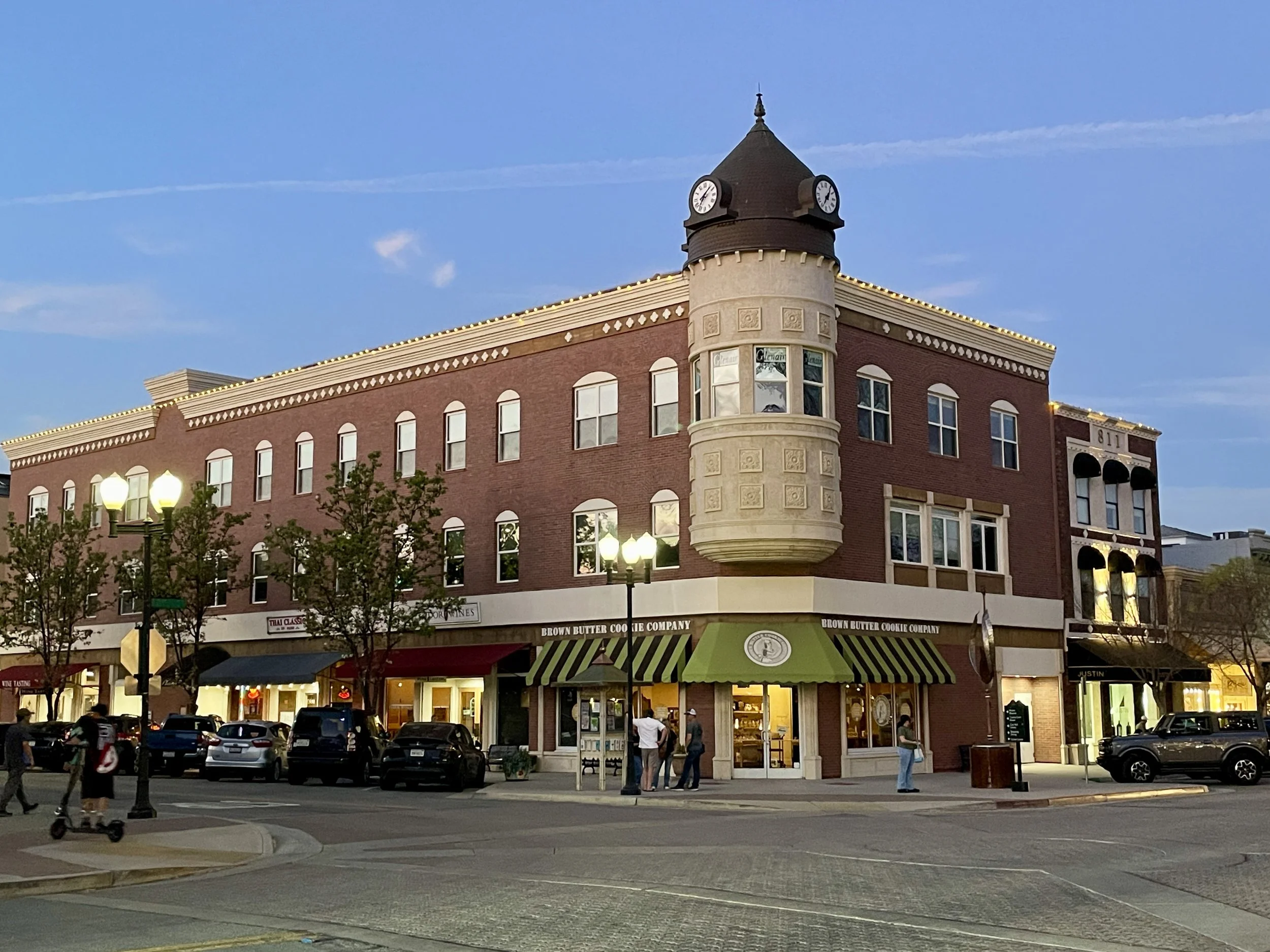
This is the rebuilt Acorn Building as it appeared in March 2026, with a replica clock tower at the top, after the original building collapsed in the 2003 earthquake. Photo by Tonya McQuade.
Initially, emergency crews thought the “horrible reek” brought on by the earthquake came from a busted sewer line, but when they called local geophysicist Floyd Butterfield to assess the situation, he recognized the smell immediately: the little “gusher” was a geothermal spring.
As explained in an NBC news report at the time: “Similar springs dot the Western states, concentrated in areas known as ‘hot spots’ like the area around Paso Robles. The springs are formed when rain or melted snow percolates through layers of porous rock and slips into the fissures of the earth’s crust. Hundreds of feet below Paso Roble’s City Hall parking lot, cold, sinking water meets a layer of rocks heated by magma. Once superheated, the water rises back up through this natural plumbing system, eventually spouting through the surface as a hot spring.” [1]
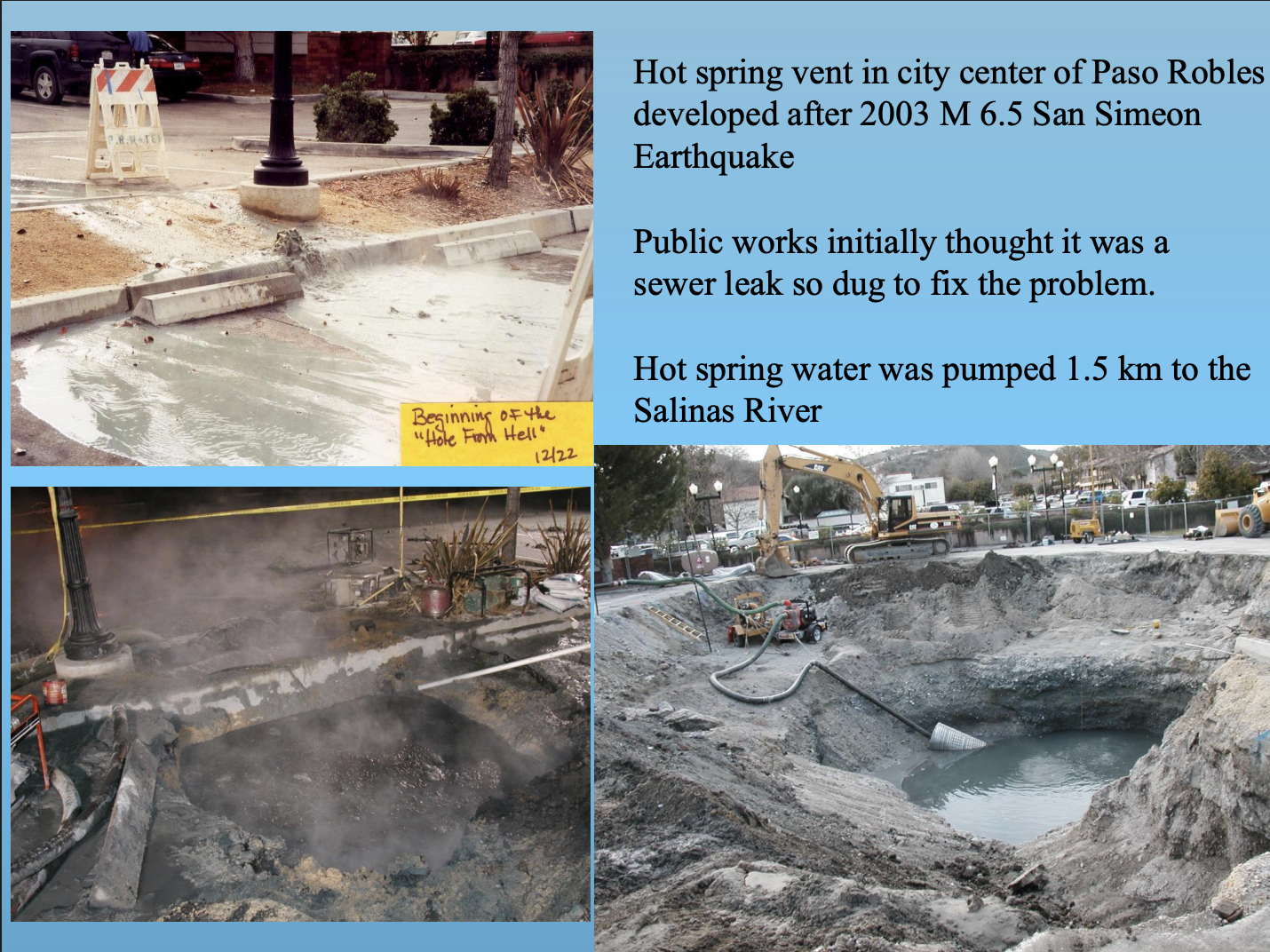
Here are some views of the “Hole From Hell” that was left behind after a quake hit Paso Robles Dec. 22, 2003. [2]
“Paso Robles was founded as a resort town in the late 1800s, and for decades downtown was dotted with hot mineral and mud baths. But as their popularity faded, the baths were closed, the springs covered, sealed, and all but forgotten. That is, forgotten until December’s quake cracked open a deep fissure, allowing 110 degree water to spout from the parking lot at about 350 gallons a minute — enough to fill six Olympic-sized swimming pools a day.” [3]
That’s a LOT of water! And that deep fissure eventually grew into a giant hole 20 feet deep and 100 feet across, taking up half of the City Hall and Library parking lot. Mike and I passed the fenced off area on several of our visits between 2003 and 2010 since we usually stay at Melody Ranch Motel, which is just across Spring Street. Initially, after first directing the water into the sewer, “city officials created a temporary fix by excavating the parking lot and pumping the sulfur into the dry Salinas River bed.” [4]
The more permanent fix eventually involved installing an underground vault to catch the water, cooling the hot water to prevent environmental damage to vegetation or wildlife, and piping it to a new disposal area near the Salinas River. It took seven years before they were finally able to fill the giant sinkhole/excavation pit in the damaged parking lot, at a cost of approximately $826,000, underscoring “the bureaucracy involved in the project: California Department of Fish and Game, the U.S. Fish and Wildlife Service, and the Army Corps of Engineers, among others, all had to give their official approval.” [5]
The healing properties of the thermal waters in and around Paso Robles have long been recognized. The native Salinan People utilized both the natural mud baths and warm springs for curative purposes and called the place “Heaven’s Spot.” It was they who introduced Spanish Franciscan padres to these natural hot sulfur springs in the 1700s. As far back as 1795, people spoke and wrote about the location as “California’s oldest watering place,” and by 1868 “people were coming from as far away as Oregon, Nevada, Idaho, and even Alabama. Besides the well-known mud baths, there were the Iron Spring and the Sand Spring, which bubbles through the sand and was said to produce delightful sensations.” [6]
Many “healing properties” were credited to the sulfur springs. These included providing anti-inflammatory and pain relief for conditions such as arthritis, fibromyalgia, and rheumatism; improving skin health for conditions such as psoriasis, acne, and eczema; possessing circulatory and vascular benefits by improving blood flow, oxygen delivery, and the removal of metabolic waste; acting as a natural painkiller for sore muscles and joints; helping with detoxification in the liver; and offering respiratory relief by opening airways and treating respiratory issues like asthma and bronchitis.
It was gold miners and brothers Daniel and James Blackburn who purchased the 26,000-acre El Paso de Robles Rancho in 1856 from Petronilo Rios, the Mexican grantee, for $8,000. It included all of what is now Templeton and Paso Robles, as well as the land in between and the surrounding area. In 1864, they “constructed a small hotel and dug a pool near the hot springs, enclosing it in a small building,” according to the “Beginning of Paso Robles” display at the history museum.
Another man who came to California in 1849 to mine for gold, Drury Woodson James, soon figured out there was more money in supplying beef to miners than searching for gold. By 1860, he bought 10,000 acres in the La Panza area near the Carrizo Plains and stocked it with 2,500 cattle. In 1866, Drury James and Daniel Blackburn married sisters, thus becoming brothers-in-law and soon business partners (read more on the founding of Paso Robles HERE).
.At the time, Paso Robles consisted of a simple bathhouse, a hotel that housed 50 guests, a few little shanties, a stage coach barn, and a few nearby houses. [7] Also around this time, Drury James received some interesting visitors: his outlaw nephews Frank and Jesse James. The James brothers, who were “laying low” after a recent robbery, are believed to have worked as cowherds on their uncle’s La Panza Ranch between 1868-69, with Jesse going by the name “Scotty”. He was then recovering from gunshot wounds he received during his last hold up and was supposedly helped by Paso Robles’ healing waters. [8] You can read more about Frank and Jesse James’s time in Paso Robles HERE).
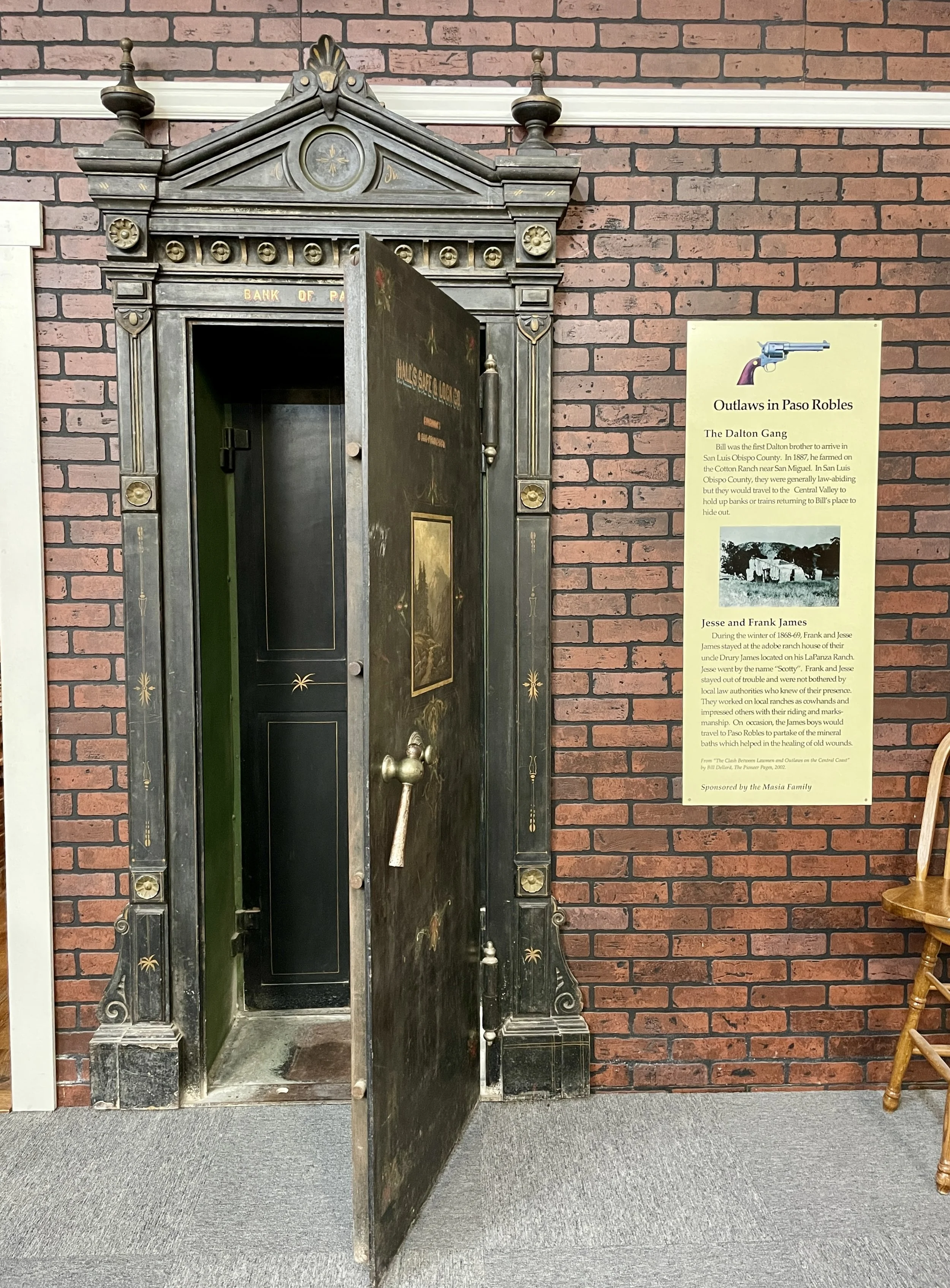
This “Outlaws in Paso Robles” display is part of the Paso Robles Pioneer Museum. Photo by Tonya McQuade.
In 1869, Drury James bought a half interest in the Paso Robles hotel and bathhouse and the surrounding 4,300 acres. He also moved to the village that year and began promoting Paso Robles as a health resort. His house appears in the illustration below in the bottom left corner.
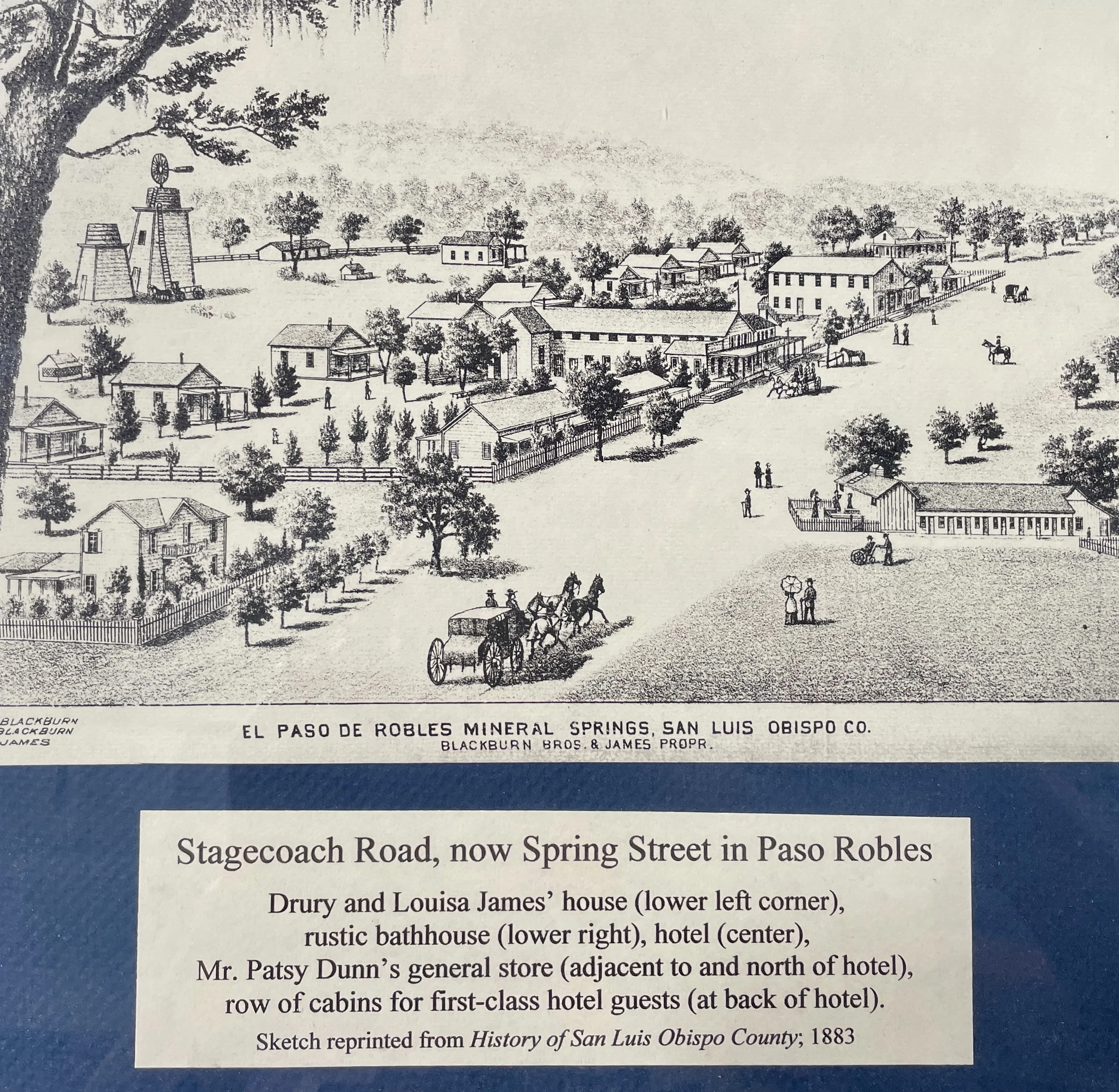
This museum display identifies some of the buildings that appeared along “Stagecoach Road,” now Spring Street, in 1883. Paso Robles Pioneer Museum Photo Collection.
In 1882, he and the Blackburn brothers issued a pamphlet titled “El Paso de Robles Hot and Cold Sulphur Springs and the Only Natural Mud Baths in the World.” The town had grown quite a bit by then, adding “first class accommodations, a reading room, barber shop, and telegraph office; a general store, a top-of-the-line livery stable, and comfortably furnished cottages for families that preferred privacy to quarters in the hotel. Visitors could stay in touch with the rest of the world, as there were two daily mails, a Western Union telegraph office, and a Wells Fargo agency with special rates for guests.” [9]
After learning that the Southern Pacific Railroad would arrive in Paso Robles in 1896, James and the Blackburn brothers laid out the town (which was officially incorporated as a city in 1889), including the city park that still stands today, then threw a barbecue, auctioned off lots, and began making plans for a large bathhouse and magnificent, three-story hotel. [8] They erected the Hot Sulphur Springs Bathhouse in 1888 over the sulphur springs located on the corner of what is now Spring and 10th Streets, where the “Hole from Hell” later formed after the earthquake. It had a large plunge pool and 37 bath rooms [10].
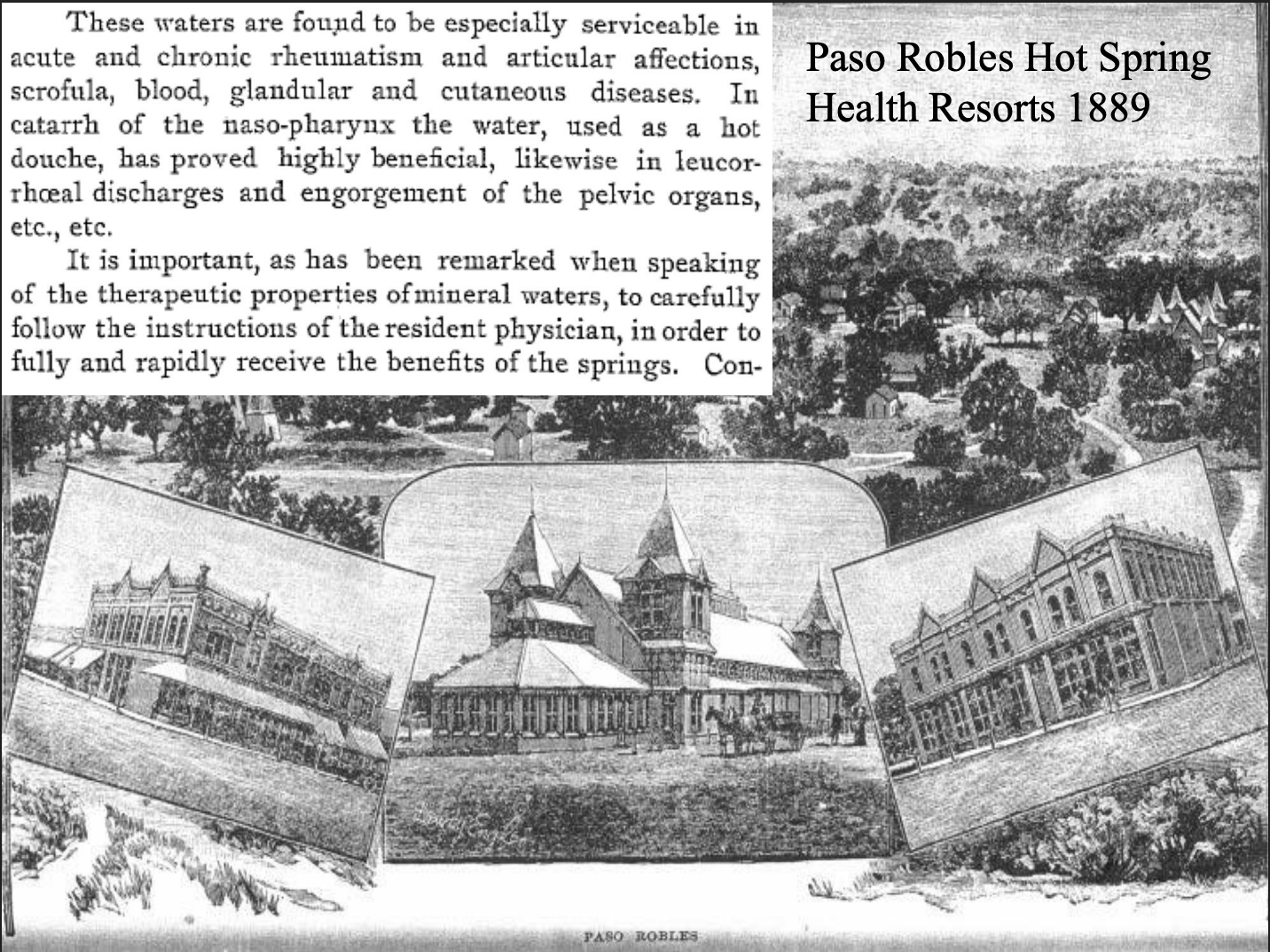
The 1888 Bathhouse appears in the middle photo here; it burned down in 1913. [11]
Work began on the Hot Springs Hotel, later named the El Paso de Robles Hotel, a year later. It opened in 1891 to great fanfare and included a 16-foot veranda around three sides of the hotel, circular towers, a large solarium, parlors, separate men’s and women’s billiard rooms, reading rooms, club meeting rooms, a saloon, a dining room, and a barbershop, and each room had its own fireplace. The hotel also added its own Hot Springs bathhouse and plunge in 1906.
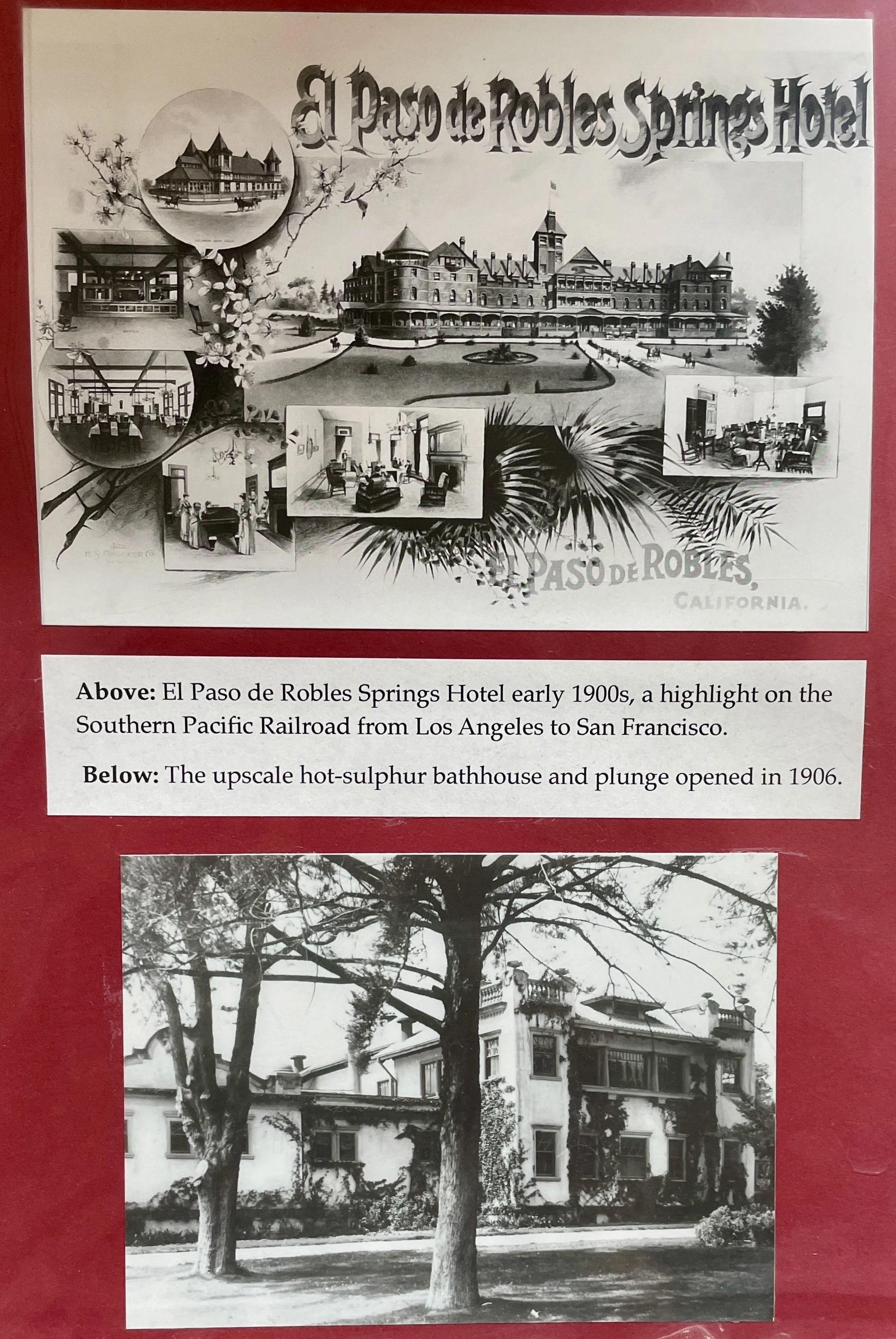
This museum display provides quite a few views of the hotel and its interior. Paso Robles Pioneer Museum Photo Collection.
Sadly, the hotel burned down in 1940. It has since been replaced by the Paso Robles Inn, where we have eaten breakfast and explored many times since it is very near to the hotel where we stay (we like to spend our money on wine when we are in Paso Robles – lol – so usually stay in more modest accommodations). That means, Nora Traughber, who visited in 1939, was among the last visitors who got to enjoy that original hotel.
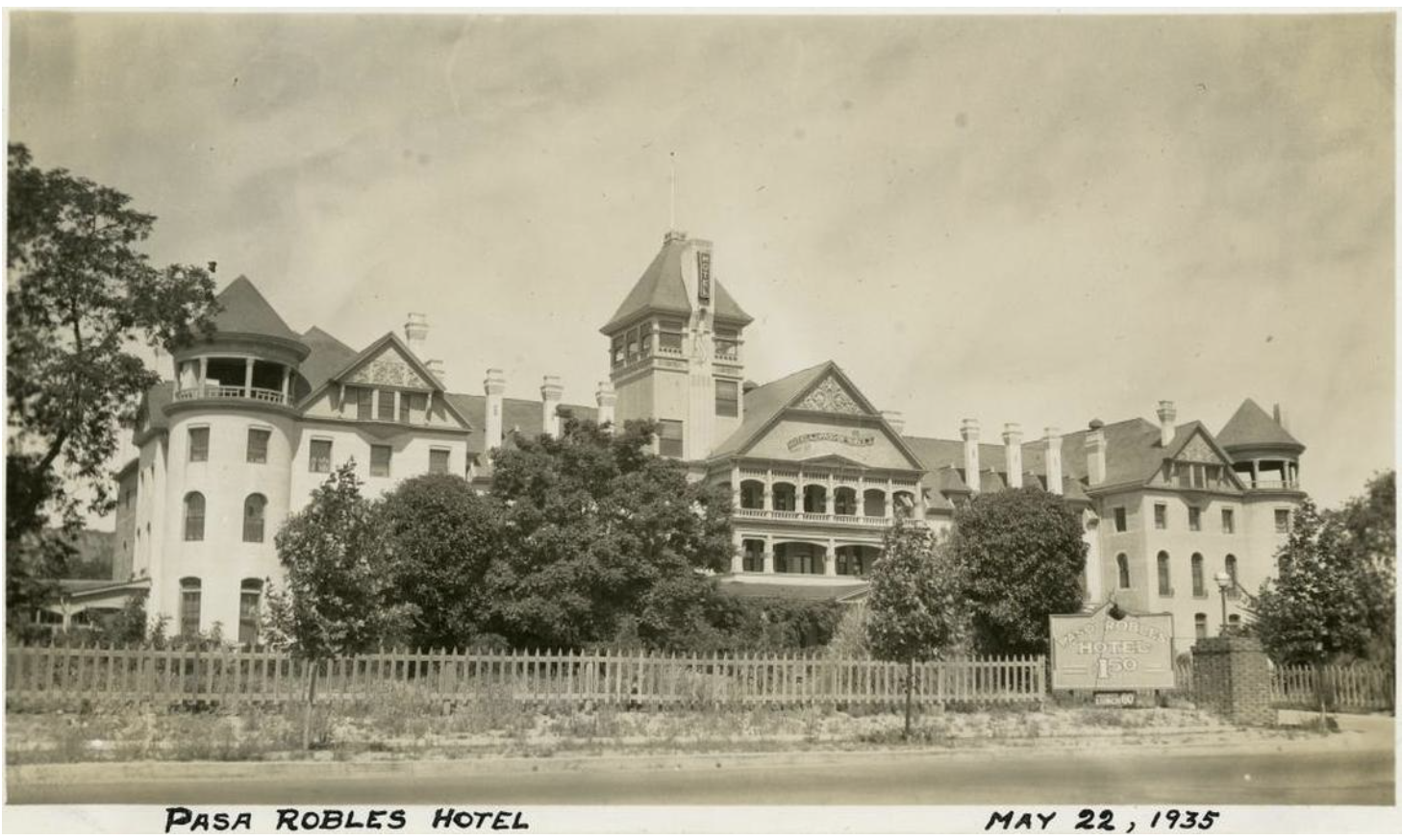
This is the hotel as it likely appeared when Nora visited in 1939. Paso Robles Pioneer Museum Photo Collection.
Only the Grand Ballroom survived the fire, and it remains standing today — having survived the 2003 earthquake as well thanks to retrofitting the building had received in 2000. Fortunately, no guests were harmed in the blaze, but “the night clerk who discovered the fire suffered a fatal heart attack immediately after sounding the alarm.” [12] Within months, plans were initiated for a new hotel, and by February 1942, the new Paso Robles Inn welcomed its first visitors.
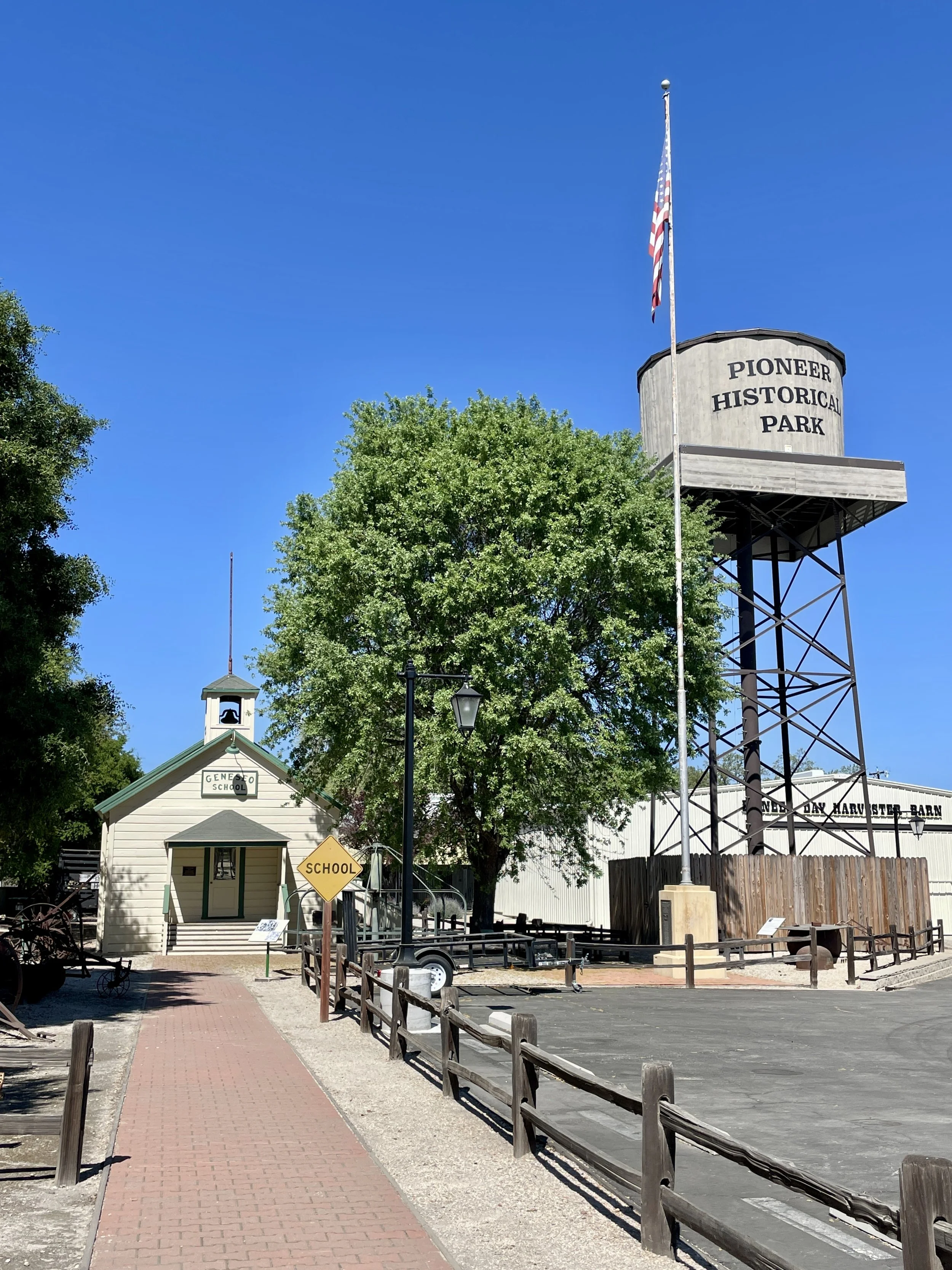
The Pioneer Historical Park includes an old jailhouse, one-room school building, harvester barn, and lots of farming equipment. Photo by Tonya McQuade.
We spent a couple hours going through the Pioneer Museum and could have spent longer (as is almost always the case with us) except it closed at 4 p.m. (plus, we had to meet up with Dan and Kathleen to get ready for the party). Besides its many historical photos and explanations, the museum features displays about agriculture; dairy farming; ranching; wine making; local families; education and schools; home life; clothing, hats, and shoes; and businesses. It also includes lots of old cars, buggies, tractors, and bicycles; branding irons and tools; crafts and woodworking; Native American artifacts; and one of the largest public collections of barbed wire in California (I never knew there were so many types!).
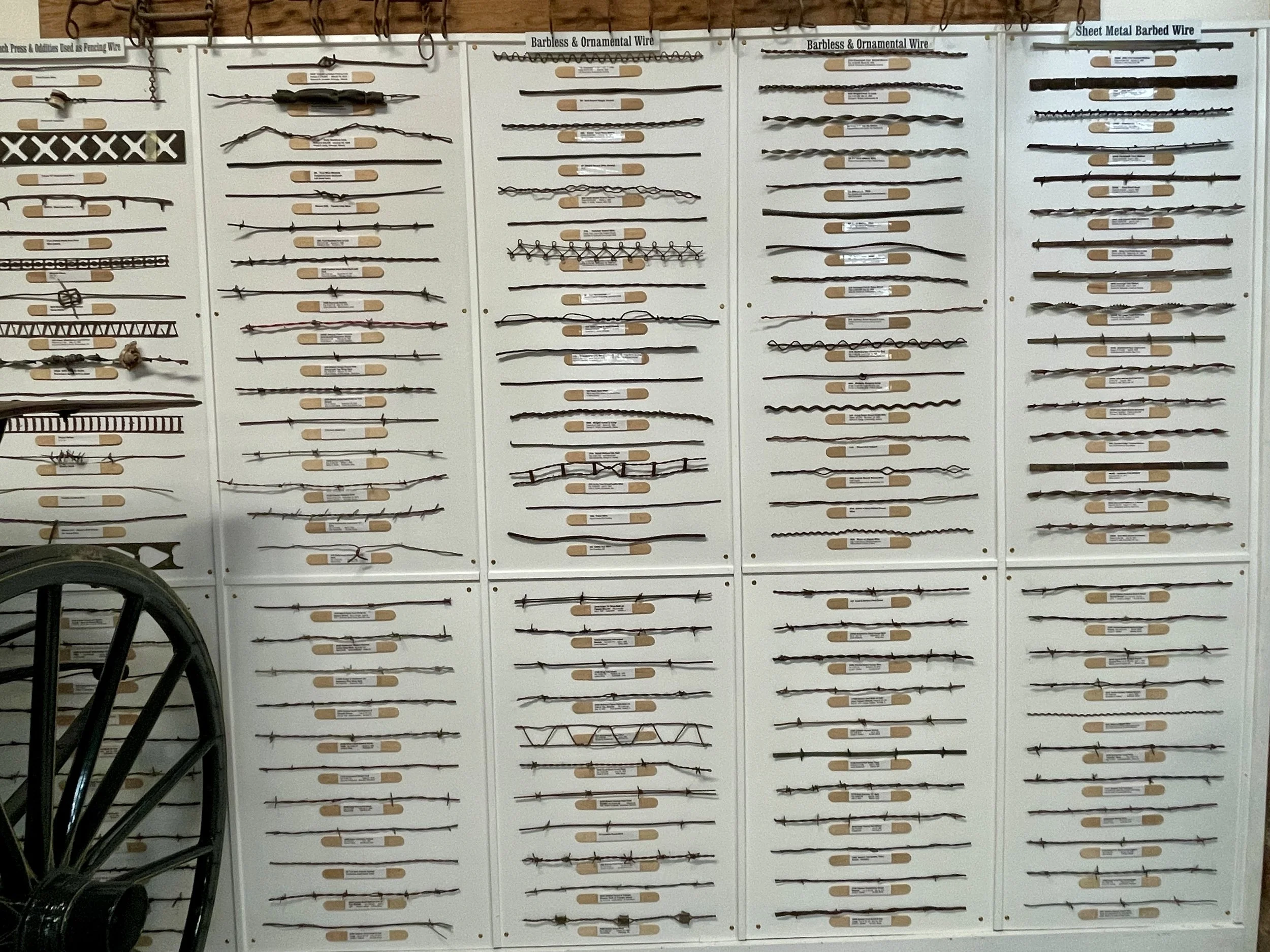
This museum exhibit displays one of the largest collections of barbed wire in California - who knew there were so many types? Photo by Tonya McQuade.
One display you can’t miss as you approach the back of the museum is the large “hotel facade” that dominates the room. A couple of original hotel chairs adorn the porch, and photos and explanations about the hotel fill the nearby display cases. I’m glad to know my great grandmother had the opportunity to experience the hotel in its heyday and that she, too, found joy in visiting Paso Robles. I’m not sure if she visited again after that week in 1939, but I know that Mike and I certainly have plans to return — and maybe next time, we’ll visit one of the hot springs that I now know are still in operation!
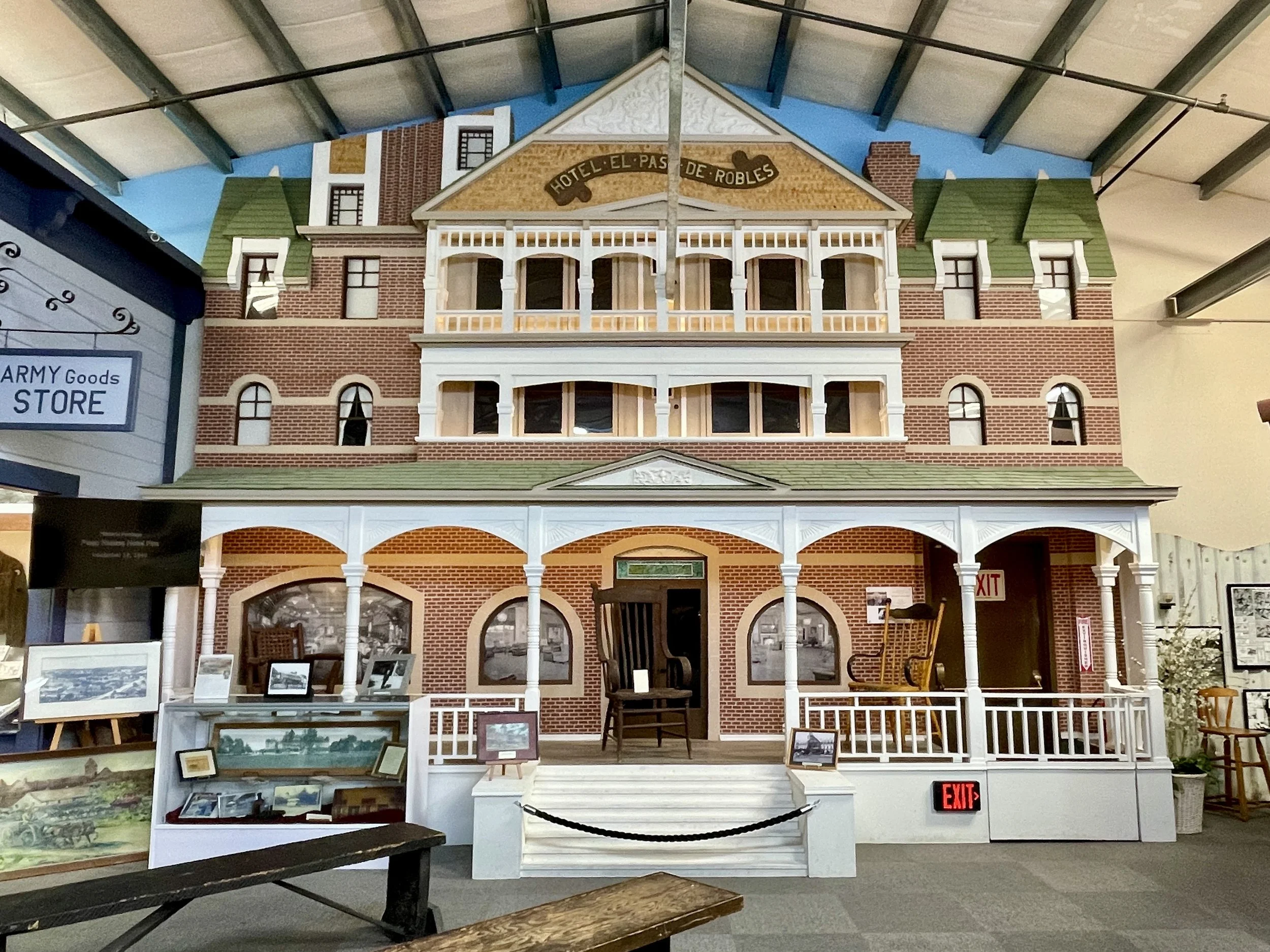
This facade of the Hotel el Paso de Robles appears in the Paso Robles Pioneer Museum. Photo by Tonya McQuade.
Endnotes:
Associated Press. “Quake left natural gift: a hot spring at City Hall / The earthquake that wrecked a California town did leave a gift from nature: a geothermal hot spring right in the parking lot of city hall.” NBC News, 9 Mar 2004, https://www.nbcnews.com/id/wbna4485599.
Rytuba, Jim and Daniel Goldstein. “Paso Robles Groundwater Basin: Effects of Geothermal Waters on Water Quality and Availability.” U.S. Geological Survey, Menlo Park, CA.
https://www.vineyardteam.org/files/resources/Rytoba_Geothermal%20Waters.pdf.
Associated Press. “Quake left natural gift: a hot spring at City Hall / The earthquake that wrecked a California town did leave a gift from nature: a geothermal hot spring right in the parking lot of city hall.” NBC News, 9 Mar 2004, https://www.nbcnews.com/id/wbna4485599.
“Paso Robles ready to fill in hole created by 2003 earthquake.” Cal Coast News, San Luis Obispo County, CA, 21 Mar 2010, https://calcoastnews.com/2010/03/paso-robles-ready-to-fill-in-hole-created-by-2003-earthquake/.
Ibid.
“History of Paso Robles - The Waters.” City of El Paso de Robles, Paso Robles, CA, https://www.prcity.com/388/The-Waters.
Middlecamp, David. “Paso Robles' founders: A vigilante, a capitalist and Jesse James' uncle.” The Tribune, San Luis Obispo County, CA, Updated 4 Apr 2014, https://www.sanluisobispo.com/news/local/news-columns-blogs/photos-from-the-vault/article39472611.html.
“Jesse and Frank James.” Paso Robles Historical Society, 2026, https://www.pasorobleshistorymuseum.org/jess.
“History of Paso Robles - The Waters.” City of El Paso de Robles, Paso Robles, CA, https://www.prcity.com/388/The-Waters.
Ibid.
“History of the Paso Robles Inn.” Brochure published by Paso Robles Inn, Paso Robles, CA.