Exploring Mike's Family History in San Francisco
Chasing History: Exploring My Ancestral Roots - Blog Post #58
By Tonya McQuade
Back in August 2024, I wrote a blog post about my husband Mike’s family history after our visit to Oregon City, Oregon, where several generations of his family had lived over the years (see THIS LINK). It was there in Oregon City that his grandfather, Thomas Victor McQuade, was born to Michael and Ella (Walker) McQuade on 14 Jan 1900. The three of them lived on Railroad Avenue, according to the 1900 U.S. Census, with Michael working as a “woolen weaver.”
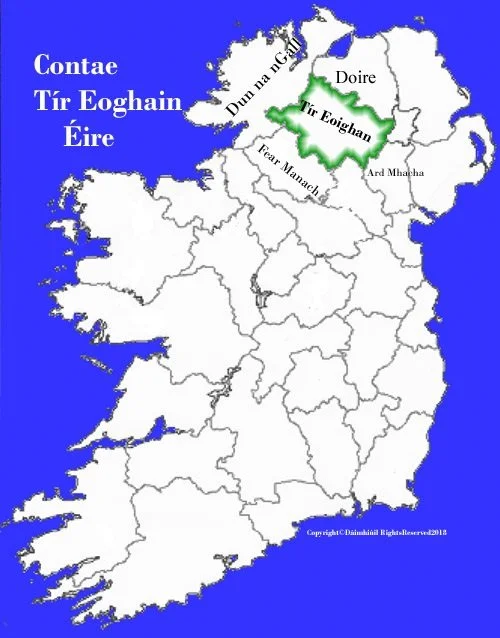
Map of Tyrone County, Ireland - one of the six counties of Northern Ireland
Michael, along with his mother and six siblings, immigrated from Tyrone County, Ireland, to Canada in 1881 when he was six years old. They departed from Londonderry on May 27, 1881, for a predicted 32-day journey on the Circassion, bound for Quebec, according to Passenger Records. Their father Thomas must have traveled separately – I cannot find him in the Passenger Records, but he is later there with them. Perhaps he came before them to find a job and a place to live.
The seven children ranged in age from one to eleven, according to the Passenger Records, but those ages do not all match up with the birth records I found on RootsIreland. It’s possible that they “fudged” the ages a bit since traveling across the ocean was cheaper if you were under 12. It’s also possible, though, that someone recorded the dates and/or ages inaccurately, as often happens in genealogical records – just one of the things that can make this kind of research difficult.
The family eventually settled in Peterborough, Ontario, Canada, for that’s where son Patrick was born in March 1882. Many Irish people lived in Peterborough at the time working for the railroad, so perhaps that is what Thomas did. A note on Thomas’s obituary mentions it should also be printed in “Peterboro, Ontario,” and a note on Maria’s 1905 obituary says to also print copies in Ontario, Canada, and Michigan newspapers, so perhaps the family lived in each of those locations for a while.
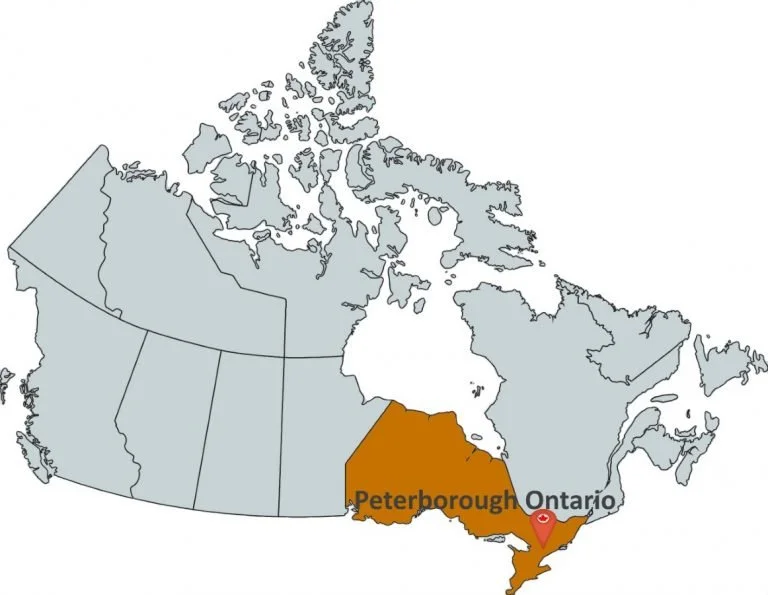
Mike’s great-great grandparents lived in Peterborough, Ontario, for a time with their family.
A “U.S. Index to Alien Case Files” record attached to Michael’s brother Patrick says he arrived in San Francisco on March 20, 1890, so it’s likely the whole family moved there at that time. What is certain is that father Thomas died in San Francisco on August 2, 1893, while living at 2616 Folsom Street, as shown in the obituary below. Maria was then on her own with eight children, though some of the older ones had by then started working and/or getting married.
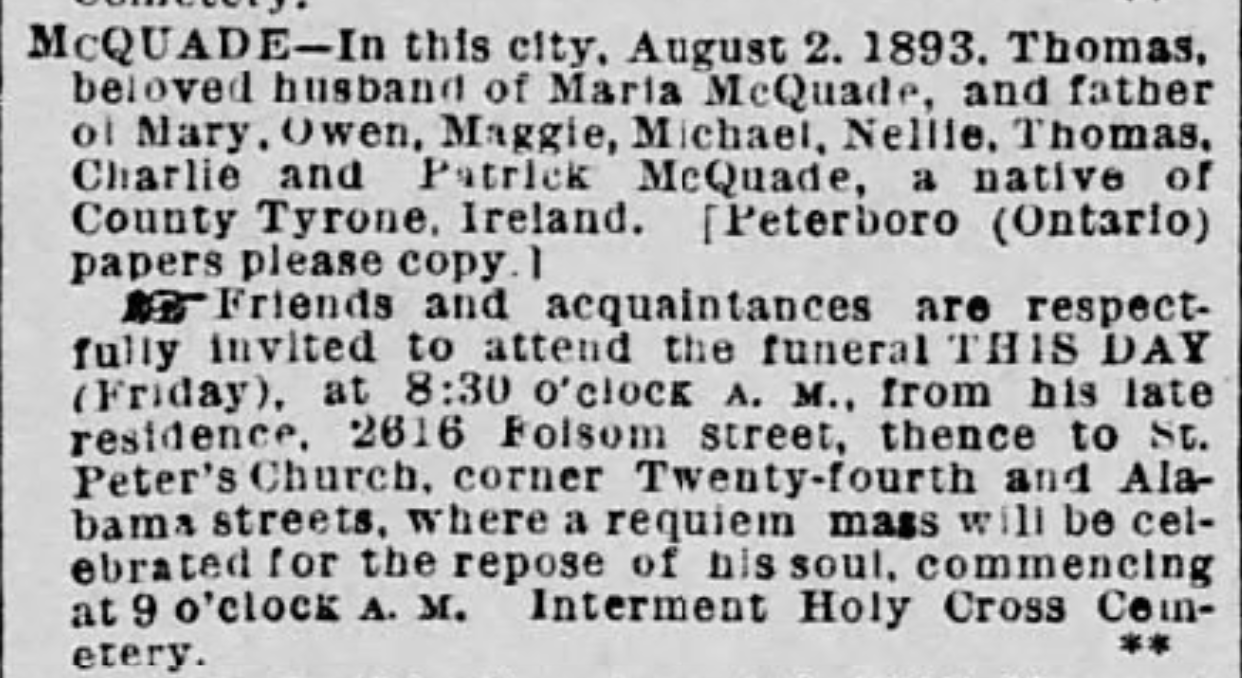
Obituary for Thomas McQuade (b. 1830 in County Tyrone, Ireland) in The San Francisco Call Bulletin, dated Aug 04, 1893
By 1899, Michael had made his way to Oregon, for that is when he married Ella Walker in Pendleton, Oregon. They set up their first home in Oregon City, 215 miles west of Pendleton, where he worked in the wool industry. They must have moved around quite a bit in the following years, for daughter Alice A. McQuade was born in 1902 in California; son Tyrone Michael McQuade, in 1906 in Portland, Oregon.
In the meantime, back in San Francisco, mother Maria moved to the Noe Valley neighborhood. According to what I read online, “The neighborhood owes its name to Jose de Jesus Noe (1805-1862), one of the last Mexican alcaldes (mayors) of Yerba Buena. Upon the American takeover of Yerba Buena (then renamed San Francisco) in 1846, Noe received a 4,443-acre land grant that encompassed a sixth of present-day San Francisco, including present-day Noe Valley, the Castro, Glen Park, Diamond Heights, West Portal, and several other city neighborhoods. In the 1850s, vegetable farms and cattle and sheep ranches dotted the valley floor. Noe reportedly presided over his vast cattle spread, called Rancho San Miguel, from a Grand View homestead he built for $30,000 (a considerable sum in those days). Over the next 100 years, boosted by the extension of the Castro Street cable-car line to 26th Street in 1887, the sparsely populated pastureland called "Horner's Addition" gave way to rows of two-story Victorians, the homes of native Californians and working-class immigrants of Irish, German, Italian, Russian, and Scandinavian descent. As the carpenters, tailors, bakers, firefighters, teachers, and longshoremen moved in, the community renamed itself Noe Valley.” [1]
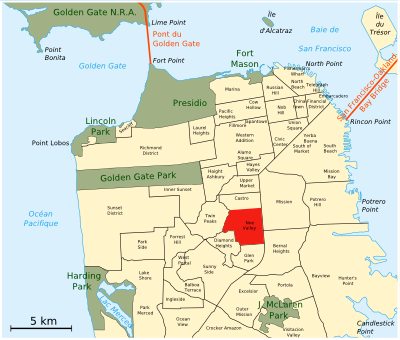
Map showing location of Noe Valley - Wikipedia Public Domain.
According to Maria’s obituary, she was living at 237 28th Street, between Church and Sanchez, when she died on May 23, 1905. At that time, sons Owen, Michael, Charles, and Patrick were still living, along with daughters Mary, Maggie, and Ellen, but another son, Thomas, had already passed away in 1899. All three – father Thomas, mother Maria, and son Thomas – were buried at Holy Cross Catholic Cemetery in Colma (but more on that later).
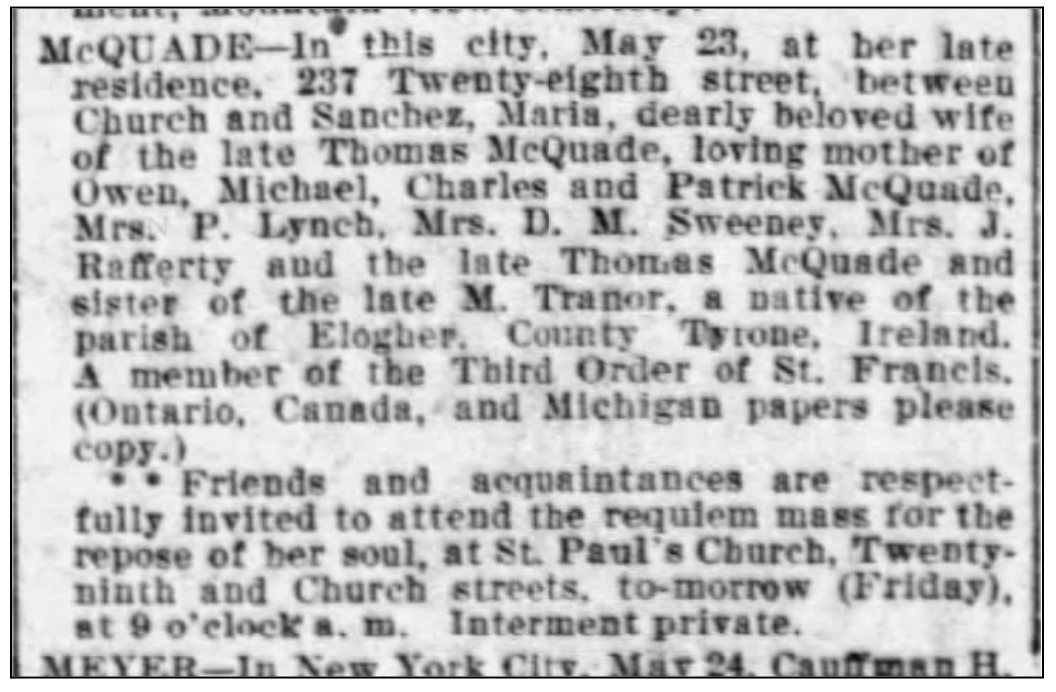
Maria McQuade’s Obituary in the San Francisco Examiner, dated May 25, 1905
By 1910, Michael and Ella had settled with their family in the Noe Valley in San Francisco and were living at 8 Palmer Street, according to the U.S. Census, with Michael working as a carpet layer. A 1915 San Francisco City Directory places them at 289 Randall Street, which is where they were still living during the 1920 U.S. Census. At that time, Michael’s job was listed as “upholster,” with son Thomas (19), Mike’s grandfather, working as a stock clerk in a hardware store; daughter Alice (18) working as a stenographer in an insurance office; and son Tyrone (13) attending school.
So, why am I writing all this now?
This past Monday, on December 29, I surprised Mike by planning a “family heritage day” in San Francisco, where we tracked down three different houses where his family members had lived over the years. One of those houses was the one located at 289 Randall Street. My initial research showed that “8 Palmer Street” no longer existed, so that was not part of our history trek. However, as I’ve now dug deeper to write this blog post, I discovered that Palmer Street became part of Harper and Randall Street, so I now believe Michael and Ella lived with their three children in the same house during those early years - that “8 Palmer Street” and “289 Randall Street” were one and the same.
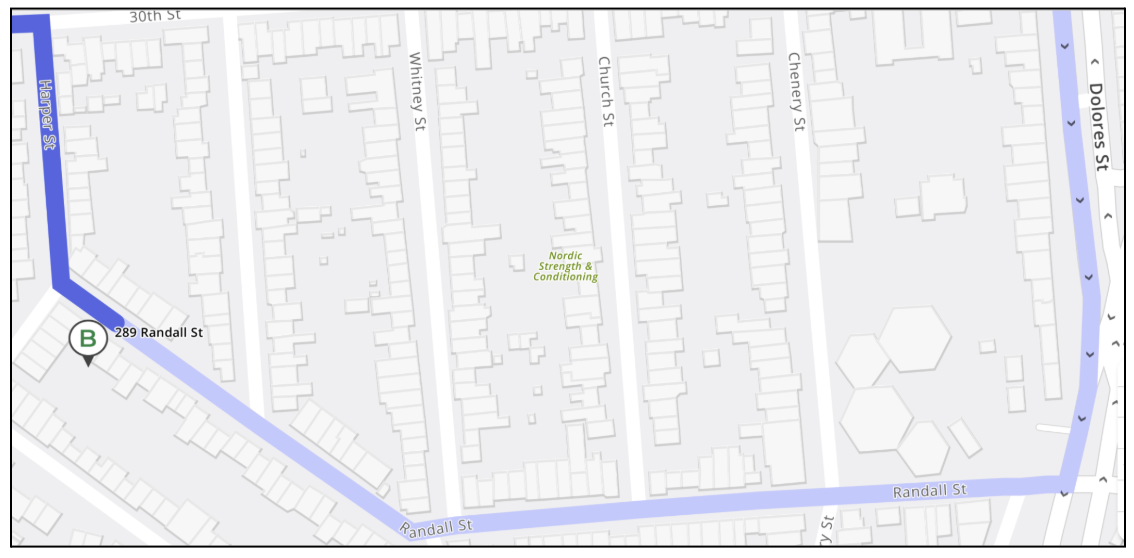
Mapquest map of the Noe Valley neighborhood where the McQuades lived
The map above shows the location of 289 Randall Street, which lies between Harper Street (above left) and Randall Street (bottom). I think that diagonal stretch used to be called “Palmer Street,” named after Cyrus Palmer, director of the Pacific Railroad Homestead Association. The chart below shows the origin of some of the street names in the neighborhood.
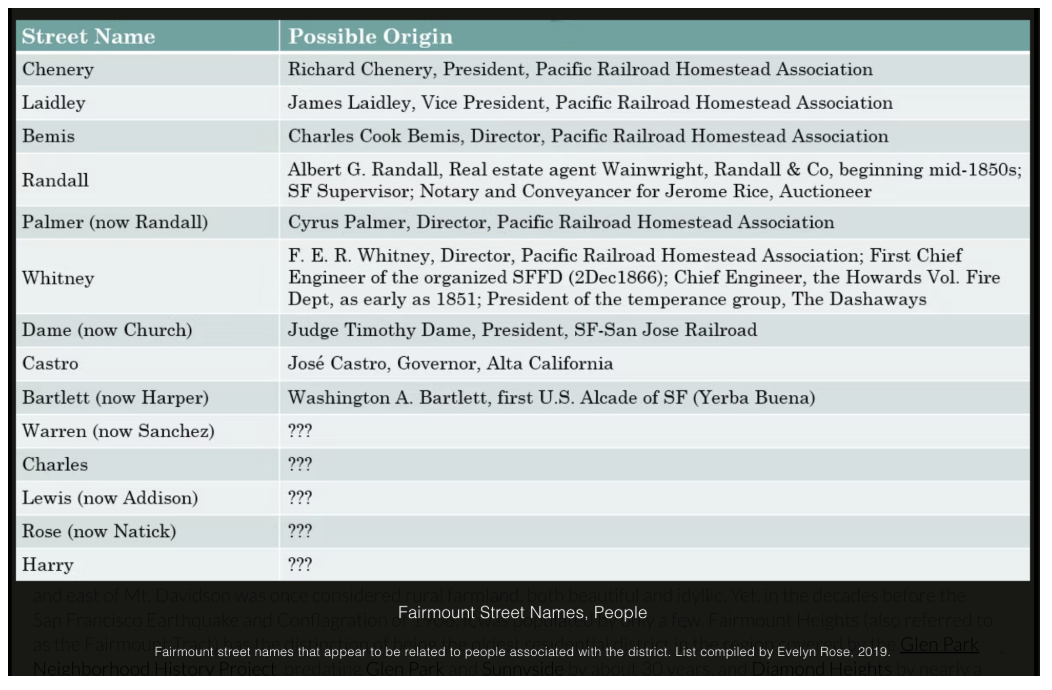
Palmer, Randall, and Harpers Streets are all mentioned here. [2]
Another news article I found mentions Michael Joseph McQuade purchasing “a piece of realty at the southeast corner of Harper and Palmer streets” for $1400 from a woman named Emma M. Noonan. She was later sued by her mother, Catherine, “for the purpose of recovering the proceeds of the sale of” that same piece of realty.
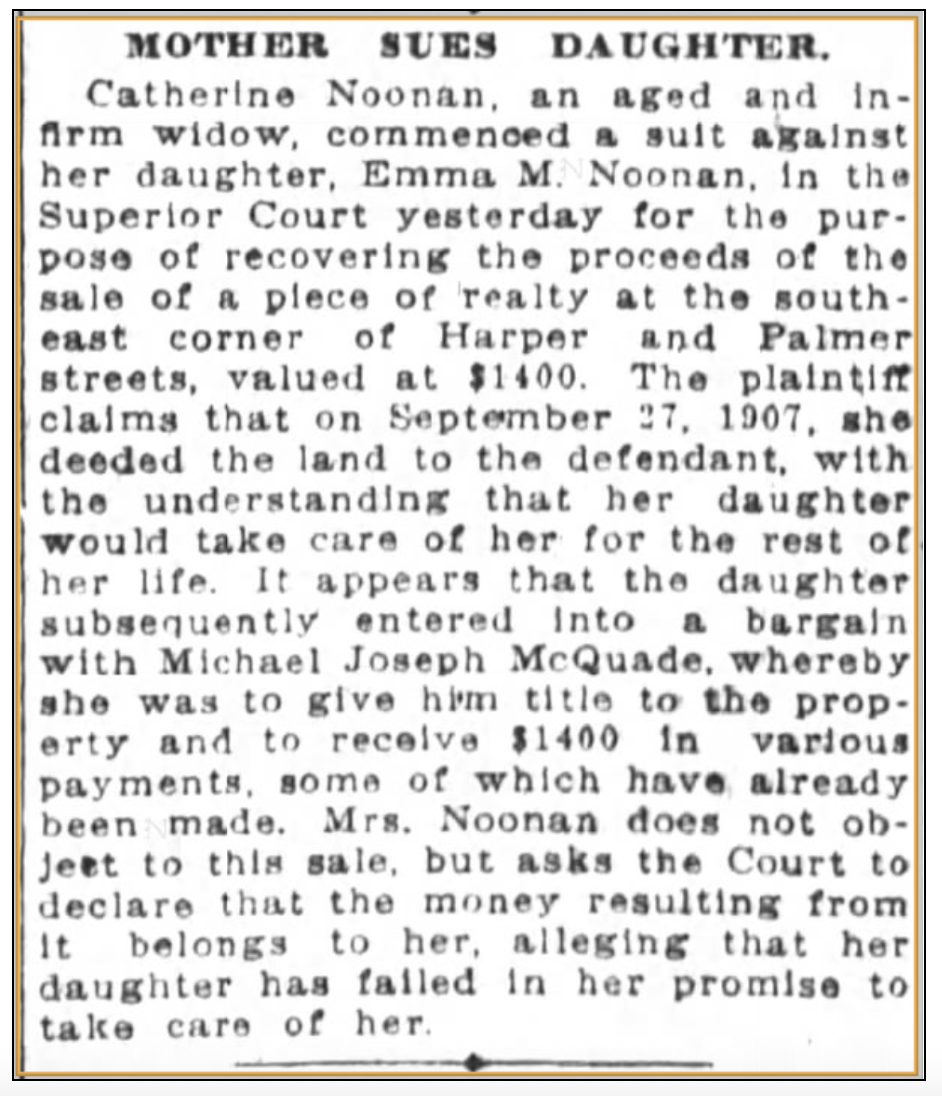
This San Francisco Chronicle article, dated Nov. 19, 1910, talks about the contested piece of property.
The home at 289 Randall was built in 1910, according to the real estate website Redfin, so it’s likely the Michael McQuade family were the first owners of the home. Whatever the case, Michael and Ella were definitely living at 289 Randall Street by 1912, for I found the following in a a San Francisco Chronicle news article dated Nov. 10, 1912: “Michael McQuade of 289 Randall Street was dragged into an alley near Third and Silver Streets early yesterday morning by three footpads, where he was knocked down and robbed of his watch and $5 in coin.” Follow up articles reported Michael had been “cruelly beaten” as well and that at least one of the “footpads” had been caught and was being held on a $10,000 bond.
I had never heard the term "footpad" before and learned, thanks to the online AI overview, that it is “an archaic slang term for a criminal who robs pedestrians, essentially a highwayman who operates on foot rather than horseback, common from the 16th to 19th centuries, focusing on street-level ambushes for money or valuables.” I’m glad Michael lived to see another day!
As described on Redfin, the house at 289 Randall Street is a single family property, sits on a 2,500 sq ft lot, is 1600 sq ft, and last sold in May 2021 for $2,200,000. Its description says, “Welcome to a gardener’s delight on the edge of Noe Valley & Glen Park! This 3BR/2BA home sits on a less traveled street and boasts a deep, South facing yard with mature plantings. The main level has an open kitchen and dining room; living room with bay windows, fireplace, and ‘library nook’; 2 bedrooms and 1 full bath. There are hardwood floors throughout. The upper level has a spacious master bedroom and bath with large windows.”
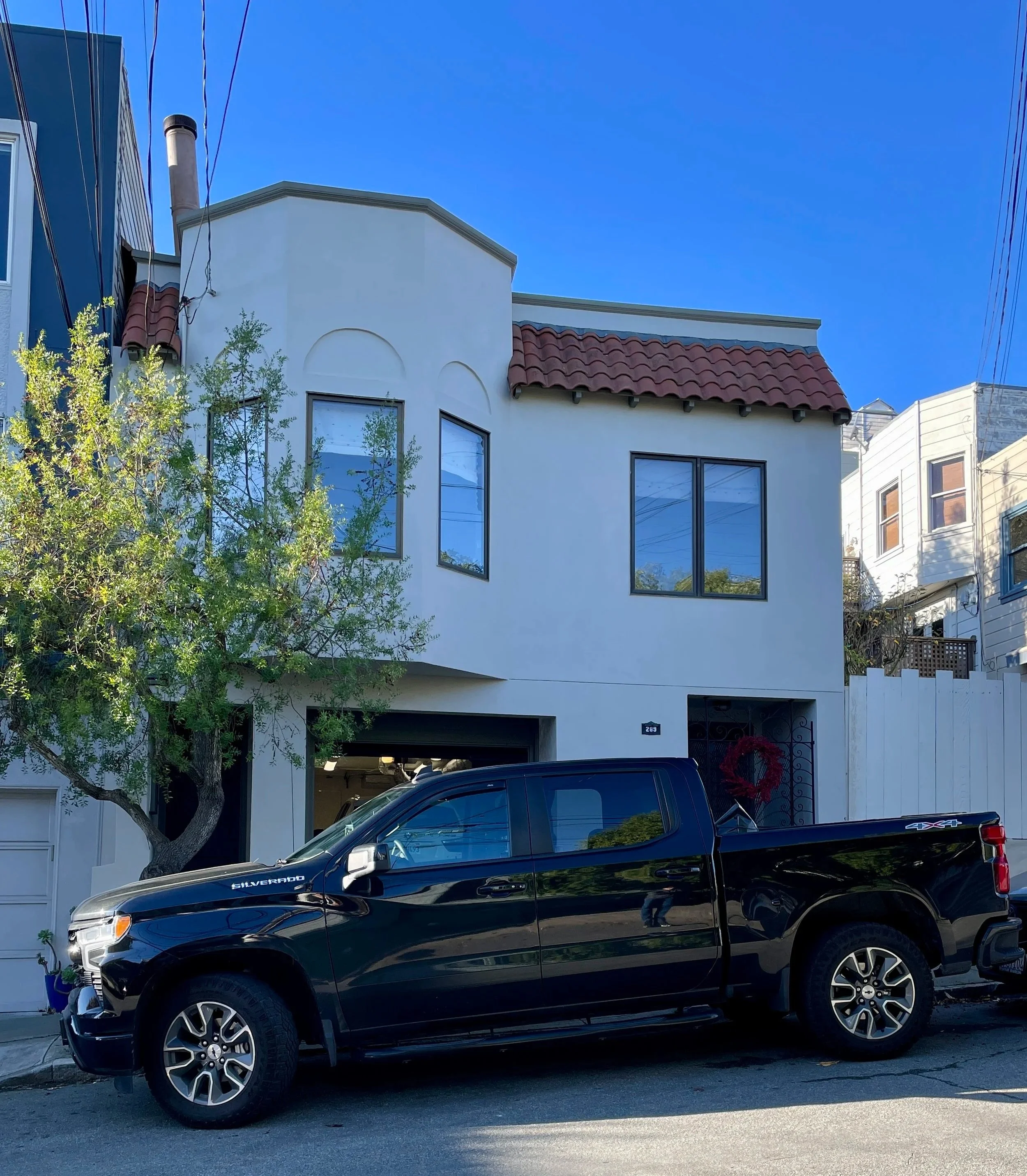
This is the McQuade house at 289 Randall Street, with the gardener’s truck blocking our view.
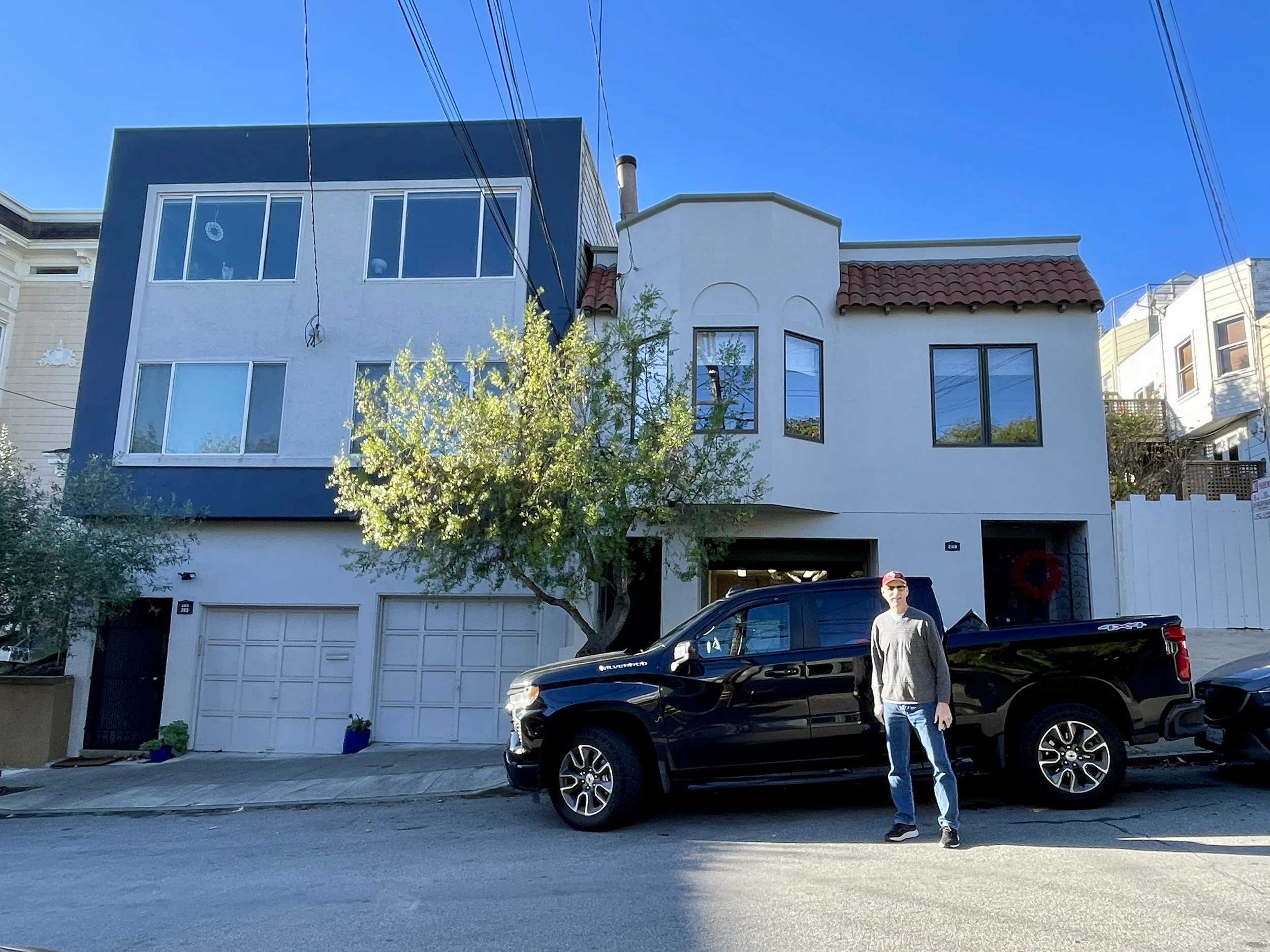
Here is Mike standing in front of the house on Randall Street where his great-grandparents lived.
When we drove up, there was a man outside who we learned was the gardener, and he told us the house had a beautiful back yard. I wish we could have seen it, but Mike did not want to disturb the owners. I did take a photo, though, of him standing in front of the door.
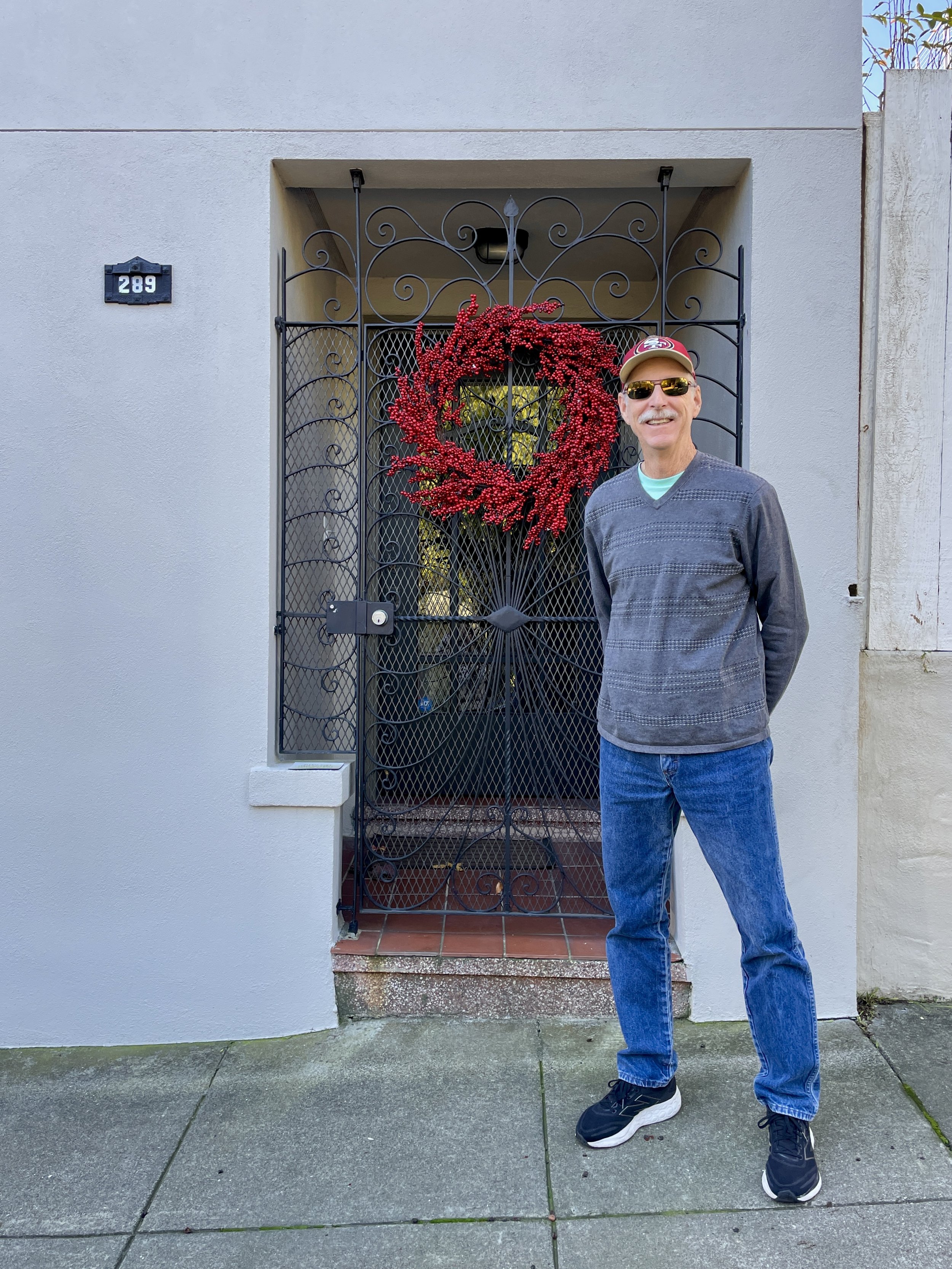
Mike’s grandfather also lived in this house at 289 Randall Street.
The house is definitely in a hilly neighborhood, and while driving there, we were struck by the amazing view we were passing of the city below and stopped to admire it.
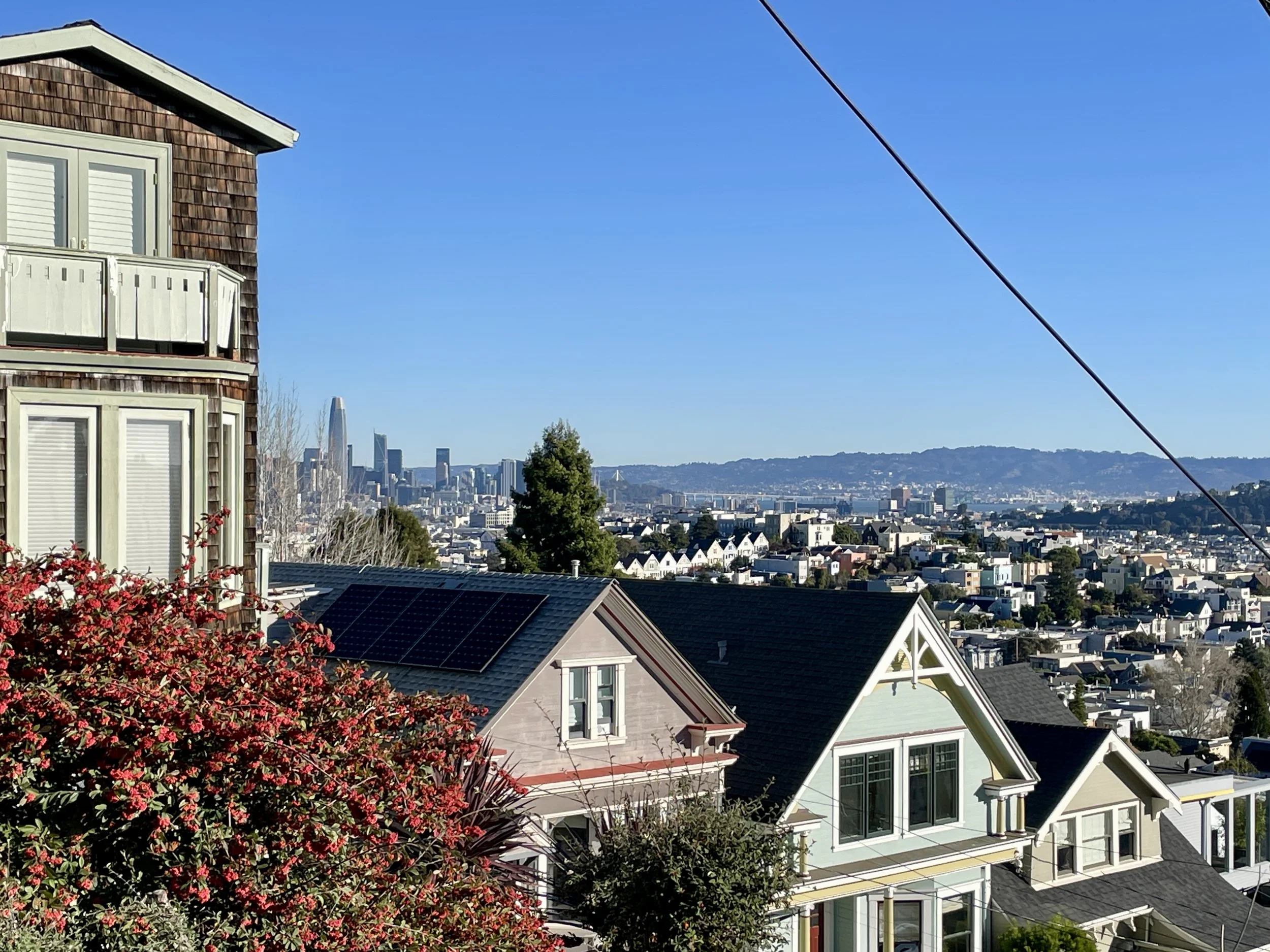
Looking out over the city from Noe Street in San Francisco provides some amazing views!
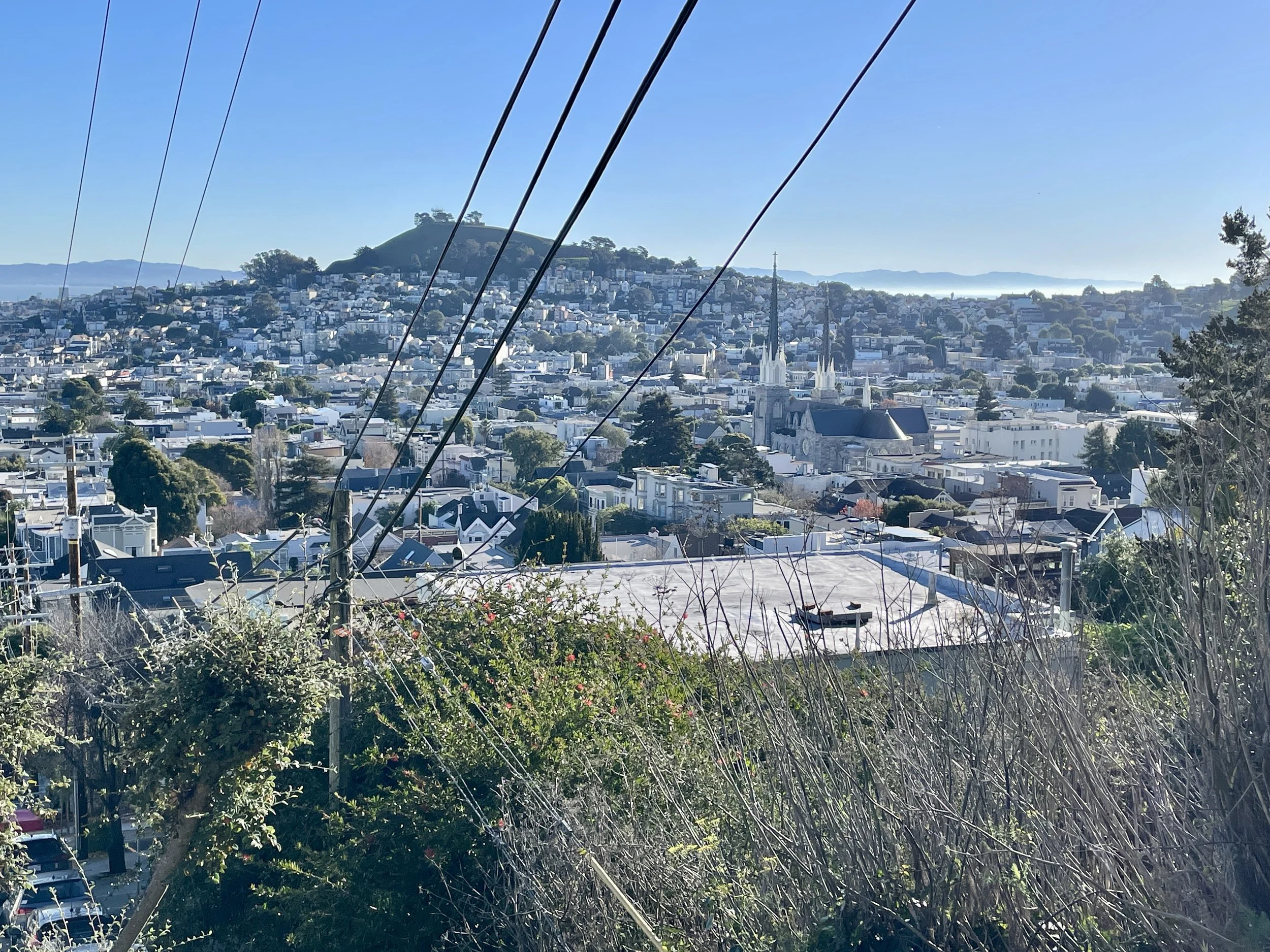
In this view from Noe Street, you can see the steeples of St. Paul’s Catholic Church.
We could see a huge church down below, and when someone walked by, we asked him the name of the church. He told us it was St. Paul’s Catholic Church and that they had filmed part of the movie Sister Act there, so we decided we would stop by the church after seeing the house. Since Mike’s family is Catholic, we figured Michael and Ella McQuade had probably attended masses at the church – and sure enough, that is the church mentioned in Michael’s mother Maria’s obituary above where they held the “requiem mass for the repose of her soul.”
Her obituary also mentions that she was a member of the “Third Order of St. Francis,” and I was curious what that was. Here’s the description I found online: “The Third Order Secular of St. Francis is an ecclesiastical association of the laity, originally founded by St. Francis of Assisi. It is a state of perfection for persons living in the world. The religious strive after perfection by observing the three vows of poverty, chastity, and obedience and live in community according to their Rule, whereas the members of the Third Order Secular live in the spirit of the vows in fraternal unity according their own separate Rule (Ch. 2, Third Order Handbook).” [3]
That same website offered this list of expectations for the Third Order Rule:
Simplicity and modesty in dress.
Keeping away from dances and shows which savor of license and avoiding all forms of dissipation.
Temperance in eating and drinking.
Fasting and abstinence on particular days.
Monthly Confession and Holy Communion.
Praying daily one of three Offices approved by the Church.
Making a last will and testament.
Leading others by setting a good example.
Maintaining charity towards others.
Refraining from taking unnecessary oaths and using indecent language.
Attending Mass daily when possible and attending the monthly meetings.
Contributing to a common fund for the needs of poor members and for the dignity of worship.
Visiting sick members.
Praying for deceased members.
We walked around St. Paul’s Church, and it is definitely an impressive building with a rich history. The parish was first established in 1876 and initially met in an abandoned hospital on the Church Street property. The cornerstone of the new church was laid in 1880, with the first church seating 750 people. As the community grew, though, church leaders decided they needed a larger church. Construction on the new building began in 1897 and was completed in 1911. You can read more about it HERE. And, if you want to hear the steeple bell (which surely would wake up anyone in the neighborhood!) and see how it is rung by hand, check out this video.
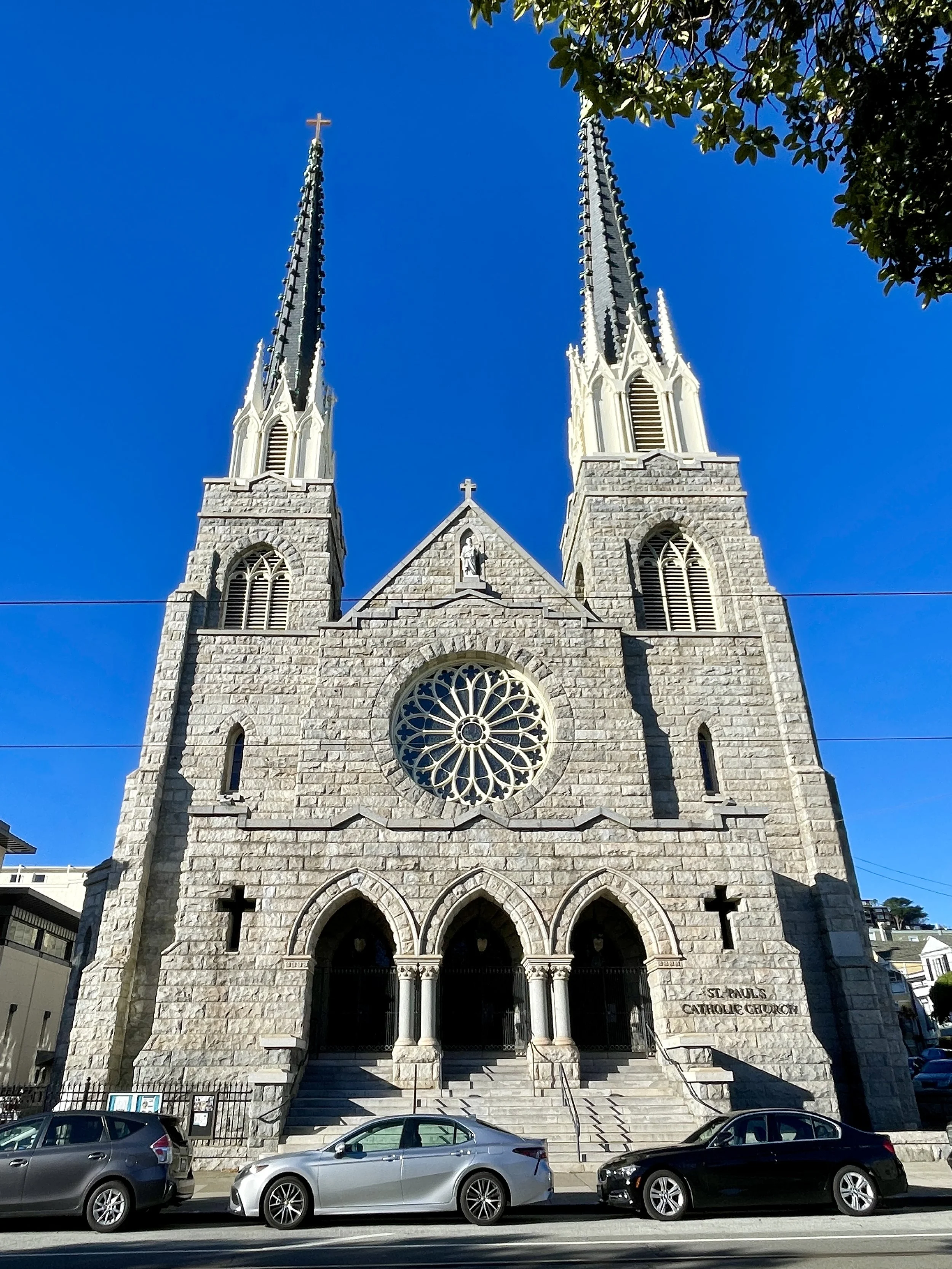
St. Paul’s Catholic Church, located at 221 Valley Street on the corner of Church Street, served as a primary film location in the movie “Sister Act” and was a church attended by Mike’s family members.
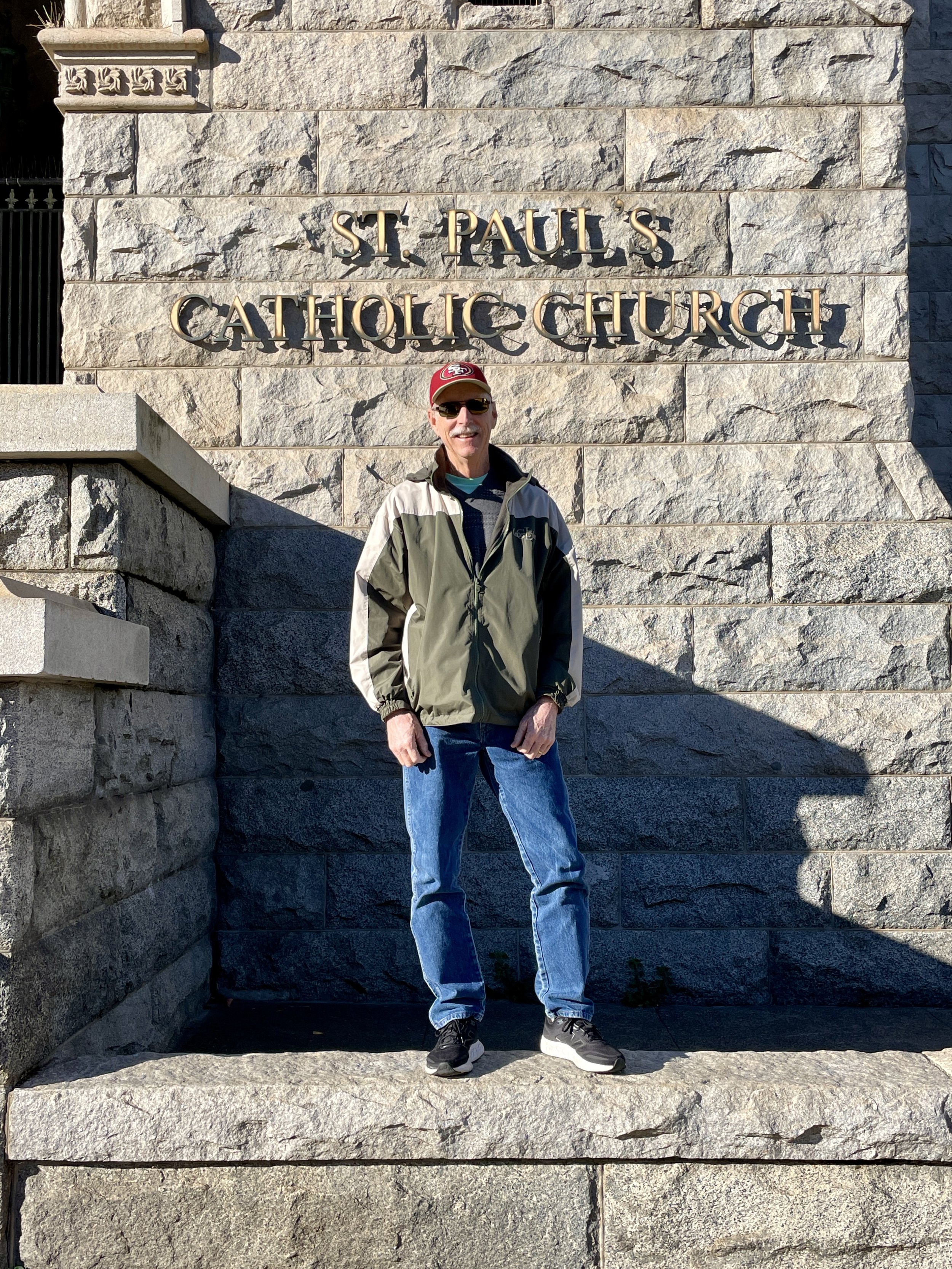
Mike standing in front of St. Paul’s Catholic Church in San Francisco
Here is something I found especially interesting about the construction process: “Then pastor, Rt. Rev. Msgr. Michael D. Connolly, acting as contractor and builder, is said to have recruited every able-bodied person in the parish, including himself, to work on the project. Thus began the building of our steel and granite church. Parishioners, including the Saturday morning religious education students, according to the parish centennial history, ‘tended to end up at the Thirtieth and Castro Streets quarry hauling rocks down to the church’. They gave many long hours of hard work constructing our beautiful church. The new Church building, with a capacity of 1400, was dedicated May 29, 1911 by Archbishop Patrick Riordan.” [4]
So, it is highly likely that Mike’s great-grandfather and perhaps even his grandfather were involved in helping to build St. Paul’s Church!
As I mentioned above, St. Paul’s was a primary filming location for the 1992 film Sister Act starring Whoopi Goldberg. It serves as the exterior of the fictional St. Katherine's Convent where Deloris Van Cartier (Whoopi Goldberg) hides under witness protection as "Sister Mary Clarence". For filming, the surrounding area was made to appear like a much poorer, run-down urban neighborhood, complete with fake graffiti, trash, and an adult bookstore across the street, contrasting sharply with its real-life setting.
Most of the interior convent scenes were filmed in Los Angeles at the Hollywood United Methodist Church; however, the actual interior of St. Paul's was used for the final scene where the choir performs for the Pope. We were not able to go inside since the church was closed, but you can see the interior (and the movie’s exciting finale!) if you check out this Youtube link).
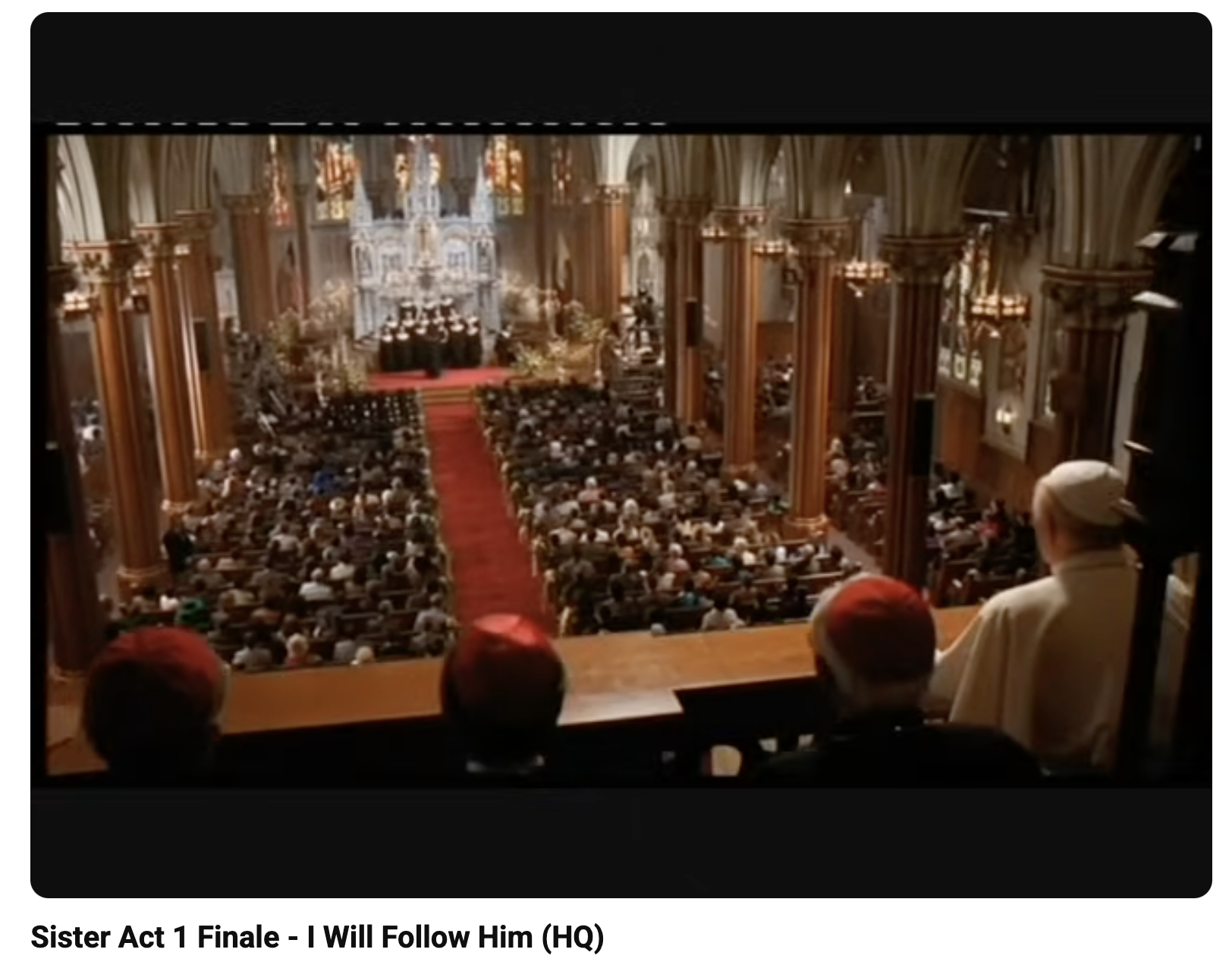
This scene from the movie “Sister Act” shows the interior of St. Paul’s Catholic Church.
By 1930, all of Michael and Ella McQuade’s children had married – Thomas (Mike’s grandfather) in 1922 to Marian Gorman; Alice in 1923 to William Lambert; and Tyrone in 1929 to Ella Hambey – and they had purchased a home on 65 Beaver Street. Michael died in 1939, but Ella shows up as living there in both the 1940 and 1950 U.S. Census records (the most recent available), and she was still living there in 1957, according to a City Directory. She may have lived there until her death in 1963, but I can find no definitive information on that.
The 65 Beaver Street house is a 4BD/2BA, 2200 sq ft house, built in either 1900 or 1916 (there are conflicting dates on different websites), and last sold in 2004 for $1,075,000, according to Redfin. It is described as a “Victorian style flat” in a “great location, one block north of Market between Castro and Noe.” Here is Mike in front of that house, which was actually our first stop of the day since it was closest to where we were staying on Union Square.
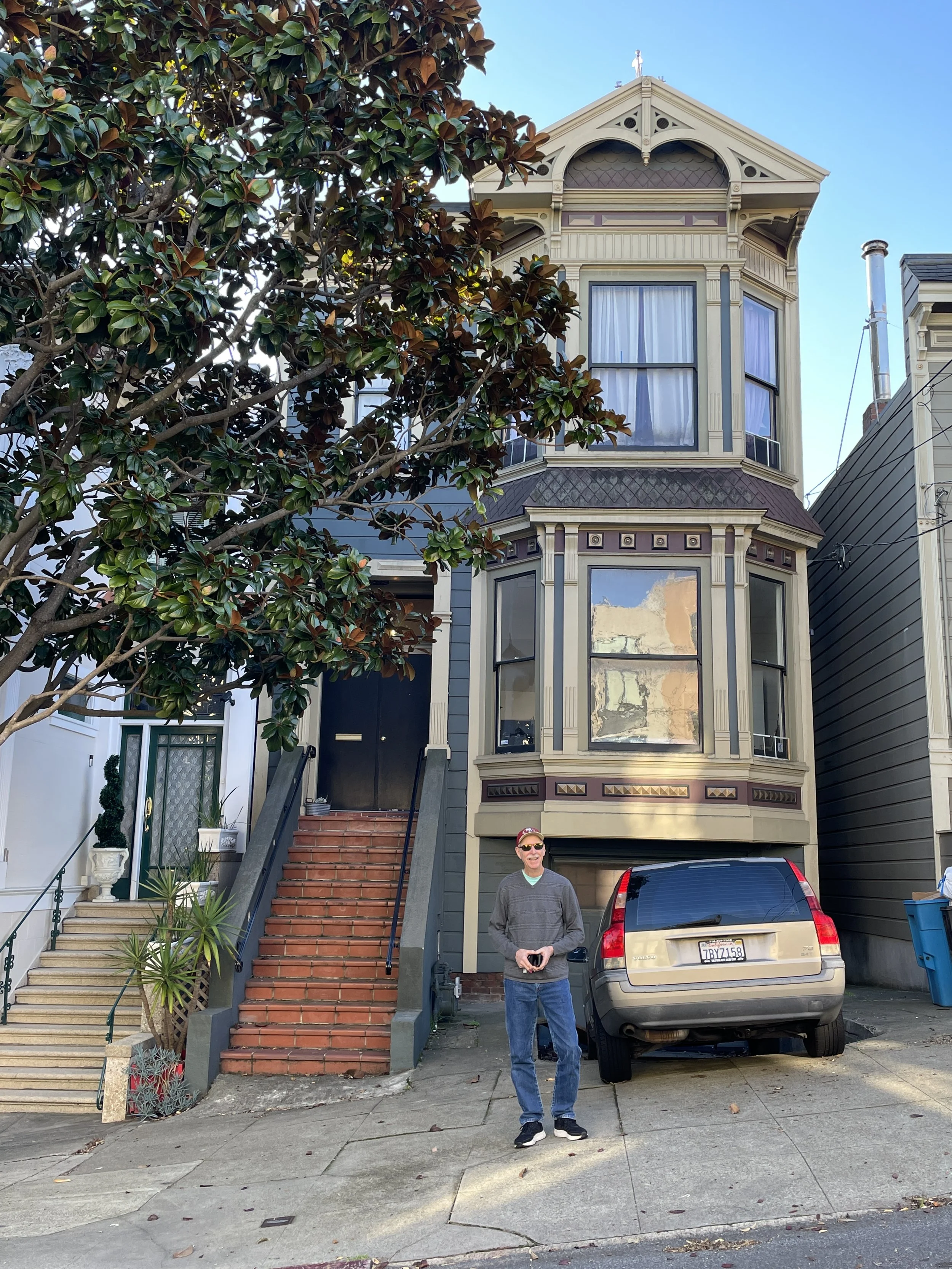
Mike’s great grandmother, Ella McQuade, lived in this house at 65 Beaver Street for many years.
Finally, we stopped at 77 Sala Terrace, which is where Mike’s grandparents – Thomas and Marian McQuade – lived in 1930, along with his father Thomas Victor McQuade, Jr., then 4, according to the U.S. Census. Daughter Lois was born later that same year. At the time, Thomas was working as an assistant cashier for Bank of Italy. By 1940, he had been promoted to bank manager, the bank had been renamed Bank of America, and the family had left San Francisco behind and moved 25 miles north, across the Golden Gate Bridge, to Fairfax.
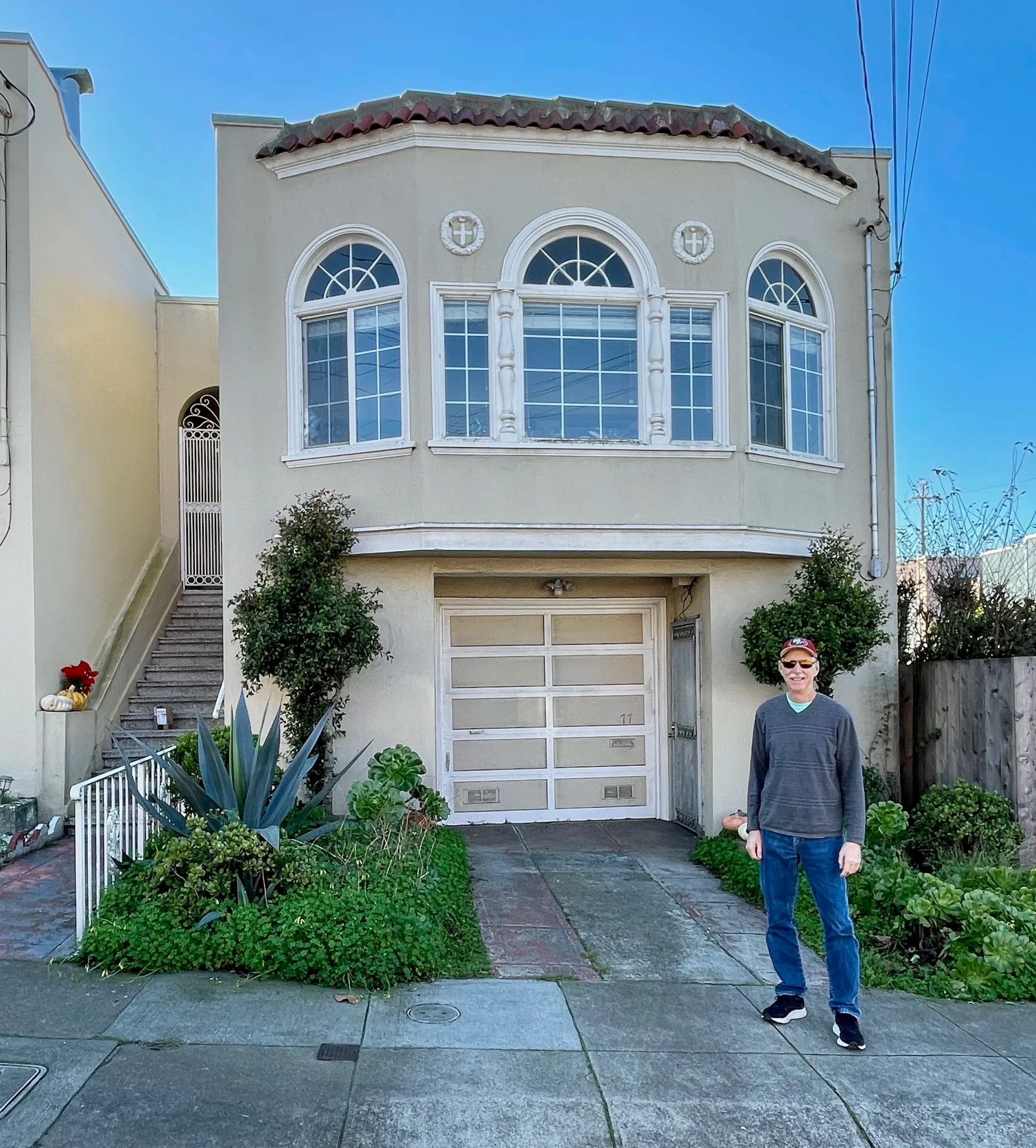
Here Mike is standing in front of the house at 77 Sala Terrace in San Francisco where his grandparents and father (then age 4) lived in 1930.
Mike remembers visiting his grandparents at their home on Tulane Drive in Larkspur many times as he was growing up. That is where they were living when Thomas retired after 45 years of employment with Bank of America. An article titled “Long Bank Career Soon To Be Over,” published Jan. 26, 1965 in San Rafael’s Daily Independent Journal, states that he “began as a bookkeeper with the bank’s day and night office in June, 1920. He moved to the Powell-Post branch in 1929 as a junior officer and four years later was named manager.”
Mike and I tried to find the Powell-Post branch of Bank of America when we were wandering around Union Square, but it turns out that it was closed on Dec. 2, just four weeks before we were there, one of many offices B of A has “shuttered” due to “low foot traffic” as more people rely on digital banking. The landmark Bank of America building at 1 Powell Street – the original Bank of Italy that opened in 1910 – is still standing.
It was in his capacity as bank manager that Thomas Victor McQuade was asked by a customer who was a photographer to pose for some photos on the Golden Gate Bridge to “help add perspective,” as explained to Mike. He has some really cool photos of his grandfather on the bridge – here are a few of them.
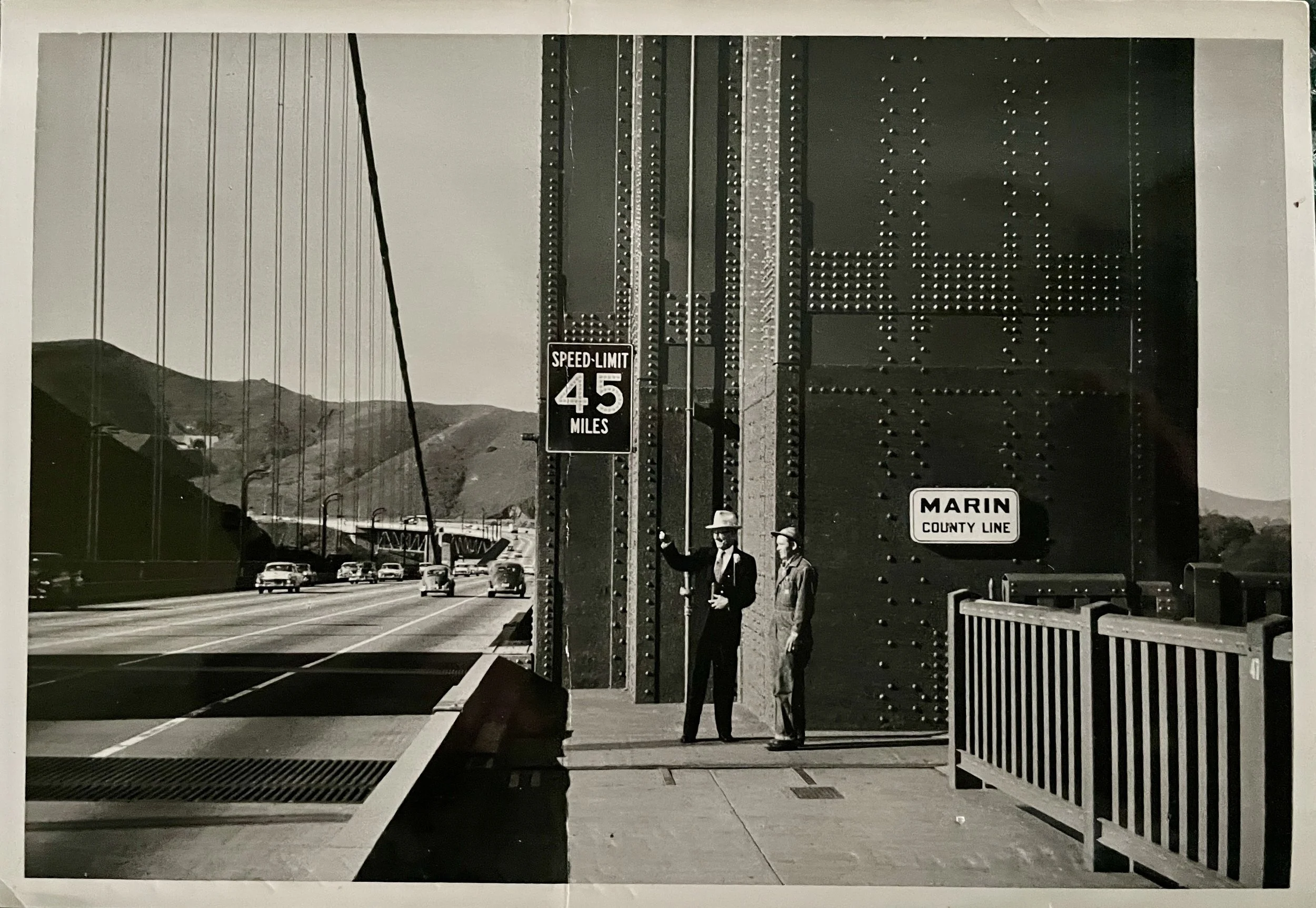
Mike’s grandfather is standing on the left on the Golden Gate Bridge, circa 1960.
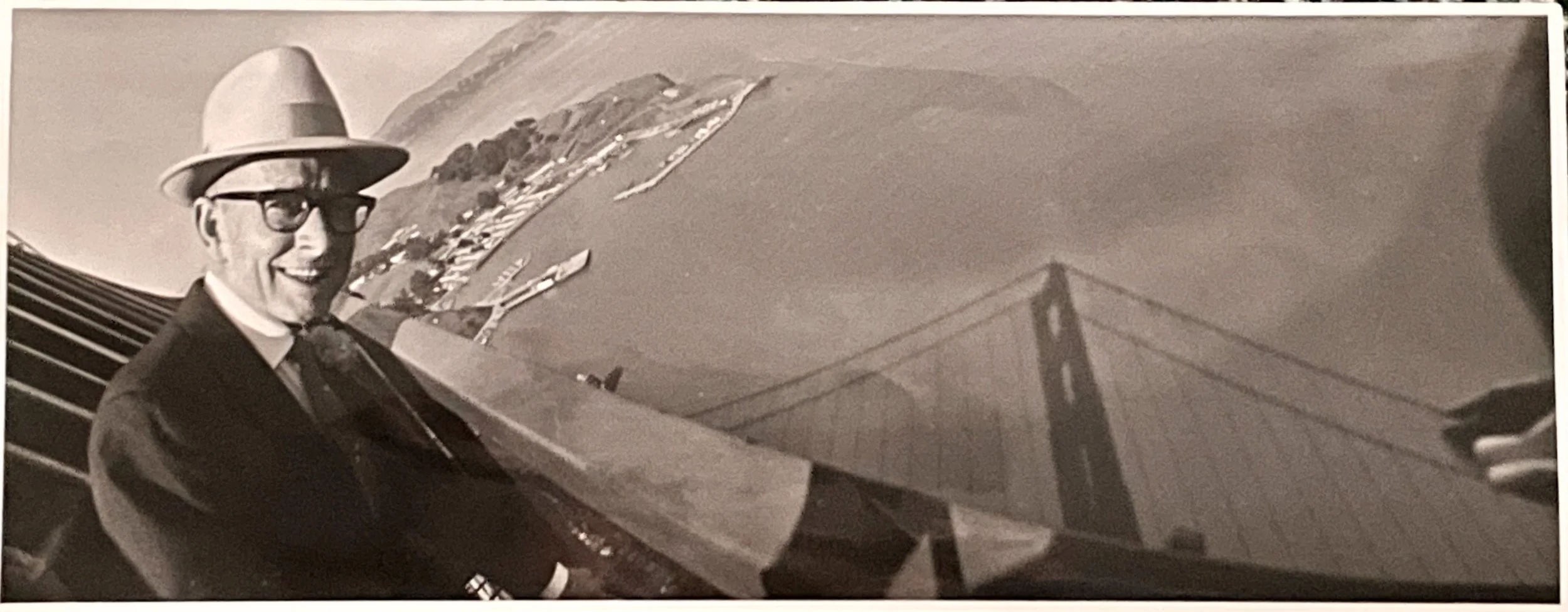
That quite a view of San Francisco Bay from high atop the Golden Gate Bridge!
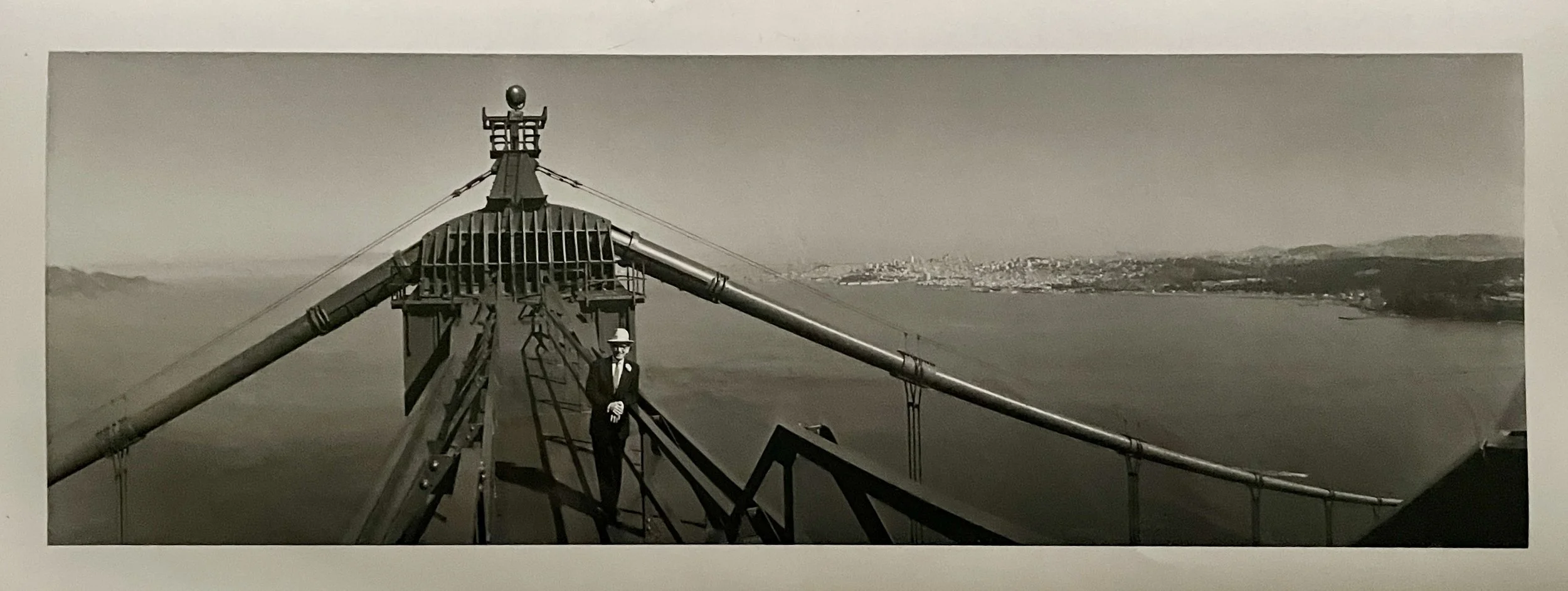
Not many people get this view!
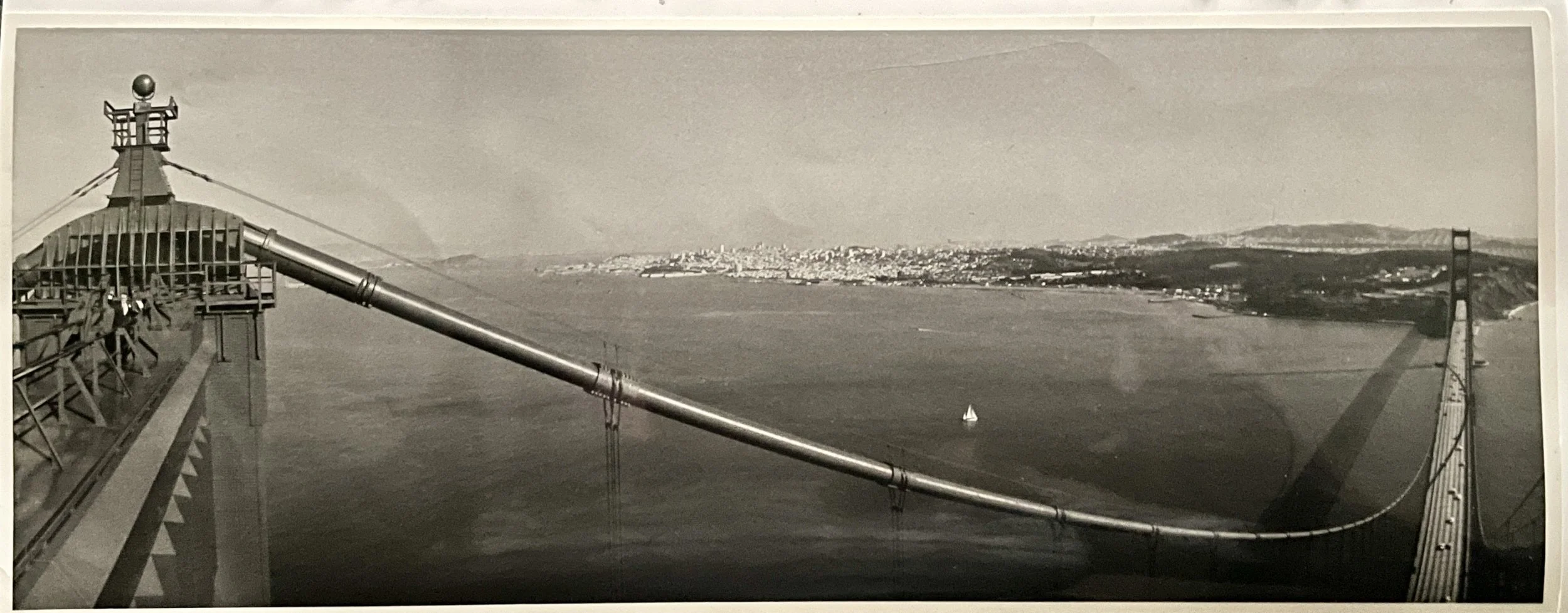
You can see Thomas McQuade on the far left - I guess he wasn’t afraid of heights!
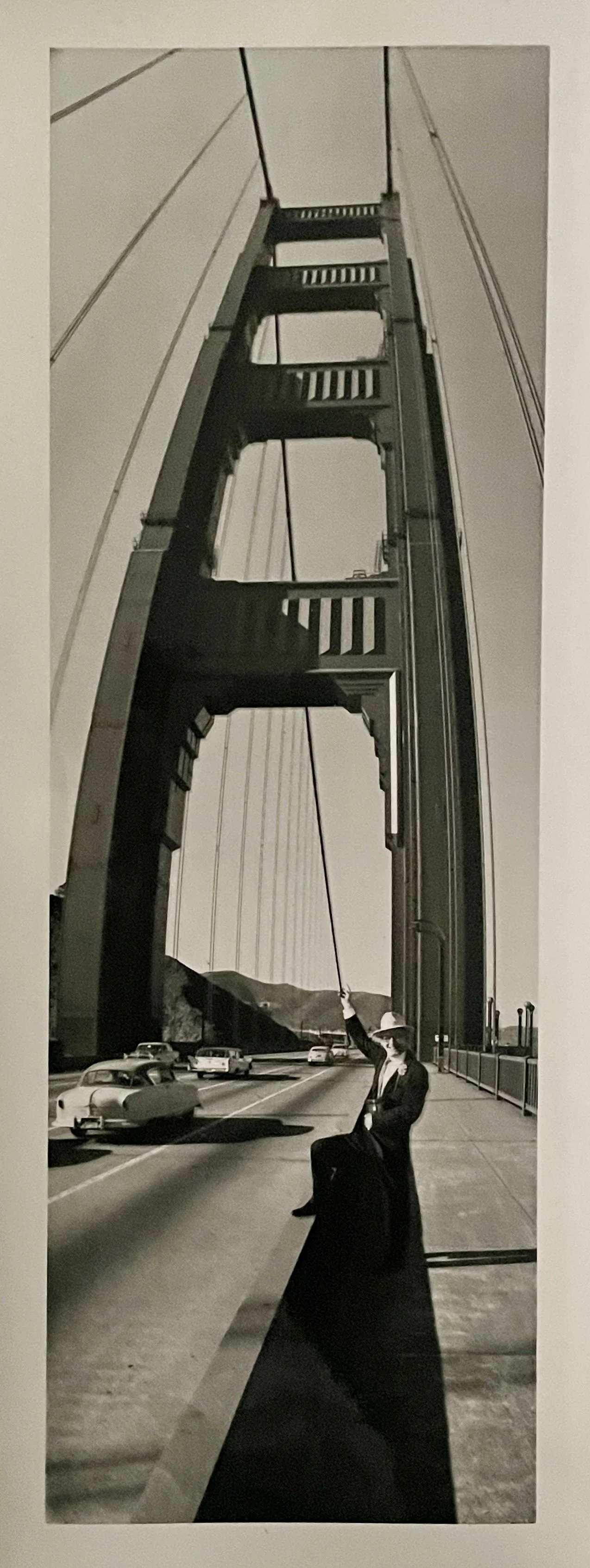
The Golden Gate Bridge, which opened to the public in 1937, spans 4200 feet; its towers are 746 feet above the water, or 500 feet above the roadway.
Our final stop on our “heritage day trek” took us to Holy Cross Catholic Cemetery in Colma, San Mateo County, where Michael and Ella McQuade are buried and share a grave marker. Michael died April 4, 1939, and Ella on March 6, 1963. Her obituary lists her as “beloved wife of the late Michael J. McQuade.” It also describes her as “loving mother of Thomas V. McQuade, Mrs. Alice Lambert and the late Tyrone M. McQuade, survived by eight grandchildren; a native of Oregon.”
The obituary does not list how many great grandchildren survived her, but Mike is one of many. Here he is, standing by Michael and Ella’s grave.
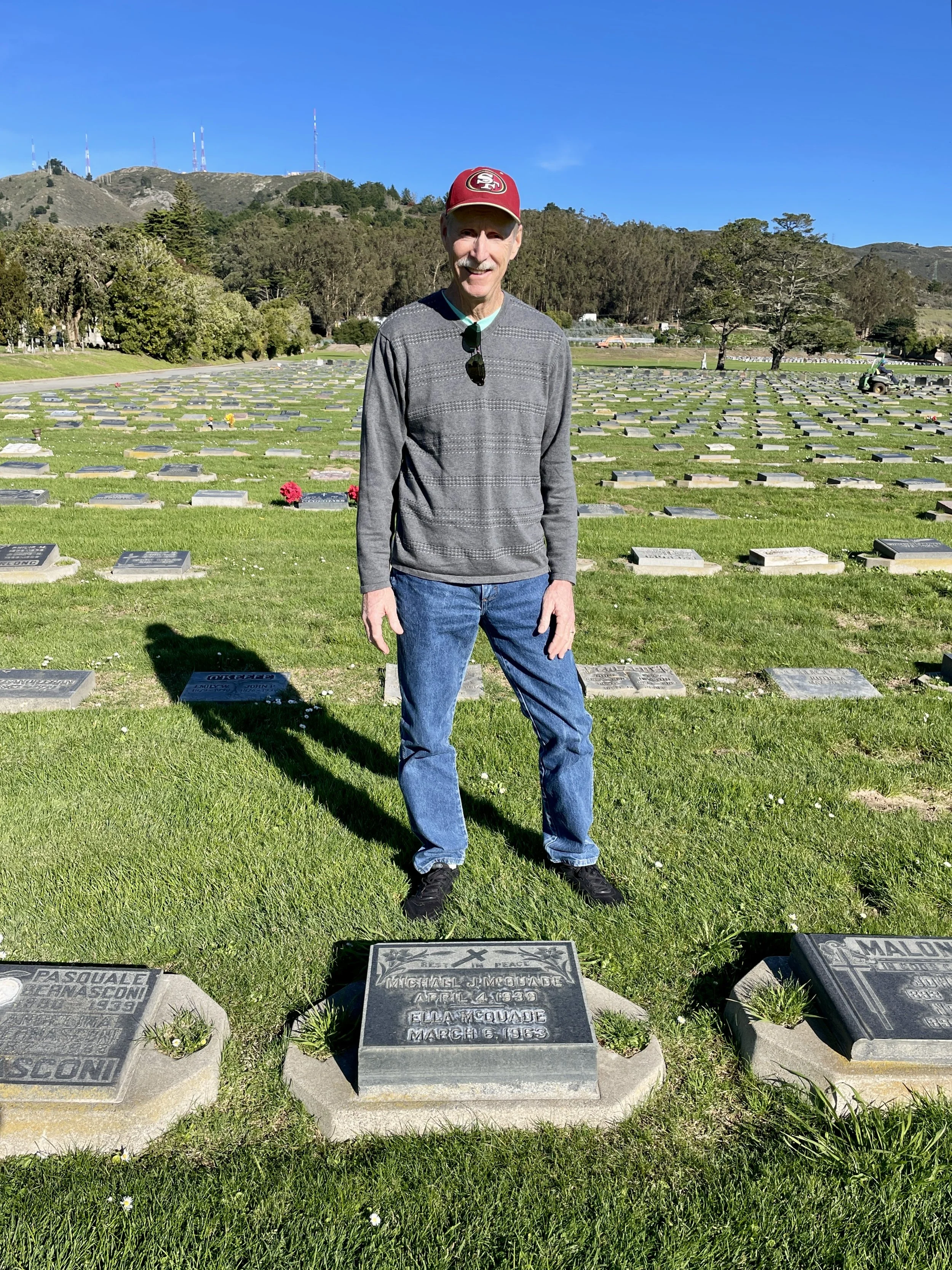
The inscription reads: Rest in Peace / Michael J. McQuade / April 4, 1939 / Ella McQuade / March 6, 1963.
We also saw the grave marker for their son Tyrone Michael McQuade in the same row at the cemetery. According to Find-a-Grave, his second wife, Elsie Persson McQuade (1907-1993), is also buried here with him, but her name is not inscribed on the marker.
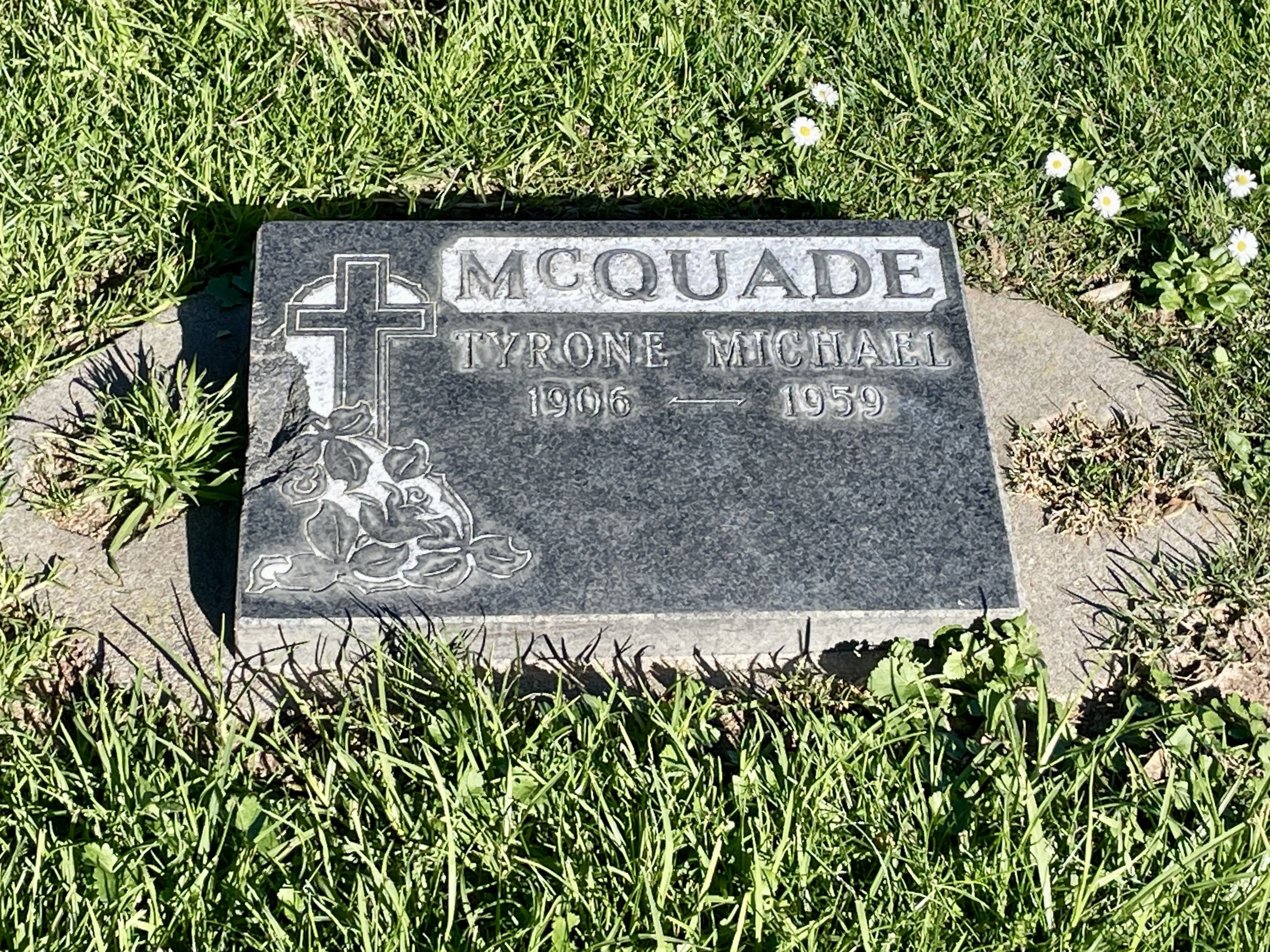
Inscription: McQuade / Tyrone Michael / 1906-1959
I did not realize when I planned our trek that Mike’s great-great grandparents, Maria and Thomas McQuade, were buried at the same cemetery. They share a burial site with various family members, under a grave marker that simply says “McQuade,” according to what I found on the Find-a-Grave website. Perhaps sometime we will make it back to look for their grave marker and pay our respects to the generation that first left “dear old Ireland” for America.
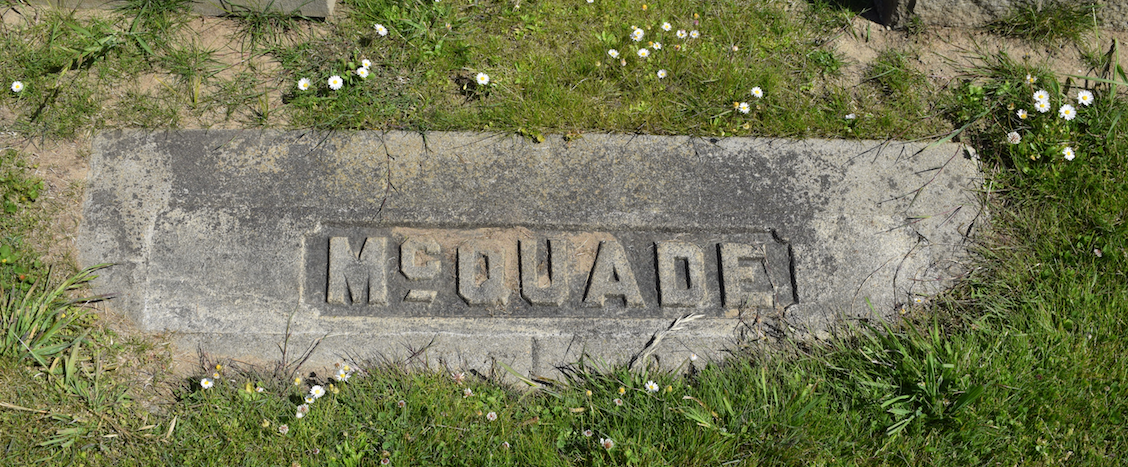
Quite a few McQuade family members, as well as Traynors (which I believe was Maria’s maiden name), are buried in this common grave at Holy Cross Catholic Cemetery in Colma, CA.
End Notes:
“Home Is Where the Story Is.” The Noe Valley Voice, https://www.noevalleyvoice.com/valley.shtml#:~:text=The%20History,community%20renamed%20itself%20Noe%20Valley.
“Fairmount Street Names, People.” Glen Parks Neighborhood History Project, https://www.glenparkhistory.org/fairmount-heights-c13bl?lightbox=dataItem-k4qq3lfc.
“Third Order of St. Francis: Info.” Society of St. Pius X, https://sspx.org/en/third-order-st-francis-info-30312#:~:text=What%20is%20the%20Third%20Order,for%20life%20in%20the%20Order.
“St. Paul’s History: Serving in Noe Valley for over 140 Years.” St. Paul’s Catholic Church, https://www.stpaulsf.org/st-pauls-history#:~:text=Rev.,our%20steel%20and%20granite%20church.