Following in My Great-Grandparents’ Footsteps: An Afternoon at Strawberry Hill in Golden Gate Park
Chasing History: Exploring My Ancestral Roots - Blog Post #59
By Tonya McQuade
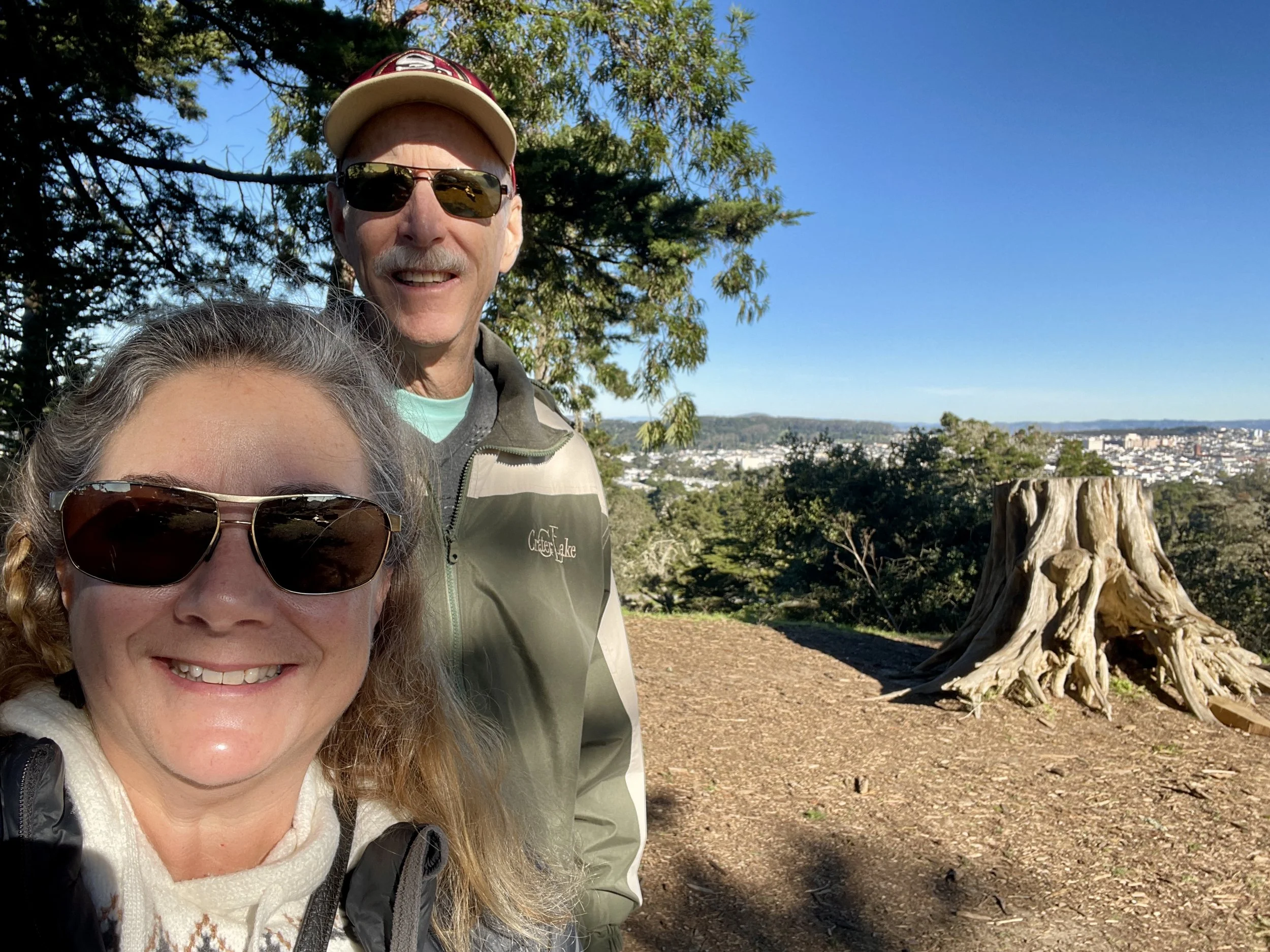
We enjoyed the views as we hiked to the top of Strawberry Hill in Golden Gate Park.
In an earlier blog post titled A Historic Trek: The Amazing Honeymoon of W.F. Traughber and Nora Petree Traughber in 1905, Part III, I wrote about my great grandparents’ visit to San Francisco as part of their four-week honeymoon. Some of the places they visited, such as the Conservatory of Flowers in Golden Gate Park, I had visited before. However, their photos also showed them atop “Strawberry Hill” and beside a lake at Strawberry Hill in Golden Gate Park that I had never seen before.
As I wrote in that 1 Oct 2024 blog post, Strawberry Hill “occupies an entire island in one of the park's man-made lakes and is connected to the mainland of the park by two bridges. Named for the many wild strawberries that used to grow there, the island is covered with a variety of trees and shrubbery. Several trails and dirt steps encircle the island and lead to the top of the hill. Strawberry Hill’s summit measures more than 400 feet in height and offers great views of the surrounding area.”
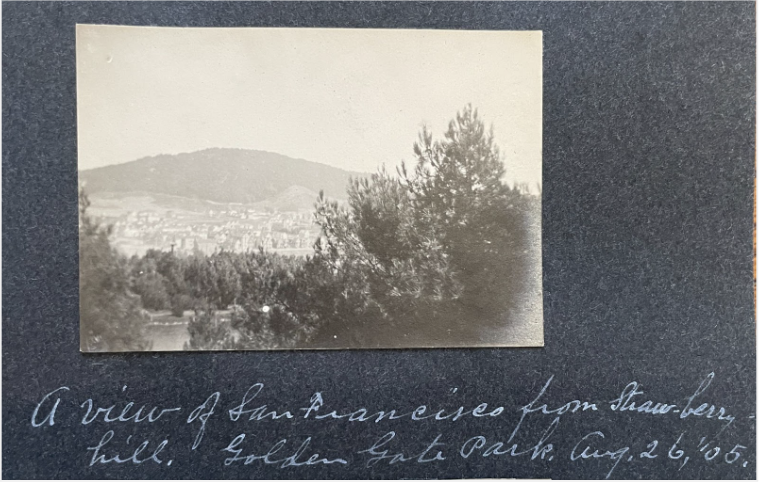
A view of San Francisco from Strawberry Hill, Golden Gate Park, Aug. 26, ‘05.
I also wrote about how Frank and Nora would have enjoyed the view in their photo above from Sweeny’s Observatory, a “mini-castle of red-tinted concrete,” dedicated on September 19, 1891, atop Strawberry Hill. As described online, “A gravel path wound up the hill to lead carriages between bastion towers into an oval of windows. Visitors had dozens of frames to enjoy the 360˚ view in slices. From a distance, the observatory appeared as a decorative crown on the hill or a half-collapsed fortification from antiquity. A glassed-in second story was added in 1892 to offer visitors a more elevated prospect. A plaque set in the crenelated entry arch read “Park Panorama, Gift of Thos. U. Sweeny, 1891.” [1]
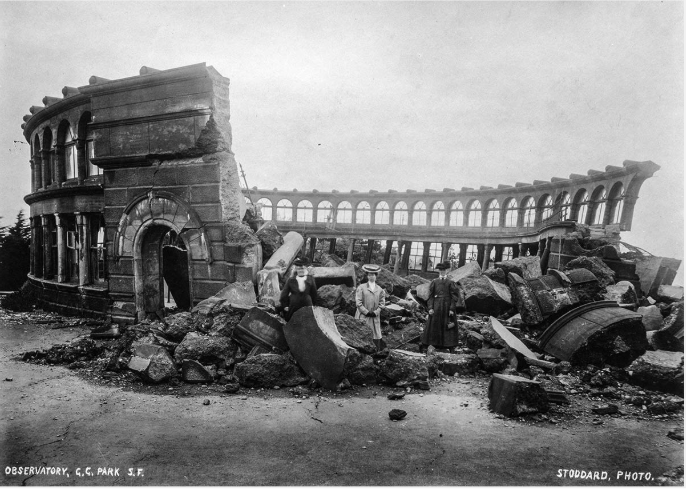
The April 18, 1906 earthquake caused significant damage to Sweeny Observatory. [2]
I wondered at the time why I had never seen this observatory, then quickly realized the reason: the observatory fell down in the 1906 San Francisco earthquake, less than eight months after Frank and Nora took in the panoramic views from its many windows. However, the lake and waterfall they saw are still there – though the lake now has a different name.
The lake was originally called Stow Lake after William W. Stow, who was a State Assembly Member between 1854 and 1857 served on San Francisco’s Park Commission in the 1890s, and gave $60,000 for its construction. However, in January of 2024, San Francisco Recreation and Park commissioners voted to rename it Blue Heron Lake after concerns were raised about Stow’s anti-semitism. The new name was chosen because “blue Herons nest on Stow Lake’s Strawberry Hill in April and May, and are a symbol of resilience, progress and evolution for the indigenous community.” [3]
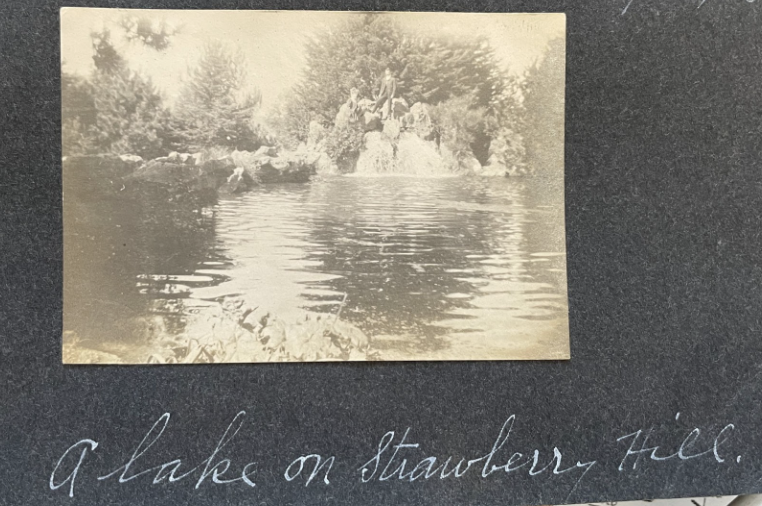
A lake on Strawberry Hill
That earlier blog post also mentioned that Frank and Nora most likely also enjoyed a view of Huntington Falls, a 110-foot tall artificial waterfall installed in Golden Gate Park that drops into the lake. The waterfall was named after railroad baron Collis Potter Huntington, who donated $25,000 to its construction. It was the vision of Park Superintendent John McLaren, who decided to incorporate artificial lakes, waterways, and waterfalls in Golden Gate Park after hiking in the Sierras with famed naturalist John Muir, who is considered Father of the National Parks.
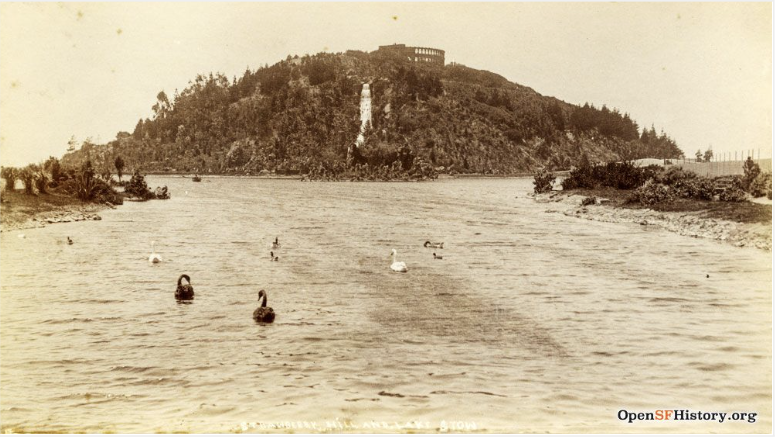
A view across Stow Lake to Huntington Falls and Sweeny Observatory on Strawberry Hill in Golden Gate Park, 1894. [4]
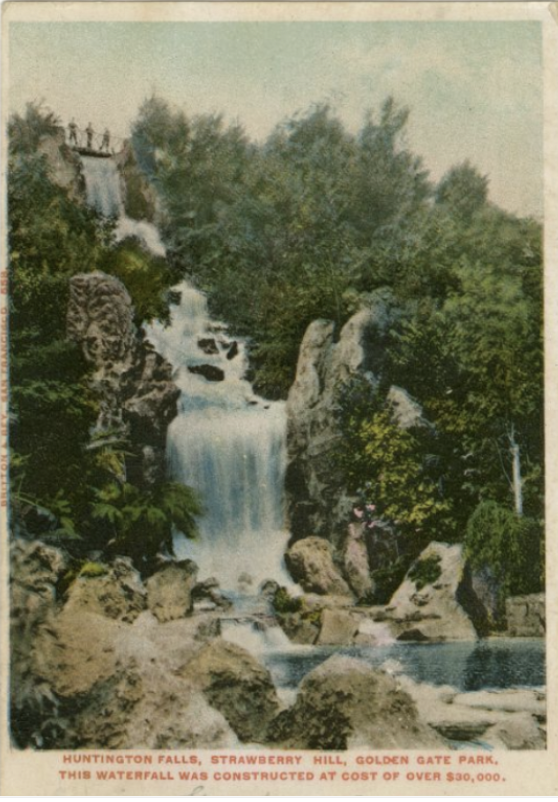
Postcard Caption: Huntington Falls, Strawberry Hill, Golden Gate Park. This waterfall was constructed at cost of over $30,000. Issued in 1905. [5]
So, why am I sharing all of this again? Because on our visit to San Francisco in late December, Mike and I finally made it to the top of Strawberry Hill! We also took in the panoramic views of San Francisco and the beautiful lake below, but the waterfall was unfortunately not running that day. It was all part of the “family heritage day” I planned for us, which also included visiting several places tied to Mike’s family (see this 3 Jan 2026 blog post)
What follows is mostly a series of photos highlighting our time at Golden Gate Park as we explored the Strawberry Hill area. Most of my prior visits had me stopping at the De Young Museum, Japanese Tea Garden, Conservatory of Flowers, San Francisco Botanical Garden, or California Academy of Sciences, which are all east of the lake.
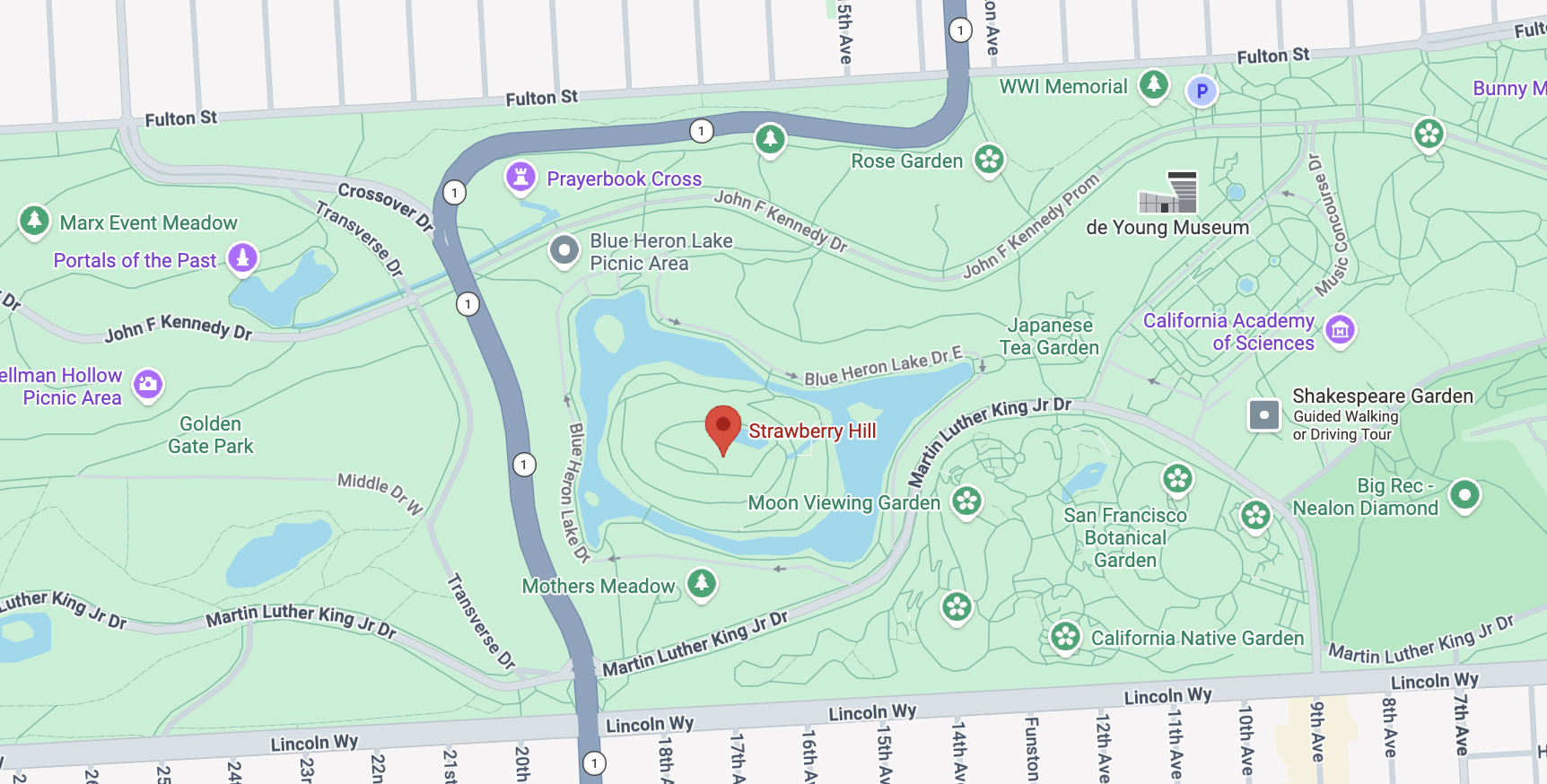
This partial map of Golden Gate Park shows Strawberry Hill, surrounded by Blue Heron Lake, with many of the park’s museum to the east.
Once we found parking along Blue Heron Lake Drive, we headed toward the bridge that would take us to the island that makes up Strawberry Hill.
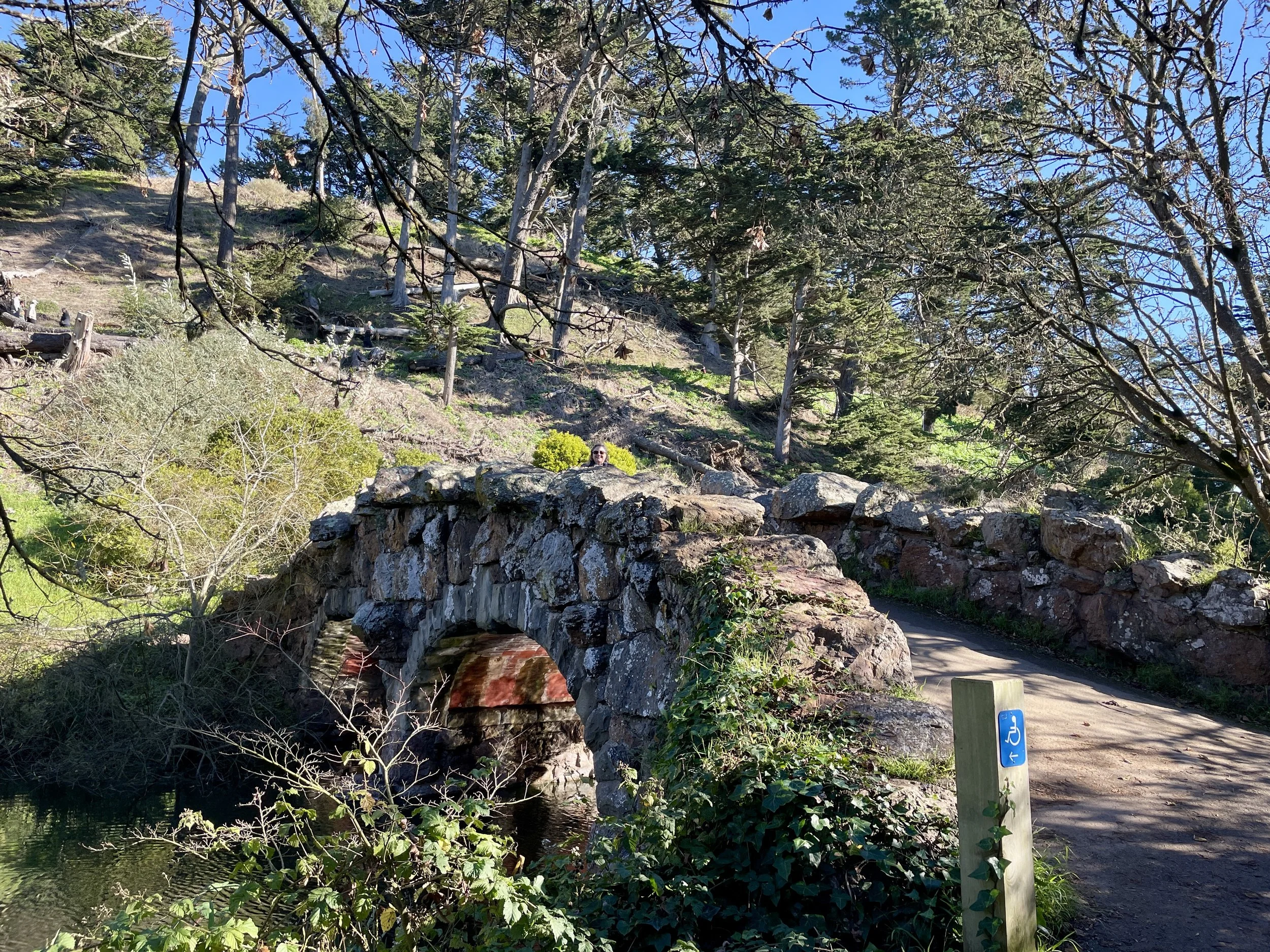
This is one of two bridges that allow people to cross over the lake to Strawberry Hill.
Just beyond the bridge, you can see the gravel path described earlier that would take carriages on a winding path up the hill to Sweeney Observatory. I’m sure that’s how Frank and Nora traveled to the top. We had no carriage to carry us – just our feet – but it is not a long hike to the summit.
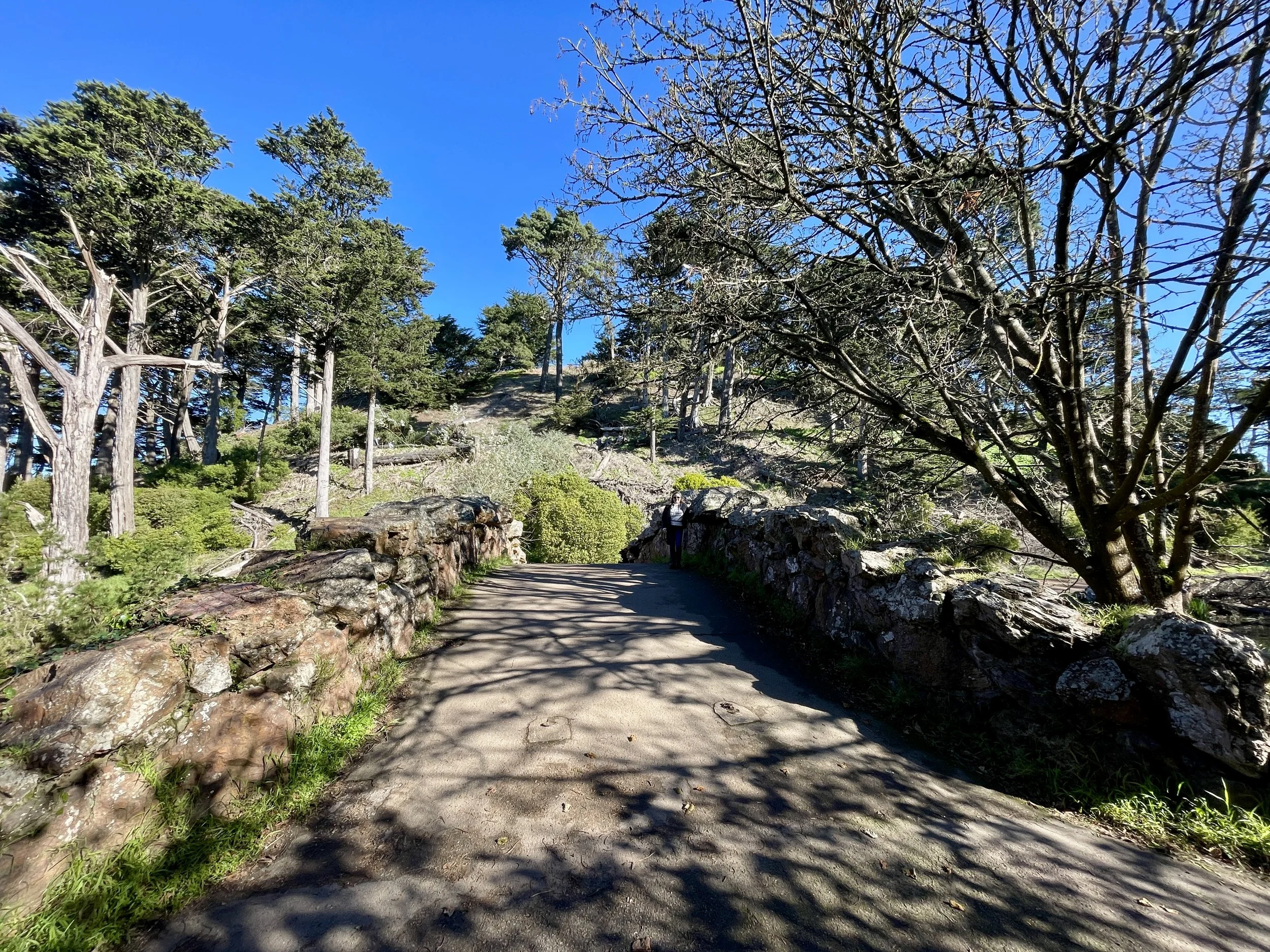
Can you see me on the bridge? (I’m on the right side)
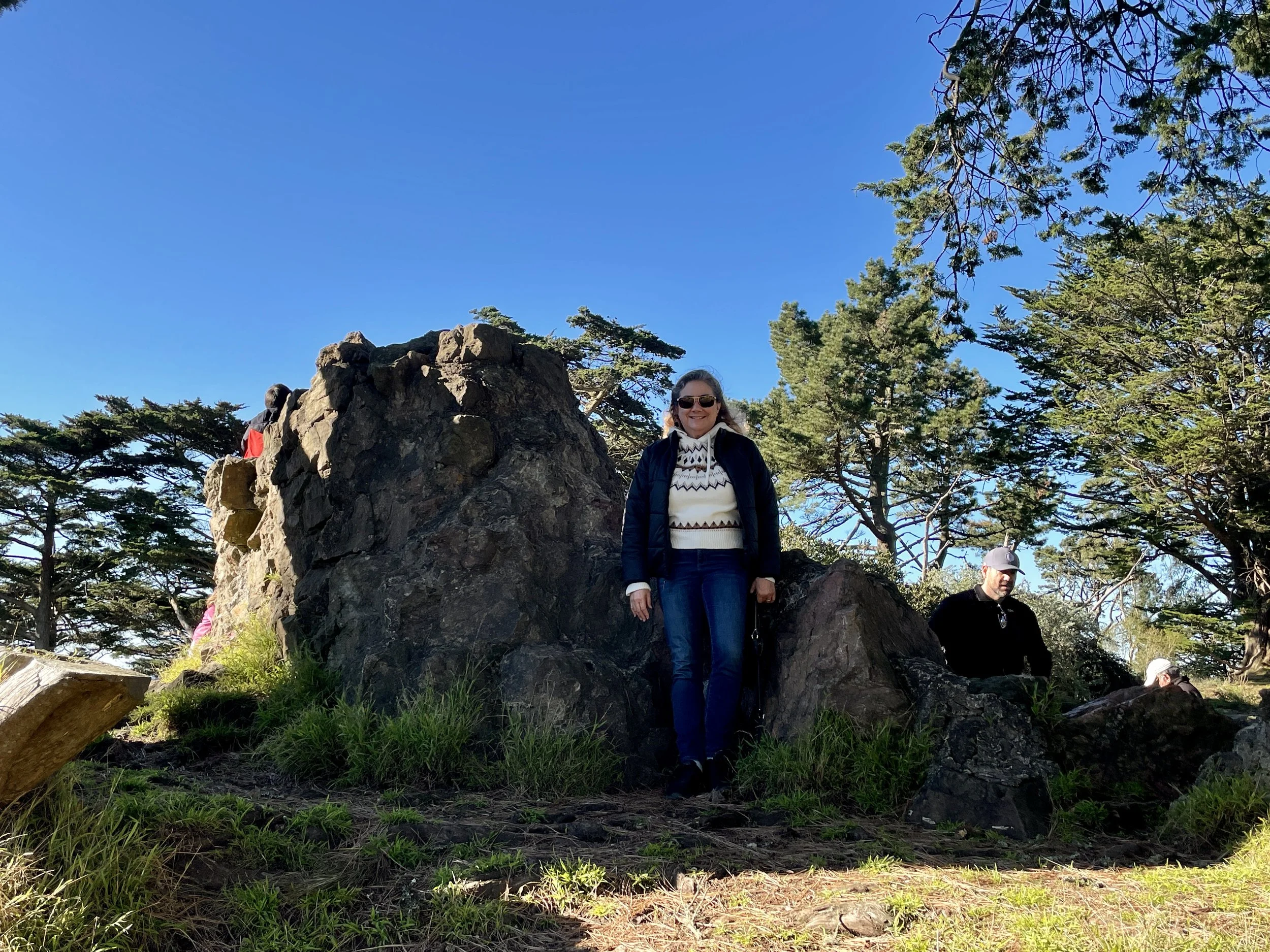
This used to be part of the two-story, castle-like Sweeny Observatory at the summit of Strawberry Hill.
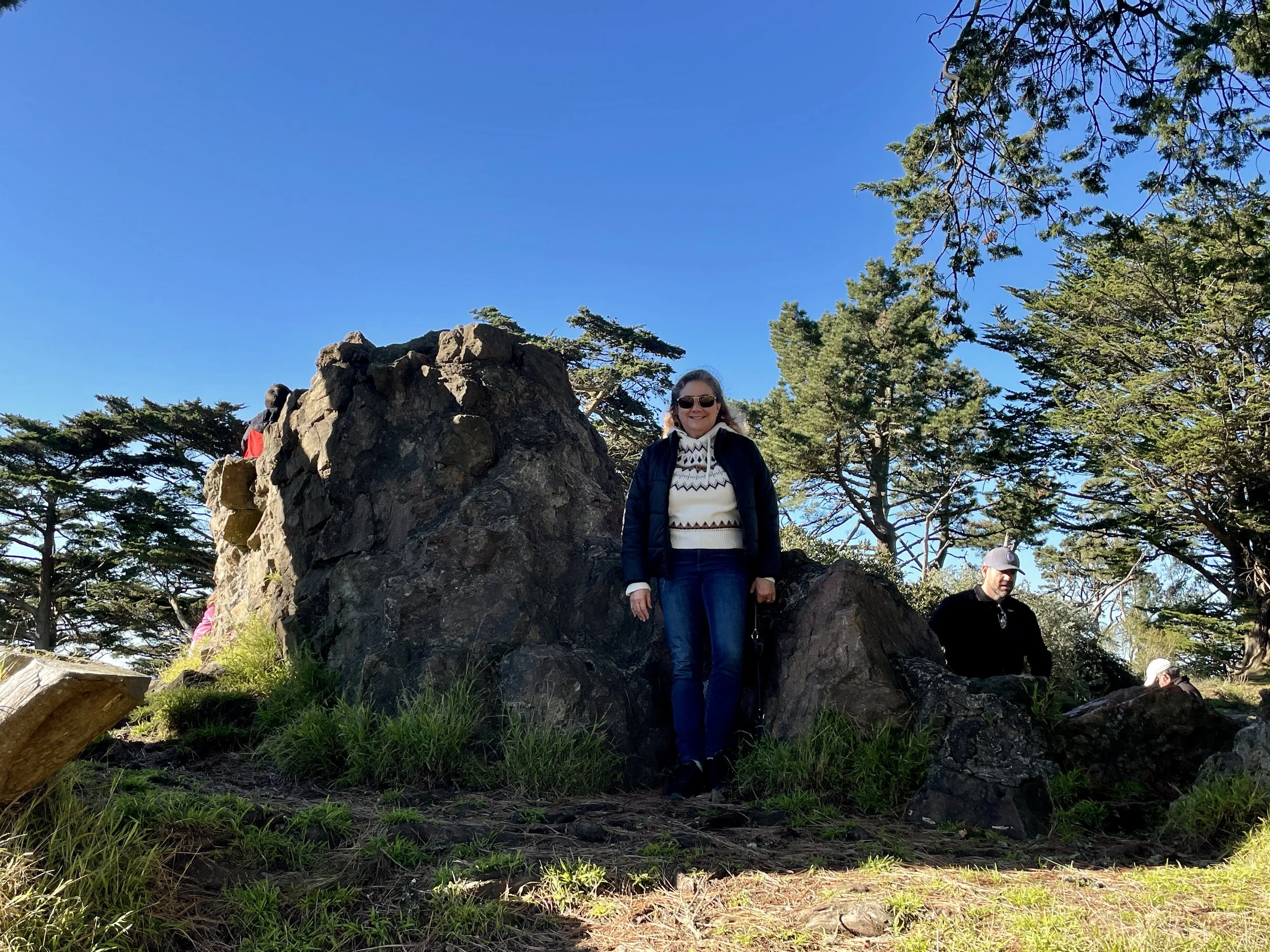
Another view of the ruins of Sweeny Observatory, with Mt. Sutro and Sutro Tower in the background
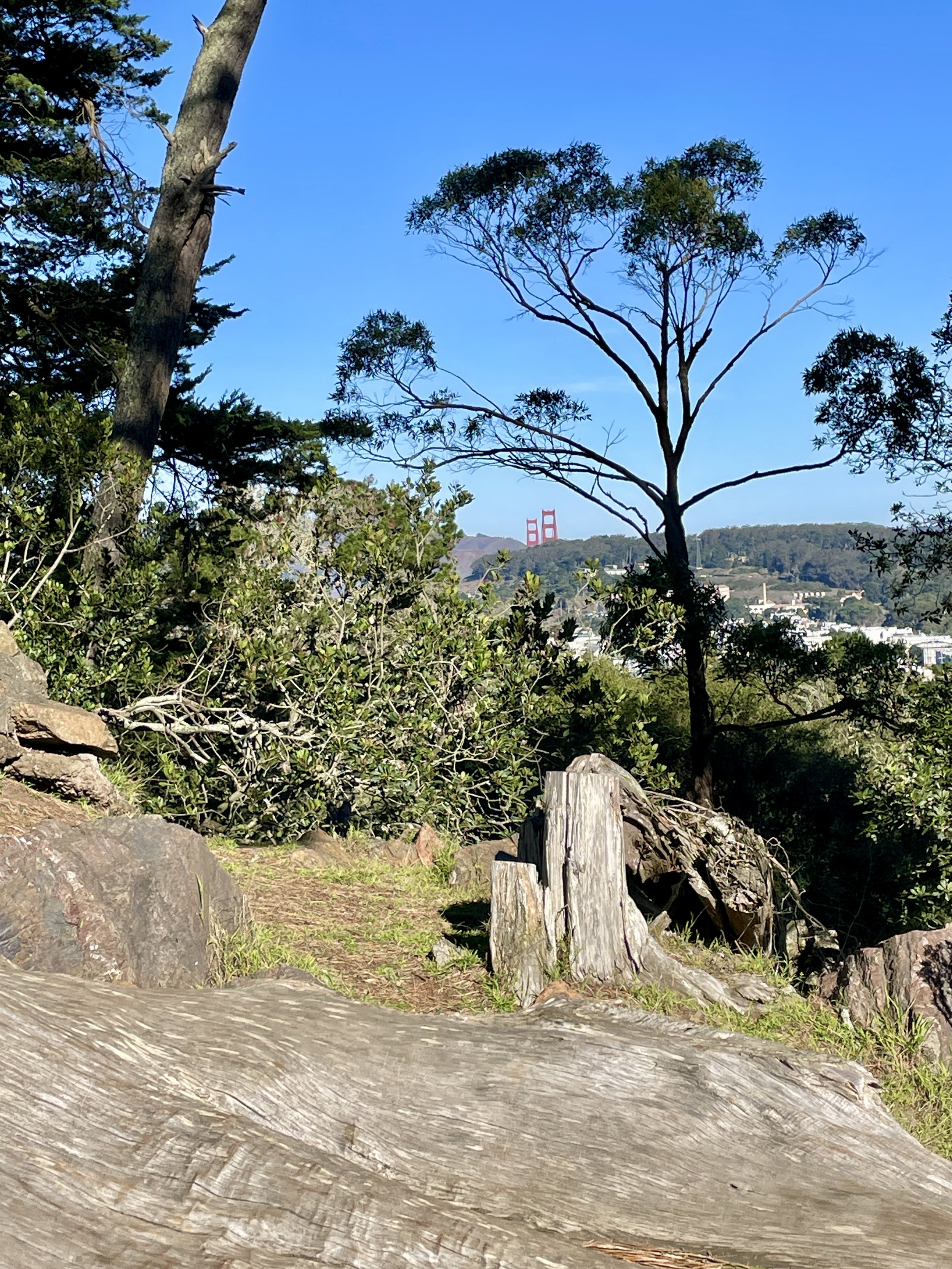
A view of the Golden Gate Bridge (completed in 1937, so Frank and Nora would not have seen this)
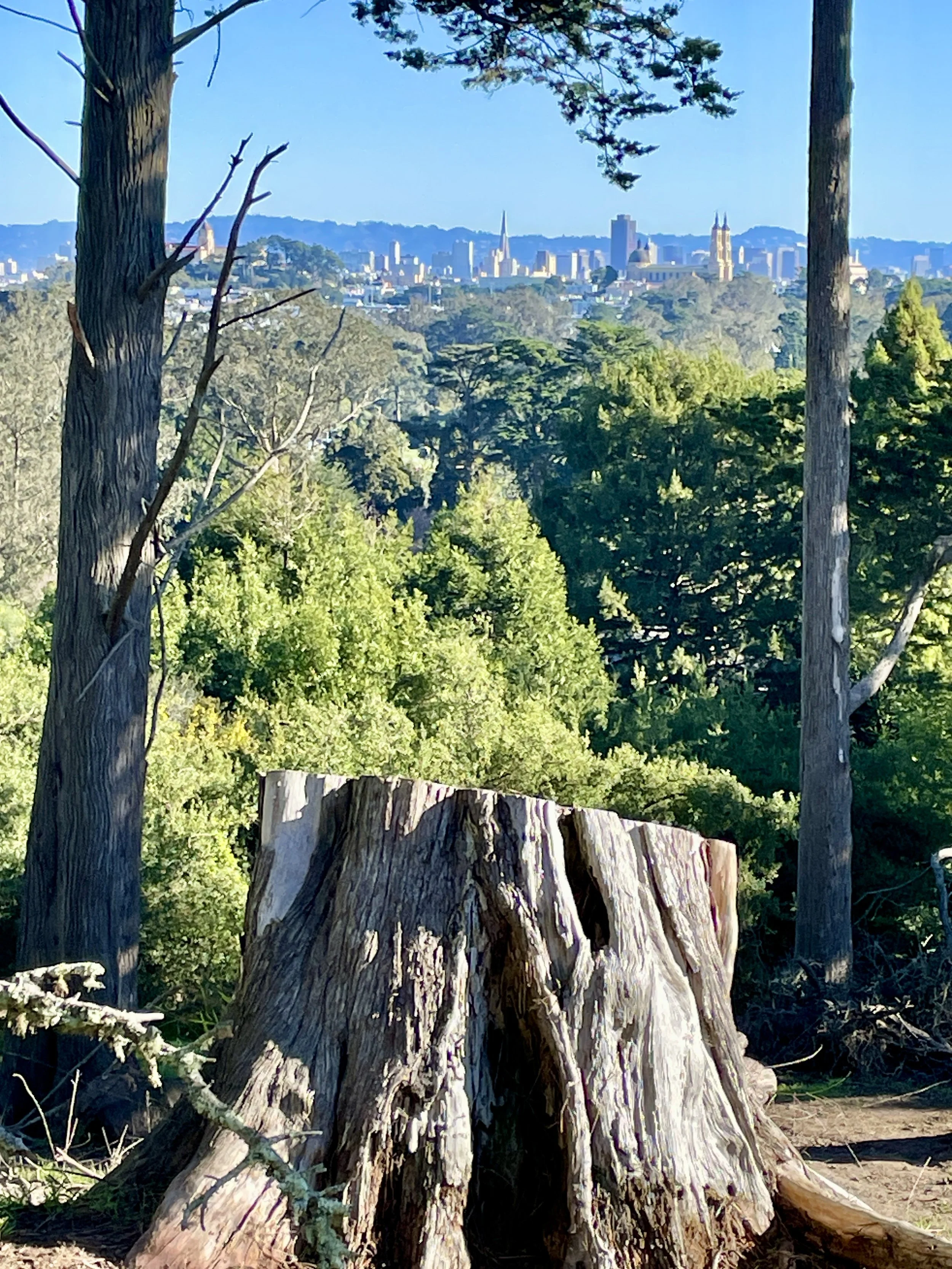
A view of downtown San Francisco
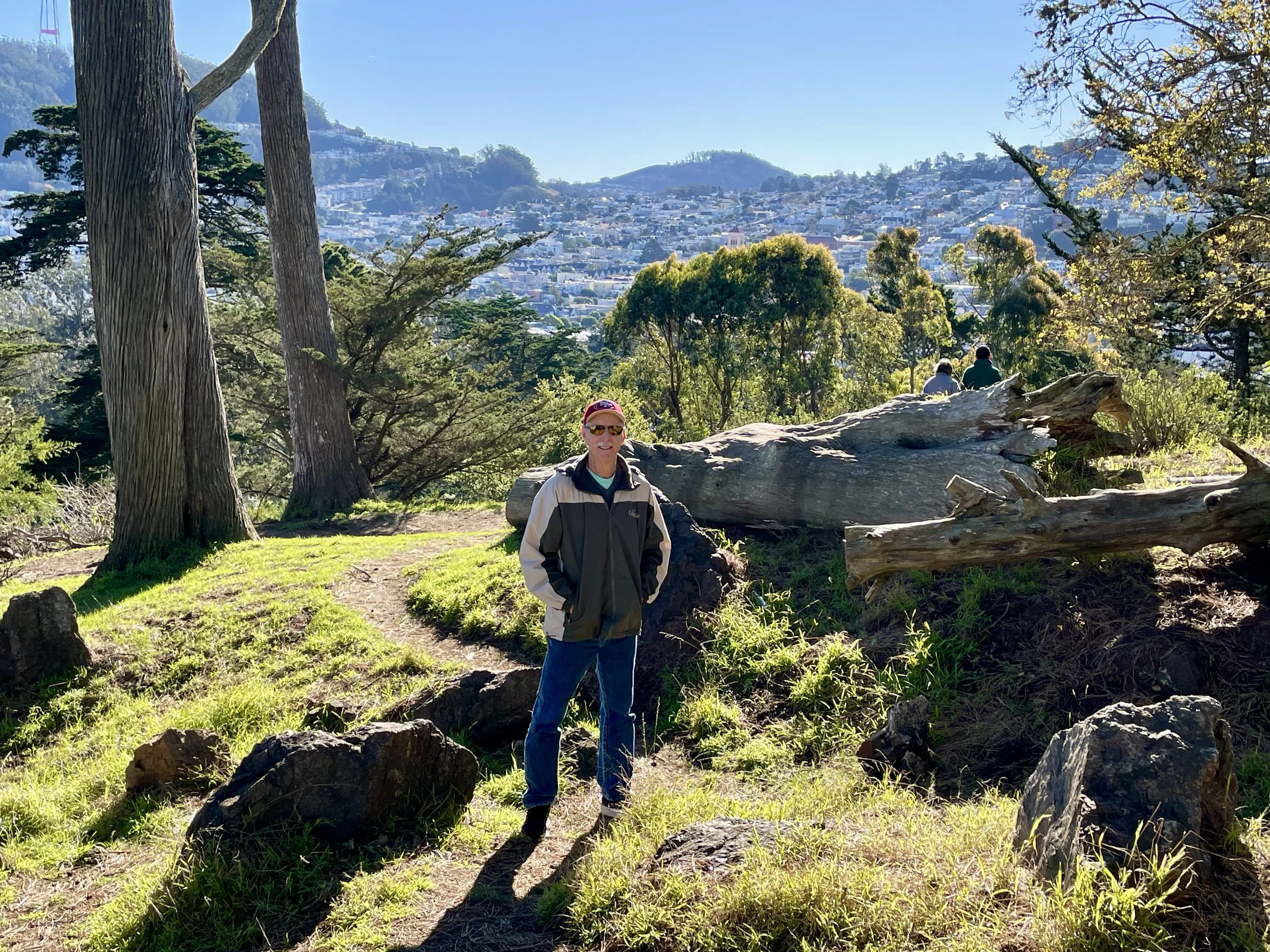
A view to the southeast - you can (barely) see Mt. Sutro and Sutro Tower on the far left, then the “Twin Peaks” area of San Francisco – which is where we drove next to see some houses that Mike’s grandparents and great grandparents had lived in.
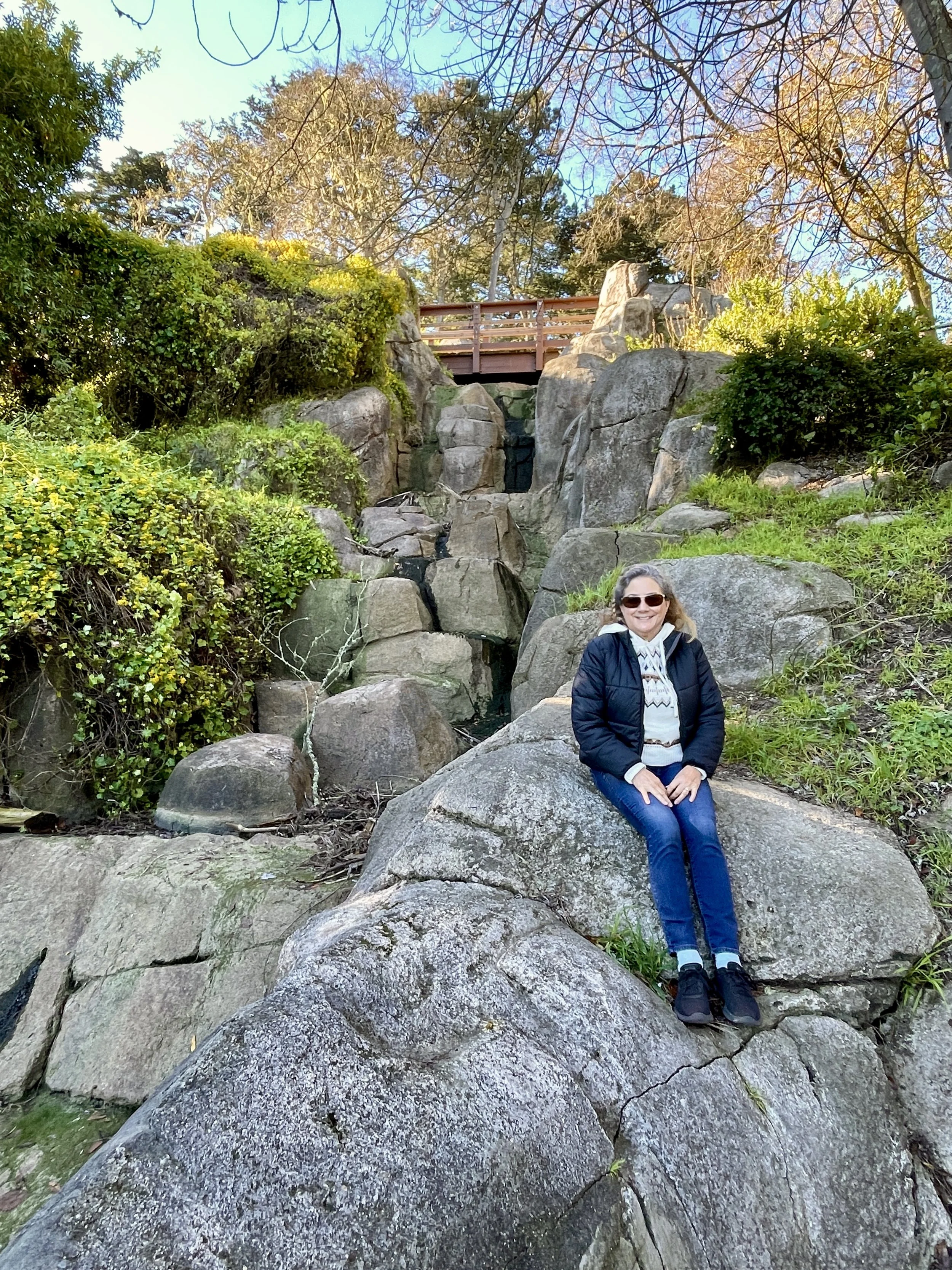
Here you can see where “Huntington Falls” should be, but the waterfall was clearly not running that day!
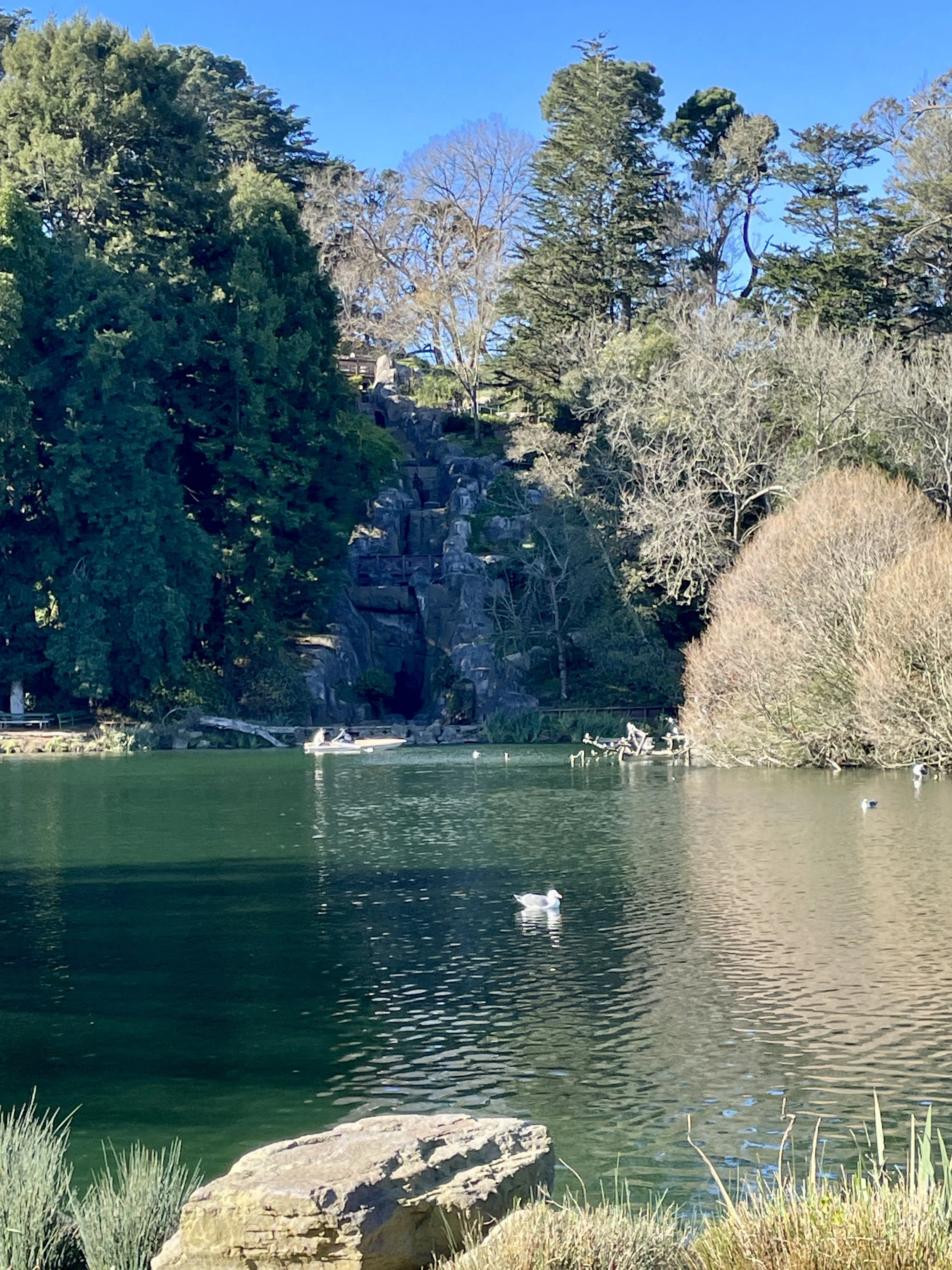
A view across Blue Heron Lake to Huntington Falls – maybe we will make it back again sometime when the falls are running!
Since we were in an “exploring mood,” we also drove to the far end of the park to see the “Bison Paddock” and to learn a bit more about the American Bison, or “tatanka,” that live there. I mean, who knew? LOL. I’ve seen bison in the wild at Yellowstone National Park and Grand Teton National Park, I’ve looked for them on Catalina Island, and I’ve seen them in various zoos, but I don’t recall ever seeing them at Golden Gate Park prior to this visit.
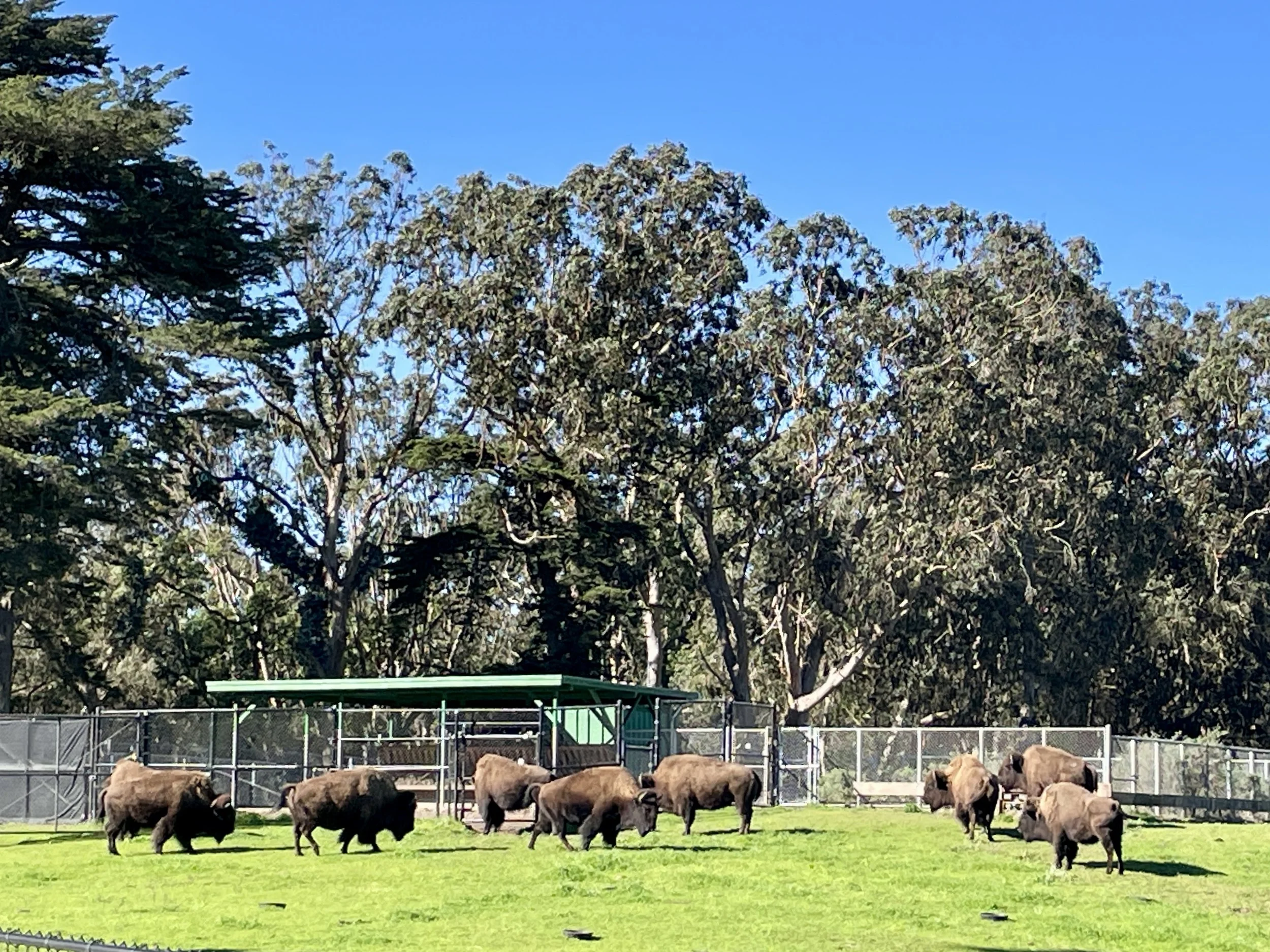
We arrived just in time to see the bison wandering about before they went inside to eat.
As the display sign below states, they are a conservation success story: “Until 100 years ago [I’m thinking this sign is a bit old!], 30-60 million bison roamed North America’s prairies. One frontiersman told of a herd five miles wide and 12 miles long. As railroads were built across the Great Plains, bison were killed for food, skins, and to deprive the Plains Indians of their primary food source. On February 14, 1891 – when the species was close to extinction – the first bison was brought to Golden Gate Park. By 1998, more than 100 calves had been born in the captive breeding program and the total number of bison in North America exceeded 200,000.” [6]
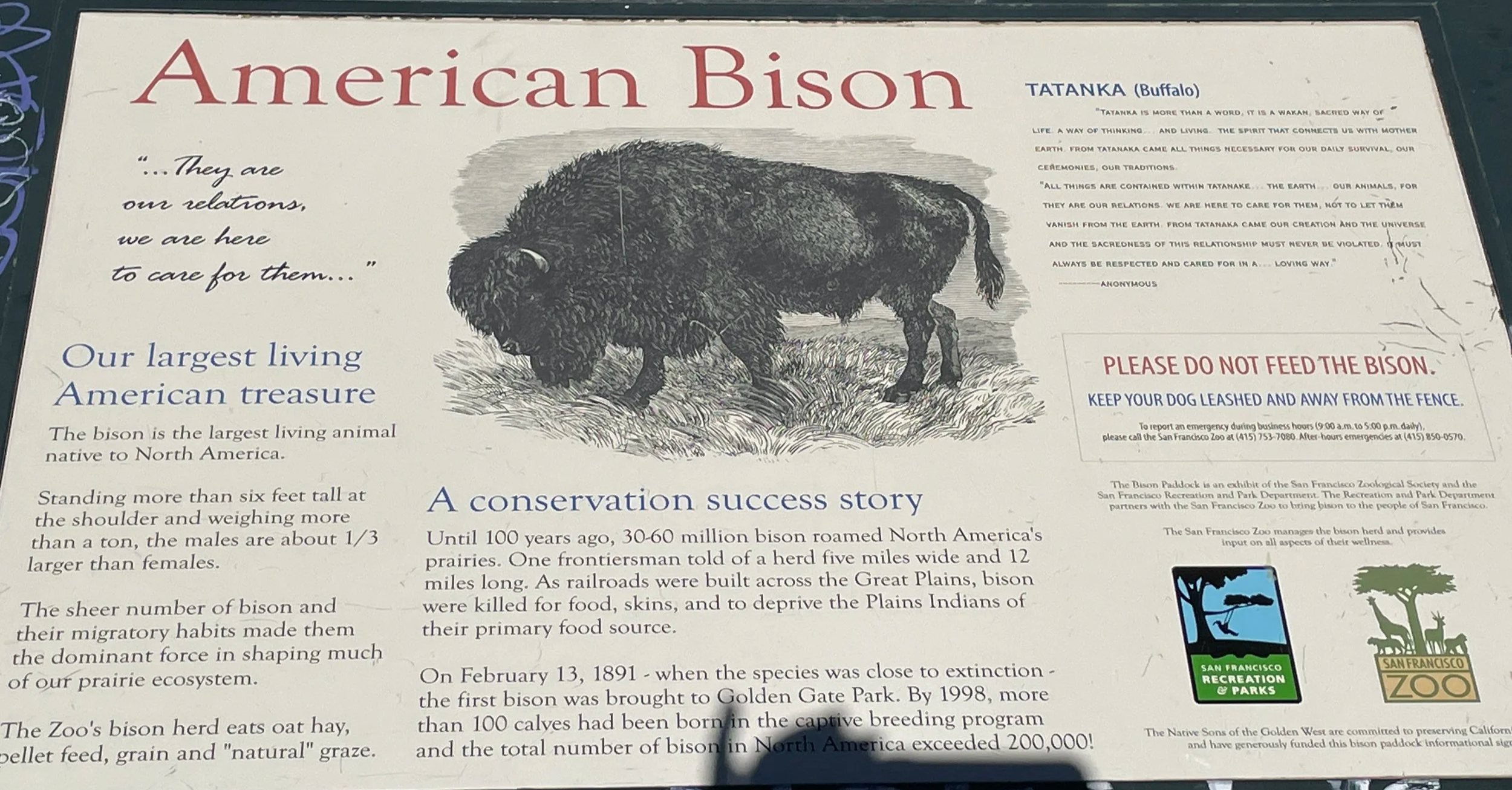
“ … They are our relations, we are here to care for them …”
More recent statistics that I found online say that more than 500 calves have been born in Golden Gate Park. That same website also explains, “SF Zoo animal staff care for the bison located at the Bison Paddock in Golden Gate Park under the management of the San Francisco Recreation and Park Department. As such, staff provide daily care and feeding and veterinary services, while Rec & Park maintain the paddock and grounds.” [7]
Originally, the bison were named after various historical figures (Ben Harrison, Sarah Bernhardt, Grover Cleveland, Bill McKinley and Bill Bunker were among the earlier names). Later, they were named after the royal family according to Shakespeare. In 1993, however, “the bison relinquished their Shakespearean names in favor of Native American names at a special bison reclaiming and renaming ceremony sponsored by the Watchbison Committee, the Native American Advisory Committee, and the San Francisco Zoological Society.”
We really enjoyed our afternoon at Golden Gate Park and would recommend that, next time you visit, you check out these interesting sights!
Endnotes
LaBounty, Woody. “Sweeny's Observatory - Golden Gate Park.” San Francisco Story, 13 September 2023, https://www.sanfranciscostory.com/sweenys-observatory/.
Ibid.
“Golden Gate Park's Stow Lake Renamed Blue Heron Lake.” San Francisco Recreation and Parks, 18 January 2024, https://sfrecpark.org/CivicAlerts.aspx?AID=1696.
Bourn, Jennifer. “Huntington Falls, Strawberry Hill Island At Stow Lake, Golden Gate Park.” Inspired Imperfection, 30 August 2016, https://inspiredimperfection.com/adventures/huntington-falls-strawberry-hill-stow-lake/.
Gardner, Louise. “Huntington Falls, Strawberry Hill, Golden Gate Park | San Diego State University Digital Collections.” SDSU Syllabus Collection, 10 May 2024, https://digitalcollections.sdsu.edu/do/cf751860-6389-49f4-91b6-cceef74bca84#page/1.
“American Bison.” Display Board at Bison Paddock, Golden Gate Park, San Francisco, CA. Photo by Tonya McQuade, 29 Dec 2025.
“Golden Gate Park Bison.” San Francisco Zoo and Gardens, 2025, https://www.sfzoo.org/historic-sites-golden-gate-park-bison/.