Faith, Community, and Global Missions: How the Traughber Family Shaped Early History at Hollywood Christian Church
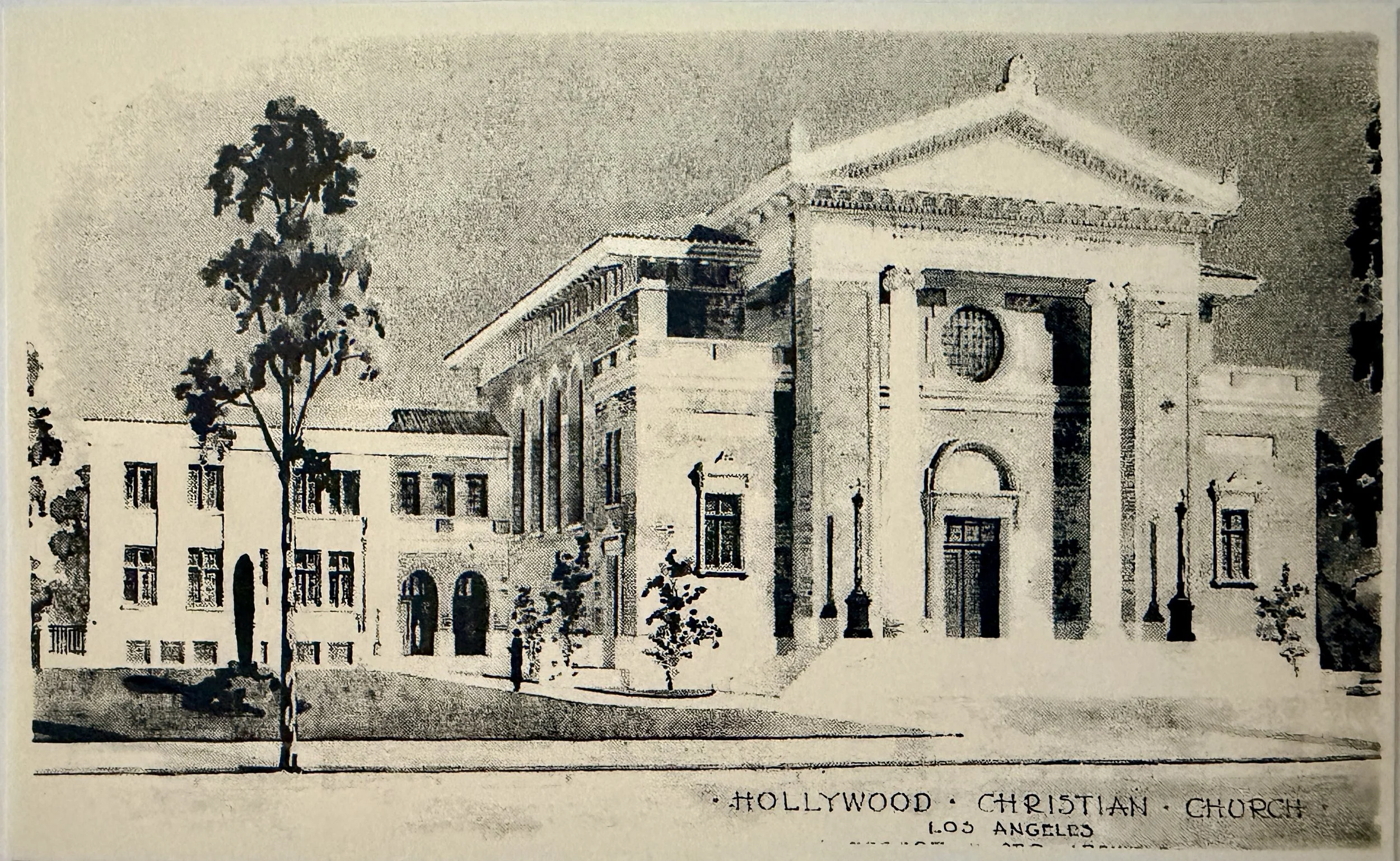
Photo of Hollywood Christian Church that appears in Frank & Nora’s album
Chasing History: Exploring My Ancestral Roots – Post #75
By Tonya Graham McQuade
Uncovering family history often leads us to unexpected places, connecting our ancestors to the vibrant growth of the cities they lived in and the historical events and global movements of their time. Recently, while diving into old family letters, photo albums, Los Angeles news archives, and even reports on the history of Hollywood consolidation, I discovered a fascinating glimpse into the lives of my great-grandparents, Dr. William Francis “Frank” Traughber and Nora Petree Traughber, and their family (which included my grandmother, Margaret Traughber Graham). Together, they left a deep, generational footprint within the Hollywood Christian Church during a pivotal era in Southern California history.
Long before it became the global capital of entertainment, Hollywood was a largely rural, citrus-growing community, and the Hollywood Christian Church was right there at its early beginnings. The congregation was first organized as a local branch of the Christian Church (Disciples of Christ) in 1888 by B. F. Coulter, a prominent Los Angeles department store merchant, alongside Rev. M. L. Yager. That was just one year after the new settlement’s founding. For its first few decades, the church relied entirely on dedicated volunteers, including Yager, who served the congregation for many years as pastor without receiving a single salary payment. In those earliest decades, the church was also nomadic, meeting in a local schoolhouse in Coldwater Canyon – sharing the space on alternating Sundays with the Southern Methodists – and later gathering in a tiny building near Sunset Boulevard.
I’m pretty sure that no one today would describe Hollywood as “a god-fearing suburb with a country-club feel, with homeowners and a small commercial area to support them.” [1] That, however, was the initial 1887 vision of Kansas land promoter Harvey Wilcox and his wife Daeida, who registered a 160-acre Christian, prohibitionist subdivision named “Hollywood” with the Los Angeles County recorder’s office on February 1, 1887. Wilcox laid out a street map of the settlement, which he centered on a dirt road called Prospect Avenue that would eventually be renamed Hollywood Boulevard. After filing the map with the L.A. County recorder’s office, “Wilcox set about laying out Hollywood’s streets, made of dirt and lined with pepper trees. As Harvey sold lots, Daeida worked to raise money to build churches, a school and a library.” [2]
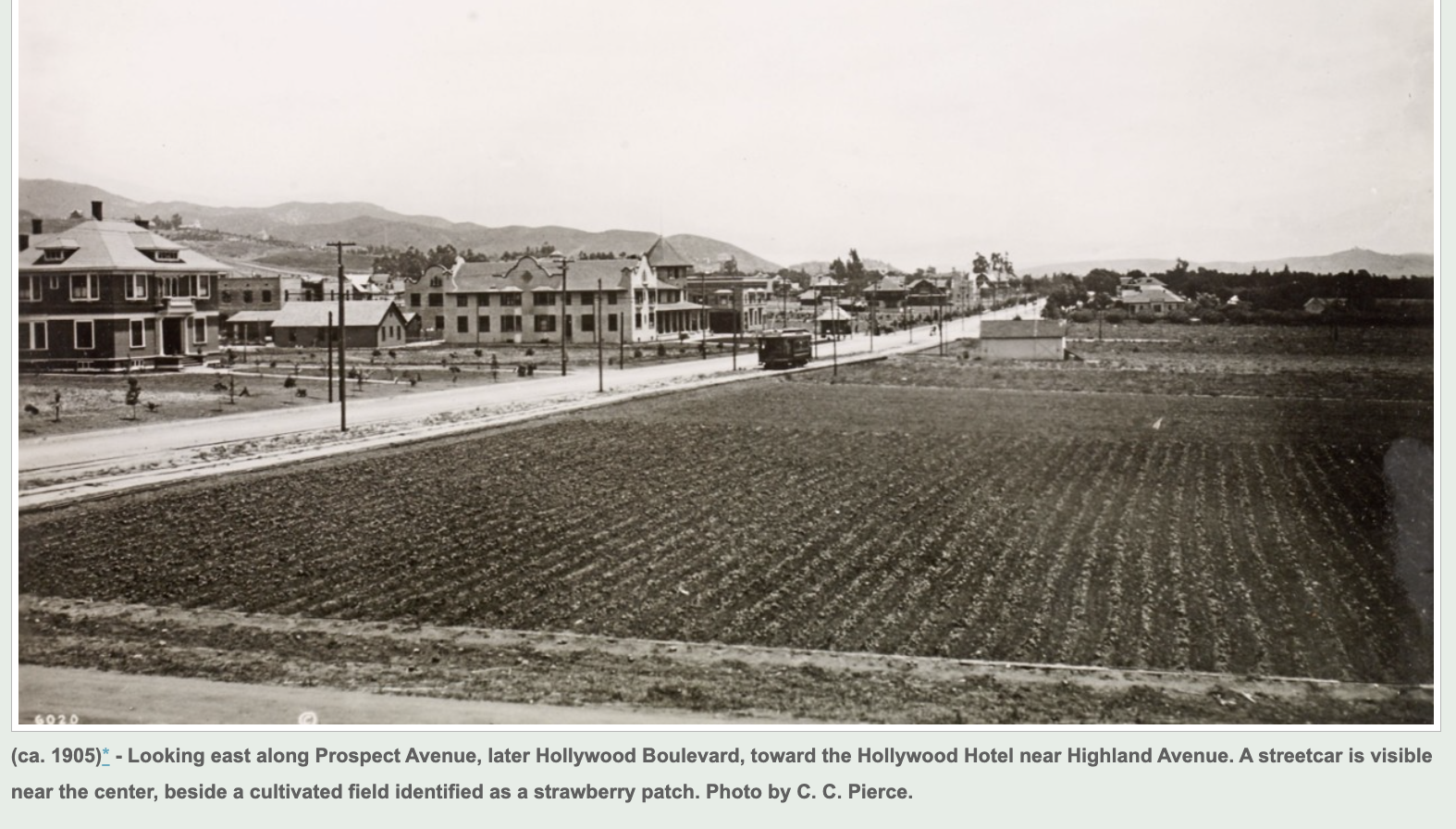
Prospect Avenue (later Hollywood Boulevard) looking east toward the Hollywood Hotel near Highland Avenue, circa 1905. A single-track streetcar sits quietly in the middle of the wide dirt road bordered by an active strawberry patch, perfectly illustrating the rural, agricultural community the Traughber family moved into in 1911. Photo by C. C. Pierce, via Water and Power Associates (Early Views of Hollywood Gallery). [3]
When Wilcox’s moral utopia failed to fully materialize, wealthy Colorado mining investor E.C. Hurd stepped onto the scene, acquiring a massive 480-acre ranch and funding the vital railroad and water infrastructure that transformed the valley. Following Hurd's death, real estate magnate H.J. Whitley purchased the estate in 1900, rapidly developing the rural settlement into a booming country town. Then, on November 14, 1903, Hollywood first became an independent city when local residents voted 88 to 19 in favor of incorporation.
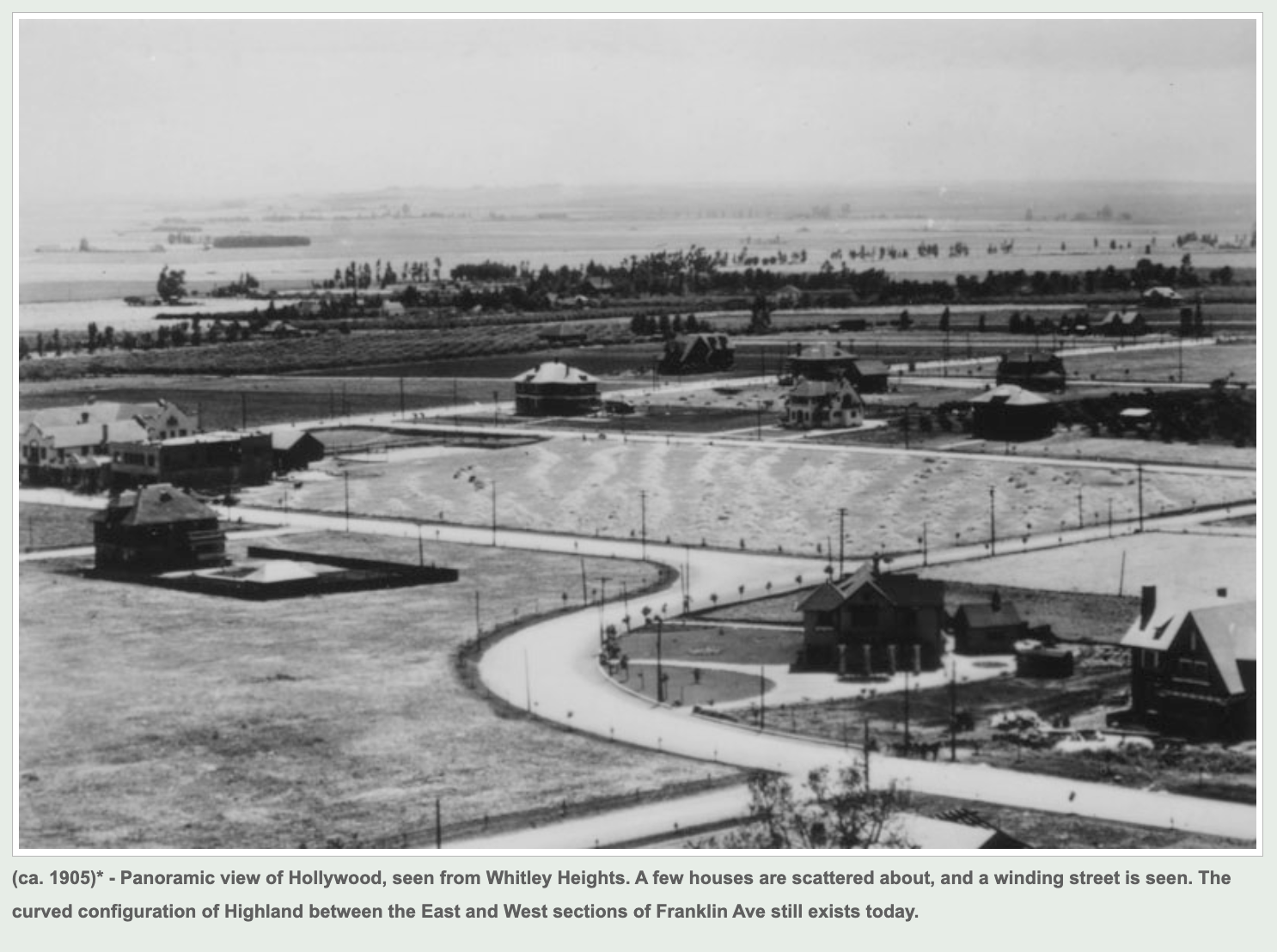
A sweeping panoramic view of Hollywood from the hills of Whitley Heights, circa 1905, showing the curved configuration of Highland Avenue winding through the valley. This wide terrain was part of the massive 480-acre ranch developed by investor E.C. Hurd and later purchased by Hobart Johnstone "HJ" Whitley before the rural settlement voted to incorporate as an independent city in 1903. In 1918, Whitley commissioned architect A.S. Barnes to design Whitley Heights as a Mediterranean-style village on the steep hillsides above Hollywood Boulevard, and it became the first celebrity community, attracting stars such as Rudolph Valentino, Barbara Stanwyck, W.C. Fields, Jean Harlow, Carole Lombard, Gloria Swanson, Rosalind Russell, Judy Garland, and Marlene Dietrich. Whitley Heights was added to the National Register of Historic Places in 1982. [4 ] Photo via Water and Power Associates (Early Views of Hollywood Gallery).
Some part of Wilcox’s initial vision, though, still remained. The new city voted in January of 1904 for Prohibition, and the following March, the Board of Trustees passed an ordinance making public drunkenness a crime. The Board also “voted to outlaw blind pigs, or illicit saloons, and to appoint a city marshal with primary responsibility for enforcing the ordinance. A 1905 booster brochure put out by the Board of Trade listed the highlights of ‘Hollywood – The City of Homes’ and stated in large capitalized bold print NO SALOONS.” [5]
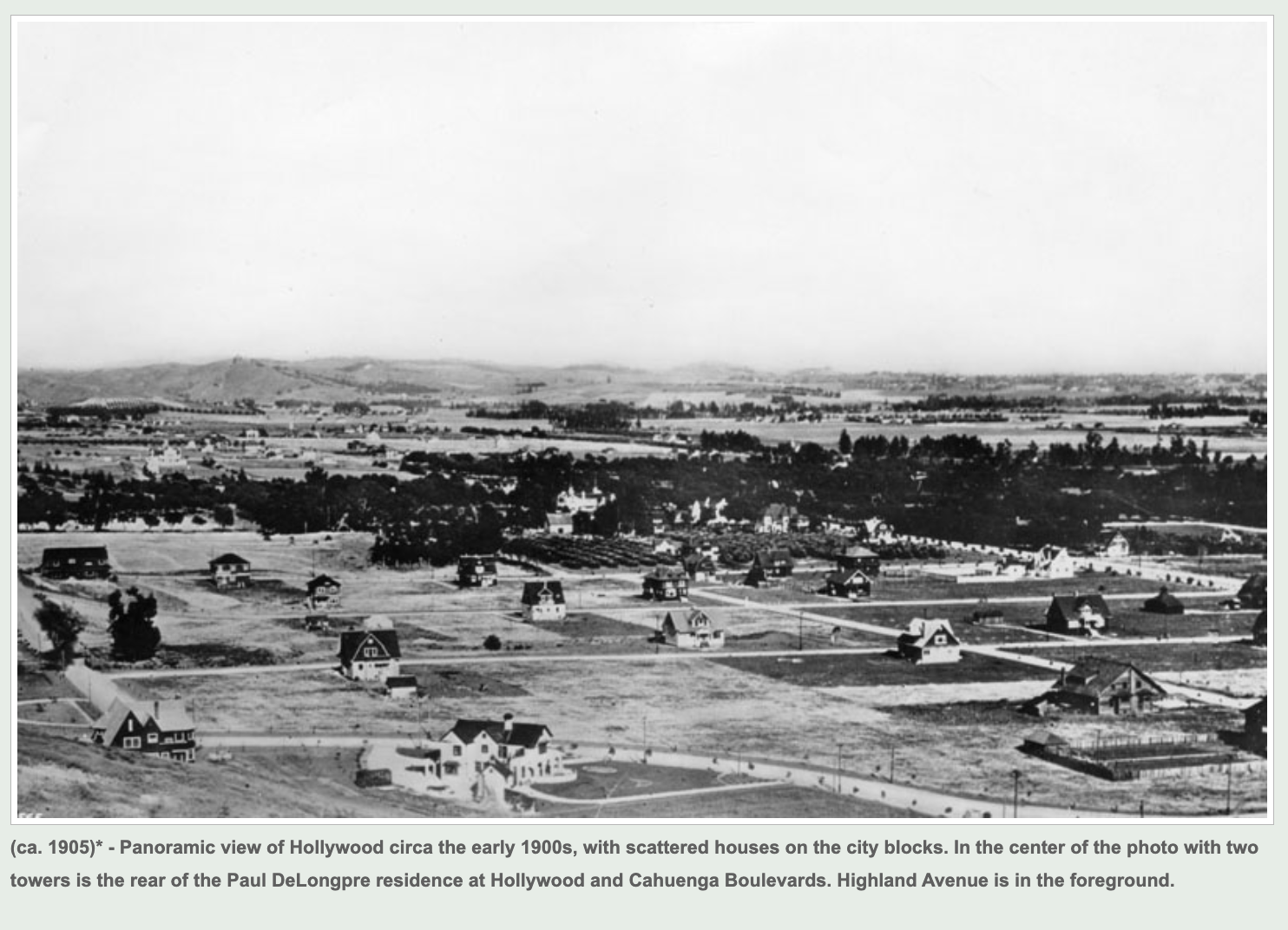
The emerging grid blocks of early Hollywood, circa 1905, showing scattered residential homes stretching across the valley floor. In the center, the distinctive twin towers of the famous Paul DeLongpre estate mark the crossroads of Hollywood and Cahuenga Boulevards, tracking the rapid development of the city right as the Hollywood Christian Church prepared to build its permanent bungalow home. [6]
As the 20th century dawned and Hollywood rapidly expanded into a booming independent city, several congregations began planting permanent roots. While the Christian Church laid claim to an earlier founding date, other groups were faster to erect formal sanctuaries along the main corridor. The First Presbyterian Church of Hollywood opened its doors at Hollywood and Vine in 1903, and the Methodists quickly followed, holding services above an Owl Drug Store on Prospect Avenue. Seeking a settled presence in this fast-growing neighborhood, the Christian Church began looking for a new property in 1910. They purchased a large, vine-covered residential house on the corner of Gower Street and Hollywood Boulevard, removing a few interior walls to create a dedicated sanctuary while purposely leaving the original fireplace, deep porches, and window seats intact to maintain a famously warm, "bungalow church" atmosphere.
In constructing this sanctuary, the building committee sought to “avoid all that is conventional in church architecture,” instead wanting “both interior and exterior [to] resemble an ideal home,” according to a 1910 Los Angeles Times news article detailing the church’s upcoming dedication. As described in the article: “The assembly room, which will seat 350 people, in appearance and decorations is a large parlor or drawing-room. The windows are draped in soft tones of brown and green, and the furnishings are in antique oak. The Sunday-school room and class-rooms seat 200 more and are connected with the larger room by wide doors. These latter rooms will embody some of the features of a conservatory, with wide ledges for potted plants and climbing vines, and with continuous large windows. The aim of the Building Committee has been to produce a convenient and restful building that will incorporate the idea of the home as well as the church. The grounds are beautified with a splendid growth of trees, vines and flowers, and form one of the most beautiful building sites in Hollywood.” [7]
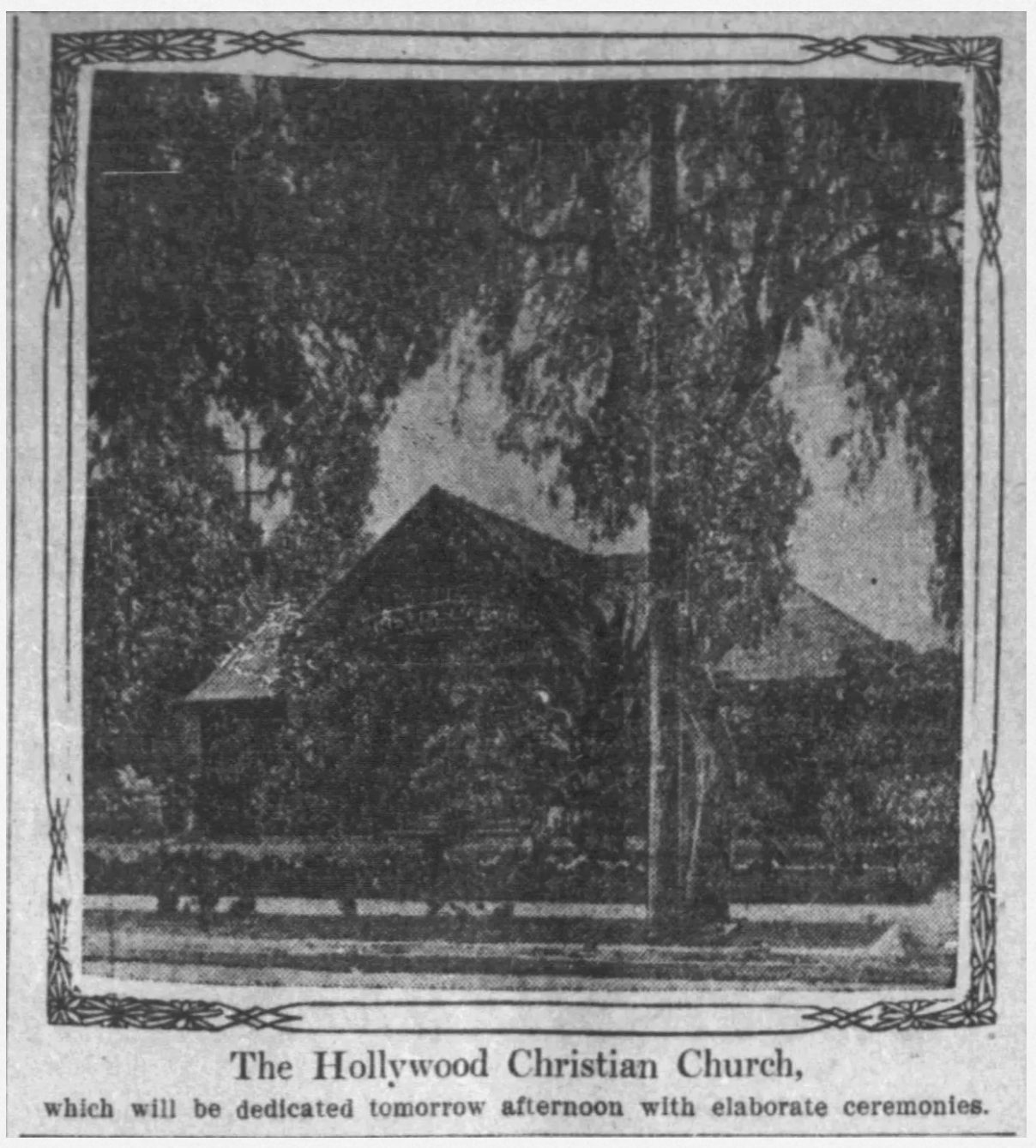
This photo of the “bungalow church” appeared in a May 21, 1910 article in the Los Angeles Times. [8]
In May 1910, the congregation officially dedicated their beautiful, craftsman bungalow house of worship on the corner of Gower Street and Hollywood Boulevard with elaborate ceremonies. The dedication featured a packed schedule of events, including an evening congratulatory service where the pastors of Hollywood's local Presbyterian, Baptist, and Methodist congregations gathered on stage in a historic display of community unity. During that inaugural morning service, a vocal solo was performed by Mrs. Jeffrey Svendsen – marking the early church presence of a woman who, along with her husband and other family members, would become some of the Traughber family's closest, lifelong companions.
Just one year after the dedication of the Hollywood Christian Church and a vote supporting Hollywood’s consolidation with Los Angeles, the Traughber family — which by that time included children Frank, Margaret, and William — moved into their new Hollywood home. Stepping into this thriving new neighborhood, the family quickly anchored themselves into the center of the young church's civic and spiritual life.
The congregation grew so rapidly over the next decade that they eventually outgrew the cozy bungalow. They acquired land on Morgan Place (later renamed Gramercy Place) just north of the boulevard and commissioned the prolific church architect Robert H. Orr to design a monumental new house of worship. Dedicated on June 17, 1923, this majestic sanctuary cost a staggering $245,000 at the time — a fortune that reflected just how quickly the local community was expanding and how prominent the congregation had become.
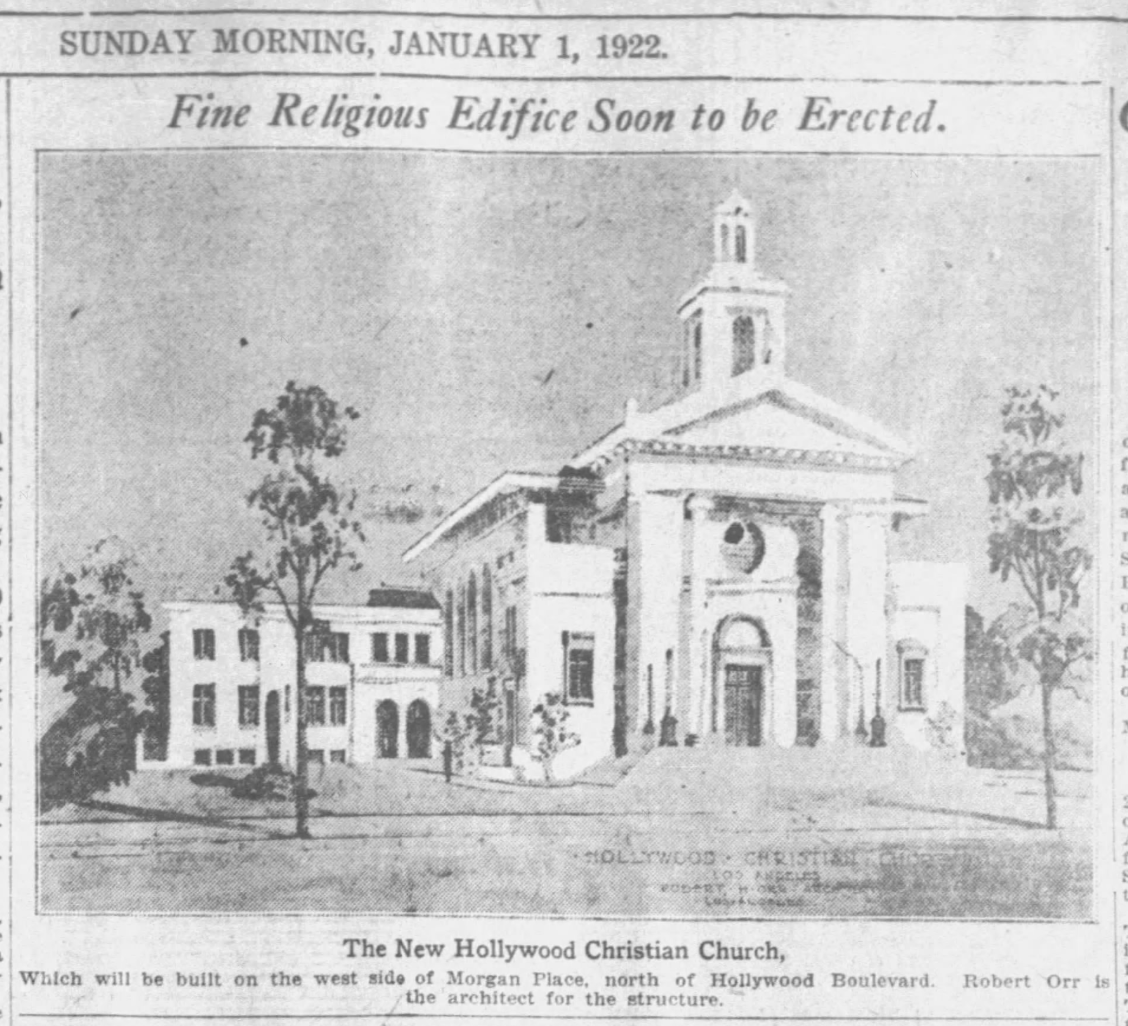
The new Hollywood Christian Church building opened on June 17, 1923. [9]
Designed in a modified Ionic style on a sprawling 200x200 foot lot, the structure featured an exterior of ruffled white brick, terra cotta trim, and a tile roof, while the interior auditorium was elegantly styled in old ivory and Douglas fir. The layout was carefully engineered across three distinct floors to facilitate religious, educational, and social work in tandem. The main floor housed a grand 700-seat auditorium equipped with a pipe organ, choir space, a baptistery, and chimes in the belfry, flanked by adult classrooms, a ladies' parlor, a library, and the pastor's study. Above, a balcony level adding an extra 240 seats looked over the main pulpit, serving as the gateway to an expansive educational wing consisting of roughly thirty-six custom classrooms and specialized assembly hubs for toddlers, intermediate groups, and senior high school students. Perhaps most remarkably, a full basement level was constructed to serve as a vibrant community hub, boasting large banquet rooms, a fully serviced kitchen, and an indoor basketball room complete with its own dedicated showers and lockers. [10]
As the church grew, my great-grandfather stepped into major positions of leadership, as I discovered in various Los Angeles news articles. By 1925, Dr. Traughber sat on the high-level Board of Elders for the church, but he also held a massive operational role as the Head of the Department of Religious Education. In this position, Dr. Traughber presided over high-stakes planning conferences to coordinate the church's seasonal campaigns. He sat at the center of a council of department chiefs that spanned finance (led by H. K. Anderson), missions, music, women's work, and "young people's life." One of his major tasks included orchestrating massive community events like the "Home Coming Day" celebration. [11]
Dr. Traughber's prominent status in the community was on full display during two major events covered by the Hollywood Daily Citizen. First, during a historic pastoral transition in April 1925, the entire congregation gathered in the church's social rooms for a massive surprise farewell celebration for their 52-year veteran minister, Dr. W. F. Richardson, who had spent the past eight years at Hollywood Christian Church. As the church presented the retiring pastor with a $1,000 love gift, Dr. Traughber was chosen as one of the primary tribute speakers to address the massive crowd alongside other city ministers. During this same era of expansion, the church heavily embraced modern technology, with their new pastor, Rev. S. J. Mathieson, broadcasting weekly morning messages to the wider Los Angeles public over the KMTR radio airwaves.
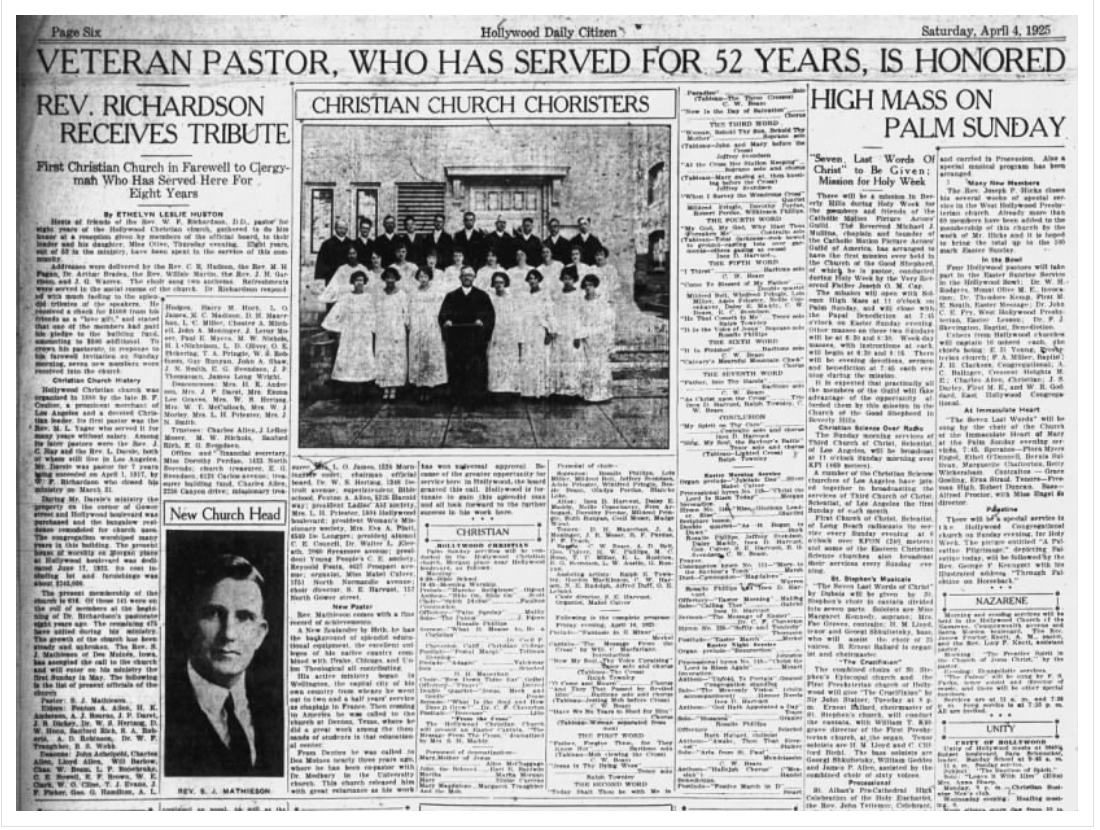
This article in the Hollywood Daily Citizen (dated April 4, 1925) described the farewell celebration for one pastor and the welcoming of another to Hollywood Christian Church. [12]
Second, during a city-wide Father and Son Week, the Hollywood Christian Church hosted a massive community mentorship banquet. Dr. Traughber stepped up to preside as the evening's head toastmaster, guiding a program that hosted over 125 fathers and sons, local Y.M.C.A. executives, and community singing.
Because Dr. Traughber directly oversaw the "young people's life" division of the church, it is no surprise that the Traughber family's involvement with these community and Y.M.C.A. programs quickly extended to the next generation. One article describes how his son, my great-uncle Robert Traughber, was an active participant and performer. To fund the association's popular summer camps, the Hollywood Branch of the Y.M.C.A. put on a massive, annual fundraising variety show. In April 1928, young Robert was listed as a featured performer in the 60-voice chorus of the fourth annual musical production, which drew crowds at both Hollywood High School and Van Nuys High School.
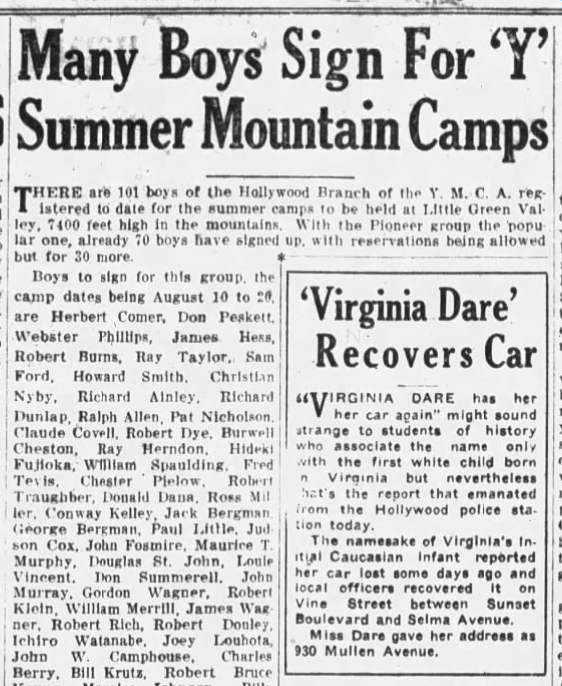
This article shows Robert Traughber’s name listed as one of the boys who will be attending the Y.M.C.A. camp at Little Green Valley in the San Bernardino Mountains. [13]
The funds raised from these performances directly supported the summer expeditions. Later that season, young Robert joined a caravan of 95 Hollywood Y.M.C.A. Pioneers who loaded into four capacity-crowded buses on Selma Avenue, setting off on a 10-day summer camping expedition into the San Bernardino Mountains at the Little Green Valley Camp. Other news articles mention him going to a Y.M.C.A. camp on Catalina Island, as well as competing in local athletic competitions. Archival tournament boards reveal he was a skilled, competitive contender in the association's challenge tournaments, successfully ranking among the town's top ten players in the 14-and-over division for "cue roque" — a popular, early 20th-century table-carom game similar to a hybrid of billiards and croquet.
Meanwhile, my grandmother, Margaret Traughber, was involved in both the church's leadership structure and its vibrant social scene. In June 1927, she was chosen as an official representative from the church's Young People's Department to serve as a delegate to the Young People's Conference held at the historic Idyllwild Pines camp in the San Jacinto Mountains. Founded just a few years prior in 1923 by a group of Christian businessmen, Idyllwild Pines was established specifically to train church leaders and pioneer cutting-edge Sunday School leadership curricula. In the 1920s, the pristine 52-acre mountain camp was a rustic sanctuary composed of humble platform tents and stone fireplaces. Serving as a delegate to this highly selective summer gathering was a distinct honor; it brought together hundreds of the most promising young church leaders from across Southern California for an intensive week of spiritual workshops, leadership training, and communal outdoor activities designed to empower youth departments back home. [14]
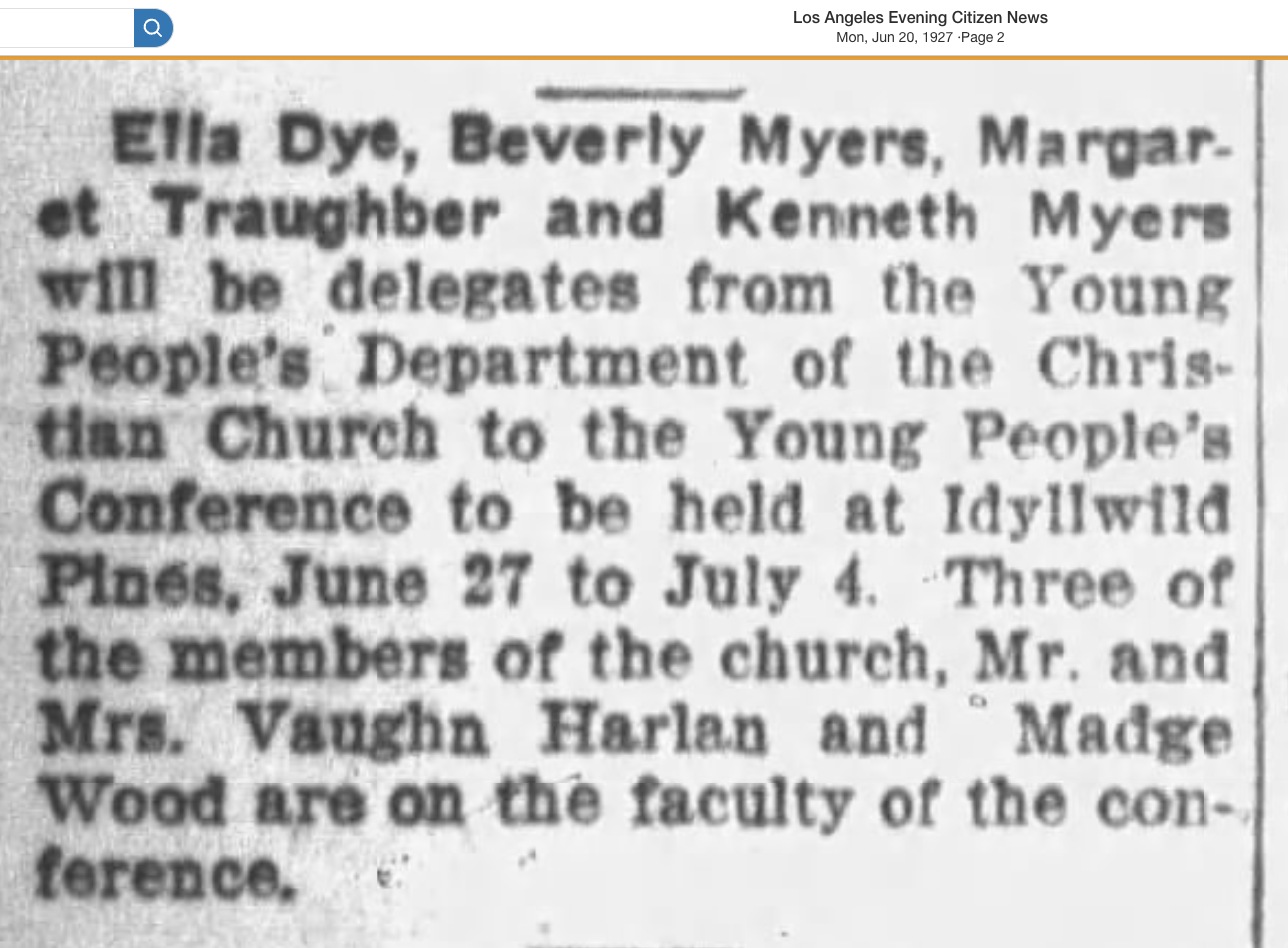
Margaret Traughber served as a delegate in 1927 to the Young People’s Conference at Idyllwild Pines. [15]
Back home in Hollywood, she also helped keep the gears turning for the church's highly anticipated annual variety shows called Potpourris. These performances featured specialty musical acts, local orchestras, and theatrical sketches to raise money for the Young People's Council, and Margaret was involved both as a performer and behind the scenes, managing the logistics of the ticket booth. Other church news articles mentioned her performing in an operetta, participating in a mother-daughter banquet, and filling the role of Mary Magdalene in an Easter Cantata titled “A Message from the Cross.”
The entire family was swept up in this culture of performance, pageantry, and community fellowship. A spectacular group photograph from around 1930 labeled as a Sunday School Class production brings this exact era to life, showing a dazzling cast of characters dressed in costume on a theater stage, showcasing everything from traditional bridal gowns to classic Charlie Chaplin pantomime outfits to media celebrity and evangelist Aimee Semple McPherson. Thanks to careful handwriting in the margins of the photo, we can spot both generations of the family sharing the stage: Dr. Traughber stands proudly in the back row next to the flag, while Margaret is seated on the far right end of the front row.
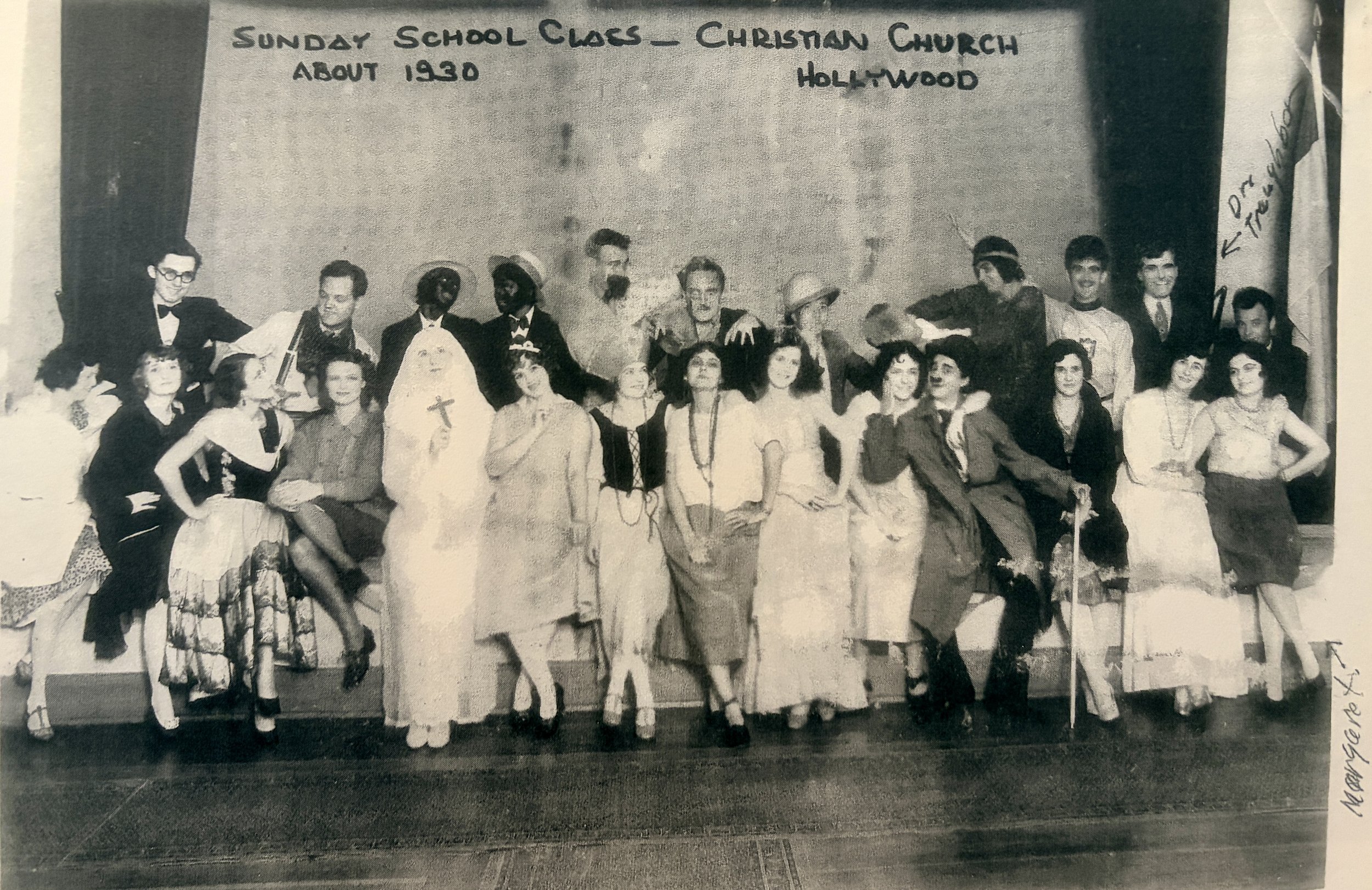
This photo from one of Hollywood Christian Church’s “Potpourri” performances features the “Sunday School Class” (c. 1930) in a variety of celebrity costumes; both Dr. Traughber and Margaret are pointed out with arrows. (Traughber Family Collection)
Nora, too, was in on the fun. Other snapshots in the family album capture Nora taking her turn in the spotlight on the church fellowship hall stage, dressed in full 19th-century pioneer attire for an early American themed community social under a banner reading "La Fiesta." In the photo below, she appears on the far right and Dr. Traughber, on the far left.
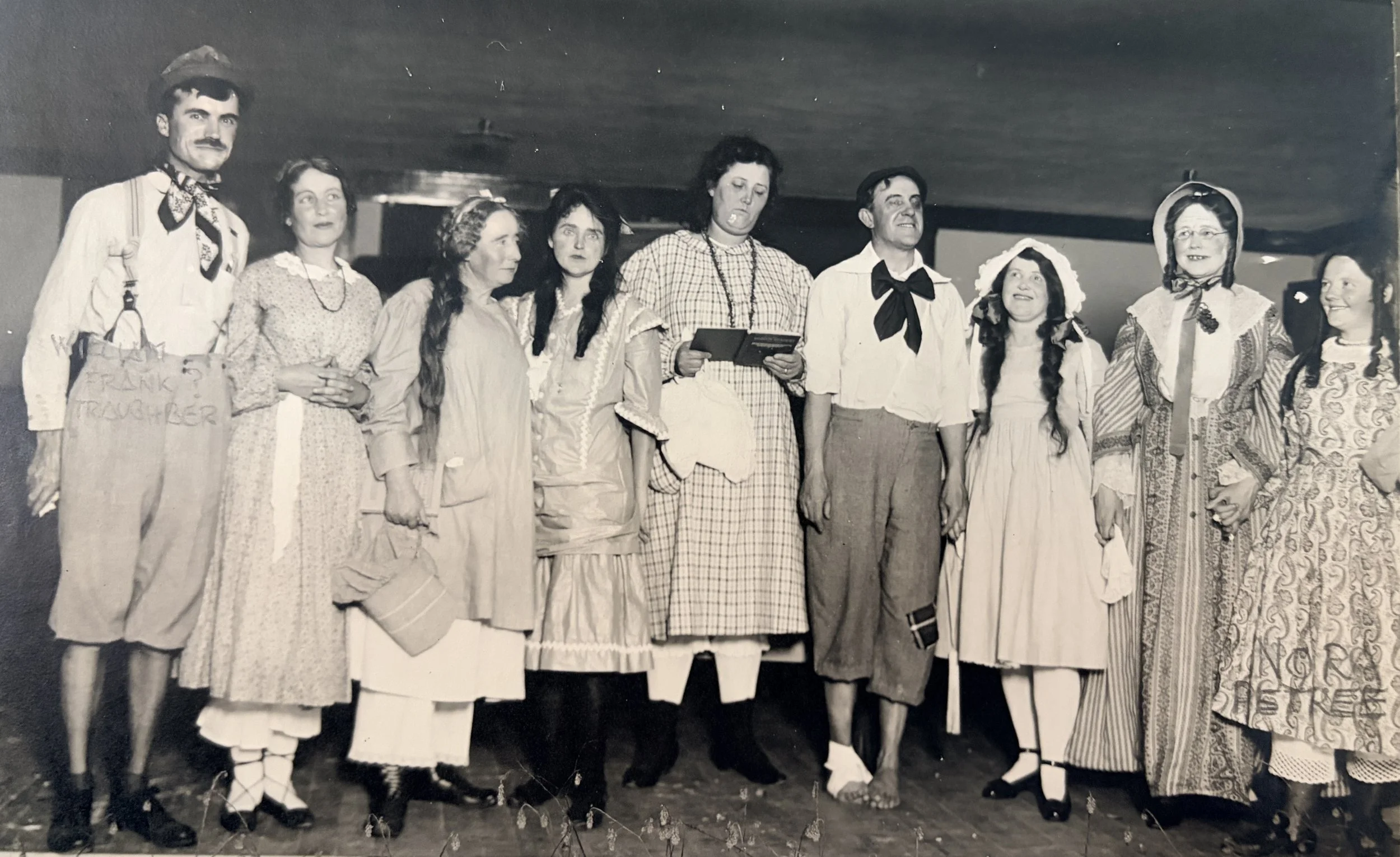
In this photo from a church dramatization, Dr. Traughber stands on the far left and Nora Petree Traughber on the far right. (Traughber Family Collection)
Nora’s active leadership in the church's social fabric, however, extended well beyond historical pageants. Local press clippings reveal she served as an officer in the church's localized chapter of the American Red Cross and acted as the general chairman in charge of major community events, including a highly creative "mock radio broadcast" seasonal luncheon for the Women's Council. Complete with a microphone broadcast under the call sign "Station SNOW," theatrical mock weddings, and humorous seasonal table decorations, the elaborate production owed its immense success to Nora’s keen eye for organization and careful committee coordination.
Beyond the local community, the family's deep roots in the church also connected them to groundbreaking global history. Family records reveal that the Traughbers regularly opened their Hollywood doors to host returning missionaries, most notably the legendary Shelton family. Dr. Albert Leroy Shelton was a pioneering medical missionary and surgeon who did radical work establishing a Western medical hospital on the dangerous Sino-Tibetan frontier in Batang. Dr. Shelton's treatment of locals and bandits alike earned him rare, tacit approval from the Dalai Lama to enter Lhasa and establish a medical clinic. Tragically, in February 1922, just as he was preparing to journey into the interior, Dr. Shelton was ambushed and fatally shot by Tibetan bandits. His wife, Flora Beal Shelton, went on to preserve his incredible memory by authoring the famous 1923 biography, Shelton of Tibet. If you want to know more about his work, you can also read this article he wrote for National Geographic in September 1921.
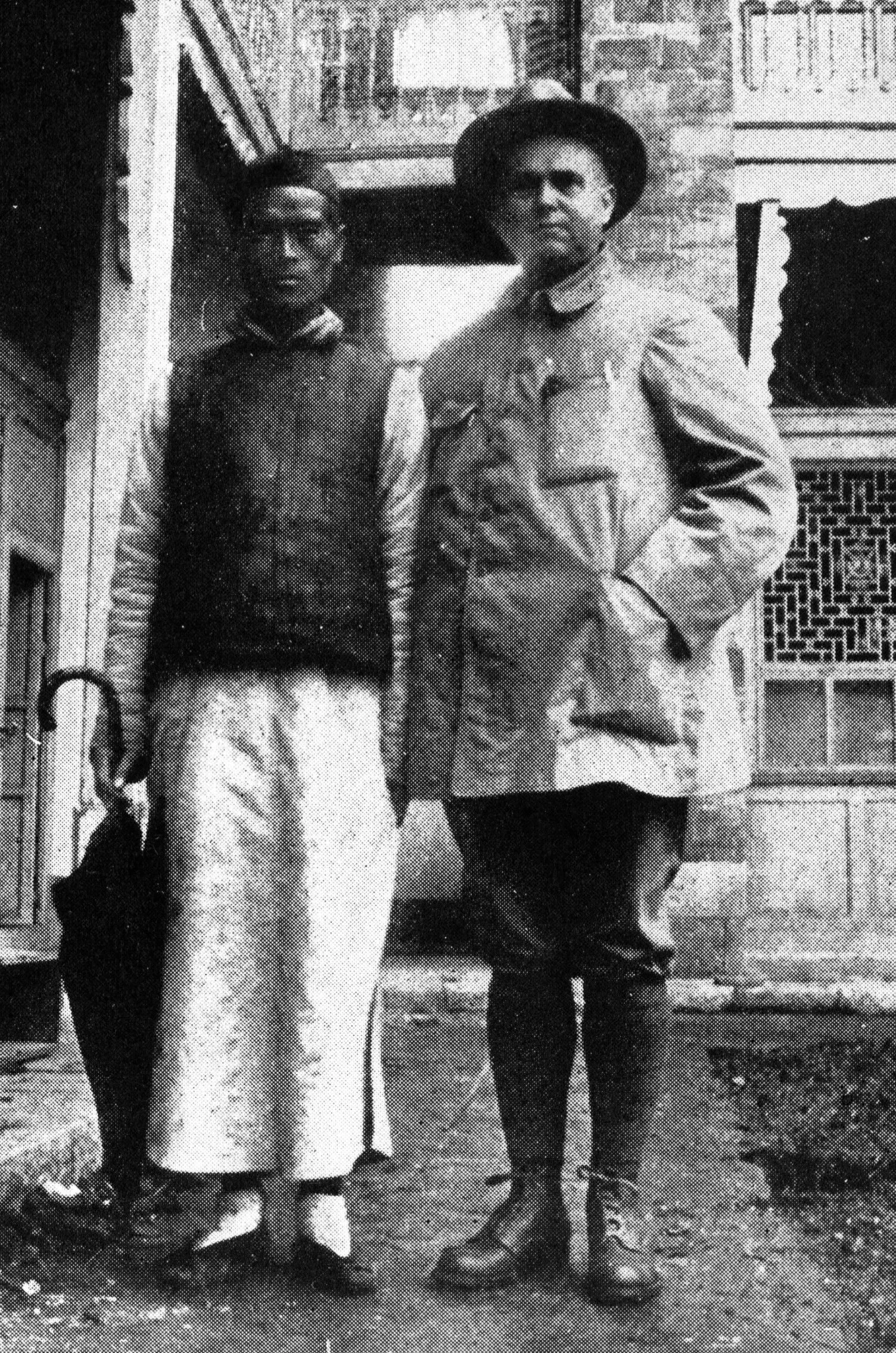
Dr. Albert Leroy Shelton prior to his fatal trip in 1922 [16]
Knowing the Traughber family's home served as a sanctuary of rest for this courageous family when they returned to the United States provides a unique connection to global history. How do I know their home served this purpose? Decades later, in a handwritten note to my father dated May 1999, my grandfather William A. Graham, who married Margaret in 1940, explained this extraordinary piece of global history:
“This book by Flora Beal Shelton, wife of Shelton of Tibet was in the library of the Yucaipa Christian Church. I asked them if I could have this book because Doctor Traughber, my wife's (Margaret) father used to have Dr. Shelton and family stay at their home when the Shelton family would come to stay in the United States for six months at a time. So they gave me permission to take the book. Dr. Traughber and wife knew the family in the late teens and early twenties before Dr. Shelton was killed near Batang, China near Tibet on February 17, 1922. I, William A. Graham, had known Dr. Shelton's son and daughter but never had known Dr. Shelton as he had been killed by bandits from Tibet. The daughter was in the United States, but was 'in love' with a Tibetan man – she went back to Tibet but found out that it was not the life for her and came back to the United States.”
This deep-rooted commitment to global missions is further illuminated by a rare letter and two photographs sent to the Traughbers from Mr. and Mrs. James H. McCallum, stationed in Nanking, China under the United Christian Missionary Society — the global missions arm of the Disciples of Christ. Decades later, Reverend James McCallum would ultimately go down in history as an international hero. In the winter of 1937, when the Imperial Japanese Army captured the Chinese capital and enacted the catastrophic Nanking Massacre, McCallum was one of only a tiny handful of Westerners who bravely refused to evacuate. Risking his own life daily, he stayed behind to serve as the administrator of University Hospital (Gulou Hospital) within the Nanking Safety Zone, physically shielding staff and driving through war-torn streets to secure food and rescue wounded civilians.
But long before those dark wartime years, our family archives reveal a deeply personal, warm correspondence bridging Hollywood and Nanking. In a beautifully preserved, typewritten letter dated November 18, 1922, Eva A. McCallum penned a long-distance update to the Traughbers, sharing the daily triumphs and trials of the mission field:
"Our life is a busy one to say the least but we are as happy as we are busy. This is our second year of the language study and next year we are planning on having our home with Miss Kelly at South City where our future work is to be.… We love China and the Chinese and are looking forward to the time when we can have a vital part in the building of God's Kingdom here.
“And our Bobbie is just a darling-seven months now and learning something new every day. I have been able to study all summer and fall so you can judge for yourself what a good baby he is…. I am enclosing a picture of him. Before I close I want to thank you for the lovely napkin ring you sent the baby. It is beautiful and we are so proud of it. I am glad it is some thing he can always keep and use. The picture of Christ you gave us we have hanging in our living room and are thoroughly enjoying it along with our friends who come…. There is a great big tender spot in my heart for you and I never cease to be thankful for such friends. You are indeed very model home missionaries."
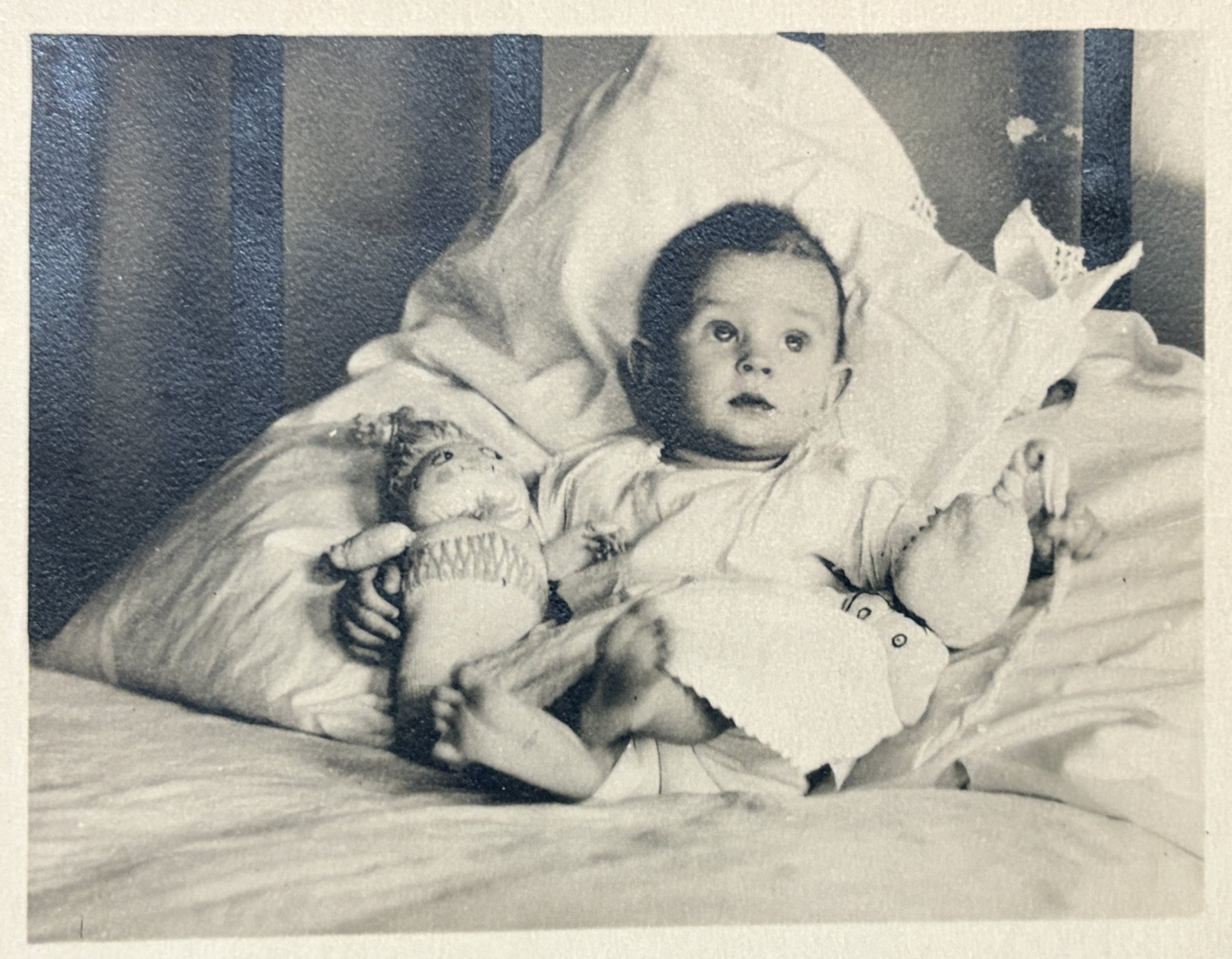
James and Eva McCallum’s son, Robert Neal McCallum, at six months in Nanking, China (Traughber Family Collection)
Tragically, this infant "Bobbie" — whose very early childhood photographs are still physically preserved in our family collection alongside Eva’s letter — would grow up to make the ultimate sacrifice. Serving as a Private First Class in World War II, Robert Neal McCallum was killed in action in 1944 at just 22 years old. Knowing my great-grandparents’ home served as a direct sanctuary of personal support, gift exchanges, and faithful record-keeping for these courageous missionary families provides a profound link to global history.
As the years pushed forward into the tail end of the 1930s, the family letters offer a more intimate, vulnerable look behind the formal newspaper headlines. Much of this precious history survives because of Nora's sister, Lettie. Though Lettie was never able to have children of her own, she possessed an extraordinarily expansive maternal heart. Over the years, she opened her home as a vital sanctuary for three different nieces — including my grandmother Margaret — whenever they faced seasons of deep personal difficulty. Beyond being a compassionate harbor for the next generation, Lettie was the intentional keeper of our family flame, carefully preserving and passing down the family archives, including historical Civil War letters that survive to this day.
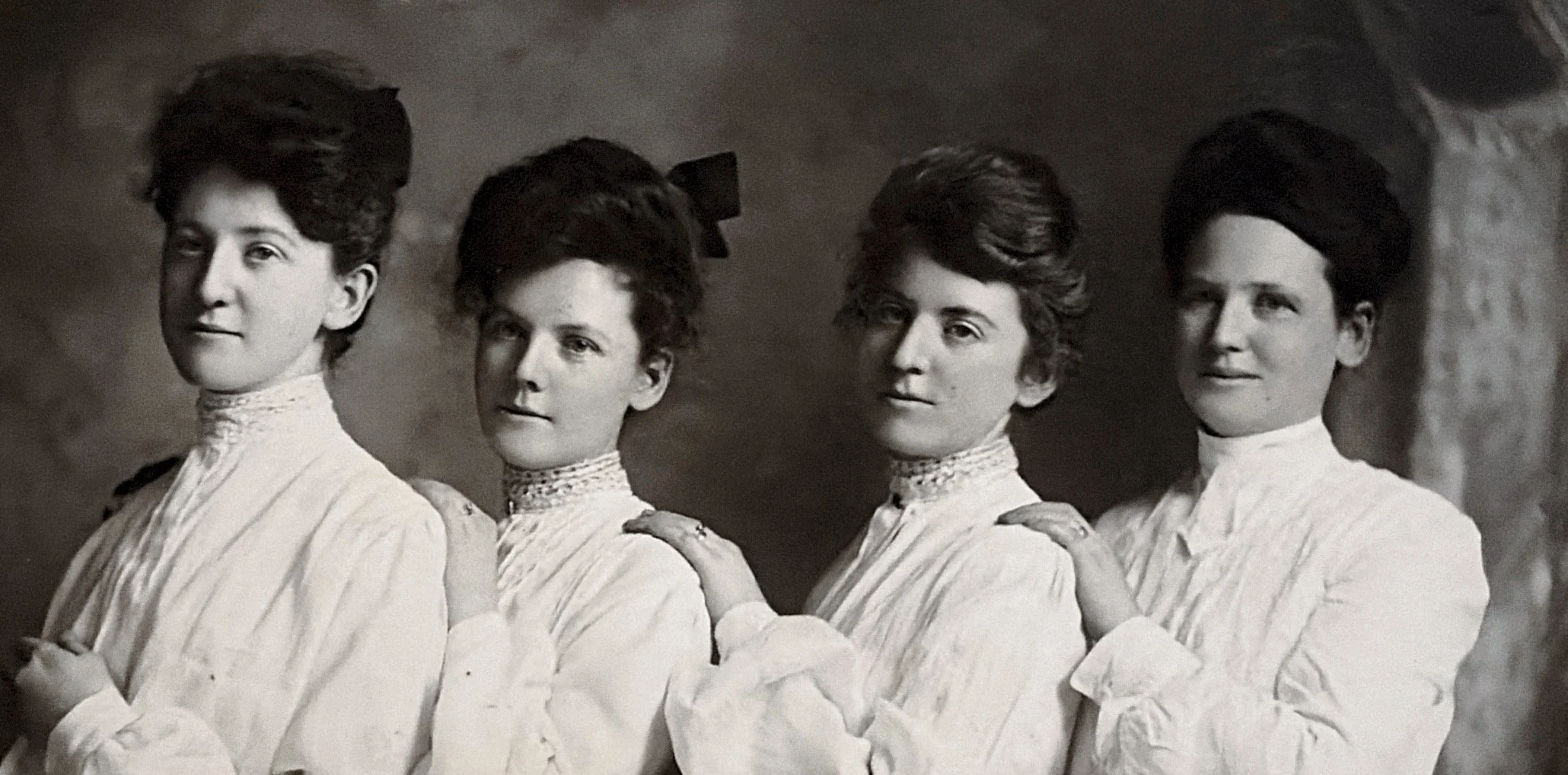
The four Petree sisters: Jessie, Nora, Lettie, and Elizabeth, c. 1904 (Traughber Family Collection)
Lettie was a prolific and exceptionally thoughtful letter writer, constantly exchanging encouraging correspondence with both her sister Nora and her niece Margaret. In a letter written to Lettie on October 11, 1939, Nora wrote back across the miles, revealing the quiet realities of aging and personal struggle within their church lives:
“Dr. T. is quite well and going strong though I can see that he is not so young as he once was but you could not tell him so. Bless his heart he teaches young people every Sunday in S.S., plays his golf (which is his salvation), enjoys his Rotary, Bridge, etc. Last night Dr. T. and I were in a lovely home in Beverly playing Bridge with a couple. That was the first social life I have had for several weeks. I have only gone to church 4 or 5 times all summer. I went 3 weeks ago but only stayed about 10 min. I just had to leave and we walked out during a solo. I cried all the way home to think I could not conquer myself. Crowds bother me but I will get over that when I get a little more sure of myself.”
The deeply human, local lens of these family letters extends into the dark era of World War II, mapping out the severe geopolitical tremors shaking their immediate neighborhood. Following the signing of Executive Order 9066, a letter written on April 29, 1942, captures the complex, conflicting undercurrents of local sentiment as the forced relocation and internment of Japanese American neighbors unfolded across Los Angeles:
“There is not much news of our coast that you do not get in your papers, “Life,” etc. The evacuation of the Japs here is moving along. All are moved out of this part of the city and we do miss them. When we have lived so close to them and dealt with them in our markets, our laundry and cleaning, at church, school, and gardens and nurseries we just learn to appreciate them. They had many fetching ways and were very thrifty. It almost seems a dream yet that we have in so short time grown to doubt the sincerity of the best of them. I still think that many of them are true Americans but who? They all act alike so far as we can discern so we cannot trust any of them. I would not even trust Kagawa though he seemed sincere. I heard him speak at our So. Calif. Church Conf. last summer, the last appearance of him before sailing to Japan. It has been interesting to see the Japs getting ready to go. They did a great deal of shopping for clothes and good luggage and such things as they could take with them. They bought the very best and went off in fashion with happy faces mostly and many fine cars but I believe they have to sell their cars when they get to their destination.”
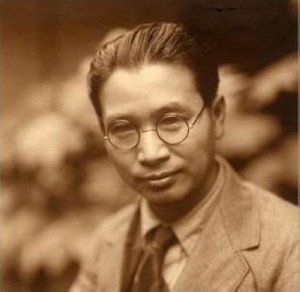
Toyohiko Kagawa - called the “St. Francis of Japan” [17]
The reference to "Kagawa" links the family's local pews to one of the most prominent international peace movements of the pre-war era. Toyohiko Kagawa (1888–1960) was a renowned Japanese Christian pacifist, theologian, social reformer, and Nobel Peace Prize nominee widely heralded as the "Gandhi of Japan" or the "St. Francis of Japan". In May 1941, just months before the attack on Pearl Harbor, Kagawa traveled to the United States on a final, desperate peace mission with a Japanese Christian delegation. During this tour, he spoke passionately at a Southern California Church Conference in a final bid to ease international tensions and strengthen bonds between Japanese and American Christians before sailing back to his home country.
By winter of 1945, with World War II finally drawing to a close and the three Traughber sons (all of whom fought in WWII) returning home to their families, the family letters show a return to structured community and international focus. In a letter to Lettie dated December 17, 1945, Nora shares her own growing role within the church's intellectual and educational efforts, helping guide the community's global awareness forward after years of global strife:
“This year I am Supt. of Miss. [Missionary] Educ. in our Women’s Council so I have a good bit to do toward program building. We had our workshop meeting the first of this month and I presented the general set up for the next six mo. study on Africa. We have many good books and all of the regular helps from Headquarters and some splendid leaders in our group work so I should not have too much to do to get our work over. I think I have our yearbook which I can enclose.”
Soon after this, however, after Dr. Traughber’s retirement, both he and Nora made the decision to sell their house as they prepared for a move to Lancaster, where they had purchased land and were having a house built. Sadly, Dr. Traughber passed away in 1947 before that project could be completed. He was laid to rest at the beautiful Forest Lawn Memorial Park, where Nora would eventually join him. In the years following his death, Nora faced a deep, echoing loneliness, but she consistently looked to both her family and the deep bonds of her church circle for strength, support, and profound solidarity.
The profound spiritual foundations established by the family continued to weave through the younger generations. In a letter written on July 5, 1949, Nora details a family gathering in La Crescenta for the baptism of her grandsons Cleve and Johnnie, the children of her oldest son Frank. The letter reveals that Nora’s nephew Neil Petree would be serving as the godfather for the youngest boy, Johnnie, and that Dr. Traughber had served years prior as the godfather to Neil. By this time, Neil Petree had risen to become a massive historical "bigwig" in Los Angeles business and civic leadership. Yet, because of that early spiritual bond to Dr. Traughber, Nora requested that Neil serve as a godfather for young Johnnie. The letter beautifully illustrates how these profound church lineages intersected with California's major historical moments:
“They hesitated at first lest Neil might think he was asked because of his prominence. When I told them that Dr. Traughber served as a Godfather to Neil and that he is still in good standing in the Episcopal Church having served as choir boy + soloist for the years that he sat in as such, that John Petree Traughber would be proud to have Neil Petree serve that way and John looks more like Neil than any of his own family and is very musical, they asked Neil at my request. Neil responded that it greatly pleased him and he was honored and that he and Vera would be delighted to attend the services in the little church at La Crescenta….
“Neil looked at his watch at 2:30 and said in fifteen minutes I must go. He would have just time to get his plane to San Francisco. He was acting as a honorary pall-bearer at the service of Mr. [Amadeo] Giannini, past Pres. & founder of Bank of America organization which now has four hundred banks. Neil is on the Governing Board of the B.A. main office in San Francisco. There was to be the highest mass (Catholic) service very early next morning so to be on time he had to fly Sun. aft. rather than take night train as he had hoped to do.”
Neil Petree, who has a hall named after him at the Los Angeles Convention Center, was certainly quite the man to have as a godfather! I will be writing more about him in a future post. It was at his parents’ house in San Jose that Frank and Nora were married — the house belonging to her brother Louis and his wife Kittie.
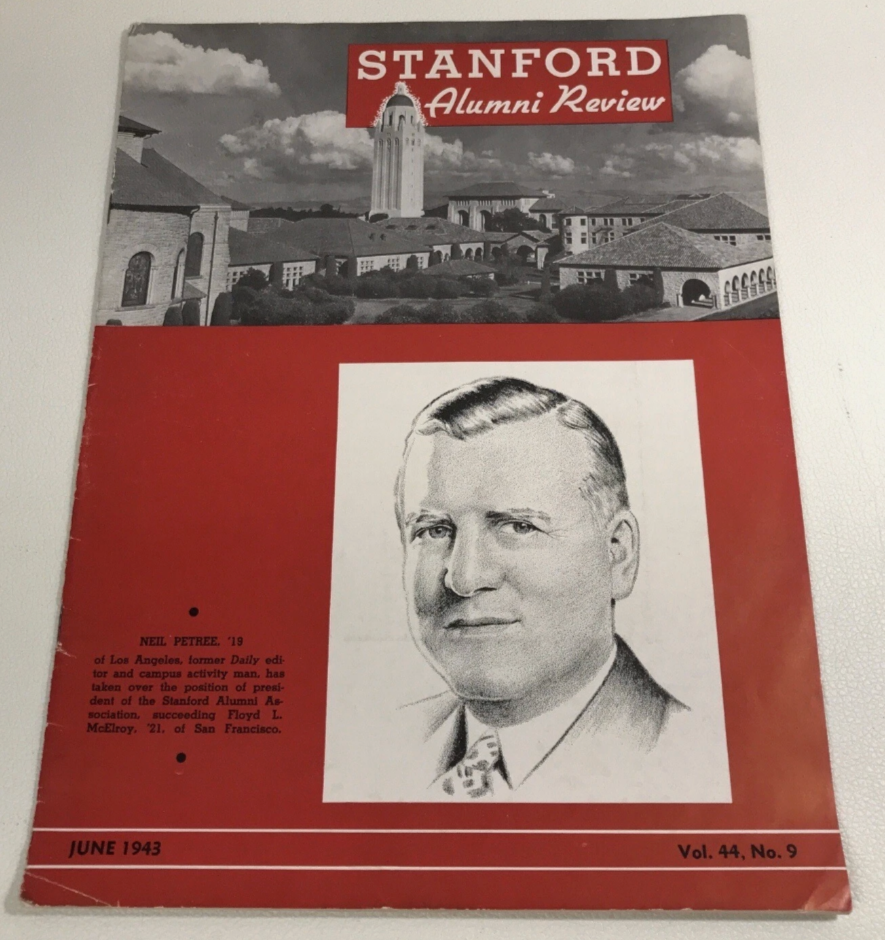
Here Neil Petree appears on the June 1943 cover of the Stanford Alumni Review.
In another poignant letter to sister Lettie, written March 25, 1949, Nora reflects on her journey to Topeka to visit Lettie and her husband Delos Bragg, expresses her ongoing grief as the loss of her life companion, and relays that she will once again be going to Forest Lawn, this time for the burial of a longtime family friend. That friend was Ed Svendsen, who had served as an elder alongside Dr. Traughber and also enjoyed golfing with him. His wife, Mrs. Svendsen, played the piano at Hollywood Christian Church:
“My last thoughts of Topeka will always be with me as I viewed from my car window, my only dear sister and husband waiting together to bid a final farewell to me. I feel so alone in spite of the lovely family I have and the interest we have in common but nothing can ever take the place of one’s life companion and I shall always feel that my dear doctor is nearer to me than flesh or blood. My stay with you was so very lovely and you were both just grand and so were your many friends. I can only wish for you both a long beautiful life together in this world which so much needs folks just like you....
“Today I have a friend calling to take me to Forest Lawn. A very dear friend of ours is to be buried there this afternoon. He was another of Dr. Traughber’s very close friends in the church from the time we entered here and he and his son and Dr. T. played golf together many times. Mrs. Svendsen was our pianist when you folks were here and I think you, Doctor, will remember Ed Svendsen as one of our elders. I know much of how Mrs. Svendsen must feel. They have a very fine record with all who know them.”
The comfort Nora discovered in Christian fellowship was a lifeline she regularly sought to extend to family and friends around her and back across the miles to her sister. In late October 1955, Lettie faced her own profound heartbreak when her husband of sixty years, Delos, passed away. Despite facing her own progressive cardiovascular health trials at the time, Nora maintained a remarkably resilient, comforting spirit, pouring her energy into long-distance letters to anchor her grieving sister:
“How my sympathy goes out to you my dear sister. I know how deep your grief is and do so wish I could be with you and able to help you bear your sorrows. You have hosts of beloved friends who will do all they can for you, I know. Your wonderful faith and courage, with God’s help, will keep you up, knowing that your beloved Delos is resting in the arms of our Savior. I know these days will be hard for you but how wonderful that our faith can assure us of peace for our loved ones who have preceded us a little. Be strong in the Lord and in the power of His might.”
Nora championed the necessity of keeping up a courageous demeanor, actively urging Lettie to consider traveling out West to live or visit with her in California. By mid-December of that winter, Nora was overjoyed to witness the steady steps her sister was taking toward healing:
“Your letter arrived today and it did me so much good to know you are taking up life anew in your own wise way. Keep up that courage and cheery way. It is smiles and laughter that brings the sunshine and good will to all you contact. I am so thankful that you have so many fine friends about you. God grant you good health is my wish and my prayer for you, and you will have happy days ahead to help you bear up under your loss and sorrows.”
Clearly, Nora’s faith played an important role in her life, just as it had for her husband. Even though the family moved out of their longtime home on La Brea Avenue in Hollywood in 1946, their emotional attachment to the sanctuary on Gramercy Place remained unbreakable into the later decades. A letter written on January 8, 1956, captures a nostalgic Christmas return to their spiritual roots, proving that the family's deep connection to the church's shifting ministry continued across the generations. As Nora wrote to her sister: "Robert wanted to attend Hollywood Church so there is where we went. He is fond of Dr. Kleihauer."
This simple Sunday journey connects the Traughber family to a very culturally influential chapter in the church’s history. Dr. Cleveland Kleihauer (1885–1960) served as the pastor of the now united Hollywood-Beverly Christian Church for nearly 26 years, earning renown across Los Angeles as an advocate for interdenominational cooperation and as a "Minister to the Stars". His high-profile flock famously included the family of a young Ronald Reagan, whose mother Nelle was an exceptionally active parishioner. Dr. Kleihauer even performed the wedding ceremony for Reagan and his first wife, Jane Wyman, and famously pushed the future president's early political philosophies, challenging him during a late 1940s men's group meeting to confront the looming dangers of international communism – a discussion Reagan later cited as a major catalyst in his personal development. [18]
Piecing together these historical fragments reminds me that my ancestors weren’t just bystanders in history; they were active participants building the communities that exist today. Dr. Traughber hosted banquets and father-son events, shaped regional religious education programs, taught Sunday School into his later years, and had fun participating in dramatic presentations. Nora led missionary society meetings and American Red Cross efforts, hosted global missionaries, and offered steadfast comfort from the scriptures. Their children and godchildren sang in choruses, ran ticket booths, performed in minstrel shows and church pageants, traveled as youth leadership delegates, participated in Y.M.C.A. camps and other activities, managed major banking organizations, and acted as a pallbearer for the founder of Bank of America. Stories like these — found in family letters and old newspaper archives — help create a living, breathing family legacy. I also appreciate knowing that theirs was a life of faith, fellowship, service, global outreach, education, personal growth, artistic fun and creativity, and community.
Sadly, due to swift turnovers in the surrounding area’s population over the ensuing decades and the fact that its location became one of the city’s most notorious hotbeds for crime and drug activity, Hollywood Christian Church’s congregation size fell from over 1,700 members in the 1950s to about 250 members in the 1980s. [19] The church also suffered significant structural damage as a result of both the 1971 Sylmar earthquake and the 1987 Whittier earthquake, leading to the main sanctuary being demolished in 1988. Only the education building remained until that, too, was demolished in 2013 to make way for a housing project.
The Traughbers, though, were there in its heyday — and they helped to make it what it was when it had a congregation of over 1,700 members and hosted numerous educational, charitable, and social activities to serve the community. Without newspapers back then reporting on “church happenings” on a regular basis, I would not have known most of what I have related here about their involvement. So, I’m grateful for the news archives that exist and once again for the many letters and photos my great-grandparents Frank and Nora left behind.
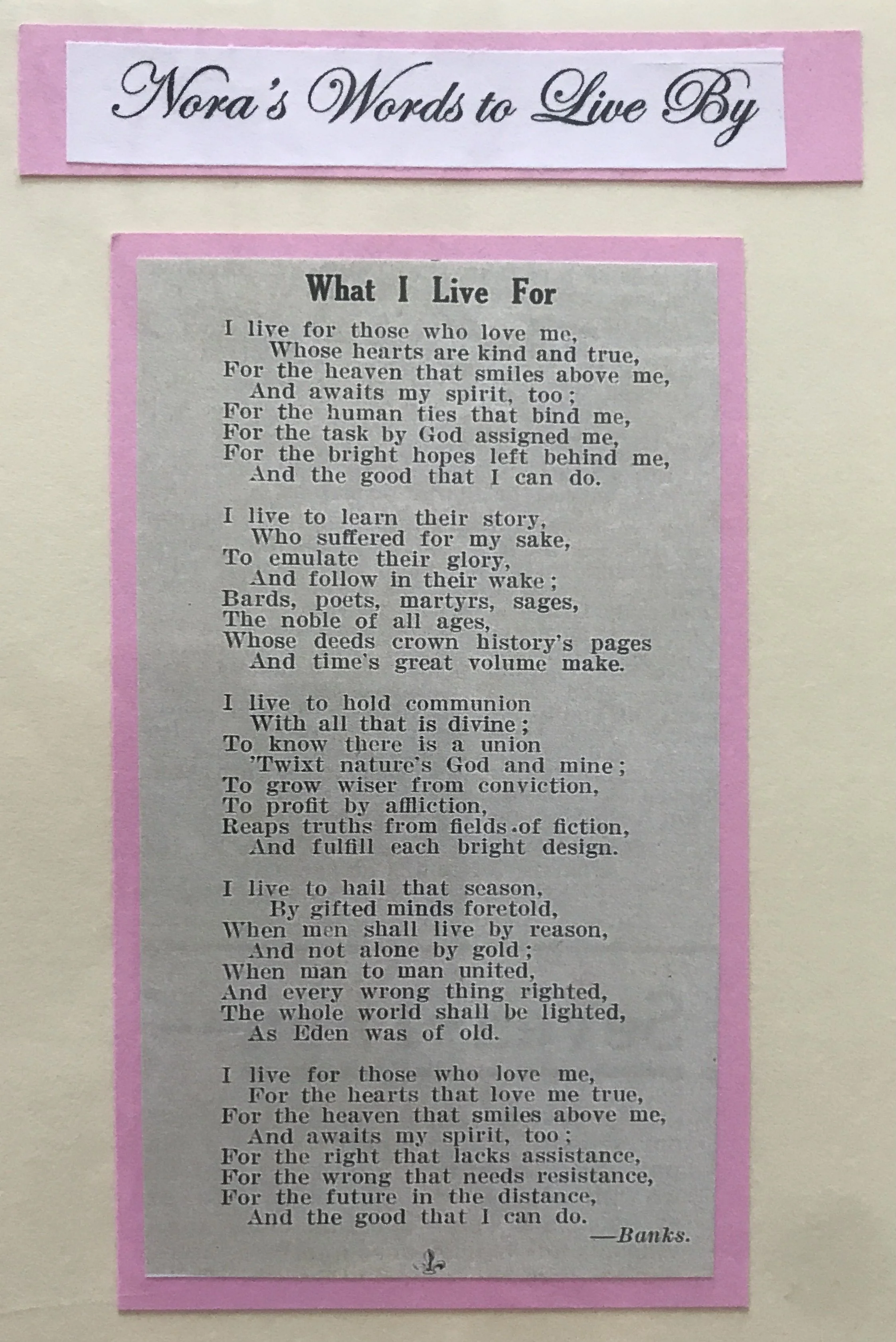
I thought I’d end on this poem that I found among Nora Petree’s letters (and which I have now added to my family scrapbook). It says a lot, I believe, about her philosophy of life:
Thanks for reading! If you want to learn more about Dr. W.F. Traughber and his wife, Nora, be sure to check out my book — Frank and Nora’s Historic Honeymoon Adventure: A Travelogue through the West with a “Time Travel” Twist. Also, keep an eye out for its sequel — Frank and Nora’s Big Move to Hollywood — coming in 2027. You can subscribe on my webpage for quarterly updates. Click here for my most recent newsletter.
Endnotes:
Paul Williams. The Story of Hollywood: An Illustrated History. BL Press, 2005, p. 15.
“Official Registration of Hollywood.” This Day in History, History.com, 31 Jan 2025, https://www.history.com/this-day-in-history/february-1/official-registration-of-hollywood.
“Early Views of Hollywood (1850-1920).” Water and Power Associates, 2026, https://waterandpower.org/museum/Early_Views_of_Hollywood_(1850-1920)_Page_2.html.
Ibid.
Croswell, The Story of Hollywood, n.p. (29); Los Angeles Times, January 31, 1904, March 8, 1904, March 11, 1904; Torrence, Hollywood, 49-50.
“Early Views of Hollywood (1850-1920).” Water and Power Associates, 2026, https://waterandpower.org/museum/Early_Views_of_Hollywood_(1850-1920)_Page_2.html.
“Church, Home, Both In One. Hollywood Bungalow Ideal to be Dedicated. Los Angeles Daily Times, 21 May 1910, Los Angeles, CA, p. 22, Newspapers.com, https://www.newspapers.com/image/380301683/.
Ibid.
“Fine Religious Edifice Soon to be Erected. Plans Finished for New Church in Hollywood.” Los Angeles Sunday Times, 1 Jan 1922, p. 75, Newspapers.com, https://www.newspapers.com/image/380434401/.
Ibid.
“Group Heads to Plan Campaign.” Los Angeles Evening Citizen News, 23 Aug 1926, p. 10, Newspapers.com, https://www.newspapers.com/article/los-angeles-evening-citizen-news-group-h/192326503.
Huston, Ethelyn Leslie. “Veteran pastor, who has served for 52 years, is honored. Hollywood Daily Citizen, 4 Apr 1925, p. 6, Newspapers.com, https://www.newspapers.com/article/los-angeles-evening-citizen-news-rev-ri/192326174/.
“Many Boys Sign For "Y" Summer Mountain Camps.” Los Angeles Evening Citizen News, 22 May 1928, p. 3, Newspapers.com, https://www.newspapers.com/article/los-angeles-evening-citizen-news-many-bo/192432809/?xid=637
“About Us.” Idyllwild Pines Camp, 2026, https://idyllwildpines.org/about-us/.
“Delegates to Young People’s Conference at Idyllwild Pines.” Los Angeles Evening Citizen News, June 20, 1927, p. 2, Newspapers.com, https://www.newspapers.com/article/los-angeles-evening-citizen-news-delegat/192321563/.
Hattaway, Paul. “Albert Shelton: Prince of Tibetan Missionaries.” Excerpted from Tibet: The Roof of the World. Asia Harvest (2020), 2026, https://www.asiaharvest.org/china-resources/tibet/Albert-Shelton.
Tizon, Al. “Discovering Toyohiko Kagawa.” Christians for Social Action, 11 Feb 2014, https://christiansforsocialaction.org/resource/discovering-toyohiko-kagawa/.
Goode, Stephen. “The Christian Faith of Ronald Reagan.” The Christian Post, https://www.christianpost.com/news/the-christian-faith-of-ronald-reagan.html.
Dart, John. “Quakes Damage Dooms Hollywood Christian Sanctuary : Church Reagan Once Attended Faces Wreckers.” Los Angeles Times, 9 Jan 1988, https://www.latimes.com/archives/la-xpm-1988-01-09-me-8882-story.html.