Exploring Burgenland, Part VII: Home, Faith, Schooling, Health, and the Little Burgenland Community
With this post, I have reached the end of my blog series, “Exploring Burgenland.” However, I’ve decided I’m not done. I plan to turn this series into a book, complete with more photos and additional chapters, and I hope you’ll come back for more once it is finished. For the time being, in this post, I will be exploring what life was like in Chicago’s “Back of the Yards” for the Burgenländer immigrants in terms of their home and family life, religious practices and celebrations, school experiences, health concerns, and community support. Of course, I’ll be tying in John Wagner and Anna Halper – as well as some of their other family members – along the way.
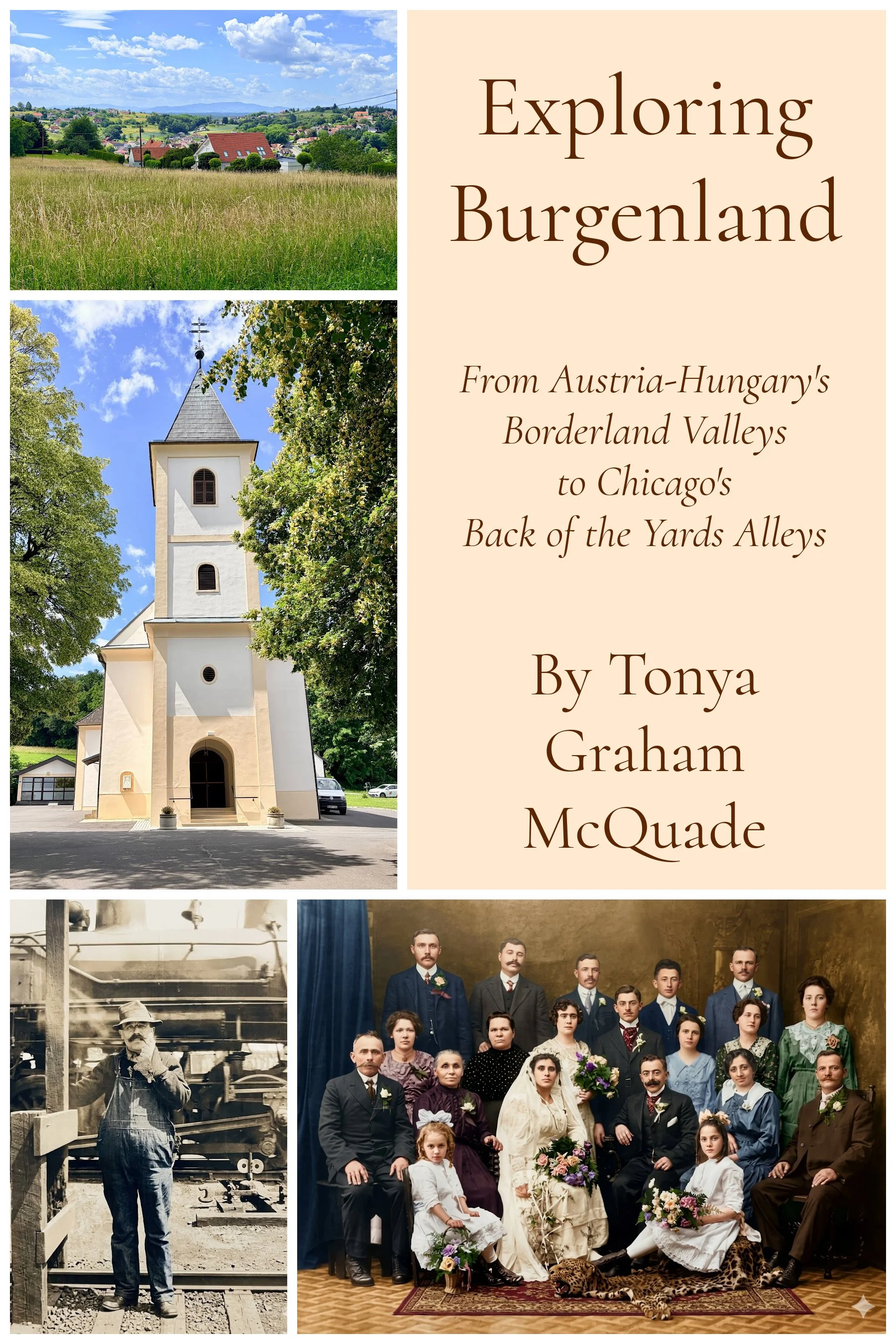
Here’s a possible cover for the book I am working on (which will hopefully be ready in time for the holidays). The top left photo shows the beautiful hills of Oberdorf; the photo below that, the lovely Church of St. Catherine in Unterwart; bottom left, a photo of my great grandfather John Wagner working at Pullman Company in Chicago; and bottom right, the wedding of John Wagner and Anna Halper at St. Augustine Church in 1917.
As I described briefly in Part VI, where I explored what it was like to work in Chicago’s Union Stock Yards, packing houses, and railroad companies, to step off the train into Chicago’s Back of the Yards neighborhood at the turn of the century was to enter a world of billowing smoke, wooden structures, muddy streets, rumbling delivery trucks, blaring train whistles, and putrid smells. For the thousands of immigrants arriving from the open, quiet pastoral fields of the Austro-Hungarian borderlands, the immediate reality of this new, industrial, decidedly urban American "home" must have been startling.
The neighborhood was lined with long rows of narrow, wood-frame worker cottages and two- and three-flat buildings, explicitly constructed to maximize space on Chicago's standard, slender city lots. These flats were defined by their density. It was common for a single floor — a "flat" consisting of just four or five small rooms — to shelter not only a nuclear family but a rotating cast of boarders, cousins, newly arrived village neighbors, and extended kin pooling their meager wages. Privacy was a rare luxury. The air inside was a heady blend of cooking smells, sweaty bodies, laundry drying near coal stoves, and animal scents from the nearby stockyard pens drifting through open windows. Yet, these crowded spaces functioned as critical economic launchpads. By cohabitating with multiple families or taking in boarders, immigrants were able to pay their high rents and save the money needed to finally move into their own apartment or even buy their own home — as John Wagner & Anna Halper eventually did in 1954.
It’s possible to map the steady, upward trajectory of John and Anna’s lives through their shifting addresses. Like most immigrants, their early years were nomadic, moving from flat to flat as their family grew and economic opportunities shifted. U.S. Census Records and Draft Registrations track them through a succession of rented flats on Bishop Street, 51st Street, and Laflin Street — before finally purchasing their home on Justine Street. In all of these locations, they remained within a few walkable blocks of the rail yards where John worked for the Pullman Company as a railroad car cleaner.
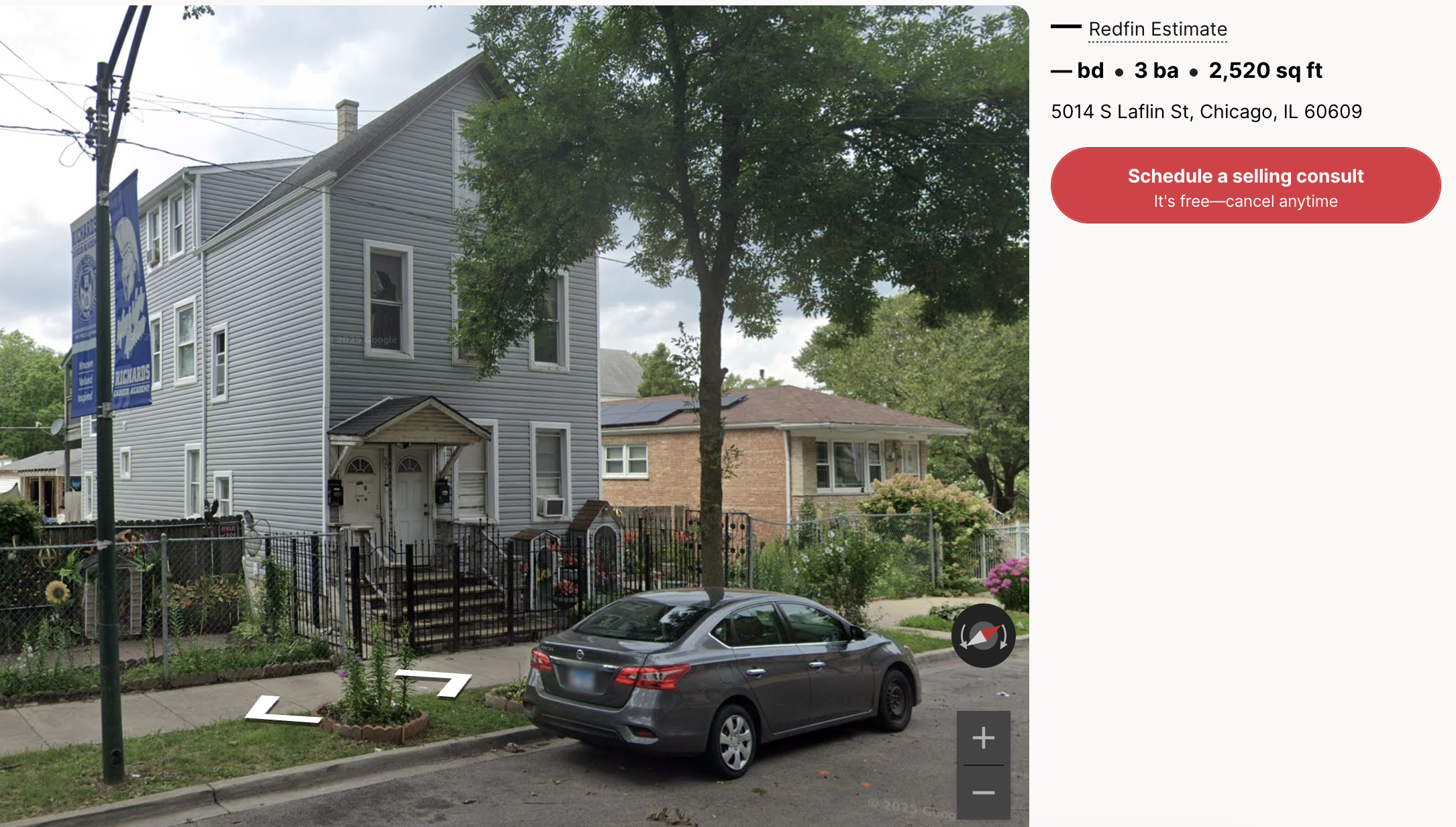
The multi-family flat where John & Anna lived with their four children at 5014 Laflin Street is still standing; in the 1940 U.S. Census, five different families — totaling 24 people — were listed as living there. [1]
They were also always within a few short blocks of the comforting sanctuary and community offered by St. Augustine Catholic Church on the corner of 51st and Laflin Street. The monumental, red-brick Gothic Revival church was built between 1891 and 1904. In a sprawling city fractured by ethnic enclave neighborhoods (the Irish, Poles, Slovak, Bohemian, and other Catholic immigrant groups each had their own church), St. Augustine was designated a "national parish,” meaning it wasn't organized by geographic boundaries, but by language. Founded by Franciscan friars to shepherd German-speaking immigrants, it transformed into the primary spiritual and social sanctuary for the influx of Austro-Hungarian families arriving from Burgenland. After a grueling six-day work week on the “disassembly lines” at the Union Stock Yards or amidst the industrial machinery of the various railroad lines and other nearby factories, I’m guessing immigrants greeted Sundays as a welcome time for rest, family, and the feeding of their souls.
For my great-grandparents, the St. Augustine parish was a physical neighbor. The family lived literally in the shadow of St. Augustine's tall spire. They could easily hear its bells chiming through their windows — acting as a community clock, summoning people to Sunday mass, pealing in celebration of weddings, warning of emergencies, and somberly signaling funerals. This July 1929 copy of Pfarrbote (The Parish Messenger) shows their address at the top and highlights the tight five-block radius that defined John and Anna’s American existence. Their home at 1356 W. 51st Street sat a mere three blocks east of the 51st Street C.R.I. & P. (Rock Island) Coach Yard where John clocked in to detail luxury Pullman cars, and just two short blocks (.2 miles) from the sanctuary doors at Laflin Street. That meant their son John (my grandfather), born in 1918, could also easily walk to St. Augustine School, which he attended (and which can you see to the right of the church in the photo below).
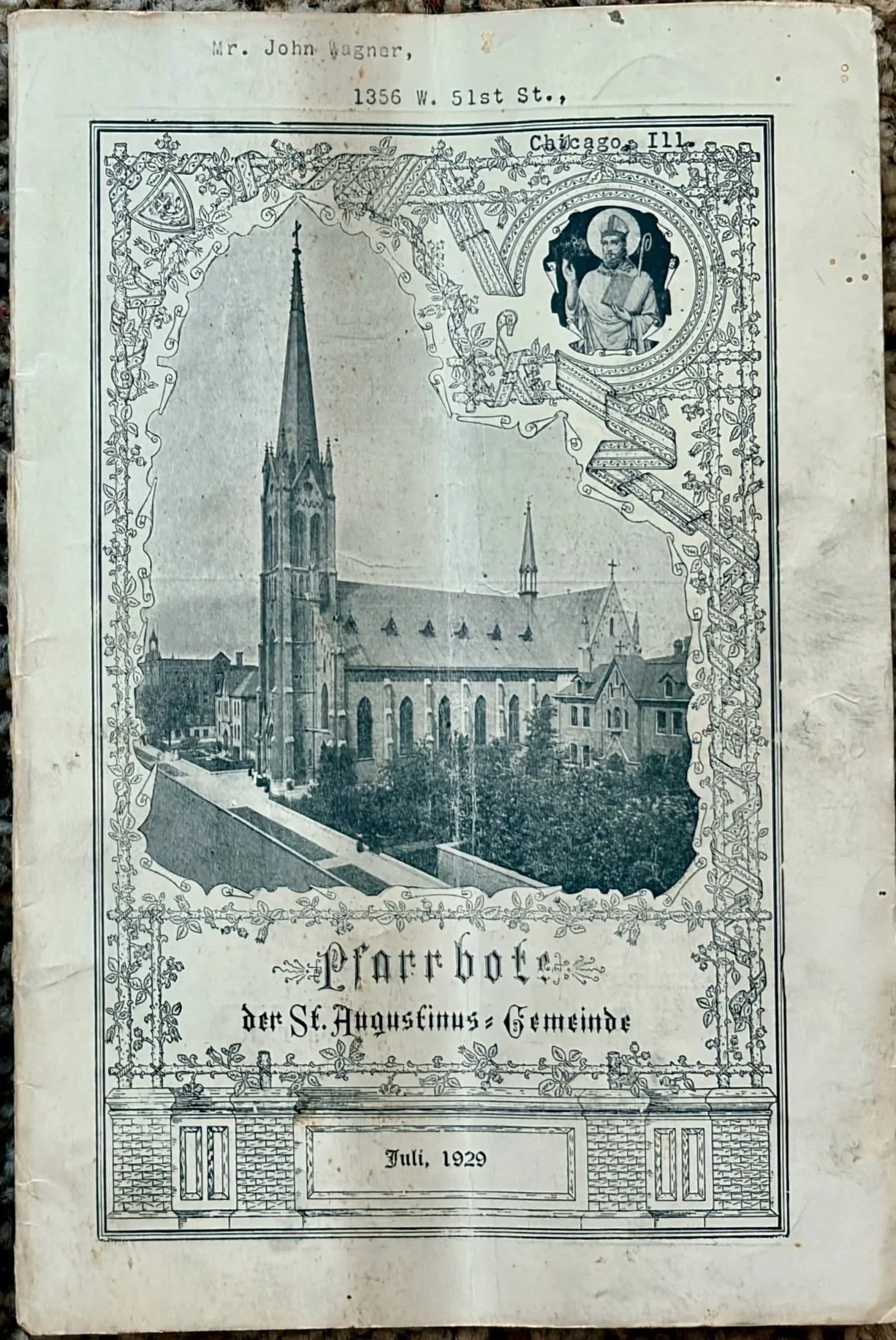
This July 1929 copy of Pfarrbote (The Parish Messenger) provides a clear view of St Augustine Church, St. Augustine School to its right, and the Convent (far left, in back) that housed the Franciscan Sisters and the Poor Handmaids of Jesus Christ who taught generations of neighborhood children. [2]
Stepping inside those massive doors on a Sunday morning provided immigrants a sensory escape that countered the grim reality that surrounded them. Outside lay unpaved mud streets, open drainage ditches, the nearby stagnant filth of Bubbly Creek (literally bubbling with methane gas from the decaying animal carcasses meatpackers dumped into the Chicago River), a rancid city dump, and a permanent low-hanging smog of coal smoke and packinghouse grease. Inside, they were bathed in the glowing jewel tones of imported Munich-style stained glass windows, hand-carved German altars, statues of their favorite saints, the powerful swell of the pipe organ, and the comforting sounds of traditional German hymns as the community sang, prayed, and confessed in their native tongue, all while enveloped in the sweet, thick haze of liturgical incense.
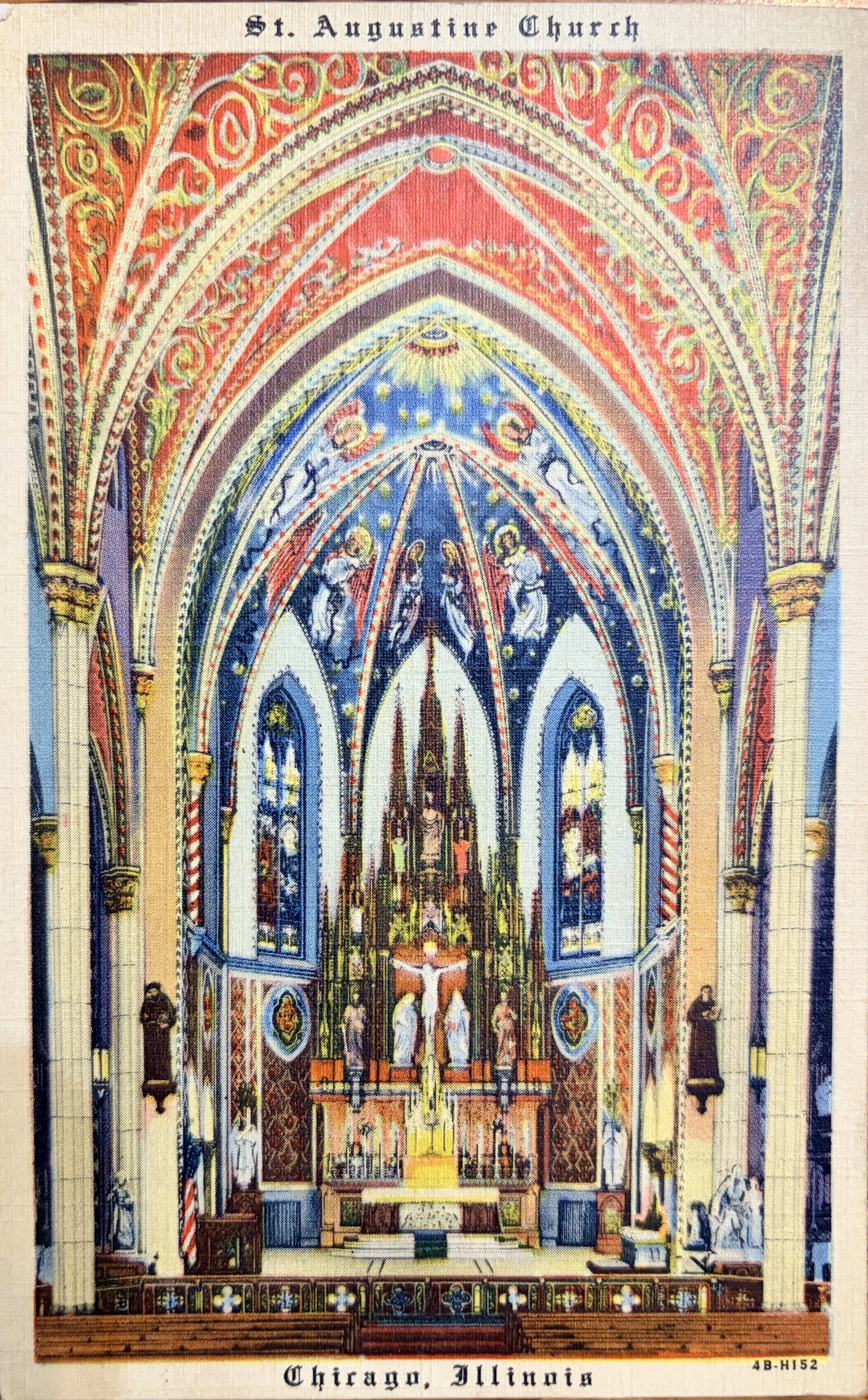
This postcard showing the colorized inside of St. Augustine Church was among my great-grandparents’ artifacts.
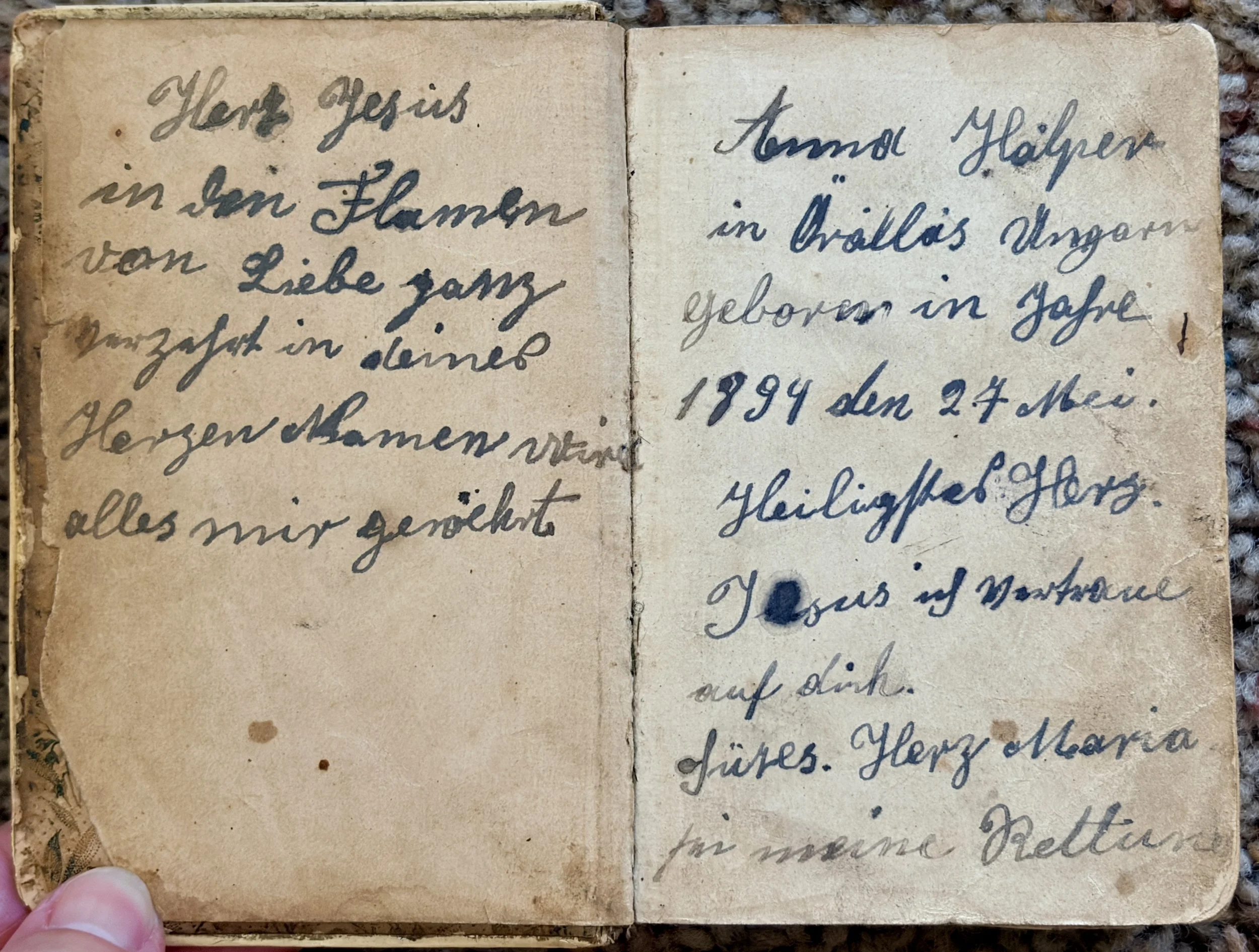
In contrast to the often uncaring industrial landscape and their not-always-welcoming new city, the Church served as a vital engine to keep immigrants going, their faith serving as a protective shield. Evidence of its importance to Anna Halper can be seen in the handwritten pages of her personal prayer book. On its inside pages, written in elegant, looping German cursive, Anna wrote: “Anna Halper in Őrállás, Ungarn, geboren in Jahre 1894 den 24 Mei.” Beneath her birth record, she wrote: “Heiligstes Herz Jesus ich Vertraue auf dich. Süses Herz Maria sei meine Rettung” ("Most Sacred Heart of Jesus, I trust in you. Sweet Heart of Mary, be my salvation"). She also turned to this book when her firstborn son arrived. She logged his birth, too, in careful script: “John Wagner - born in the year 1918 - August 8 - in Amerika.”
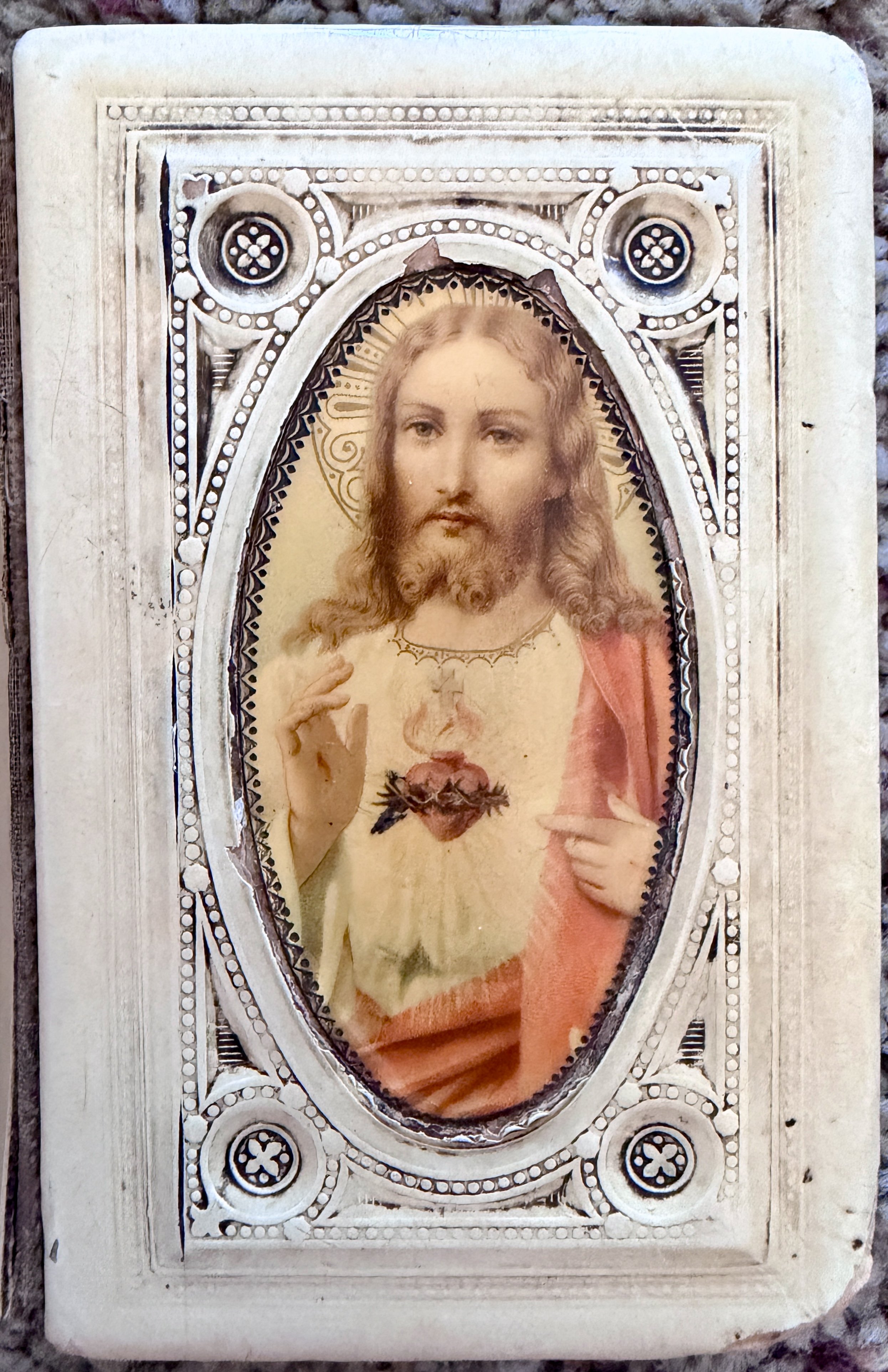
Above you can see the cover from Anna Halper’s prayer book; below, on the inside pages, she wrote a prayer (on the left) and her birth information (on the right).
St. Augustine parish served as an important bookend for many major life milestones in my family’s history: a chain of baptisms, first communions, school days, marriages, and funerals. My first evidence includes the wedding photo and marriage certificate from December 1, 1917, when John Wagner and Anna Halper were lawfully united in the Holy Bonds of Matrimony. It was a double wedding, set during the troubles brought by World War I (occurring a mere six days before the United States officially declared war on their home country of Austria-Hungary), spoken in the comforting German tongue of the Franciscan friars, witnessed by several of Anna’s immediate kin: her brother Paul, her sister Katherine, and her mother Marie Halper. Their best friends “the Konraths of North Side Chicago” (as labeled on the photo) were also present.
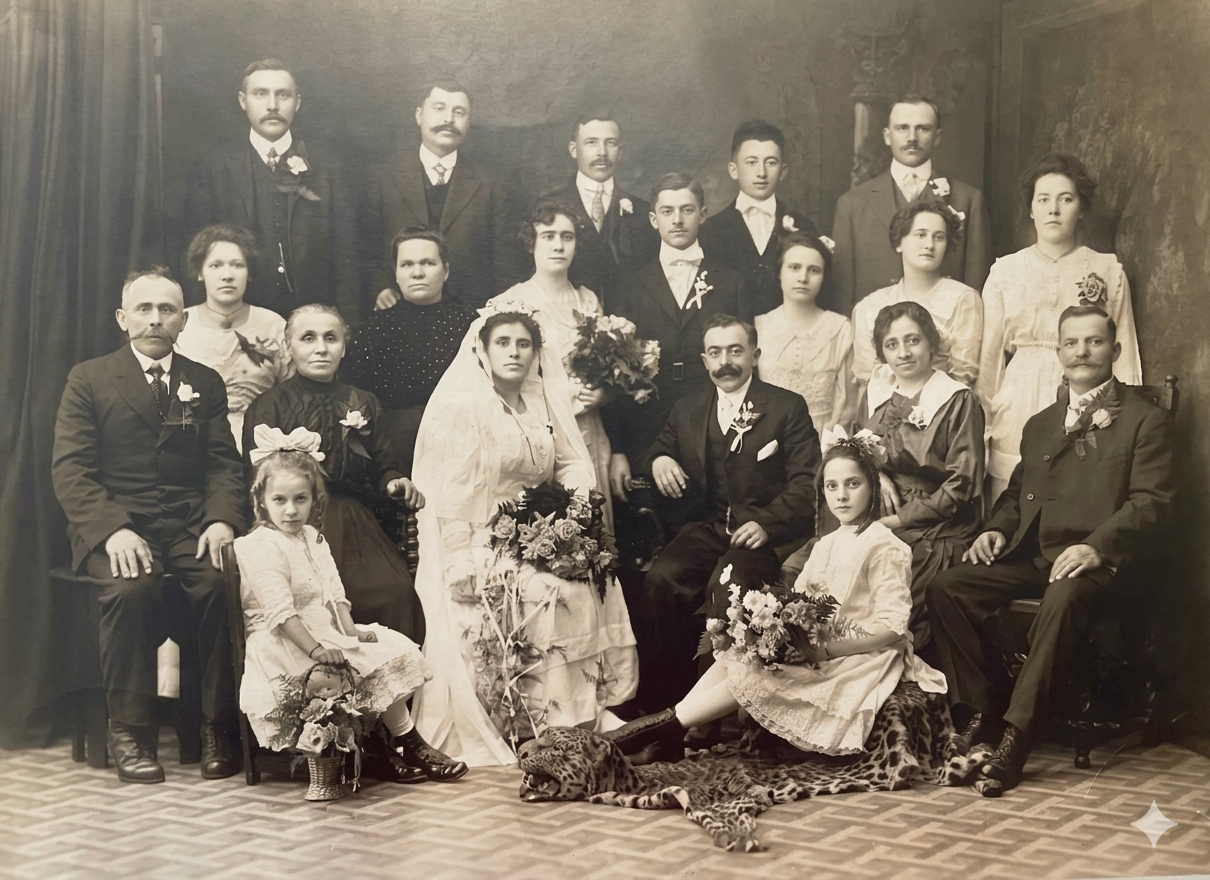
Here you can see Anna Halper and John Wagner, seated at the center, on their wedding day; they were married at St. Augustine Catholic Church, just like their son (my grandfather) would be 24 years later.
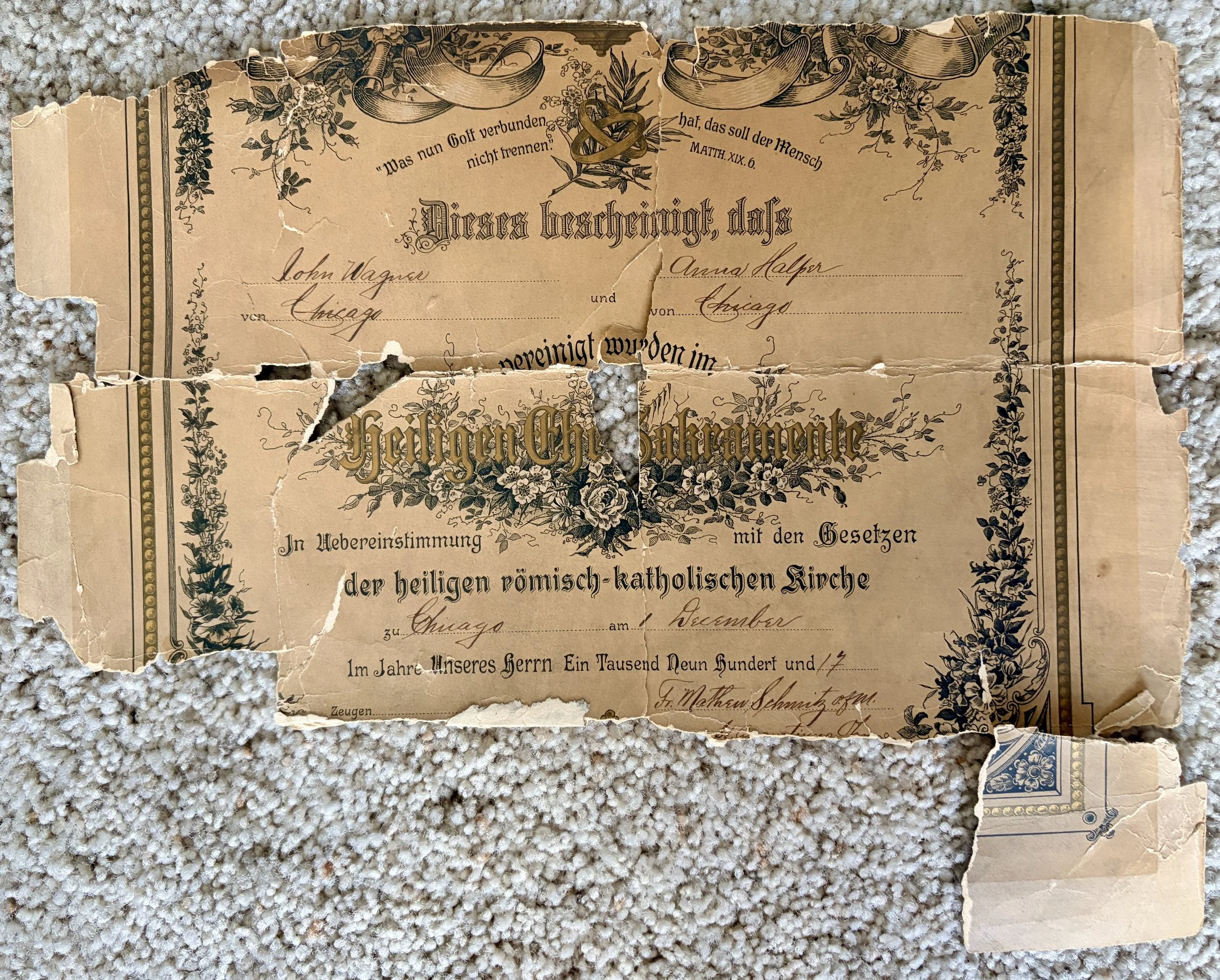
This, sadly, is all that remains of John & Anna’s original marriage certificate.
That same altar witnessed the joy of another family wedding celebration 24 years later, this one mixed with the heavy anxieties of a new global conflict: World War II. On January 13, 1941, my grandfather John Paul Wagner, Jr. stood at the front of St. Augustine Church to marry his high school sweetheart, Rose Muriel Brandt. Muriel (as she preferred to be called) had also grown up in the Back of the Yards — her family moving from Laflin to Bishop to S. Ashland according to various Census records and her father working as a Foreman for a Packing House. They were not Burgenländers — her paternal grandparents had come from Bavaria in the mid-1800s — but they followed a very similar, German-speaking immigrant pathway. The ceremony was beautiful, but it occurred just weeks before John Jr. had to report for military training at the newly-built Camp Roberts in California. Later, he would be sent to France, Germany, and Central Europe as part of the 518th Field Artillery Battalion. Fortunately, he returned from the war physically unharmed, but he never talked about his war years, so my mother could never tell me anything about them.
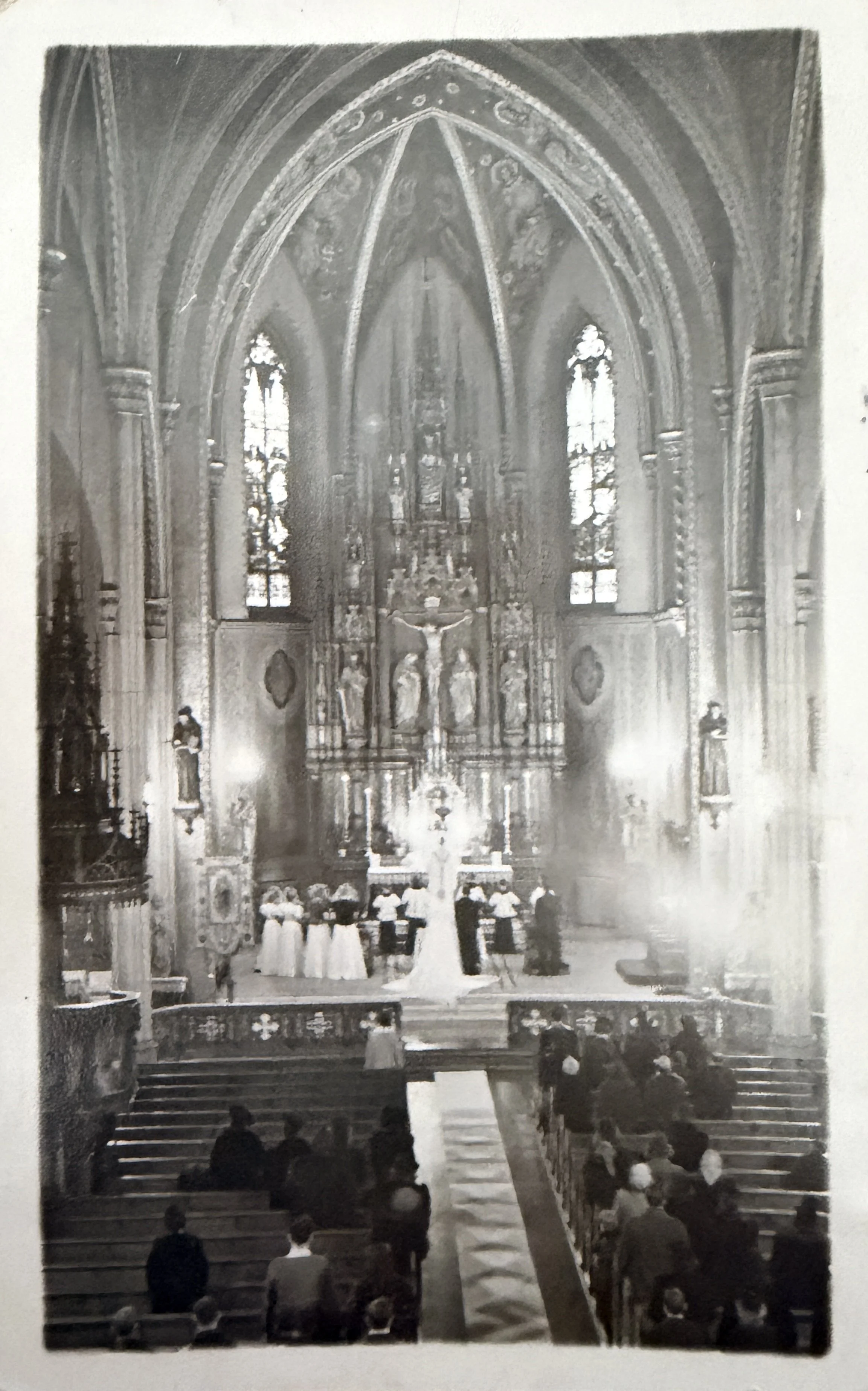
John Paul Wagner and Rose Muriel Brandt were married on January 13, 1941, at St. Augustine Church; the above photo provides a great view of the High Altar and the church’s interior, but the one below provides a closer up view of the altar and wedding party.
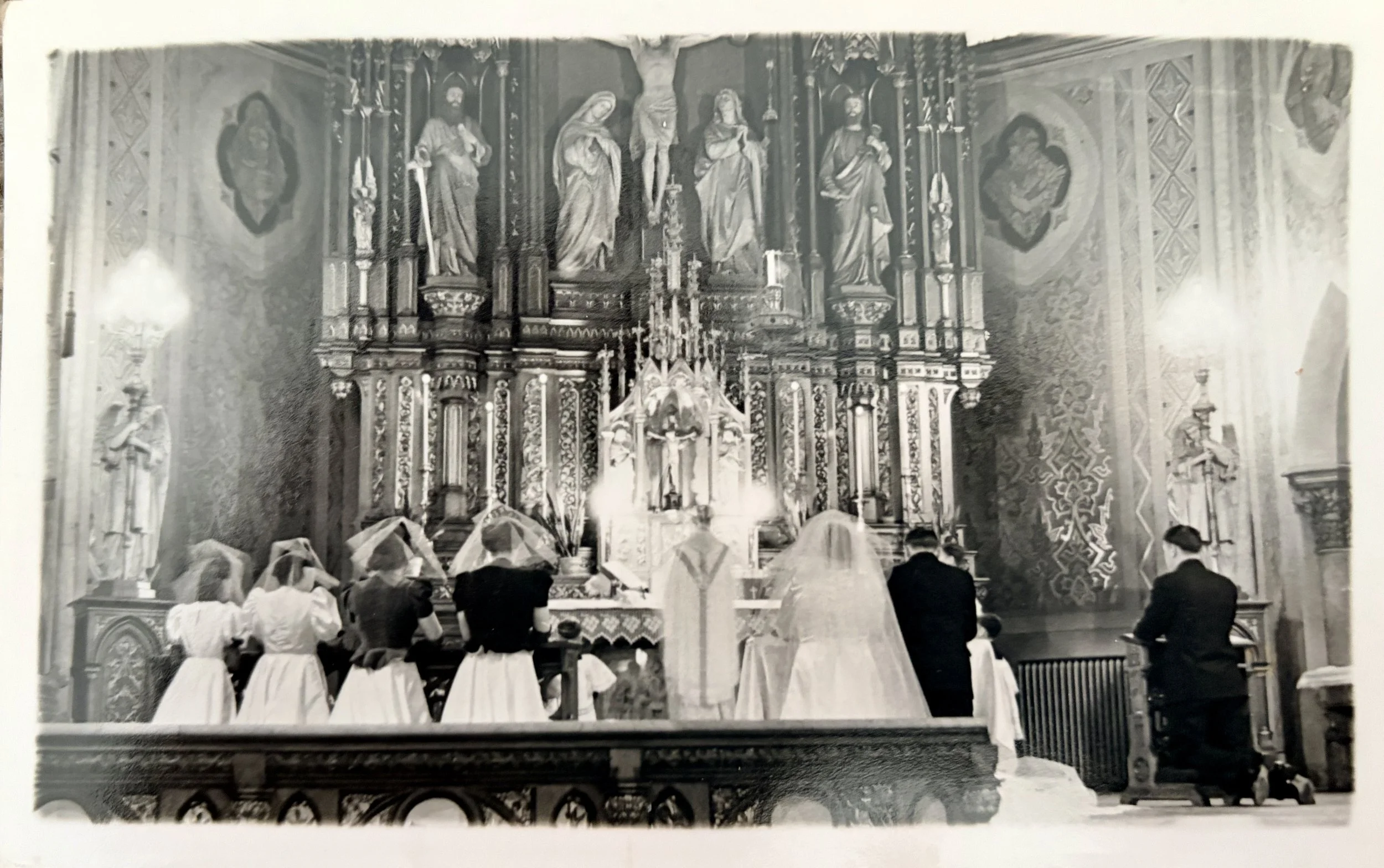
The wedding party is shown here at the altar rail inside the Gothic sanctuary of St. Augustine Church; the best man kneels on the right.
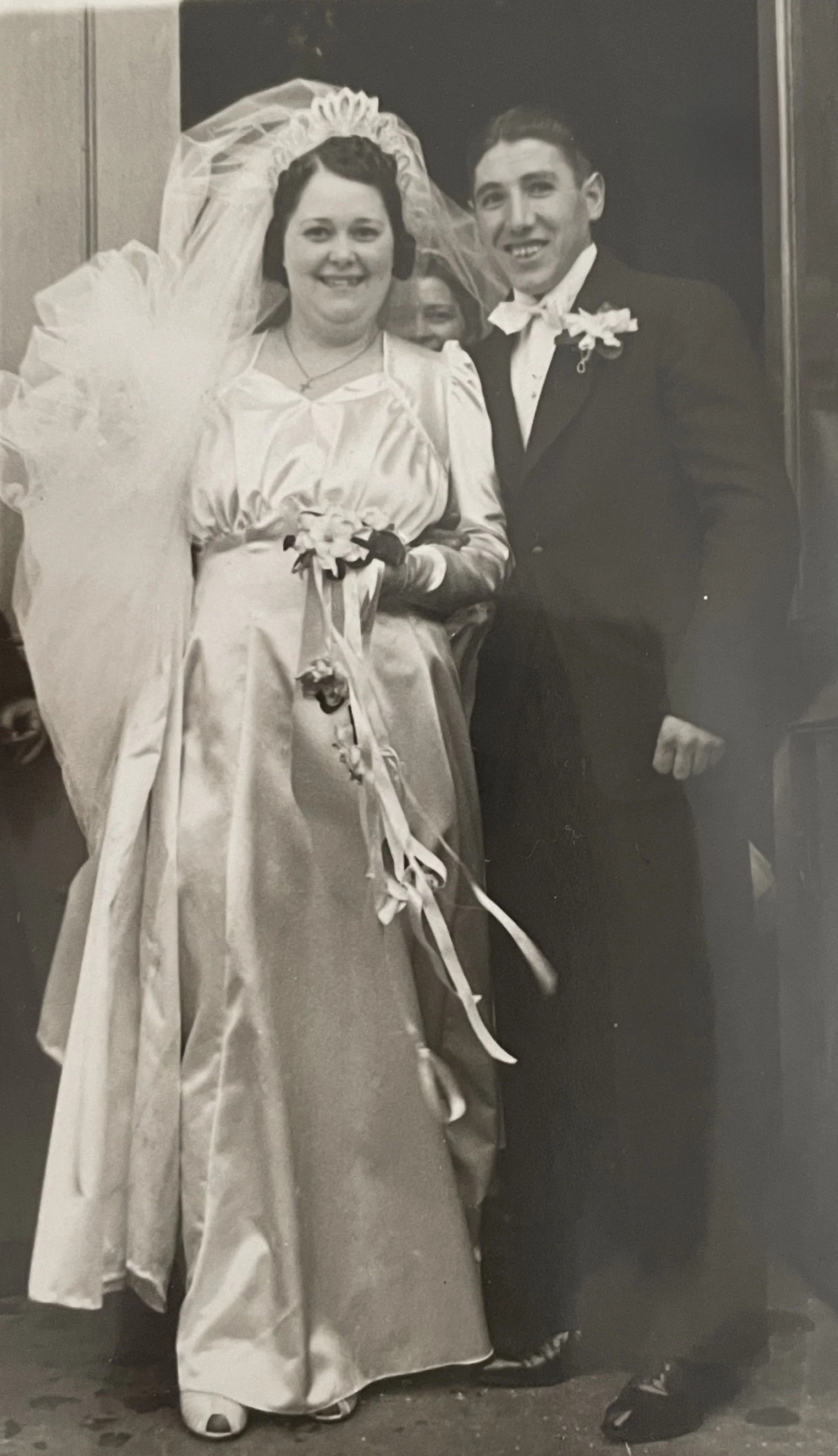
My grandparents — John Paul Wagner and Rose Muriel Brandt — greet the crowd as husband and wife on their wedding day.
Besides weddings, St. Augustine was the “school home” for many of my family members who attended St. Augustine Parochial School and St. Augustine Commercial High School. The classrooms, run with rigorous care by the Poor Handmaids of Jesus Christ, educated all four of the Wagner siblings, as well as the Brandt siblings (my grandmother was one of seven children). John and Muriel likely met there, and amidst the depths of the Great Depression, they graduated together from Commercial High School in 1934. My mother, too, attended St. Augustine School through eighth grade until her family moved from Ashland Avenue to a house they bought at W. 88th St. in Hometown, a suburb of Chicago.
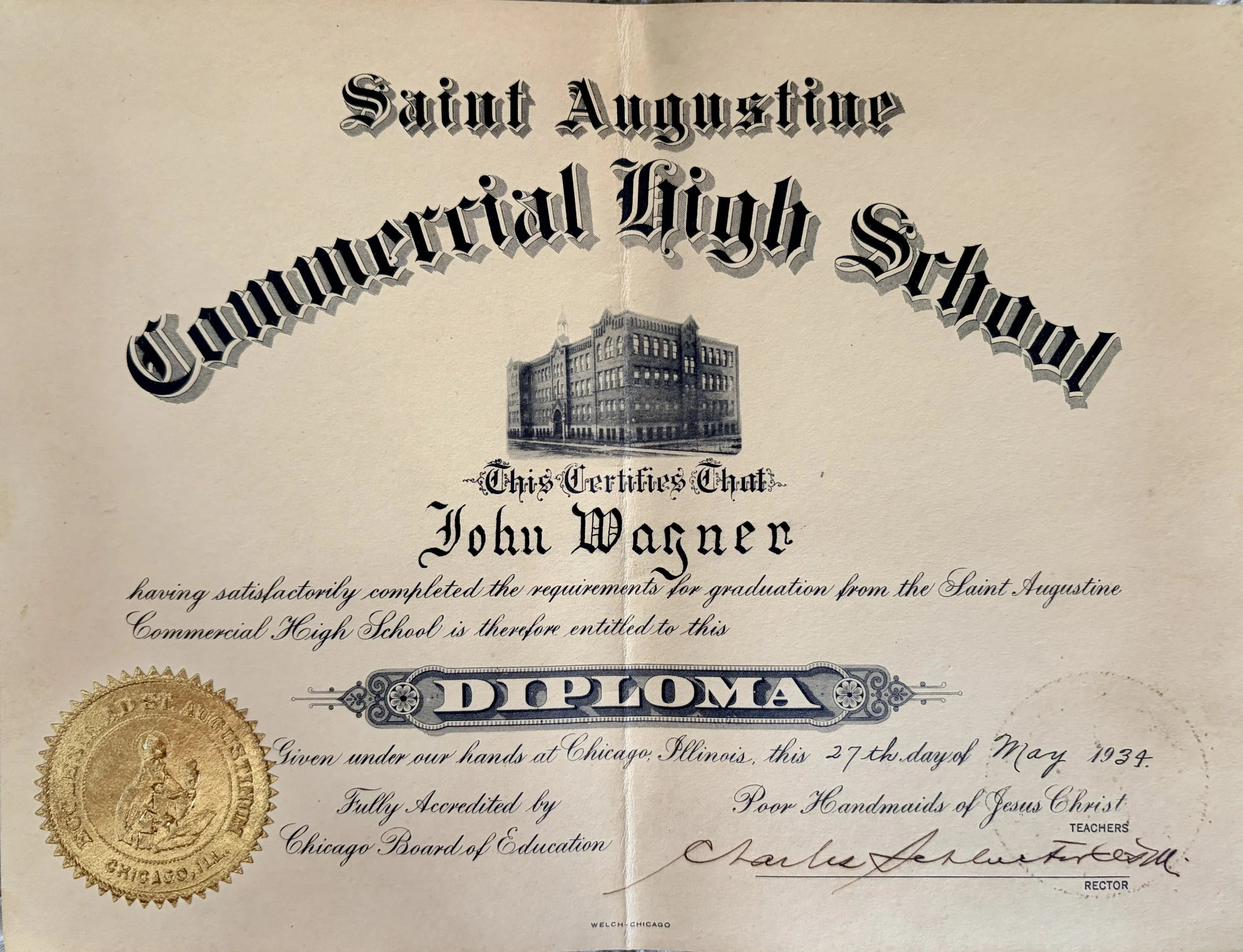
John Wagner graduated from St. Augustine Commercial High School on May 27, 1934.
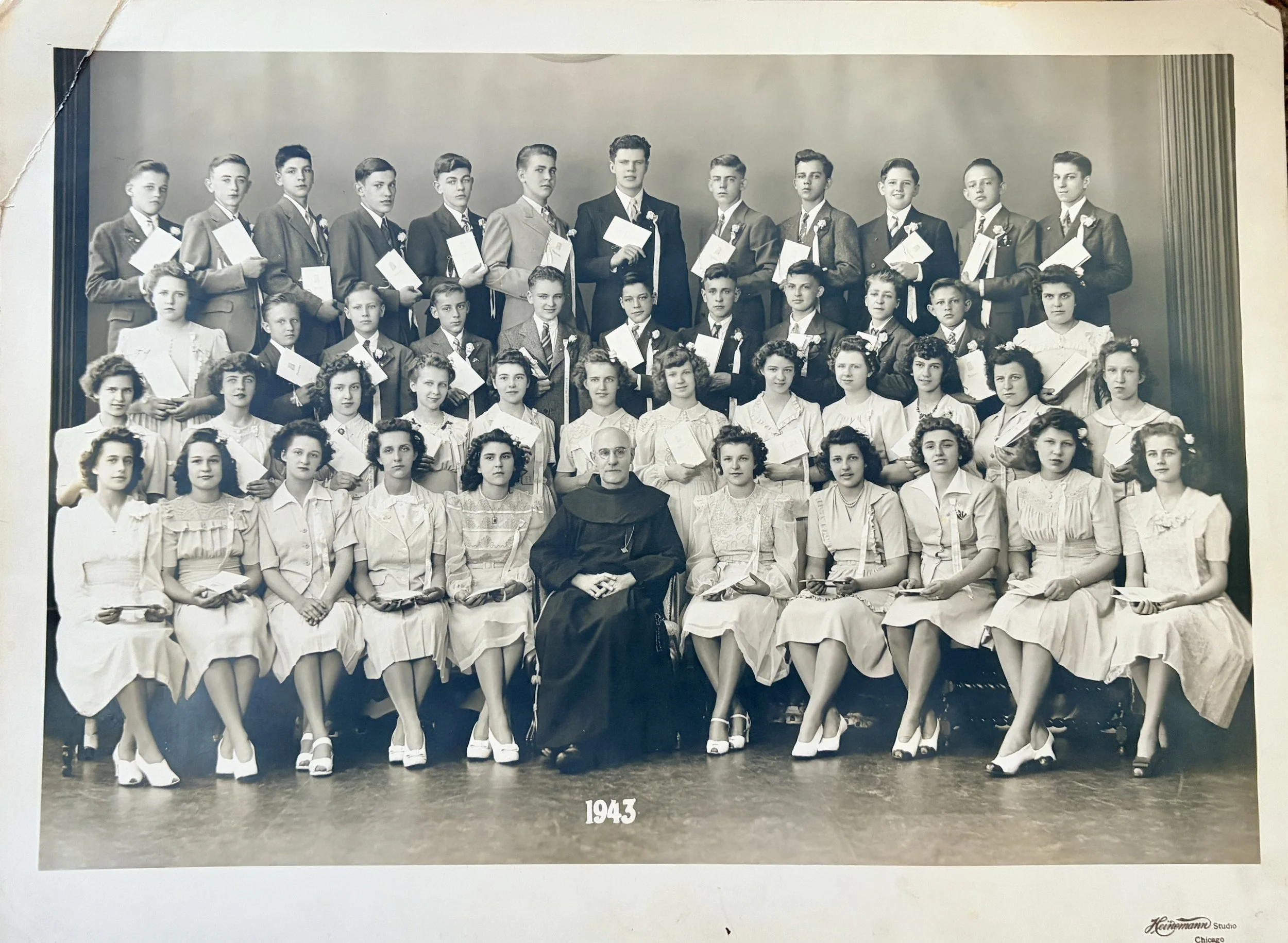
This class photo from 1943 shows John Jr.’s younger brother, Joseph “Joey” Wagner, in the third row, fourth from left, not looking too happy about taking a class photo — lol.
So, what was a Commercial High School? In the 1930s, a "commercial" high school track involved a highly specialized education. Rather than just teaching general humanities, Saint Augustine Commercial High School explicitly trained children of working-class immigrants in advanced business skills. They were trained in bookkeeping, accounting, stenography, business typing, and commercial law, better preparing them for the difficult Depression-era job market. The engraving in the center of John Wagner’s diploma above provides an architectural rendering of the actual multi-story brick Saint Augustine School building that stood right next to the church on 51st Street. It also explicitly notes the teachers were the Poor Handmaids of Jesus Christ. This religious order was legendary in Chicago for providing rigorous, disciplined, top-tier education to immigrant children.
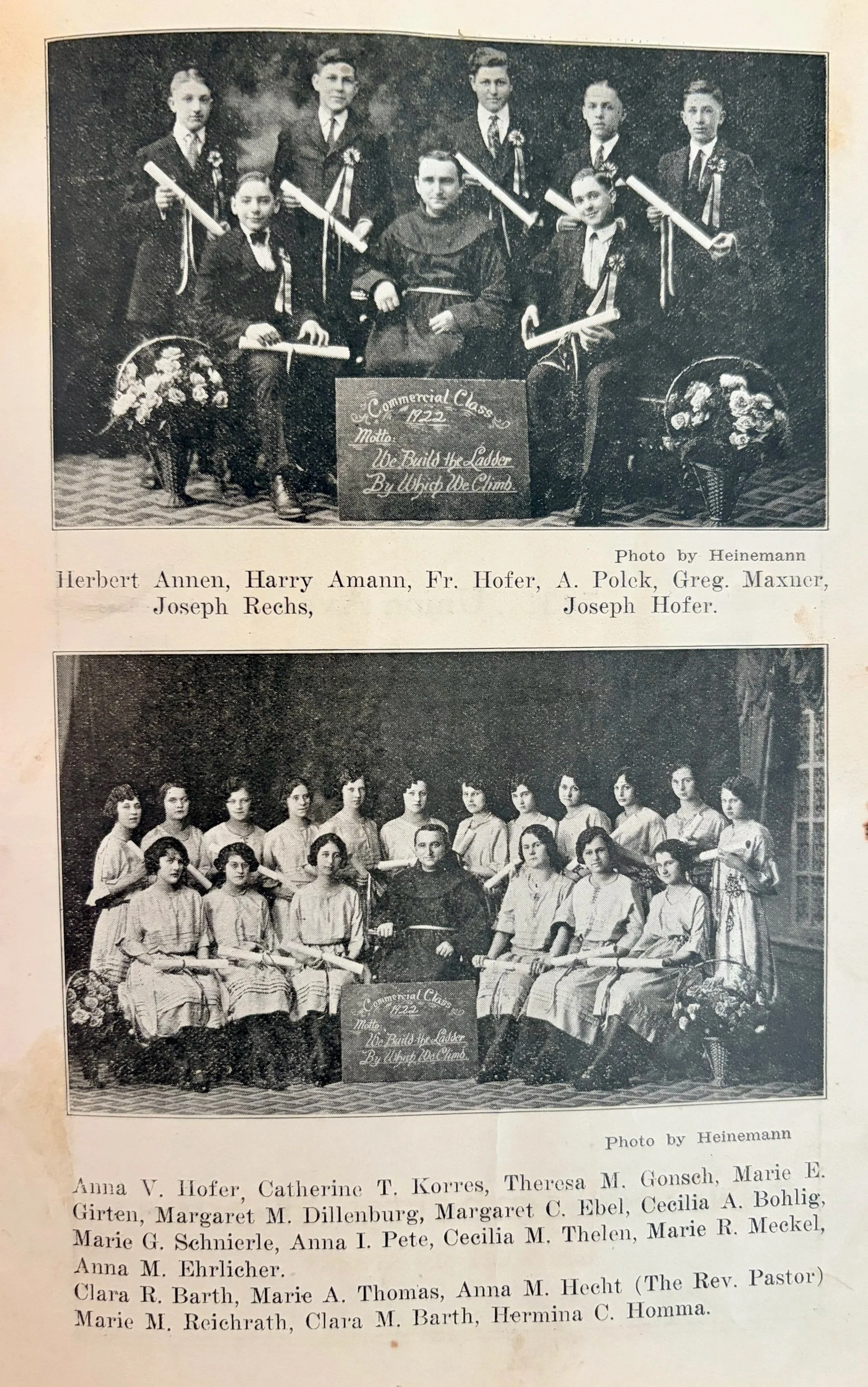
In these photos from Commercial High School’s Class of 1922, you can see the class motto: “We build the ladder by which we climb.” [3]
The immersion by many Burgenländers in the parish school system reflected a hidden cultural war taking place across Chicago’s immigrant neighborhoods. In The Jungle, Upton Sinclair depicted how Catholic national parishes aggressively discouraged parents from utilizing the city’s free public schools, and this was a historically, accurate representation. The Catholic hierarchy in Chicago viewed the public school system as an Anglo-Saxon, implicitly Protestant institution designed to strip immigrant children of their faith and heritage. [4] In response, a strict mandate gripped the South Side: every parish was expected to provide its own school, and parents were warned from the pulpit that bypassing the church system risked their children's souls. While public options were physically available in the Back of the Yards, attending them carried a heavy social stigma.
That is not to say the schools did not meet the educational needs of their students. The Poor Handmaids of Jesus Christ did not just teach catechism; they delivered a rigorous, disciplined, and accredited curriculum while also helping to preserve their students’ faith and culture. As I read online, “Parochial schools met the needs of diverse ethnic and racial constituencies. These included Irish, Germans, Poles, Czechs, Bohemians, French, Slovaks, Lithuanians, African Americans, Italians, and Mexicans. They primarily were Catholic nuns’ creation, who were often immigrants themselves, and who lived in neighborhood convents close to the families they served…. Built with voluntary contributions, Catholic schools sought to preserve their culture and transfer their faith while educating immigrants’ children for U.S. citizenship…. Between 1900 and 1930, Catholic elementary school enrollment in Chicago tripled, from 49,638 to 145,116.” [5]
For the Burgenländers, the parochial school was an indispensable cultural fortress. By keeping their children within the walls of St. Augustine, families shielded them from rapid Americanization, ensuring the next generation retained their moral compass and communal ties. This educational legacy eventually extended to the third generation. My own mother, Dorothy Ann (Wagner) Graham, attended St. Augustine School through eighth grade, learning her lessons in the very same building her parents, aunts, and uncles had occupied. Her time there also included participating in her First Communion — a milestone captured the beautiful studio portrait below where she proudly in her white dress, wearing her Cross Necklace and holding her Prayer Book and Rosary.
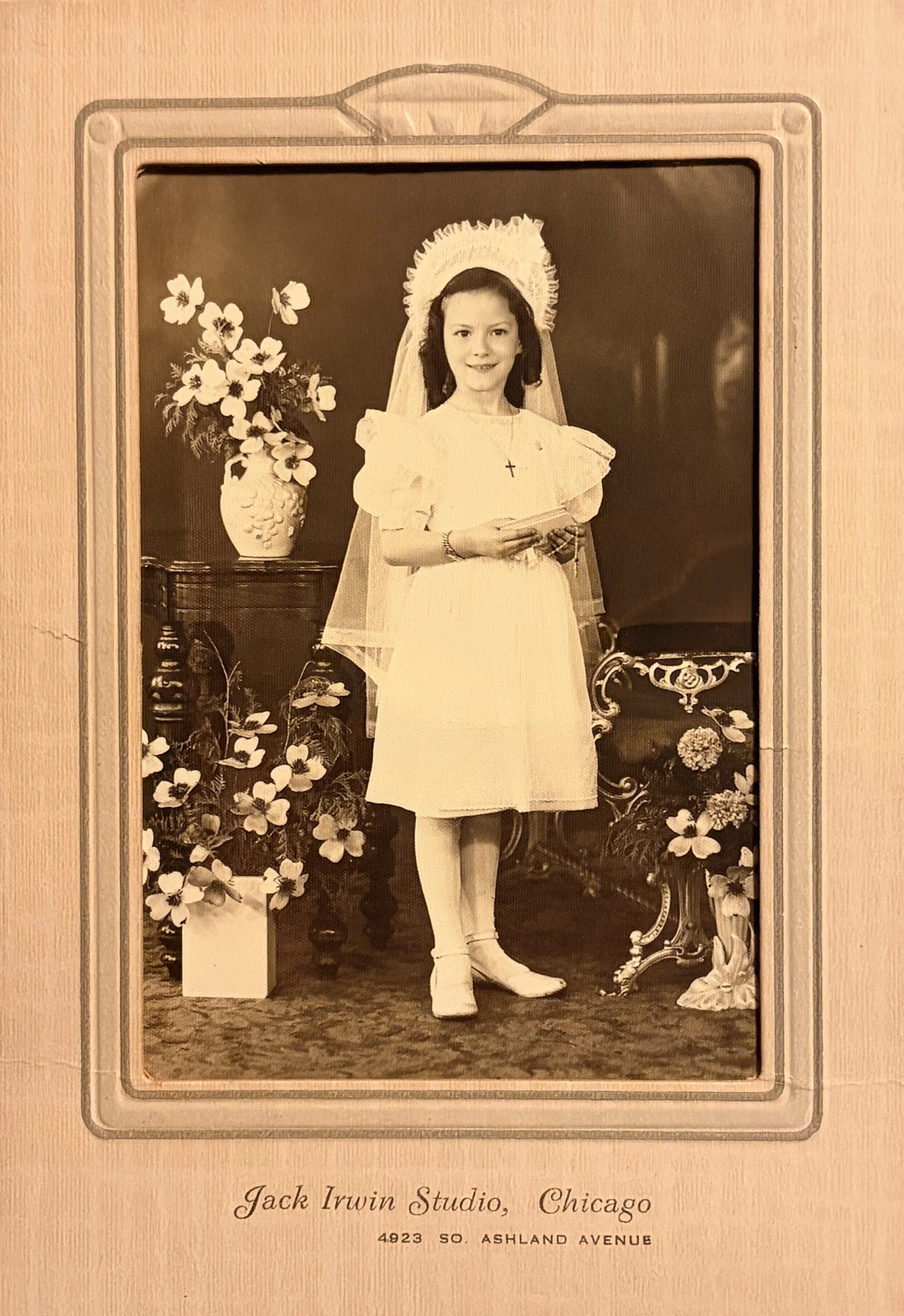
My mother, Dorothy Ann Wagner, stands proudly for her First Communion photo.
Besides meeting the sacramental and educational needs of its parishioners, St. Augustine Church was also there to help families through their most difficult times as they said goodbye to loved ones. Among my great grandparents’ things were many “prayer cards” for loved ones, church bulletins listing death notices, and receipts for payments to “Kowske Funeral Directors” for funeral services and cemetery plots. A bedrock institution for Back of the Yards families navigating loss, Kowske Funeral Directors was located directly across from the parish grounds at 1503 W. 51st Street.
Operated by Joseph A. Kowske and his wife Elen, a pioneering “Licensed Lady Embalmer” tasked with looking after deceased women and children, the business was meticulously woven into the fabric of the immigrant community. Listing themselves as “Leichenbestatter” in the parish bulletins to welcome German parishioners, the Kowskes provided everything from traditional horse-drawn carriages to modern automobiles. For decades, a typical neighborhood farewell meant a wake in the Kowske chapel followed by a short, somber procession across Laflin Street for a funeral mass at St. Augustine.
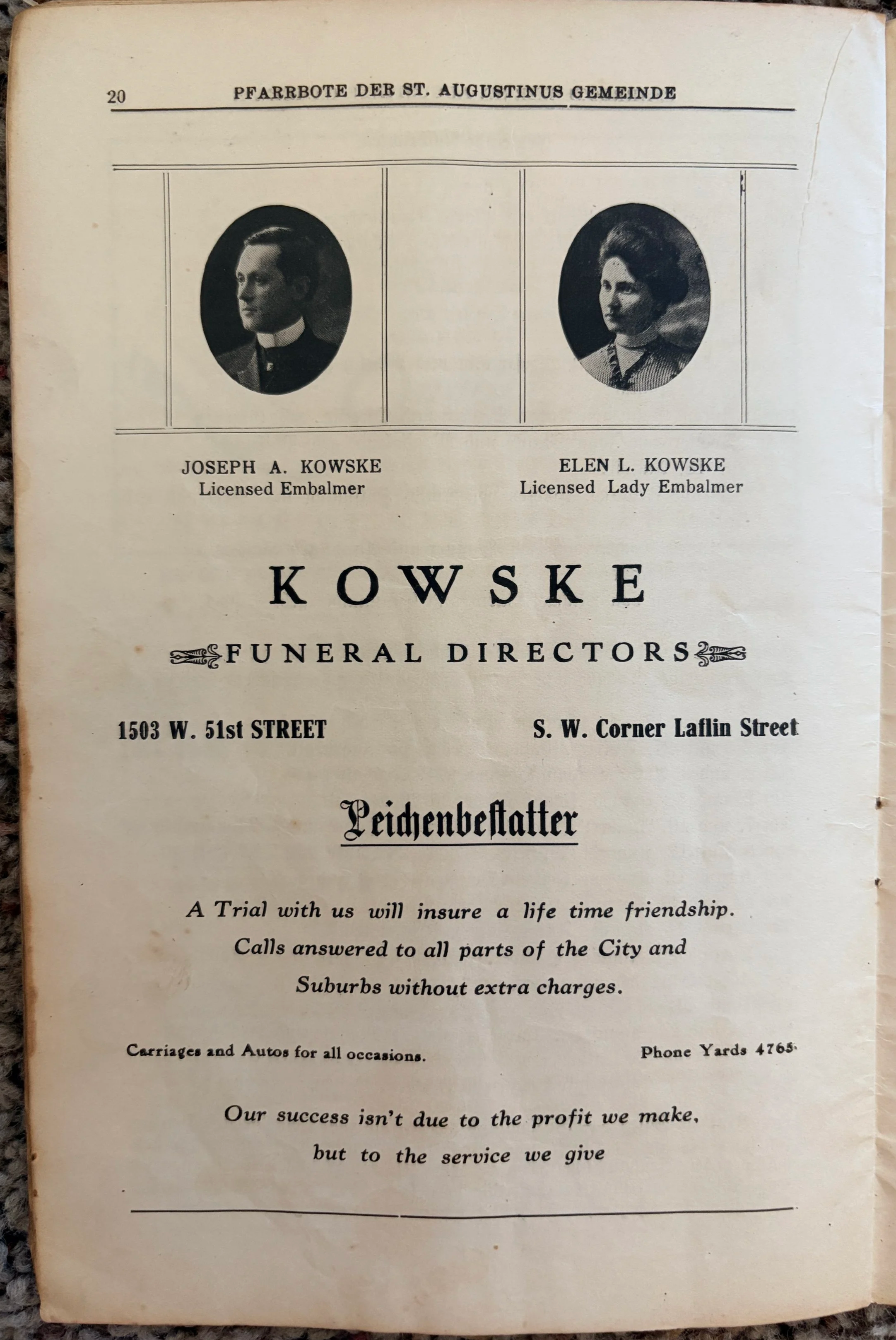
This Kowske Funeral Directors ad appears in the May 1922 edition of Pfarrbote (The Parish Messenger). [6]
The final journey for the faithful of St. Augustine took them south out of the neighborhood to St. Mary Catholic Cemetery. For generations of Back of the Yards families, this sacred ground in Evergreen Park became the quiet repository of their departed family members. The long funeral processions marked their final earthly chapter. I have been to St. Mary Catholic Cemetery with my mom on several occasions to see her parents’ graves, as well as those of various other family members — Wagners, Brandts, Lenhardts, and McKennas among them. Walking past the historic headstones at St. Mary is like reading a roll call of the old parish itself, just as it was in the Burgenland cemeteries Mike and I visited in Unterwart and Oberdorf. The cemetery serves as a lasting monument to the immigrants who built their lives under the church spires, endured the grit of the stockyards, and found their final rest side-by-side.
The first of the Wagner family members to die in Chicago was not John Sr. or Anna (Halper) — it was their daughter Anna Rose, who was born in June 1922 with epilepsy and a partially paralyzed left side. Treatments for epilepsy at this time were extremely limited, with no modern anticonvulsants or specialized clinics available, so families simply had to manage the devastating physical toll of severe seizures entirely at home. Anna only attended a few years of school, required significant amounts of care, was bed-ridden for many years, and died in 1955 at age 33 of a seizure.
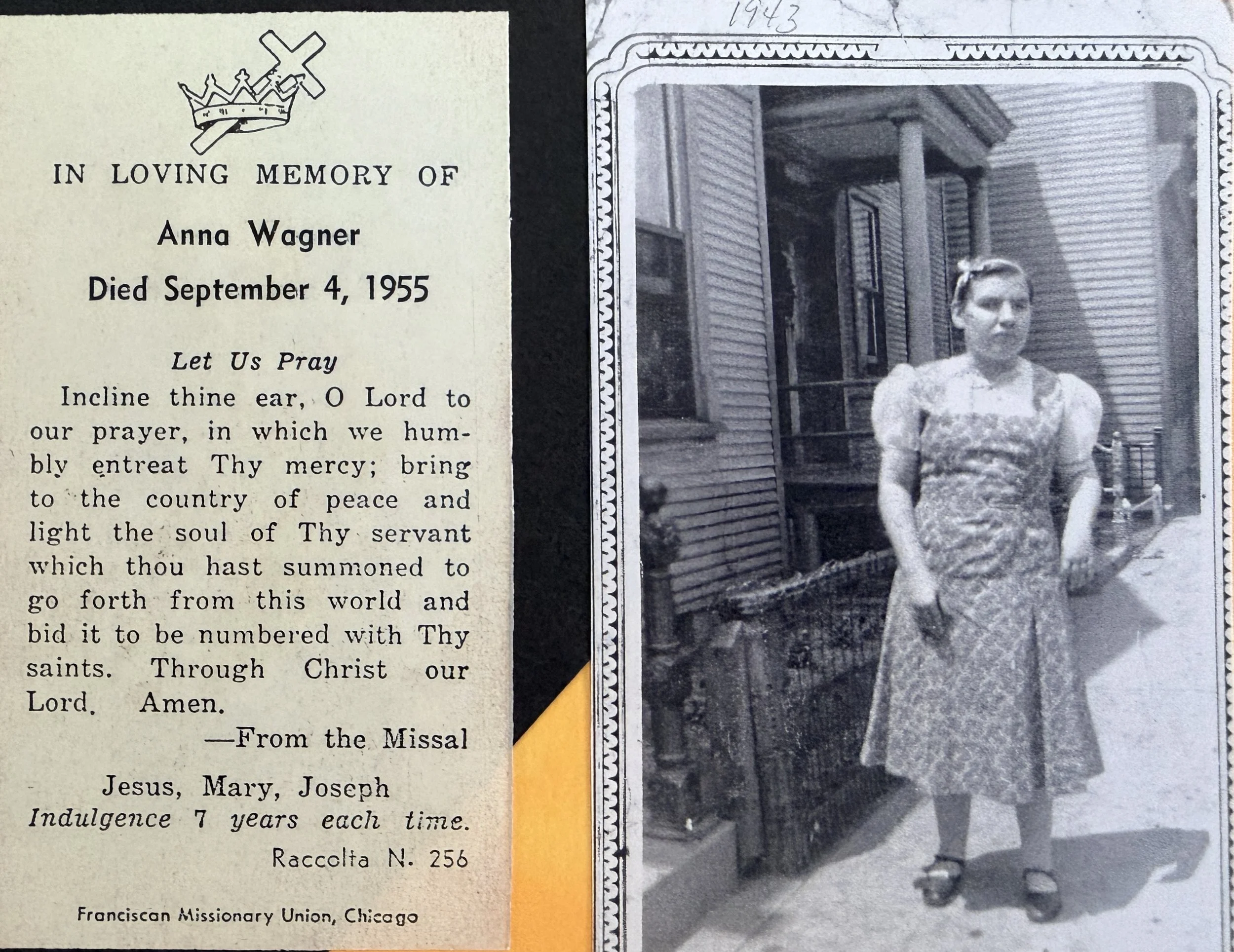
The photo on the right shows daughter Anna Rose Wagner in 1943; she sadly passed away in 1955 (as noted on this copy of her prayer card) from an epileptic seizure.
By 1955, Anna Halper had already had to watch the burials of her sister Mary in 1927, as well as two of Mary’s infant children before her; her brother Paul (in 1938) and his wife (in 1934); and perhaps her mother Maria — though I’m not sure when she died or if she died in Chicago or back in Oberdorf (as I discussed in Part VI). She had seen her brother Frank move back to Austria to run the family farm, leaving his forlorn wife and five children behind in Chicago; and she’d seen her sister Katherine (married sometime after 1920 to someone with the last name Stoker) admitted to Dunning State Hospital by her husband, who apparently left her there (despite Katherine’s pleas, according to a letter she sent to Anna). Katherine shows up as living at Dunning on Chicago’s northwest side in both the 1930 and 1940 U.S. Census. I don’t know the condition with which she was admitted, if she was ever released, or if she died there — but it seems to me a very tragic end for a young woman who dared to cross the ocean at age $16 with just three dollars in hand.
Clearly, Anna saw her share of grief and disappointment. She also outlived her son Joey (d. 1963); husband John (d. 1965), and son John Jr. (d. 1971). I’m sure she leaned a lot on her friends and church community for support, and she continued to live with daughter Minnie and Minnie’s husband Jim and daughter Tracey until her death in 1972. Many immigrants, I’m afraid, shared similar tales of woe. Upton Sinclair’s fictional family in The Jungle certainly experiences more than their share of heartache, and my grandmother’s “Brandt” side of the family also lost several members far too young.
Around the Turn of the Century, the Back of the Yards had some of the highest infant mortality rates in the city — nearly 1 in 3 children died before reaching their fifth birthday. [7] The primary culprits were poor sanitation, overcrowded tenement flats, and contaminated water and milk supplies. Before the widespread pasteurization of commercial milk, urban infants frequently succumbed to deadly summer diarrhea or severe respiratory infections like bronchitis, pneumonia, croup, and influenza. Others died from measles, whooping cough, typhoid, diphtheria, and scarlet fever.
In an effort to address these problems, “In 1908 Chicago became the first city in the world to require the pasteurization of its milk supply, and the chemical treatment of the city's water supply began in 1913. Widespread reductions in childhood disease and death could not be fully realized, however, until significant numbers of families adopted appropriate daily hygiene practices within their own households, measures such as frequent hand washing and the sterilization of baby bottles.” [8] By 1920, “the death rate from all causes had fallen by 40 percent, and infant and childhood mortality had fallen sharply. While child and infant mortality still accounted for about one-quarter of all deaths, this represented a large improvement over the 1870s, when they accounted for more than half of all deaths.” [9]
One “side effect” of this high rate of childhood mortality was a reliance on formal studio portraits to preserve children’s memories. Parents knew all too well that a single photograph might be the only permanent, physical evidence they would ever have of a child’s brief time on earth. Gathering their nickels, they would dress their toddlers in their finest clothes — as seen in this beautiful portrait of my grandfather John Jr. sporting an oversized white neck bow and high-buttoned tassel boots — and march them to a neighborhood studio to lock their likenesses safely away from the vulnerabilities of the tenements. Perhaps in a nod to his father’s job at Pullman, John Jr. has a small train propped beside him on the table.
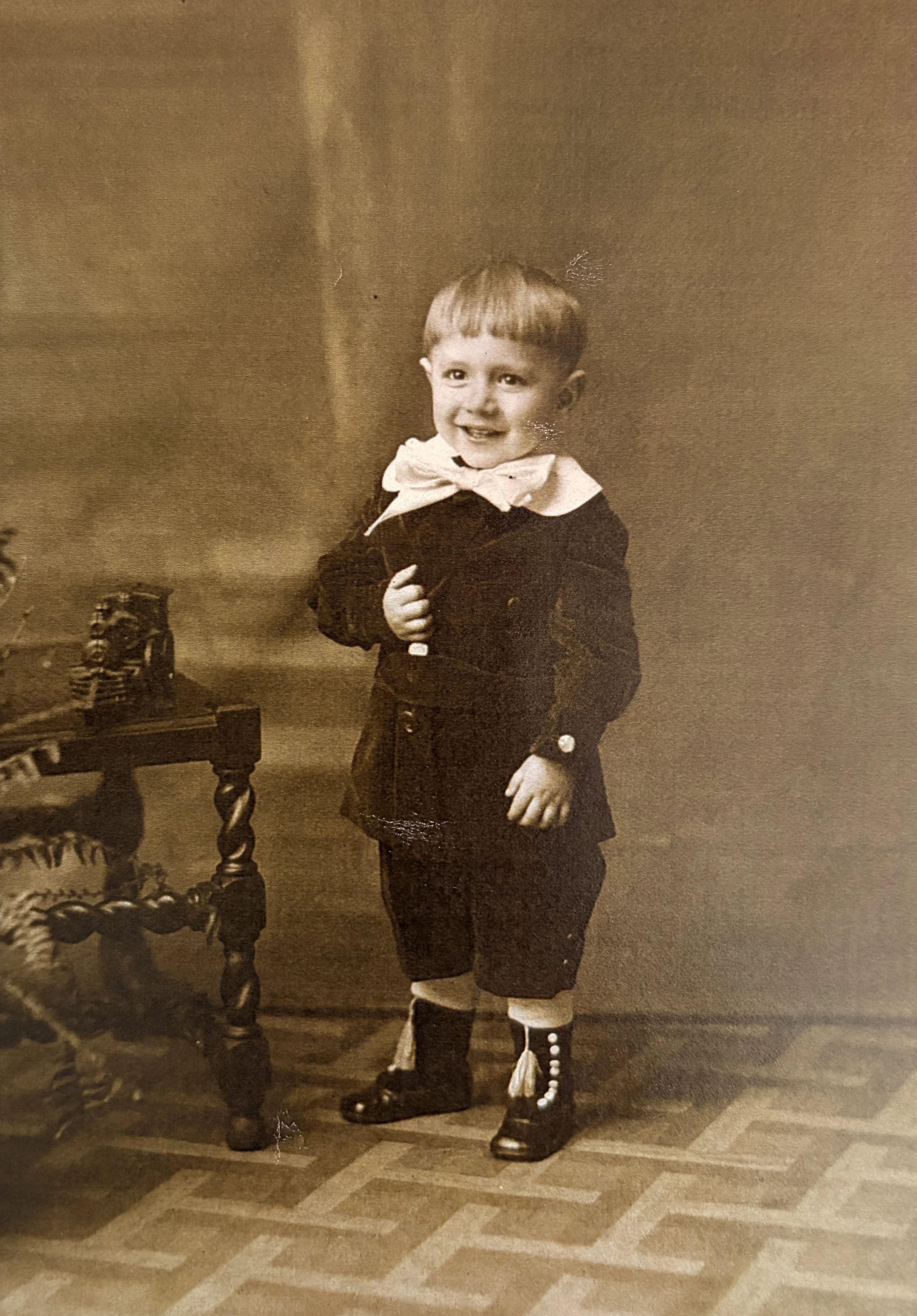
I love this photo of my grandfather, John Paul Wagner Jr., who is looking quite dapper here!
These formal portraits served as an emotional insurance policy, capturing a child at their healthiest and most vibrant. While daily life was a relentless battle against coal soot, overcrowded rental flats, and industrial grime, the studio provided a controlled sanctuary of painted backdrops, elegant carved tables, interesting props, and pristine lighting. In front of the camera lens, an immigrant child was completely removed from the harsh economic realities of Packingtown and elevated to a state of timeless dignity. If tragedy did strike a household, these photographs were transformed into the most sacred objects in the home, prominently displayed on parlor walls or tucked safely inside family prayer books.
The opportunity for less formal portraits also sometimes arose when photographers would wander through the neighborhood, occasionally with a pony, offering to take photos. This happened at least twice for John Jr. because I have two photos of him sitting on a horse at different ages. He looks at least a couple years older in the second photo, in which he and sister Anna enjoyed an opportunity to sit on a pony together for a picture. I imagine that seeing young Anna have this “little bit of fun” brought their parents some comfort — it must have been heartbreaking for them to watch her suffer for so many years with severe epilepsy.
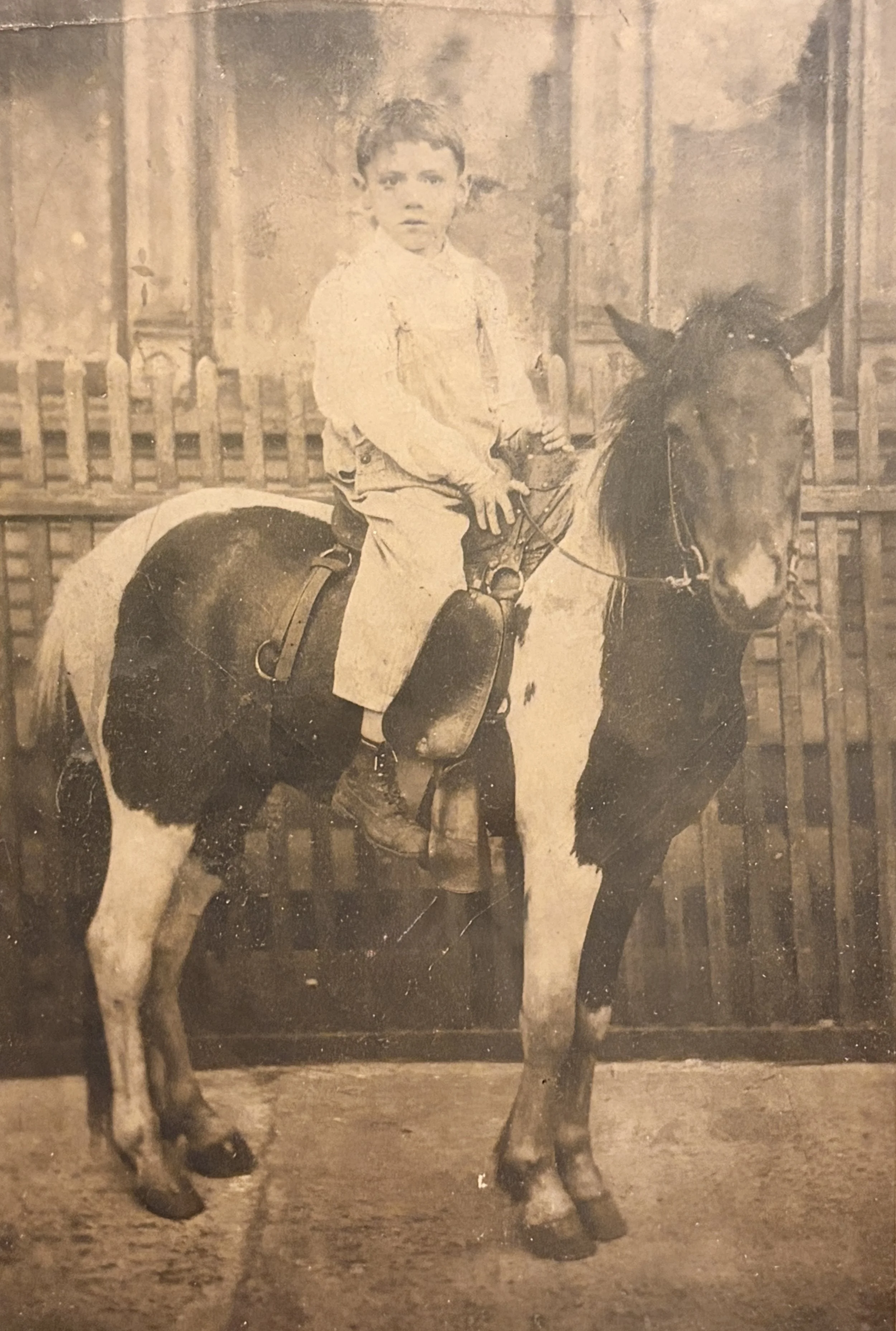
John Jr. looks a bit nervous sitting on the horse, but the horse looks quite practiced at his photographic pose.
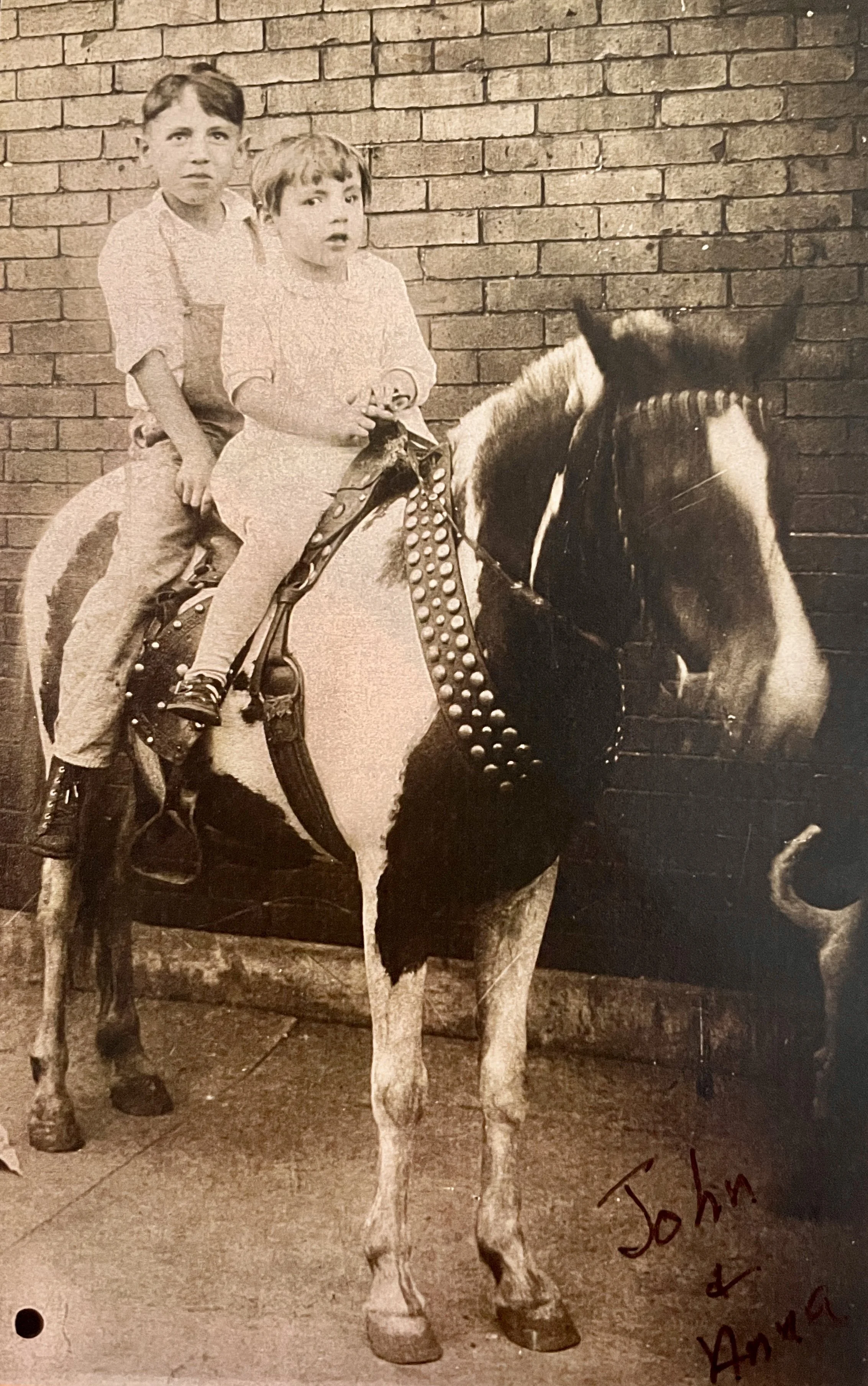
Here John, Jr. and his sister Anna enjoy sitting together on a pony for a traveling photographer’s photo.
The underlying terror of childhood illness was closely paired with the sudden, violent hazards of the workplace — a reality documented in Dr. Walter Dujmovits’s history, The Burgenländer Emigration to America. In 1906, a catastrophic industrial accident shook Chicago's South Side, claiming the lives of roughly 40 laborers, many of the Burgenländers, including a man named Josef Polanyi from Schachendorf. Dujmovits describes Polanyi as one of the first emigrants to Chicago from his Upper Pinka Valley village. [10] At the time of his death, the United States suffered from the highest rate of industrial accidents in the world, with tens of thousands of workers crushed, burned, or killed on the job every single year. [11]
Look at these crazy statistics: “Between 1911 and 1912, 1% of all ironworkers died on the job. During the push to raise skyscrapers in the 1920s, a worker died every 33 working hours. The United States Bureau of Labor Statistics (BLS) estimates that in the early 1920s, more than 30,000 fatalities happened in the workplace each year. Before 1920, more than 75,000 railroad workers died laying down tracks across America.” [12] While Dujmovits doesn’t add any specific details, it’s likely the accident in which Polanyi was involved resulted from an explosion at the Illinois Steel Company's massive South Works mill, another huge employer for immigrants arriving from Burgenland and other parts of the Habsburg and Russian empires.
With 10,000 workers by 1915, South Works mill, which became part of U.S. Steel — then the world’s largest company of any kind — in 1901, “was one of three large, integrated steel works in Chicago, which together turned out about a million tons of steel each year. It came to specialize in “structural” steel: for rail cars made at the nearby Pullman factory; rails; bridge spans; and girders for the skyscrapers that were then beginning to create the jagged Chicago skyline. [13] Read more HERE if you want to know more about the history of the steel industry in Chicago.
While Upton Sinclair’s The Jungle famously exposed the sickening realities of Chicago’s meatpacking plants, an equally horrifying industrial crisis was unfolding along the shores of the Calumet River at the Illinois Steel Company’s sprawling South Works mill. The plant functioned like a sovereign, self-contained city — complete with its own private police force, fire department, and on-site hospital — which allowed U.S. Steel to largely shield its brutal operational costs from public scrutiny. Those costs included a relentless, weekly toll on human life. In the single year of 1906, the mill claimed the lives of 45 laborers, while leaving another 598 permanently maimed or disabled. [14] Men were routinely incinerated by blast furnace detonations, suffocated by creeping carbon monoxide leaks, or crushed beneath internal freight trains, treated as mere disposable fuel for America’s industrial engine. [15]
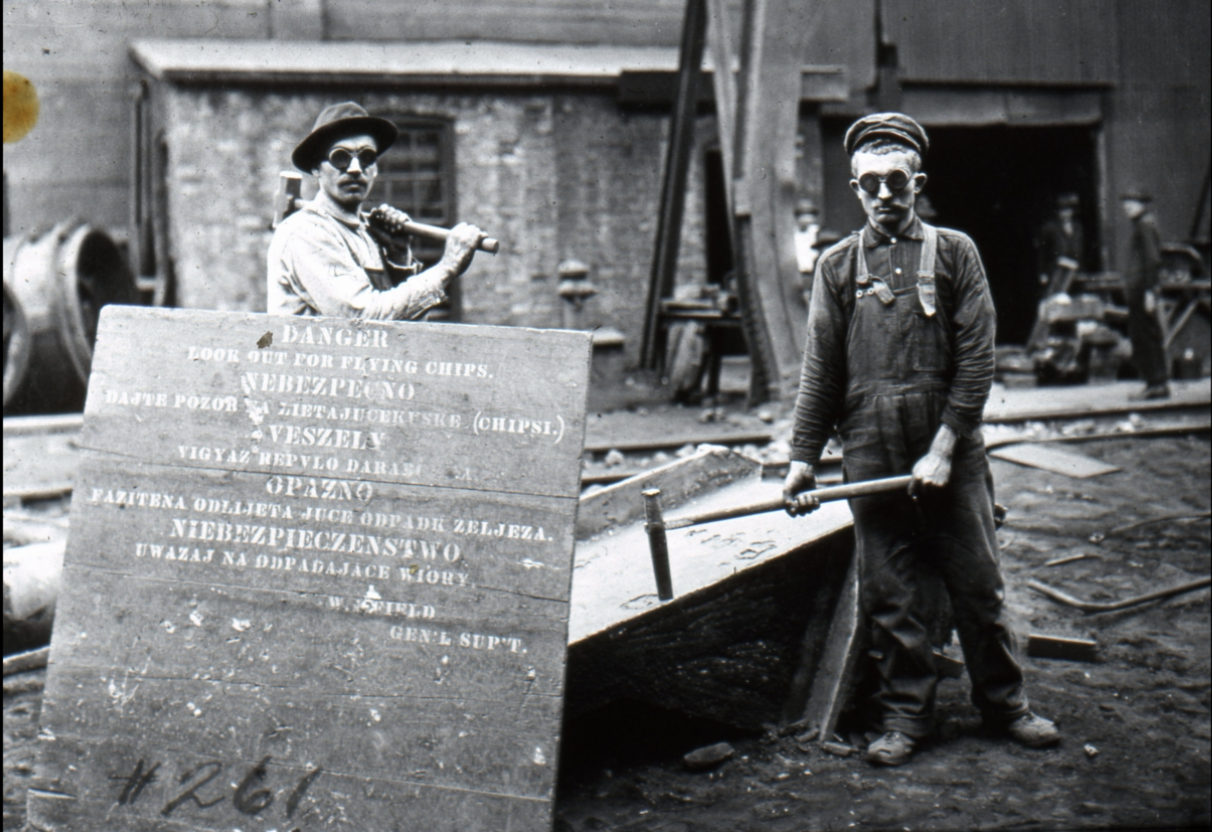
Because many early steelworkers were immigrants who spoke various languages, warning signs had to appear in many different languages, as shown here; the workers are also modeling their new safety glasses. [16]
The veil of corporate secrecy was shattered in 1907 when muckraking journalist William Hard published his groundbreaking exposé, "Making Steel and Killing Men." By meticulously cataloging the grim, day-by-day fatalities of 1906, Hard proved to a stunned nation that an average of nearly one worker was sacrificed every single week at a single Chicago facility. His vivid descriptions of laborers being swallowed by molten iron galvanized the Progressive Era labor movement.
Just a few years later, the tragedy struck again — this time targeting the city's first responders. In the freezing, early morning hours of December 22, 1910, a ferocious blaze broke out inside a grease-soaked Morris & Co. warehouse at the Union Stock Yards. As crews battled the inferno, a massive seven-story brick wall suffered a catastrophic structural collapse, burying the men under an avalanche of blazing debris. The disaster claimed the lives of 21 Chicago firefighters, including Fire Marshal James Horan, and stood as the deadliest building collapse involving firefighters in American history until September 11, 2001.
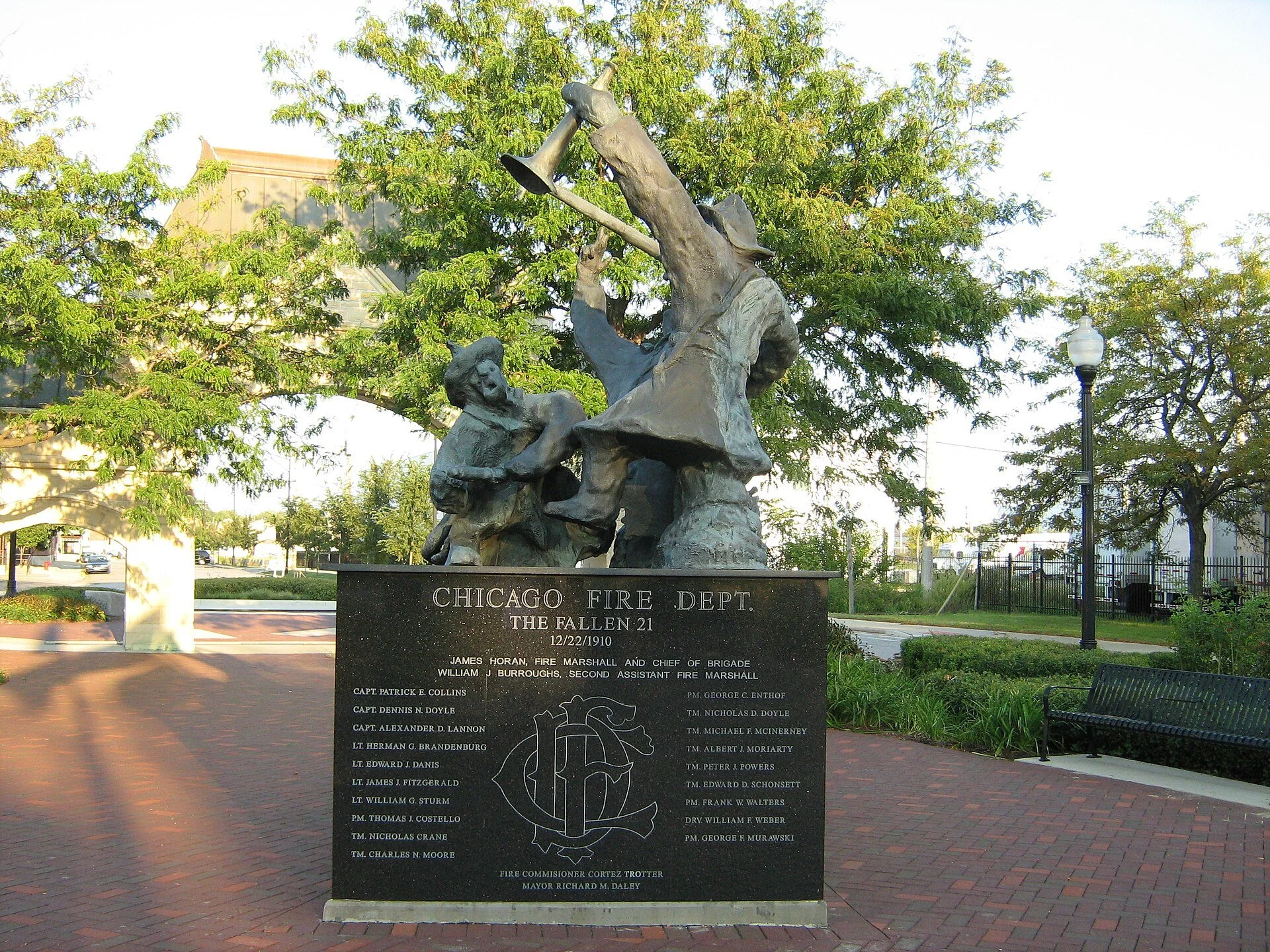
The above bronze monument, titled “Memorial to the Fallen 21,” is located in a plaza directly behind the historic Union Stock Yard Gate at the intersection of West Exchange Avenue and South Peoria Street in Chicago.[17]
After writing a book about the fire, retired Chicago fireman Bill Cosgrove decided he wanted commemorate these courageous men, so he set about rallying support and the needed funds to build a monument. Designed by artist S. Thomas Scarff and dedicated in 2004, the resulting 8-foot bronze memorial attempts “to recreate the scene of that fateful fire, showing the chief of the brigade, James Horan, holding a bugle upwards to warn the men of the falling wall. The second figure is of a truckman raising his axe to protect himself as he falls backwards. The third figure depicts a engine man focusing his hose on the fire and unaware of what is about to occur. The granite base … includes the names of those who died that day as well as others who have perished in the line of duty.” [18]
These various workplace tragedies eventually altered the American workplace. The intense public outrage generated by Hard's journalism and the horrific loss at the Stock Yards forced a defensive corporate landscape to change. It pressured massive entities like U.S. Steel to pioneer the corporate mandate of "Safety First," serving as a direct catalyst for the birth of modern occupational safety codes, mandatory worker compensation laws, and stricter municipal building codes. Ultimately, these early 20th-century disasters proved to the public that the true cost of industrial progress was far too high to ignore.
Prior to the 1910s, however, corporations offered zero automatic financial payouts, insurance, or workers' compensation to families; a husband's sudden death meant immediate destitution and potential eviction for his widow and children. This complete absence of a legal or corporate safety net explains why the families of “Little Burgenland” clung so fiercely to their community organizations and the altar of St. Augustine. In a neighborhood where a slice from a butcher’s knife, a slip on a rail track, a blast at a steel furnace, or a sudden outbreak of croup could shatter a household overnight, faith and mutual aid were the immigrants’ only defense mechanisms against the grinding gears of industrial America.
The protective canopy of the Burgenländer community extended far beyond church pews and classroom doors. Because early 20th-century industrial life came with no corporate safety nets, the immigrants built their own. Chicago’s South Side was anchored by various secular and parish-backed community organizations, fraternities, and Krankenunterstützungsvereine (Sick Benefit Societies). Working-class families pooled their spare change into these mutual aid networks, ensuring that if a worker was injured in the stockyards or laid off from the rail lines, the community could step in to pay for a doctor, buy groceries, or cover a dignity-saving funeral.
I plan to spend more time discussing some of those organizations, as well as some of the social activities the Burgenländers enjoyed in additional chapters in my eventual book. The various church newsletters mention quite a few, including young men’s and women’s sodalities, bowling leagues, bunco nights, missionary clubs, fundraising contests, teas, and more. Church members also got involved in the Back of the Yards Neighborhood Council, formed in 1939, which sought to unite the neighborhood's fiercely divided Polish, Slovak, Irish, and German-Austrian enclaves into a single bargaining collective, with the goal of pressuring City Hall for basic municipal services. They successfully lobbied for paved streets to replace winter mud traps, updated sanitation infrastructure, and proper garbage routing.
The Burgenländers also turned their attention outward as they heard reports about the catastrophic devastation in Austria — including the easternmost province of Burgenland — following World War II. The infrastructure of the country had collapsed, agricultural production was completely decimated, and severe shortages gripped the entire region. Compounding the structural devastation was the harsh political and physical reality of the era. The period between 1946 and 1947 brought catastrophic "Hunger Winters" to Central Europe. Extreme freezes combined with a lack of fuel, transport, and basic farming supplies pushed millions to the brink of starvation. Daily rations allotted by authorities frequently plunged below 1,000 calories per person—far short of what was needed to survive.
The immigrants who had scrambled for economic security in America suddenly became the vital lifelines for the home villages in Burgenland. Families across Chicago’s South Side mobilized to send aid back across the Atlantic. They utilized the newly formed cooperative network CARE (Cooperative for American Remittances to Europe) to purchase and ship standardized CARE Packages directly to their relatives in Burgenland. Packed tightly with American staples — like Jack Frost sugar, Uncle Ben's rice, Chase & Sanborn coffee, and shelf-stable canned meats — these boxes, stamped CARE UNITED STATES OF AMERICA, arrived at European ports like Bremen to be distributed to desperate rural households.
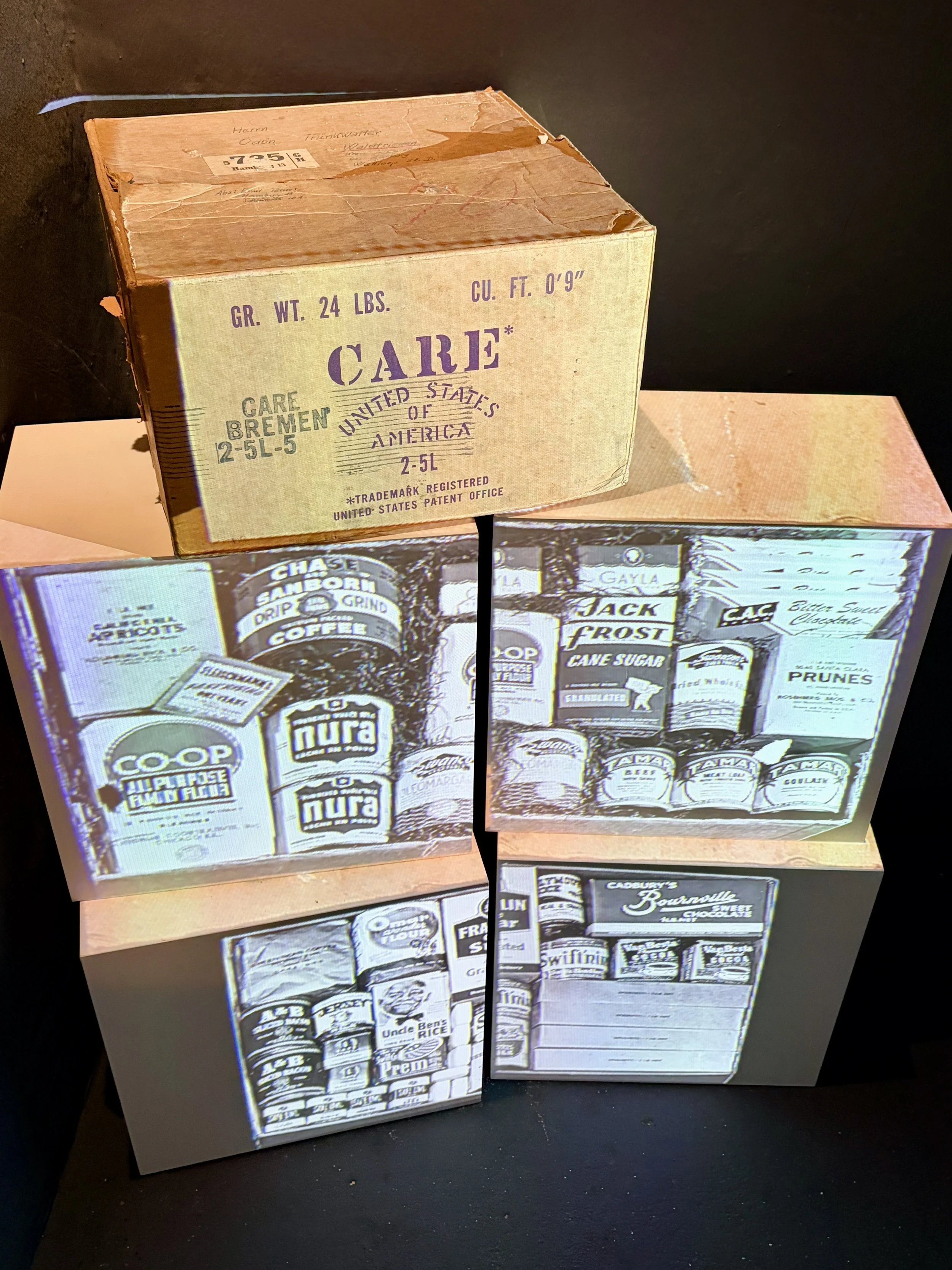
Between 1946 and mid-1955, CARE delivered over 1 million packages across Austria, each including 80 life-saving meals made up of many staple products (as listed below).
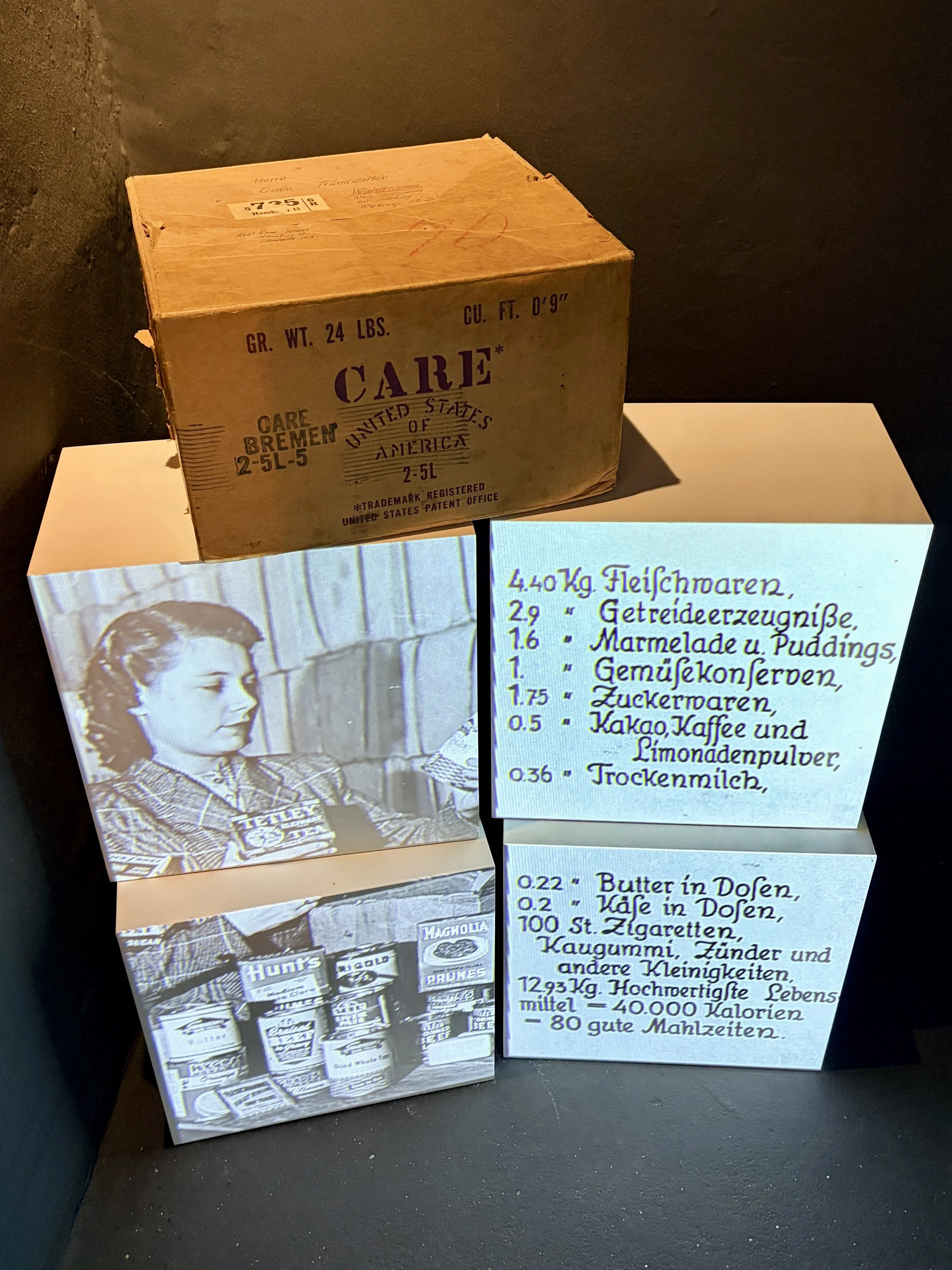
We saw displays about this at the Stadtvilla Eisenstadt museum in Eisenstadt when we were there last June that called these packages “lifesavers for millions of people in Europe following the end of the Second World War, given the lack of food, clothing, and medicine.” [19] Austria received about one million such parcels, though “only around three percent of them [made] their way to Soviet-occupied Burgenland.” [20] In the photo above, you can see a list of everything included in the box. Here you can see the list translated into English:
Care Package Contents:
4.40 kg Meat products
2.9 kg Grain/Cereal products
1.6 kg Jam and puddings
1.0 kg Canned vegetables
1.75 kg Confectionery/Sweets
0.5 kg Cocoa, coffee, and lemonade powder
0.36 kg Powdered milk
0.22 kg Canned butter
0.2 kg Canned cheese
100 pcs. Cigarettes
Chewing gum, matches, and other small items
Total Impact:
12.93 kg of highest quality food
40,000 calories
80 good meals
Perhaps you can imagine how relatives back in places like Unterwart and Oberdorf felt when they received these boxes. In a region where fresh dairy and meat had largely vanished from markets, a single box provided enough supplemental nutrition to yield 80 life-saving meals for an entire household. Items like coffee, cocoa, chewing gum, and real tobacco were impossible to obtain or carried astronomical prices on the black market. Cigarettes and coffee functioned as a universal currency, allowing families to trade them for building materials, firewood, or medical help if needed.
As mentioned above, besides the devastation brought by the war, Burgenland was contending with being entirely under Soviet military control. The region experienced intense requisitioning of resources, and its geographic isolation near the developing Iron Curtain made the transport of commercial goods and international public aid incredibly difficult. Because official government channels were slow and heavily restricted by occupation politics, private citizens took matters into their own hands. Through CARE, for $10 (roughly equivalent to $140 today), a regular American family could purchase a pre-packed, 22-to-25-pound cardboard box such as the one above and guarantee its delivery straight to a specific relative or struggling family in war-torn Europe.
Beyond the physical sustenance, the psychological impact was profound. Receiving a carefully packed box from across the Atlantic served as a powerful emotional reminder to isolated, war-weary Austrians that they had not been abandoned by the outside world. It transformed the phrase "care package" from a literal corporate acronym into a universal, worldwide symbol of human empathy and grassroots relief. I know I was the happy recipient of several “care packages” from my mother when I was in college — often bearing homemade cookies or other treats — and they certainly made me feel remembered, comforted, and loved.
I want to end this series on what must have felt like the ultimate crowning achievement for my great- grandparents: being able to purchase their own home in 1954. It was the culmination of a multi-decade dream that led them out of their small villages in Western Hungary to the Port of Le Havre in France, across the Atlantic Ocean to Ellis Island, by train from New York City to Chicago, and through various flats in the Back of Yards to their very own house at 5426 S. Justine Street. Moving just a few blocks southwest, this house was the reward for nearly half a century of John detailing Pullman cars and Anna working at a bakery in her early years, managing a bustling household filled with four children, then later on working as a cleaner in Chicago’s F.B.I. Building.
It was at the house on Justine Street that John Wagner could eventually relax in the recliner he was gifted by Pullman upon his retirement in 1955, and that Anna could display her treasured figurines and many hand-crocheted lace doilies. She made a lot of them — it’s one of my few memories of the house! I did get to see the house on Justine on several occasions, both when Anna was still alive and when we would visit Minnie and Tracey after she had passed away. I’m glad to have at least a few photos that capture the four generations together. You can see some of Anna’s many crocheted doilies that helped to protect the dishes in the cabinet behind us; some of those dishes now sit on my living room shelf, along with a couple of Stein mugs that belonged to my great-grandparents.
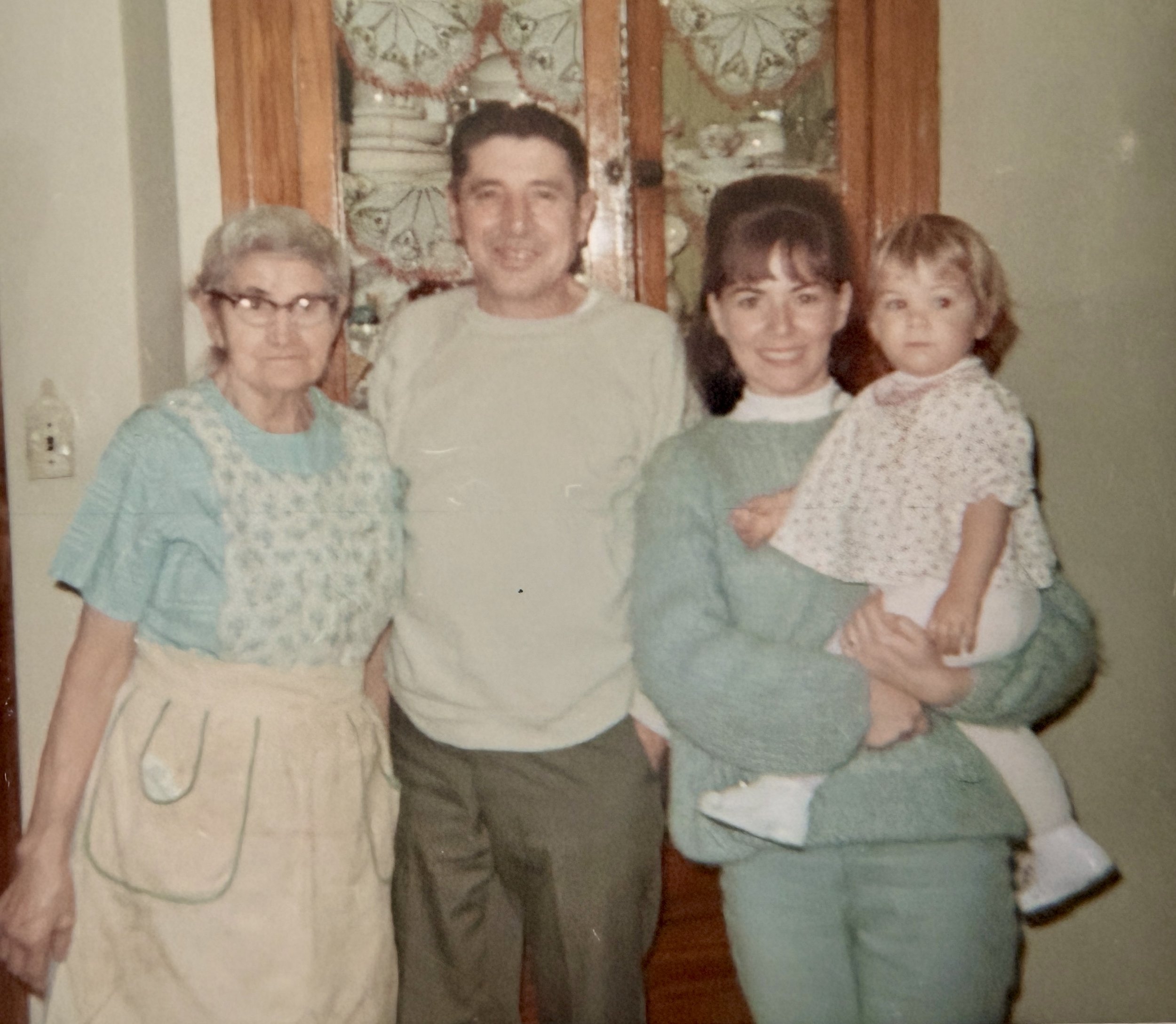
My great-grandmother Anna Halper; grandfather John Paul Wagner, Jr.; mother Dorothy Ann (Wagner) Graham, and me — I know I already added this photo to an earlier post, but it seemed like it should be here as well.
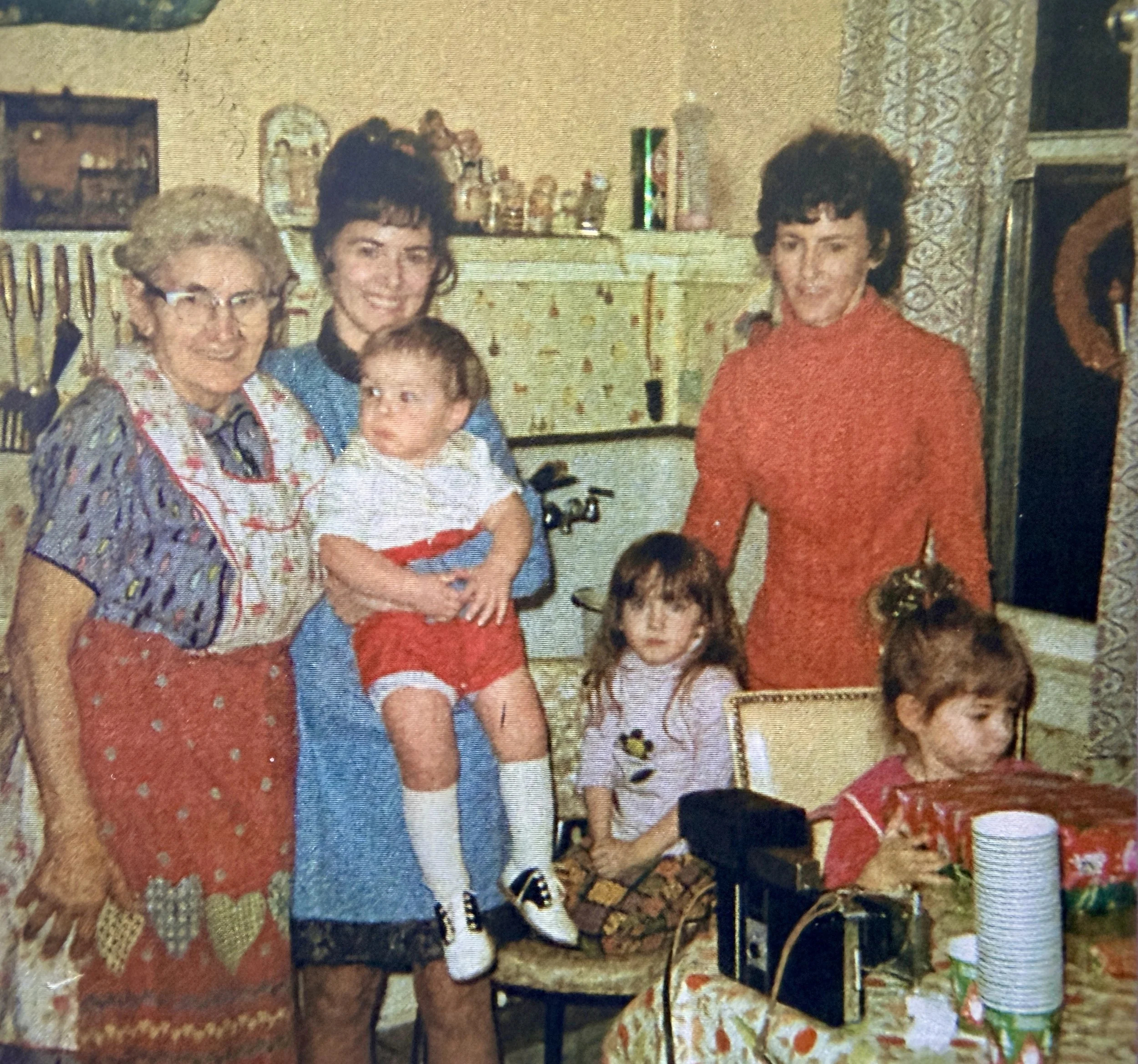
Here you can see Anna Halper, my mom holding my brother Cameron, my great-aunt Minnie with her daughter Tracey, and me (apparently more interested in the present in front of me than in smiling for the camera).
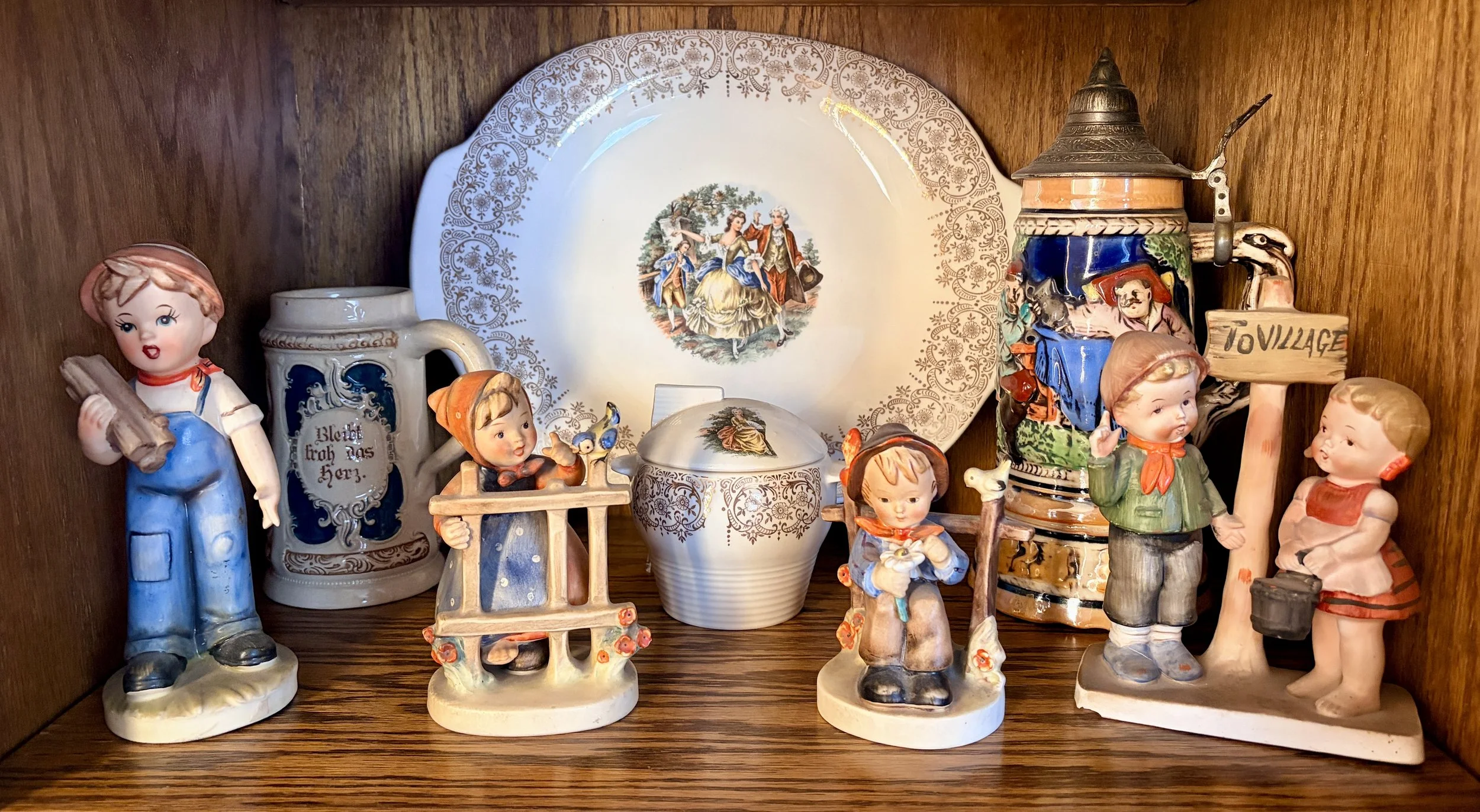
This is the “John Wagner and Anna Halper” shelf in my living room, featuring some of their treasured household items.
Years ago, as one of a few blog posts I wrote about Ellis Island, I wrote a poem about Anna Wagner titled “I Wish I Got to Know Her” (you can find it HERE). I don’t remember much about her — she died when I was five — but I remember her doilies, that I thought her house smelled funny, and that she would always give me “a little something” when we visited. I now have a couple of the doilies, plus a lot of other family artifacts I inherited from Minnie and Tracey. The smells I’m not sure about. They could have been due to the animals they kept, but more likely they were caused by her style of cooking, which according to my mom included a lot of sauerkraut, cabbage, and other pickled and fermented foods, as well as as cooking in lard.
My mom’s brother, John Paul Wagner III, most remembers walking into the kitchen one day and seeing “calves’ brains, pigs’ feet, and other animal parts” on the counter. “That memory haunts the hell out of me,” he told me last night after I told him I had a list of questions I hoped to ask him. He also remembers having a bowl of chicken noodle soup one day at their house, and he found a chicken heart in his bowl. “I brought my own food after that,” he said. He doesn’t remember having any long conversations with either of his grandparents and said they spoke in “broken English.” He remembers his grandfather had “lots of beer mugs around” and liked to “walk and sip, walk and sip” on his way to his chair.
He also recognizes that his grandparents “were hard-working, managed to have a home, and raised their kids,” all in a neighborhood where life was not easy for them. They never had a TV, never had a car to his knowledge, couldn’t drive, and always took public transportation. Once, coming home from work on the bus, his grandmother (Anna) got mugged, he recalled, but was fortunately not hurt. He also remembers going to “more wakes and funerals than I care to remember.” [21] Based on the number of names in the guest book for Anna (Halper) Wagner’s funeral, the Little Burgenland community liked to show up in support of each other — by the third generation, perhaps not so much.
Surprisingly, this was the first time I had talked to my uncle about his memories of his grandparents. I can no longer ask my mom any questions since she passed away last December, and Minnie and Tracey have been gone for quite a few years now. It has been an amazing journey “Exploring Burgenland” and learning more about the lives of my ancestors by digging into historical records and texts, family artifacts, museum exhibits, muckraking exposés, and lots of online sources. My advice, though, to other Burgenländer descendants out there is, if you still have family members you can talk to about their lives or their parents’ or grandparents’ lives, make it a point to ask some questions! Those personal stories truly make history come alive.
Endnotes:
"5014 S Laflin St, Chicago, IL 60609." Redfin, 2026, www.redfin.com/IL/Chicago/5014-S-Laflin-St-60609/home/13954045.
Cover Image. Pfarrbote [St. Augustine Church, Chicago], Vol. 25, No. 7, July 1929, p. 1.
Heineman Photo - Commercial High School’s Class of 1922. Pfarrbote [St. Augustine Church, Chicago], Vol. 19, No. 5, May 1922, p. 29.
Lockwood, Robert P. “The Urban Legend of Catholic Schools.” Catholic Answers, 1 May 2006, https://www.catholic.com/magazine/print-edition/the-urban-legend-of-catholic-schools.
Lefkovitz, Dr. Aaron E. “Religious Histories.” Back of the Yards: Histories & Contexts of a Chicago Neighborhood. De Paul University, Pressbooks, https://depaul.pressbooks.pub/backoftheyards/chapter/religious-histories/.
Advertisement for Kowske Funeral Directors. Pfarrbote [St. Augustine Church, Chicago], Vol. 19, No. 5, May 1922, p. 20.
Ferrie, Joseph P., and Werner Troesken. Death and the City: Chicago’s Mortality Transition, 1850-1925. Working Paper no. 11427, National Bureau of Economic Research, June 2005. NBER, www.nber.org/papers/w11427.
Curry, Lynne. “Children’s Health.” The Electronic Encyclopedia of Chicago, Chicago Historical Society, 2005, http://www.encyclopedia.chicagohistory.org/pages/281.html.
Ferrie, Joseph P., and Werner Troesken. Death and the City: Chicago’s Mortality Transition, 1850-1925. Working Paper no. 11427, National Bureau of Economic Research, June 2005. NBER, www.nber.org/papers/w11427.
Dujmovits, Walter (translated by Robert Strauch). The Burgenlander Emigration to America. English issue of the 3rd ed., Stegersbach, Austria, The Burgenland Bunch, 2013, pp. 112-113.
“Achievements in Public Health, 1900-1999: Improvements in Workplace Safety.” Morbidity and Mortality Weekly Report, Centers for Disease Control and Prevention, Atlanta, GA, 11 Jun 1999, https://www.cdc.gov/mmwr/preview/mmwrhtml/mm4822a1.htm.
Liggett, Ted. “Workplace Accidents: US History and Facts.” Liggett Law Group, 15 Jul 2024, https://liggettlawgroup.com/blog/workplace-accidents/history-facts/.
McNeill, J.R. “Chicago’s Temple of Steel: South Works since 1882.” The Rachel Carson Center Review, Issue No. 10, 13 Dec 2022, https://springs-rcc.org/chicagos-temple-of-steel-south-works-since-1882/.
Exhibit of the Illinois Steel Company in the American Museum of Safety, 29 W 39th St, New York, #275. Circa 1911–1912. Archive ID: [ID Number], Southeast Chicago Archive & Storytelling Project, Southeast Chicago Historical Society, www.sechicagohistory.org/archive/browse/exhibit-of-the-illinois-steel-company-in-the-american-museum-of-safety/.
Ibid.
Two Workers and “DANGER” sign in multiple languages. Circa 1910s. Archive ID: 1981-051-5, Southeast Chicago Archive & Storytelling Project, Southeast Chicago Historical Society, www.sechicagohistory.org/archive/browse/two-workers-and-danger-sign/.
Zol87. Chicago Fire Department The Fallen 21 Memorial. 10 Sept. 2008. Wikimedia Commons, https://commons.wikimedia.org/wiki/File:Chicago_Fire_Department_The_Fallen_21_Memorial.jpg.
Koenig, Wendy, and Christine Badowski. “Memorial to Fallen 21.” Chicago Public Art, 26 Aug. 2013, https://chicagopublicart.blogspot.com/2013/08/memorial-to-fallen-21.html.
Kroemer, Heike, and Tom Koch, curators. “Return of the CARE Package.” Stadtvilla Eisenstadt Permanent Exhibition, visited 17 June 2026, Stadtvilla Eisenstadt, Eisenstadt, Austria. Exhibit.
Ibid.
Wagner, John Paul. Personal Interview. 25 Aug 2026.