Exploring Burgenland, Part VI: Life in Chicago’s “Back of the Yards,” Packingtown, and the Pullman Legacy
For those of you who have been reading this series, you know that Parts I, II, III, and IV described our trek through Burgenland, Austria, as well as briefly explained some Hungarian and Burgenland history; and Part V looked at why so many people left Burgenland in the late 1800s and early 1900s (when it was still part of West Hungary) for various industrial cities in the United States. In this post, I will specifically look at why so many – including many of my own ancestors – settled in Chicago and will describe what their “work life” might have been like in those early years after their arrival. In my next post (yes, I decided there’s going to be one more — lol — too much to write here), I will describe their home and community life more fully.
How strange it must have felt for those Grenzlers (borderlanders) from the “borderlands” between Hungary and Austria to suddenly find themselves in a massive urban setting where they did not speak the language, had to learn how to navigate finding jobs and places to live, struggled with poverty and discrimination, were confronted with new cultural traditions and ways of thinking, and faced the difficulties associated with establishing themselves in a new community, finding suitable marriage partners, and starting families. What a relief it must have been, though, to land among other Grenzlers (they were not yet called Burgenländers) in what eventually became known as “Little Burgenland,” surrounded by people who understood their cultural traditions and roots, spoke their specific Hianzn dialect, shared their Roman Catholic faith, and often were related through bloodlines or marriage.
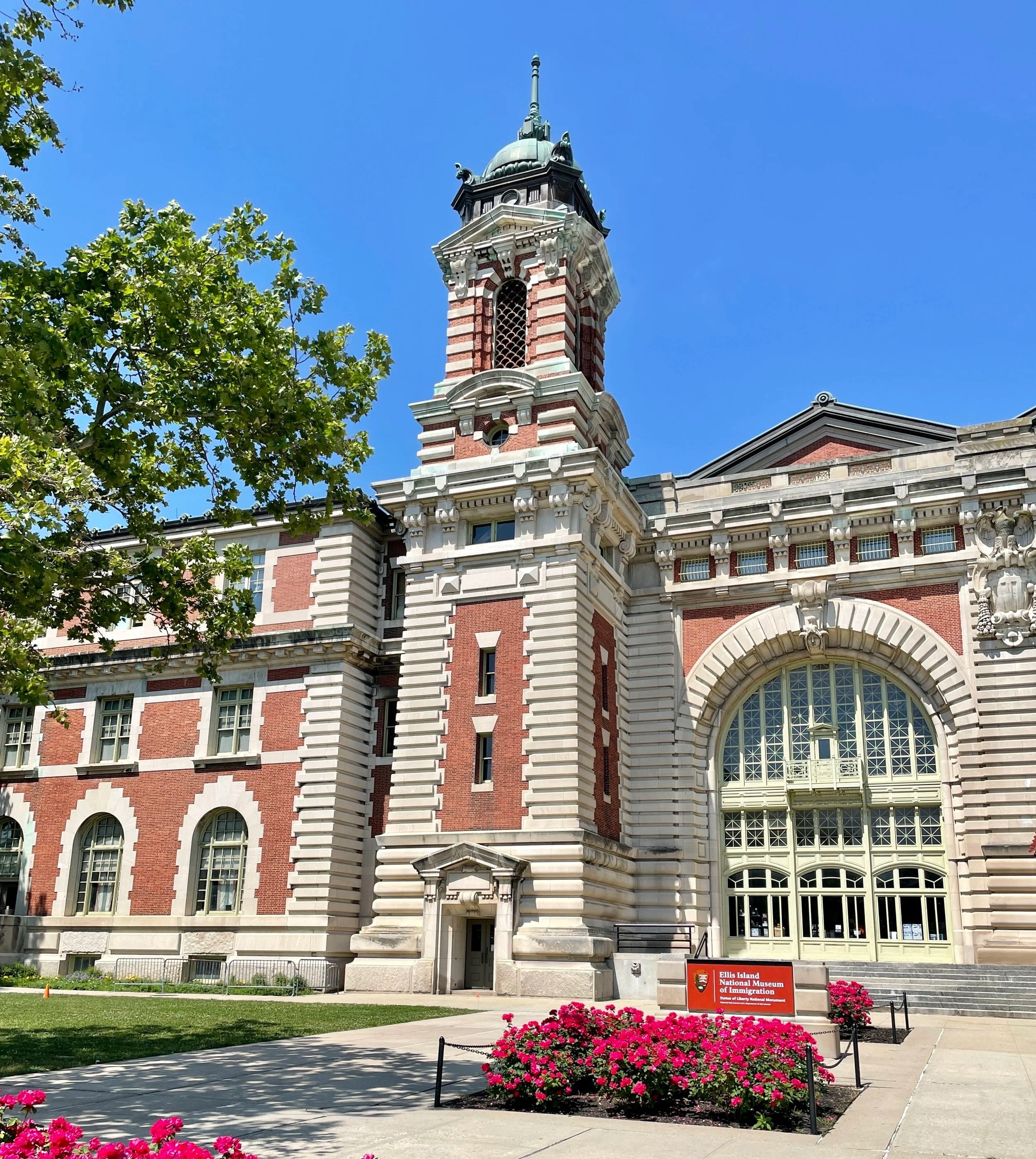
Between 1892-1954, approximately 12 million immigrants passed through Ellis Island Immigration Station.
First, though, they had to pass through the immigration screening stations at Ellis Island, proving they did not carry any communicable diseases, were not mentally deficient, would not become a “public charge” dependent on the state, were not anarchists who might foment political rebellion, carried the requisite amount of money (which starting in 1909 was $25, though this was not always strictly enforced), and had some place to go. Here is where it helped to have a family member or friend who came before you – and in the case of my ancestors (and many Burgenländers), they did.
The first of my relatives to arrive at Ellis Island were my great-great grandmother, Maria Halper, and two of her children – son Paul (26) and daughter Maria (19) – in 1904. They set sail from the Port of Le Havre in France on 26 Mar 1904 on the S.S. L’Aquitaine and arrived at the Port of New York on 6 Apr 1904. She listed herself as 45 and a widow, but neither was correct. According to church records, she was born 16 Jun 1853, so she would have actually been 50, and her husband Paul back in Oberdorf (known as Őrállás, its Hungarian name, at the time) did not die until 25 Feb 1917. Also, according to the birthdates listed on church records, Paul would have been 24 and daughter Maria 18. So … so much for accuracy. Paul said he was a laborer; mother Maria, a servant; and sister Maria, a maid. All said they were going to “Cousin Michael Lorenz” at 5217 Laflin Street on the south side of Chicago. They were traveling with several others from Őrállás going to Chicago: Michael (33) and Stefan (28) Halper, Franz (40) and Klara (38) Konrath, Rosalia Halper (23), and Joseph (38) and Franziska (34) Konrath.
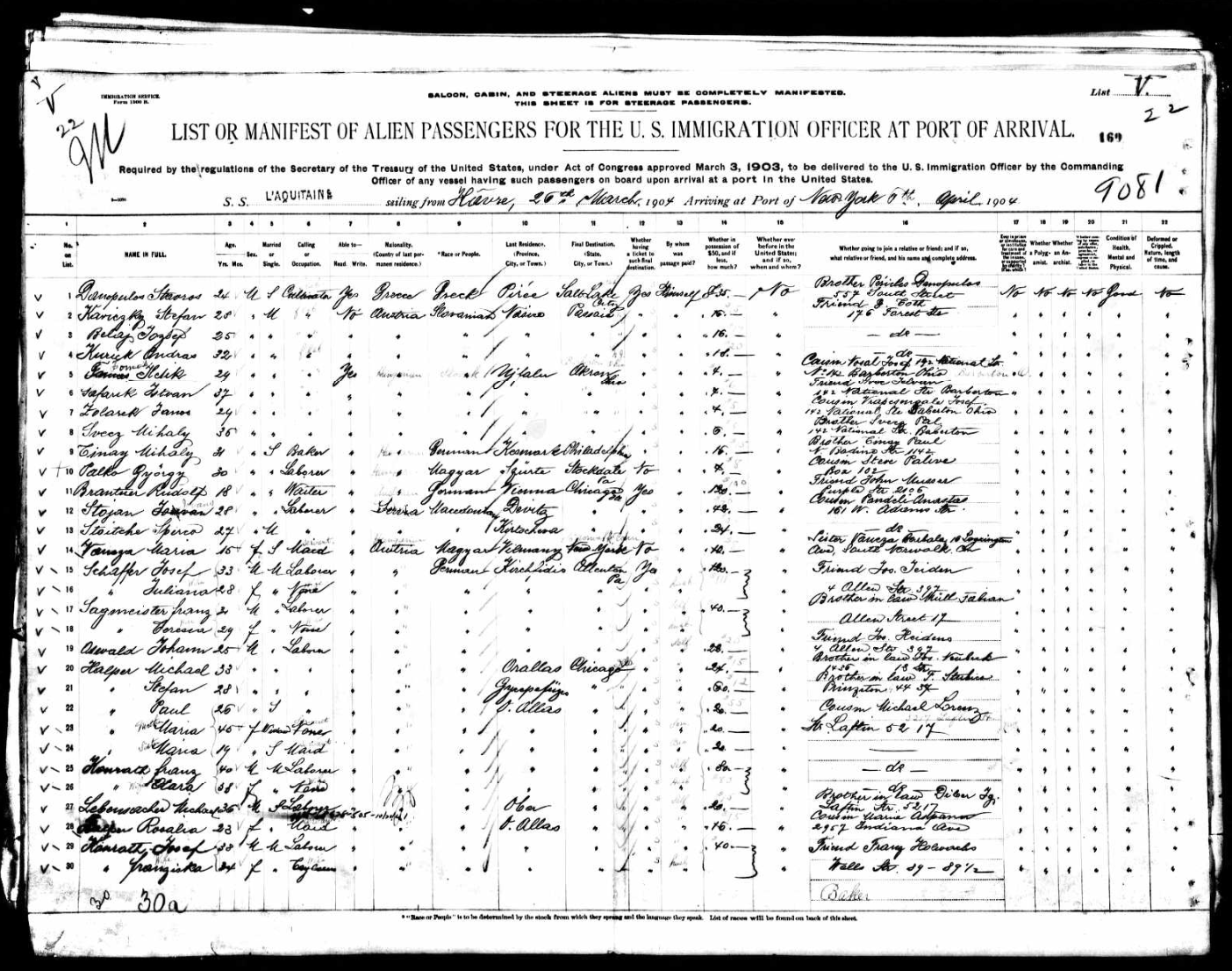
This ship manifest shows that Paul Halper, along with his mother Maria and sister Maria, arrived at Ellis Island from Le Havre on 6 April 1904. [1]
It’s likely the cousin whose house they were going to was the Michael Lorenz (25) from Őrállás who arrived with his wife Barbara (25) on the S.S. La Savoie on 2 May 1903. He listed himself as a tailor and said he and his wife were going to “sister-in-law Maria Aspan” at 1529 49th St. (who had arrived 27 Feb 1903). Eight others traveled with them from Őrállás, with three listing themselves as masons, one as a smith, and the others as laborers. Several of them said they were going to join Leopold Halper at 1420 50th St. (who had arrived in Feb. 1903).
Maria Halper returned to Hungary after about a year in Chicago, probably because she still had three children at home – and apparently a husband with whom she may or may not have lived. Son Paul and daughter Maria (who went by “Mary” in America) stayed. Paul married Sidonia Halper on 27 July 1905, though later they must have divorced because on 3 Nov 1917, he married Justina Tatler; and Sidonia married John Bomher in 1916. Mary married Frank Joseph Halper (her cousin) on 20 Nov 1907 in Chicago, and their first child was born the following year.
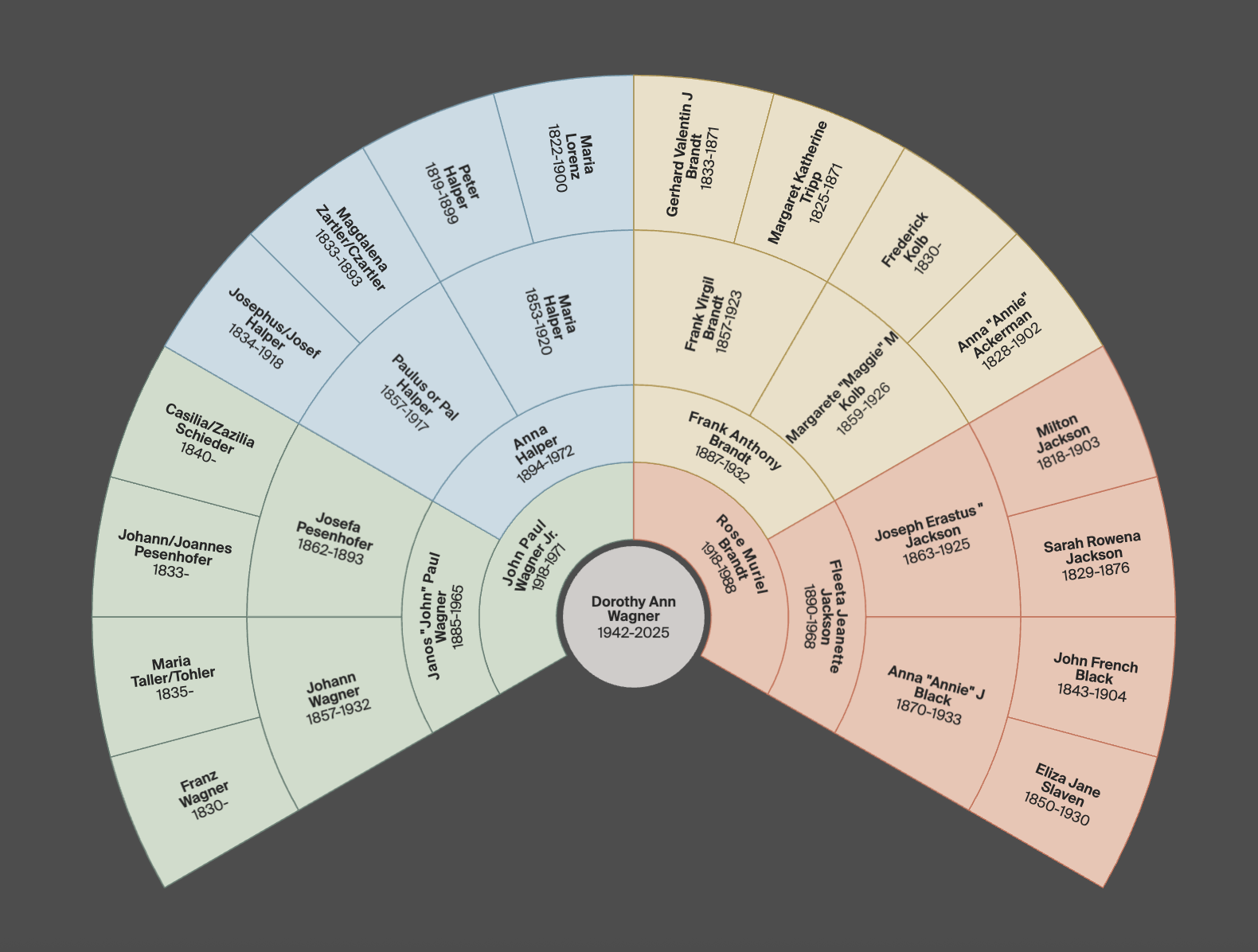
Here you can get a clear picture of my maternal ancestors, three of whom immigrated to America: Janos “John” Paul Wagner, Anna Halper, and Maria Halper; some of John and Anna’s siblings also made the journey.
Maria’s daughter Katarina left home at age 16 with four others from Őrállás (perhaps with money Maria brought home from America) – arriving in New York 9 Apr 1905 on the S.S. La Touraine with $3 in her pocket. She must have told the immigration officials $10 because that was the number initially written down, but they must have checked and discovered the reality. They crossed out “10” and replaced it with “3”. She was on her way to her sister Maria at 5217 Laflin. Brother Franz “Frank” Halper followed on 4 May 1909, arriving on La Gascogne, on his way to “brother Paul” at 4918 Wood St. In the 1910 U.S. Census, however, he shows up as living with sister Maria and her husband, Frank Halper, at 4955 Marshfield Ave.
Later that year, mother Maria returned to Ellis Island on 9 Nov. 1910, also saying she was going to stay with her daughter Maria in Chicago (who clearly had a busy household!). This time, she said she was 48 (she was actually 57), and she did not pass through quite as easily. Older, single women arriving alone were often scrutinized more closely by immigration inspectors. By claiming she was 48, Maria likely sought to position herself as a woman still capable of performing manual labor, domestic service, or factory work, but she was called on her ruse. There is a stamp next to her name on the ship manifest that says “S.I.” — Special Inquiry — which means she had to go through a formal review with additional questioning.
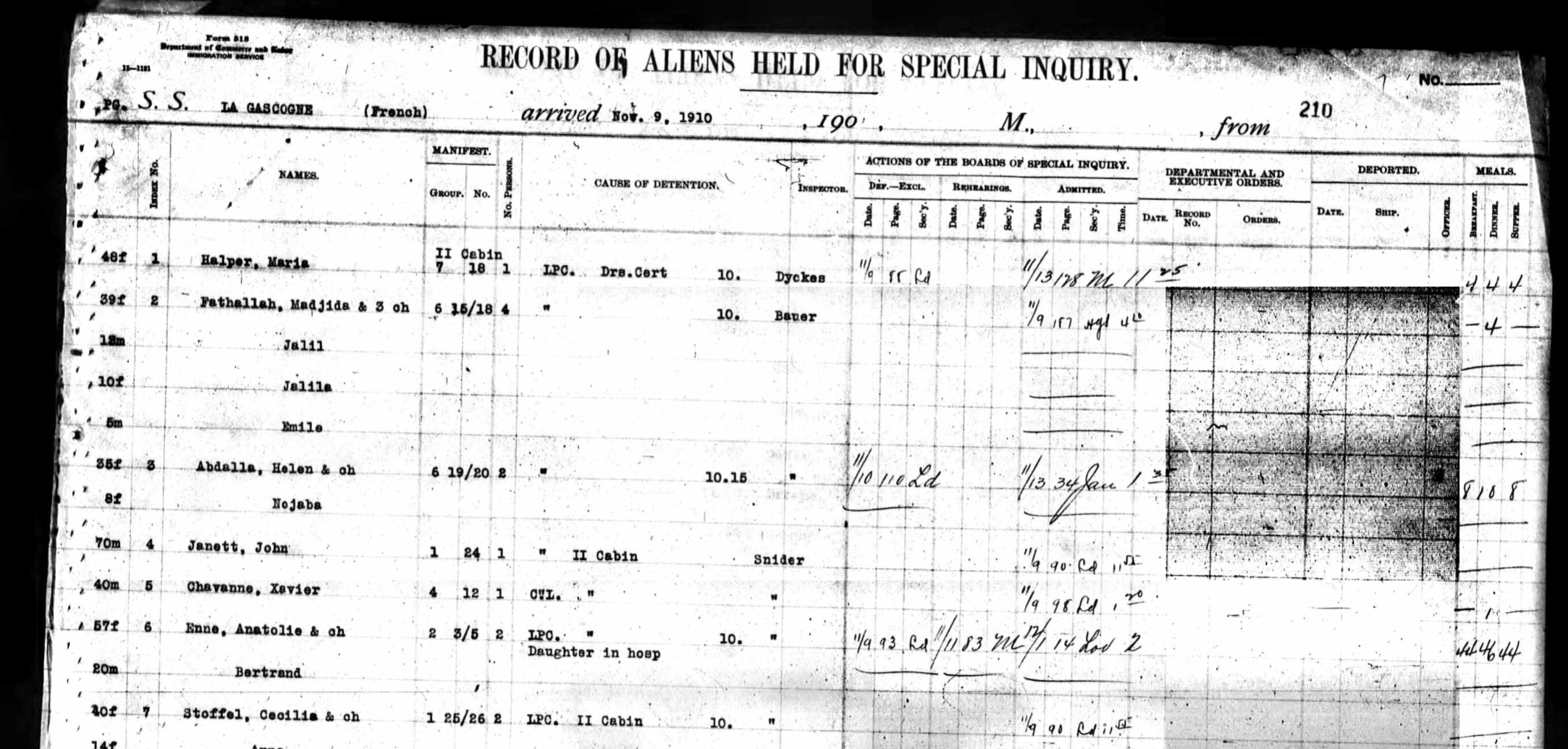
This page in the ship’s manifest shows that Maria Halper was held for “Special Inquiry” the second time she arrived at Ellis Island in 1910. [2]
A fuller explanation appears at the end of the manifest. The “LPC” means they were concerned she was “Likely to become a Public Charge.” The “Drs. Cert.” indicates she required a Doctor's Certificate because she failed a preliminary medical screening upon arrival and was flagged by the port's medical inspectors. The "10" refers to Section 10 of the Immigration Act of 1907, which mandated that steamship companies had to pay to deport any alien who was rejected at the port of entry due to a medical condition that existed before they boarded the ship. The final columns also reveal she was fed four breakfasts, four dinners, and four suppers. Maria eventually had a hearing on Nov. 11 and was finally admitted Nov. 13, I’m sure to her great relief.
The area where the Halpers all settled on Chicago’s south side was known as the “Back of the Yards” because it backed up to the Union Stock Yards. The year Maria and her two children arrived, 1904, is the same year Upton Sinclair visited the stockyards and packing houses, interviewed the workers, and began writing his shocking and transformative novel, The Jungle, which laid bare the many dirty secrets of Chicago’s meat packing industry. Initially serialized in 1905 in a Socialist newspaper, The Jungle was later published as a book by Doubleday, Page & Company in 1906, and it caused an immediate sensation. If you’ve never read it, let me tell you … it does not paint a pretty picture of the Union Stock Yards, “Packingtown,” the “Back of the Yards” neighborhood, or the life of an immigrant laborer at this time. (If you’re interested, you can read the text online for free through Project Gutenberg).
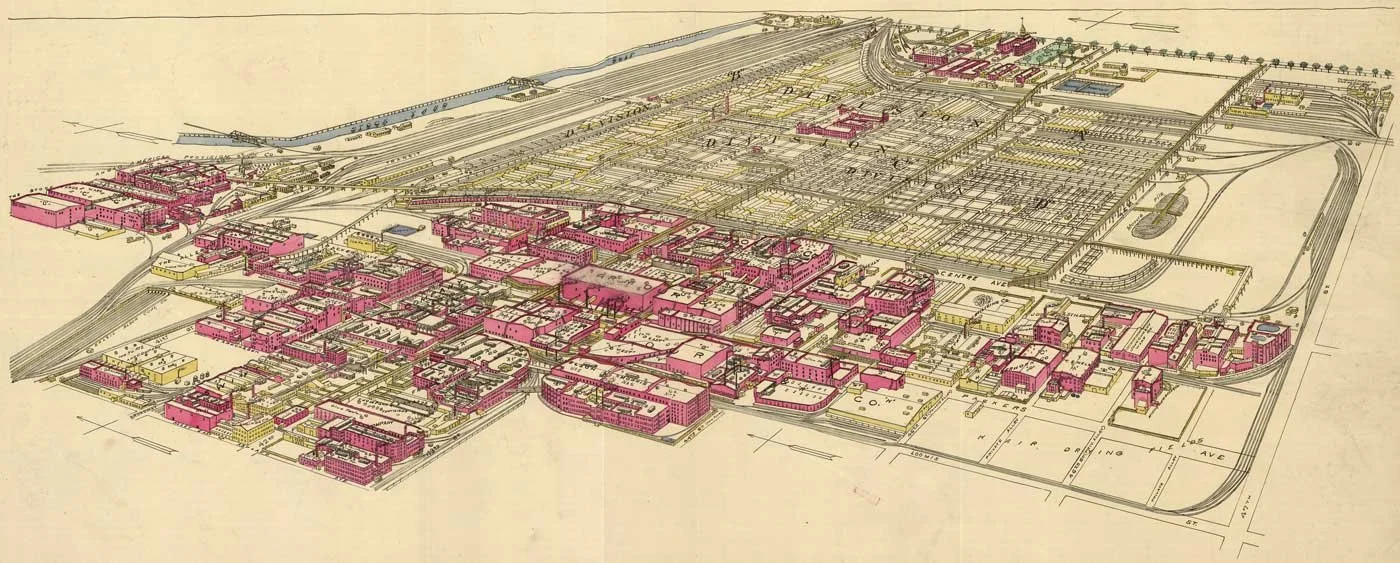
The 1889 map above looks northeast across the yards; the tiny spire of the Stock Yards Bank in the distance marks the front gate and managerial side of the stock yards.The animal pens or "yards" appear in the center in yellow. The vast complex of meat-packing and associated industries of Packingtown appear at the front in pink. The blank area in the foreground is the "back" side of the yards, developed as an area of working class housing in the late 1800s for its convenient access to Packingtown jobs. [3]
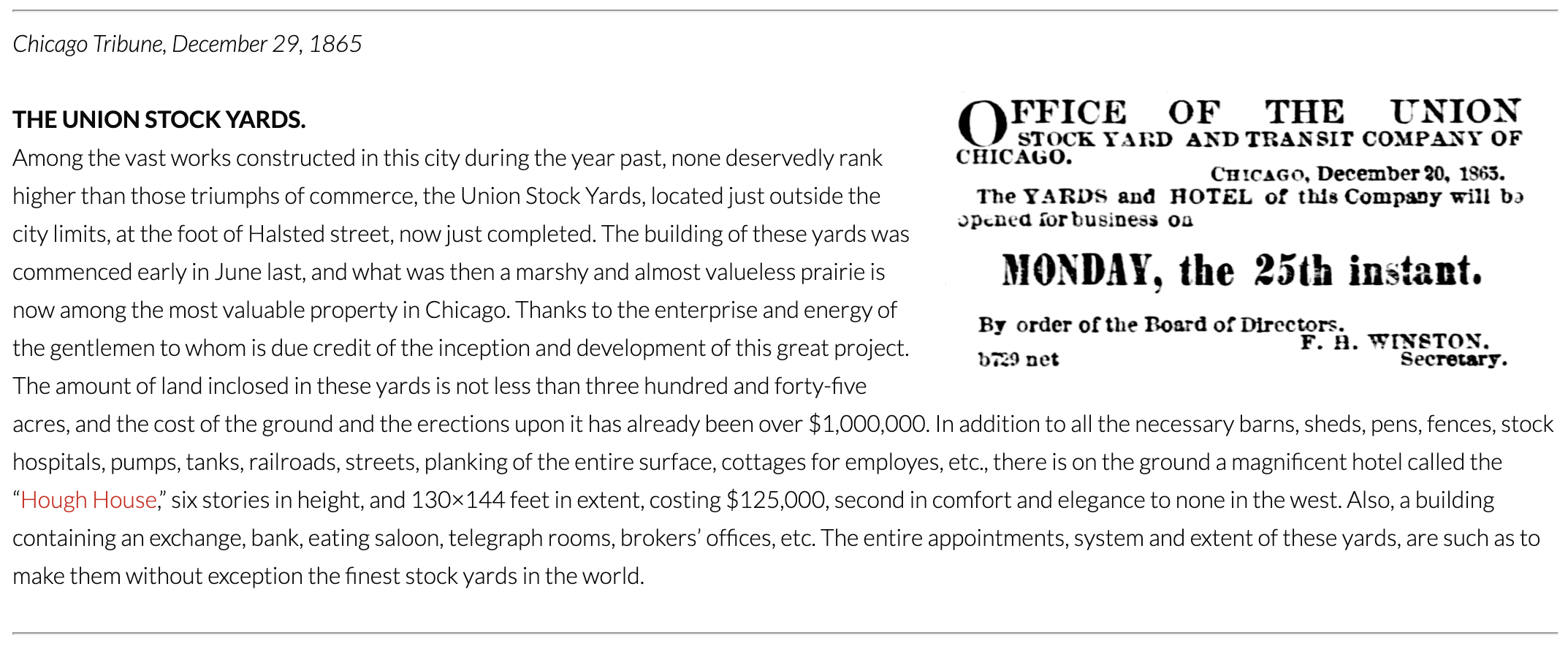
This Chicago Tribune article from 1865 describes the process of constructing the Union Stock Yards — with “all the necessary barns, sheds, pens, fences, stock, hospitals, pumps, tanks, railroads, streets, planking of the entire surface, cottages for employees, etc.” — on 345 acres of what was previously “a marshy and almost valueless prairie.” [4]
Largely funded by “Vanderbilt money,” the Union Stock Yards “functioned as an integrated system linking transportation, livestock handling, processing, and distribution within a single site…. From the Civil War through the 1920s, peaking in 1924, more meat was processed in Chicago than in any other place in the world…. Eventually, the 375-acre site had 2,300 separate livestock pens, room to accommodate 75,000 hogs, 21,000 cattle and 22,000 sheep at any one time…. Processing two million animals yearly by 1870, in two decades the number rose to nine million by 1890. Between 1865 and 1900, approximately 400 million livestock were butchered there.” [5]
For the wave of new immigrants pouring into Chicago’s Back of the Yards in the early 1900s, the Yards offered an immediate, if rather gruesome and exhausting, economic foothold. By the start of the century, the stock yards and various packing houses — the “Big Three” being Armour & Co., Swift & Co., and Morris & Co. — employed about 25,000 workers, many of them immigrants, and produced 82% of the domestic meat consumed nationally. About 15% of the workforce were women. [6] By 1921, employment reached around 40,000 workers. Those job opportunities were definitely a lure for many immigrants to move to the south side of Chicago. If you want to read more about the history of the meat packing industry in Chicago, you can click HERE.
Employment was strictly segregated by age and physical stamina, transforming entire families into cogs in the assembly line — or “disassembly line,” since many of the jobs involved taking whole animals apart piece by piece. Stronger, adult men were funneled into the dangerous manual labor of the killing floors, working as “knockers” who felled frantic cattle with sledgehammers; “shacklers” who hoisted the unconscious steers or caught the live, frantic pigs and hooked their hind legs to the overhead conveyor chains; “stickers” who plunged a knife into the necks of the hanging steers to cut the aorta, causing the animals to bleed out rapidly over the blood gutters, or a dual-edged knife into the shackled hogs’ throats to sever the carotid artery; “splitters,” wielding heavy axes, cleavers, or saws to split the hanging carcasses precisely down the center of the backbone; and a slew of other awful-sounding jobs on the “disassembly line.”
Women and older girls were largely sequestered into the freezing, dark rooms of Packing Town, working as “canners” or meat-trimmers where they spent twelve hours a day slicing low-grade cuts — which Sinclair revealed in The Jungle were often contaminated, spoiled or swept off the floor — and packing them into tin cans; or painting toxic, lead-heavy red paint onto the cans to disguise rust or leaks. Even children were dragged into this brutal world, as happens with several young characters in Sinclair’s novel. Teenaged boys lied about their ages to scrape rust-preventative oil onto lard tins, while younger siblings traversed the muddy Chicago streets for miles as "newsboys," sacrificing their education to keep the family from eviction.
To step into this industrial empire was to experience an assault on the senses that no immigrant could have anticipated. Long before workers even reached the packing houses, they were overwhelmed by the heavy, sickening stench of the “Bubbly Creek” section of the Chicago River — choked with rotting animal carcasses, chemical acids, and blood. Inside the plants, the sensory nightmare intensified. Workers stood ankle-deep in warm blood, fat, and entrails, working amidst a deafening cacophony of screeching machinery, squealing hogs, and the frantic shouting of foremen forcing a relentless pace. The boiling steam from the cooking vats mixed with the caustic fumes of chemical preservatives, leaving workers with chronic respiratory illnesses, while the sharp tin edges of the canning lines left hands permanently scarred, infected, and susceptible to blood poisoning.
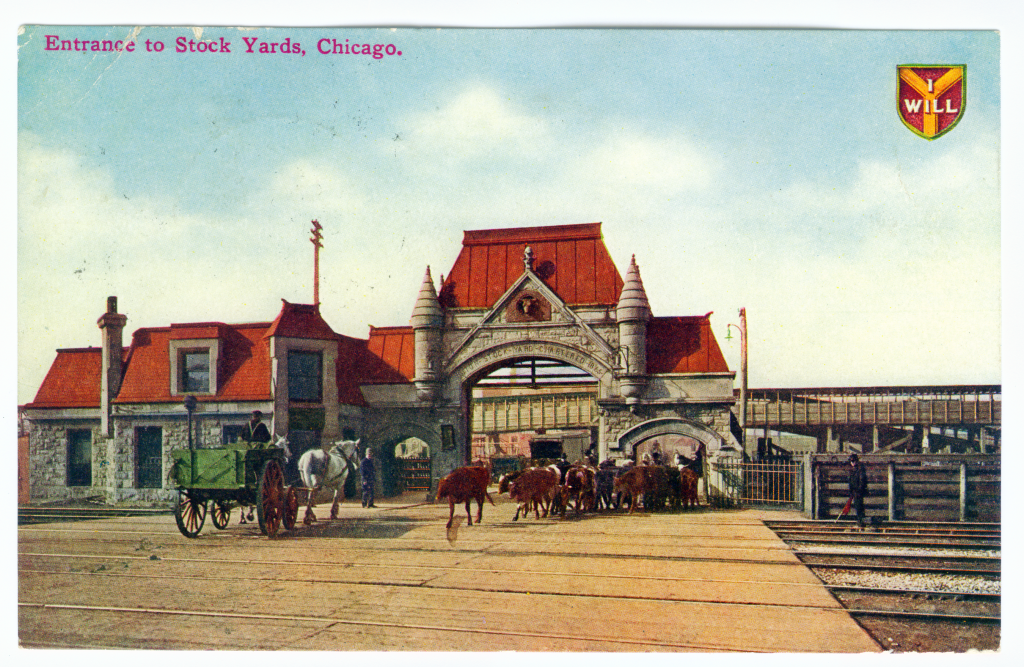
This Entrance Gate to the Union Stock Yards, designated a National Historic Landmark in 1981, was built in 1879 and is the only significant structural element of the stock yards that still stands. [7]
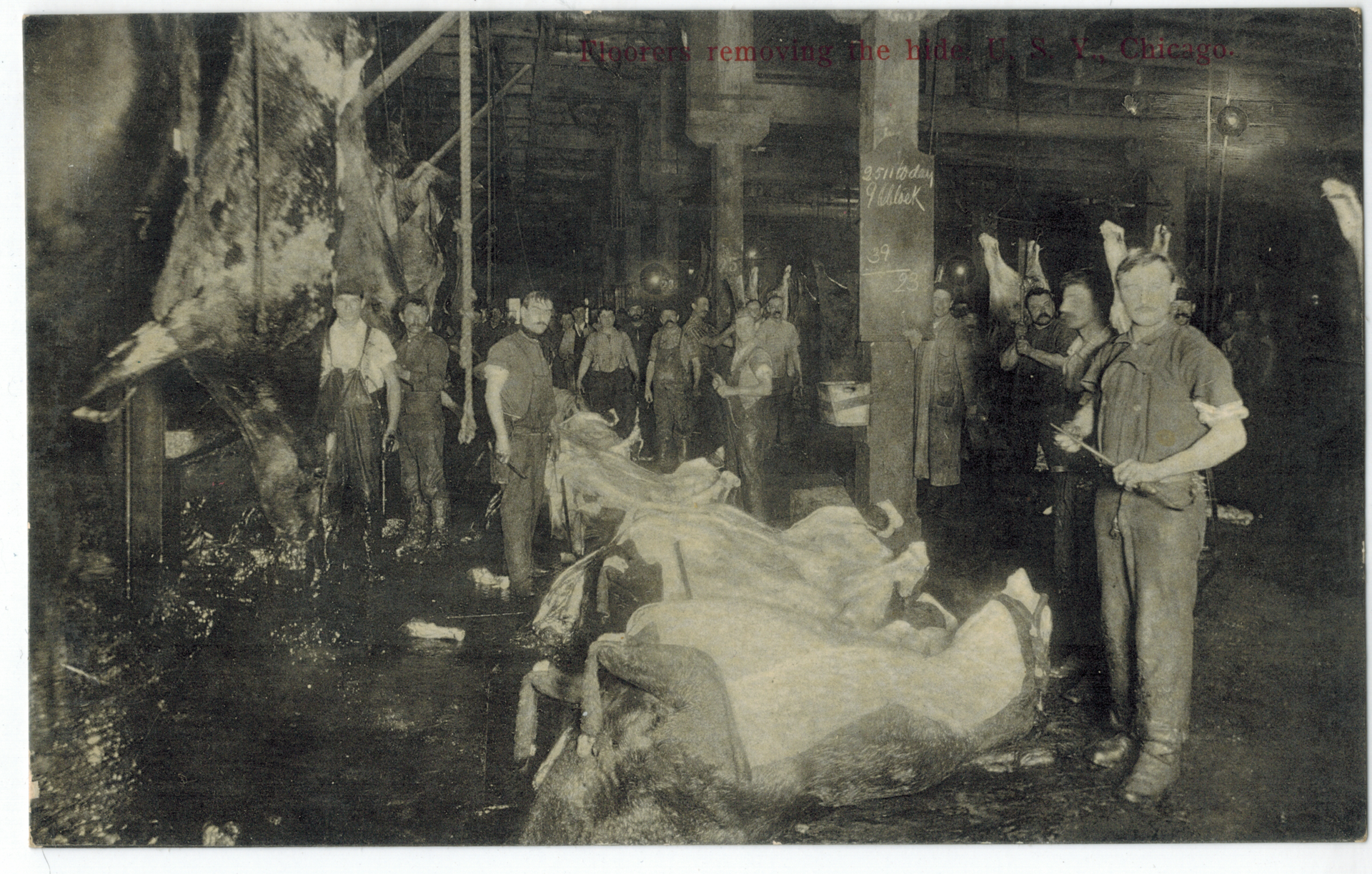
This postcard, c. 1905-1907, shows “Floorers” removing hides at the Union Stock Yards in Chicago. [8]
The financial reward for enduring these back-breaking, hazardous realities was incredibly meager. During the era of The Jungle, the average meatpacker earned less than twenty cents an hour, amounting to a weekly wage of about seven to eight dollars for a grueling six-day week. Because the work was dictated entirely by a piece-rate system or the erratic arrival of livestock trains, laborers were rarely guaranteed a full day's pay, frequently standing in freezing holding pens for hours without compensation just waiting for a shift to begin.
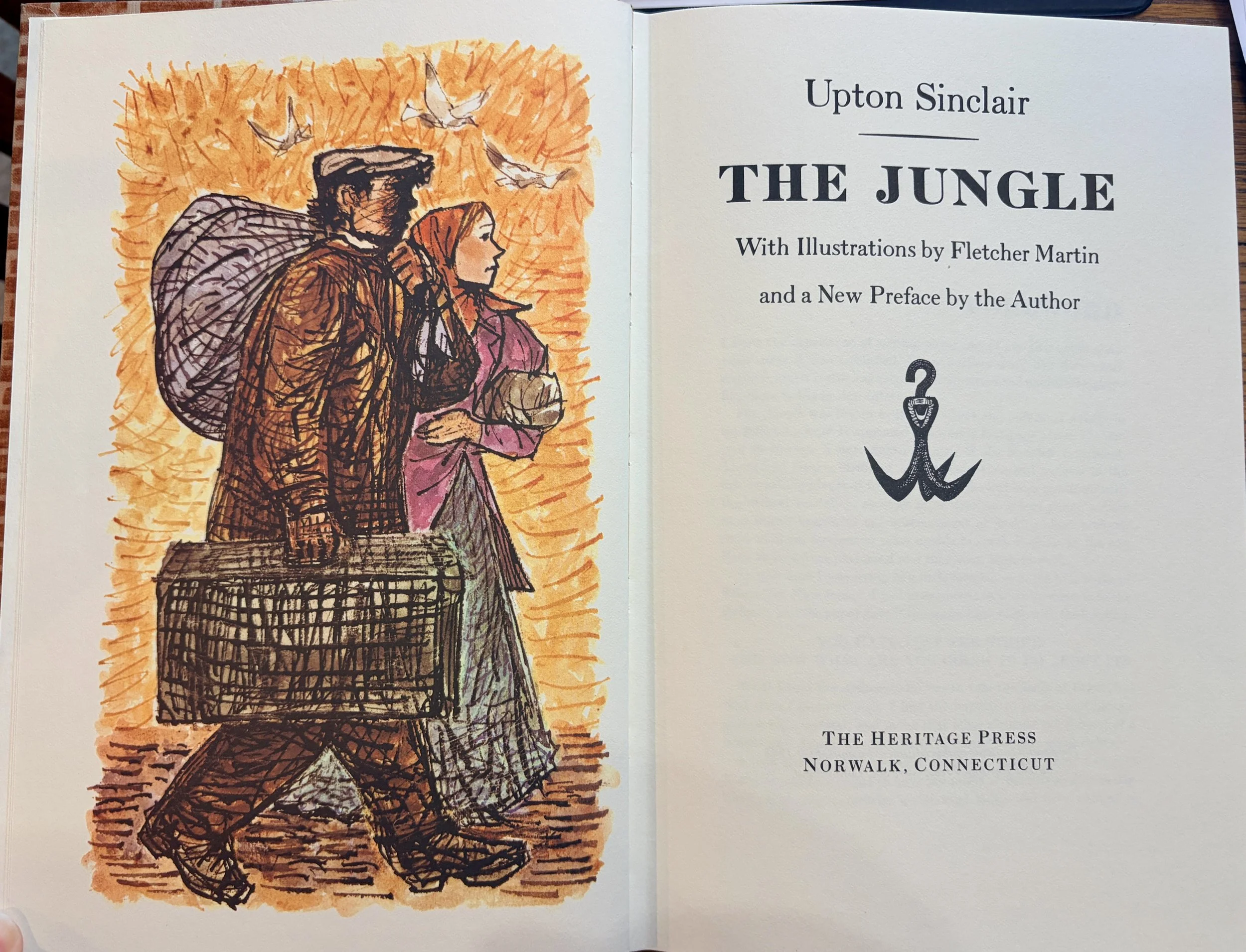
This Heritage Press version of The Jungle, published in 1965, includes a new Preface by Upton Sinclair written 60 years after the book’s initial publication. [9]
Some workers earned more – but with good reason. Sinclair describes one of his characters, Mikolas, as a “beef-boner, and that is a dangerous trade…. Your hands are slippery, and your knife is slippery, and you are toiling like mad, when somebody happens to speak to you, or you strike a bone. Then your hand slips on the blade, and there is a fearful gash. And that would not be so bad, only for the deadly contagion. The cut may heal, but you never can tell. Twice now, within the last three years, Mikolas has been lying at home with blood poisoning – once for three months and once for nearly seven…. There are learned people who can tell you out of the statistics that beef-boners make forty cents an hour, but, perhaps, these people have never looked into a beef-boner’s hands” (Sinclair, The Jungle, 12).
As Sinclair explained in the Preface to the edition of The Jungle that I read, published in 1965 – sixty years after the book’s initial publication when Sinclair was just 27: “My main source of information was, of course, the strike leaders and rebel workers. I would be invited to their homes, and there would be half a dozen men and women, ready to pour out their hearts while I sat and made notes, hour after hour. I talked with men who worked on the ‘killing beds’ and on the lard vats, where they sometimes slipped and fell in; with workers in the fertilizer rooms, where the acids destroyed the soles of their feet – and so on through innumerable horrors. I stayed on the job for seven weeks and accumulated well-filled notebooks, which I shopped home by registered mail” (Sinclair, “Preface,” vi).
After The Jungle caused a furor, President Theodore Roosevelt sent two of his men to check out the veracity of what Sinclair had written, “The President’s two representatives went out to the stockyards,” Sinclair wrote, “and when they came back I returned to Washington to talk with them…. They were honest men and they had verified my charges. They had only one uncertainty to report; they had not been able to verify my statement that men who had fallen into the lard vats had gone out to the world as Armour’s pure leaf lard. I had already warned them that when that happened the families were paid off and shipped back to Lithuania (where his main characters originated), or whatever European land they had come from” (Sinclair, “Preface,” viii).
Soon after this, Congress passed and President Roosevelt signed the Federal Meat Inspection Act and the Pure Food and Drug Act of 1906, which permanently altered the meat-packing landscape. While these federal laws targeted product cleanliness – forcing companies to ban the toxic dyes used to mask spoiled meat and introducing federal inspectors to the line – the shift initially did little to protect the workers themselves. The immediate aftermath actually intensified factory speeds as owners tried to offset the costs of new sanitary regulations, proving to the immigrant community that the American government cared deeply about the cleanliness of the meat on its dinner tables, but remained largely indifferent to the human lives breaking inside the factories. As Sinclair famously said after those meat-packing changes went into effect, “I aimed at the public’s heart and hit it in the stomach.”
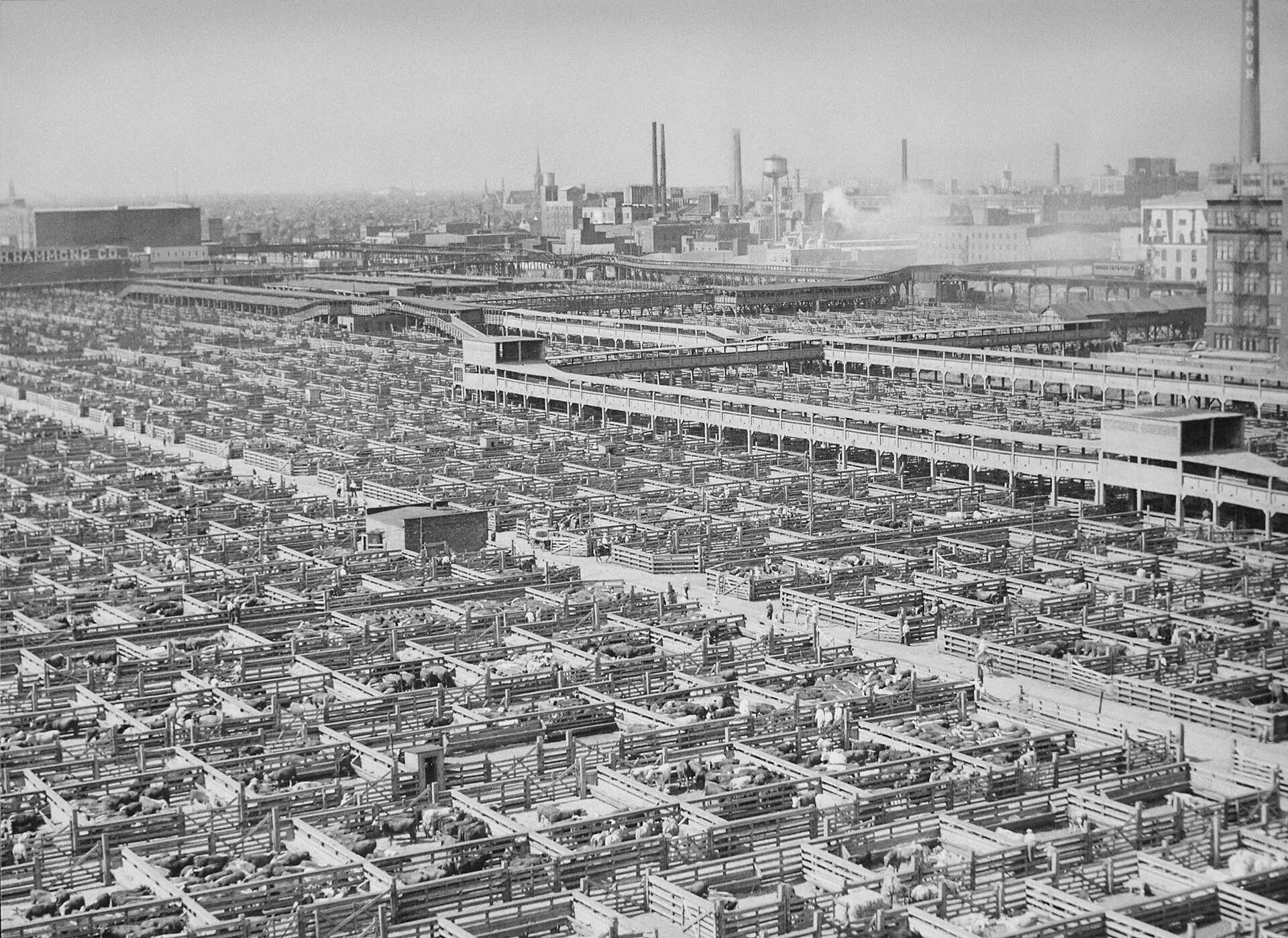
This photo (ca. 1947) shows the maze of livestock pens and walkways at Chicago's stockyards. [10]
In his review of the book, newly-elected member of Parliament Winston Churchill wrote: “Let me say at once that people have no right to hold their noses and shut their eyes. If these things are true, all honour to him who has the power and skill to fasten worldwide attention on them. If they are only half true, a great public service has been rendered. If only one-tenth part be true, there would still, I fancy, be some debt owing by society to Mr. Sinclair. And there is, unhappily, good reason to believe – scarcely, indeed, any reason to doubt – that a very considerable body of undeniable and easily ascertained truth sustains the charges that are made” (Sinclair, “Preface,” ix).
I do not know for certain whether any of my family members worked at the Union Stock Yards in those early years, but my guess is, they did. They likely stood among “the hungry mob that wait(ed) every morning at the gates of the packing houses, from six o’clock until nearly half-past eight” in desperate hope of being given a job (Sinclair, The Jungle, 19). I do know, based on U.S. Census records, that by 1910, Anna’s sister Mary’s husband was working as an “elevator conductor” at the “Packing House,” and her brother Frank (18) was working there as a “laborer.” Brother Paul and sister Katherine do not show up in the 1910 U.S. Census (even though they were living in Chicago at the time), but in the 1920 U.S. Census, Paul was working as a “carpenter” at the “stockyards,” and Katherine was there as a “canner”.
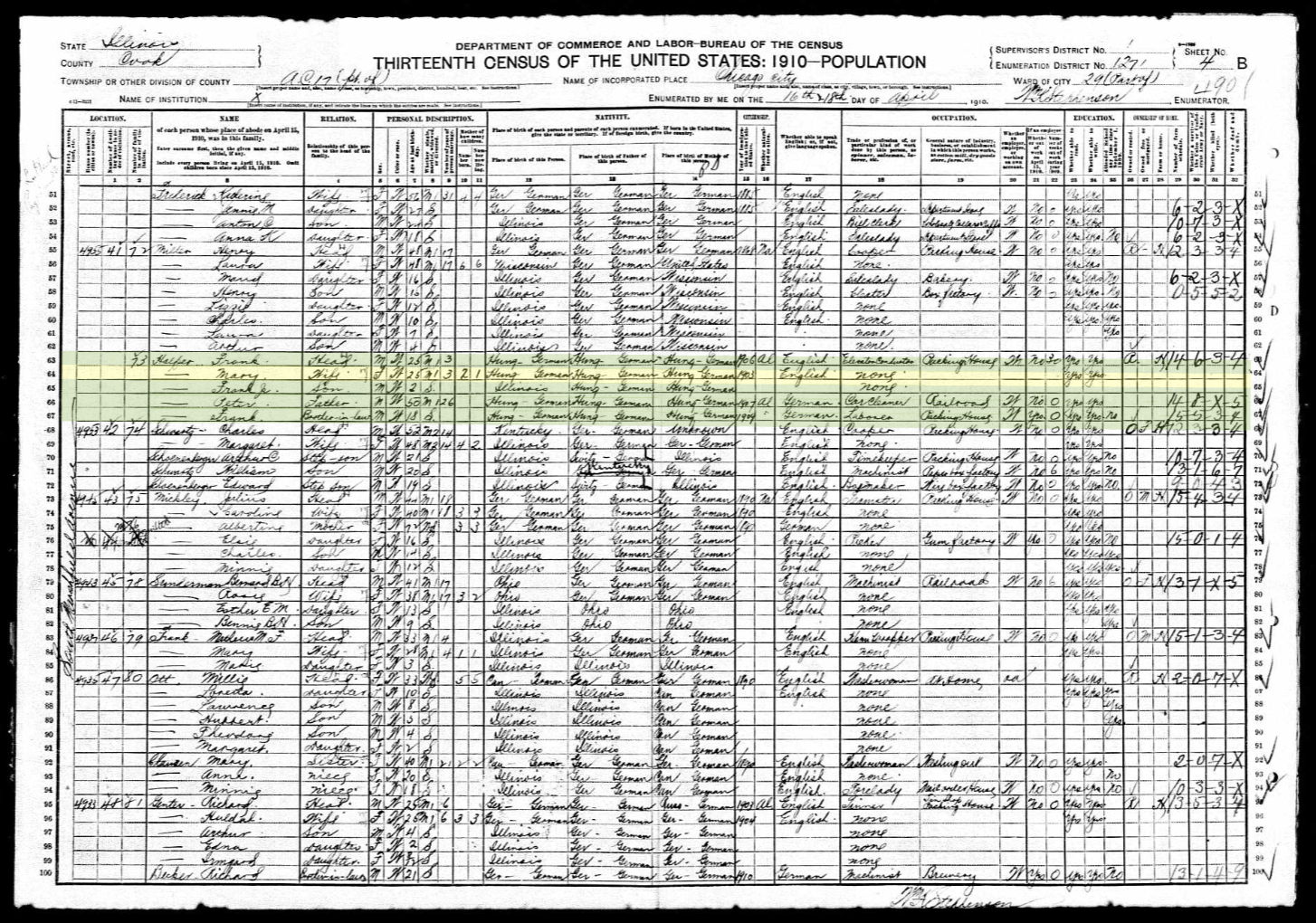
The 1910 U.S. Census shows Mary’s husband Frank and brother Frank working at the Packing House. [11]
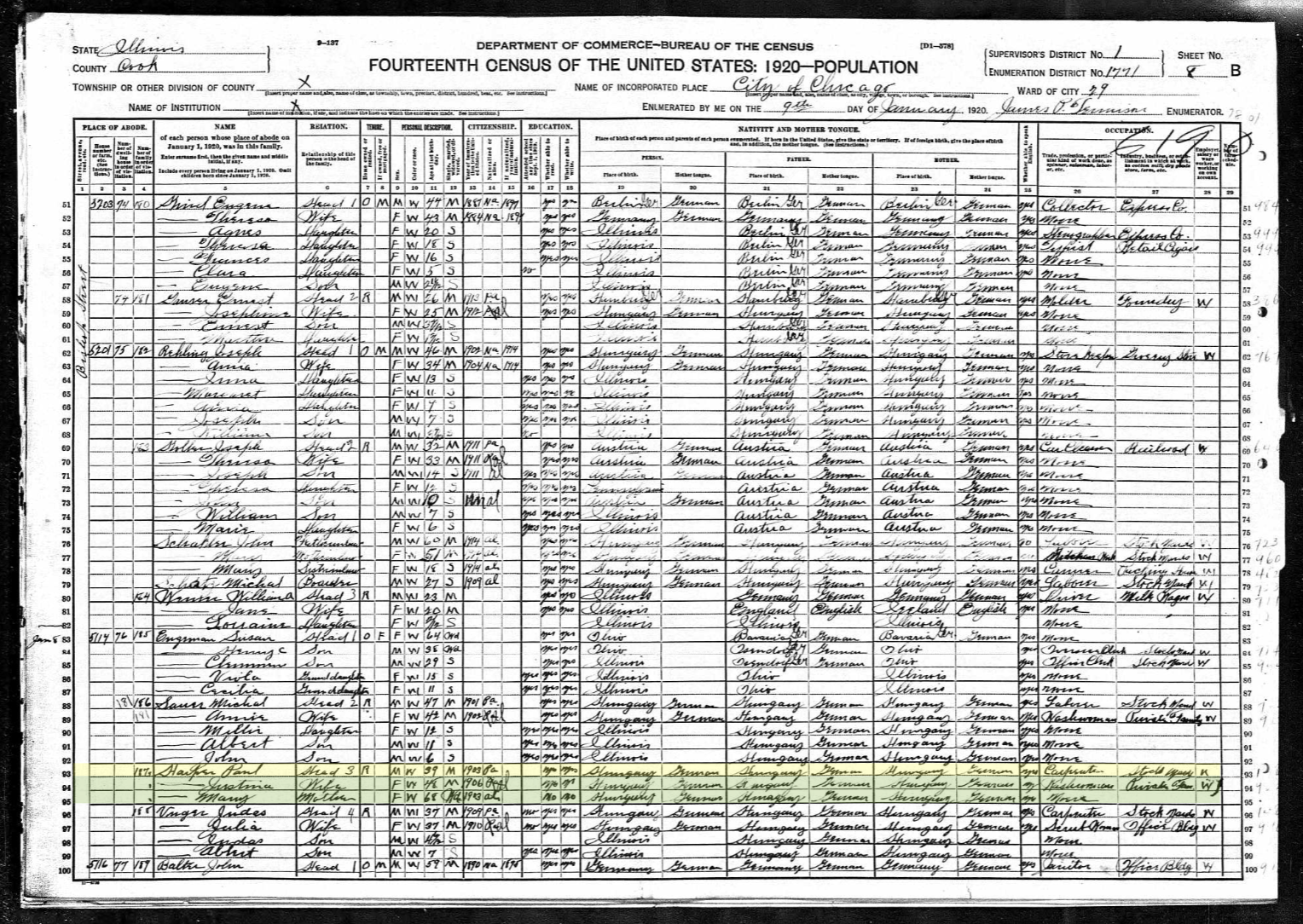
This 1920 U.S. Census record shows Paul Halper working as a carpenter in the stock yards; his wife Justina was working as a washerwoman. [12]
While occupations like “carpenter,” “canner,” or “elevator conductor” might sound like comfortable alternatives to the gruesome horrors of the blood-soaked slaughter lines, all of these were still high-stress, hazardous positions. Though I initially pictured an elevator conductor as a more “cushy” job that involved operating buttons or a lever, my online research proved otherwise. The industrial freight elevators at the stockyards were massive, open-platform mechanical traps used to haul things such as heavy carts of animal carcasses and multi-hundred-pound vats of boiling lard. The conductor was actively responsible for loading and unloading these freights at a frantic pace to keep up with the assembly line. Because the elevator shafts acted like chimneys for the entire building, conductors spent their shifts trapped in a moving column of choking, humid steam rising from the lower cooking rooms, mixed with the caustic fumes of chemical preservatives and the stench of raw waste. Without modern safety interlocks, a single misstep while pushing a heavy meat cart on or off the moving platform could result in being crushed or plunging down a multi-story open shaft.
For a woman like Anna’s sister Katherine working as a canner, the job was a relentless, high-speed battle against sharp tin edges in dark, poorly ventilated rooms. Under a strict piece-rate system, canners stood for twelve hours a day packing low-grade meat or painting toxic, lead-heavy red paint onto tin cans to disguise rust, leaving their hands permanently scarred and prone to severe blood poisoning. Meanwhile, a carpenter like Anna’s brother Paul was thrust into a grueling maintenance regime. Tasked with keeping a massive city of timber from collapsing under the crushing weight of stampeding cattle, stockyard carpenters spent their days performing heavy manual framing, reinforcing rotted elevated runways, and constructing massive shipping crates and holding pens amidst Chicago’s freezing winter elements and Packingtown’s relentless industrial soot. Ultimately, whether a worker handled a carpenter's saw, a canner's knife, or an elevator's lever, every job in the stockyards was relentless in its expectations and an exercise in pure physical survival.
If you wonder what it might have been like to not just work but to also live in the “Back of the Yards,” imagine not just the sights of the billowing chimneys and towering buildings and walkways, but also the feel of the muddy roads and the noxious smells and raucous sounds that would have been ever-present. Sinclair describes his main characters’ arrival to their new “home” this way:
“A full hour before the party reached the city they had begun to note the perplexing changes in the atmosphere. It grew darker all the time, and upon the earth the grass seemed to grow less green. Every minute, as the train sped on, the colors of things became dingier; the fields were grown parched and yellow, the landscape hideous and bare. And along with the thickening smoke they began to notice another circumstance, a strange, pungent odor…. They were divided in their opinions about it. It was an elemental odor, raw and crude; it was rich, almost rancid, sensual, and strong. There were some who drank it in as if it were an intoxicant; there were others who put their handkerchiefs to their faces. The new emigrants were still tasting it, lost in wonder, when suddenly the car came to a halt, and the door was flung open, and a voice shouted — ‘Stockyards!’
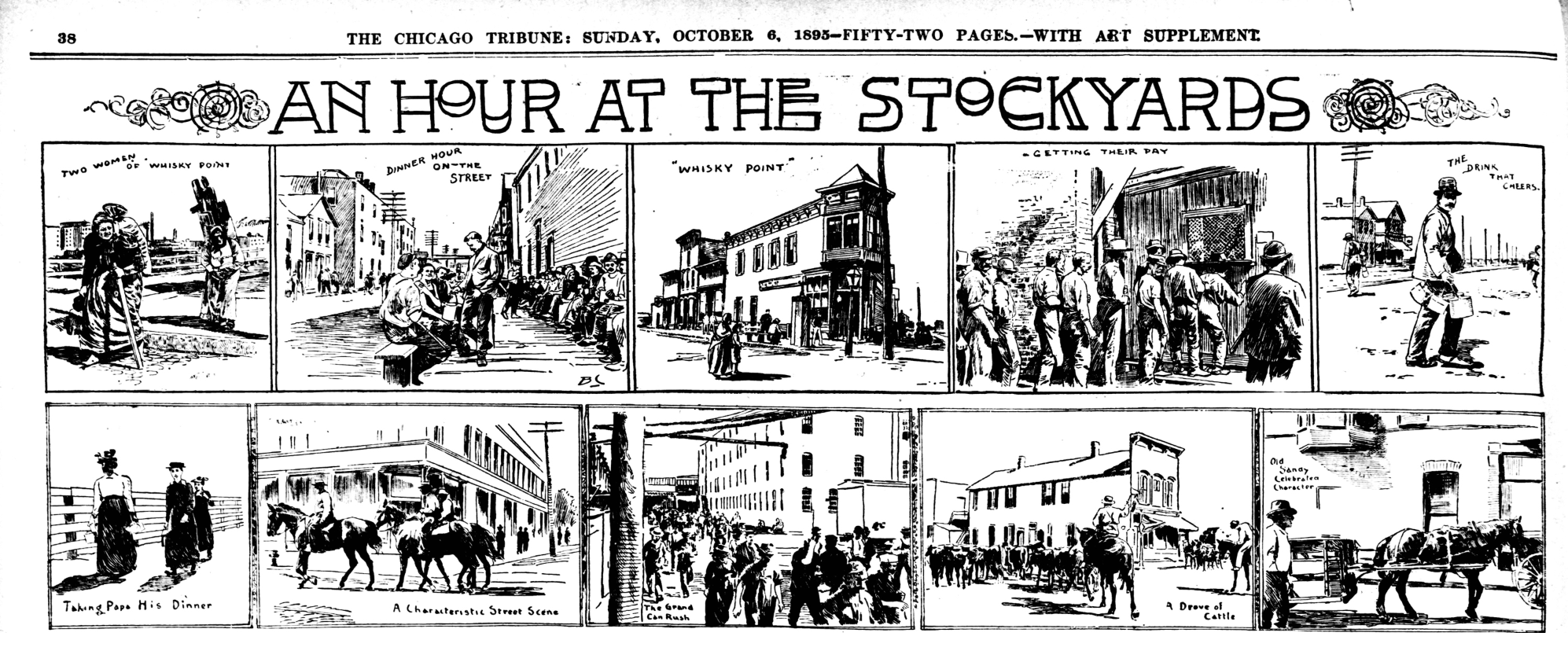
This illustrated newspaper feature consists of nine individual, hand-drawn comic or sketch panels capturing daily life, labor, and scenes around the neighborhood surrounding the historic Union Stock Yards in Chicago. [13]
“They were left standing upon the corner, staring; down a side street there were two rows of brick houses, and between them a vista: half a dozen chimneys, tall as the tallest of buildings, touching the very sky—and leaping from them half a dozen columns of smoke, thick, oily, and black as night. It might have come from the center of the world, this smoke, where the fires of the ages still smolder. It came as if self-impelled, driving all before it, a perpetual explosion. It was inexhaustible; one stared, waiting to see it stop, but still the great streams rolled out. They spread in vast clouds overhead, writhing, curling; then, uniting in one giant river, they streamed away down the sky, stretching a black pall as far as the eye could reach.
“Then the party became aware of another strange thing. This, too, like the color, was a thing elemental; it was a sound, a sound made up of ten thousand little sounds. You scarcely noticed it at first – it sunk into your consciousness, a vague disturbance, a trouble. It was like the murmuring of the bees in the spring, the whisperings of the forest; it suggested endless activity, the rumblings of a world in motion. It was only by an effort that one could realize that it was made by animals, that it was the distant lowing of ten thousand cattle, the distant grunting of ten thousand swine” (Sinclair, The Jungle, 25-26).
The overwhelmed, newly-arrived Lithuanian family soon meets up with an “old friend” who helps them find accommodations:
“Yet, when they saw the home of the Widow Jukniene they could not but recoil, even so, in all their journey they had seen nothing so bad as this. Poni Aniele had a four-room flat in one of that wilderness of two-story frame tenements that lie ‘back of the yards.’ There were four such flats in each building, and each of the four was a ‘boardinghouse’ for the occupancy of foreigners – Lithuanians, Poles, Slovaks, or Bohemians. Some of these places were kept by private persons, some were cooperative. There would be an average of half a dozen boarders to each room – sometimes there were thirteen or fourteen to one room, fifty or sixty to a flat. Each one of the occupants furnished his own accommodations—that is, a mattress and some bedding. The mattresses would be spread upon the floor in rows—and there would be nothing else in the place except a stove. It was by no means unusual for two men to own the same mattress in common, one working by day and using it by night, and the other working at night and using it in the daytime. Very frequently a lodging house keeper would rent the same beds to double shifts of men…. The most uncanny thing about this neighborhood was the number of the children; you thought there must be a school just out, and it was only after long acquaintance that you were able to realize that there was no school, but that these were the children of the neighborhood—that there were so many children to the block in Packingtown that nowhere on its streets could a horse and buggy move faster than a walk!” (Sinclair, The Jungle, 27-28).
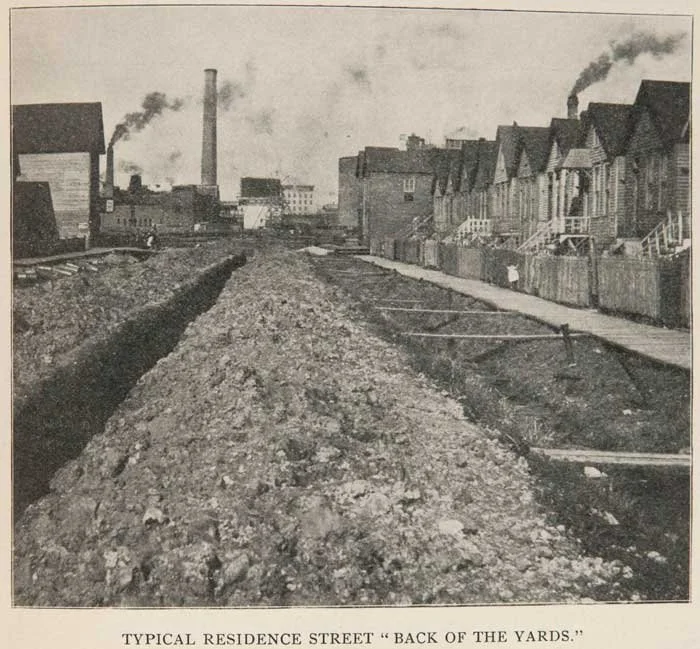
This 1901 photo shows a row of workers cottages on the 4500 block of Laflin Street; the Maria, Paul, and Mary Halper arrived in 1904, they went to stay with “Cousin Michael Lorenz” at 5217 Laflin Street. [14]
That is the neighborhood into which the Halpers – and many other Burgenländers – moved. It must have been a difficult life in many ways, but then again, life had been difficult for them in different ways back in Hungary. Perhaps they approached it like Carl Sandburg did in his 1914 poem, “Chicago.” He describes the city as “Hog Butcher for the World, / Tool maker, / Stacker of Wheat, / Player with Railroads and the Nation’s / Freight Handler; / Stormy, husky, brawling, City of the Big Shoulders,” and he admits the city has its share of wickedness, crookedness, brutality, and hunger. However, he also praises the city for “singing so proud to be alive and coarse and strong and cunning … / Fierce as a dog with tongue lapping for action, cunning as a savage pitted against the wilderness, / Bareheaded, / Shoveling, / Wrecking, / Planning / Building, breaking, rebuilding,” and still finding reasons to laugh.
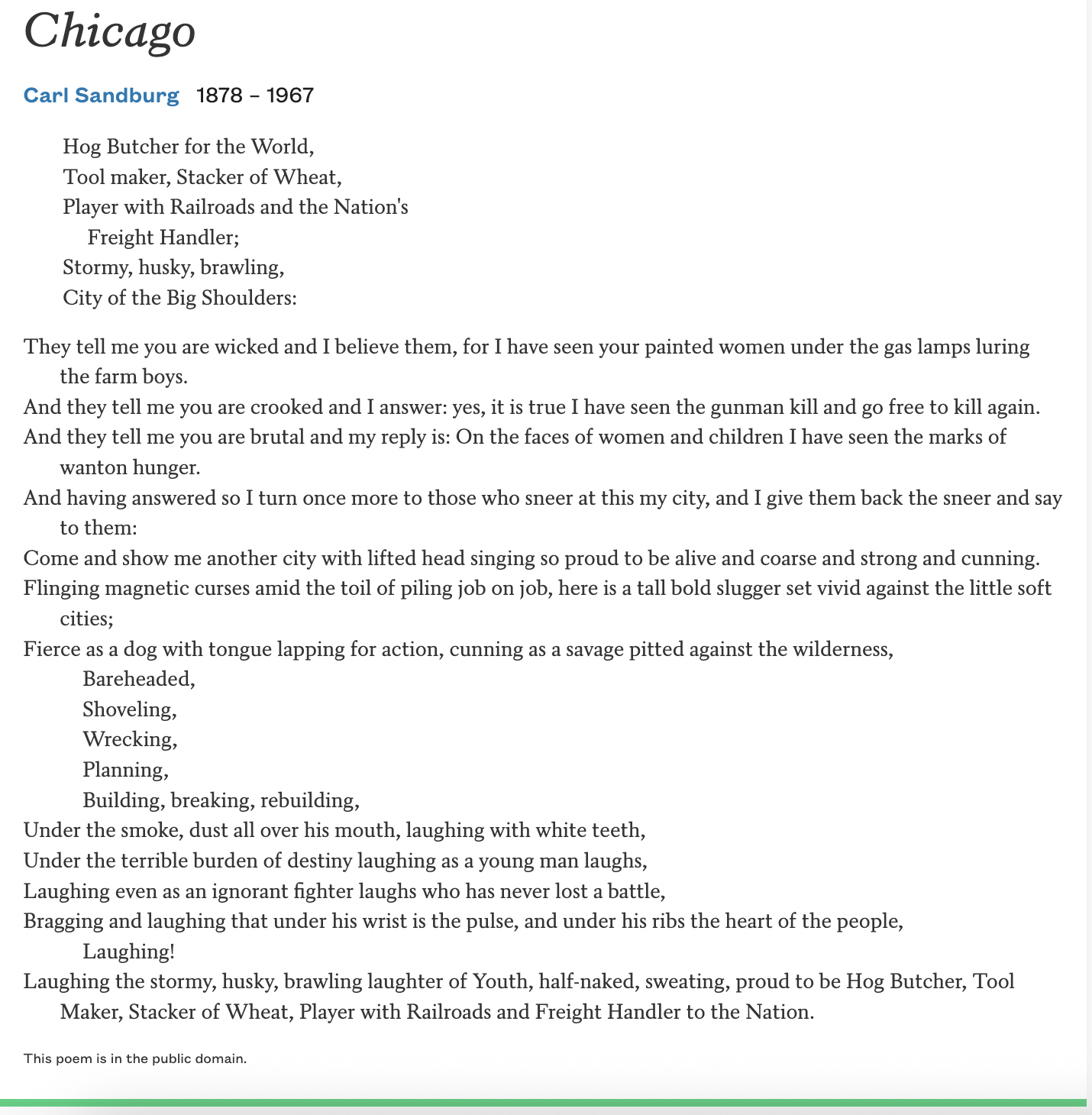
Carl Sandburg moved to Chicago with his family in 1912; it was while living in an apartment on N. Hermitage Avenue that he wrote this poem, in which he famously immortalized the city's industrial power, branding it the "Hog Butcher for the World" and the "City of the Big Shoulders." [15]
The map below, which highlights an area in which worker cottages were being built in the Back of the Yards neighborhood, shows many of the streets on which my family members lived at different times, including Laflin, Bishop, and Justine. When my great grandmother Anna Halper finally immigrated in 1913 at age 19, arriving at Ellis Island on 13 May 1913 on the S.S. La Provence, she said she was going to join her mother Maria at 5205 Bishop in Chicago. She was still living there in 1920, according to the U.S. Census, but by then, she was living with her husband John Wagner, whom she had married 1 Dec 1917, and they had a one-year-old child: John Paul Wagner, Jr. — my grandfather. Her sister Katherine (the canner) was also living with them, but her mother was living with brother Paul.
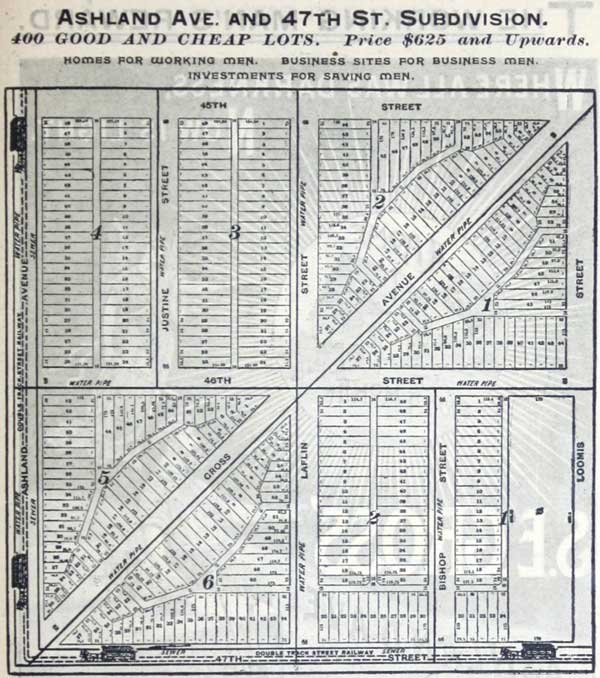
In 1887, developer Samuel E. Gross purchased 40 acres of land in what would become the Back of the Yards neighborhood and subdivided the land into eight blocks on which he built workers cottages. My ancestors lived on several of the streets that appear on this map, though on different blocks, including Laflin, Bishop, and Justine. [16]
John Wagner, as I discussed in Part V, immigrated from Unterwart to Chicago in September 1909 and initially stayed with an uncle — Edward Gaugl — on Chicago’s north side. I’m not sure what kind of work he did in his first couple years in Chicago, but by 2 Jan 1912, he had begun working for The Pullman Company, and he would go on to work for them for 43 years and 11 months. While he is listed as a “railroad laborer” in the 1920 U.S. Census, he is described as a “car cleaner” in the 1930, 1940, and 1950 U.S. Census records, and his 1919 income statement shows that he was already a “cleaner” at that point. My great-aunt Minnie’s earlier written description said he was a “supply clerk,” so perhaps he did that in his final years. You can read more about the history of The Pullman Company HERE.
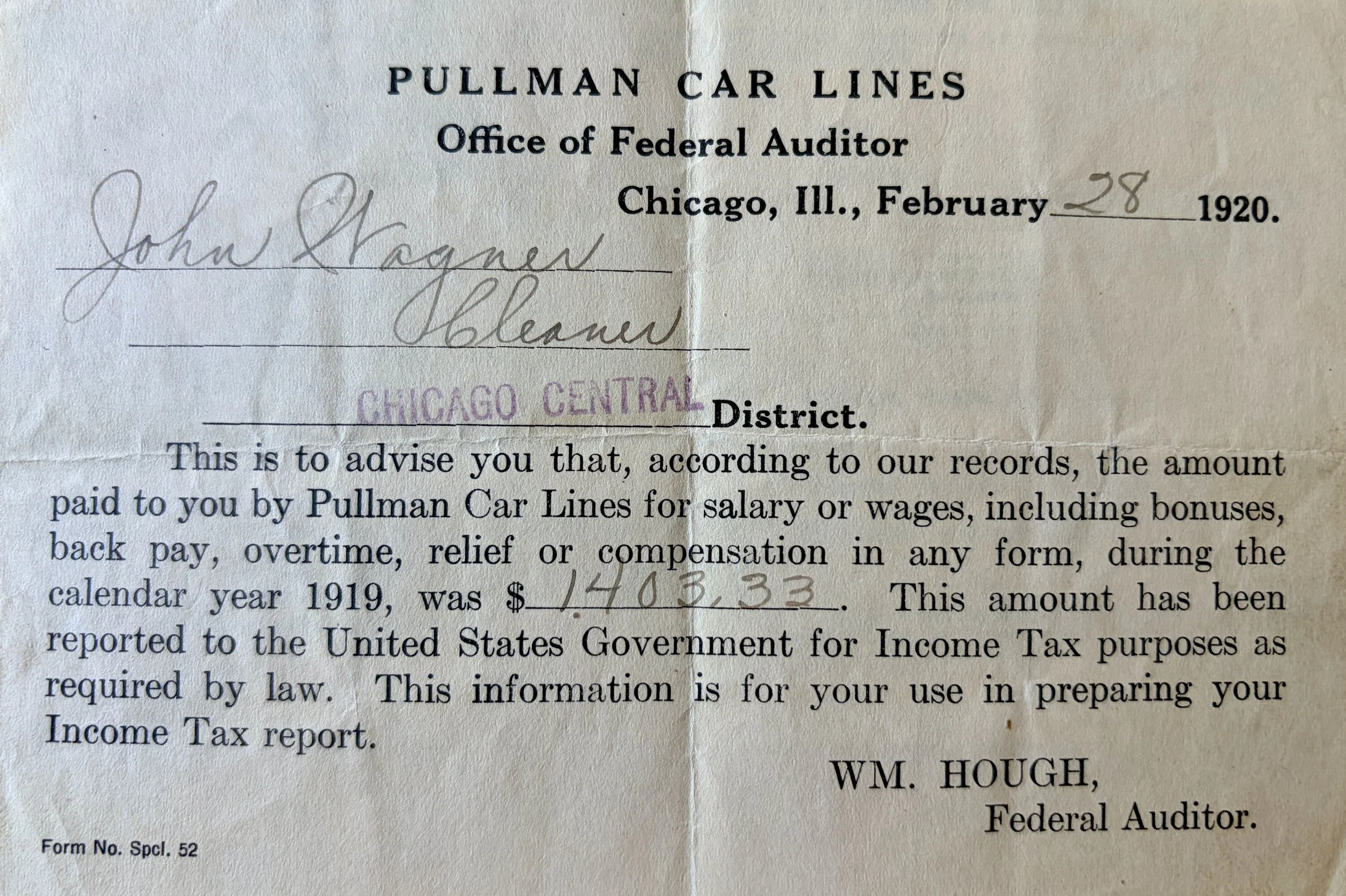
This wage report shows that John Wagner, Cleaner, earned $1403.33 in 1919 — a significant increase from the $1191.63 he made in 1918; that’s because, during WWI and its immediate aftermath, the U.S. government temporarily nationalized the railroads under the United States Railroad Administration (USRA), and the USRA standardized rail jobs, instituted the 8-hour workday, and sharply bumped pay scales for support yard workers nationwide to counteract massive wartime inflation.
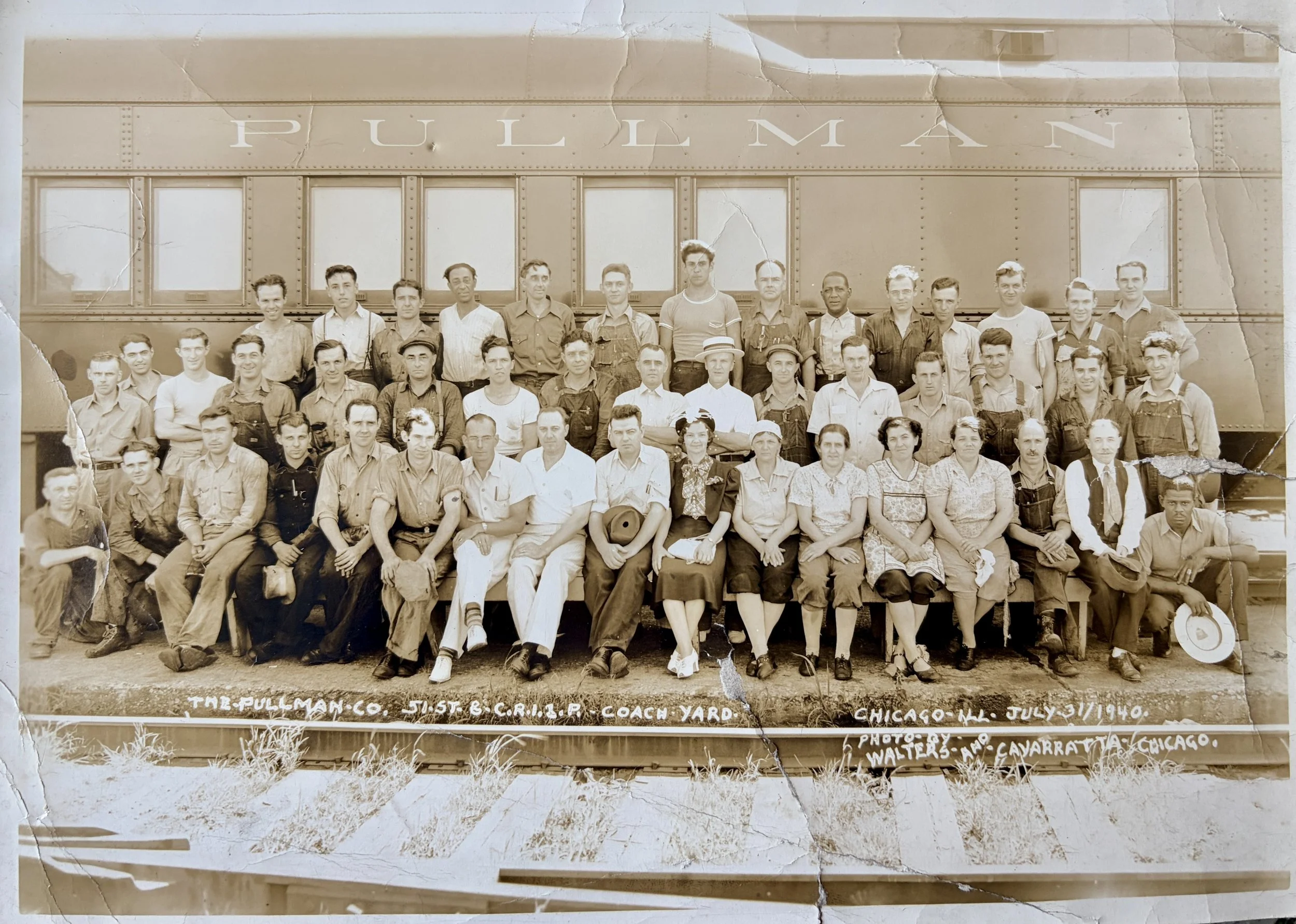
“The Pullman Co. 51st & C.R.I. & P. Coach Yard. Chicago, Ill. July 31, 1940. Photo by Walters and Cavarratta, Chicago.” In this photo, taken in the Chicago, Rock Island and Pacific Railroad coach yard, John Wagner is seated in the front row, second from right.
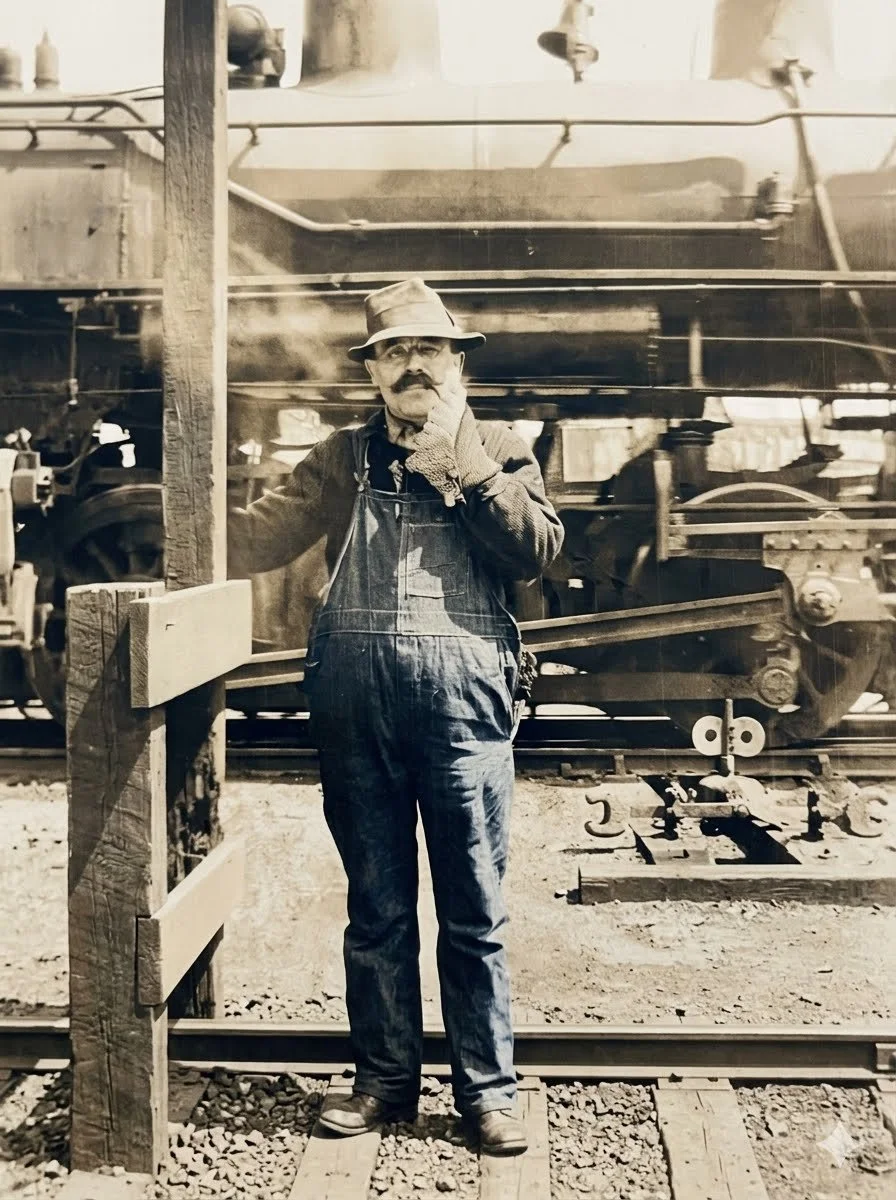
This slightly repaired and colorized photo (thanks AI) shows John Wagner at work, ca. 1945.
When George Pullman opened his massive manufacturing complex on Chicago’s South Side in April 1881, he didn't just build a factory—he launched a massive industrial empire that completely changed how Americans traveled. While master carpenters and painters at the main plant at 111th Street and Cottage Grove spent their days assembling high-end, luxury sleeping cars, keeping this giant network moving required a massive army of laborers working behind the scenes across the city's rail hubs. In gritty, fast-paced coach yards like the one at 51st and Wallace where John initially worked (according to his 1918 WWI Draft Registration), crews of new immigrants worked side-by-side in all kinds of weather, scrubbing down the steel cars, hauling heavy blocks of ice, and checking brake lines to prep trains for their next cross-country run. Supported by the famous Pullman porters who managed the service onboard, these everyday workers were the real engine behind the scenes, transforming Chicago into the bustling, unstoppable heart of American transportation.
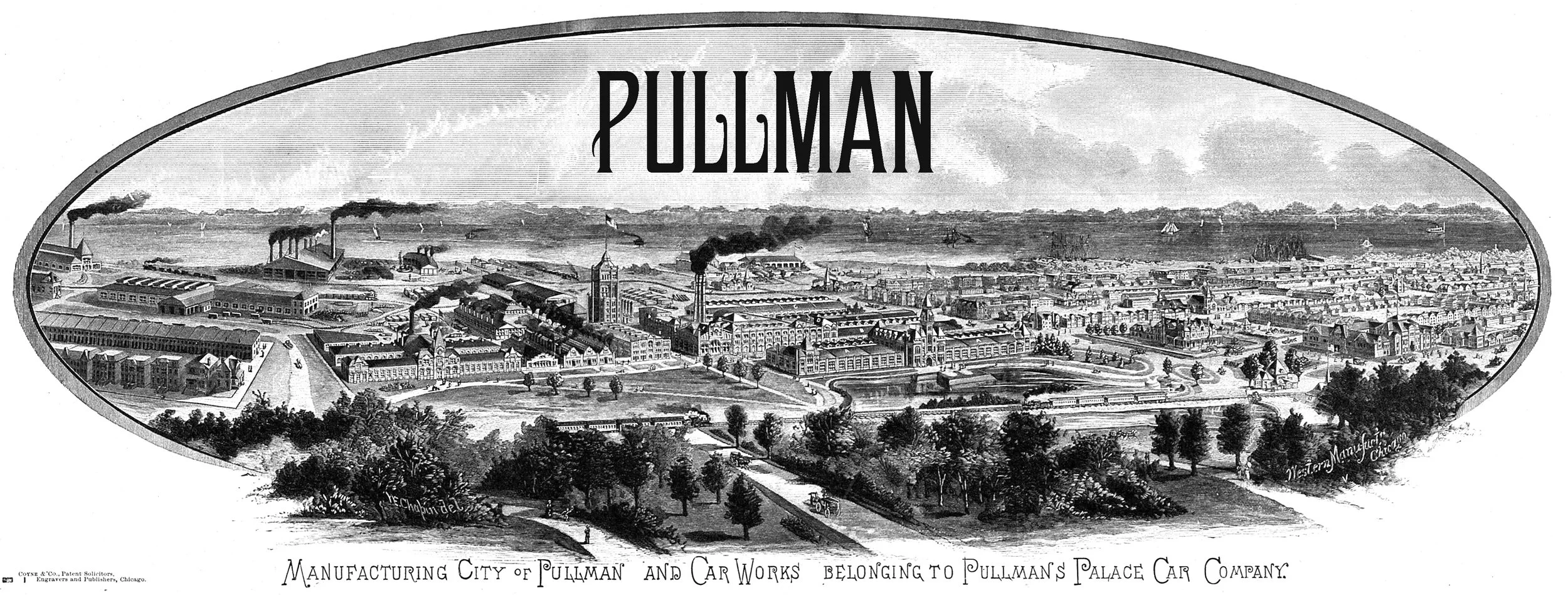
Pullman: Manufacturing City of Pullman and Car Works Belonging to Pullman’s Palace Car Company [17]
The above image highlights George Pullman's vision of the all-inclusive industrial community he built. The center and left portions of the illustration feature the massive Pullman Car Works factory complex. Large brick buildings with smokestacks billowing dark plumes of smoke highlight the manufacturing going on. To the right of the central smokestacks sits the Pullman Factory Clock Tower and the ornate, multi-story Administration Building – both of which today are important parts of the Pullman National Historical Park (which Mike and I plan to visit next May). To the right of the factories, the image reveals the grid of the company town. This area shows orderly streets lined with worker housing, tenements, and prominent public structures, including the Hotel Florence and the Arcade building. In the background, the open waters of Lake Calumet stretch across the horizon, accented by small sailboats. The foreground is heavily manicured with trees, lawns, public parks, and a small artificial lake designed to reflect the beautiful architecture of the administration buildings.
As explained on the National Park Service website: “The Pullman Palace Car Company … soon become known for luxury and comfort. For an extra fee, railcar passengers could travel in style in the United States, Mexico, Canada, and Europe. For passengers traveling by train, the Pullman company offered observation cars, dining cars, parlor cars, and their famous sleeper cars. The Pullman Palace Car Company did not invent the sleeping car, but they improved upon its design, efficiency, and service. The interiors of Pullman cars rivaled five-star hotels. These surroundings gave customers the feeling of being a part of the elite. Train cars often had plush seating, detailed woodwork, and brass fixtures. The company embraced new technology to use on their cars for a better experience. They installed Allen Paper Wheels and Westinghouse air brakes for smoother rides. Pintsch gas lights and Edison electric lights replaced messier oil lamps. ‘Baker system’ heated car interiors with steam. Jenney knuckle couplers linked cars together. The Pullman Company adapted the Sessions Vestibule (1887) on their passenger cars as well making transit from one moving car to another safe for workers and passengers. The Pullman Company was responsible for hundreds of patents to improve their rail car designs. They also staffed their cars with service workers to make travel enjoyable. They included Pullman porters, maids, dining car staff, attendants, and more. The company trained workers so passengers could experience great hospitality and quality.” [18]
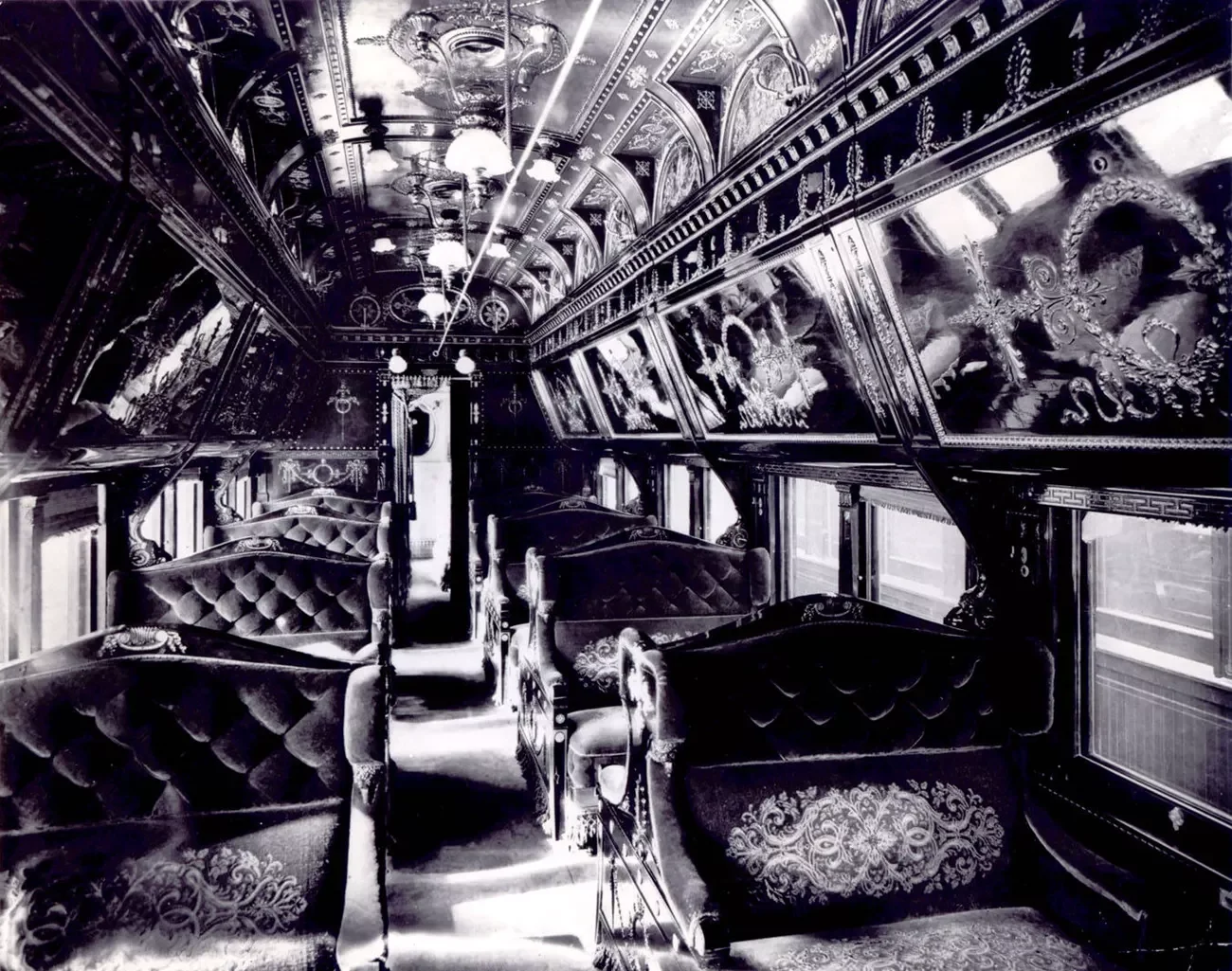
Cross country train riders in the 19th century could pay an extra fee to enjoy luxurious surroundings and extra amenities such as fine dining. Courtesy of the Pullman State Historic Site. [19]
During the 1910s when John started working for Pullman, Chicago was the undisputed railroad capital of the world. The city was a massive spiderweb of tracks operated by dozens of competing lines. Around this decade, the total railroad workforce in the Chicago metropolitan area was approximately 20,000 to 25,000 workers, a figure that grew closer to 30,000 by 1930. [20] When you add the massive transit and streetcar networks that moved those laborers — such as the consolidated Chicago Surface Lines — the broader rail transit workforce exceeded over 35,000 people in the city. [21] When you scan through the Census records for the Back of the Yard neighborhood, you see lots of “Railroad,” “Stock Yard,” and “Packing House” workers.
For immigrants seeking to escape the blood-soaked floors of Packingtown, Chicago’s rail networks offered an alternative — though still difficult — path to survival. New arrivals who found work as railroad laborers were thrust into a world of immense physical strain, tasked with laying ties, clearing track blockages, and shifting massive steel and iron castings across chaotic industrial yards. Yet, when compared to the nightmarish realities of the stockyards, railroad labor was widely considered a superior alternative. While a stockyard worker spent twelve hours a day knee-deep in blood and offal, breathing in the sickening stench of animal rot and chemical preservatives inside unventilated slaughterhouses, a railroad laborer worked primarily outdoors. It was grueling work, but it was physically cleaner and carried a degree of dignity that the meatpacking plants lacked.
While many newly arrived immigrants struggled to adapt to the jarring speed of American manufacturing, John Wagner possessed a distinct competitive advantage when he walked into the Pullman gates in early 1912. Back in Hungary, John hadn't merely been a traditional agricultural worker; he had labored as a miller's assistant, including a stint at the “Emilia” hengermalom in Rotenturm. Named in honor of Countess Emilia, the wife of the local ruling aristocrat Count Erdődy, this steam-powered roller mill was far from a quaint, old-fashioned waterwheel. It was a modern, high-speed, coal-fired industrial factory dominated by high-pressure steam boilers, massive pistons, and roaring iron gears. This experience provided John with an invaluable level of “industrial discipline.” He already knew how to safely navigate a hazardous factory floor, operate mechanical hoists, and perform maintenance on complex machinery.
When he began working at the Pullman Company, he was likely not intimidated by the deafening noise nor overwhelmed by the steam-powered equipment. The hiring bosses at Pullman favored workers who already understood industrial mechanics and heavy logistics. The very technological forces he mastered while processing grain under the patronage of Count Erdődy in Rotenturm unlocked his entry into the world's most elite corporate transportation empire, allowing him to seamlessly shift his skills from handling food to handling steel.
At a time when Pullman was transitioning its entire fleet to state-of-the-art all-steel luxury cars, a car cleaner was entrusted with maintaining Pullman’s flawless public image. Operating out of local passenger coach hubs like the massive yards at 51st & Wallace, a car cleaner’s job was meticulous and highly structured. As soon as a luxury sleeping car completed its cross-country journey, cleaners boarded the train to strip the heavy linens, scrub the plush velvet upholstery, polish the ornate mahogany and brass fixtures, and wash down the windows until they gleamed. This role offered steady, reliable hours away from hazardous machinery, within minutes of his home, allowing him to earn a respectable livelihood within the world's most elite transportation empire.
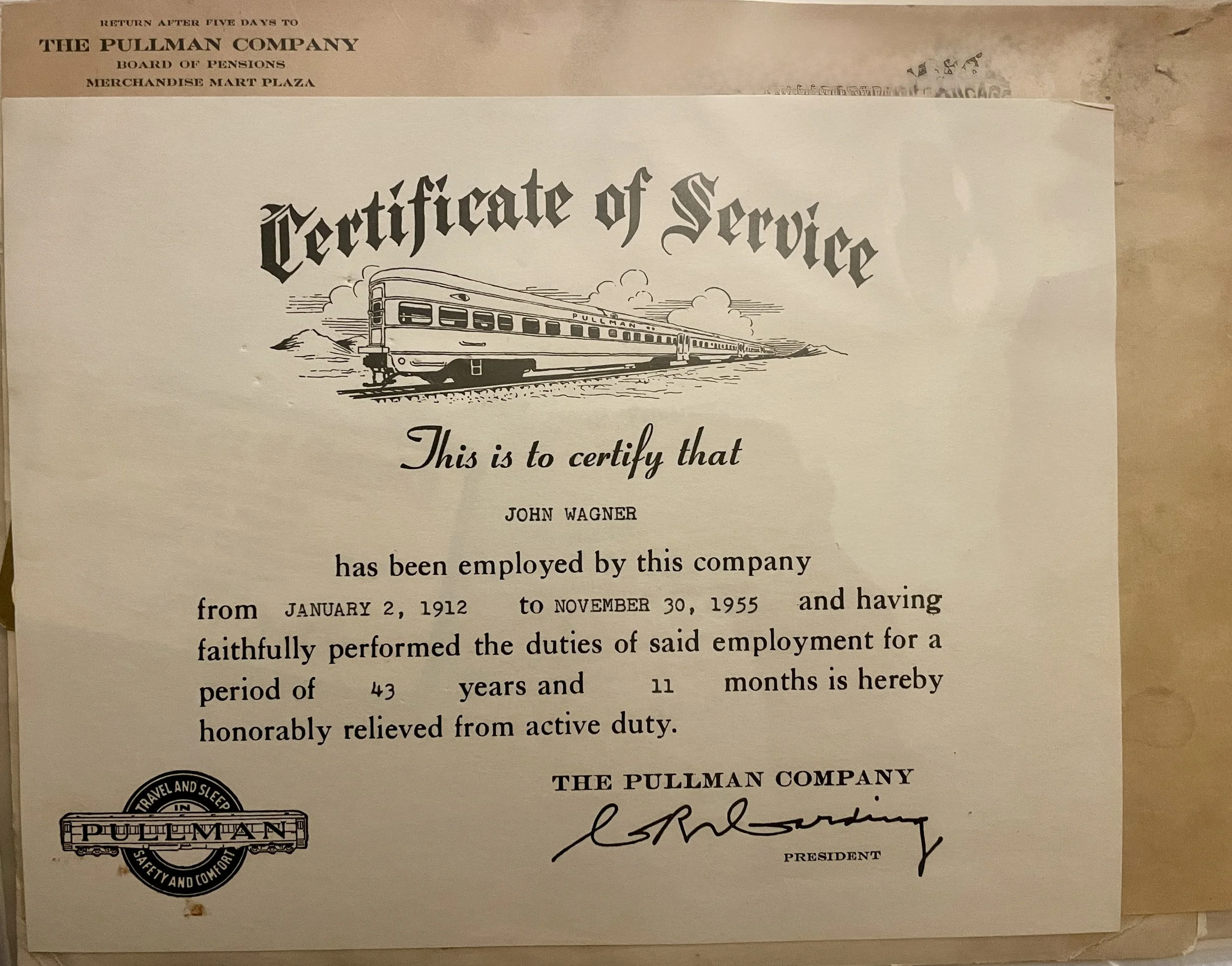
John Wagner worked for The Pullman Company for almost 44 years; his retirement gift, according to my great-aunt Minnie, was a recliner (which I believe is the one shown in the photo below).
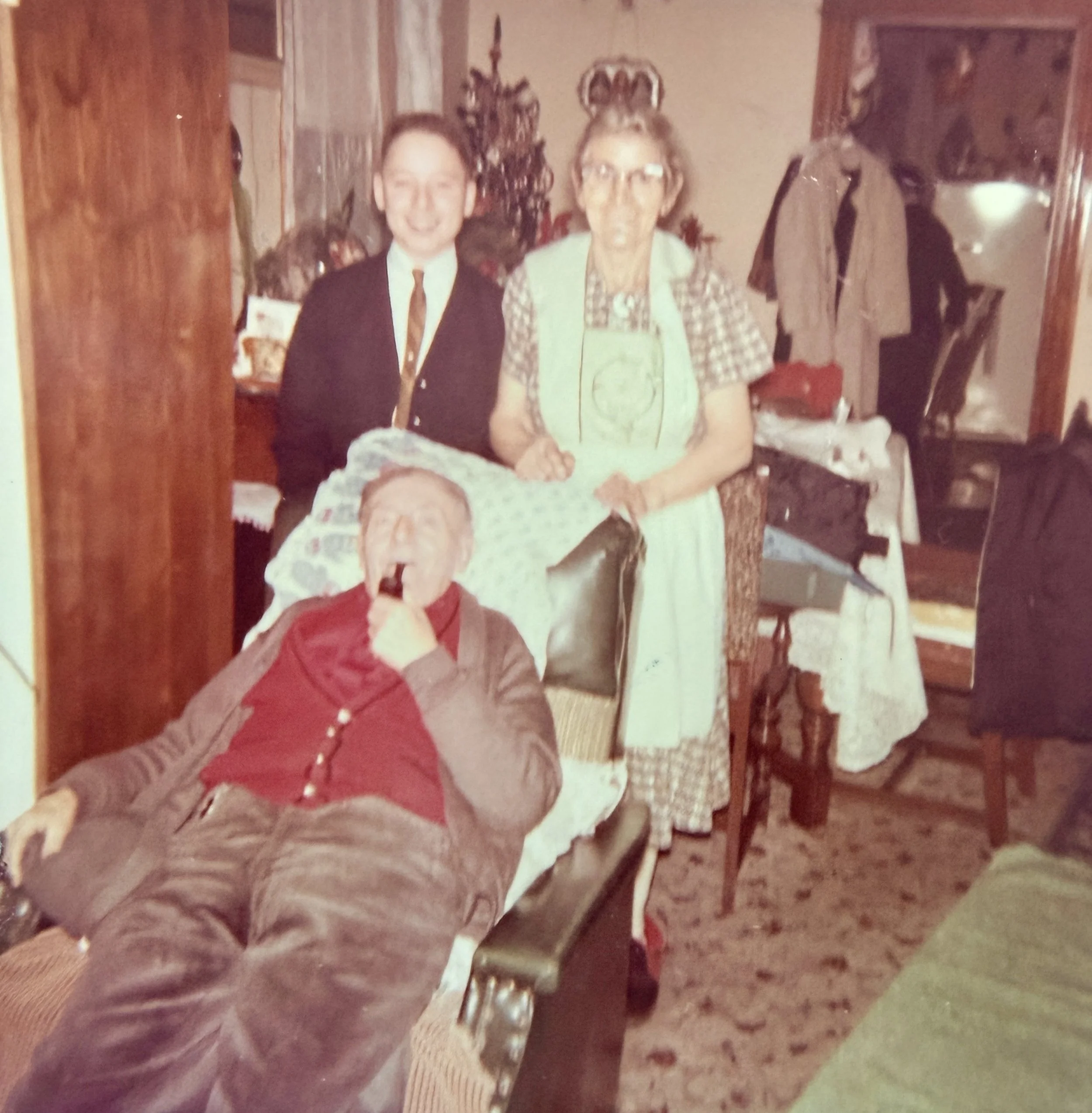
Here you can see John Wagner sitting in his recliner, relaxing with his pipe; behind him stand my Uncle John (my mom’s brother) and Anna Halper.
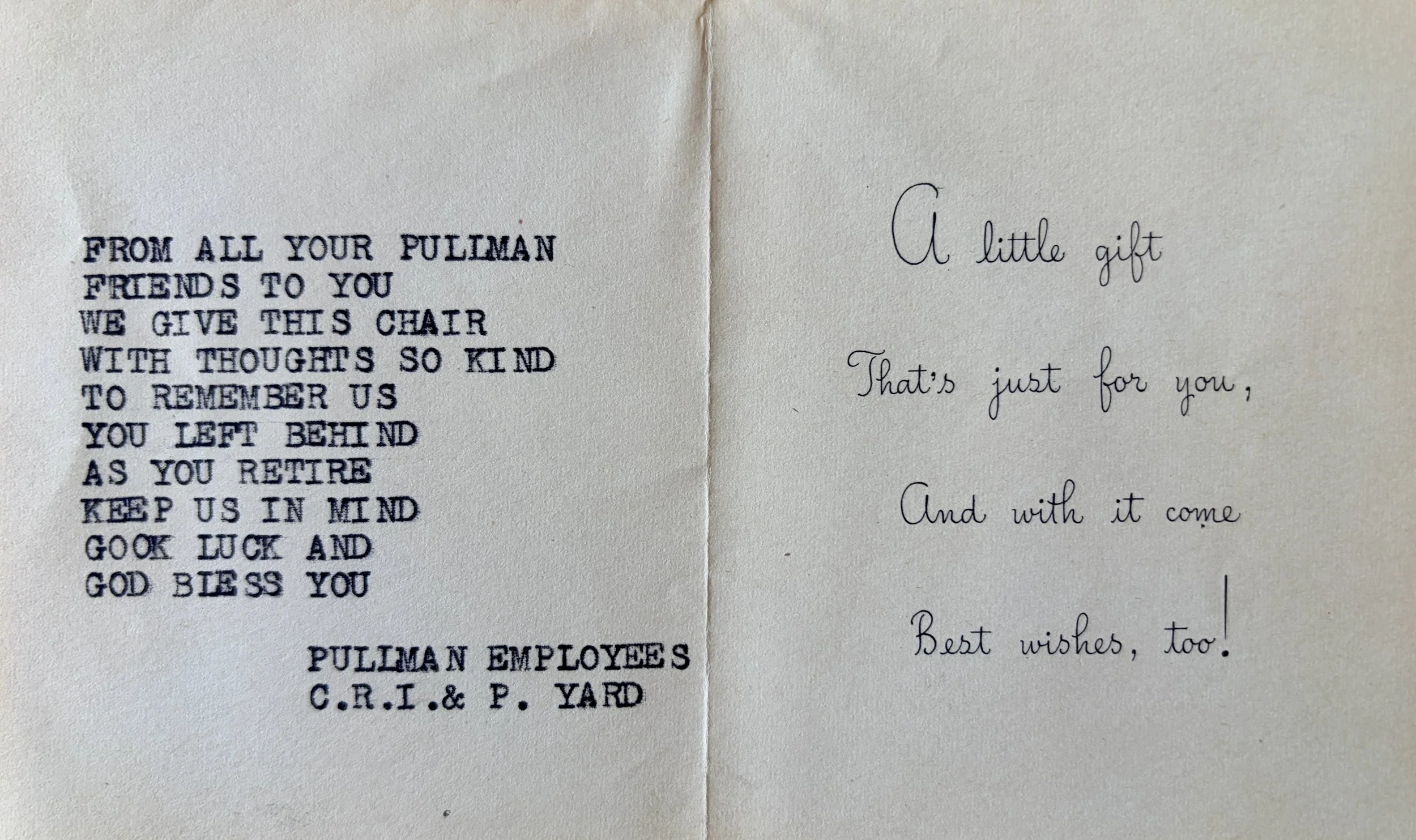
A retirement note from the Pullman Employees at the Chicago, Rock Island and Pacific Railroad yard
Well, as usual, this post has gotten much longer than planned — hopefully you have found it interesting to learn about south side Chicago’s “working world” in the early 1900s. In my next post, I will look more at non-work related aspects of living in the Back of the Yards neighborhood, such as the important role St. Augustine Catholic Church played for the Burgenländer community, how families supported each other — both within Chicago and through aid sent back in Burgenland, and how they kept their social and cultural traditions alive. Stay tuned! And be sure to subscribe on my website if you want to get my quarterly newsletter and stay updated on my writing projects. Just click HERE and scroll down to the bottom to subscribe.
Endnotes:
“New York, U.S., Arriving Passenger and Crew Lists (including Castle Garden and Ellis Island), 1820-1957.” Database with images. Ancestry, 2010, www.ancestry.com/imageviewer/collections/7488/images/NYT715_443-0549?pId=4003342568. Original data from Passenger and Crew Lists of Vessels Arriving at New York, New York, 1897-1957; Microfilm Publication T715, Roll 443; Records of the Immigration and Naturalization Service, Record Group 85; National Archives, Washington, D.C.
United States, Bureau of Immigration. “Record of Aliens Held for Special Inquiry.” S.S. La Gascogne, 9 Nov. 1910. Passenger and Crew Lists of Vessels Arriving at New York, New York, 1897-1957. National Archives and Records Administration Microfilm Publication T715, roll 1590, page 855. Ancestry, www.ancestry.com/imageviewer/collections/7488/images/NYT715_1590-0855?pId=4008427781.
Rascher, Charles. Rascher's Birds Eye View of the Chicago Packing Houses & Union Stock Yards. 1890. Chicago Workers Cottage Initiative, workerscottage.org/BOTYsurvey.html. Library of Congress, Washington, D.C., call no. G4104.C6A3 1890 .R3 TIL.
“The Union Stock Yards.” Chicago Tribune, Chicago, Illinois, 29 Dec 1865. Chicagology, 17 Mar 2003, https://chicagology.com/prefire/prefire084/.
“Union Stock Yards.” Wikipedia Foundation, 6 Aug 2026, https://en.wikipedia.org/wiki/Union_Stock_Yards.
Ibid.
“Union Stock Yard Gate.” Wikipedia Foundation, 23 Jun 2026, https://en.wikipedia.org/wiki/Union_Stock_Yard_Gate.
“Floorers removing the hides - U.S.Y. Chicago.” Postcard, ca. 1905–1907, Suhling & Koehn Co.Wikimedia Commons, Wikipedia Foundation, 6 Apr 2025, https://en.wikipedia.org/wiki/Union_Stock_Yards.
Sinclair, Upton. The Jungle. The Heritage Press, 1965.
“Union Stock Yards.” Wikipedia Foundation, 6 Aug 2026, https://en.wikipedia.org/wiki/Union_Stock_Yards.
United States, Bureau of the Census. Thirteenth Census of the United States, 1910. Cook County, Chicago, Ward 29, Enumeration District 1271, sheet 4B, household of Frank Halper. National Archives and Records Administration microfilm T624. Ancestry, www.ancestry.com/imageviewer/collections/7884/images/31111_4328170-00063?pId=117223374.
United States, Bureau of the Census. Fourteenth Census of the United States, 1920. Cook County, Illinois, Chicago Ward 29, Enumeration District 1771, sheet 8B, household of Paul Harper (Halper) National Archives and Records Administration microfilm T625, roll 345. Ancestry, https://www.ancestry.com/imageviewer/collections/6061/images/4300496_00930?pId=67496163.
“An Hour at the Stockyards.” Chicago Tribune, 6 Oct 1895. Chicagology, 17 Mar 2003, https://chicagology.com/prefire/prefire084/.
Bushnell, Charles J. “Some Social Aspects of the Chicago Stock Yards.” American Journal of Sociology, Vol. 7, No. 3 (Nov., 1901). Chicago Workers Cottage Initiative - Back of the Yards Survey, 2023, https://workerscottage.org/BOTYsurvey.html.
Sandburg, Carl. “Chicago.” Academy of American Poets, https://poets.org/poem/chicago.
Gross, S.E. Tenth Annual Illustrated Catalogue of S.E. Gross’s Famous City Subdivisions and Suburban Towns, 1891. Internet Archive. Chicago Workers Cottage Initiative - Back of the Yards Survey, 2023, https://workerscottage.org/BOTYsurvey.html.
“City of Pullman.” Chicagology, 17 Mar 2003,https://chicagology.com/goldenage/goldenage195/.
“The Pullman Car Shops - Pullman National Historic Park.” U.S. National Park Service, https://www.nps.gov/pull/learn/historyculture/the-pullman-car-shops.htm.
Ibid.
Thale, Christopher. “Railroad Workers.” The Electronic Encyclopedia of Chicago, Chicago Historical Society, 2005, http://www.encyclopedia.chicagohistory.org/pages/1038.html
Wilson, Mark R. “Chicago Surface Lines.” The Electronic Encyclopedia of Chicago, Chicago Historical Society, 2005, http://www.encyclopedia.chicagohistory.org/pages/2610.html.