Exploring Burgenland, Part I: A Visit to the Capital of Eisenstadt & Some Burgenland History
Chasing History: Exploring My Ancestral Roots - Post #68
by Tonya Graham McQuade
On our recent trip through Germany, Austria, Hungary, and the Czech Republic, I had the opportunity to visit the land of my ancestors: Burgenland, Austria. Of course, when my great grandparents immigrated to the United States in 1912 and 1913, they were not leaving Burgenland, Austria, but Vorosvar, Hungary – a fact I did not initially realize and which left me confused when they listed different birth countries on various U.S. Census records. Our recent trip, though, helped to answer many of my questions and gave me a lot more insight into the lives of Janos “John” Paul Wagner and Anna Halper, who married in Chicago, Illinois, in December 1917 and gave birth to my maternal grandfather, John Paul Wagner, Jr. , the following year.
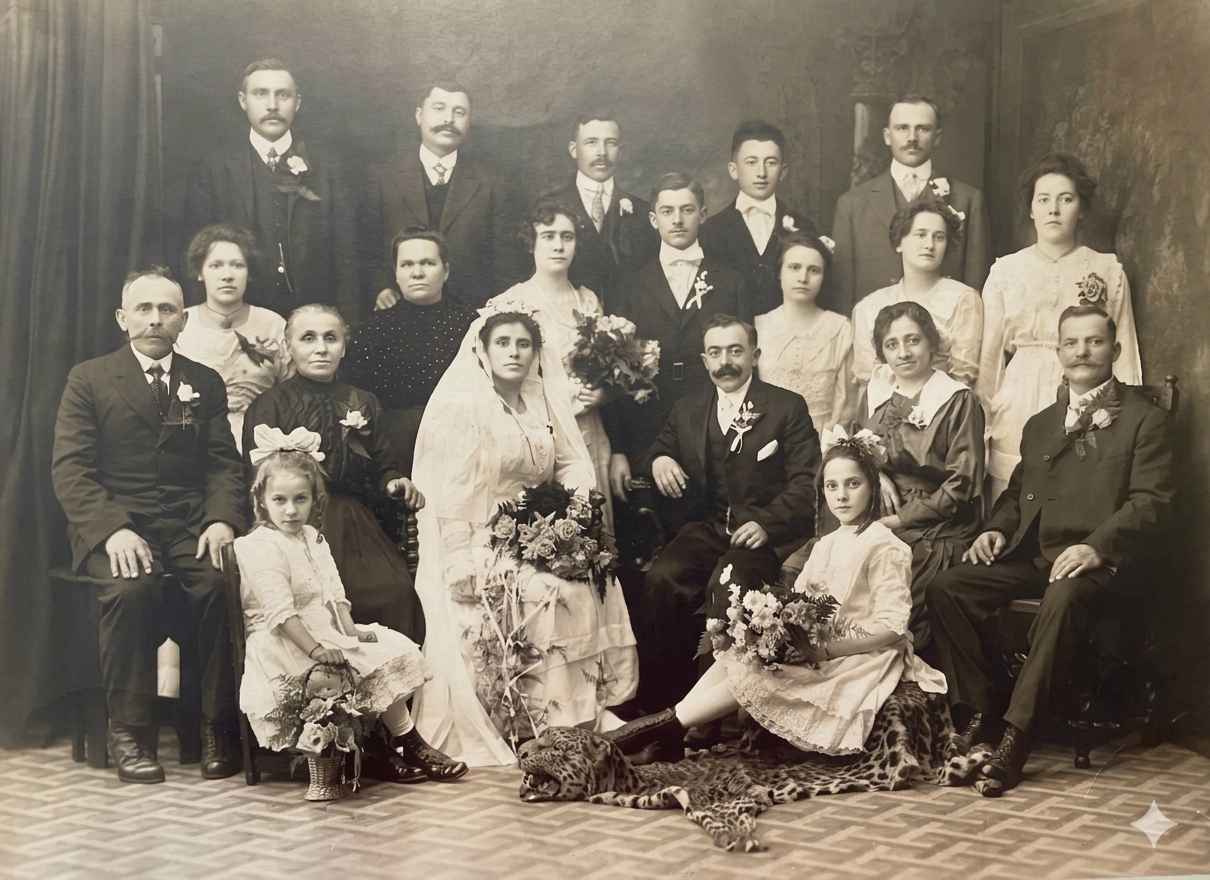
My great grandparents Anna Halper and Janos “John” Paul Wagner, center, were married 1 Dec. 1917 in Chicago at St. Augustine’s Church. Anna’s mother, Maria Halper, is seated to her right.
In my next several posts, I am going to share photos and stories from our trip through Burgenland, as well as delve a bit into Austro-Hungarian history and the lives of the Wagners and Halpers in their respective towns of Unterwart and Oberdorf, both of which lie in the Oberwart district of what is now the state of Burgenland in Austria. Here, though, I will start with our visit to Eisenstadt, a city of about 16,000 people, which since 1925 has served as Burgenland’s capital. This “smallest Austrian capital” lies about 35 miles south of Vienna and about seven miles west of the Hungarian border.
Before becoming part of Austrian Burgenland, Eisenstadt was part of the Kingdom of Hungary for 273 years, from 1648 until 1921, and was known by its Hungarian name, Kismarton. It had officially become a royal free city of Hungary in 1648 when the citizens of Eisenstadt paid a ransom of 16,000 florin and 3,000 buckets of wine (worth around 9,000 florin) to Emperor Ferdinand III to secure its independence. [1] The city also served as the main seat of the powerful Esterházy Hungarian noble family. They transformed the town's landscape with the construction of the landmark Schloss Esterházy palace (more on that later).
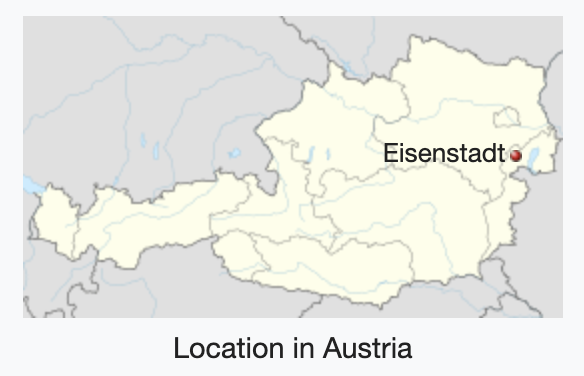
Burgenland’s capital of Eisenstadt lies about 35 miles south of Vienna and about seven miles west of the Hungarian border.
Prior to 1648, Eisenstadt – originally settled by Halstatts, Celts, and Romans – was a heavily fortified medieval border town that spent centuries being fought over, burned down, and traded back and forth between the Kingdom of Hungary and the Austrian Habsburgs. The town was destroyed during the Mongol invasions of 1241, but was later rebuilt. It first appears in official Latin records in 1264 as Capella sancti Martini de minore Mortin ("The Chapel of St. Martin in Little Martin"). Its Hungarian name, Kismarton (Little Martin), stems from this, and its main cathedral today is known as Martinsdom. [2]
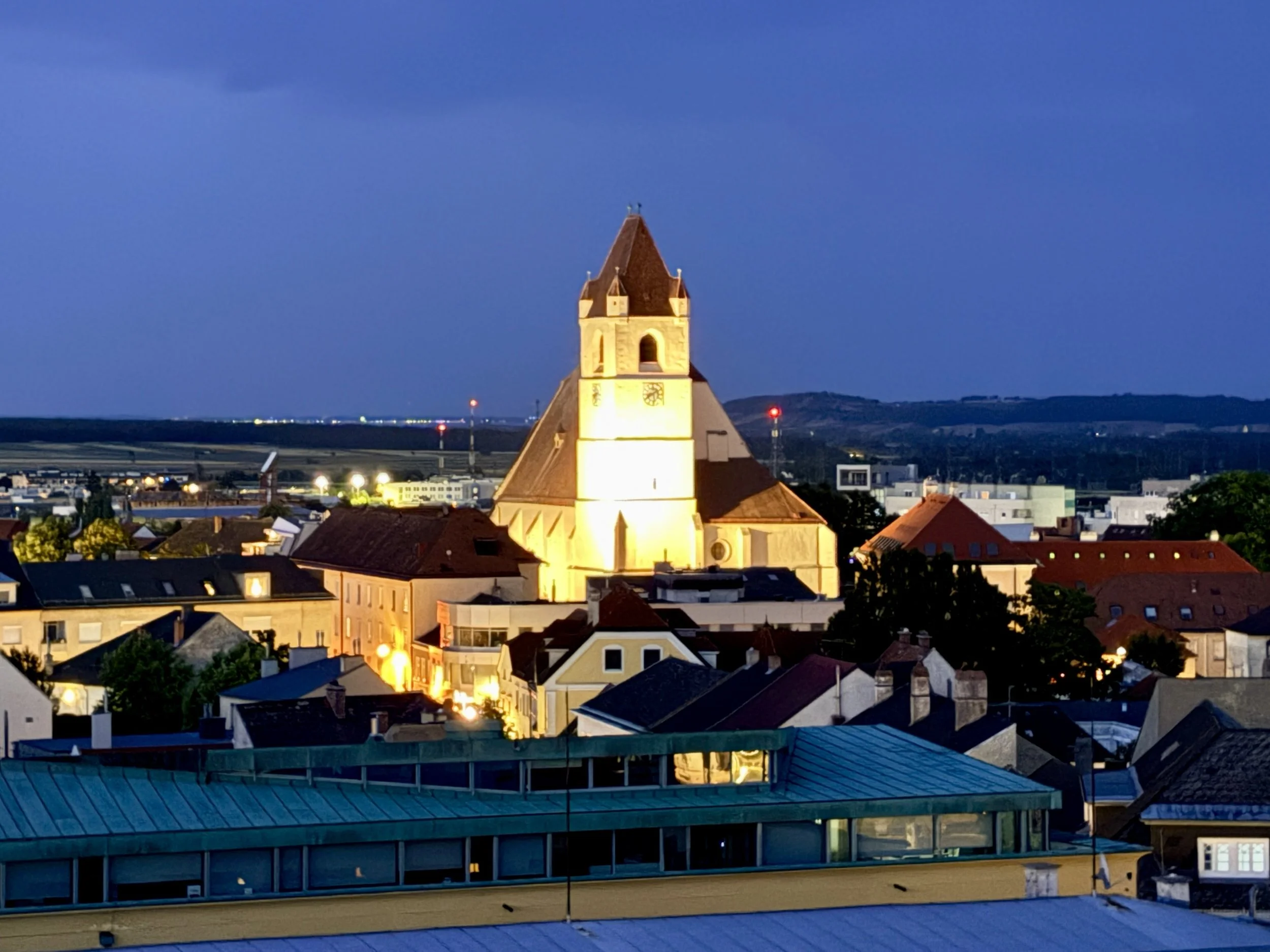
Here you can see a nighttime view of Martinsdom (aka. the Cathedral of St. Martin) in Eisenstadt; built in 1460, the cathedral houses the historic Haydn organ inside.
In 1371, the powerful Hungarian Kanizsai family acquired the town and built a massive stone fortress around it. Because of these seemingly impenetrable iron-strong fortress walls, the town earned its German name: Eisenstadt (literally "Iron City"). However, because of its strategic position right on the geopolitical fault line between the Holy Roman Empire and Hungary, Eisenstadt became a pawn for emperors and kings. In 1440, the cash-strapped Kanizsai family pawned the city to the Austrian Duke Albert VI, thus beginning a kind of Austro-Hungarian border tug-of-war that continued from 1440 to 1622.
By 1445, the Austrian Habsburg Emperor Frederick III took full control of the city. Then, in 1482, the legendary Hungarian King Matthias Corvinus fought back and successfully conquered Eisenstadt, bringing it back into Hungarian hands for a few decades. King Matthias, who ruled Hungary from 1458-1490, is revered in Hungary and is known as the “Philosopher King.” In Hungarian folktales, he is known as “Matthias the Just,” for legend says he loved to dress up in common peasant clothing and wander anonymously through the villages of Hungary. If he found a local wealthy lord abusing or overtaxing the poor, he would reveal his royal identity and punish the nobleman on the spot. [3]
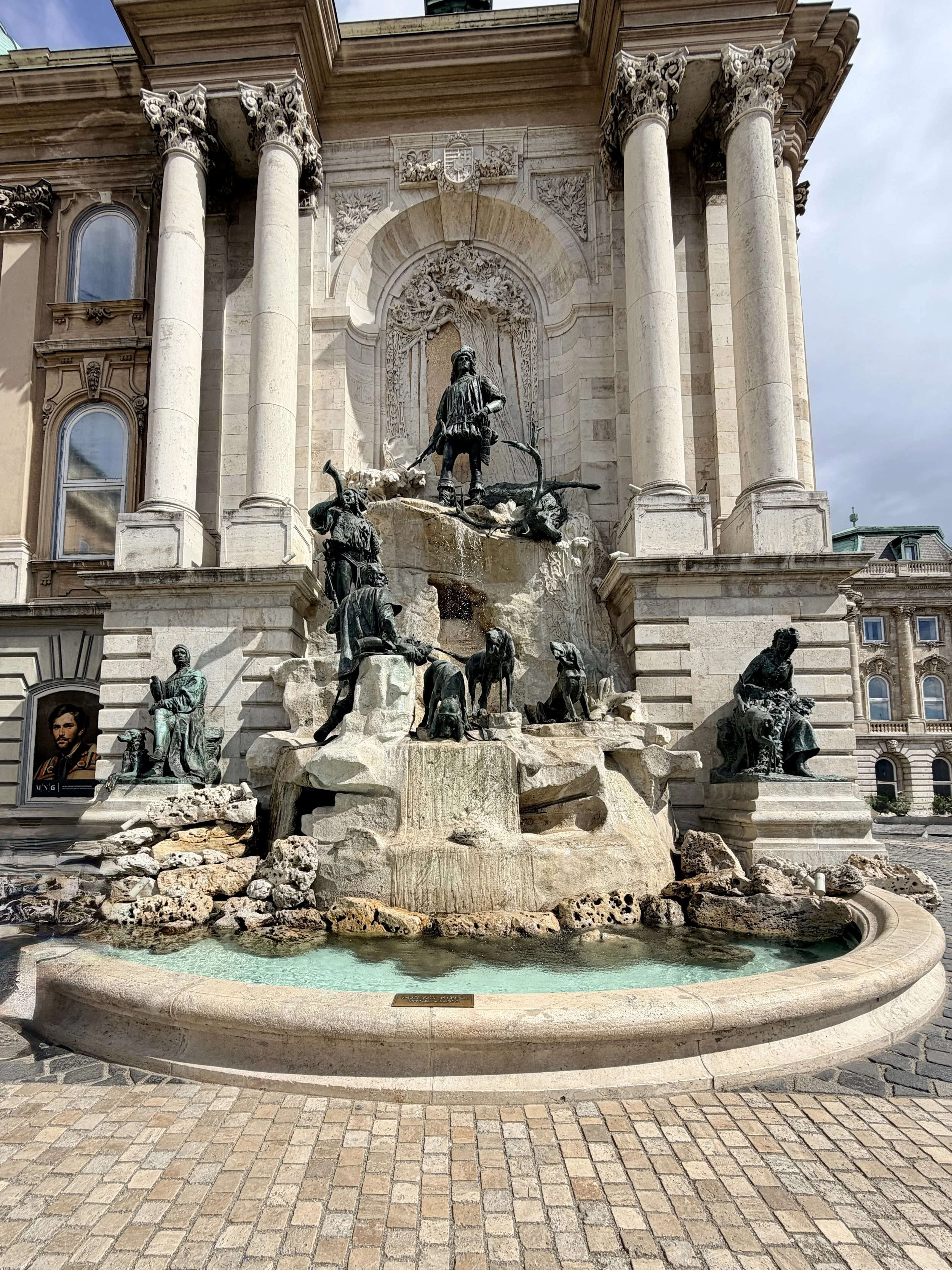
This photo shows the Matthias Fountain, located in the Buda Castle complex on the Hunyadi Court, featuring King Matthias in a royal hunting scene with a hidden love story.
Mike and I saw two statues of King Matthias during our recent visit to Budapest, the first being the Matthias Fountain shown above that is located near Buda Castle. If you want more description of the fountain and its symbolism, you can read more HERE. The second is part of the 1896 Millennium Monument in Heroes’ Square, celebrating 1000 years of Hungarian history. The cluster of fierce equestrian statues at the base of the central column represent the original tribal leaders — the Seven Chieftains — who founded Hungary. The two matching semicircular pillared structures behind the column hold 14 statues of Hungary's greatest kings, governors, and leaders — including King Matthias, who is the second statue from the left in the right-hand semicircular colonnade. He is depicted as a powerful Renaissance ruler wearing a suit of royal armor, holding a long sword, and resting his hand on a large shield
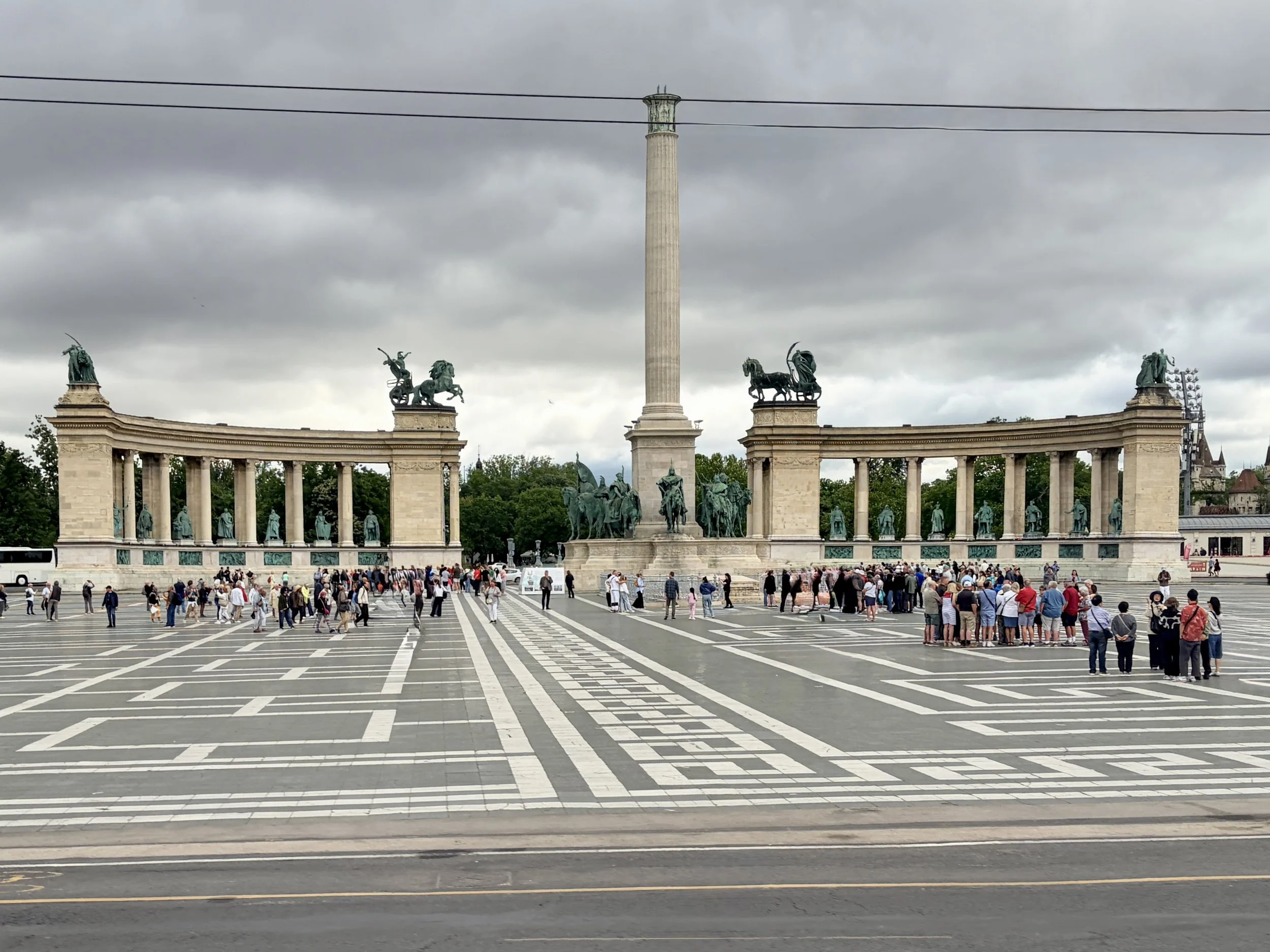
King Matthias’s statue is the second from the left of the colonnade on the right side; he is standing beside his father, John Hunyadi, who was a powerful military leader and served as Regent-Governor of the Kingdom of Hungary from 1446 to 1453.
We also visited Matthias Church on Castle Hill, where it sits next to Holy Trinity Square, a giant equestrian statue of St. Stephen, and Fishermen’s Bastion. According to historians, the very first church on this site was founded in 1015 by Saint Stephen, the first king of Hungary. That church was destroyed during the Mongol invasion in 1241. The current Roman Catholic church was constructed between 1246 and 1255 by King Bela IV. We were very impressed by the church’s colorful tile work and its tower’s beautiful stonework; but unfortunately, it was closed for a special event, and we were not able to go inside. We did, however, enjoy the views from nearby Fishermen’s Bastion. For more description of the church, you can read more HERE.
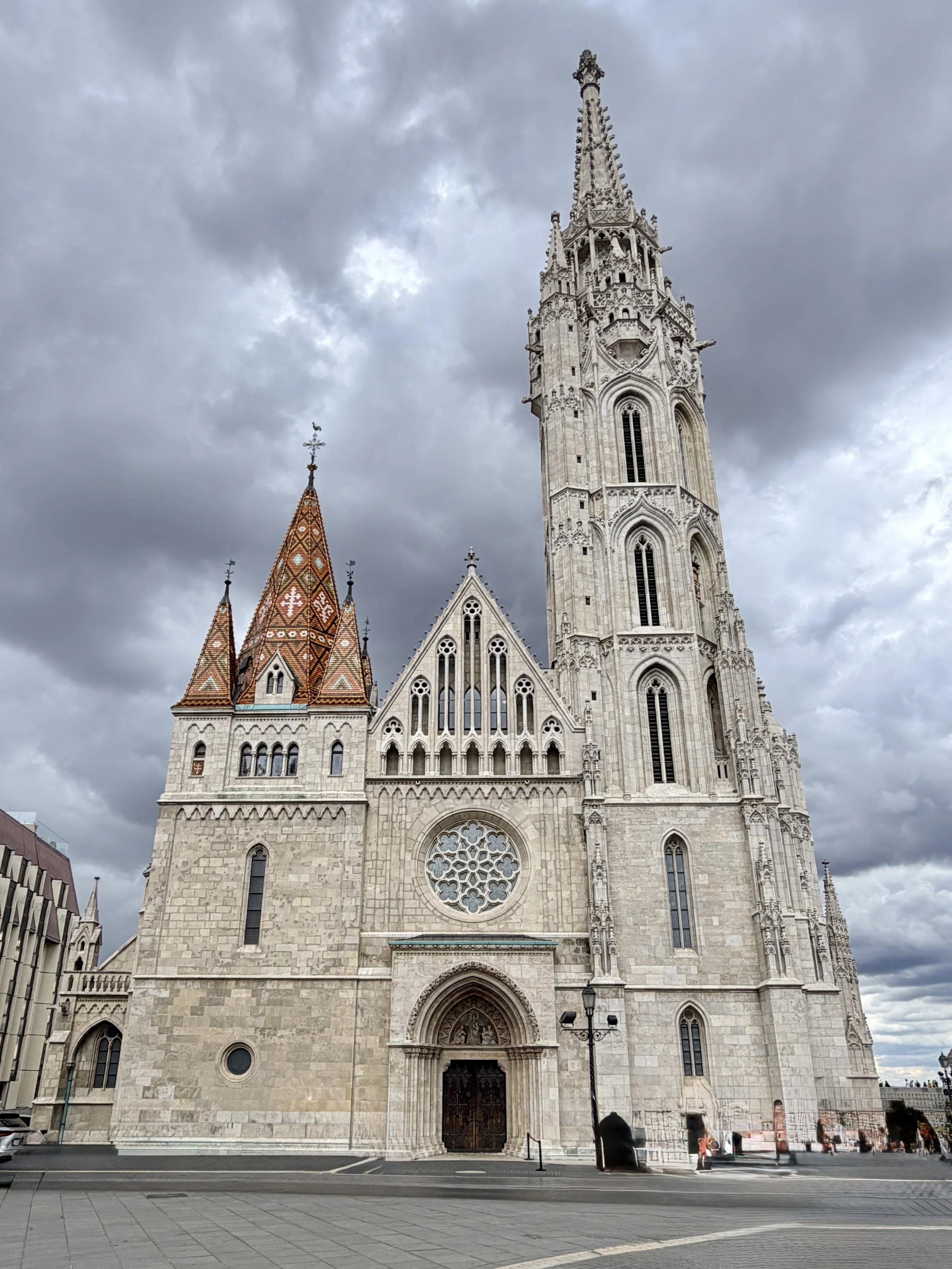
Officially named Church of the Assumption of the Buda Castle, most people call this Matthias Church, named after King Matthias Corvinus, who ruled Hungary from 1458-1490.
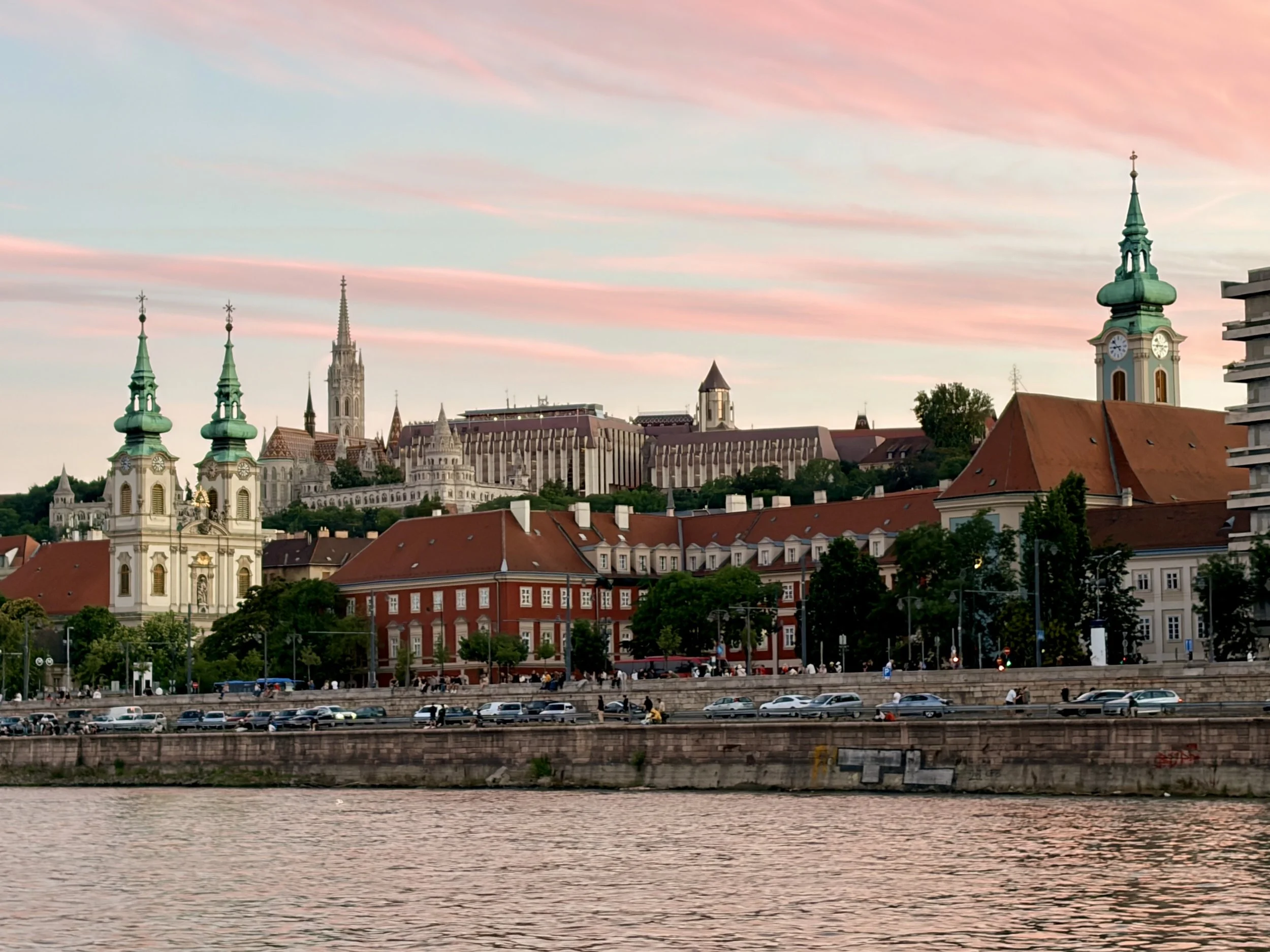
In this photo from our evening cruise on the Danube, you can see the tall tower of Matthias Church in the background on the left; in front of it, you can see the castle-like Fishermen’s Bastion; and the church with the two green spires is St. Anne’s. The long building that fronts the river is the Hilton Budapest.
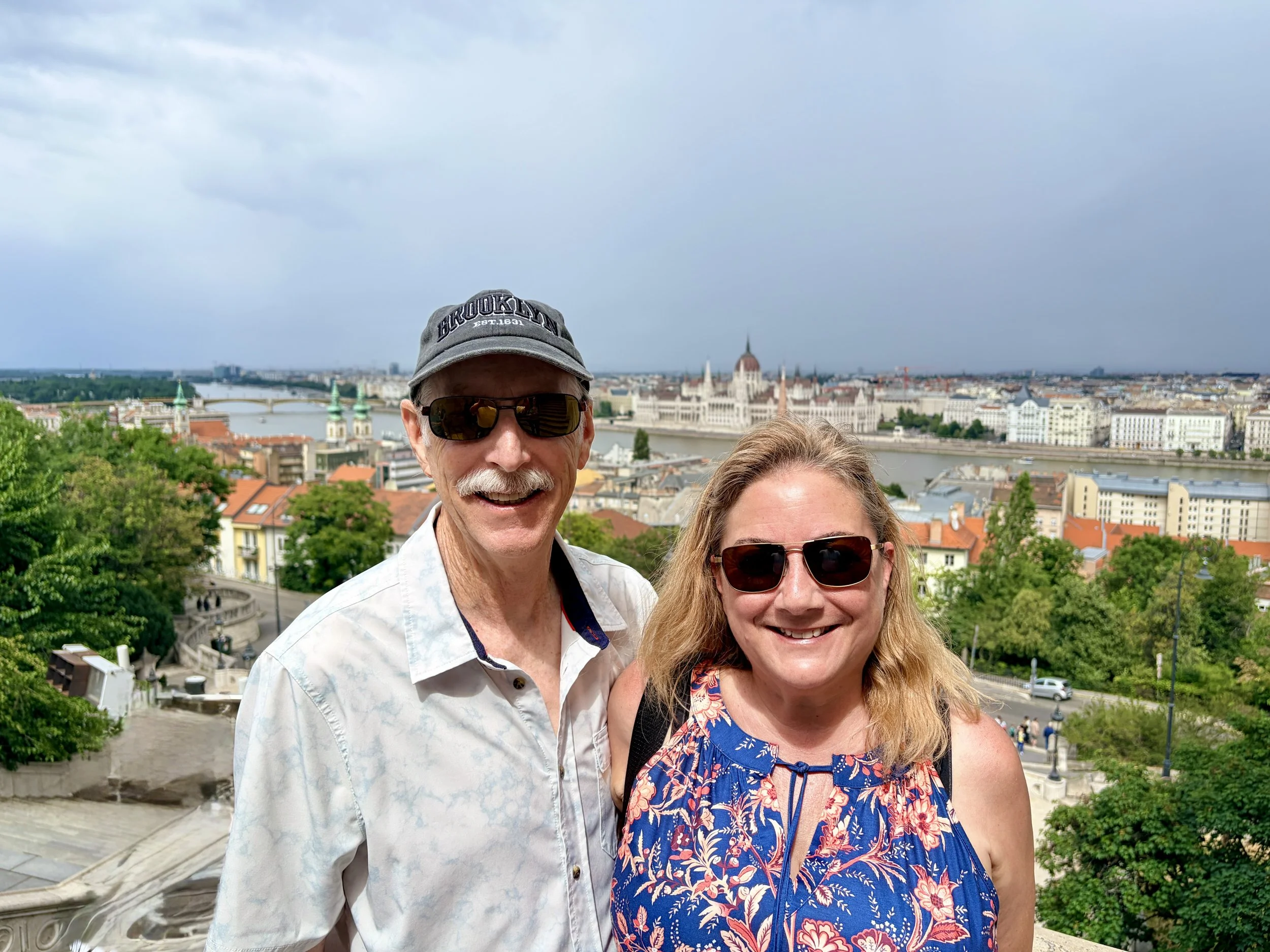
Here you can see the earlier view we enjoyed from Fishermen’s Bastion; behind us is the giant Budapest Parliament building across the River on the Pest side (the Castle District is on the Buda side).
Following King Matthias's death in 1490 without a male heir, the Holy Roman Emperor Maximilian I retook the city of Eisenstadt for Austria. For the next 150 years, Eisenstadt was administratively run by Austria, even though it sat on Hungarian soil. Throughout the 1500s, it experienced Ottoman attacks, religious shifts due to the Protestant reformation, and a great fire in 1589 that destroyed most of the town’s homes and buildings.
Eisenstadt’s future began to change in 1622, when Holy Roman Emperor Ferdinand II awarded the region (both Eisenstadt and Forchtenstein) to a loyal, wealthy Hungarian nobleman named Count Nikolaus Esterházy. In exchange for his new estates, Nikolaus ceded his territory in Munkács, Transylvania, to the Prince of Transylvania, Gábor Bethlen. This transfer was part of a larger transfer of land that occurred as financial compensation under the terms of the Peace of Nikolsburg, which ended a critical conflict in the Thirty Years’ War (1618-1648) between the Catholic Ferdinand II and the Protestant Gábor Bethlen.
This strategic transaction effectively laid the foundation for the Esterházy family’s centuries-long wealth, power, and massive property ownership in the region. At the peak of their power, the Esterházys owned roughly one-eighth of all the land in Hungary – including dozens of castles and hundreds of villages – and ruled over tens of thousands of peasant serfs. Their private wealth was so immense that it often eclipsed the Habsburg treasury. When the Habsburg Emperors needed to fund massive wars against the Ottoman Empire or France’s Napoleon Bonaparte, they routinely went to the Esterházy family to borrow millions of gold coins. [4]
And how did they get so much land and money? For one, they continued to support and stay on the “good side” of the Catholic Habsburgs, so they were often given land taken from defeated Protestant lords as their reward; and two, they married quite strategically, often gaining significant wealth through their marriages. While Nikolaus and his first son, Ladislaus, held the title of Count, by 1687, Emperor Leopold I elevated Nikolaus’s son Paul to the rank of Prince of the Holy Roman Empire for his extreme loyalty and military success – a title that stayed with the family until the 20th century.
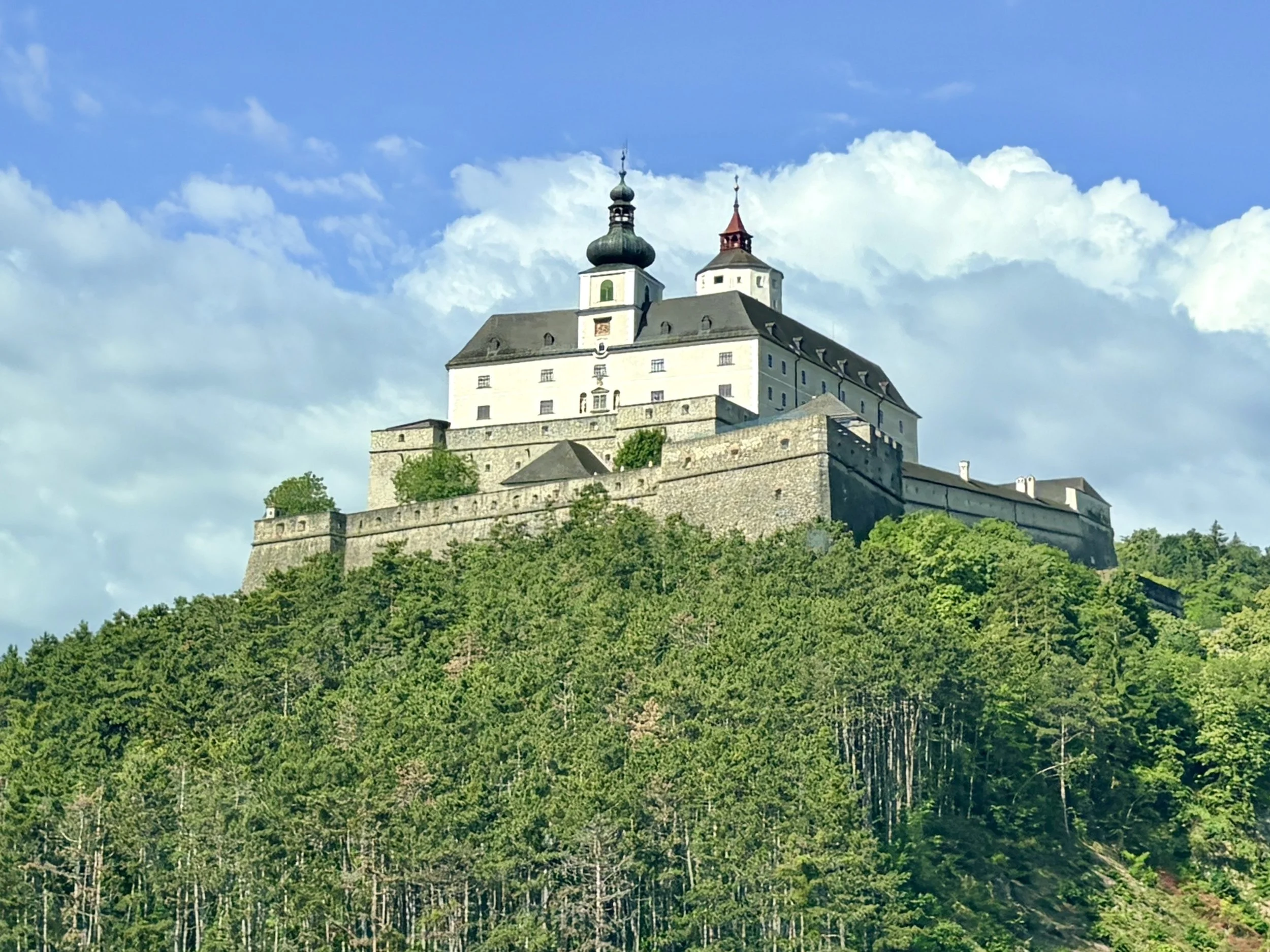
Here, high up on the hill about 15 miles southwest of Eisenstadt, you can see the medieval Forchtenstein Castle in which the Esterházy family lived from about 1622-1672.
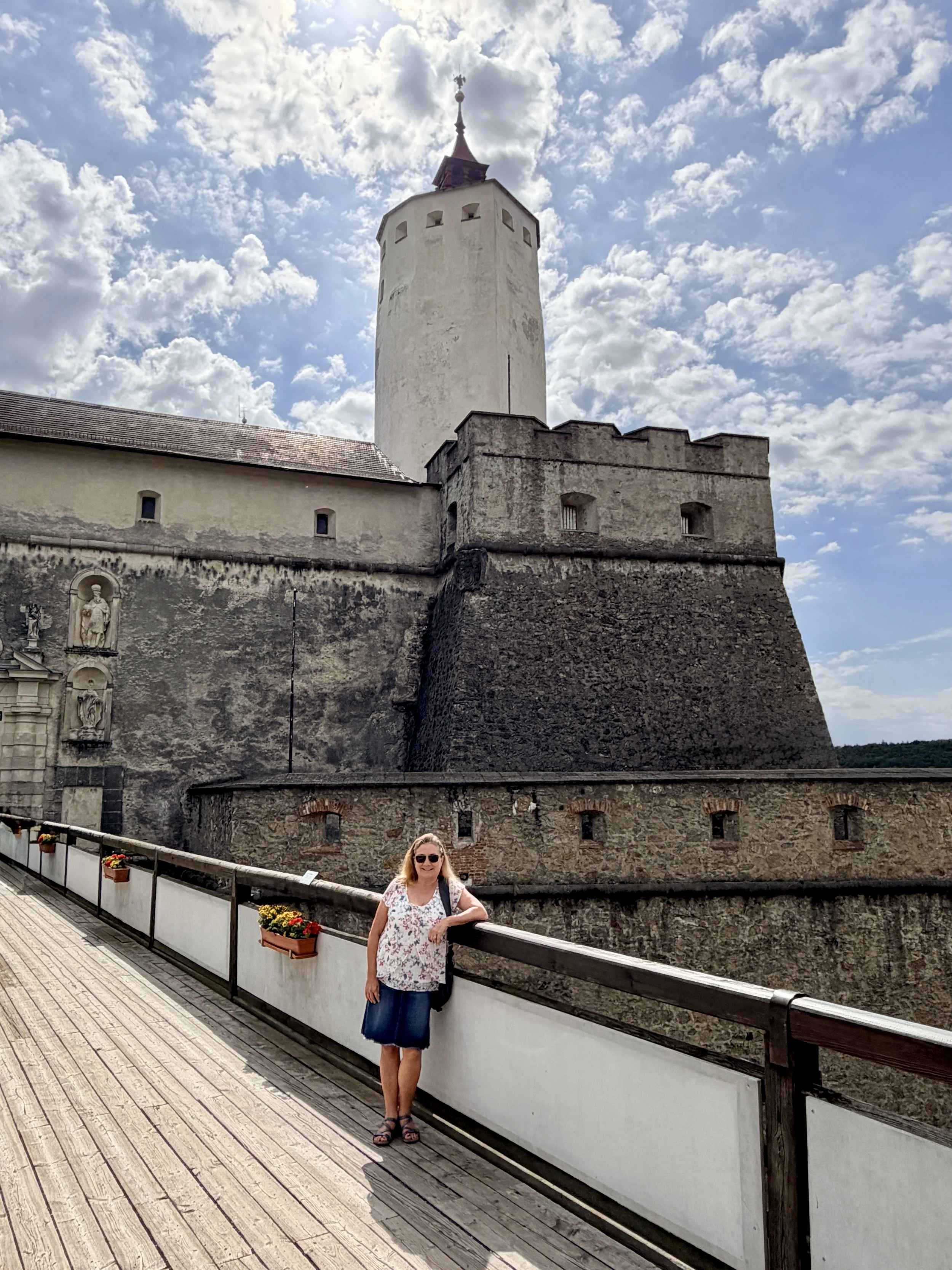
Here is a closer up view of the tower at Forchtenstein Castle; I am standing on the bridge that crosses the dry moat.
Initially, after acquiring both properties, Nikolaus Esterházy moved his family into the medieval Forchtenstein Castle (shown above), which he believed could better serve as a defensive stronghold against the advancing Ottoman forces. When Nikolaus died in 1645, his oldest son Ladislaus took over his father’s title and lands. However, in August 1652, Ladislaus and three of his cousins were killed while battling the Ottoman Turks in northern Hungary (modern day Slovakia) in the Battle of Vezekény.
Thus, the family estates officially passed to Nikolaus's younger son, Paul I, later that same year. Since the Habsburgs ultimately defeated the Ottoman Turks in the 1652 battle, Paul I presided over a much more stable region and decided he wanted a more modern, opulent palace. He decided to heavily renovate the old fortress in Eisenstadt (originally built in 1364) into a grand Baroque residence and moved the primary court there in 1672. Eisenstadt became the grand, cultural headquarters of the family for the next 300 years.
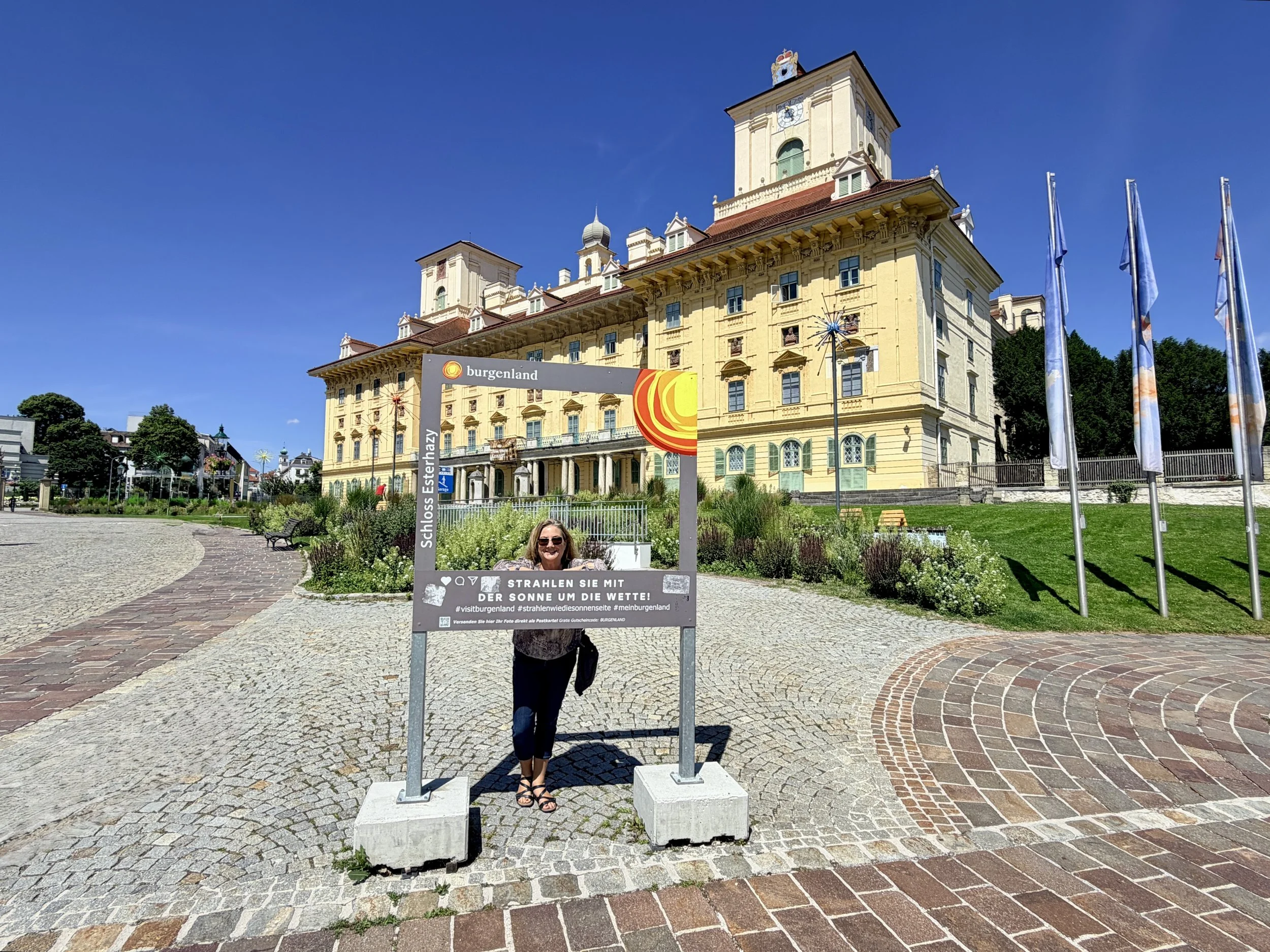
Here I am, standing in front of “Schloss Esterházy” in Eisenstadt, the grand palace where the Esterházy family lived for several centuries.
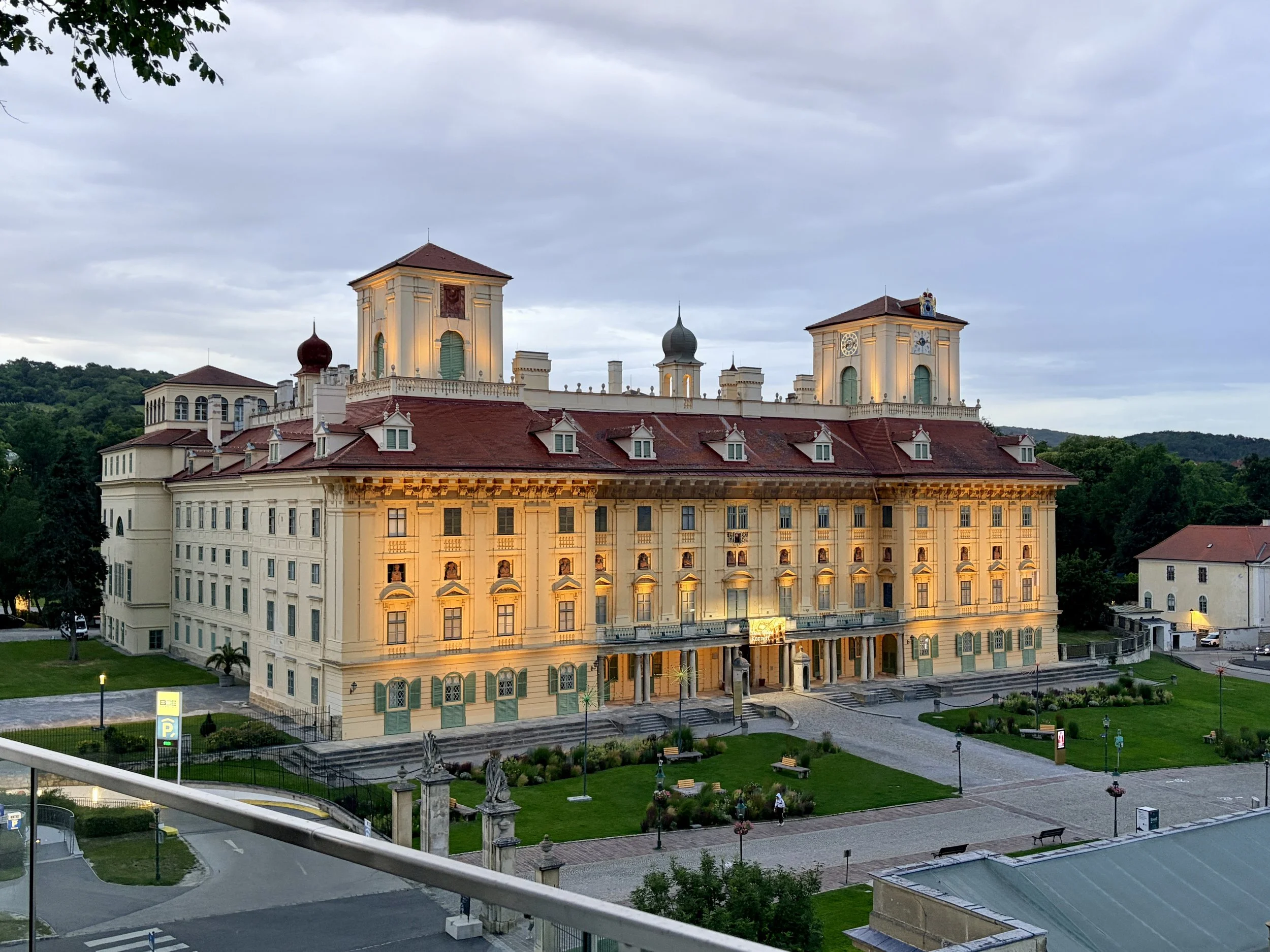
Here’s another view of Schloss Esterházy, this one from the rooftop bar at Hotel Galántha, where we stayed for our night in Eisenstadt.
I know that’s a lot of history – but here’s just a bit more to add to the confusion (LOL). Because the town’s citizens pooled their money in 1648 to purchase their independence directly from the Emperor (as mentioned earlier in this post), they were never “ruled” by the Esterházys. However, the Esterházys did rule their palace land inside the city, as well as their significant amounts of land outside the city, which led to many conflicts between the Esterházys and the town leaders. Adding to the confusion, the Habsburgs ruled the Holy Roman Empire almost continuously from 1438-1806, while also ruling the Kingdom of Hungary almost continuously from 1526-1918, but they kept the two separate … somehow. Hungary was never part of the Holy Roman Empire. It’s too much for me to explain here, but you can see why this gets very confusing.
Unlike Eisenstadt, the region encompassing Unterwart and Oberdorf was part of the Kingdom of Hungary for more than 800 years, from 1043 until 1921, avoiding the political tug-of-war that Eisenstadt faced. I will explore more of that history in a different post. Despite their different lengths of time under Hungarian rule, however, all three ultimately shared the exact same fate at the end of World War I: suddenly, they found themselves part of Austria.
The Treaty of Trianon, signed in 1920, punished Hungary severely for its role in WWI. It forced Hungary to cede 72% of its total land area and nearly two-thirds of its population to various neighboring nations. It shrunk from a pre-war size of 125,483 square miles (roughly the size of New Mexico) down to just 35,936 square miles (roughly the size of Indiana), and it became a land-locked nation, losing its southern territory on the Adriatic Sea to the Kingdom of Serbs, Croats and Slovenes (later Yugoslavia) and its strategic port city of Fiume (modern-day Rijeka, Croatia) to Italy. It had to cede Transylvania to a greatly expanded Romania, losing a chunk of land larger than the entire remaining state of post-war Hungary. It lost its former capital and the historical Hungarian coronation city of Pressburg (modern-day Bratislava, Slovakia) to Czechoslovakia and its small mountainous regions in the northernmost borderlands to Poland.
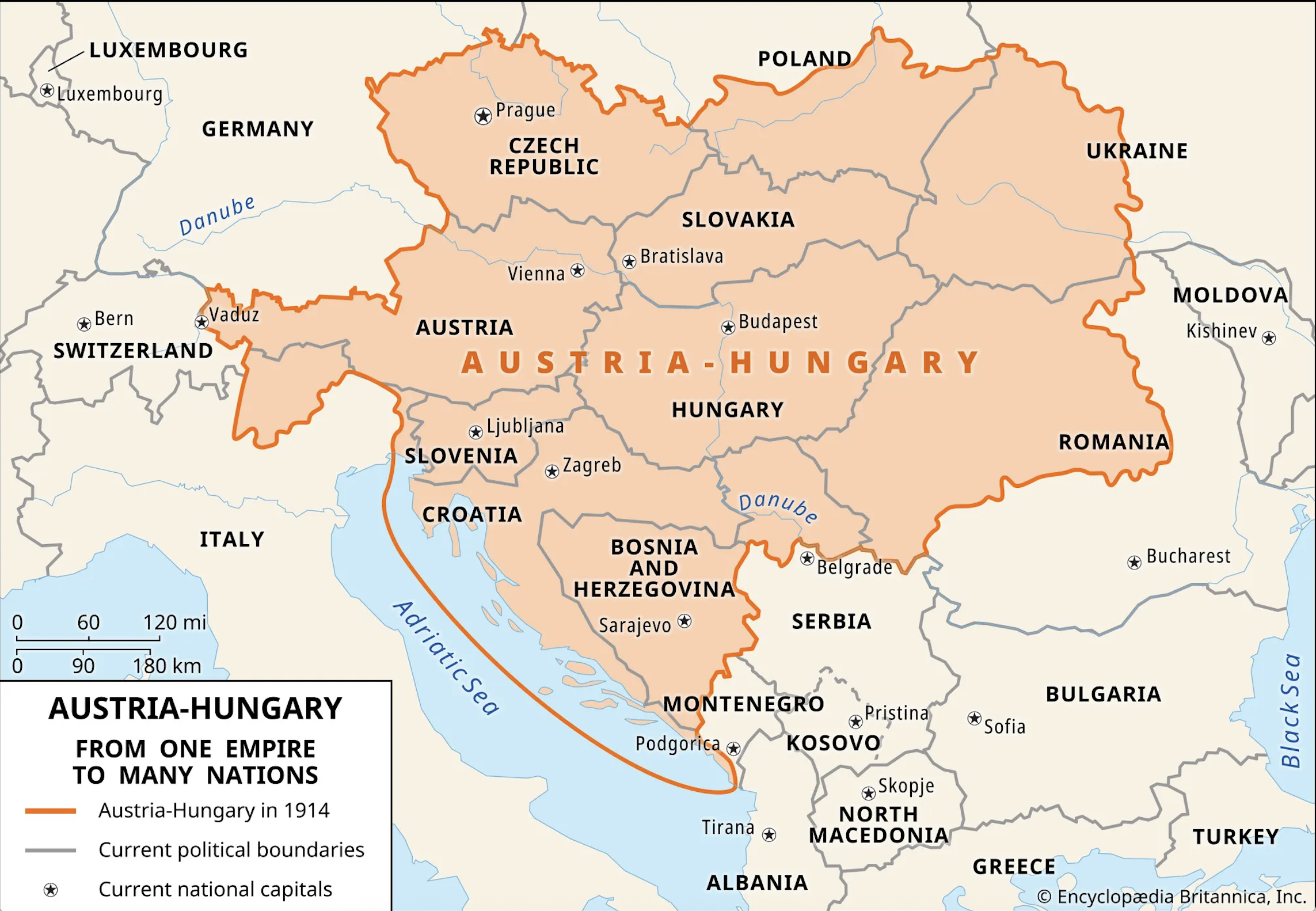
Here you can see what the borders of the Austro-Hungarian Empire (1867-1918) looked like in 1914, prior to WWI. [5]
Most relevant here, Hungary was forced to cede its westernmost, predominantly German-speaking borderlands to the new Republic of Austria, forming the area that now makes up Burgenland. In August 1921, Hungary officially transferred the territory. Eisenstadt, Unterwart, and Oberdorf became part of this newly created Austrian state, with Eisenstadt being named the capital four years later.
When we visited Eisenstadt in June, we visited five main sites that I will discuss here:
Schloss Esterházy (where the Esterházy family lived for about 300 years)
Haydn House (where composer Joseph Haydn lived with his wife)
The Franciscan Church and Monastery (where the Esterházy family crypt is located)
Bergkirche (where Haydn is buried)
Stadtvilla Eisenstadt (a fantastic local history museum)
We also stayed at the Hotel Galántha, named after the city of Galántha in old Hungary (now Galanta, Slovakia) from which the Esterházy family originated.
Schloss Esterházy is a massive, four-winged building that contains 256 total rooms and is surrounded by a 123-acre public park. Out of the palace's 256 rooms, many are currently leased out to the provincial government for administrative use. Approximately 25 specific staterooms are historically preserved and open to public tours. The “crown jewel” is the grand Haydnsaal, a 4,671 square foot, three-story-tall concert hall in the northern palace wing. Its elaborately painted ceiling, created by Northern Italian artist Carpoforo Tencalla in the late 17th century, depicts various scenes from the mythological tale of Cupid and Psyche, as well as scenes from the ancient Roman novel Metamorphoses (The Golden Ass), by Apuleius. Portraits of legendary Hungarian rulers frame the ceiling. The famous composer Joseph Haydn, who performed in this hall, lived and worked in the city for more than forty years as a court musician under the patronage of the Esterházy family.
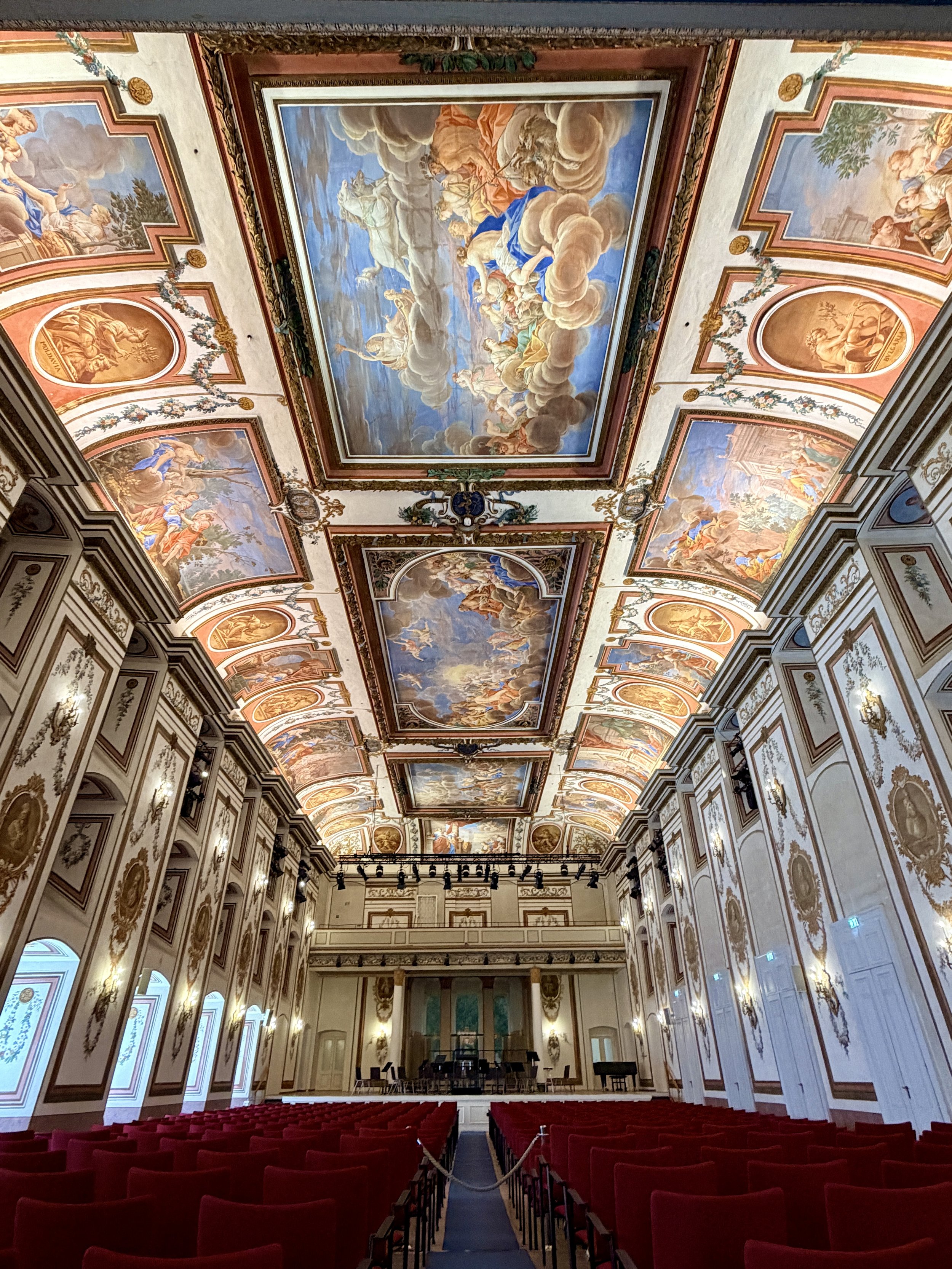
Here you can see Haydnsaal in Schloss Esterházy, with its elaborately painted ceiling, ornate walls, and beautiful concert seats.
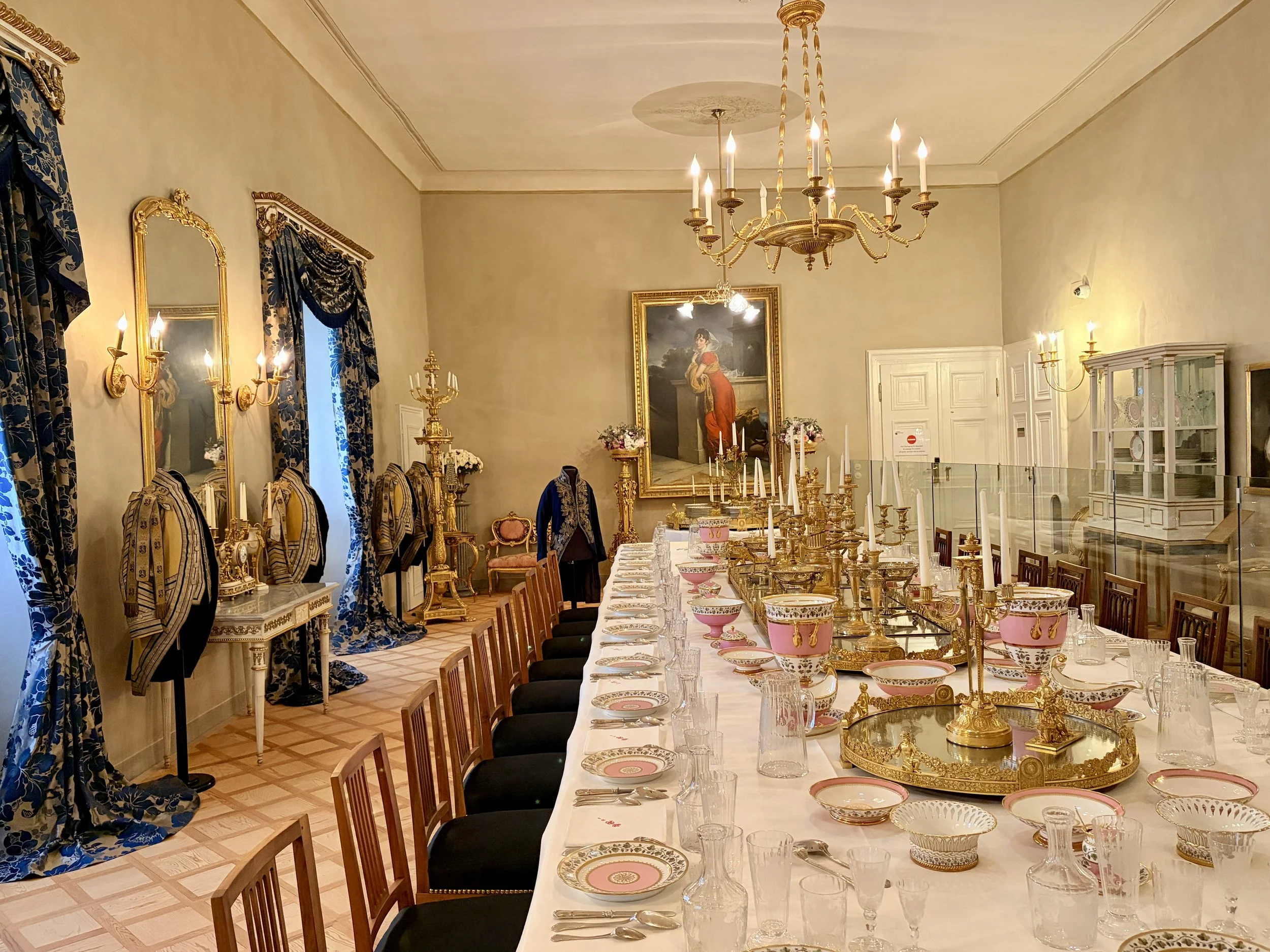
Here you can get a peak at the Empire Dining Room, with its pink and gold porcelain tableware and various court uniforms lining the wall.
One room that definitely stands out is the Empire Dining Room (shown above). Unlike the heavily decorated Baroque style of the Haydnsaal, this room represents the Neoclassical style the family preferred in the 19th century. The pink and gold porcelain tableware was a diplomatic gift from the French Emperor Napoleon Bonaparte to Prince Nikolaus II Esterházy in the early 1800s. Traditional (and authentic) Hungarian-style uniforms featuring intricate gold braiding, which were worn by the household staff, are displayed on mannequins along the wall. A portrait of Nikolaus’s wife, Princess Maria Josepha Hermenegild, is visible on the distant wall. The Princess was a close friend and major patron of Joseph Haydn, who wrote his final six masses in honor of her name day celebrations.
You can read more HERE if you want a fuller description of the palace’s rooms and decor. Here, I will just add a bit about the Esterházys’ 300-year-old wine cellars, which now house the largest wine museum in Austria. The massive, maze-like cellars stretch across multiple underground levels directly beneath the palace and functioned as a self-contained wine production and storage facility for the princely court. They were documented as being able to hold over 280,000 liters (about 74,000 gallons) of wine at a single time. [6] Wine was so valuable in the 17th and 18th centuries that the Esterházy princes used their massive wine reserves as a form of currency to pay their private army, trade for goods, and fund palace expansions. It also made up part of Haydn’s official salary. Today, the cellars house colossal historic wooden barrels — the largest of which could hold thousands of gallons of wine at a single time — and display some of the oldest surviving wooden wine presses in Austria and over 700 unique historical artifacts. [7]
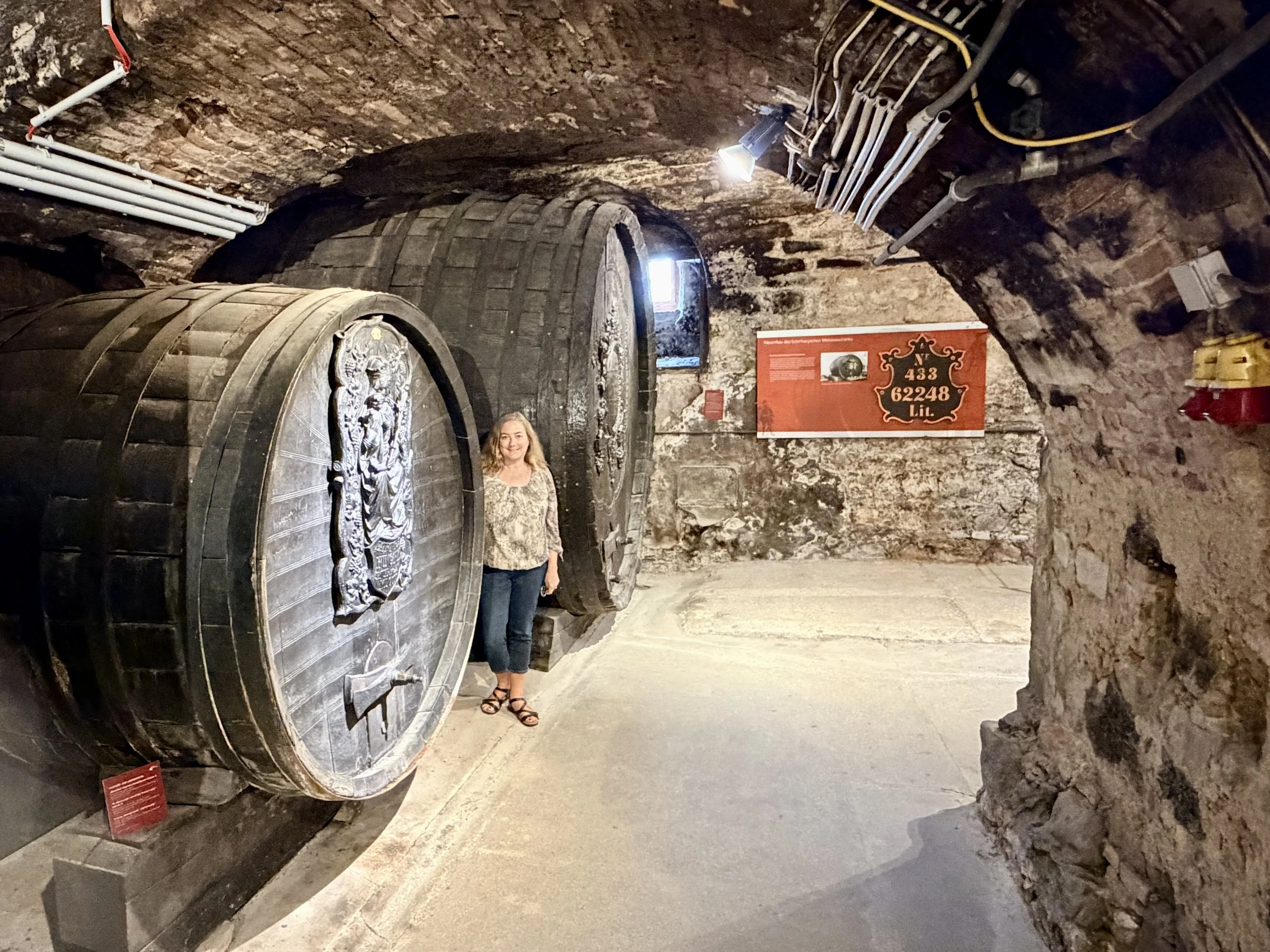
We enjoyed exploring the 300-year-old wine cellars directly beneath the palace that functioned as a massive, self-contained wine production and storage facility for the princely court.
The palace complex also includes the Orangerie, one of the largest historic greenhouse complexes in Europe, and the Stables, which were built directly across the main entrance square to house the family's elite cavalry and carriage horses. We walked by the former stables, but they no longer house horses. Instead, you can find an upscale restaurant, wine bar, and shops. Sadly, we did not have time to explore the Orangerie, the former stables, or the palace park and lake since this was only a one-day stop.
The next few places we visited I will only describe briefly here — you can more online if you are interested. The first is the Haydn House, where composer Joseph Haydn lived with his wife from 1766-1778. It features numerous original furniture items, instruments, and musical compositions.
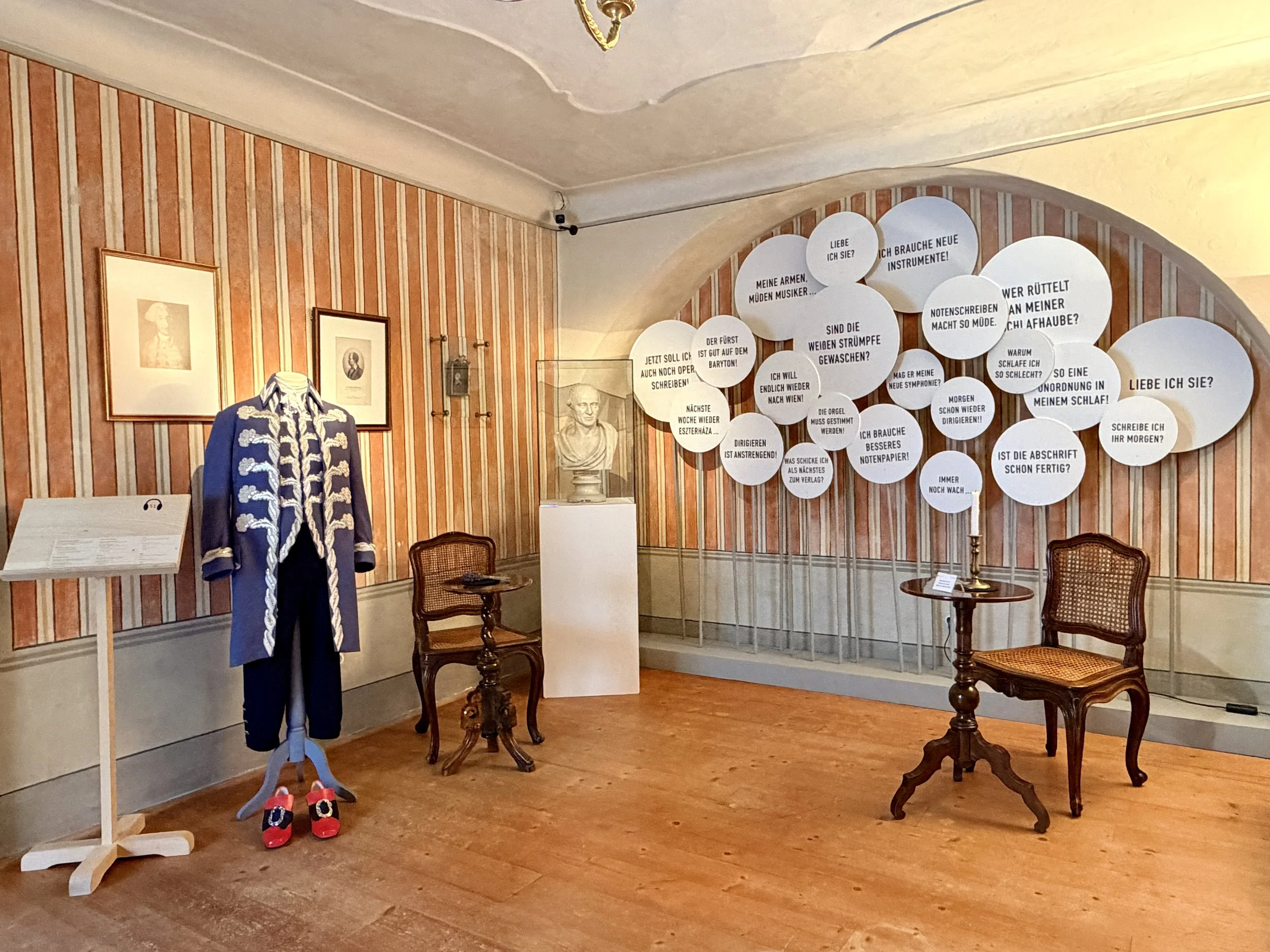
Here you can see the “uniform” Count Esterházy provided Haydn to wear so he could look like a “music director,” including the red platform shoes so “[his] stature may correspond with [his] knowledge,” according to a sign at the Haydn-Haus.
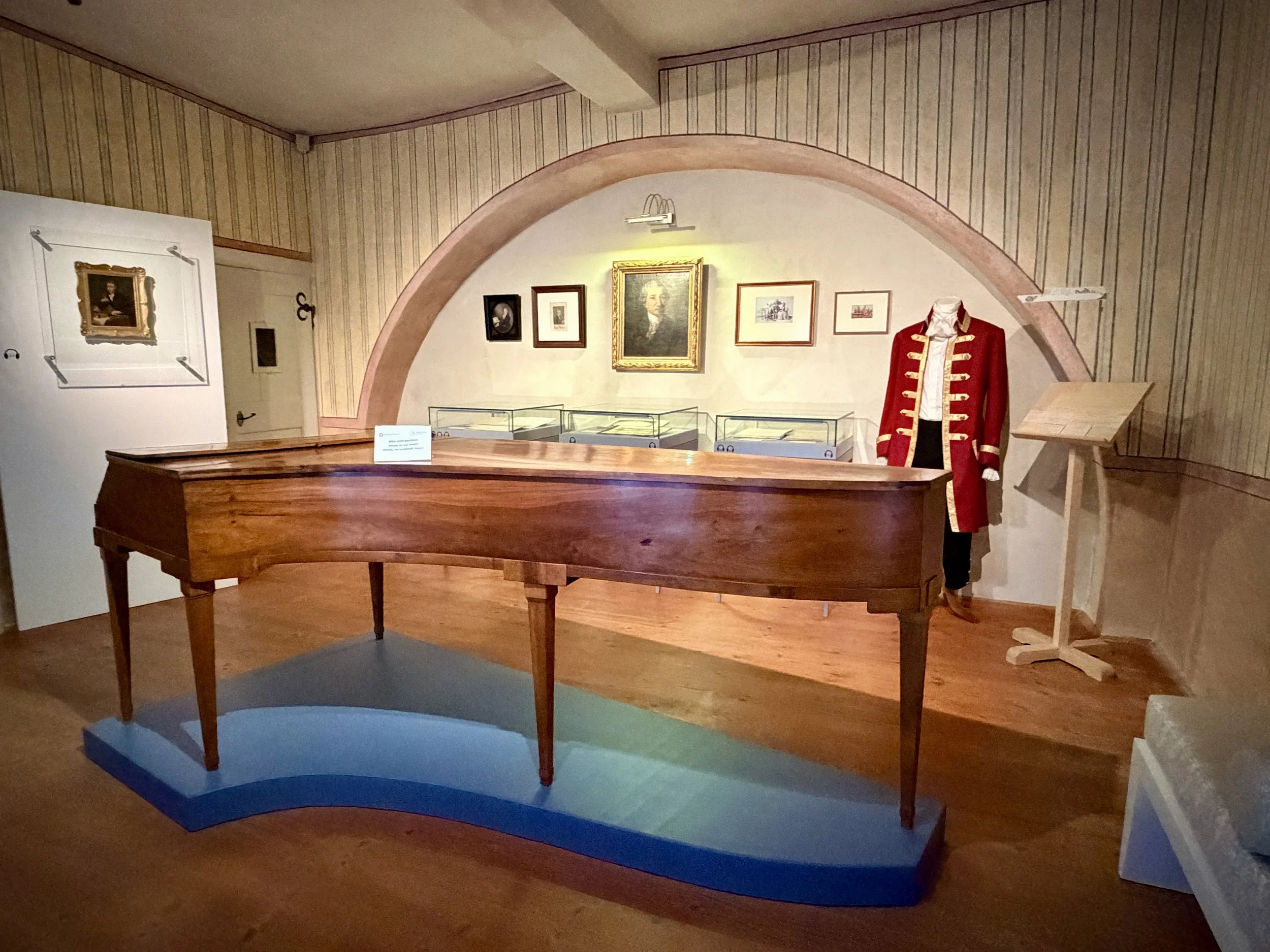
The fortepiano shown here dates from 1780 and is believed to have come from the Esterházy family’s summer residence, Eszterháza Palace, in Fertőd, Hungary, about 30 miles southeast of Eisenstadt; Haydn may have used this when coaching his singers.
We also visited two churches during our time in Eisenstadt. The first, The Franciscan Church and Monastery, holds the Esterházy family crypt. The second, the Bergkirche, is where Haydn is buried in the Haydn Mausoleum. We were too late to go inside, but we got a look outside the church. While we were at the Haydn-Haus, we learned the bizarre and very macabre story of Haydn’s skull. It involved grave-robbing, phrenology, a fake skull swap, and a 145-year journey to reunite his head with his body. You can read more HERE if you want to hear the strange tale.
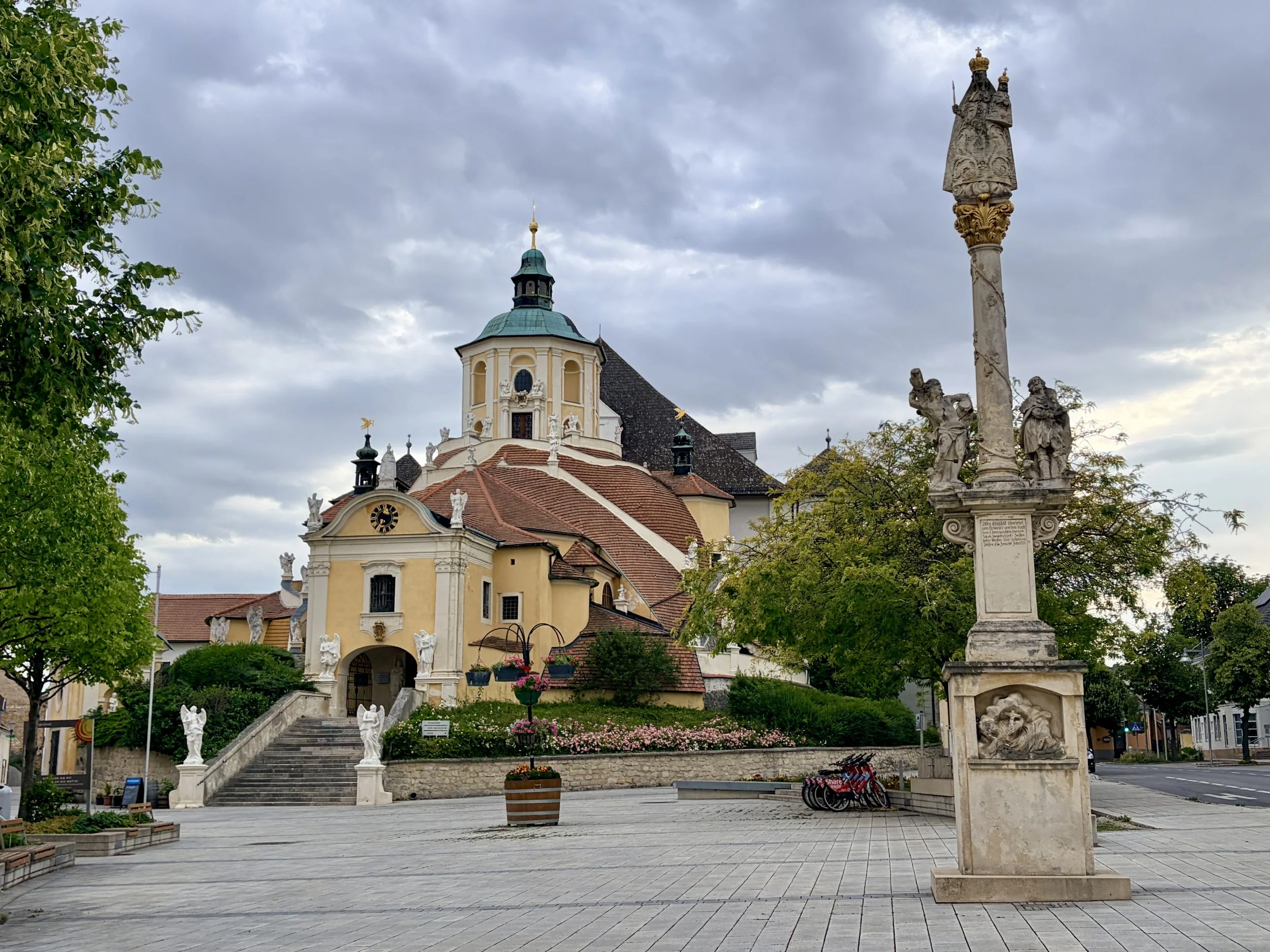
Composer Joseph Haydn is buried in the Hadyn Mausoleum inside Bergkirche in Eisenstadt.
Our final stop was at the Stadtvilla Eisenstadt museum — which they opened especially for us! It is normally closed on Tuesdays, but when I posted in the “Burgenland Bunch” Facebook page that I was disappointed we could not see it, Heike from the museum posted that they would open it for us. Even more, when we arrived, she said she hoped it was okay that the mayor wanted to come take his picture with us! So, he did — arriving with his photographer for a few photos, then posting about it on Facebook!
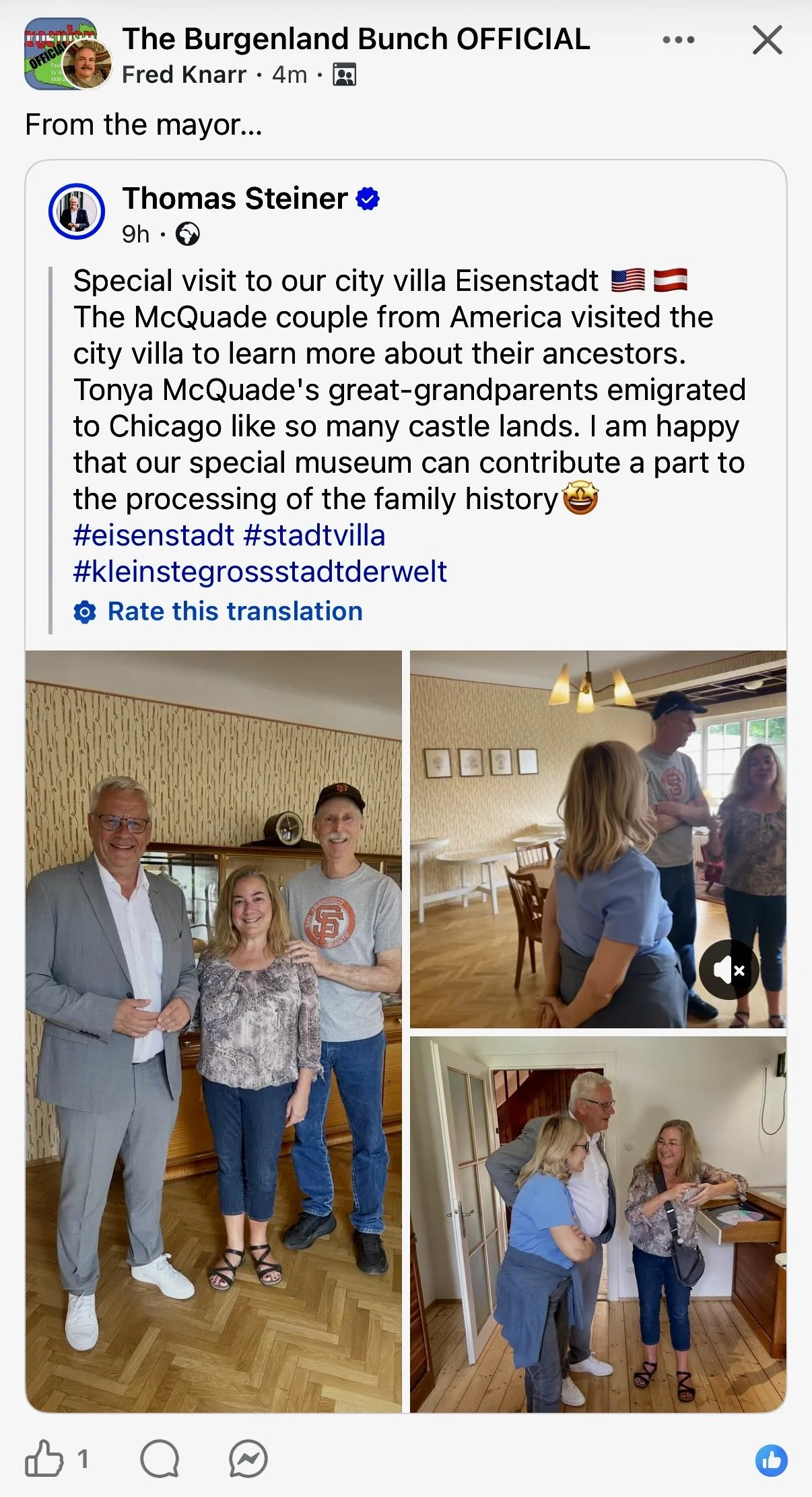
Here you can see us meeting with both Heike and Eisenstadt’s mayor, Thomas Steiner, at the museum.
The museum had many amazing exhibits, but I am going to save much of what I learned there for a future post that more fully describes Burgenland’s emigration history. It was because of those high emigration statistics that Chicago became “Burgenland’s biggest city,” with both John Wagner and Anna Halper adding to that number.
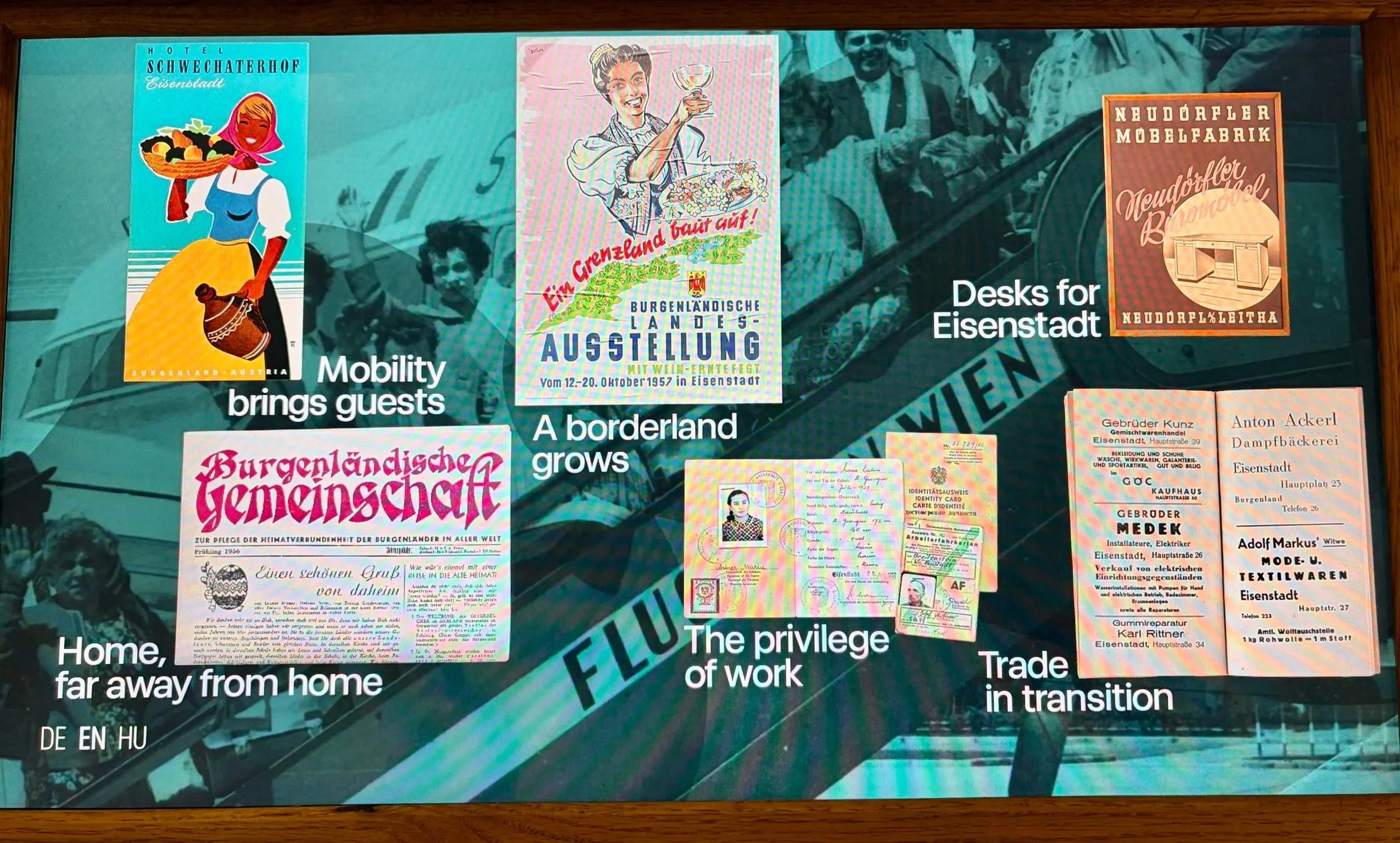
This touch display in one of the rooms presented LOTS of information and photos on a wide variety of topics; I found the “Home, far away from home” section, which talked a lot about Chicago’s Burgenlanders, especially interesting.
The museum takes a clever approach to telling that history, with visitors choosing a fictional character to follow on a listening device: a doctor, reporter, housekeeper, landlady, or dog. I chose the reporter, but I’m really curious how some of the other “voices” compared! The focus is on the 1950s and 1960s. At that time, WWII and the Soviet occupation were finally over. The economy began to recover, and people could again live in freedom and peace. The five fictional characters, representing many people in Eisenstadt, recount their experiences during this period. The narratives encompass real historical events, personal stories, and humorous or exciting anecdotes. The characters also provide explanations for each room and various items in the room.
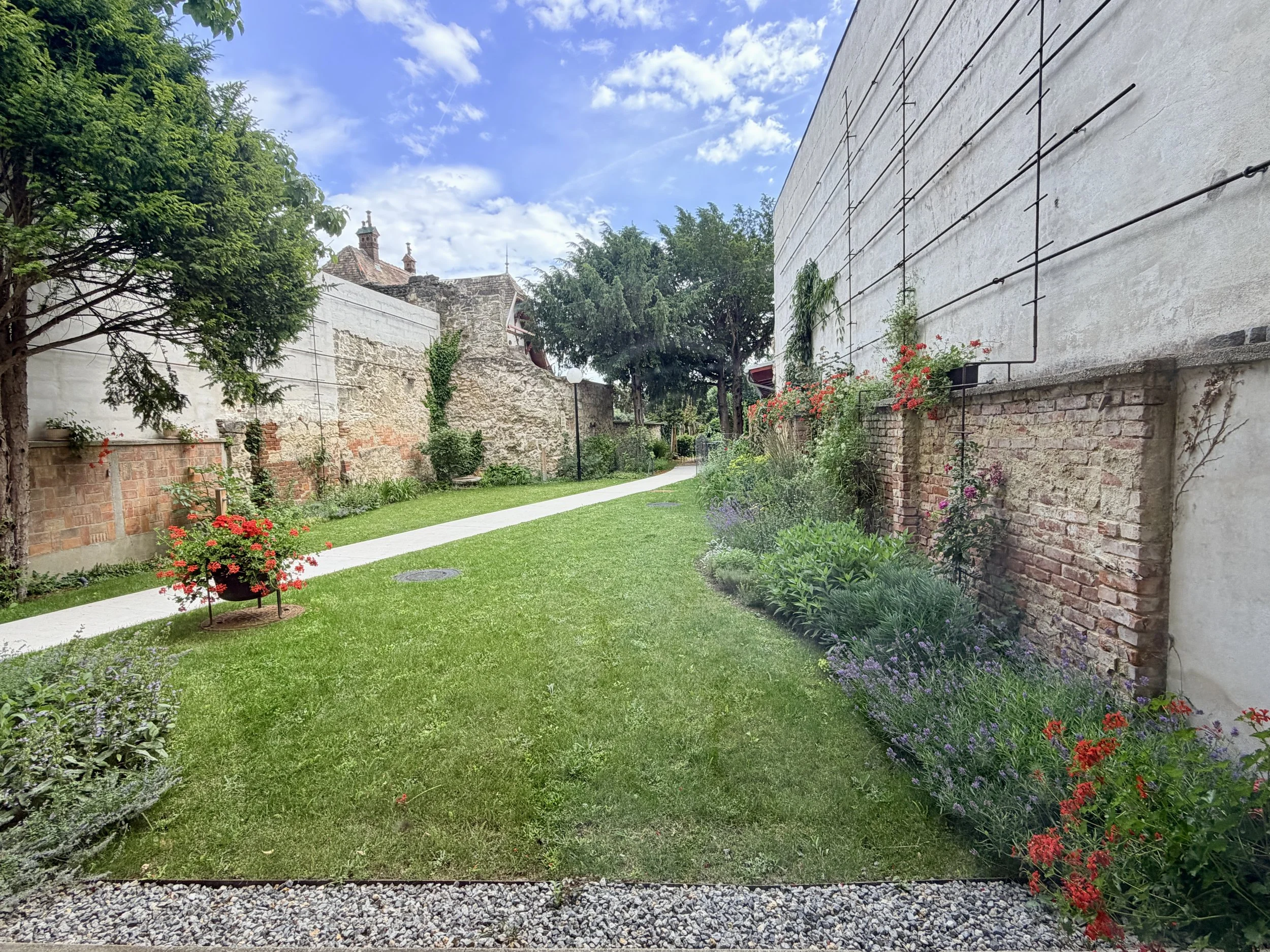
Here you can get a look at the area behind the museum, which includes a portion of the 700-year-old city wall on the left.
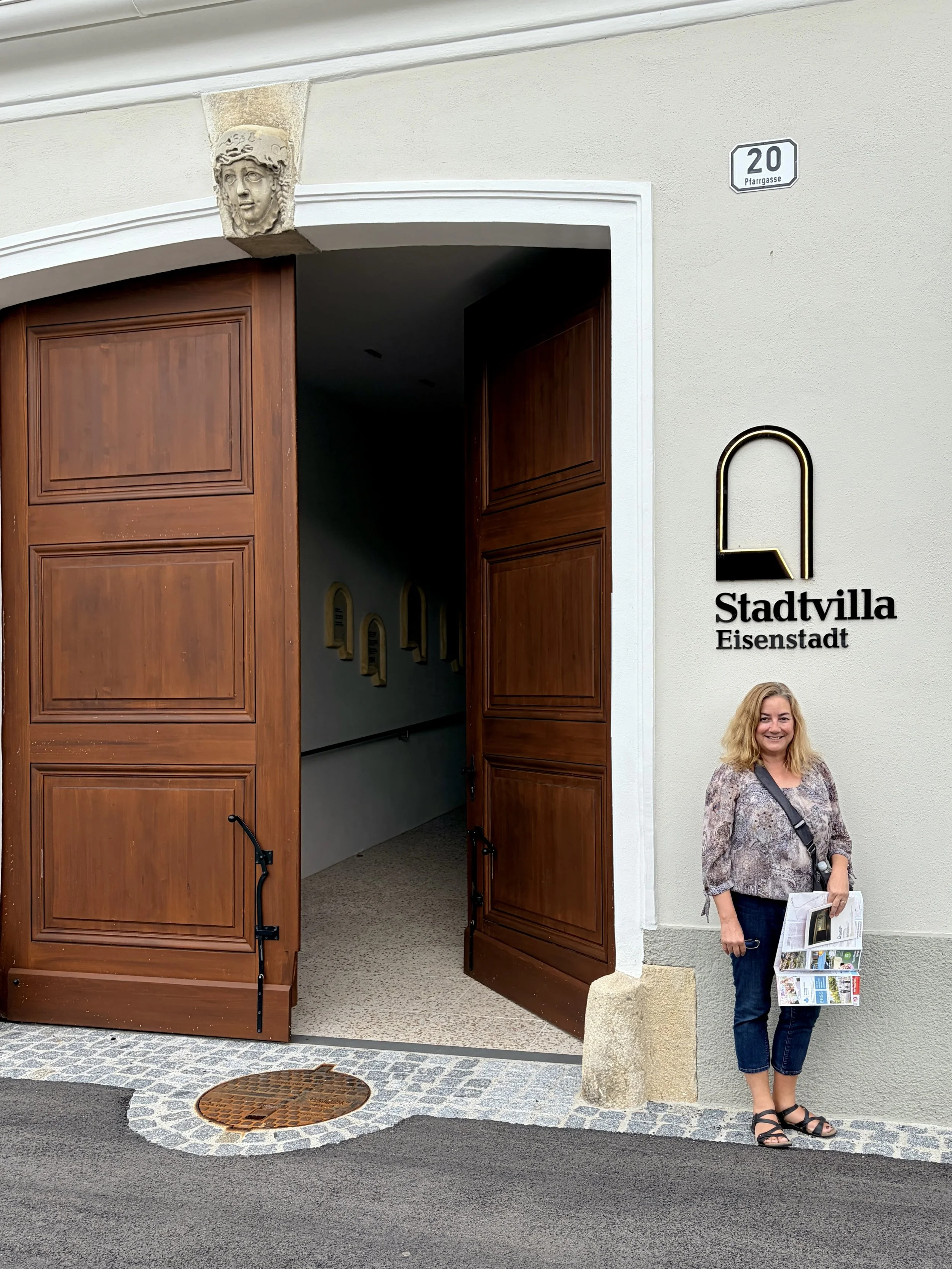
Here I am standing at the entrance to the Stadtvilla Eisenstadt museum, located at 20 Pfarrgasse in the downtown area.
Thanks for reading! Stay tuned for future posts, which will delve further into the museum’s exhibits, as well as describe our visits to Unterwart, Oberdorf, and Gussing in Burgenland. Be sure to subscribe on my website if you want to receive future quarterly newsletters (here is the most recent one) with updates on my blog posts and writing projects.
Endnotes:
“Travel Information - Historical.” Eisenstadt Tourismus. https://www.eisenstadt-tourismus.at/en/hotels-travelinformation/historical.
“Eisenstadt.” Wikipedia, https://en.wikipedia.org/wiki/Eisenstadt.
Ibid.
“Esterhazy Family.” Brittanica, https://www.britannica.com/topic/Esterhazy-family.
“Austria-Hungary.” Britannica, https://www.britannica.com/place/Austria-Hungary.
“Exhibitions - Wine Museum.” Esterhazy, https://esterhazy.at/en/exhibitions/wine-museum.
Ibid.