Exploring Burgenland, Part II: A Visit to Unterwart and a Brief Look at some Hungarian History — including Attila the Hun!
Chasing History: Exploring My Ancestral Roots - Post #69
by Tonya Graham McQuade
In my most recent blog post, I described our June visit to Eisenstadt, the capital of Burgenland, Austria, which included stops at Esterházy Palace, Haydn House, and the Stadtvilla Eisenstadt museum, as well as nearby Forchtenstein Castle. I also shared some basic history about Burgenland, with a focus on Eisenstadt and the Esterházy family. Here, I will delve a bit deeper into my “Wagner” family history, as well as the history of the Kingdom of Hungary, as I describe our visit to my great grandfather János/Johan/John Paul Wagner’s home village of Unterwart, which is in the district of Oberwart in the state of Burgenland. The following post will include descriptions of our visit to Oberdorf, where my great grandmother Anna Halper originated.
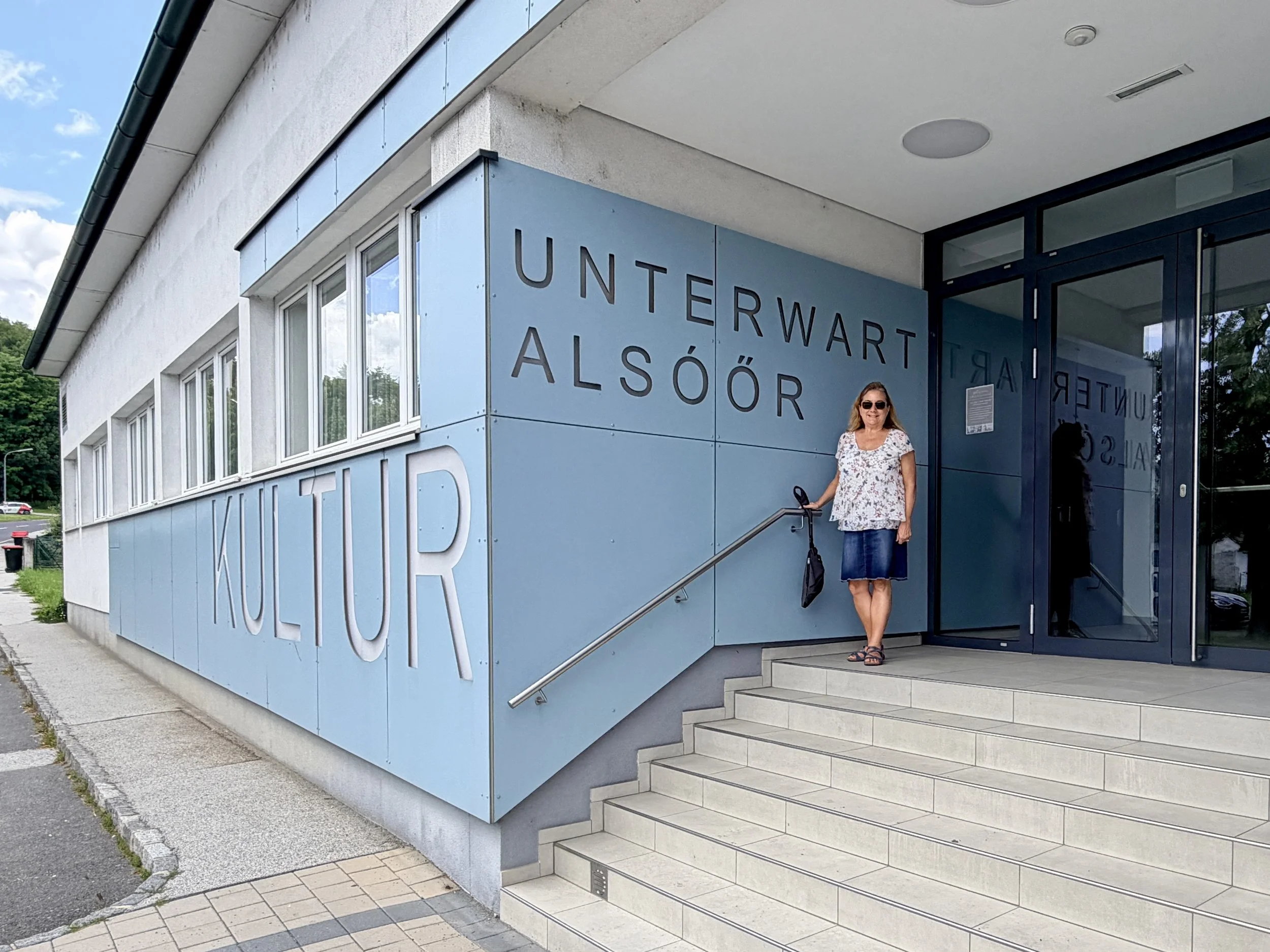
Here I am, standing in front of the “Kultur Haus” Cultural Center in Unterwart (aka. Alsóőr in Hungarian).
First, let me explain the three names. “János” is the Hungarian version; “Johann,” the German version; and “John,” the English version. Through age 24, when he immigrated to Chicago, Illinois, my great grandfather was mostly known as János. There are also Hungarian and German names for the towns I will be discussing: Alsóőr/Unterwart, Őrállás/Oberdorf, and Felsőőr/Oberwart are all the same places, with the first name being the Hungarian version in each case. To add to the confusion, all three used to be part of Vas County in the far western area of the Kingdom of Hungary, in a geographical zone known as Transdanubia (the lands west of the Danube River). However, as I explained in my last post, the 1920 Treaty of Trianon required that Hungary cede 72% of its land as punishment for its role in WWI. Vas County was split, with the more eastern part (including the former capital of Szombathely) remaining in Hungary and the more western part (including Eisenstadt, Unterwart, Oberdorf, and Oberwart) becoming part of the new state of Burgenland, Austria. All of this has certainly made my family history research a bit more complicated!
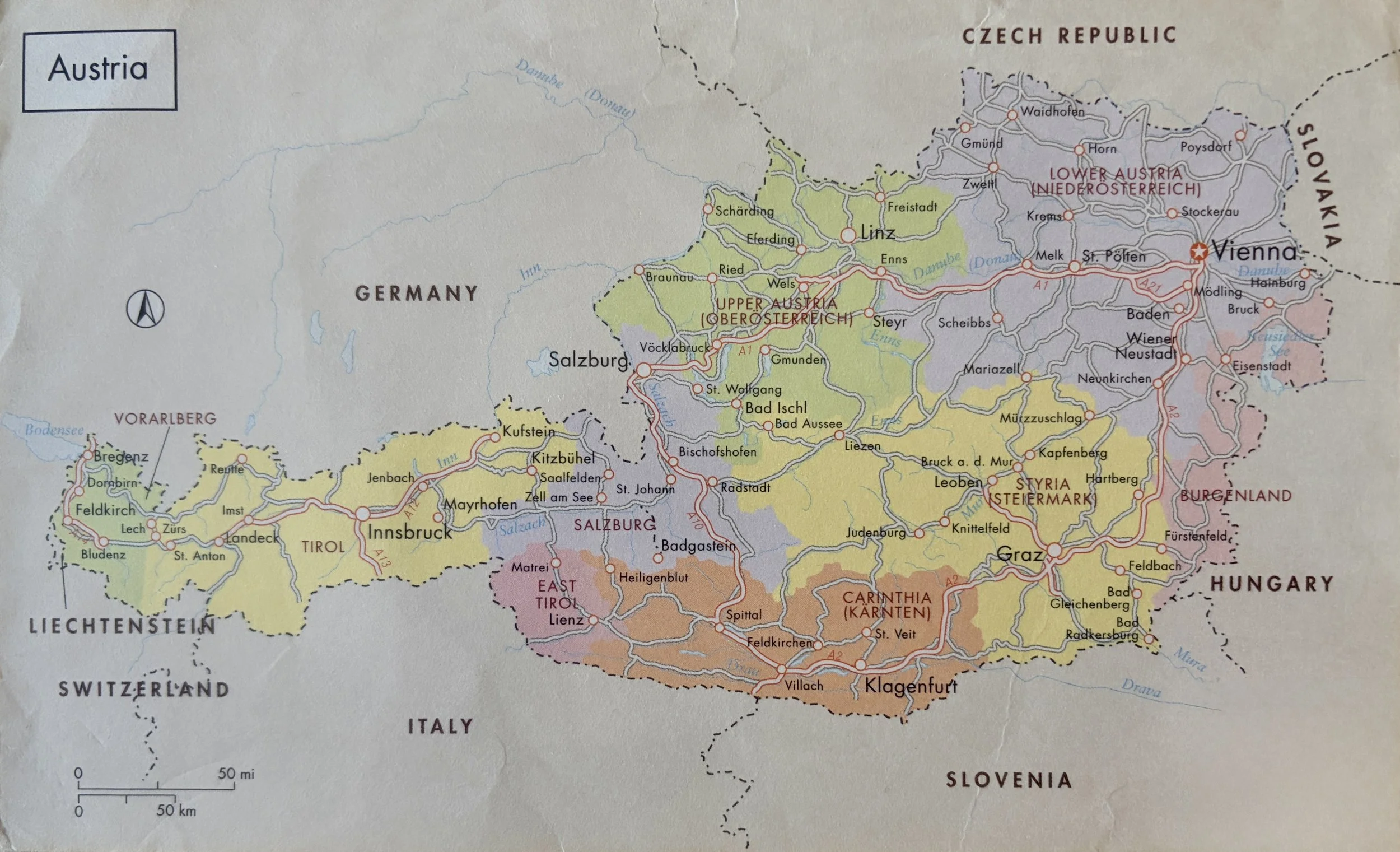
Austria has nine federal states (Bundesländer): Burgenland (on the eastern border), Carinthia, Lower Austria, Salzburg, Styria, Tyrol, Upper Austria, Vienna, and Vorarlberg. Each state has its own local capital and government, with Burgenland’s capital in Eisenstadt.
When it comes to my Wagner/Halper ancestors, I don’t have a bunch of letters, scrapbooks, news articles, or historical texts to guide me (as I do with the Hales, Petrees, and Traughbers on my dad’s side), so I’ve had to rely on much more “detective work” to fill in the gaps. Worker’s Books, Immigration Records, U.S. Census Records, Draft Registrations, Naturalization Papers, Death Notices, and Hungarian Church records have been important sources, as have recollections passed on by my mom’s Aunt Minnie (her father’s sister) and a few of my mom’s own memories of her grandparents. The “Burgenland Bunch” website and Facebook group have also been a big help, especially when it came to breaking through the “brick wall” to figure out who their parents were back in Hungary. I never met John Wagner – he died in 1965, before I was born. I do, however, have a few memories of Anna Halper, who died when I was five. I’ll share those next time. Here, I will focus on János Wagner.
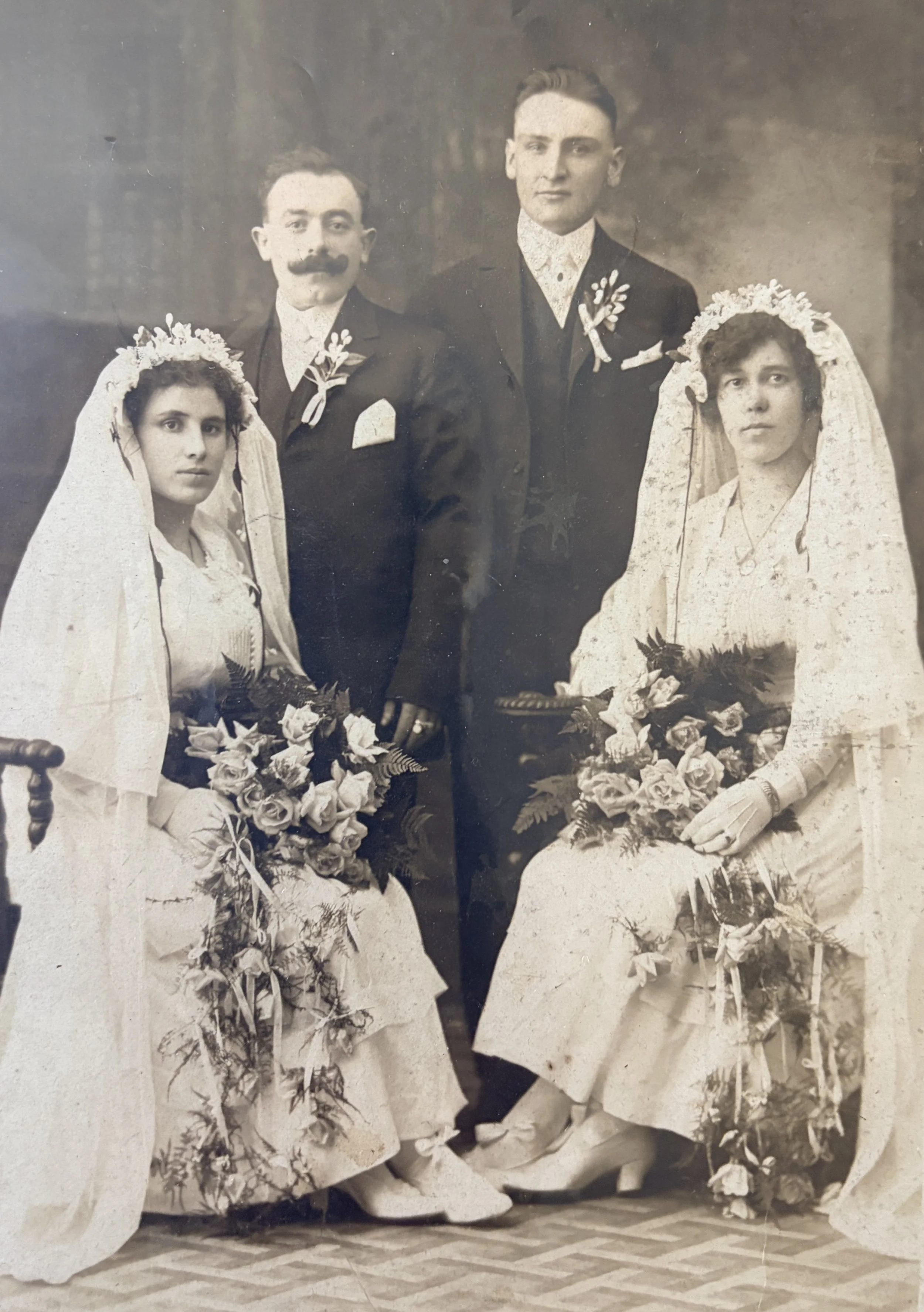
This is the earliest photo I have of John Wagner and Anna Halper, taken on their wedding day, 1 Dec 1917, at St. Augustine’s Church in Chicago; they are the couple on the left (it was a double wedding), but I’m not sure who the other couple is.
What did my mother remember about her grandfather? As she described, he was rather gruff, he liked to sit in his chair and smoke his pipe, he didn’t talk much, and he seemed to think where he came from was somehow “better than” the village where his wife came from. She also remembers him saying something about how his father or grandfather (or other ancestor?) had been some sort of mayor or leader in the town. She would have been surprised to learn her grandparents’ villages of Unterwart and Oberdorf are only six kilometers apart. She thought they were from “different worlds.” In fact, she told me one was from Hungary and the other from Austria – and that is what her father’s sister, Hermina “Minnie” Marie Wagner, wrote back in the early 2000’s when she typed up a brief family history. She said her father came from Hungary and her mother came from Austria.
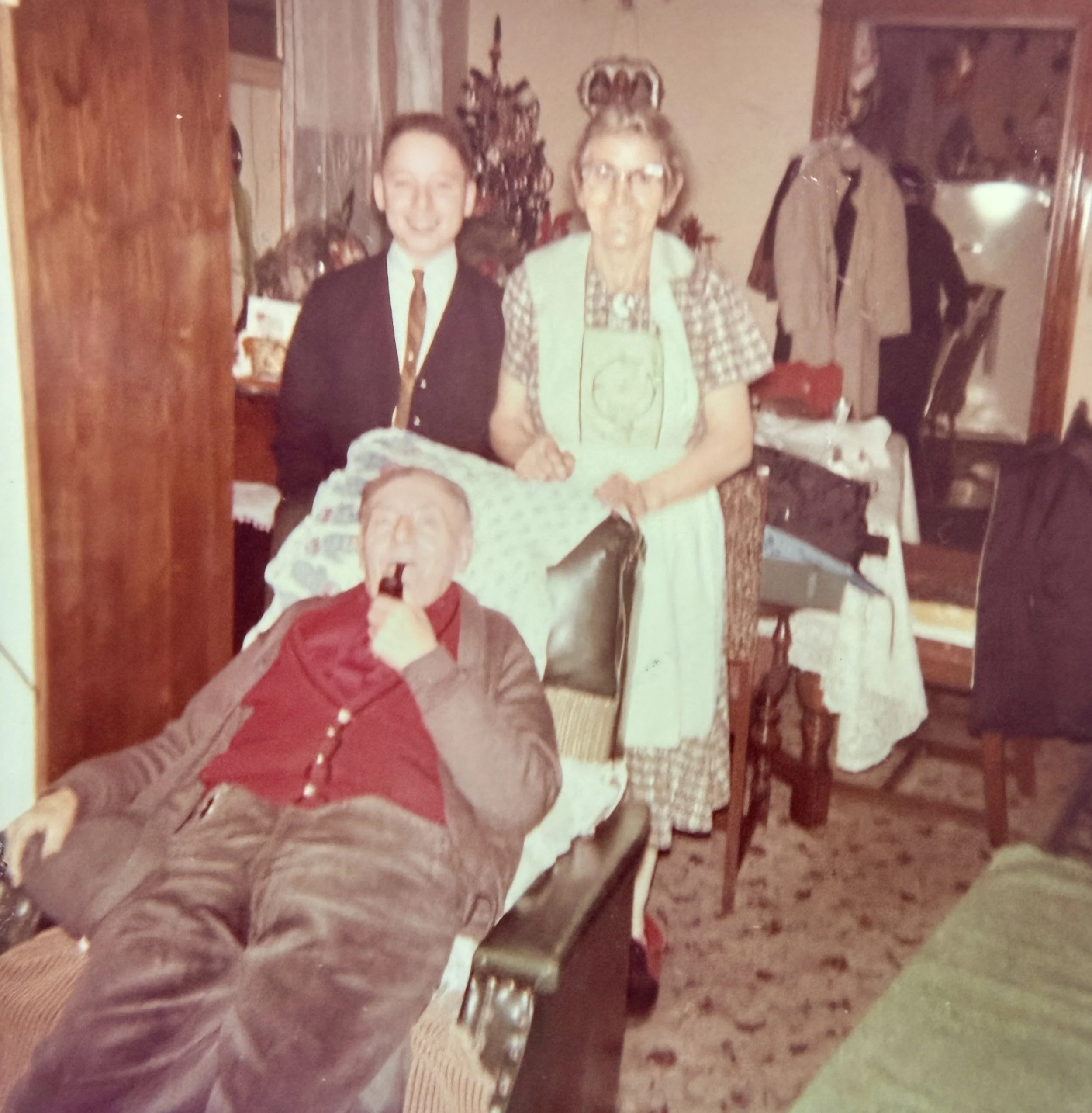
This picture (early 1960’s) fits my mom’s memories of her grandfather John sitting in his chair and smoking his pipe; her grandmother Anna and brother John stand behind him.
So, what might have created this inaccurate impression? As it turns out, even though they are only six kilometers (less than four miles) apart, Unterwart and Oberdorf are very different in their ethnic and cultural makeup and history. Both were part of the Kingdom of Hungary from their earliest beginnings in the Middle Ages until they suddenly found themselves part of Austria in 1921, but while Oberdorf was settled in the early 1400s as an agricultural and feudal village by German-speaking farmers, laborers, and craftsmen, Unterwart was founded around the year 1000 under the Hungarian Árpád dynasty by a sovereign group of royal border guards to safeguard the western frontier of the newly formed Kingdom of Hungary. Even today, Unterwart is one of only two settlements in Austria with an ethnic Hungarian majority and where Hungarian is the predominant language. So, let me tell you a bit about Unterwart and how it connects to Hungarian history …
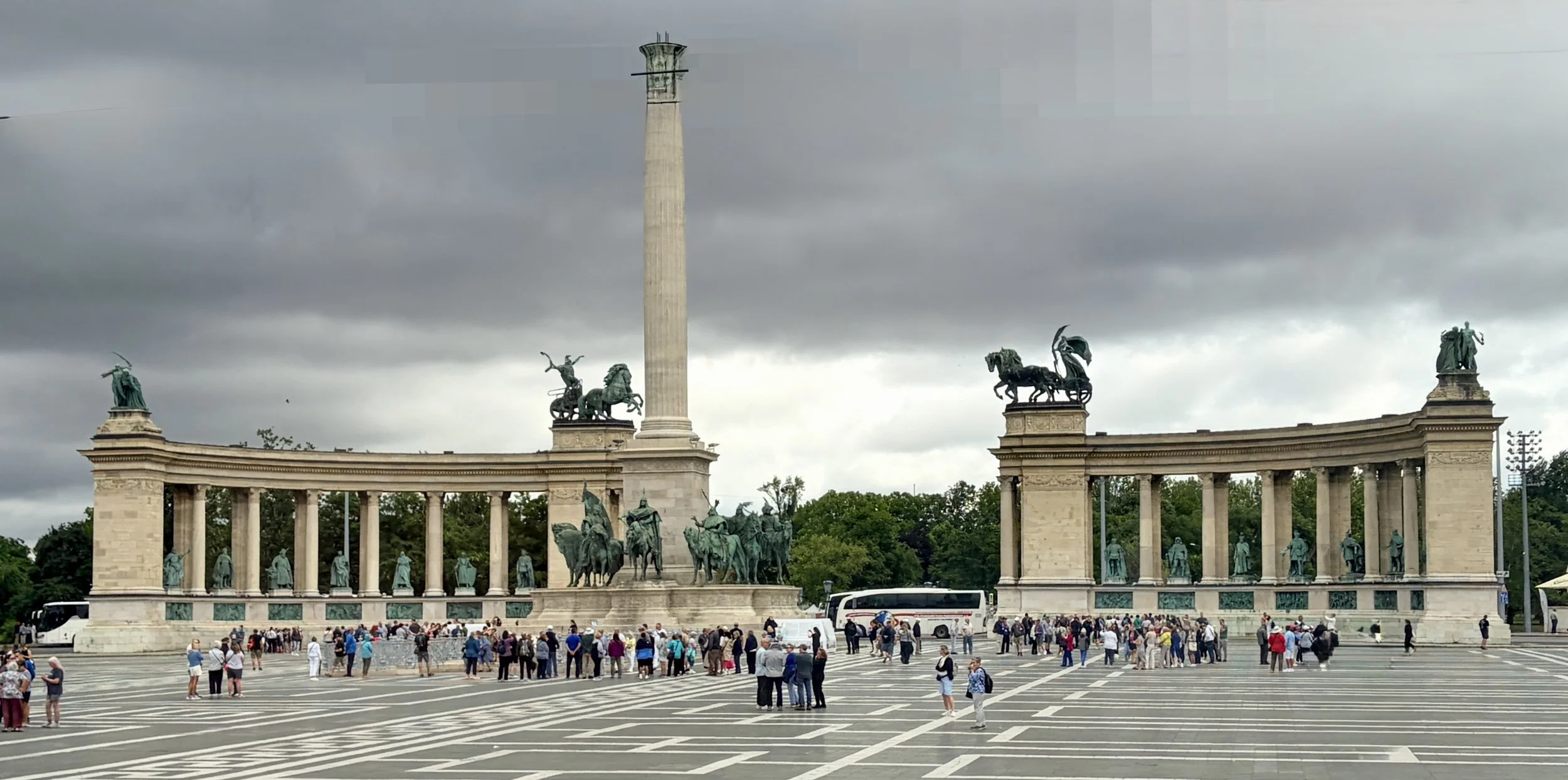
Millennium Monument in Heroes’ Square in Budapest features many Hungarian leaders of the past.
The Kingdom of Hungary (aka. Magyarország) celebrated its 1000th anniversary in 1896. The “Millennium Monument,” which now sits at the center of Heroes’ Square in Budapest, commemorates the Magyar (Hungarian) conquest and settlement of the Carpathian Basin in 896 AD. The 118-foot Millennium Column dominates the plaza and usually is topped by the Archangel Gabriel, holding the Holy Crown of Hungary and the Apostolic Double Cross. The statue of Gabriel was removed in 2024 for needed restoration, so we sadly missed out on seeing that.
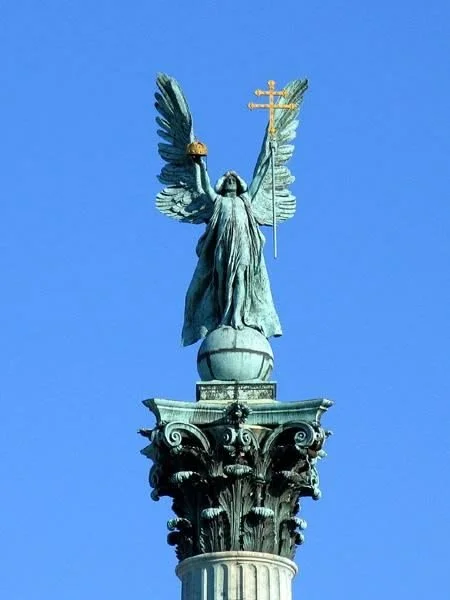
Here is a photo of the statue of Archangel Gabriel that usually sits atop the Millennium Column. [1]
So, why is the Archangel Gabriel usually up there? And why is he holding the Holy Crown of Hungary and the Apostolic Double Cross?
According to ancient Hungarian chronicles, the Archangel Gabriel played a key role in helping to forge the Kingdom of Hungary. As the story goes, in late December of the year 1000 AD, Pope Sylvester II sat in Rome with a magnificent royal crown prepared for the Duke of Poland. However, on the night before it was to be handed over, Gabriel appeared to the Pope in a vivid, prophetic dream, commanding him to halt the gift. Gabriel foretold that messengers from an unknown nation would arrive the following morning, and that this crown belonged to their leader. True to the vision, Bishop Astrik — sent by the far-off prince who would become King (and later Saint) Stephen I — arrived at the Vatican to request a crown for his newly converted Christian nation. Recognizing the angelic decree, the Pope handed the crown to the Hungarian envoys.
Now on display at the Hungarian Parliament, where it is under 24-hour military guard, the “Holy Crown of Hungary” (aka. the Crown of St. Stephen) has been used to crown more than fifty Hungarian kings, with the last being Charles IV in 1916. [2] We saw it on our Hungarian Parliament tour last month, but no photos were allowed, so the close up picture I have is of a replica we saw at the Treasury at St. Stephen's Basilica. There, the life-sized, hand-painted porcelain replica of the Holy Crown sits alongside the elaborate gala uniform of an Imperial Crown Guard. (I did manage to get this short video of the Changing of the Guard while on our Parliament tour, and if you look down the hall behind the marching guards, you can see the display case for the crown in the background.)
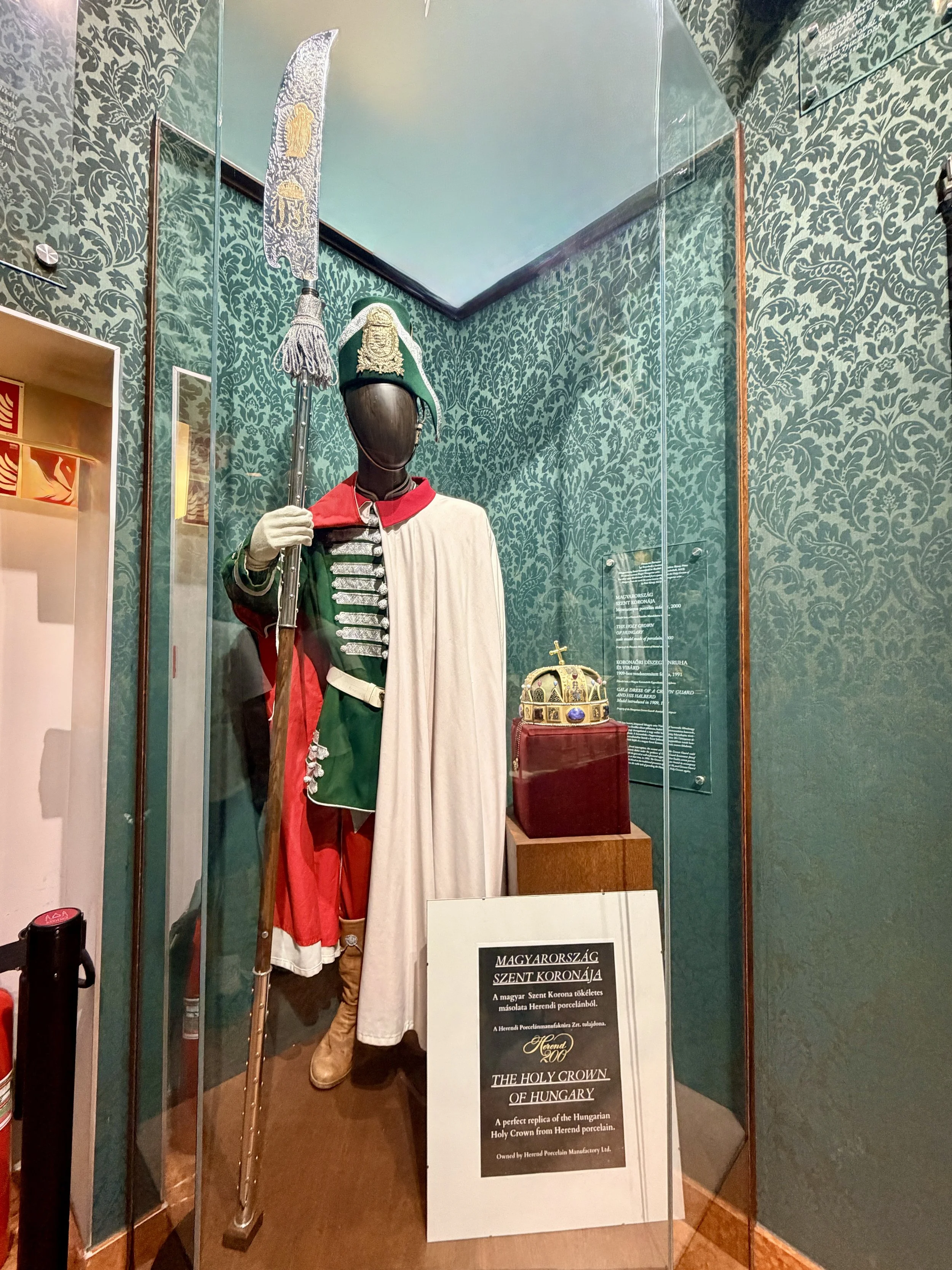
This replica of the “Holy Crown of Hungary” is on display at the Treasury at St. Stephen's Basilica, alongside an elaborate gala uniform of an Imperial Crown Guard.
And what exactly is an Apostolic Double Cross? It is similar to a Christian Patriarchal Cross, which has the two bars at the top, with the shorter beam representing the plaque bearing the inscription "Jesus, King of the Jews" (often abbreviated in Latin as "INRI") that was on Jesus’s cross. However, the Apostolic Double Cross specifically refers to a special papal mandate granted to a monarch (an Apostolic King) allowing them broad authority to found dioceses and manage the church within their realm – such as the power granted to King Stephen I by Pope Sylvester II. This specific double-cross symbol is featured in the coat of arms and national symbols of Hungary, as shown below.
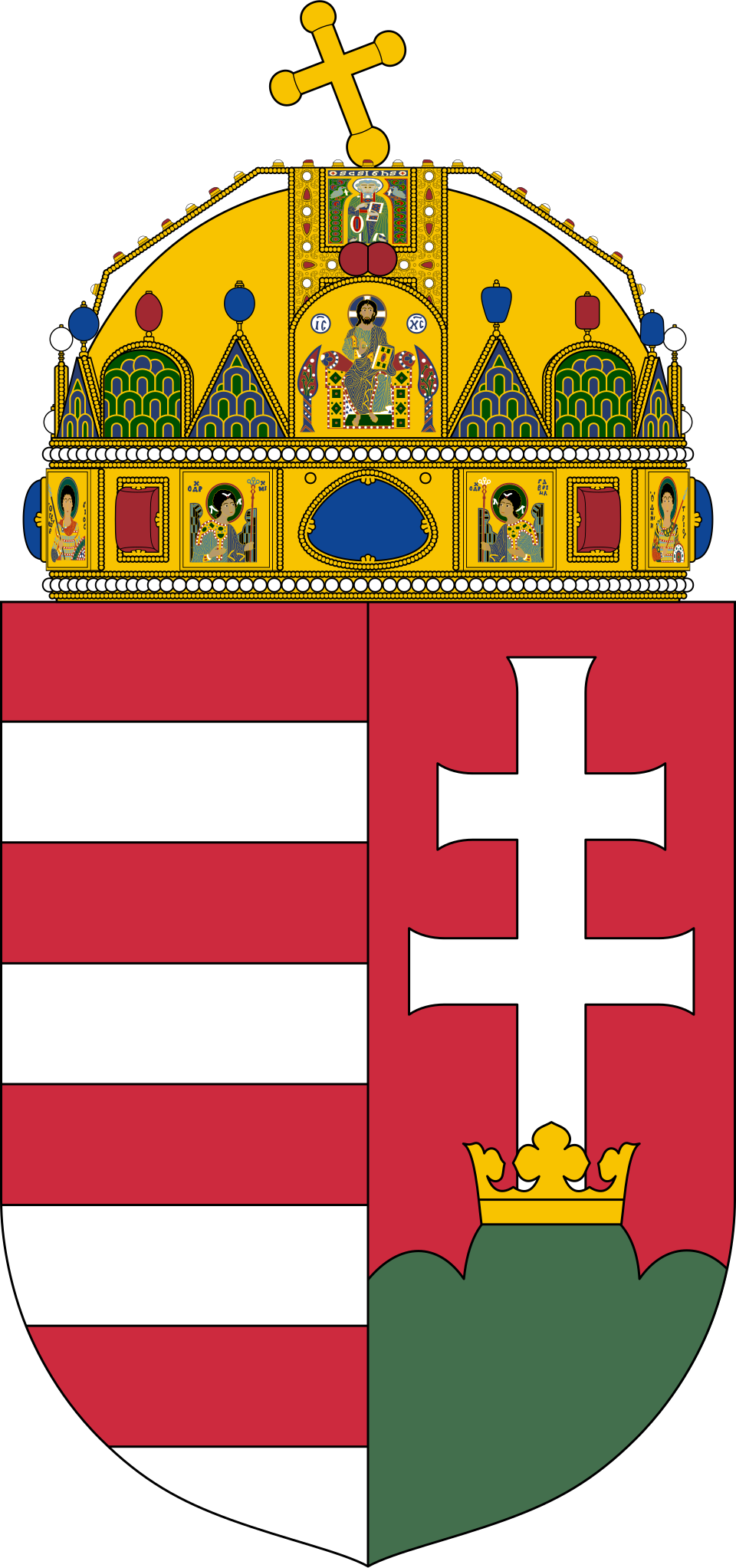
Both the Holy Crown of Hungary and the Apostolic Double Cross appear on Hungary’s Coat of Arms, along with the red and white stripes of the Árpád dynasty. [3]
King Saint Stephen I became the first Christian king of Hungary, but there were others who came before him who helped establish the Principality of Hungary before the kingdom was recognized by the Pope. At the base of the towering Millennium Column, looking ferocious, the Seven Chieftains sit astride their horses. They represent Prince Árpád and the six other tribal chieftains who led the Magyar tribes into the region. Behind the Millennium Column stand two massive, semicircular colonnades, which house 14 statues of Hungary’s most important historical figures. They are arranged chronologically from left to right, beginning with King St. Stephen I (975-1038) and ending with Lajos Kossuth (1802-1894), who led the 1848 revolution for Hungary’s independence from Austria (but was eventually defeated and forced to flee). In my last post, I also talked about King Matthias (1443-1490), who is included among the 14 honored leaders, along with his father. Beneath each leader is a detailed bronze relief depicting a pivotal scene from his rule.
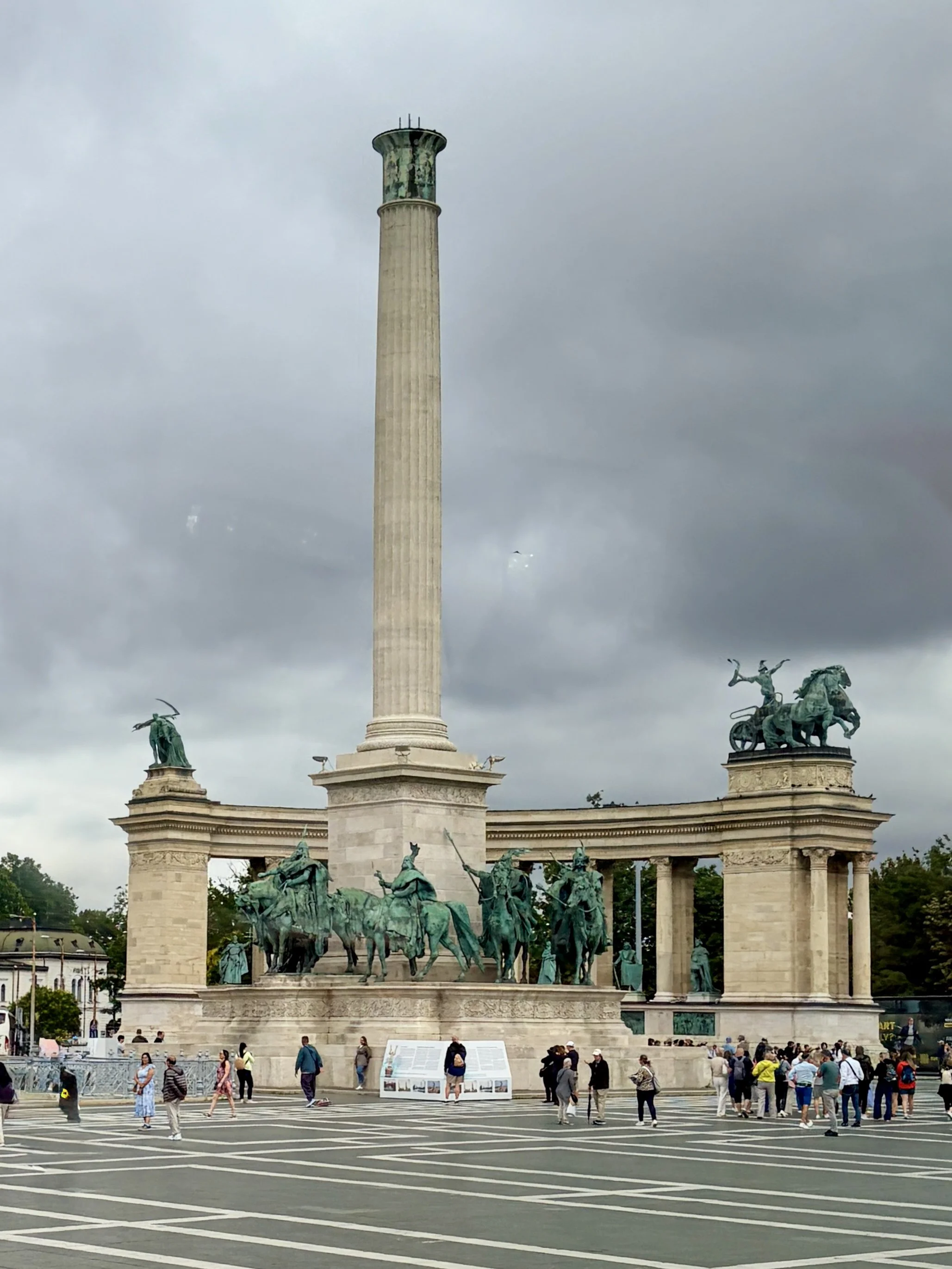
Here you can get a clearer view of the Seven Chieftains and can see where the missing Archangel Gabriel usually sits atop the Millennium Column.
So, where did these Magyar tribes come from? As we learned at an interesting exhibit at the Hungarian National Museum in Budapest, Prince Árpád was believed to be directly descended from Attila the Hun. Yes, that Attila! While many throughout history have branded him a barbarian, a scourge, or a devil, the Hungarians see him as a hero, and they see the Huns as their ancestors. And though Dante in The Divine Comedy’s “Inferno” placed Attila in a river of boiling blood in the seventh circle of Hell with other tyrants, in the Germanic tradition, Attila was seen as “a sovereign who had reached the pinnacle of his power, in whose court Germanic kings and warriors jostled for attention.” [4]
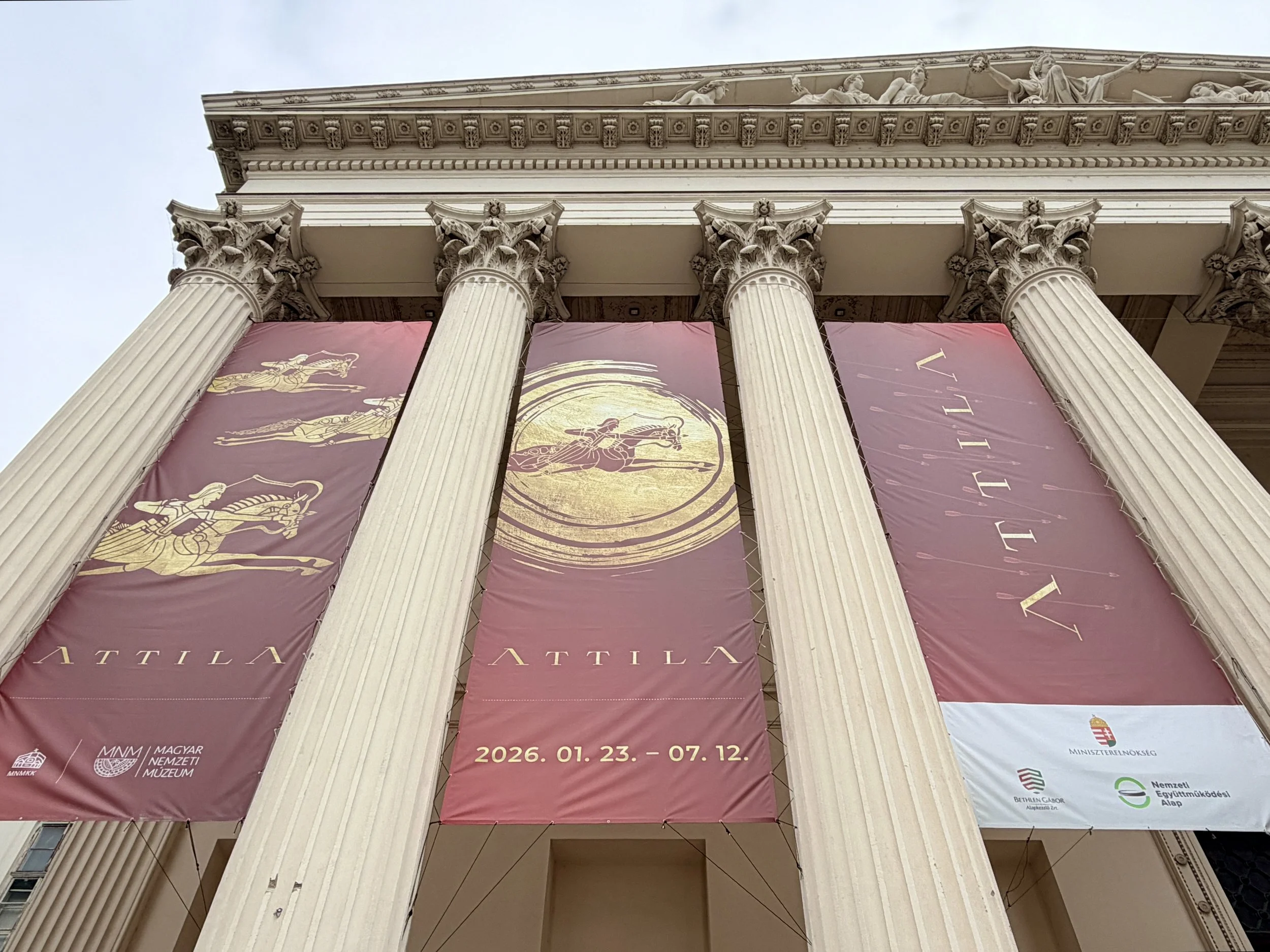
The Attila exhibit brings together 400 priceless artifacts from 64 museums across 13 countries as it considers his debated legacy: “Attila’s remembrance leads into the timeless realm of legends. He was both the mythical ancestor of the House of Árpád, and an instrument of divine retribution sent by God for chastising the Christians.”
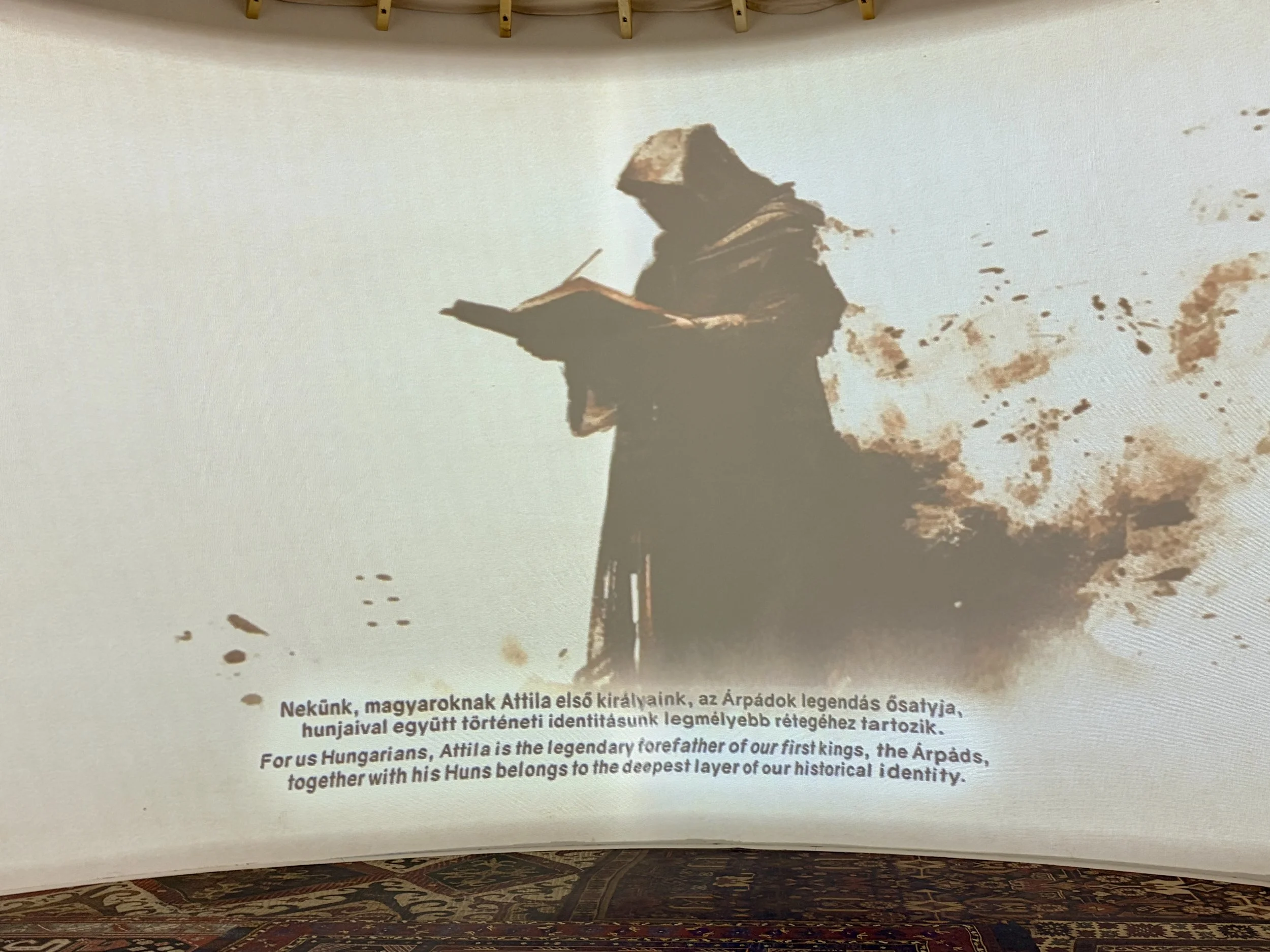
A brief film at the start of the exhibit provides some background information about Attila and includes this statement: “For us Hungarians, Attila is the legendary forefather of our first kings, the Arpads, [and] together with his Huns belongs to the deepest layer of our historical identity.” [5]
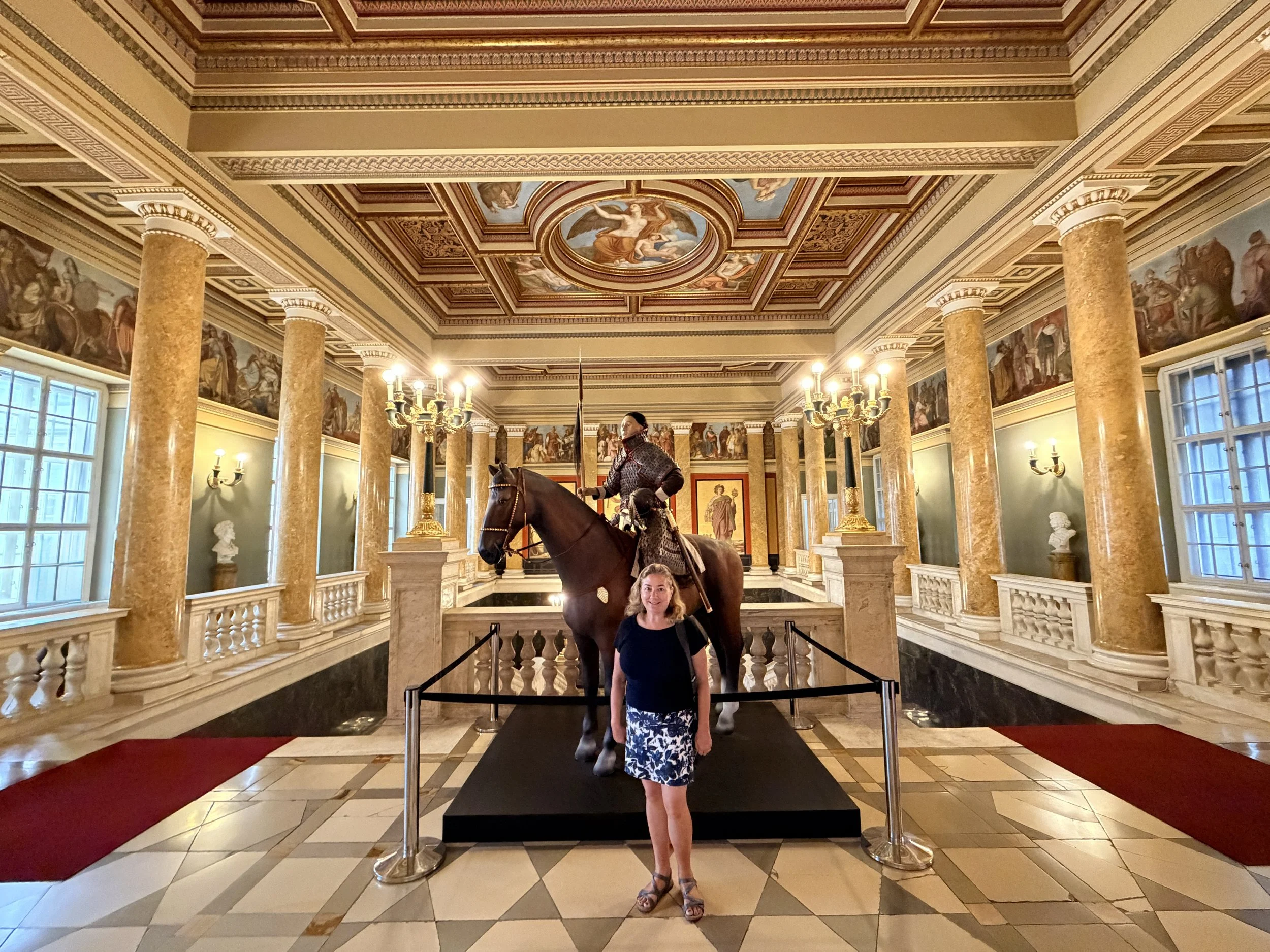
Here I am, standing near the entrance to the exhibit inside the beautiful Hungarian National Museum.
Clearly, people have different opinions of this fearsome warrior who was born into the Hunnic royal family in the Carpathian (aka. Pannonian) Basin that makes up modern-day Hungary and lived from approximately 406-453 AD. By the time he was born, the Huns had already swept in from the east, poured across the Volga River around 370 AD, overwhelmed the Alans (ancient Iranian nomadic warriors), and shattered the mighty Germanic kingdoms of the Ostrogoths and Visogoths. The Huns were masters of mounted warfare, and their attacks sent tens of thousands of displaced Germanic refugees fleeing west to the Roman Empire for sanctuary, igniting Europe’s historic “Great Migration Period.”
So, where exactly did the Huns come from? Were they descendants of the Asian “Huns,” the fearsome Xiongnu warriors who clashed with ancient China? For centuries, historians argued over that question. Today, modern DNA testing has proven that, while the vast majority of Attila's empire was of European blood, the ruling elite shared a direct, generational bloodline with the ancient Asian Xiongnu. They were a political dynasty that stretched all the way from the Mongolian steppe to Western Europe.
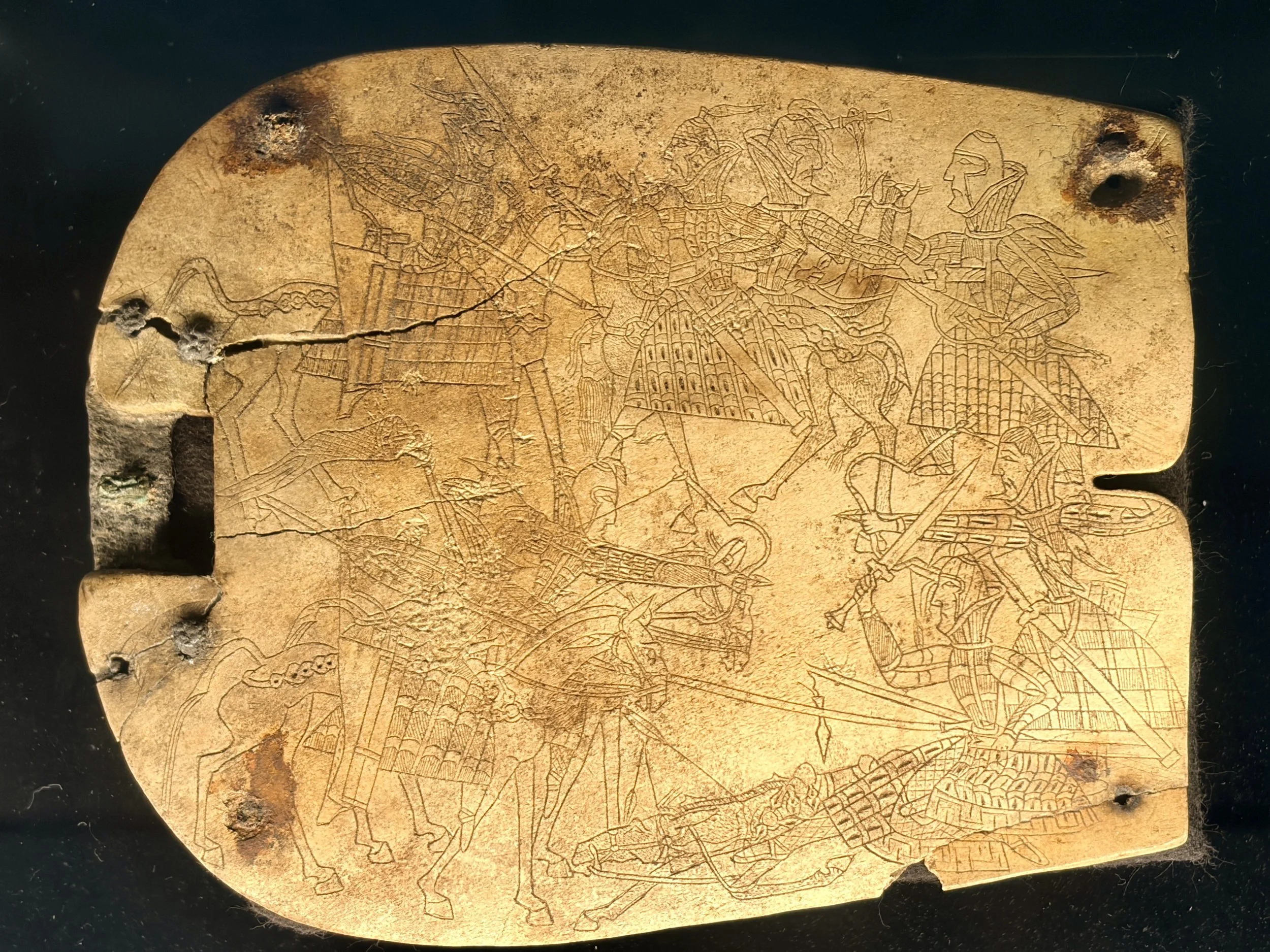
Archaeological evidence, such as the Orlat Plaques on display at the Hungarian National Museum (on loan from Uzbekistan for the first time), help further bridge the gap between the European Huns and the Asian Huns, who lived two centuries earlier. After the fall of the Asian Hun (Xioungnu) Empire, the Hun people began migrating westward, interacting and intermarrying with peoples of Central Asia and Eastern Europe, resulting in a very multi-ethnic population. The Orlat Plaques can be dated back to the period when the Huns passed through the Central Asia region. According to historians, “The costumes and weapons appearing in the battle and hunting scenes engraved onto the bone plaques were probably similar to how the Huns appeared to Europeans when they first encountered them.” [6] One example: the bows depicted match the unique, tilted, asymmetrical composite bows that gave the Huns their terrifying military advantage over the Roman Empire.
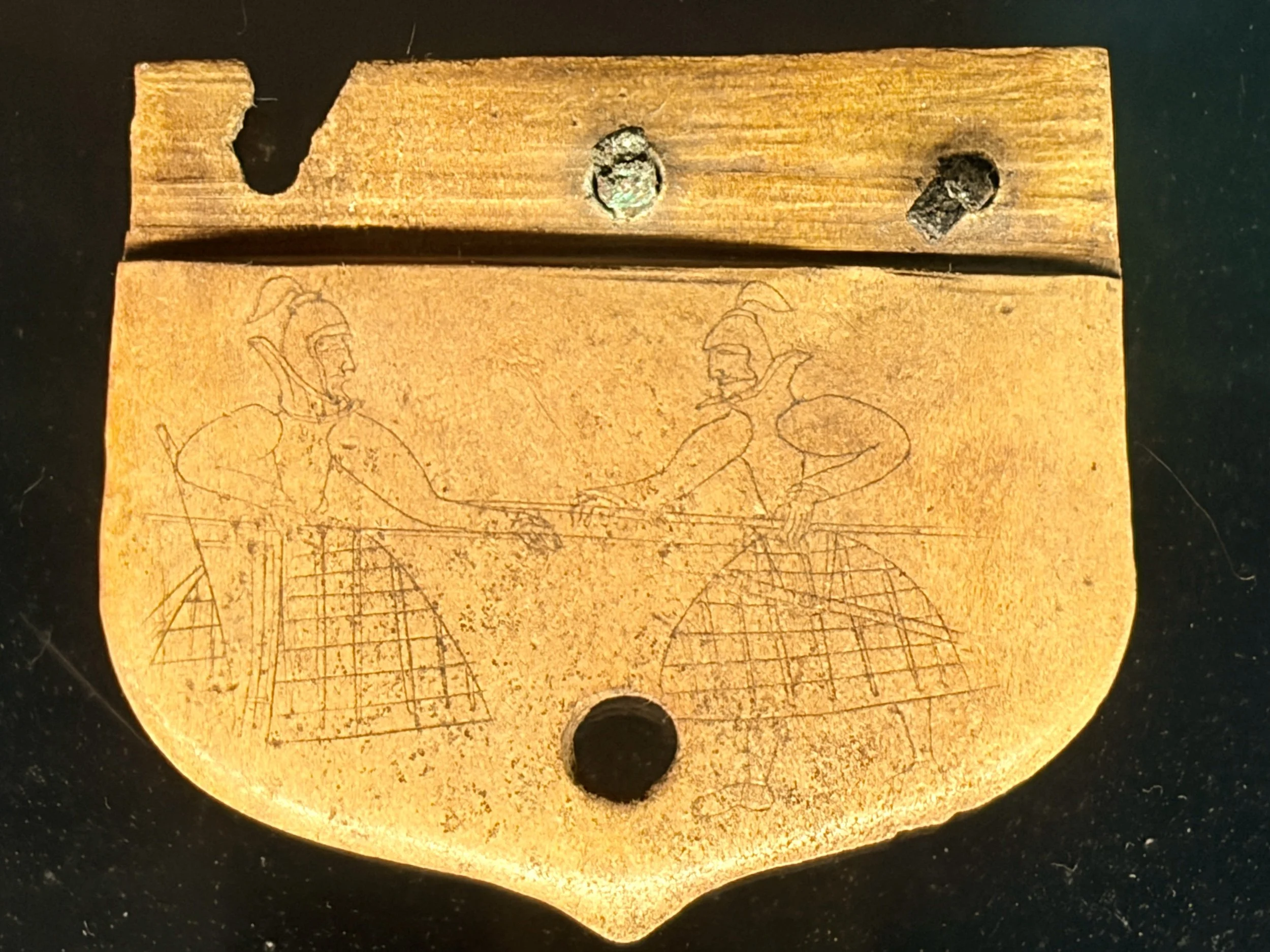
The Orlat plaques are a series of bone plaques that were discovered in the mid-1980s in Uzbekistan. The plaques are thought to have been decorative belt buckles, and they depict hunting and battle scenes that have been tied to the Huns.
Whatever the case, by the early 5th century, the Huns had established their permanent headquarters in the flat grasslands of the Lower Danube region and the Carpathian Basin. It was from this strategic basin that Attila would rise to power a few generations later, transforming a loose confederation of horsemen into an empire that terrorized the continent from the Rhine to the Caspian Sea. It was also here that he would build his finely polished wooden palace, which was described in detailed eyewitness accounts by Priscus of Panium, a Roman diplomat and historian who visited Attila's headquarters in the Great Hungarian Plain in 448 AD. It was likely here, too, that he was secretly buried in three coffins — gold, silver, and iron — along with significant amounts of treasure and weapons, likely near the Tisza River. Those who buried him were immediately executed afterward so they could never reveal the secret location — which has never been discovered to this day.
So, what exactly is the Carpathian Basin? It is a vast, bowl-shaped geographic region located in Central Europe that is completely encircled by mountain ranges. The Carpathian Mountains curve around the north, east, and southeast, forming a massive semi-circular wall. The Alps form the edge of the basin on the west, and the Dinaric Alps border it along the south. The Danube River and the Tisza River flow right through its flat, fertile lowlands. Today, nine different countries lie at least partially in the Carpathian Basin: Hungary (which sits right at its epicenter), Slovakia, Romania, Serbia, Croatia, Ukraine, Austria, Slovenia, and Czechia. Parts of Poland and Bosnia and Herzegovina are sometimes included.
The Huns devastated many Eastern Roman provinces, burning regional cities and infrastructure in the Balkans and extracting immense sums of gold as tribute from Constantinople, thereby draining the Eastern Roman treasury. It was St. Isidore of Seville who first called the Huns the ‘scourge of God,” sent by God to punish Christian communities for growing too weak and comfortable and for failing to live up to the moral expectations of their faith. Isidore compared the Huns to the ancient Persians and Babylonians of the Old Testament. Just as God used pagan empires to discipline Israel, He used the Huns to discipline the early medieval Church.
Other Christian saints were credited with helping deliver their cities from the Huns through their intense prayers, sacrifices, or even their conjuring of dense fog. One example of this was St. Genevieve, who became the patron saint of Paris: “According to the legend, when Attila crossed the Rhine in spring 451 and was marching on Paris, the simple peasant girl gathered the women of Paris for a ‘prayer marathon,’ in the wake of which Attila turned south towards Orleans instead of moving on Paris.” [7]
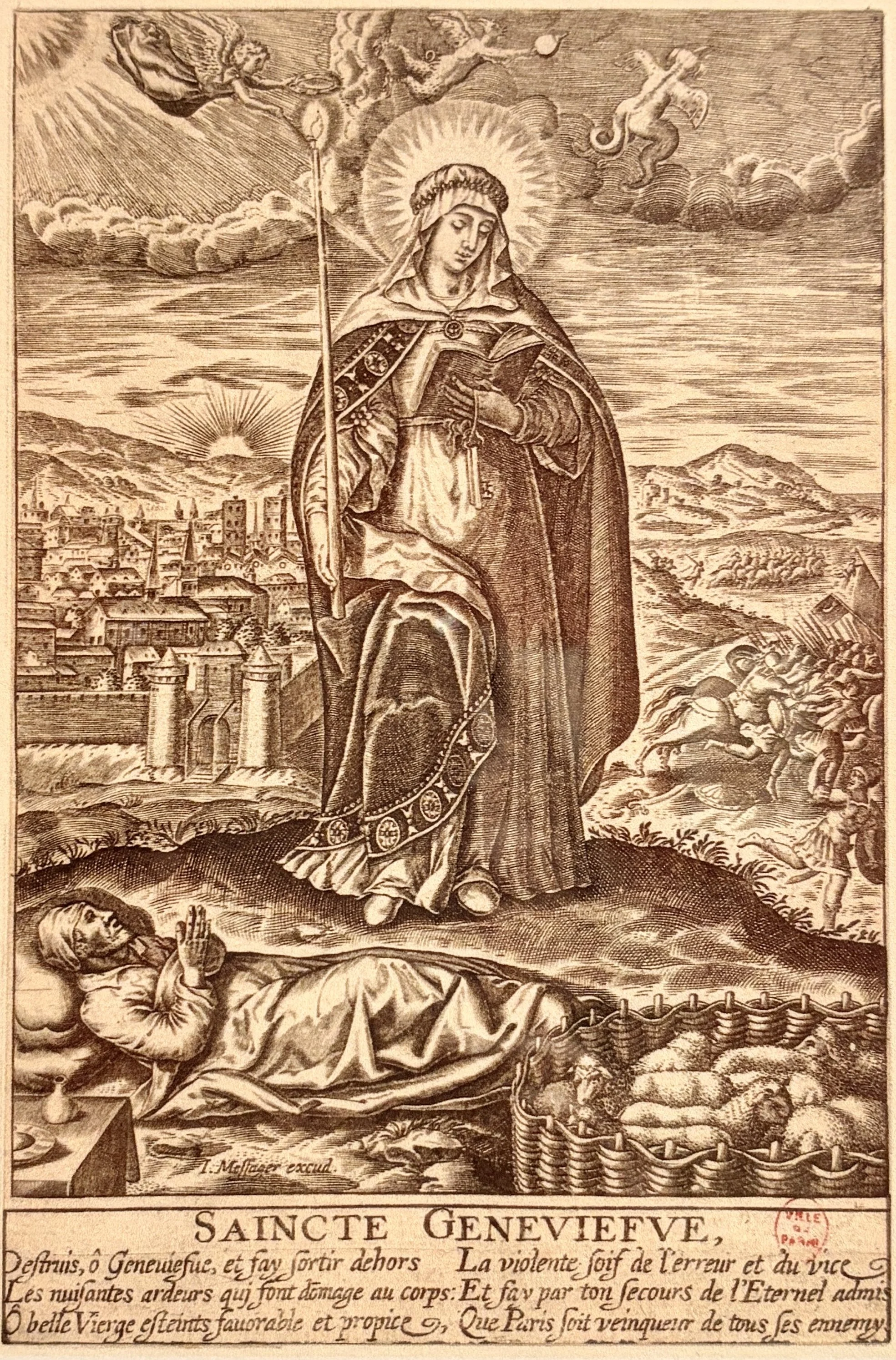
The prayers of St. Genevieve are credited with helping to save the city of Paris from the Huns in 451 AD.
Many local legends also arose around the saints Attila and the Huns massacred. One of those legends surrounds “The Martyrdom of Saint Ursula and the Eleven Thousand Virgins,” as depicted in the mid-17th century painting below by an unknown Flemish artist. According to the legend, Ursula, the daughter of the King of Brittany, sailed down the Rhine River with her entourage to Cologne and arrived on the very day that the Huns took the city. They massacred the 11,000 virgins accompanying her, but Attila wanted to marry Ursula. When she refused, the Huns showered her body with arrows.
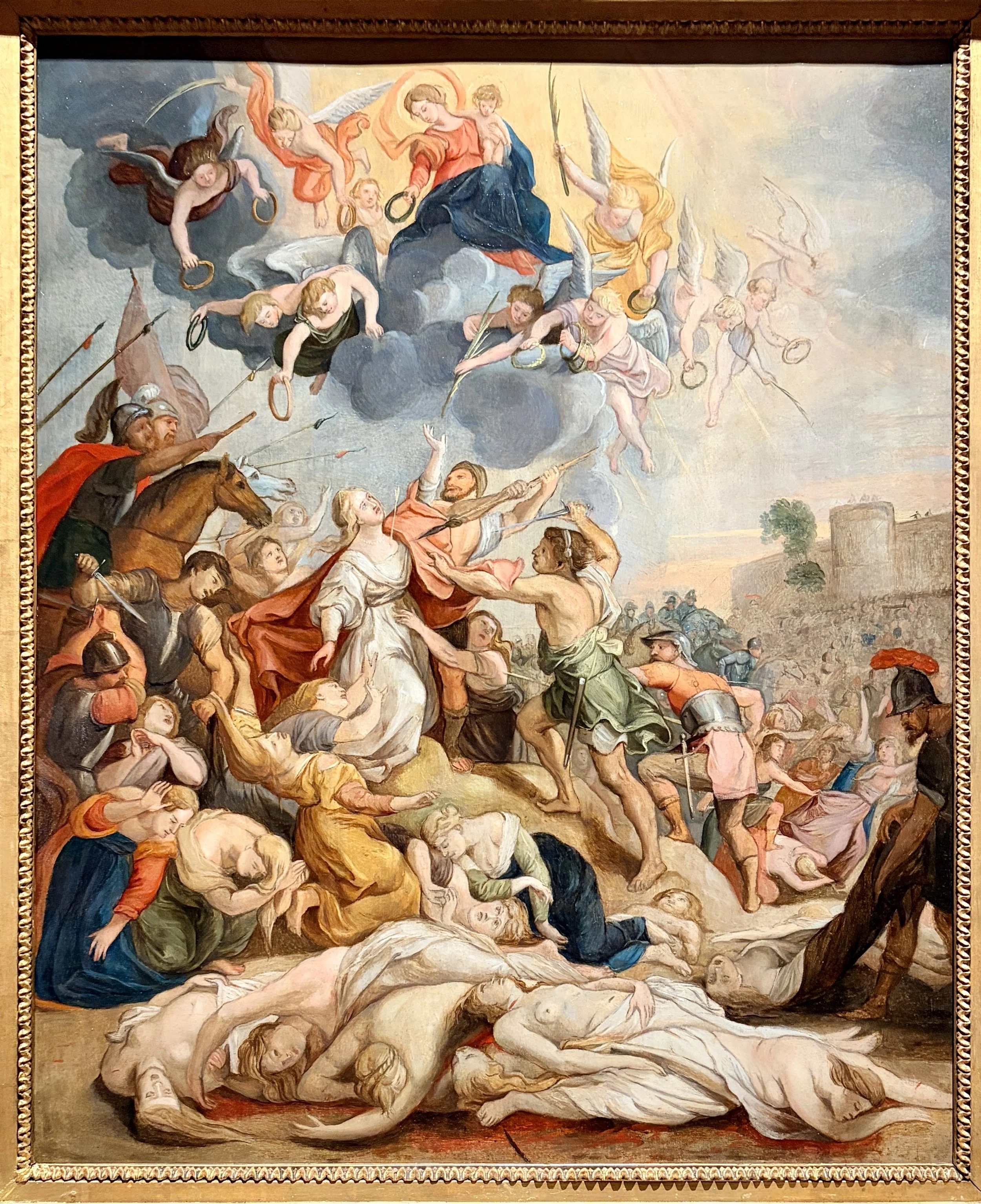
“The Martyrdom of Saint Ursula and the Eleven Thousand Virgins,” as depicted in the mid-17th century painting below by an unknown Flemish artist.
Between 422 and 452 AD, Attila led at least 11 military campaigns, many of them against the Eastern Roman Empire. It was in early 451 AD that Attila led his massive, multi-ethnic army of around 200,000 men across the Rhine River into Gaul (modern-day France). There, they fought the bloody Battle of Catalaunum against the Romans and various allied Germanic groups, and they experienced their first and only defeat before retreating.
They then marched against Italy the following year, occupying several towns in northern Italy, including Milan. When Attila set out to march on Rome, however, he was met by an embassy led by Pope St. Leo I the Great at Mantua. When Pope Leo – acting as an envoy for Roman Emperor Valentinian III – offered tribute and begged for peace, Attila agreed. According to the Pope’s 13th century biography, this came about because “a bearded old man appeared in the sky, drew his sword, and spoke to Attila: ‘If you do not obey him, you will perish together with your men.’” [8]
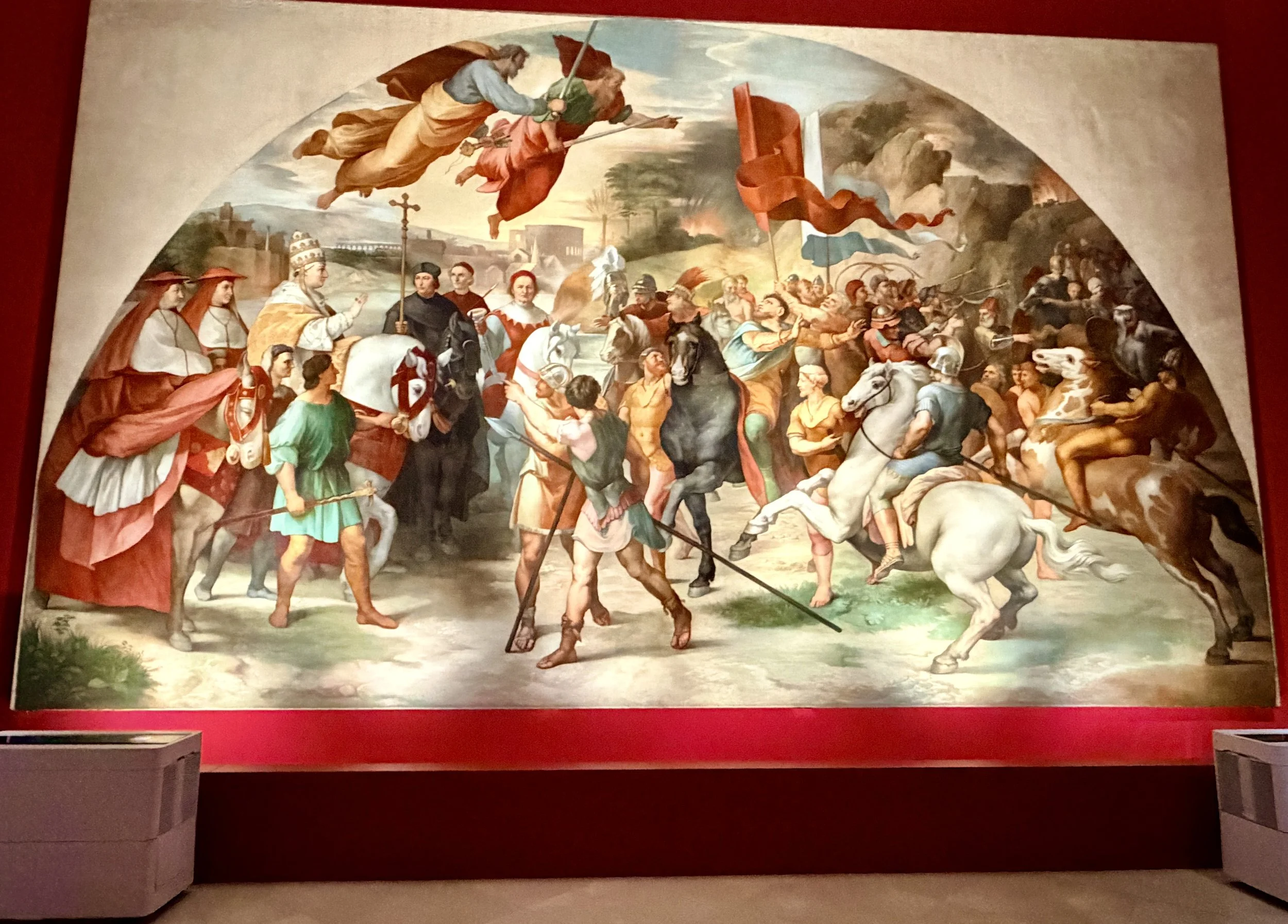
This copy of Raphael’s original fresco for the Vatican, titled “The meeting of Pope Leo I the Great and Attila” (1514), by Antal Haan, is currently on display at the Hungarian National Museum for the first time in 120 years.
In the above painting, which is a copy by Antal Haan of Raphael’s original 1514 fresco for the Vatican, this scene is played out beneath the walls of Rome, with the Colosseum in the background and the figures of St. Peter and St. Paul in the sky. The actual meeting in 452 AD took place at Mantua – 280 miles north of Rome. The result, however, was the same: Attila and his men left Italy. While many church leaders interpreted this as a miracle, the reality is probably somewhat different. Italy was suffering through a catastrophic famine, and Attila’s massive army was being decimated by an outbreak of the plague or malaria, making a prolonged stay in the peninsula a death sentence. Furthermore, the Hunnic home territories were being attacked in the east, so Attila had to rush his army back to defend his own borders
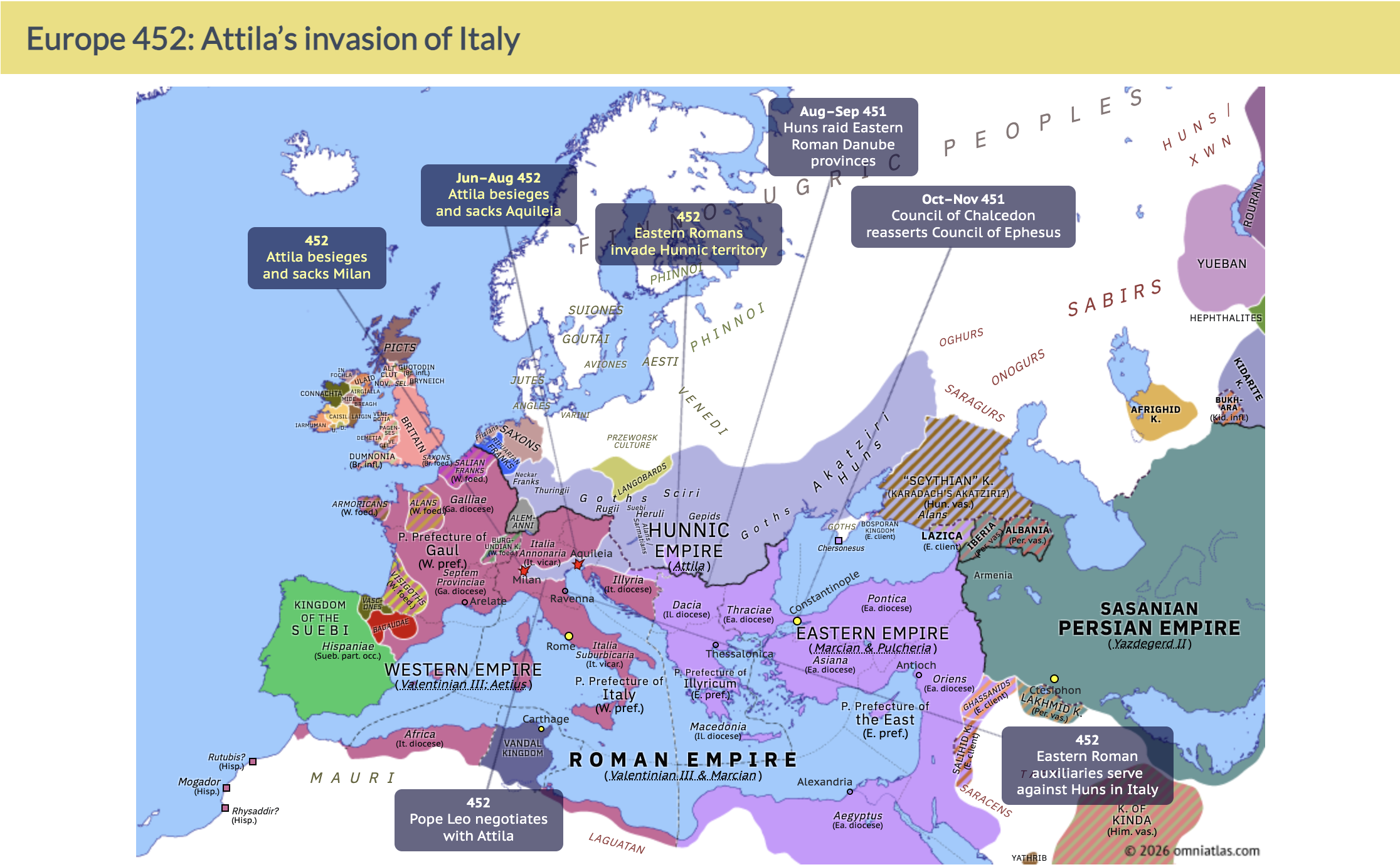
Here you can see the expanse of the Hunnic Empire and a map of Attila’s invasion of Italy. [9]
Another interesting painting was the one below, which is based on the legend of how Attila received his sword (it reminds me of the story of King Arthur and how he became the “rightful king” of England by pulling the sword from the stone). According to the legend, a local shepherd noticed that one of his heifers was limping in the pasture and trailing a bloody footprint through the grass. Following the trail of blood to find the cause of the injury, the shepherd discovered that the animal had accidentally stepped on the sharp, rusted point of an ancient iron sword that was buried straight up in the earth. The shepherd dug the weapon out of the ground and, believing it was a gift from the gods themselves, immediately brought it straight to Attila's grand timber headquarters.
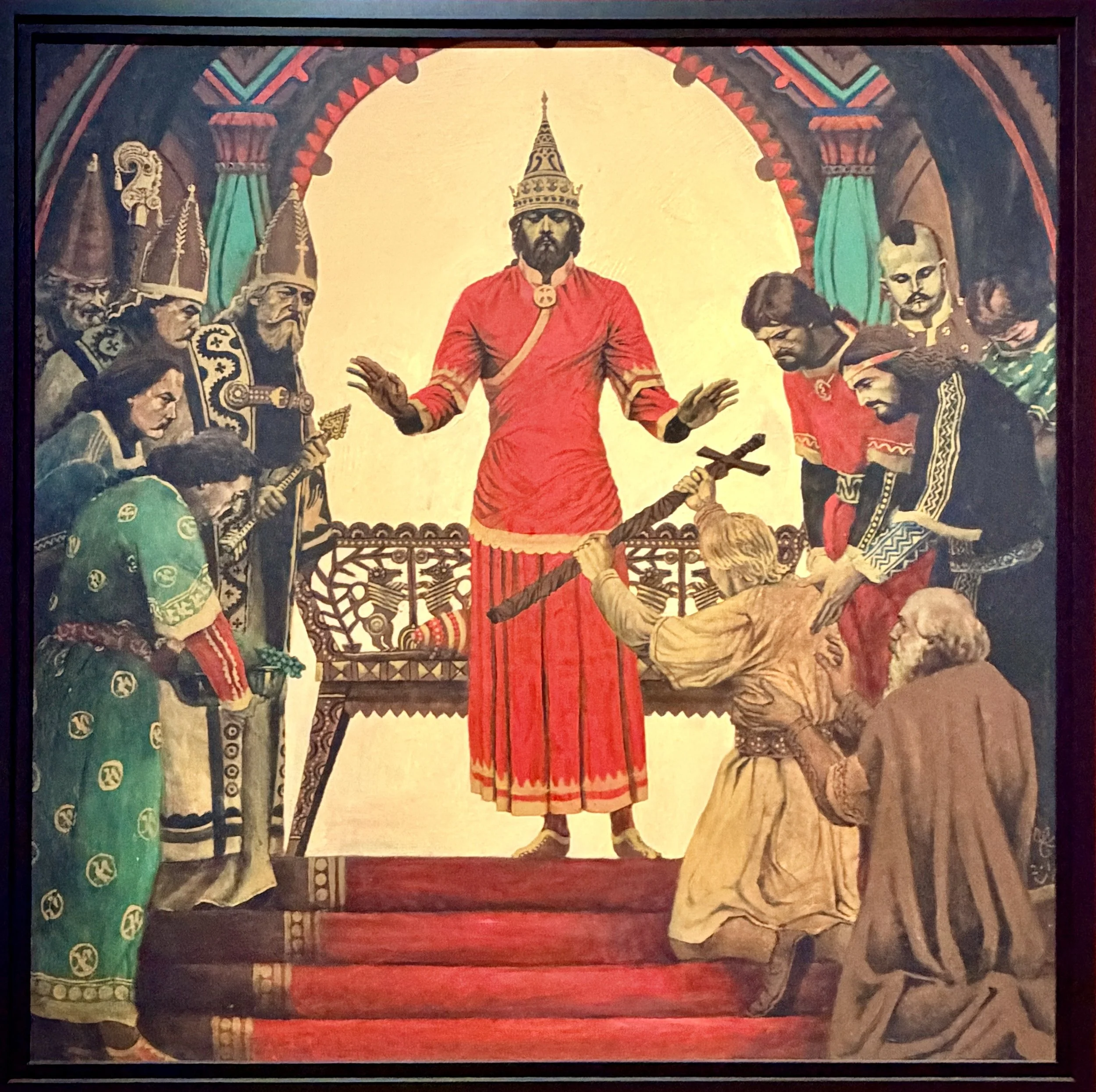
The painting “The Sword of God” (2012), by Tamas Tulipa, depicts the legendary scene when the shepherd boy presents the sword discovered in the field to Attila the Hun, representing his investiture with sacred power.
According to the 6th-century historian Jordanes (who preserved the accounts of the diplomat Priscus of Panium), Attila was given the Sword of God (also known as the Sword of Mars or the Sword of Attila) around 445 AD. He declared that the weapon was the legendary, long-lost sword of Mars (the Roman god of war) and that it had been intentionally sent down from the heavens to confirm his divine right to rule. He also announced to his warlords that holding the sword guaranteed him absolute victory in all future military campaigns and total dominion over the entire world, which helped unify the fractured nomadic clans under his banner and injected confidence into his cavalry. He wielded the sword across Europe, not just as a physical weapon but as a psychological tool, and those who saw it trembled. It became an artifact shrouded in mystery, steeped in legend, and imbued with awe-inspiring power; a symbol of divine right and earthly dominion. While the Huns employed a variety of weaponry and tactics, the Sword of Attila was often cited as the driving force behind their combat success. [10]
So, what became of the sword? Some said it was buried with Attila. Others believed it reappeared in the 11th century when Queen Anastasia of Hungary (mother of King Solomon) gifted a beautiful, ancient-looking family heirloom sabre to Otto of Nordheim, the Duke of Bavaria, in 1063. To enhance the prestige of this incredible weapon, the medieval royal court claimed it was the exact physical weapon that the 5th-century shepherd had pulled from the ground and presented to Attila. Because of its legendary prestige, the weapon eventually entered the core coronation regalia of the Holy Roman Empire. Later physical analysis, however, determined the sword to be a 10th-century Hungarian cavalry sabre, likely built for a high-ranking Magyar warlord or member of the early Hungarian royal house. The weapon normally resides in the Imperial Treasury at the Kunsthistorisches Museum in Vienna, but it is temporarily on loan to the Hungarian National Museum for this landmark Attila exhibition.
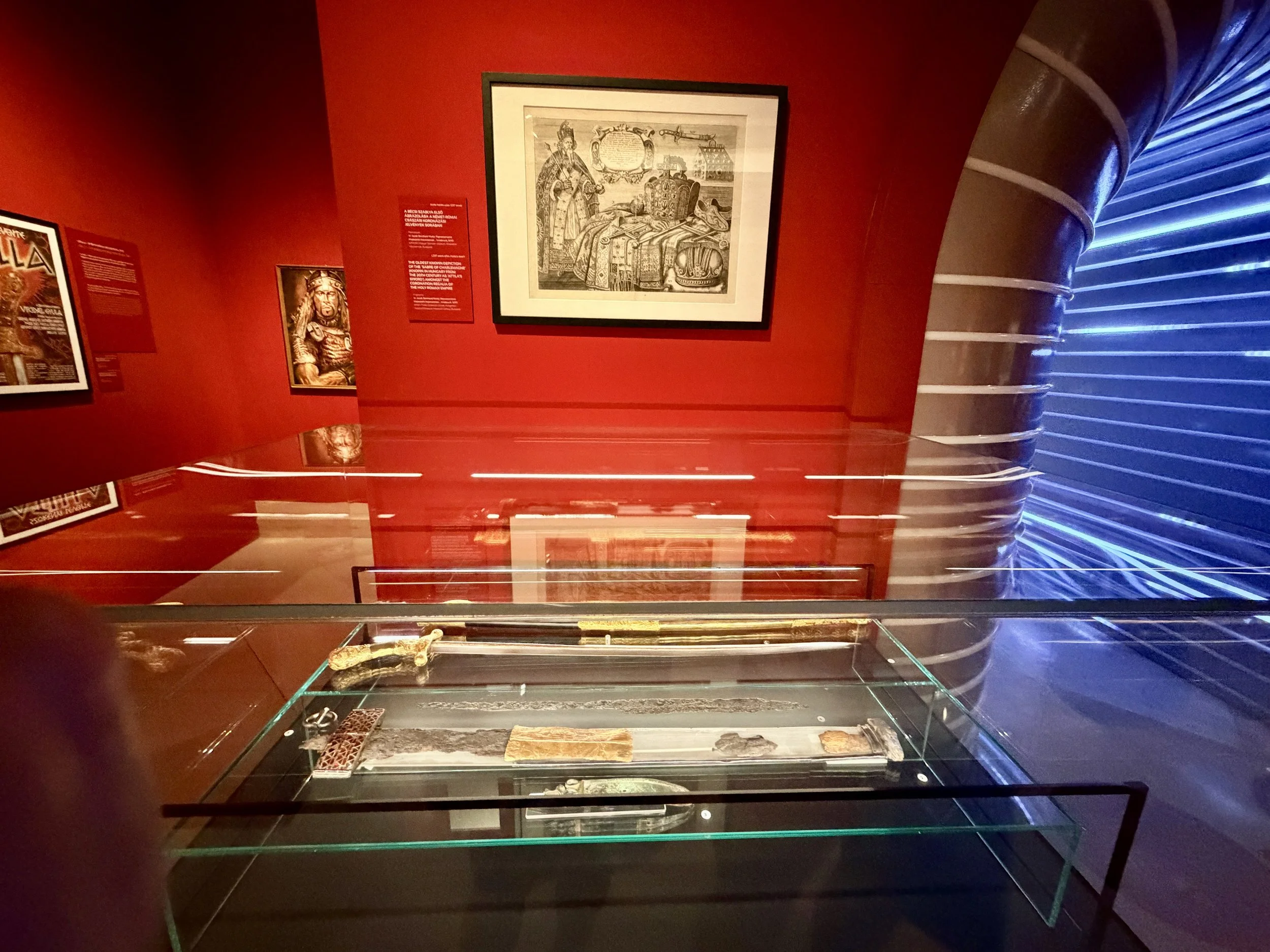
This elaborate sword, at one time believed to be the Sword of God (also known as the Sword of Mars or the Sword of Attila), is on display at the Hungarian National Museum.
While I tried to capture a clear photograph of the legendary weapon in its display case, the reflection on the museum glass made this impossible. However, peering past the glare reveals the sword’s amazing artistry. Professional close-ups reveal that the hilt and crossguard are crafted from solid gold, wrapped in delicate filigree wire. The curved steel blade features an elegant fuller inlaid with pure gold panels, and its scabbard is encased in silver-gilt sheets chased with thousands of tiny hand-stamped circles.
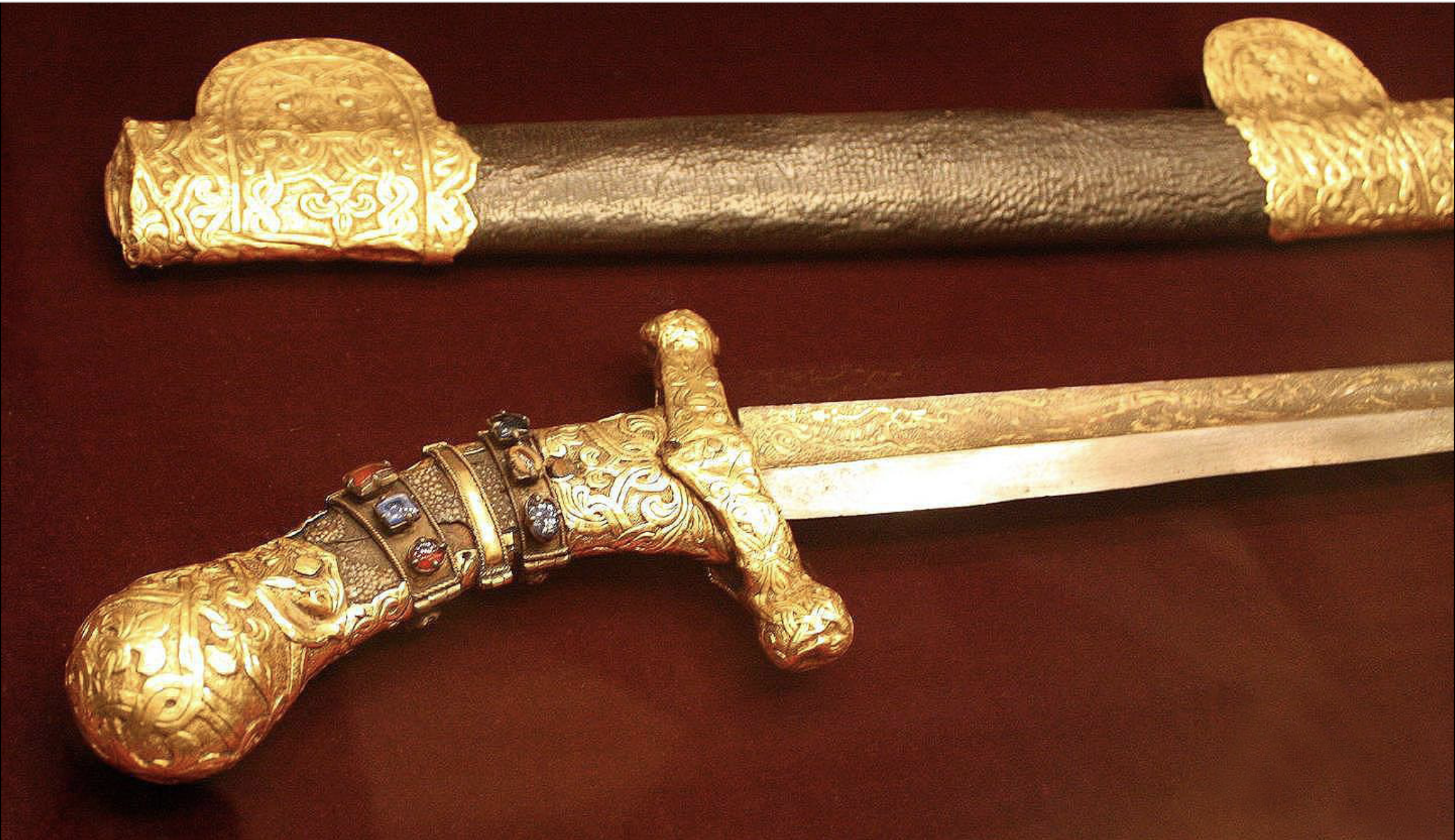
This close-up photo, not taken by me, better reveals the detail on the “Sword of Attila.” [11]
I could go on with more details about the Attila exhibit, but I need to get back to the later Hungarian kings, the town of Unterwart, and the misperception that my great grandparents came from places far apart from each other. LOL - so many rabbit holes to go down! To understand why my great-grandfather János looked down on the neighboring village – and why Aunt Minnie believed her parents came from two entirely different countries – requires taking a look back at King Saint Stephen I (remember him?).
Around the year 1000 AD, King Saint Stephen I established a massive, heavily fortified western frontier defense system called the gyepű. He didn't build stone walls like the Romans; instead, he left wide swaths of dense forests and marshy valleys along the Alps as natural barriers, populating them with specialized, fiercely loyal frontier scouts. These elite sentinels were known as the Őrs (Guards). They were strategic, free-born horsemen who were historically tied to the semi-nomadic steppe warrior tribes who migrated across the massive mountain fortress of the Carpathian Basin under Prince Árpád in 896 AD. They may also have been related to the Székelys of Transylvania, who also believed they were descended from Attila’s son Csaba through a different wife (but that’s a whole other story). My great-grandfather's village of Unterwart was born as Alsóőr (meaning "Lower Guard-house"), serving a pivotal role in this protective ring along with nearby Felsóőr (today Oberwart).
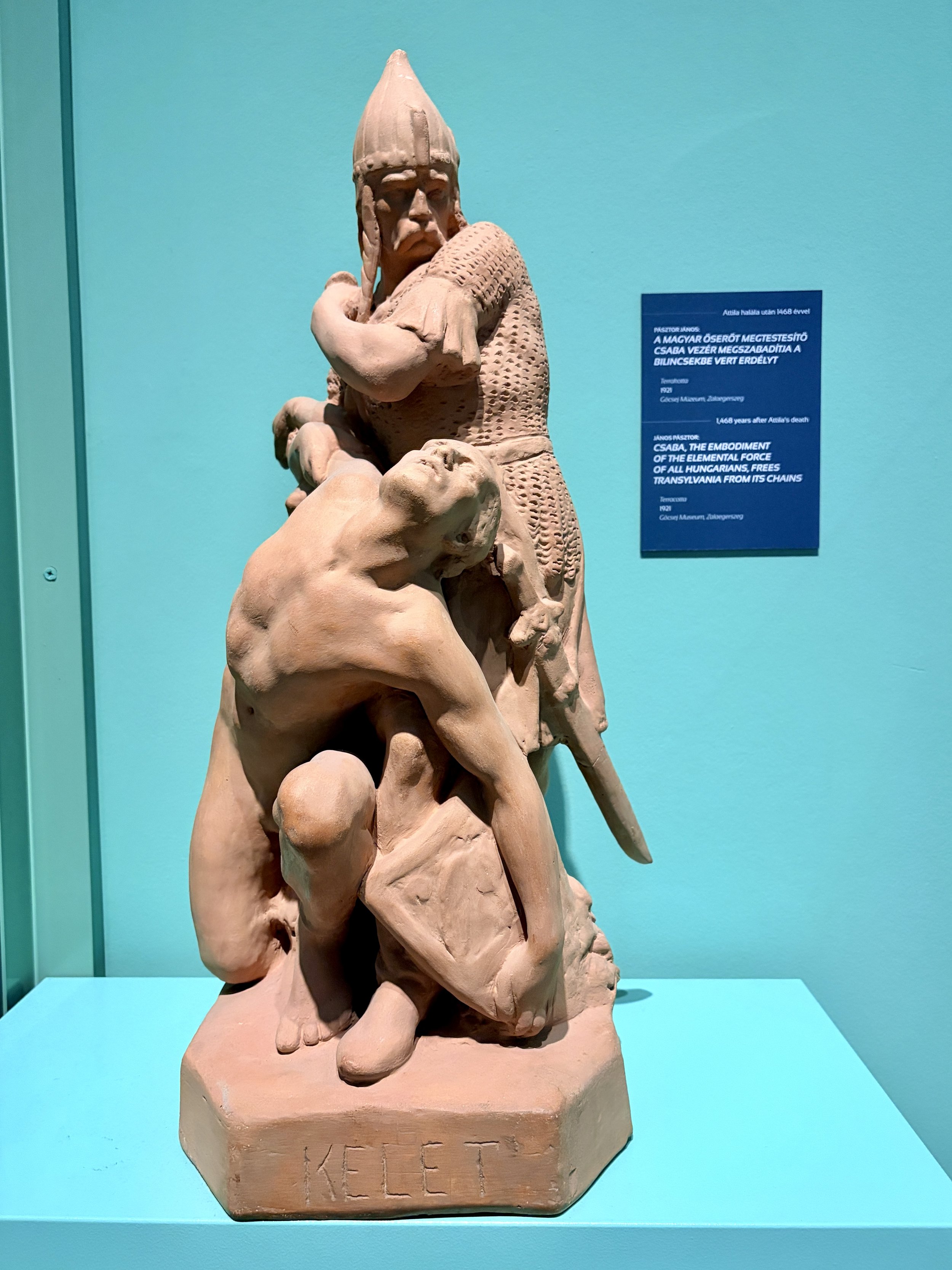
Both the Magyars (of Hungary) and the Székelys (of Transylvania) believe they are descended from Attila through his son Csaba, though by different mothers.
The people of Unterwart were never common serfs. In 1327, King Charles I (Károly Róbert) formally consolidated their privileges, elevating the entire local guard community to the legal status of minor nobility. For centuries, the villagers were tax-exempt, self-governing, and answered only to the Hungarian king himself in exchange for their military service. This deep-seated, generational warrior pride is likely what my mother picked up on when she remembered her grandfather acting as if where he came from was somehow "better than" his wife’s town. It also explains why he mentioned an ancestor who was a "leader" or "mayor"—the village of Unterwart operated under an autonomous council of peasant-nobles who elected their own leaders for hundreds of years.
When you contrast this with Anna Halper's hometown of Oberdorf (Őrállás), just a seven-minute drive away, you instantly see why they felt like different countries. While Unterwart was a sovereign island of Hungarian border guards, Oberdorf was settled in 1434 as a traditional feudal lordship. Its residents were German-speaking tenant farmers who worked the lands owned by powerful noble dynasties like the Erdődys (more on them later).
Then came the flashpoint of the 1848 Revolution led by Lajos Kossuth. When the revolutionary parliament abolished serfdom, it was a massive victory for Anna's German-speaking agrarian ancestors in Oberdorf, who suddenly became the legal owners of their own land. But for János's family in Unterwart, the revolution introducing universal legal equality actually stripped away their centuries-old noble privileges, reducing them to the same legal footing as everyone else.
By the time János (1885) and Anna (1894) were born, the Hungarian government was aggressively enforcing "Magyarization" policies. German-speaking Oberdorf was forced to officially use the Hungarian name Őrállás, while Unterwart doubled down on its insular identity to preserve its ancient medieval Hungarian dialect. Even though they physically grew up less than four miles apart under the same Vas County administration, they were culturally, linguistically, and historically a world apart. When they finally crossed paths and married on the South Side of Chicago in 1917, they were blending two vastly different halves of old Europe's borderland history.
I will tell more about their immigration stories in a future post. Here, I want to end with some photos and details from our visit to Unterwart, which has a population of just under 1,000 people and sits in the valley of the Pinka River, about 75 miles south of Vienna and 11 miles from the Hungarian border.
Unfortunately, we did not have much information to go on in Unterwart, nor could we find anyone to help us. The museum we had hoped to visit, which said online it would be open, was closed. I had tried to email a couple days earlier to confirm it would be open but got no response. We stopped by the Town Municipal Office and Library to try to ask some questions but could not find anyone to speak to (even though the door was open and we could hear voices coming from somewhere). One interesting discovery arose at the Town Municipal Office, though, for it was in front of this building I first saw the sign that said Oberdorf was only 6 km away, which amused me since my mom grew up thinking they were so far apart. I was happy to know we wouldn’t have far to drive to our next destination!
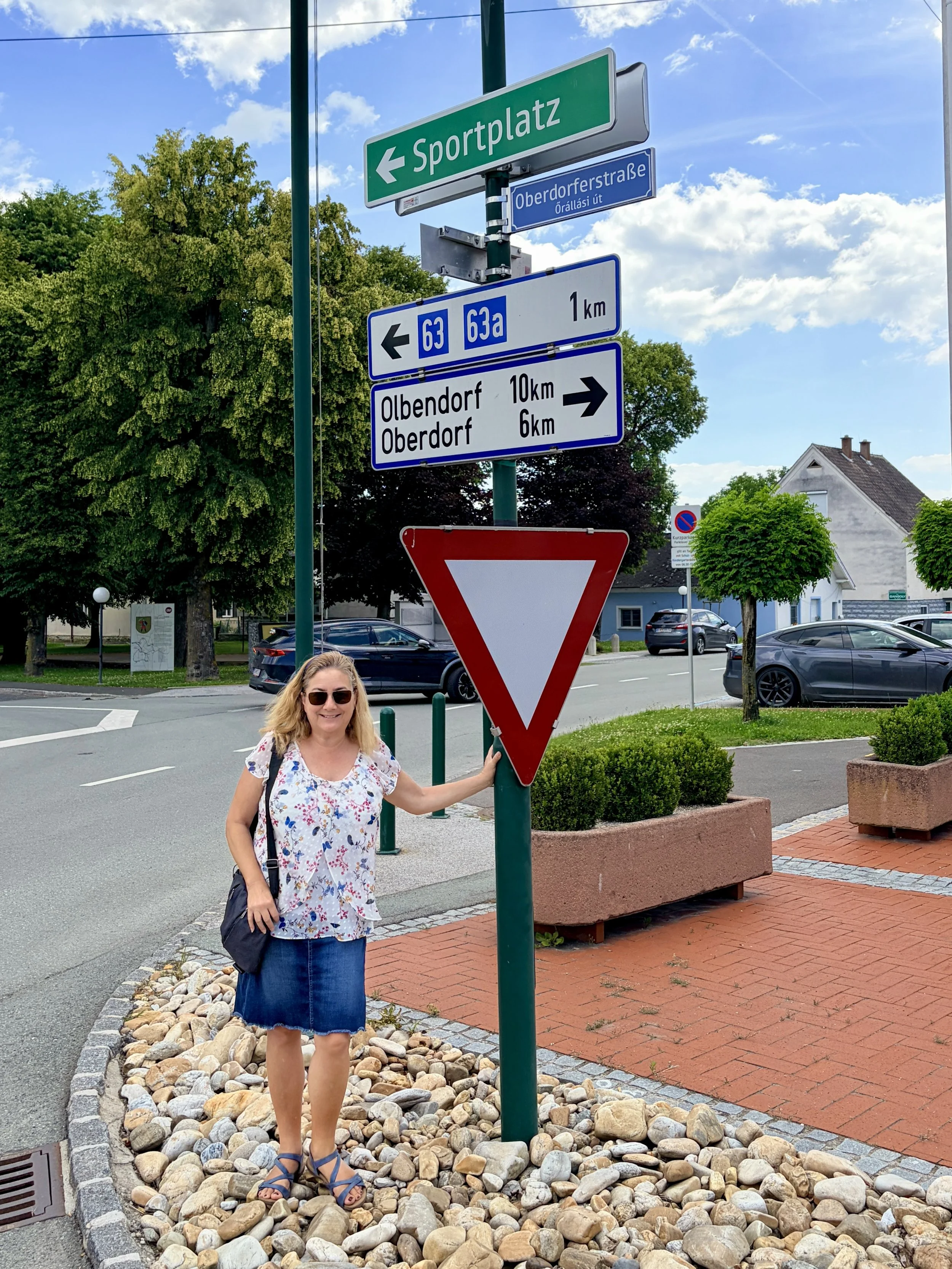
Less than four miles separate the towns of Unterwart and Oberdorf in Burgenland.
Since we could find no one to talk to and no open businesses to enter, we decided to wander around. Our first stop was at the old stone church, the Roman Catholic Parish Church of St. Catherine, which was built in 1769 by Alsóőr’s community of peasant-nobles. Prior to that, the village of Alsóőr had a little church built of wood with a painted ceiling, according to a 1697 report. [12] The present church’s tower is topped by an Apostolic Double Cross, as discussed earlier. The church was enlarged in 1833, which is the version the Wagner family likely attended (and where János was likely baptized, though I have not yet found that record).
Someone had said through another person that he would open up the church, but I never made any direct contact with him despite two email attempts. When we went to the church, we could see through a screen door, so perhaps that was its "open" state. At least we could get a peak inside. The main altar is decorated with the wooden statues of King St. Stephen I and his son, St. Emericus, as you can see in the photo below. Also nearby, you can see the baroque Column of the Virgin Mary, which was erected in the first half of the 18th century and marks the area called the “Marienplatz,” or main municipal and cultural square in Unterwart.
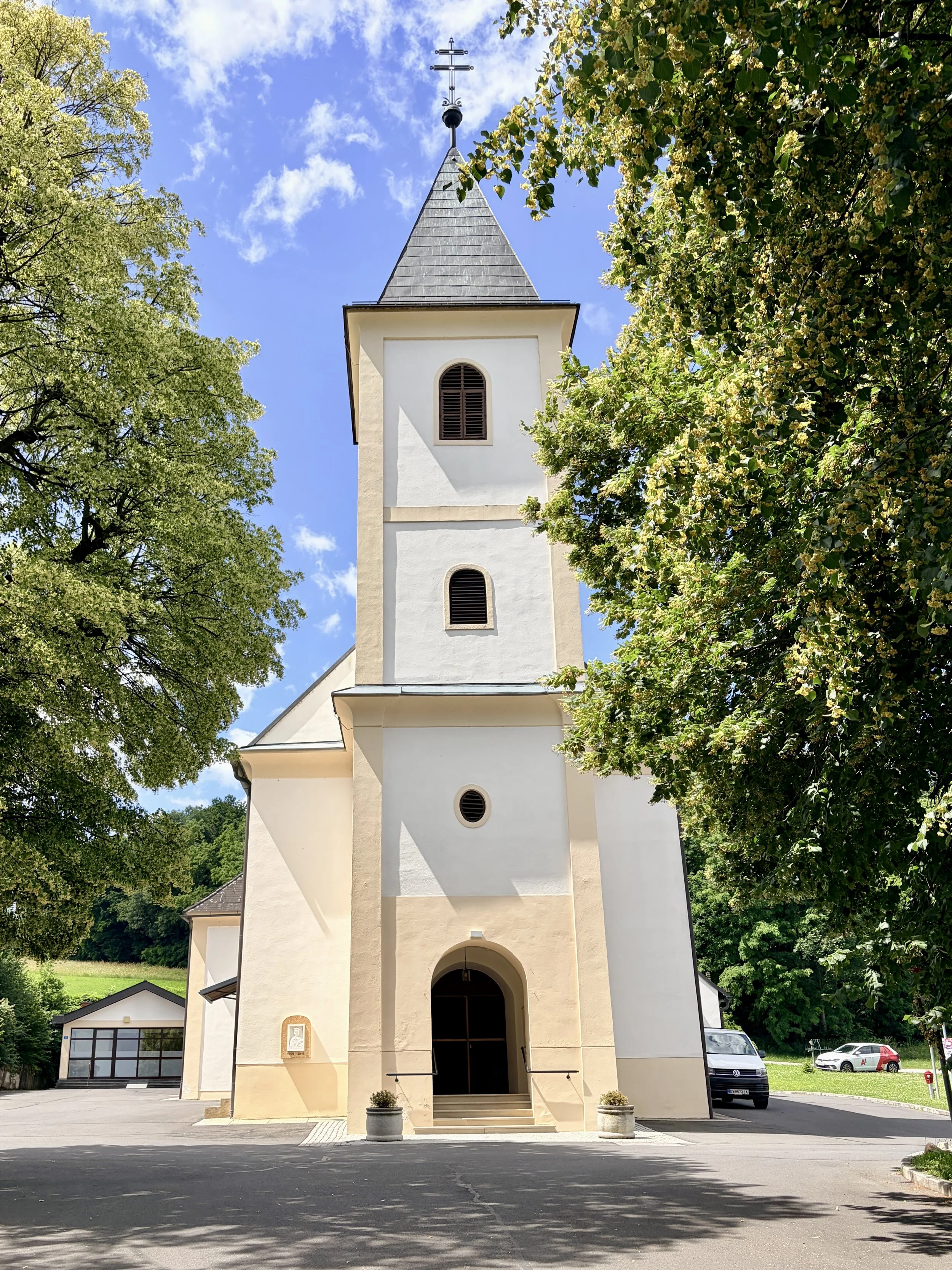
While this spot began as fortified border post in the 14th century and by the 17th century hosted a small wooden church, the present Roman Catholic Parish Church of St. Catherine was built in 1769.
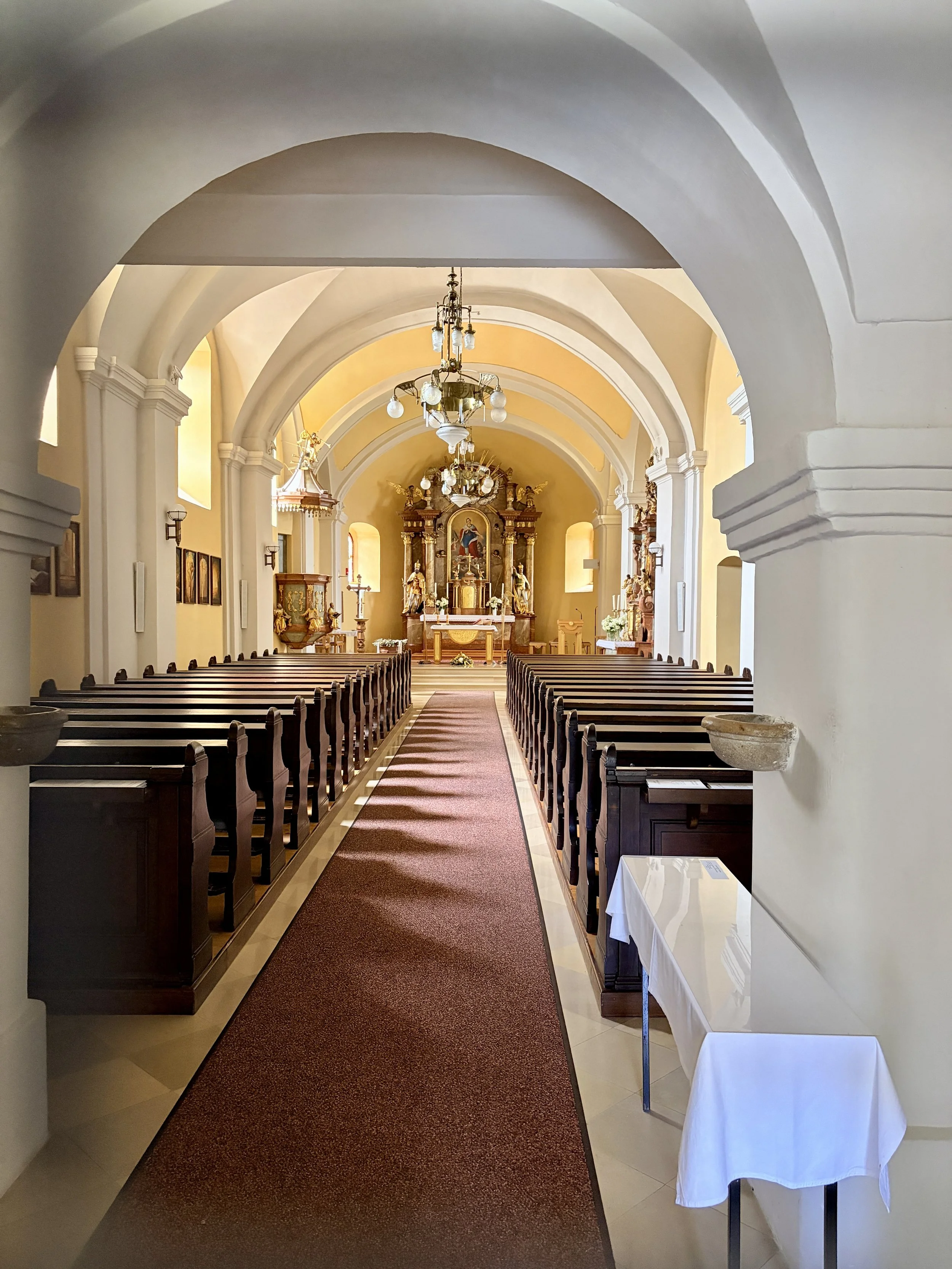
This is the view we got of the inside of the church from outside the screen door; you can see the main altar with its wooden statues of King St. Stephen I and his son, St. Emericus.
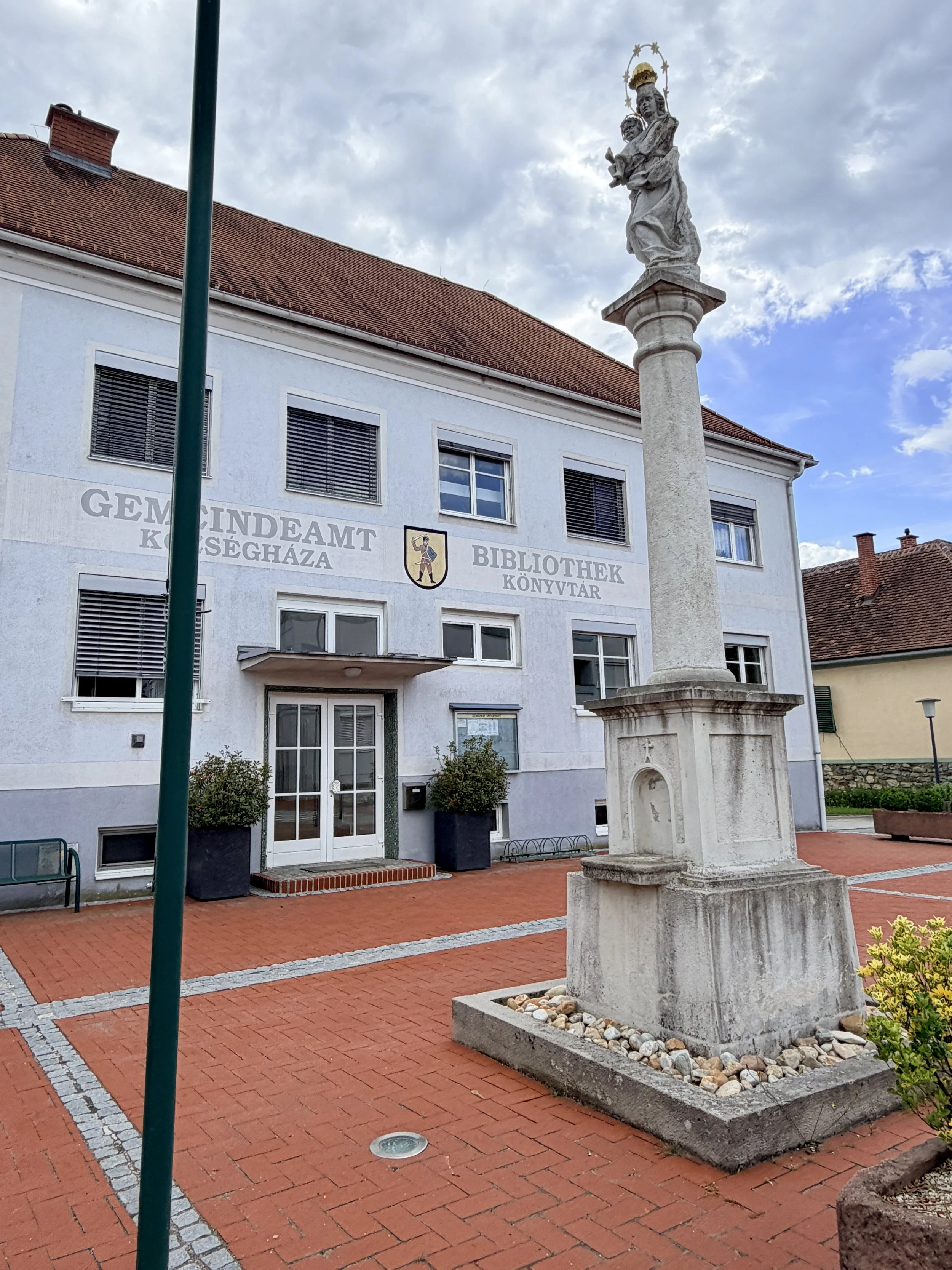
The baroque Column of the Virgin Mary, which was erected in the first half of the 18th century, stands in front of the Town Municipal Office & Library and marks the town’s “Marienplatz” central square.
Mounted on the exterior wall of the church is a beautiful white marble commemorative plaque dedicated to Alsóőri Sz. Katalin (Saint Catherine of Unterwart). The relief depicts the village's patron saint wearing a crown, holding a cross, and resting her hand on a heavy spoked wheel — the traditional instrument of her martyrdom. The plaque bears the jubilee dates 1769 – 2019, marking exactly 250 years since the local Hungarian community of peasant-nobles pooled their private resources to erect this stone structure.
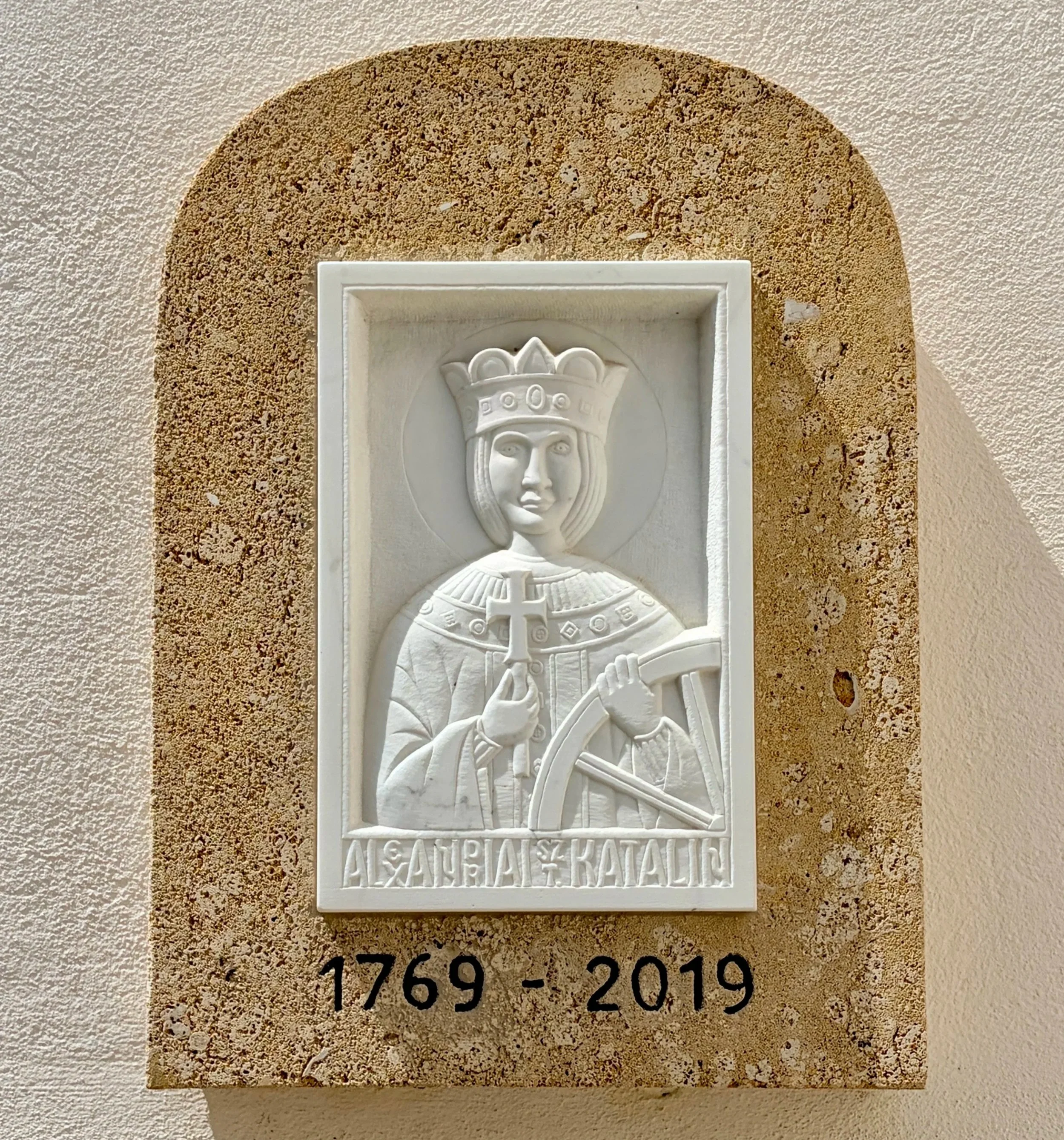
This commemorative plaque dedicated to Saint Catherine hangs on the church’s exterior.
We wandered through the cemetery behind the church looking for any Wagners, but we did not see any (we saw LOTS of Szabos and Sepers). We heard, though, that older graves often get covered over by newer ones, so perhaps that is what happened. I was hoping to find graves for my great-great grandparents: Johann Wagner (1857-1932) and Josefa Pesenhofer Wagner (1862-1892/3), who were John’s parents, or perhaps for his stepmother Maria Gaugl Wagner (b. 1873). I know she died sometime after 1952 since the one family letter I have, dated 1952 from Unterwart, is from his stepmother and sister Hermine. We did, at least, get some great views.
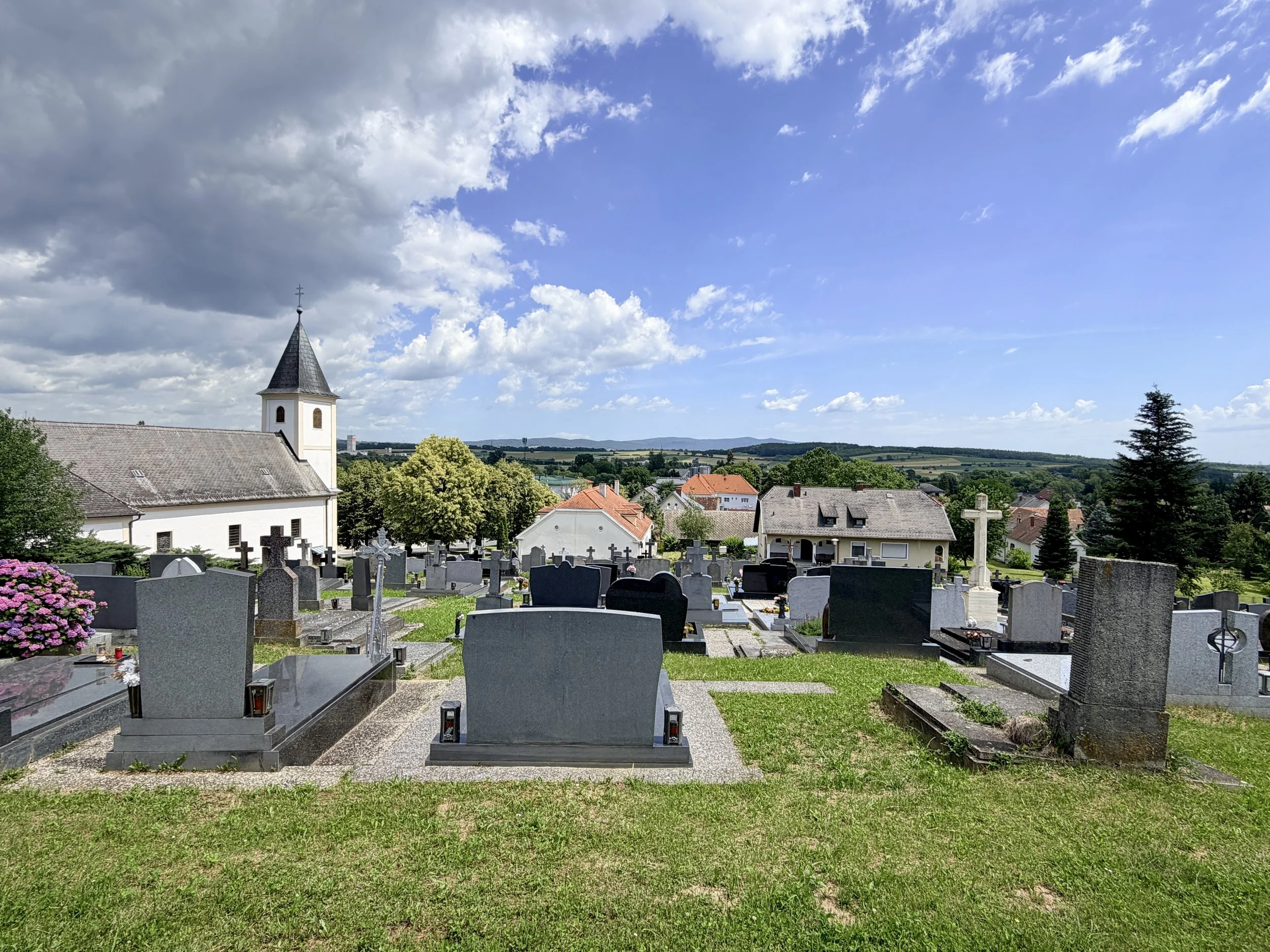
This was the view from the back of the cemetery looking toward the church.
One building we saw next to the church, but I didn’t realize what it was at the time, was the old school. The notice board out front says Öreg Iskola (which, as I now know, translates to "Old School" in Hungarian), alongside the abbreviation UMIZ, which stands for Ungarisches Medien- und Informationszentrum. According to what I read online, the “Hungarian Media and Information Center” housed inside the old school serves as a dual-language library, publishes books, digitizes historical regional records, and provides educational resources to ensure that the unique dialect, history, and traditions of the Burgenland Hungarians are preserved for future generations. Since this school has been around since 1850, it’s likely that my great grandfather and his siblings attended it at some point.
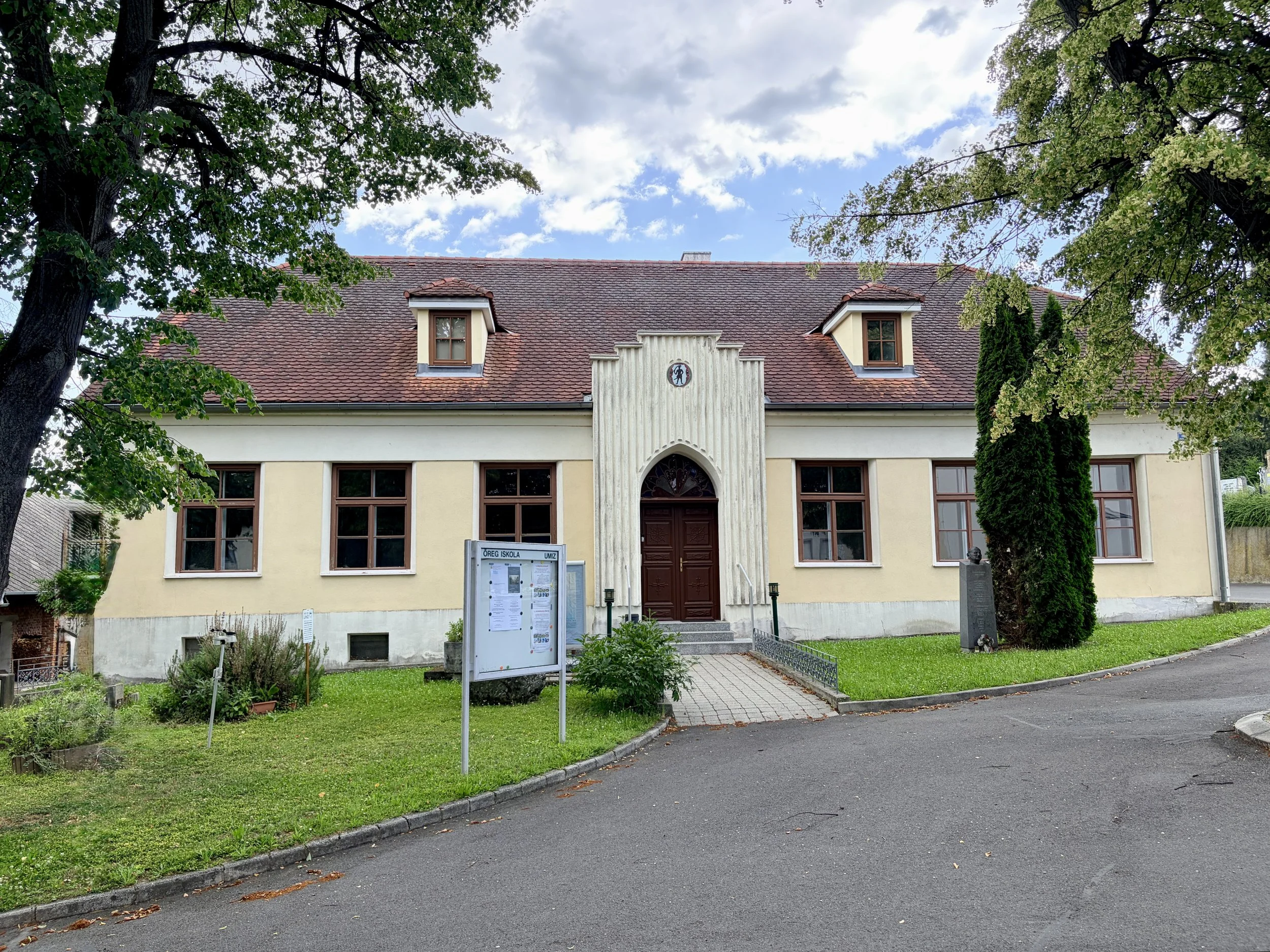
This old school, originally built in 1850, now houses a Hungarian Media and Information Center.
We then headed back to the village museum, near which we had initially parked, hoping perhaps someone had shown up to open the doors. They had not, which was definitely disappointing. From what I read online, the museum – named Heimathaus Unterwart – is housed in two old peasant houses (which we could see from the outside) and documents the life, traditions, and language of the Hungarian ethnic group in Burgenland. It features over 4,000 cataloged artifacts including traditional folk costumes, ceramics, household utensils, and historical documents, as well as preserved workspaces showcasing traditional trades like a blacksmith, shoemaker, wagon maker (Wagner), and carpenter. We tried peering through the windows but could not make out much.
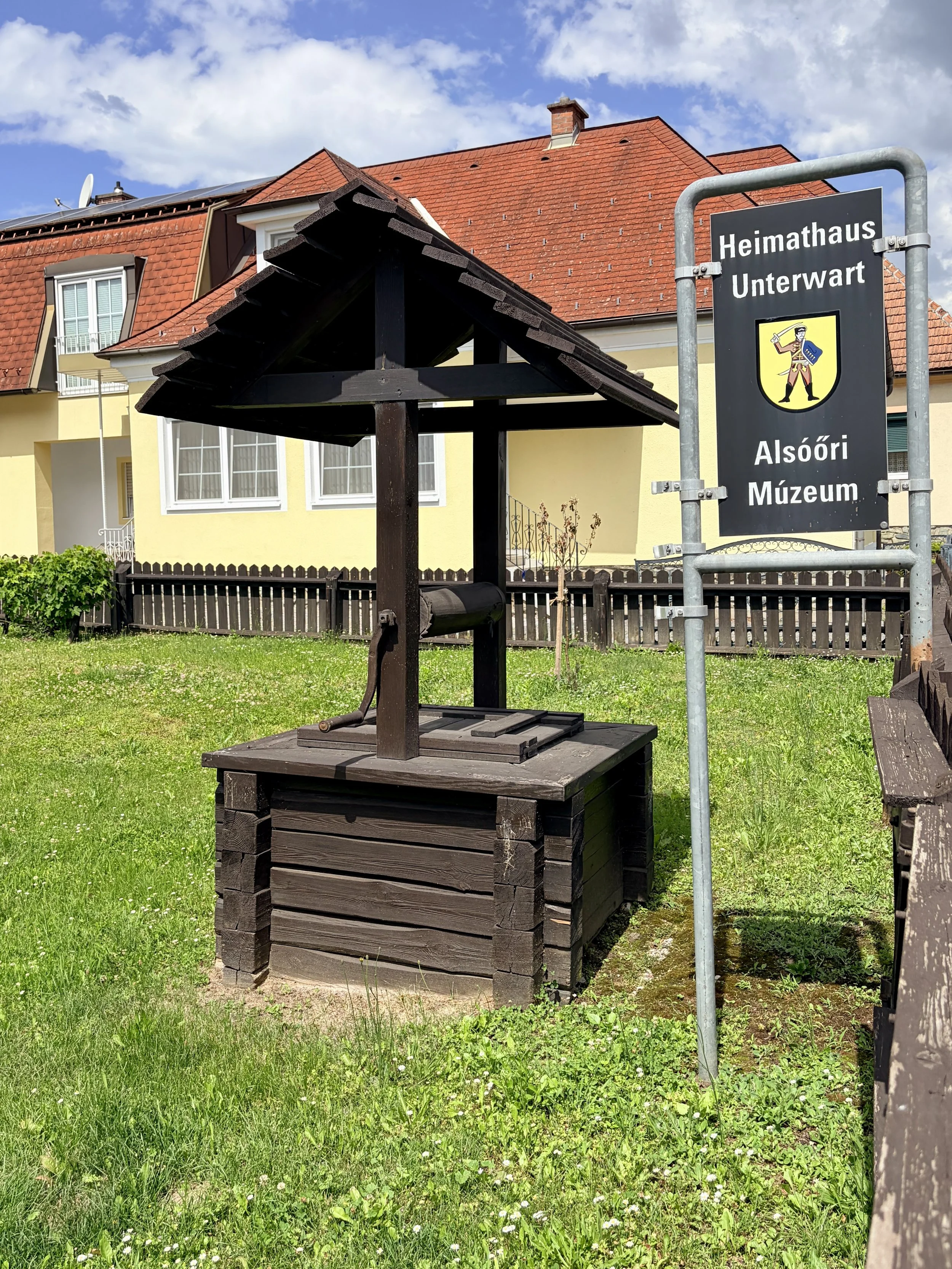
This sign outside the Heimathaus Unterwart (aka. Alsóőri Múzeum) shows Unterwart’s coat of arms, which depicts an old Hungarian frontier guard (őr) wearing a traditional bright red military uniform adorned with golden lacing down the chest, a royal blue “dolman” (a braided military jacket) trimmed in silver slung over his left shoulder, and holding up a sword in his raised right hand.
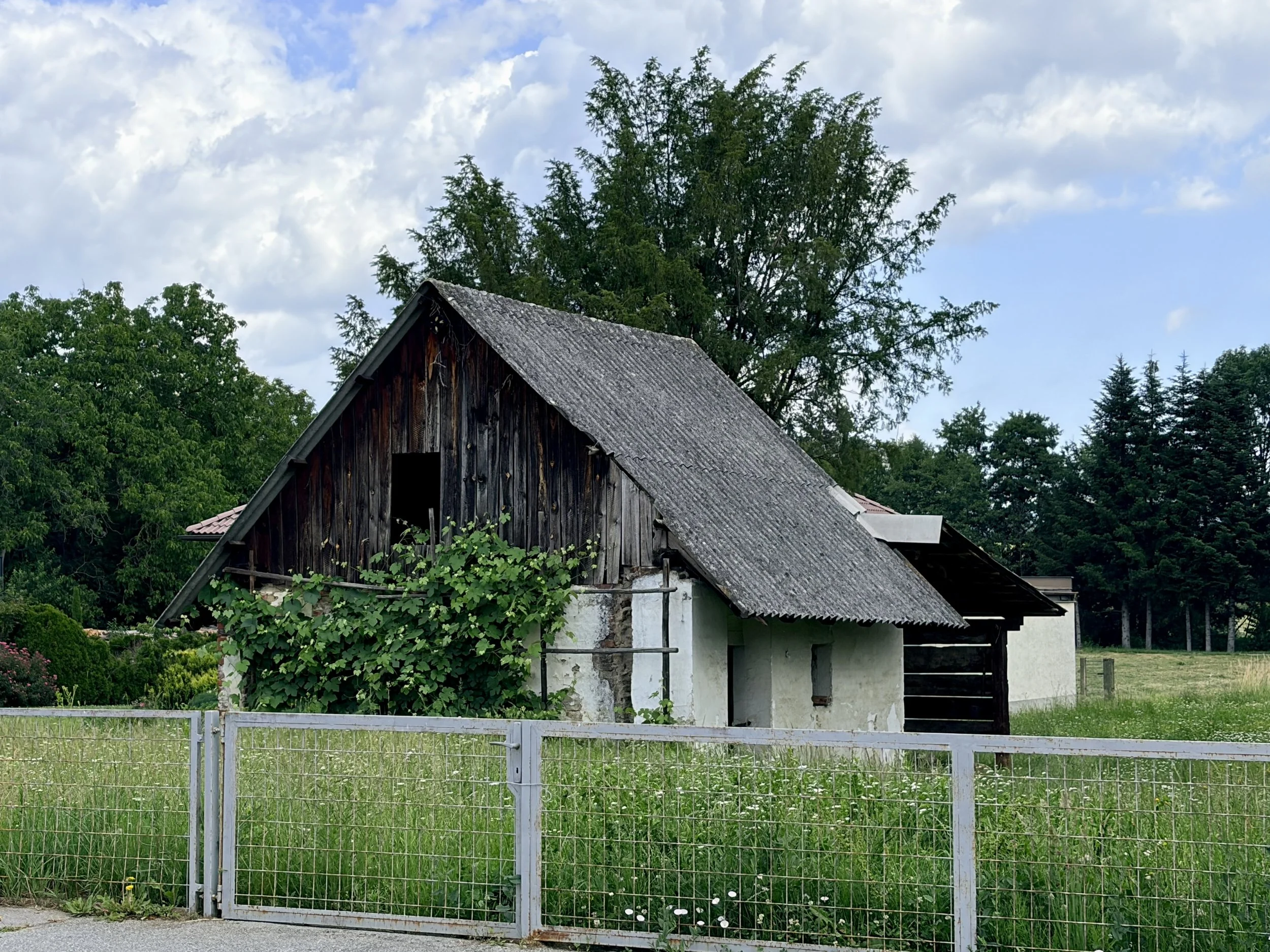
As we wandered through the streets, we saw some interesting old peasant houses that have survived into modern times. Below you can see a couple examples.
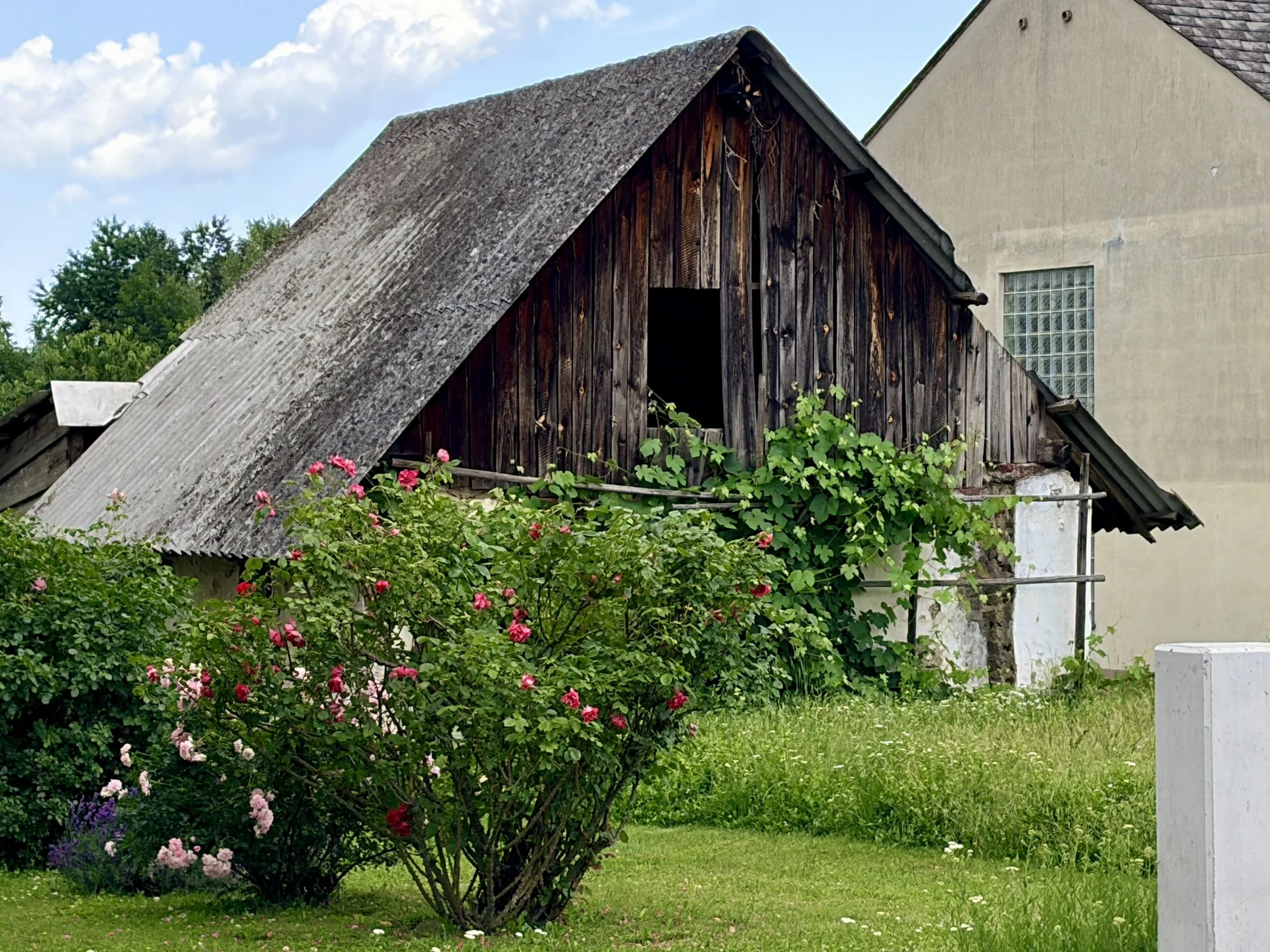
Both of these structures are old peasant houses still standing in Unterwart.
We also found a "Wagnergasse," so perhaps that was the street the Wagner family lived on at some point. We started walking down the street, but a woman gave us a strange look. When I asked if she spoke English, she said, “Hungarian.” In a not-very-good display of Charades, I tried pointing at the sign, then pointing at myself and saying “Wagner.” What she took from that, I have no idea, but she didn’t stop us from walking down the narrow street — which looked more like a long driveway to someone’s house. We soon decided to turn around.
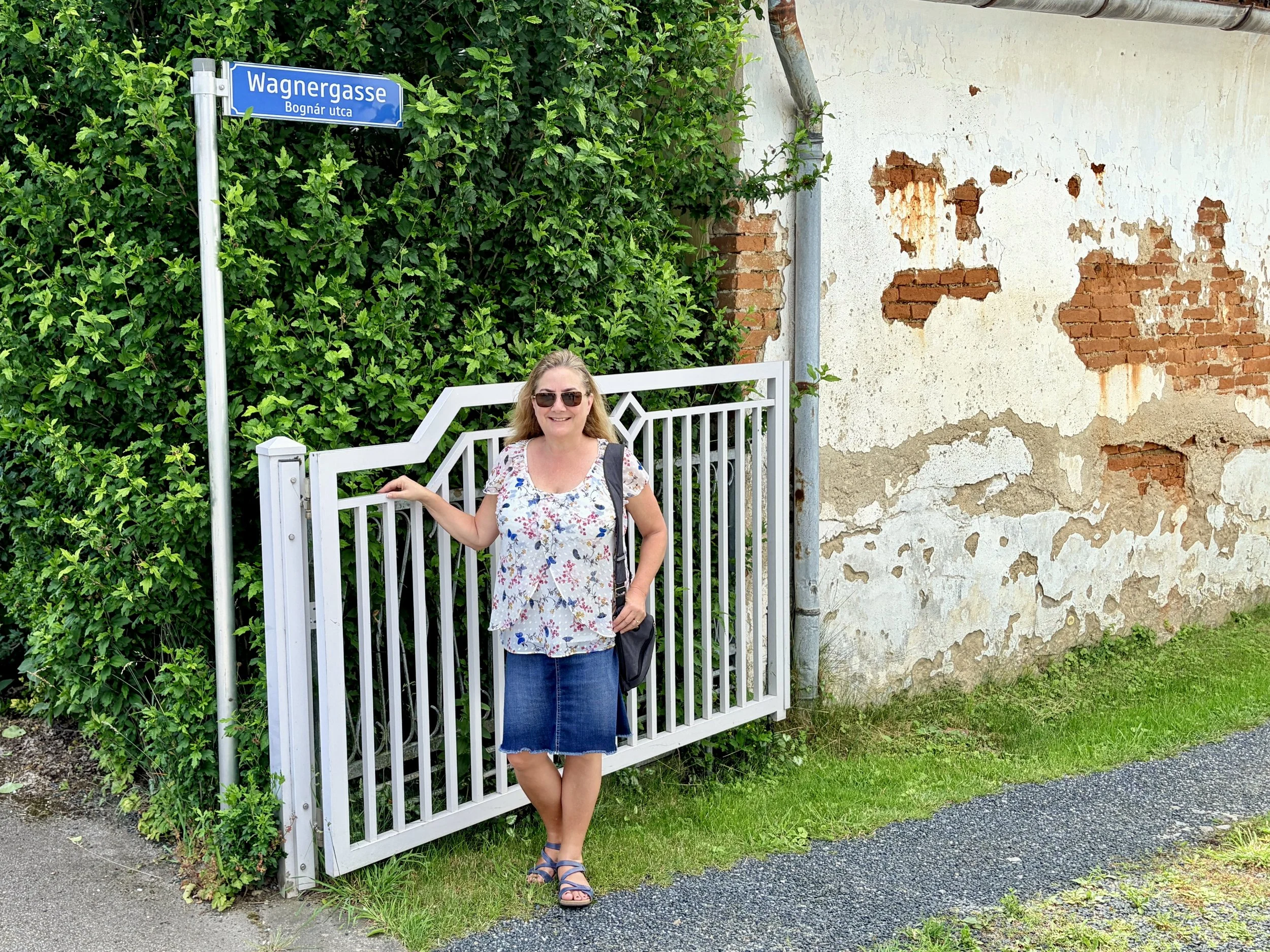
Here I am, standing under the “Wagnergasse” sign (Bognár utca in Hungarian) which may or may not have ties to my Wagner ancestors; the last known address I have for them in Unterwart #5, but I’m pretty sure the numbering has changed since then.
As you can clearly see, many of the signs in Unterwart are in both Hungarian and German since Unterwart is one of a small number of ethnically Hungarian villages in Burgenland. The schools still provide a bilingual education in both German and Hungarian. Here’s another example from town — this one you can probably figure out.
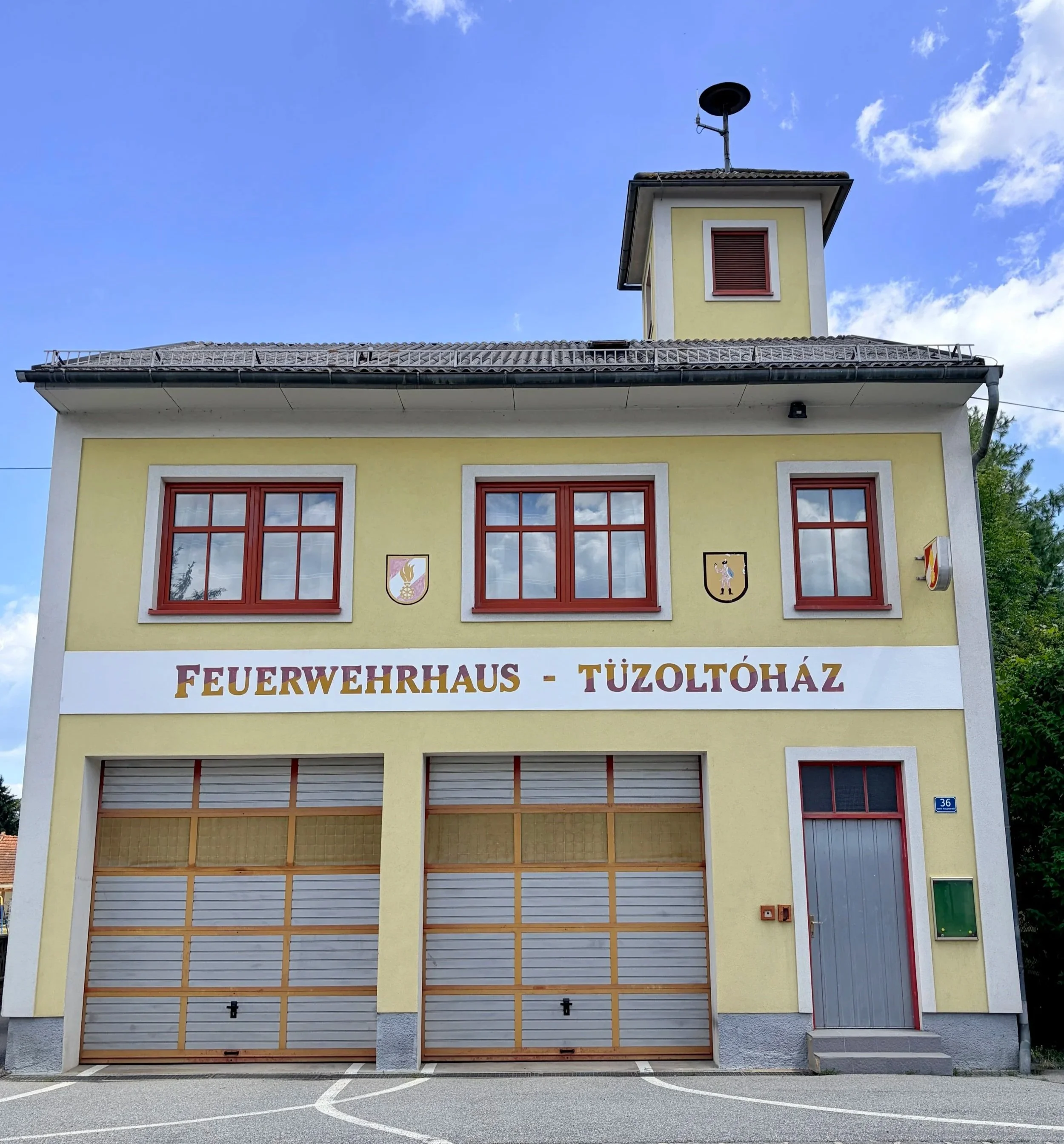
This is the local fire house in Unterwart - labeled with both its German and Hungarian names.
Back in the car, we decided to make one final stop just outside of Unterwart at Rotenturm Castle, which is in nearby Rotenturm an der Pinka (the Pinka is the River which flows through both villages). For nearly 400 years, this property was in the hands of the power Erdődy family. However, the current structure — which has been majorly renovated in recent years — was not built until 1860-1864 at the commission of Count Stefan (István) Erdődy. His son Count Julius (Gyula) Erdődy took over the property and title after his father’s death in 1896, and in the following years, the estate experienced its peak cultural boom. He and his wife, Countess Emilie Erdődy, transformed the interior into a private palace museum, filling its 70 rooms with a world-renowned art collection and the immense Erdődy family historical archives.
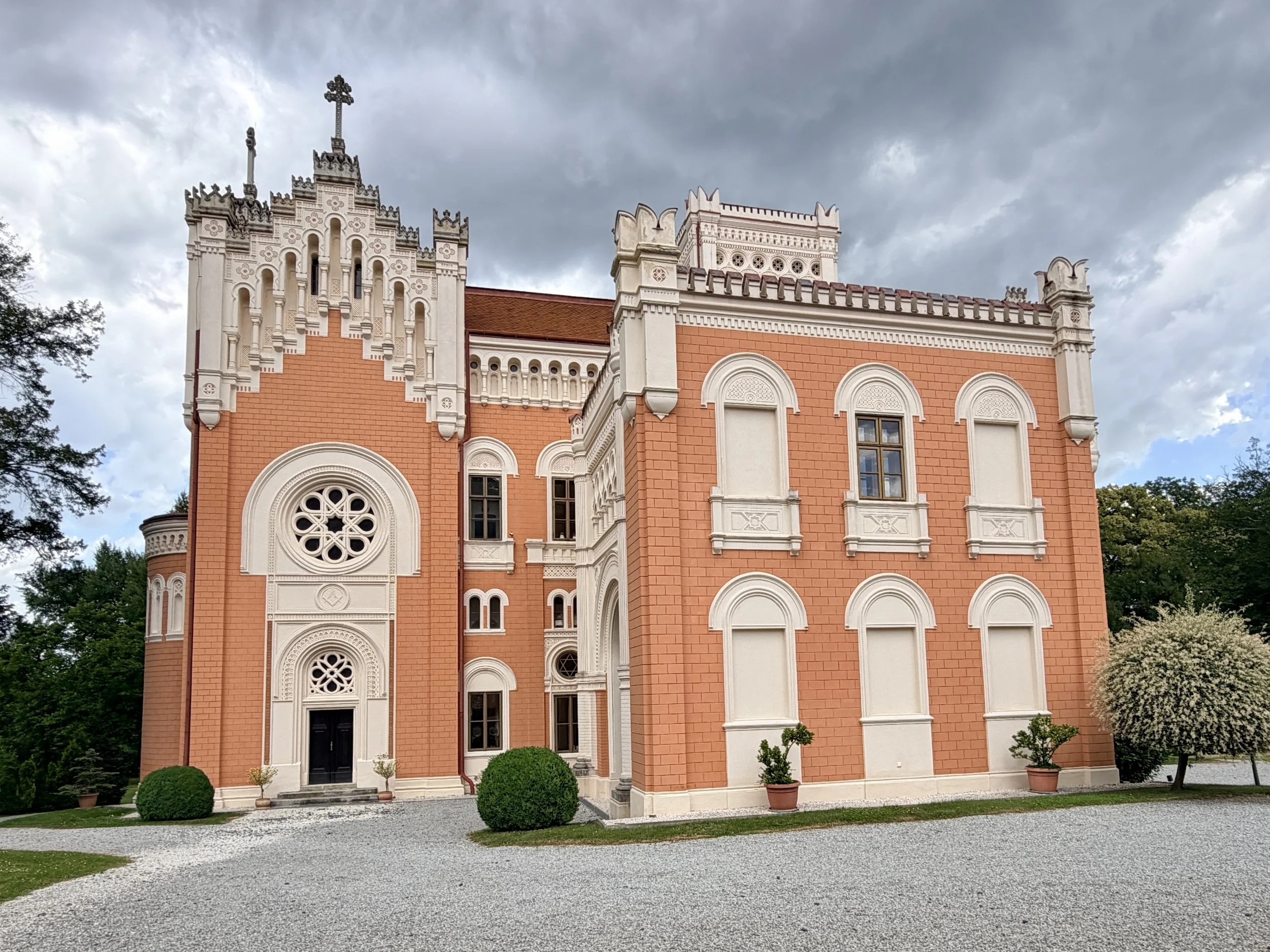
Rotenturm Castle now operates as a private event venue, frequently hosting weddings and galas in its seven festive historic halls; it is sometimes open for public tours — but not when we were there.
According to John Wagner’s work record, he briefly worked for Count Erdődy in 1907 at his Emília Roller Mill/Steam Mill as a “molnársegéd” (a journeyman miller or assistant miller). The mill, which was very cutting edge at the time, used advanced steel rollers instead of traditional millstones to grind grain far more efficiently. To power his sprawling enterprises — which included the mill and a large electric sawmill —Erdődy introduced steam power and eventually electricity to the estate. His sons took over after his death in 1919, but a catastrophic fire in 1924 tore through the castle, gutting the roof and interior, as well as destroying countless family archives and artworks, which forced the family to give up the estate.
Well, this post is far longer than I first imagined — but trying to explain so much history can easily do that! In my next post, I will talk about our time in Oberdorf; then, after that, our visit to Güssing. Finally, I’ll take a look at what drove so many from Burgenland to emigrate — including John Wagner and Anna Halper — to the point where Chicago became the “largest Burgenland city,” exponentially larger than any town or village in Burgenland.
Thanks for reading! Be sure to stay tuned for future posts — and if you have any feedback to offer or corrections to suggest, I’d love to hear from you. Trying to get at least this minimal grasp of Hungarian history has been quite an undertaking, but it has been an interesting journey. I hope you’ve learned something from this blog post and perhaps even found something you want to further explore. Enjoy the rabbit holes!
Endnotes:
“Archangel Gabriel, the genius of victory.” Pinterest, 7 May 2017, https://www.pinterest.com/pin/386957792973442106/.
“Holy Crown of Hungary.” Wikipedia, https://en.wikipedia.org/wiki/Holy_Crown_of_Hungary.
“Coat of Arms of Hungary.” Wikipedia, https://en.wikipedia.org/wiki/Patriarchal_cross#/media/File:Coat_of_arms_of_Hungary.svg.
Display Text. Attila Special Exhibit, 23 Jan-12 July 2026, Hungarian National Museum, Budapest, Hungary.
Ibid.
Ibid.
Ibid.
Ibid.
“Europe 452: Attila’s invasion of Italy.” OMNIATLAS, https://omniatlas.com/maps/europe/4521018/#google_vignette.
Display Text. Attila Special Exhibit, 23 Jan-12 July 2026, Hungarian National Museum, Budapest, Hungary.
“Sword of Attila.” Wikipedia, https://en.wikipedia.org/wiki/Sword_of_Attila#/media/File:Attila_kardja.jpg.
“Unterwart.” Wikipedia, https://en.wikipedia.org/wiki/Unterwart.