Exploring Burgenland, Part III: A Visit to Oberdorf im Burgenland and a look at St. Anne’s Church, the Erdődy Family’s Feudal Rotenturm Estate, and the Peasant Lifestyle in Hungary
Chasing History: Exploring My Ancestral Roots - Post #70
by Tonya Graham McQuade
In Part I and Part II of this blog series, I described our June visits to Eisenstadt and Unterwart in Burgenland, Austria, as well as some Burgenland and Hungarian history. Here, I will delve a bit deeper into my “Halper” family history, as well as take a brief look at how the feudal system worked in Hungary; how that was impacted by the Urbarium of 1767, the 1848 Hungarian Revolution, and the 1867 Austro-Hungarian Compromise; and how villages like Oberdorf im Burgenland (that full name distinguishes it from another Oberdorf in Austria) were impacted by the aggressive Magyarization policies that followed. I will try to tie all this to my great grandmother Anna Halper’s family history.
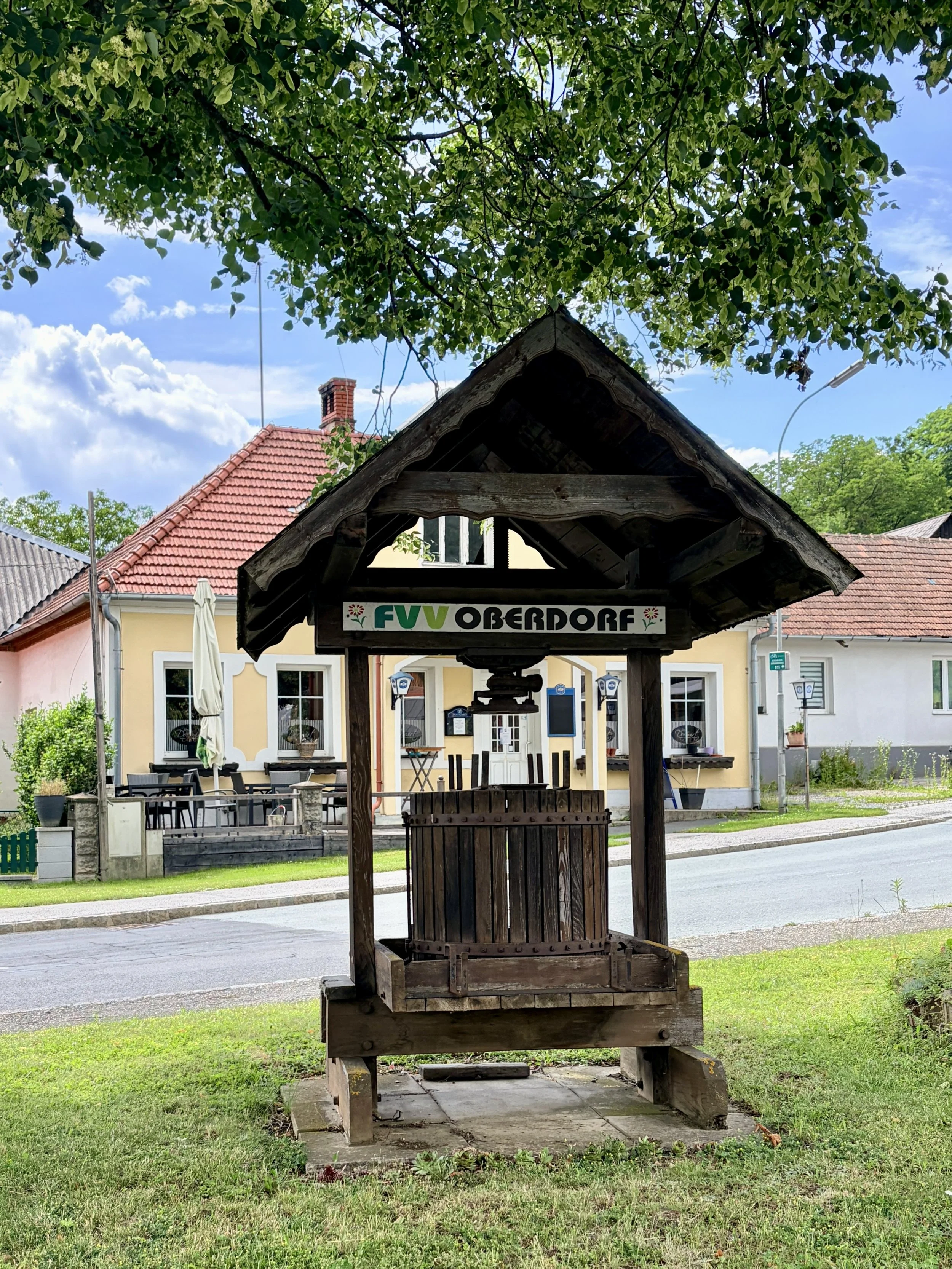
As this old wine press hints, Oberdorf and the surrounding area are well-known today for their wine making industry.
I don’t have many records to go on when it comes to the Halpers, but I do have two photos of Anna’s mother, Maria Halper, who traveled to Chicago on at least two separate occasions, in April 1904 and December 1910, and lived there for quite a few years. One of the photos is from her daughter Anna Halper’s wedding to John Paul Wagner in December 1917. Her son Paul and daughter Katherine also appear in that photo, along with Paul’s wife Justina. I wish I was sure which ones they were. I think (based on some very unclear labeling from my Aunt Minnie) that brother Paul is standing in the back row, second from the left, with his hand on his wife Justina in front of him; and sister Katherine is the third woman from the right in the middle row. A note on the left side says that their best friends, the Konraths from the North side of Chicago, are also in the photo (perhaps the couple on the left).
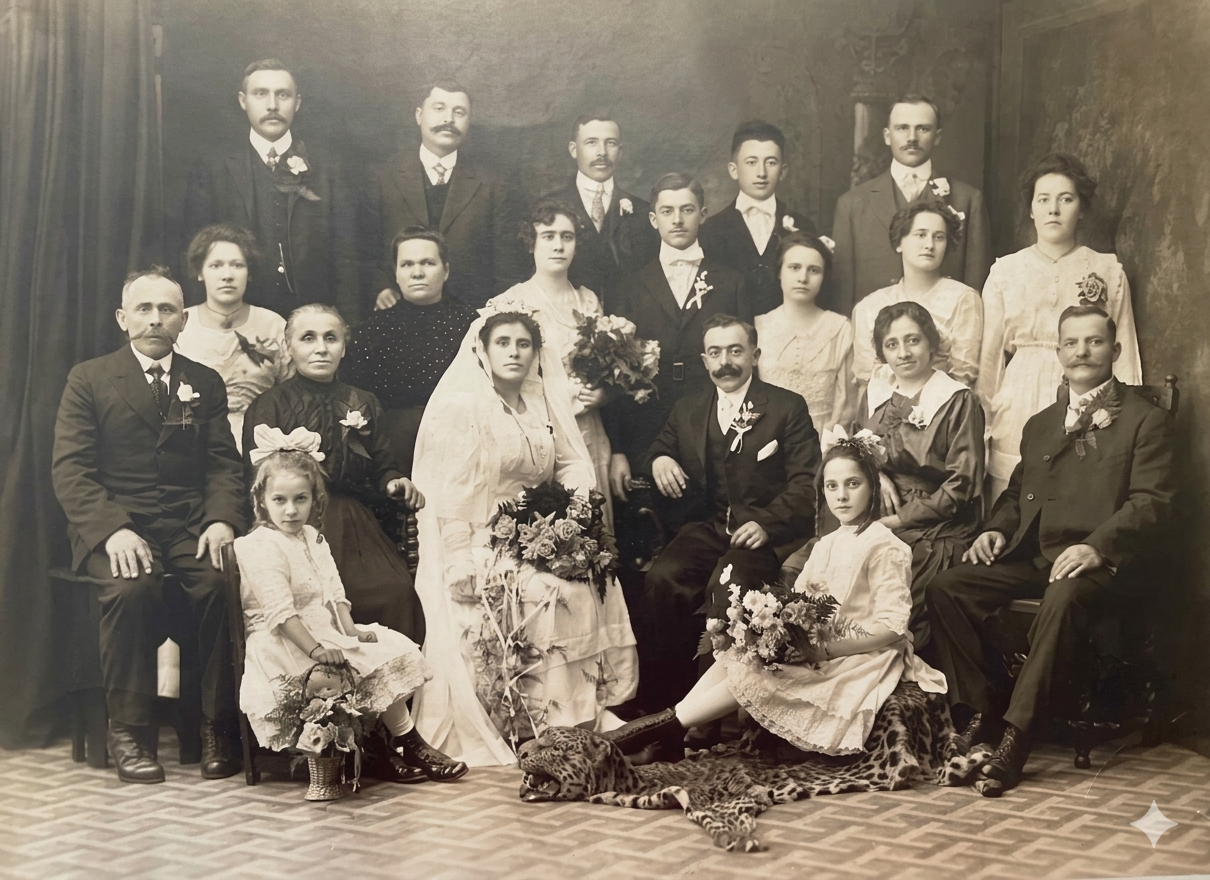
In this wedding photo, my great grandparents Anna Halper and John Wagner sit at the center, with her mother, Maria Halper, seated to her right.
The other photo I have is the one below. I’m not sure where this one was taken or whose writing appears on it, but my mother gave me a copy of it in a Heritage Album she made for me years ago.
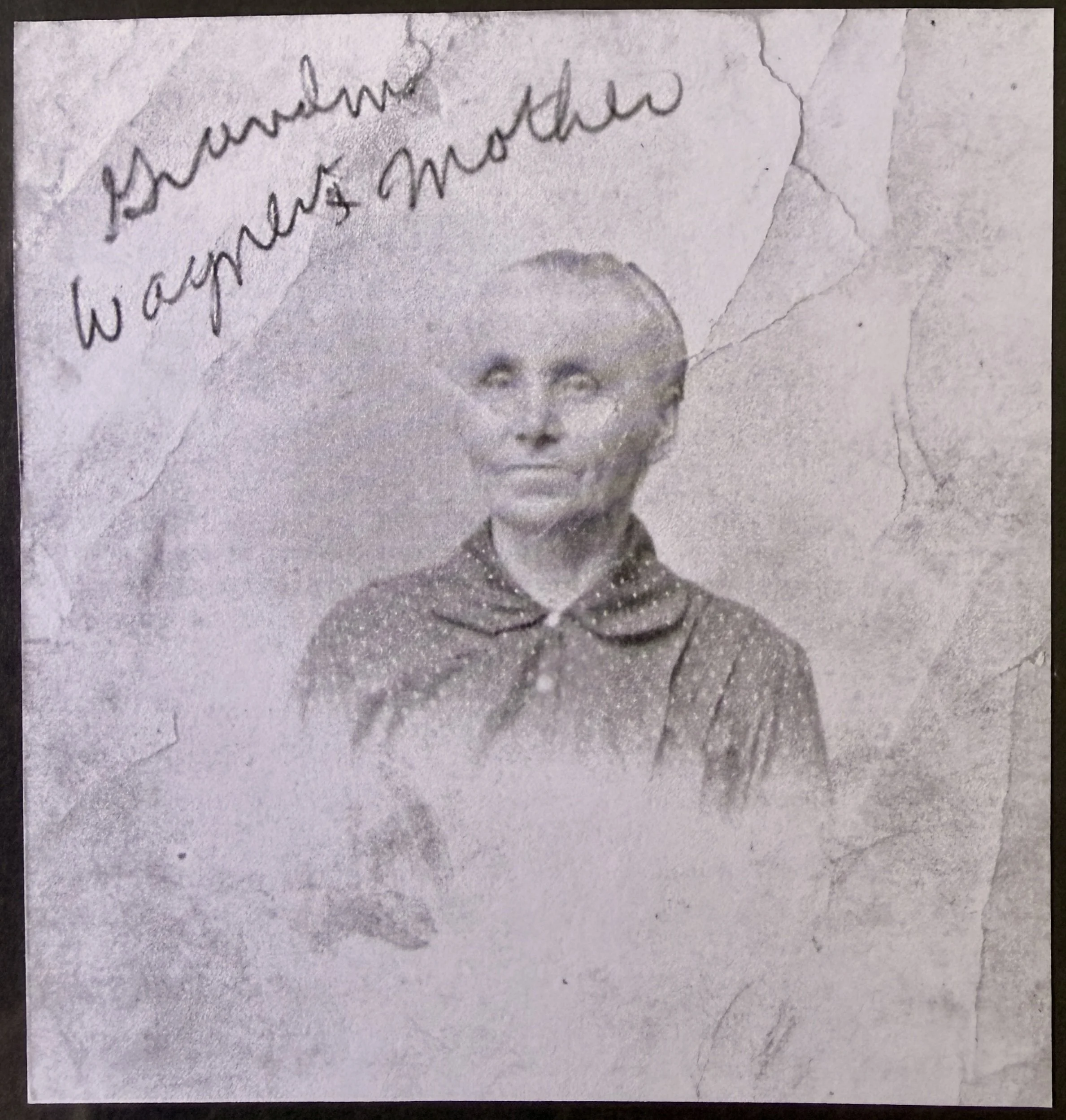
My great-great grandmother Maria Halper, born 16 Jun 1853 in Vörösvár, Vas, Hungary (aka. Oberdorf, Burgenland, Austria)
I have not been able to figure out if Maria Halper died in Chicago or returned to Austria (aka. Österreich). She described herself as a widow when she passed through Ellis Island in both 1904 and 1910, and that is how she is listed in the 1920 U.S. Census, where she shows up living with her son Paul (1880-1938) and his wife Justina. However, when her son Frank immigrated to Chicago in May 1909, he listed his father Paul Halper back in Őrállás as his closest relative, and church records show that Paul actually died 25 Feb 1917. So, perhaps he and Maria were separated? When Anna Halper immigrated in 1913, she did not list her father as her closest relative; she listed her Uncle Frank Lorenz in Őrállás and said she was on her way to meet up with her mother Maria in Chicago. At this point, I think that’s a family mystery I won’t be able to solve.
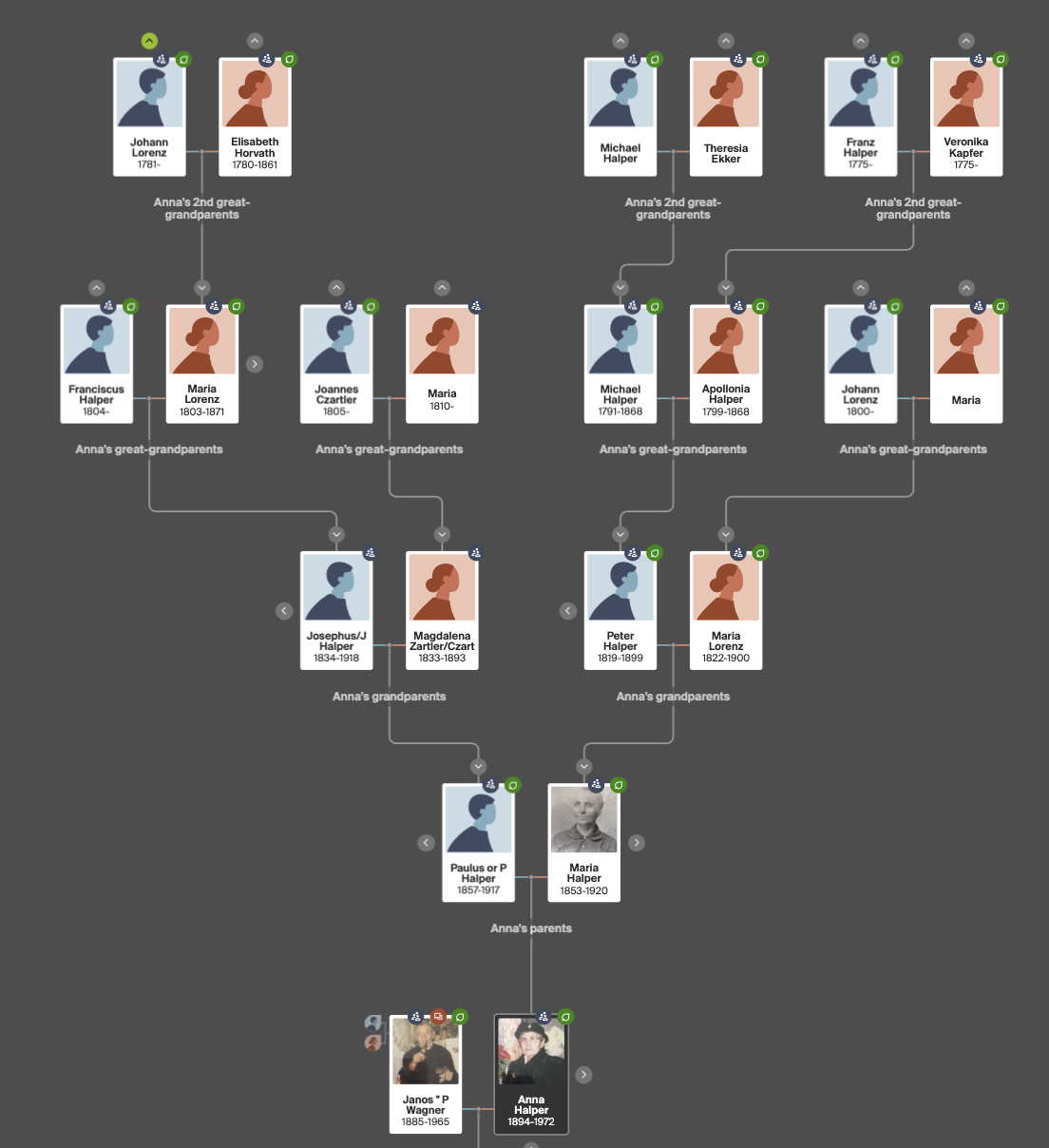
Here you can see some of my Halper (and other) ancestors for five generations, going back to the late 1700’s, all born in Oberdorf.
What I do know is that Maria Halper was born 16 June 1853 in Vörösvár, Vas, Hungary to Peter Halper (1819-1899) and Maria Lorenz (1822-1900). Her husband Paul was born 28 June 1857 to Josephus/Josef Halper (1834-1918) and Magdalena Zartler (1833-1893). Their parents, their parents’ parents, and their parents’ parents were also born in the same place – you get the idea. I found evidence of five different Halpers living there in 1720, listed in that year’s census record. People didn’t move far, and there was a lot of intermarriage among families and cousins (making family history tracking very difficult).
Eventually, Maria and five of her children immigrated to Chicago, Illinois. I will explore their immigration stories more in a future post. However, at some point between 1923 (when his youngest child would have been conceived) and 1930, her son Frank returned to Austria to run the family farm, leaving behind a wife and five children in Illinois, the youngest aged six (that information came to my mother through one of his granddaughters). None of Maria’s other children ever returned to their homeland.
So, when Frank headed back to Austria, did his mother Maria return with him? Is this photo possibly of the two of them? It was mixed in with some old “family stuff” my Great Aunt Minnie (Anna’s daughter) had, but it is unlabeled, so I cannot say for certain. By 1930, Frank would have been 39 and his mother, 77. What I find especially interesting about this picture is the group of at least four children hiding in the background inside the house. To anyone in the Burgenland Bunch who is reading this – do you have any idea what is going on here and what year this photo might have been taken?
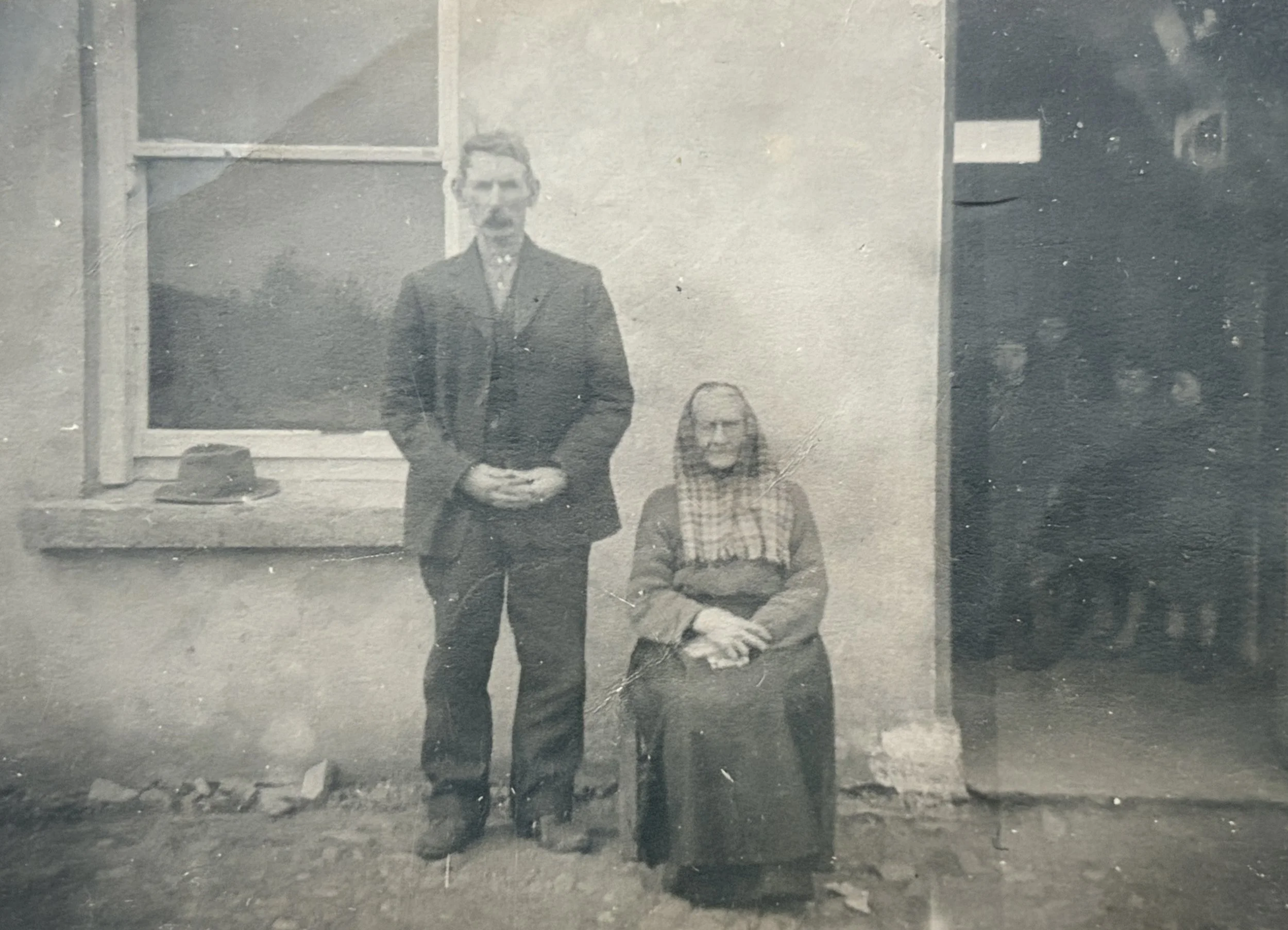
This photo, which I found among my Great Aunt Minnie’s “family stuff,” appears to have been taken of family members in Oberdorf — I’m just not sure who.
So, what was life like in Oberdorf for the Halpers over the generations? What kept them there? What work did they do? Why did so many eventually leave? What was the Halper family’s experience as they traveled to New York City, passed through Ellis Island, and eventually settled on the south side of Chicago in the area called “back of the yards”? I’ll be exploring those questions and more in this and the next couple posts.
Let’s start at the very beginning … a very good place to start (as they say in Austria, according to The Sound of Music). While archaeologists have found evidence that humans inhabited the area thousands of years ago, the village of Oberdorf is first mentioned in a historical record in 1434. That document records the purchase of the local Rotenturm (Vörösvár) estate by Berthold von Ellerbach, the head of a noble family from southwestern Germany with ties to Bavarian royalty. The estate included a former castle built at the end of the 14th century by the Vörösvár family, as well as the land that now makes up Oberdorf, Unterwart, and dozens of surrounding agricultural communities.
The Ellerbachs rebuilt and expanded the ruined medieval castle at Rotenturm and used it as their eastern headquarters. From their base in Rotenturm, the family aggressively acquired neighboring lands, cementing themselves as one of the most dominant landowning families in Southern Burgenland. For a time, the family even gained control of the strategic fortress of Güssing Castle and its dependent villages. I’ll be writing about our visit to Güssing in my next post.
The peak of the Ellerbachs’ political power came under the reign of the legendary Hungarian King Matthias Corvinus. In 1465, King Matthias appointed the brothers John (János) and Berthold Ellerbach as the joint Voivodes (Governors) of Transylvania. This was one of the highest political and military offices in the entire kingdom, tasking the family with defending the realm against Ottoman encroachment and domestic rebellions.
So, what happened to the powerful Ellerbach family? Why did they disappear? Simply put, they ran out of male heirs. By 1524, less than a century after the Ellerbach family purchased it, the House of Erdődy took control of the Rotenturm lordship and castle. At the time of this transition, the inhabitants in the area were “mostly serfs who paid their taxes partly in kind and partly in money to the manor” (ie. they gave a certain percentage of their crops and livestock to the feudal lords, as well as paid taxes). [1]
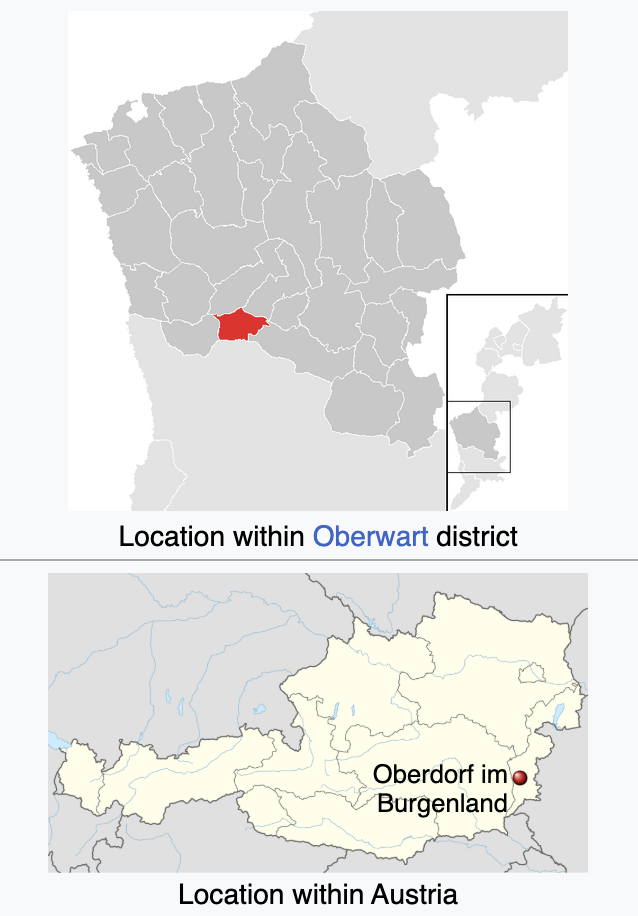
These maps show where Oberdorf is within the Oberwart district (the red mark), where Oberwart is within the state of Burgenland, and where Oberdorf im Burgenland (its full name, to distinguish it from another Oberdorf) is located in the country of Austria. [2]
This takeover occurred at a massive turning point in Central European history. Just two years later, in 1526, the Ottoman Turks crushed the Hungarian army at the Battle of Mohács. Because the Erdődys were fierce military commanders loyal to the Habsburg monarchy, they successfully held on to the heavily fortified Rotenturm estate through the brutal centuries of border warfare that followed. They would remain the principal landlords of the region for the next 400 years, right up until the feudal estate system was permanently dissolved in the 20th century.
However, in the 1500s and 1600s, the Ottoman Empire swept across Hungary, completely devastating the region. Villages were burned, and populations fled. To rebuild the decimated workforce and revive agriculture, landlords (including the Erdődys) heavily recruited German-speaking settlers (often called Hospites or "guests") from neighboring Styria, Lower Austria, and deeper Bavarian territories. Over time, these German-speaking Bavarian/Austrian peasants heavily assimilated into the region, eventually outnumbering the original Hungarian border-guard (Őr) families that had settled there 500 years earlier in areas such as Alsóőr/ Unterwart, Felsőőr/Oberwart, and Őrisziget/Siget in der Wart (as I discussed in Part II).
And these German-speaking settlers kept on coming, bringing with them the distinct dialects and agricultural techniques that defined villages in the area for centuries. By 1851 Oberdorf, despite being within Hungary’s borders, was described in the Geographical Dictionary of Hungary as “a German village, in the county of Vas, in the manor of Vörösvár, with a population of 610 Catholics and a thin, wooded border." [3] I’m not sure exactly when the Halpers arrived in Oberdorf, but by 1688, “there were 24 houses in the village, and the Halper, Konrath, Tuider and Lorenz families still live in the village today.” [4] ALL of those names appear in my family tree, and they were all living in Oberdorf by 1688.
That means that they were there both before and after the changes brought by Empress Maria Teresa’s issuance of the Urbarium of 1767, which radically changed the rights of peasants in the Austrian Empire. As I read online:
“For the first time, the urbarial land rights of peasant farmers were defined and their feudal obligations to their lords were regulated. A urbarial ‘census’ was conducted in each village that showed the size of each peasant's farm land which he had the right to use. The standard size of a farm (sessio) for a given village was determined by the quality of land in that area…. A sessio included a house, barn, garden area, cultivation field, and meadowland used to produce hay…. A peasant might have rights to a whole or some fraction (1/2, 1/4, 1/8 etc) of a sessio. The peasant's dues (taxes) to his lord and the number of days he was required to work for his lord was determined by the size of the farm land he lived on and used. Supposedly, the Ubarium established the maximum number of days a lord could require a peasant farmer to work for him (known as the robot). The maximum work days for a farmer using a full sessio farm was set at two days labor per week (104 days a year). This was cut in half to one day per week (52 days a year) if the farmer used draft animals to do the work. The days required were then adjusted proportionately to the size of the farm. men who didn't have a farm and were just day laborers on the farms of others, still had a "robot" obligation to the lord.” [5]
I spent a frustrating couple hours trying to track down the village of Oberdorf in the 1767 Urbarium records, but have so far had no luck. Therefore, I cannot provide specific information for the Halpers or any of the other names in my family tree. I’m not sure what size sessios (farms) they lived on, what robot (number of work days) was required of them, how much they had to pay in taxes, or how much they were required to give in firewood, yarn, butter, capons (castrated roosters whose meat was more tender), chickens, or eggs to their feudal lord and his family (the Erdődys) — all of which was reported in the Urbarium. Besides the above, all peasants had to give one-ninth of their crops to their lord, but this did not include what they grew in a house garden on in a depleted or damaged field. What was required of them may or may not have been changed by the more clearly defined land rights and work obligations that resulted from the Urbarium.
Since I first posted this yesterday, I got some help (once again) from Burgenland Bunch research Patrick Kovacs, who sent me the link that confirmed my great-great grandfather’s death in 1917 (thanks for that!). He also sent me a link to the 1720 Urbarium for Oberdorf (he didn’t have one for 1767). The 1720 record shows a Georgius Holperd (Halper) living in Oberdorf and lists measurements for his plowable land, meadows, and vineyards. Three other Holperds/Halpers were living in neighboring Litzelsdorf and one in Vörösvár, but all had vineyards in Oberdorf. So, apparently, my ancestors were winemakers! Yay! That same 1720 records also lists numerous men with the last name Konredth (Konrath), Laurencz (Lorenz), and Kopfer (Kapfer) in Oberdorf — all names that appear in my tree in the late 1700’s.
The first place I see with certainty the name of one of my specific ancestors in a historical Oberdorf record is below. Michael Halper’s name appears on this drawing from the Josephinische Aufnahme (Josephine Survey), an expansive military and cadastral mapping project conducted across the Habsburg Empire between 1782 and 1785 — and he is my 5th (or perhaps 6th?) great grandfather. He lived at House #1, with his plot of land visible in the top right corner of the drawing. I’m guessing he is a descendant of the Georgius Holperd mentioned above. In a later land survey done in 1858, my 4th great grandfather, also named Michael Halper, and his wife Apollonia show up as living in the same House #1.
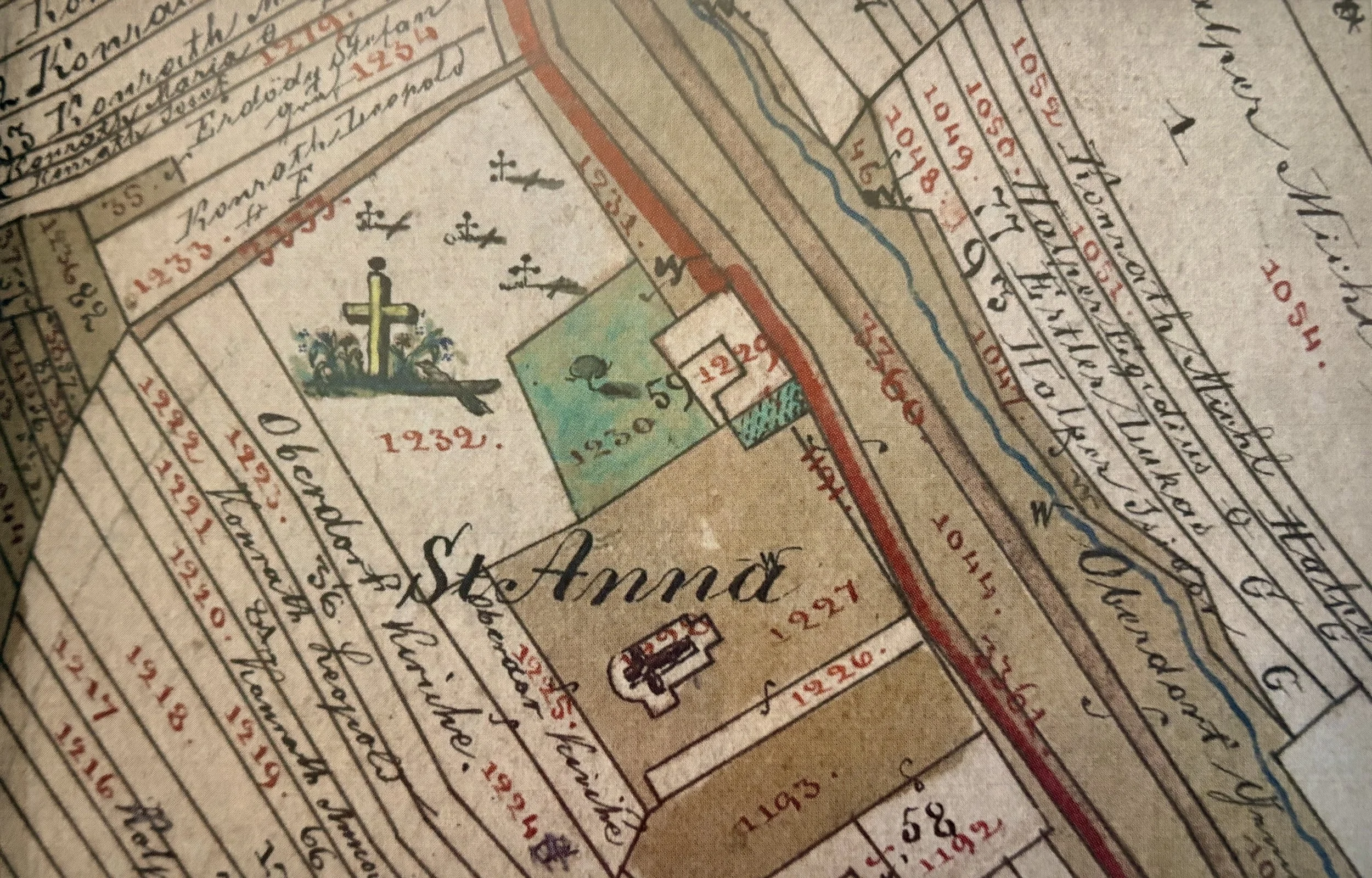
This drawing of Oberdorf appears in the Josephinische Aufnahme (Josephine Survey), a military and cadastral mapping project conducted across the Habsburg Empire between 1782 and 1785. [6]
As shown above, Oberdorf’s history cannot be separated from that of Rotenturm (Vörösvár) because, for the most part, the people who lived there were peasants/serfs, living on land owned by the Erdődy family. They were farmers who had to pay rent, whether in money or “in kind” from their crops and livestock; and they were required to work a certain number of days a week or year on the Erdődy land. How much rent and how many days changed over the years. For a more complete discussion of that, I encourage you to check out this Burgenland Bunch newsletter. It is FAR too much for me to try to explain here.
Understanding that connection helped me to finally understand why many of the Halper birth records list “Vörösvár, Vas, Hungary” as their place of birth, but their Ellis Island records say they were from Őrállás/ Oberdorf. This left me confused for some time, but I see now that the Vörösvár domain (Vörösvári uradalom) was a massive, multi-village economic empire owned and overseen by the Erdődy family. The estate officials included a lawyer, an administrator, a treasurer, a physician, and a clerk for recording important information.
What’s more, the church in Oberdorf was a “filial church” that did not have its own parish status. It was a “daughter church” of the parish church in Vörösvár/Rotenturm, where all the parish records were maintained. As such, they did not have a resident priest; they could not make their own independent administrative or financial decisions; and for significant events such as baptisms, weddings, and funerals, they had to travel to the mother church to have their names officially written in the ledger. That did not change until the mid-19th century, when the community successfully petitioned the bishop to break away from Rotenturm to become a self-governing parish church.
I also only recently learned that the name Őrállás didn’t come into use until 1885. Why then? Because Hungary’s Magyarization policies after the 1867 Austro-Hungarian Compromise required each town to have a Hungarian name. They also required that legal records of all sorts be in the Hungarian language, so a son named “Johann” might be officially registered as “János,” even though the family was German-speaking; or a daughter named “Katarina” (as in the case of Anna’s sister) might be registered as “Katalin.” That has also made tracking down family records more difficult.
Before I go any farther, there are a few key events besides the Urbarium of 1767 that brought significant change to Hungary and the Oberdorf area that are important to understand (for a fuller explanation, read this article):
1848 Hungarian Revolution - The 1848 Hungarian Revolution was a violent political uprising against the absolute rule of the Austrian Habsburg Empire. It was one of many revolutions that spring, simultaneous democratic and nationalist uprisings that swept across more than 50 European countries. Led by nationalist reformers and inspired by the upheavals in Paris and Vienna, the Hungarian Revolution broke out on March 15, 1848, in Pest and Buda, with leaders demanding independence, freedom of the press, religious equality, civil rights, and the immediate abolition of the feudal serfdom system that bound the peasantry. The revolt culminated in the declaration of a Hungarian Republic under the charismatic leadership of Lajos Kossuth, as well as the signing by the Emperor of the so-called April Laws, which abolished serfdom and made peasants the owners of the land they cultivated. [7]. While the revolution was ultimately crushed in 1849 by combined Austrian and Russian military forces, it successfully broke the economic power of the old nobility, forcing an end to the feudal way of life and liberating millions of rural peasants across the realm. However, it left Hungary completely subordinate to the highly centralized, absolutist regime established in Vienna under new emperor Francis Joseph I. [8]
1867 Austro-Hungarian Compromise - Following the 1849 defeat, military dictatorship and absolutist rule over Hungary lasted until 1867, when the Austro-Hungarian Compromise established the dual monarchy of Austria-Hungary and partially re-established the former sovereignty of the Kingdom of Hungary. The agreement also restored the country’s old historic constitution. This arrangement allowed Hungary to manage its internal affairs independently, while military, foreign policy, and financial matters were jointly overseen by Austria. [9]
Magyarization Policies - Despite gaining political control over their half of the Dual Monarchy in the 1867 Compromise, the ruling Magyars (Hungarians) were actually a demographic minority in their own country. The remaining 54% to 55% majority of the population was a mosaic of diverse ethnic minority groups, including Romanians in the east (Transylvania); Slovaks and Ruthenians in the northern mountains; Germans in the western borderlands and major trading cities; and Croats and Serbs in the southern regions. Ethnic Hungarians made up only between 45% and 46% of the total population [10]
Magyarization was an aggressive cultural and political assimilation campaign launched by the Hungarian government between 1867 and 1918 with a goal of systematically transforming a highly multi-ethnic kingdom into a monocultural Hungarian state. The policy forced ethnic minorities – such as the German peasants in Oberdorf – to adopt the Hungarian language, culture, and national identity through several key measures:
The government banned minority languages from public schools, requiring all children to achieve fluent literacy in Hungarian within four years.
Traditional non-Hungarian town and village names were legally outlawed and replaced with newly manufactured Hungarian versions, such as changing Oberdorf to Őrállás.
All official records, courts, church registries, and government business had to be conducted exclusively in Hungarian, forcing minorities to translate their own names to access legal services.
Ultimately, these heavy-handed policies backfired. They caused deep resentment among minority populations and contributed to thousands of families emigrating to places like Chicago and New York. The policies officially ended in November 1918 following the collapse of the Austro-Hungarian Empire at the end of World War I. After the border shifted following the Treaty of Trianon in 1921, the artificial name Őrállás was permanently abolished, the German language was restored to schools and courts, and the village legally went back to being called Oberdorf, though it was now part of Burgenland, Austria, instead of Vas, Hungary.
Okay, enough history. Now, I want to focus on our visit to Oberdorf in June. Unlike in Unterwart, where we were left to wander on our own, in Oberwart we were fortunate to have someone from the Burgenland Bunch group offer to show us around: Ingrid Grossmann. To her we are very grateful! She was a wonderful host, and we enjoyed getting to meet her.
Ingrid, as it turned out, was from Oberdorf but had lived in New York for about forty years before returning to Oberdorf to help care for her mother. She and I arranged to meet at the Municipal/Town Office Building (Gemeindeamt), where we hoped to perhaps find some answers in the town records as to where my ancestors might have lived or when they might have died. We did not find any new information (I wish I’d seen the above map before we went!), but we did briefly get to say hello to the mayor, who hurried by on his way to his office (no photo with the mayor this time, unlike in Eisenstadt - lol).
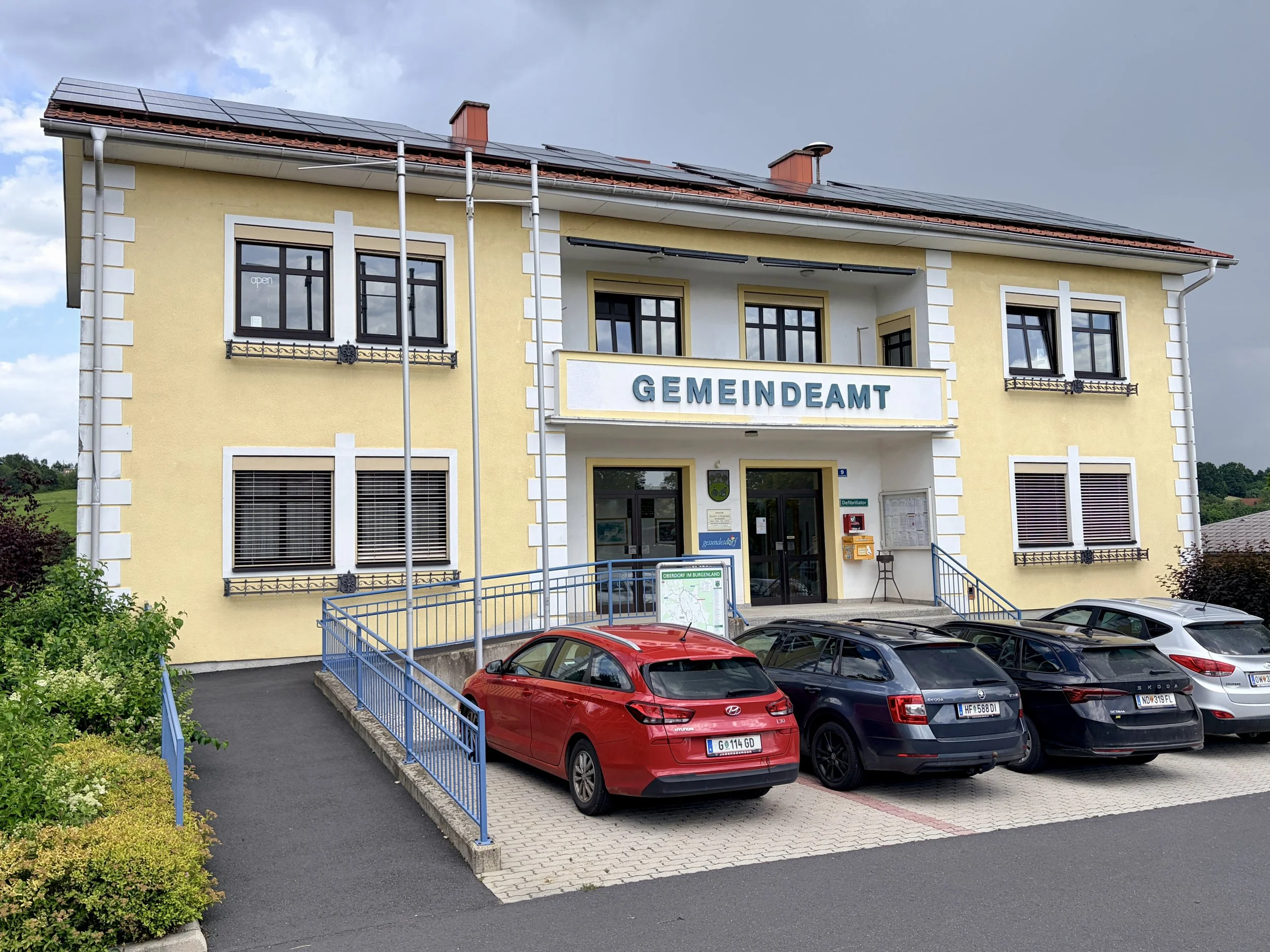
This is the Gemeindeamt (Municipal/Town Office Building) where we met up with Ingrid.
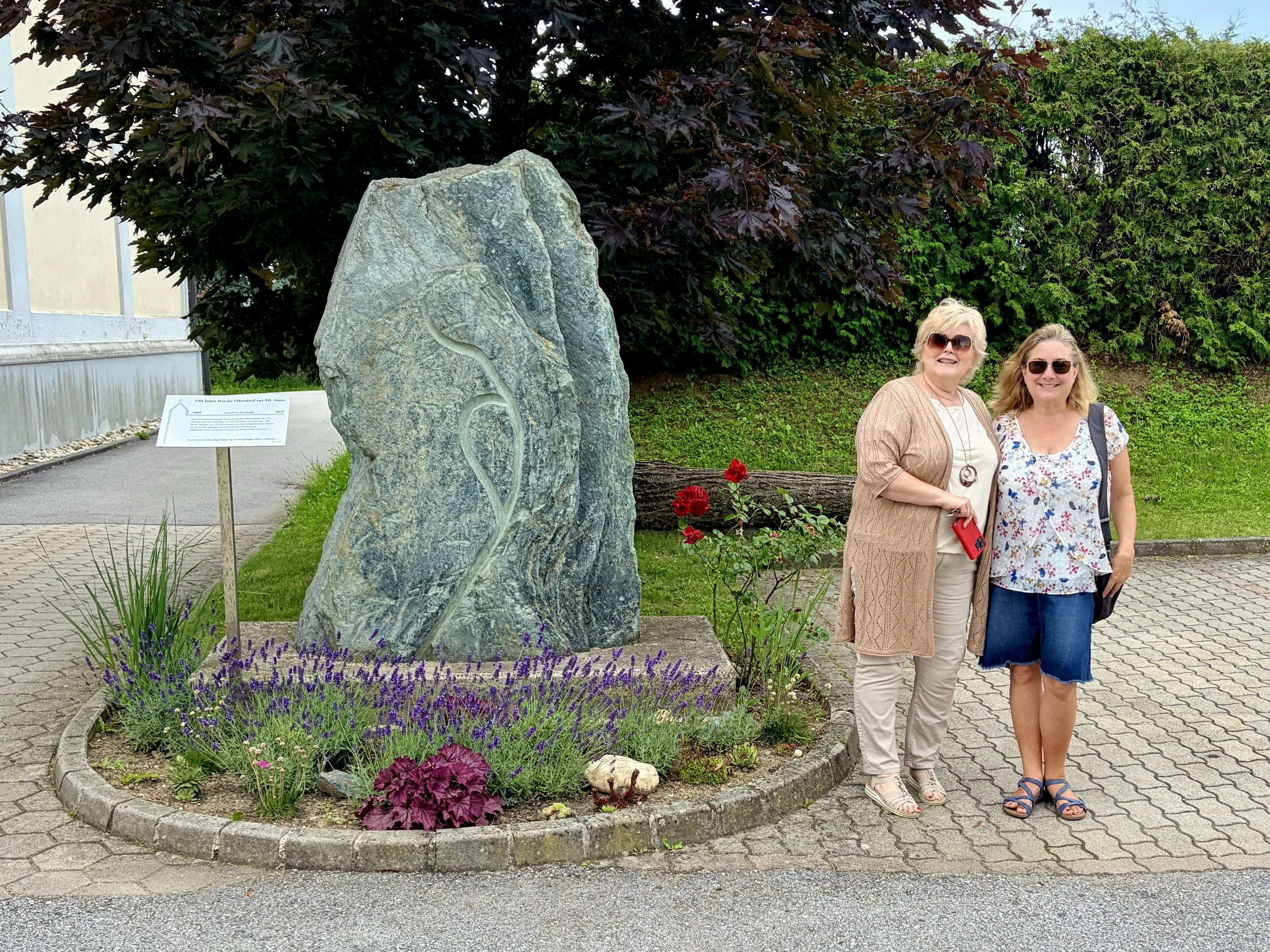
Here I am with Ingrid, standing beside a commemorative stone placed here for the church’s 150th anniversary in 2019.
The thing I was most excited about was that Ingrid had been able to arrange for someone to open the church up for us. So, we headed over to Römisch-katholische Pfarrkirche zur Heiligen Anna (the Roman Catholic Parish Church of Saint Anne) to meet up with Karl Tuider. This is the church my great grandmother’s family would have attended. The church sits on Sauberg Hill, which offers beautiful views of the surrounding area. The German name Oberdorf actually translates to "Upper Village," describing its topographic layout on the elevated hills rising above the surrounding valley.
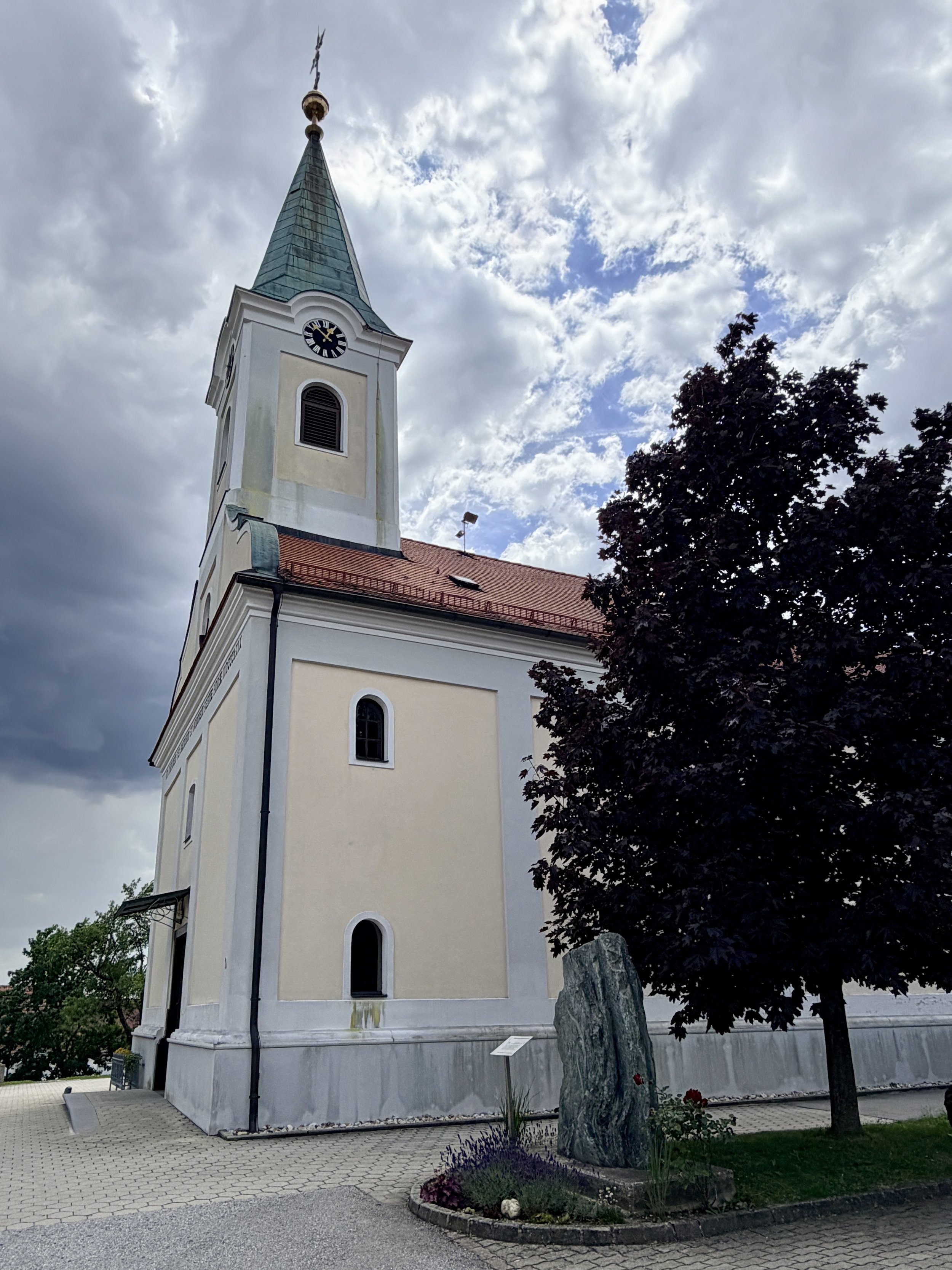
Here you can a view of St. Anne’s Church and its distinctive clock tower.
The first church in Oberdorf was built around 1757 (I have seen conflicting dates) by Count Ludwig Erdődy. A new and larger church was built in 1833 under the patronage of one of his descendants, Count George Erdődy. He provided the funds and transferred a side altar to the church from his old Rotenturm castle. It was George’s son Stefan who rebuilt Rotenturm Castle in the Moorish-Byzantine style between 1862 and 1866.
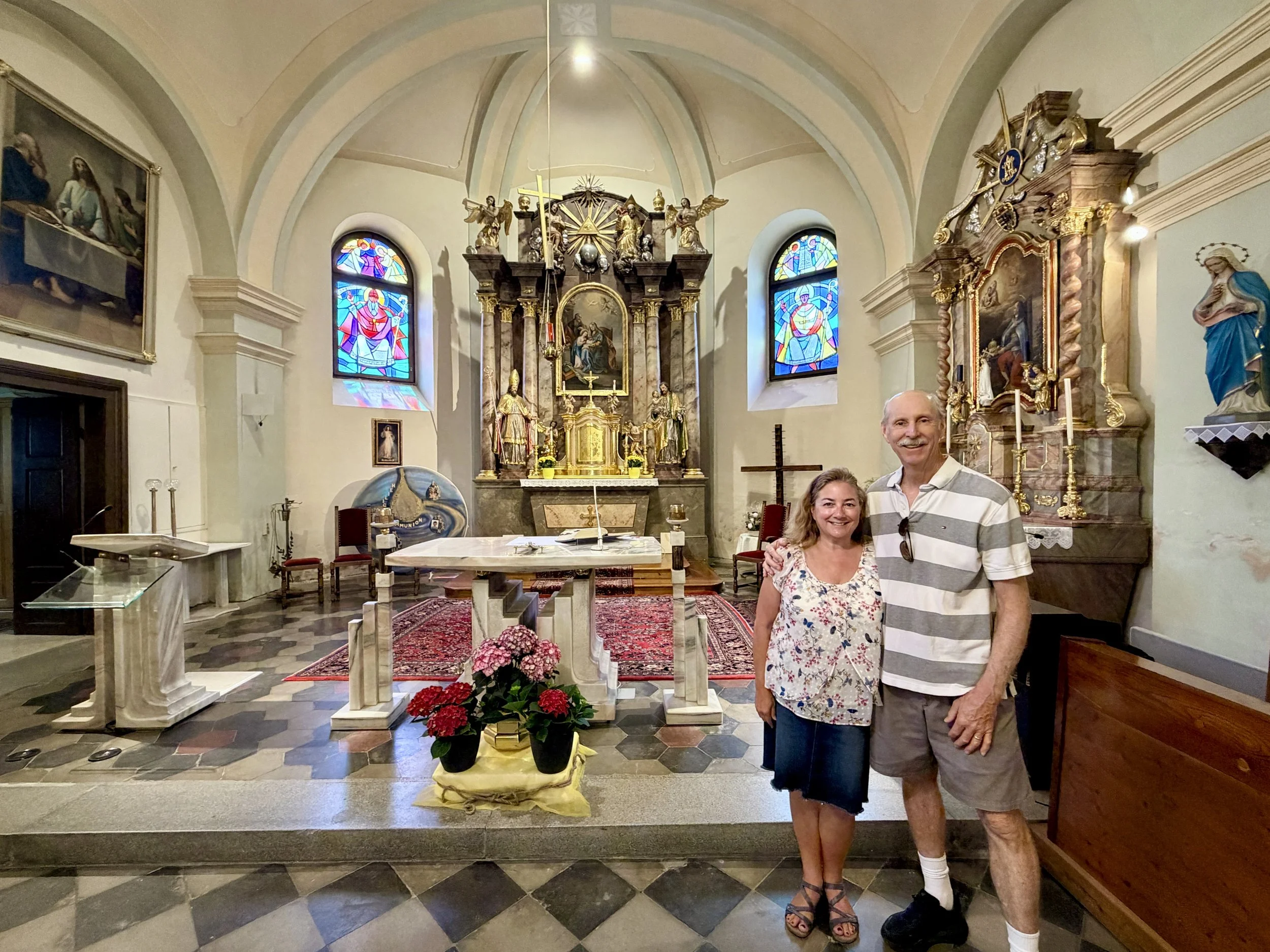
In this photo, on the wall behind Mike and me, you can see the side altar gifted to the church in 1836 by the Erdődy family; it includes a painting of the Virgin Mary with baby Jesus, as well as the Erdődy Coat of Arms.
It was also Stefan Erdődy who provided material resources for the Oberdorf church to be rebuilt in 1869, this time in an expanded form, with a bell tower and interior vaults. He and two of his sons, Ladislaus and Julius, attended the solemn consecration of the new house of worship when it was completed. After the ceremony, the three Erdődys joined the congregation for a midday meal in the school, “during which Judge Egidius Halper delivered a laudatory speech to the Count and thanked him and his two sons on behalf of the entire community.” [11]
I wrote a bit about Count Julius Erdődy, as well as his wife Emilia, in my last post. Besides collecting large amounts of artwork and building the Emilia steam mill (where my great grandfather John Wagner briefly worked), they were considered benevolent philanthropists, spending large sums on numerous associations for the needy and helping to build Oberwart District Hospital. [12] He also founded Rotenturm’s volunteer fire brigade.
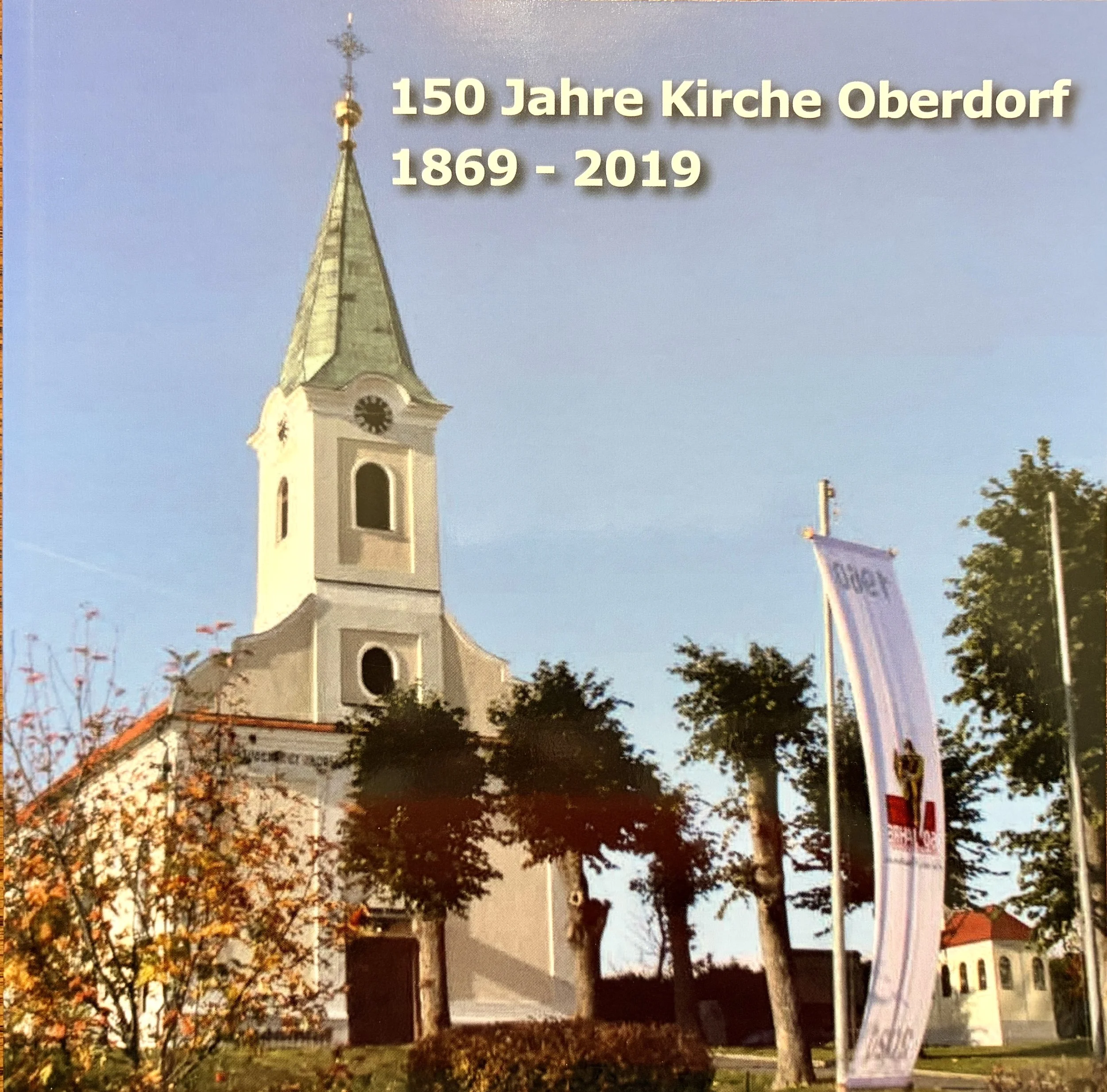
This is the cover of the book Karl gave me, titled 150 Jahre Kirche Oberdorf (150 Years of Oberdorf Church): 1869-2019. Thanks to Google Translate, I was able to read it!
St. Anne’s Church, with its distinctive bell tower, is easily visible and recognizable from various viewpoints around Oberdorf. The church tower can be interpreted as a stone-made finger pointing toward heaven, as explained in the book Karl Tuider gave me titled 150 Jahre Kirche Oberdorf (150 Years of Oberdorf Church): 1869-2019. Many thanks to Google Translate for helping me to read it!
In a time when hardly anyone owned watches, the church tower clock and the chimes of the bell provided orientation for the entire village. The tower still contains the original clockwork from 1883 and clock mechanism from 1889. According to the book, it was the bells that gave the day its rhythm, rang for prayer and the midday break, or served as an alarm in crisis situations. The three old bells, which came from the church built in 1833, were requisitioned for war purposes by the German Wehrmacht, but the church has acquired other bells since then, with a small bell given as a gift in 1921 by Oberdorfers living in Chicago. [13]
The church is dedicated to St. Anna, whose name is derived from the Hebrew “Han-na” and means “grace” and “faith” and also “Yahweh has had mercy.” Anna is recognized as Mary’s mother and St. Joachim as Mary’s father, though their names never appear in the Bible. Everything we know about them comes from “apocryphal writings,” primarily from the Protoevangelium of James. I had never actually read this apocryphal story before and found it interesting – here’s a LINK to one version if you want to check it out.
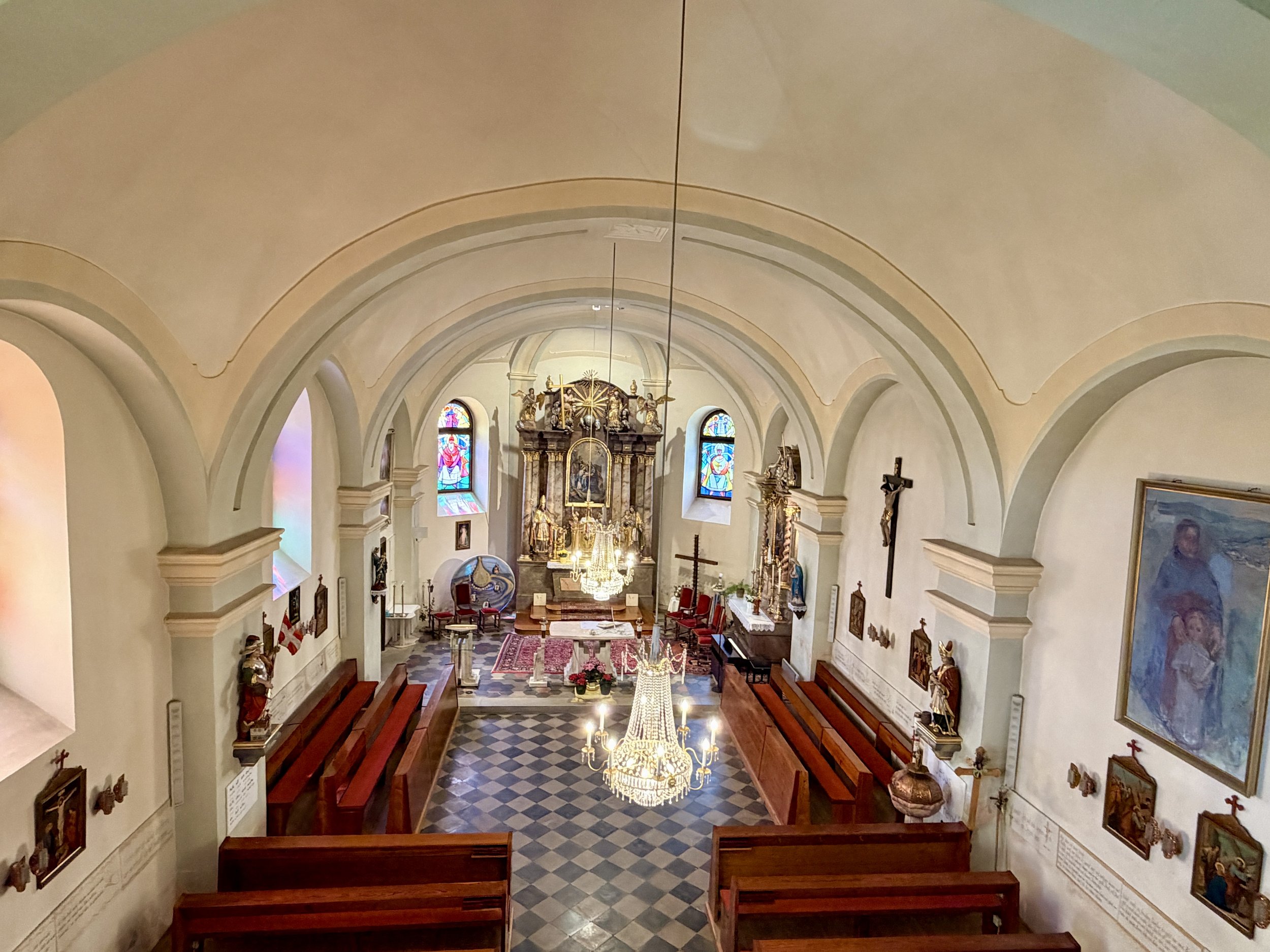
This is the view of the church from the Organ Loft; on the right, you can see a 1968 painting by Franz Erntl of St. Anna with daughter Mary.
Though not much more is known about Saints Joachim and Anna (aka. Anne), as early as the sixth century, “churches were built in her honor, prayers were offered for her intercession, devotions were formulated, and patronages were attributed to her.” [14] St. Anne is recognized as the “patron saint of grandparents, grandmothers, mothers, cabinetmakers, carpenters, dressmakers, equestrians, expectant mothers, homemakers, housewives, lace workers, seamstresses, miners, old-clothes dealers, Canada, and France.” [15] Additionally, both the Roman Catholic Church and the Eastern Orthodox Church celebrate the “Presentation of Mary in the Temple,” as a liturgical feast on Nov. 21, commemorating Mary’s presentation at the temple by her parents at age three.
For many centuries, the name “Anna” enjoyed great popularity and around 1900 was one of the most widespread first names in German-speaking countries. That should be no surprise to anyone doing family history research – I have come across MANY “Anna Halpers” (and other Annas) in my research. It wasn’t until Burgenland Bunch researcher Patrick Kovacs stepped in to help me find the correct Hungarian church records that I could be certain which family line was actually hers. My great grandmother Anna also named one of her daughters “Anna Rose,” and I named my daughter the same in 1998.
St. Anna is depicted in several paintings in the church, each showing her with her daughter Mary. In the painting that hangs above the church’s High Altar, which dates back to 1869, both St. Anna and St. Joachim are instructing their daughter Mary, who is holding a book. Above her, a dove representing the Holy Spirit descends holding a ring, representing that she will be the Spirit’s mystical bride.
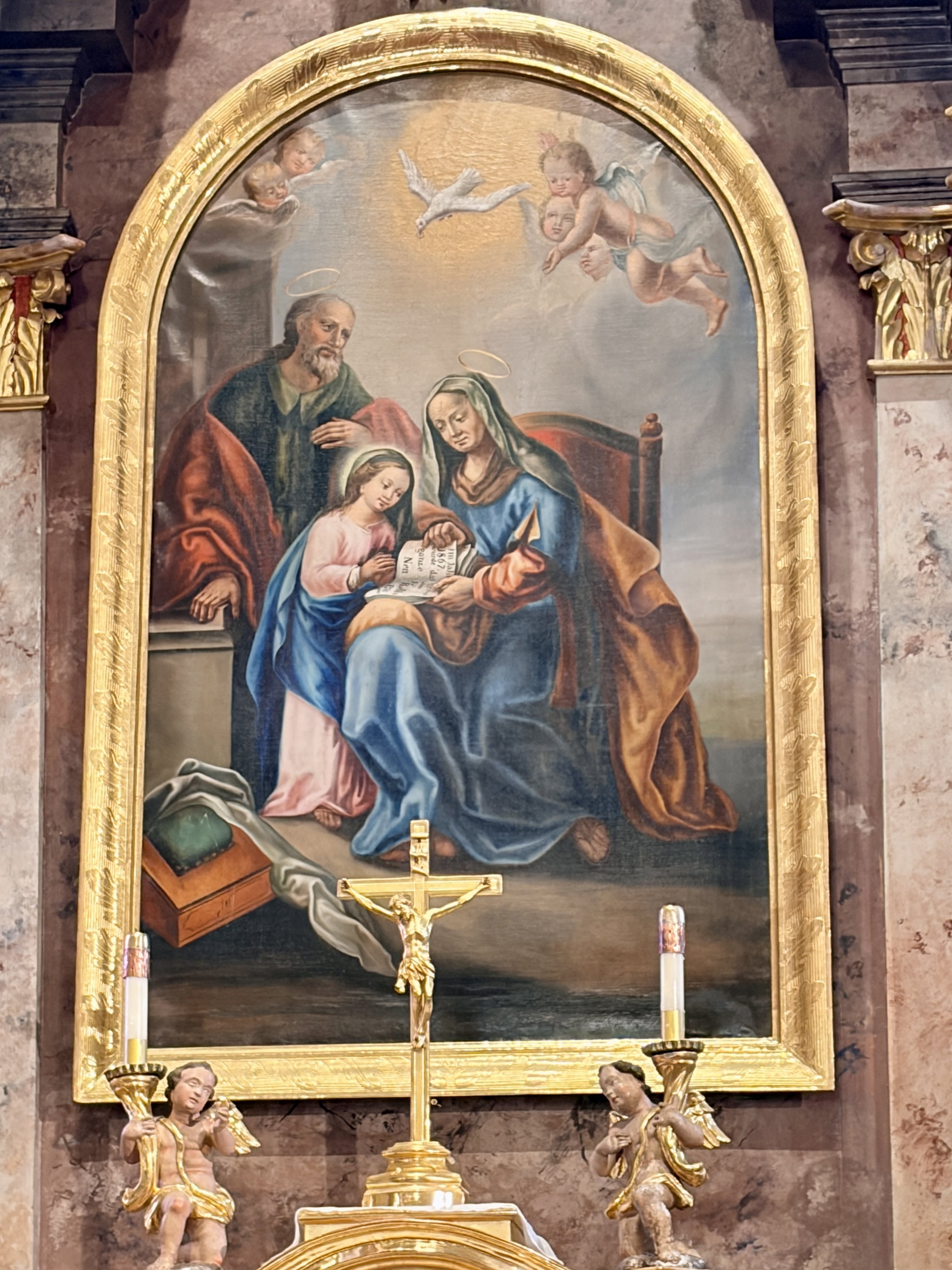
This painting of Saints Joachim and Anna instructing their daughter Mary hangs at the center of the church’s High Altar, which was created in 1869; as for the painting itself, the book Mary is reading states: “In 1867, the whole thing was repainted by J. Rath Pollau.” Below you can get a view of the High Altar.
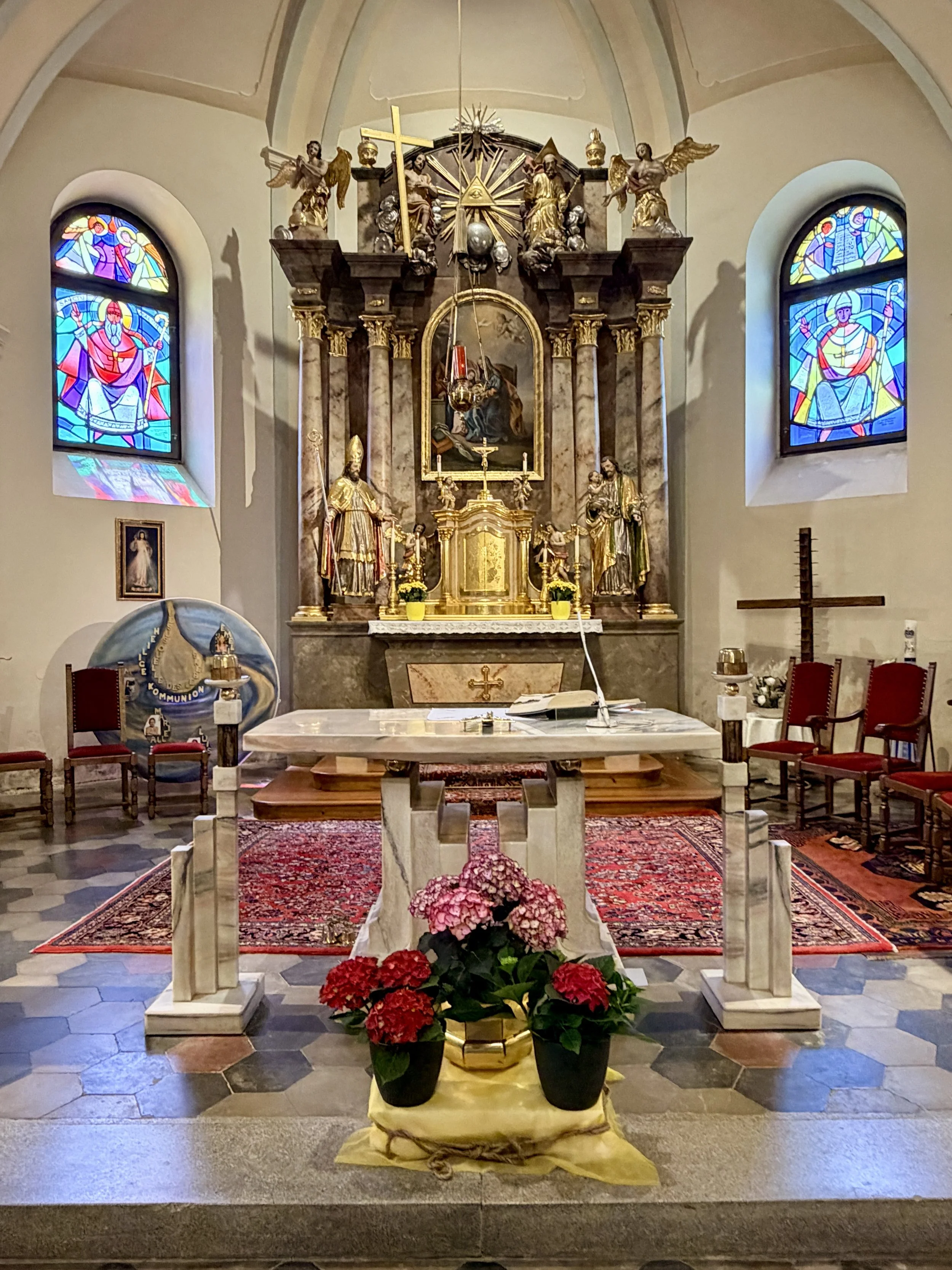
The High Altar also includes symbols of God the Father, Son, and Holy Spirit in the center at the top. The dove represents the Holy Spirit, the “Eye of God” in a triangle surrounded by a halo of rays represents the trinity and divine glory, and the globe represents Jesus Christ. On either side of the altar stands St. Patrick (on the left) and St. Joseph holding baby Jesus (on the right). The stained glass windows depict St. Martin (on the left), donated by Irene (Halper) Strabl in 1992; and St. Charles Borromeo (on the right), donated in memory of Carl Strabl.
One of the statues that caught my eye was this one of St. Florian, the patron saint of firefighters, chimney sweeps, and anyone seeking protection against fires and devastating floods. He appears here with a bucket of water to put out the burning church at his feet. In a town where thatched roofs were common, fire was an ever-present danger, so many churches had statues to honor St. Florian. He was also Austria’s first homegrown saint, making him one of the most widely venerated saints in Central Europe.
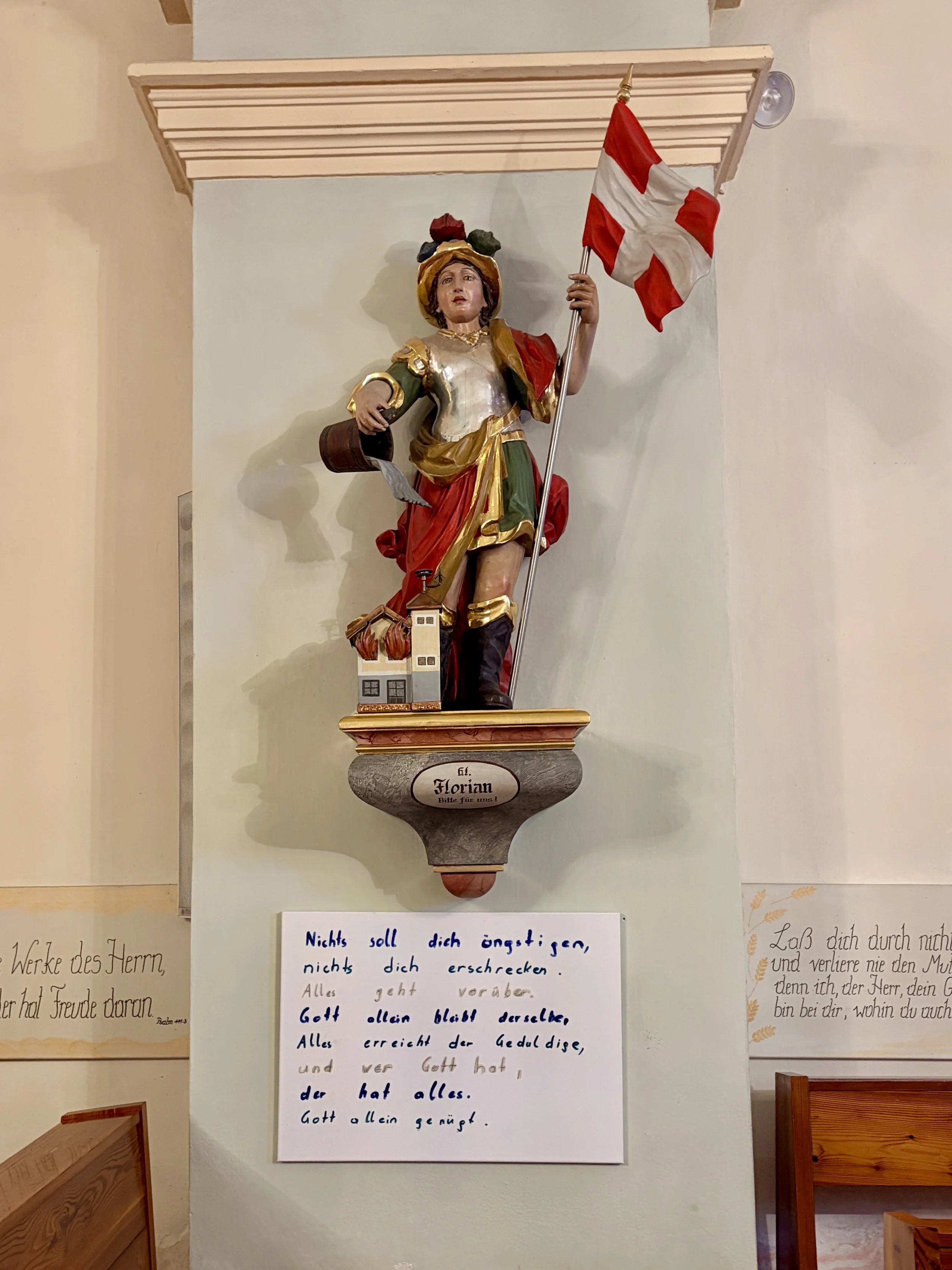
Here you can see a statue of St. Florian, the patron saint of firefighters, chimney sweeps, and anyone seeking protection against fires and devastating floods.
Beneath the statue, the handwritten paper contains the German translation of a famous medieval prayer written by the Spanish mystic Saint Teresa of Ávila that is widely used as a devotional for finding inner peace during times of anxiety or chaos. It says:
Let nothing disturb you,
let nothing frighten you.
All things are pass.
God alone remains the same,
Patience achieves everything,
and whoever has God
lacks nothing.
God alone suffices.
St. Florian was born in Tulln sometime around 250 AD, where he served as a Roman official to the governor of the Roman province of Noricum in modern-day Upper Austria. Besides his military obligations, he helped organize and train soldiers to fight fires. One legendary tale says that he once “miraculously saved a burning house (some say an entire city) using just a single bucket or pitcher of water.” [16]
Florian eventually became a Christian, and when 40 Christians were arrested during the persecution of Emperor Diocletian, Florian tried to help them. When he refused to renounce his faith, he too was arrested. According to tradition, he was beaten with clubs, his shoulder blades were broken with sharpened irons, and he was threatened with burning at the stake. Florian declared, “If you do, I will climb to heaven on the flames,” so his executioners decided to drown him instead. [17] He was thrown into the Enns River with a heavy millstone tied to his neck. The 40 Christians (known as the Martyrs of Lorch) died in prison. [18]
As an interesting side note, seeing the name “Tulln” reminded me that Mike and I made a brief stop in Tulln on our Danube River cruise. We were bussed there after our visit to Göttweig Abbey in Krems, Austria, to get back on the ship. While in Tulln, we saw the Nibelung Fountain, which sits prominently on the Danube promenade across from the “Rathaus” government building and a beautiful nature park.
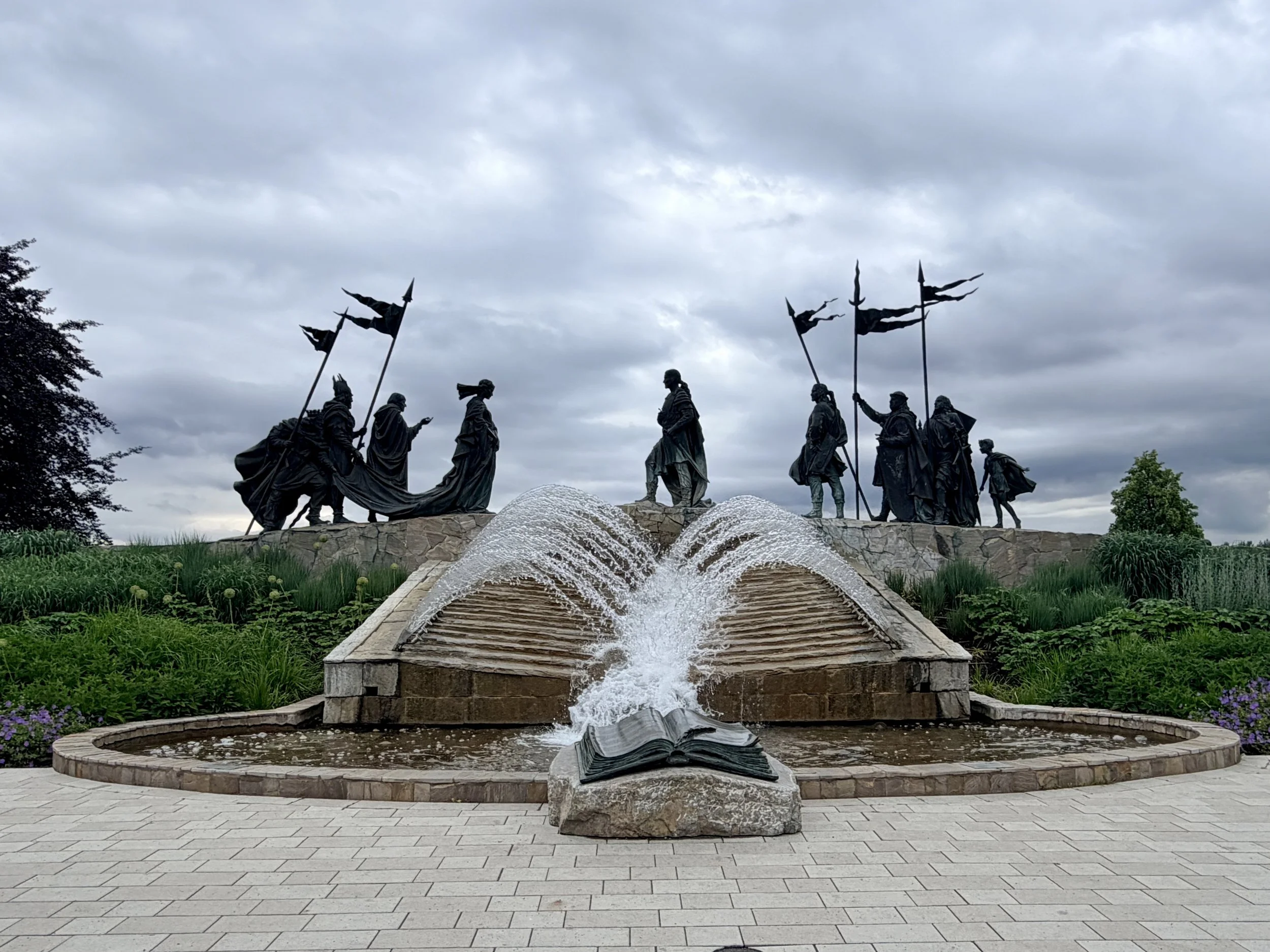
The Nibellung Fountain in Tulln depicts the moment Kriemhild (the Burgundian Queen) meets Attila the Hun (called King Etzel in the German epic poem The Nibelungenlied), who proposes marriage to her.
At the time, I didn’t know exactly what we were looking at, but it turns out that the fountain, sculpted by Michail Nogin and unveiled in 2005, depicts a legendary moment from the medieval German epic poem, the Nibelungenlied. It captures the precise moment Kriemhild (the Burgundian Queen) meets Attila the Hun (called King Etzel in the text), who proposes marriage to her. The design serves as a symbol of the merging of East and West — or the cultural convergence of the Occident and the Orient — taking place in the historic border town of Tulln. [19] I love how I keep discovering more about the things we saw, especially since I had no idea before that “King Etzel” was Attila the Hun, whom I wrote a lot about in Part II.
But back to St. Anne’s Church – lol. These are the kinds of “rabbit holes” I keep going down. Several interesting stained glass windows appear in the church. The one that stood out to me the most was this one, which was donated by Anna (Wagner) Frost from Bensonville in Chicago, Illinois, in 1994 on the occasion of the 125th anniversary of the church. It depicts St. Elizabeth of Thuringia, who was born in northeastern Hungary in 1207 to King Andrew II of Hungary and his wife Gertrude. She was famous for her social work, which included founding hospitals, helping the sick, and giving away significant amounts of money and food. At one point her husband, frustrated by her charitable giving, demanded to see what she had in her basket, and the bread she had hidden away, as the story goes, miraculously turned into roses (as seen in the stained glass window).
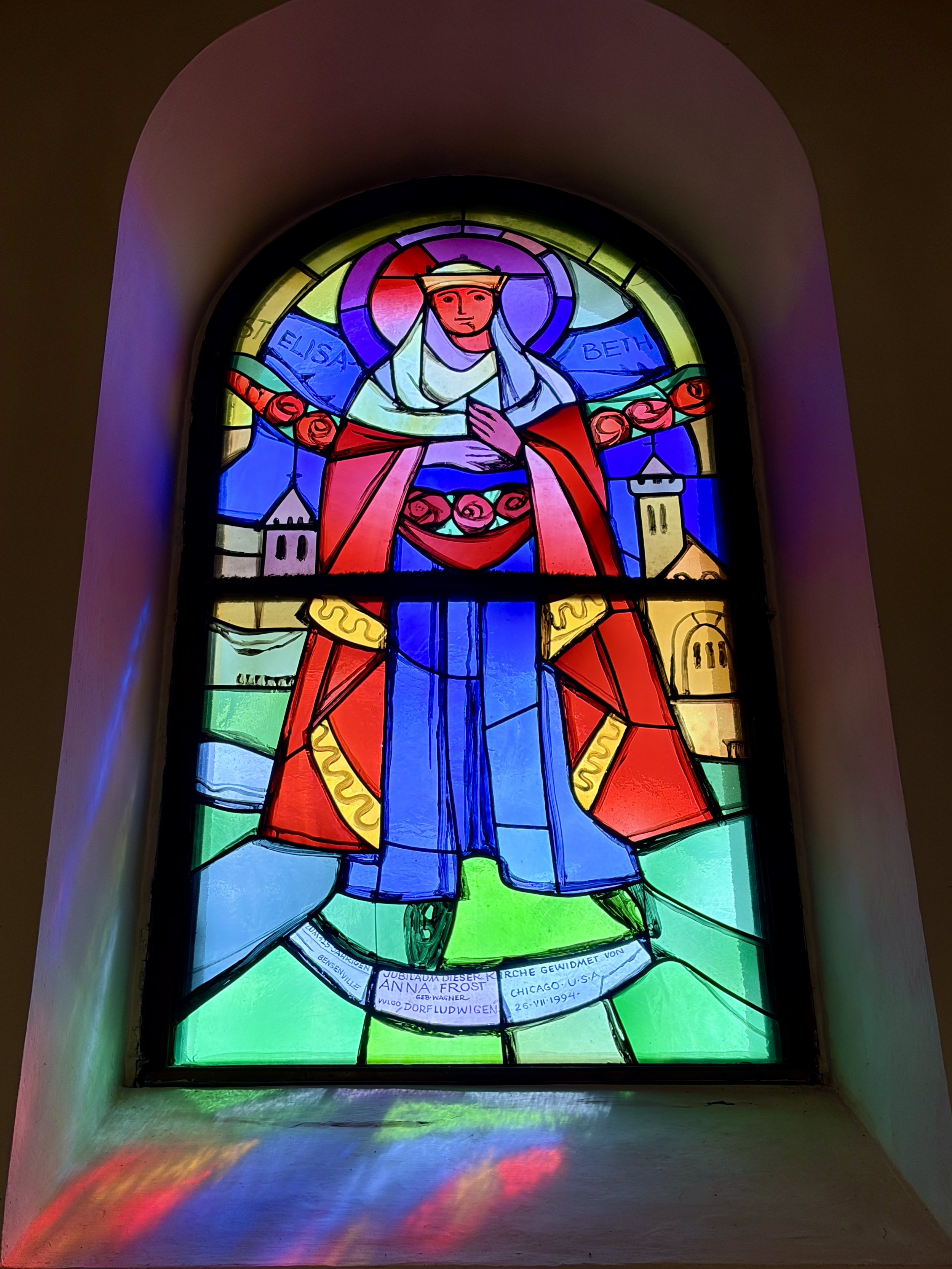
This stained glass window, donated by Anna (Wagner) Frost from Chicago, depicts St. Elizabeth of Thuringia holding her basket of “bread” that miraculously turned into roses.
Another stained glass window in the church depicts St. Michael, that one donated by Theo Frost, also from Bensonville, in 1994. Also lining the walls are fourteen paintings depicting the Stations of the Cross, several statues of Mary, a statue of St. Anthony, and a statue of St. Rupert, which stands behind the baptismal font. I had never heard of St. Rupert — he helped build abbeys and monasteries, promoted salt mining, and is credited with founding the city of Salzburg (which takes its name from the wealth brought in by salt mining).
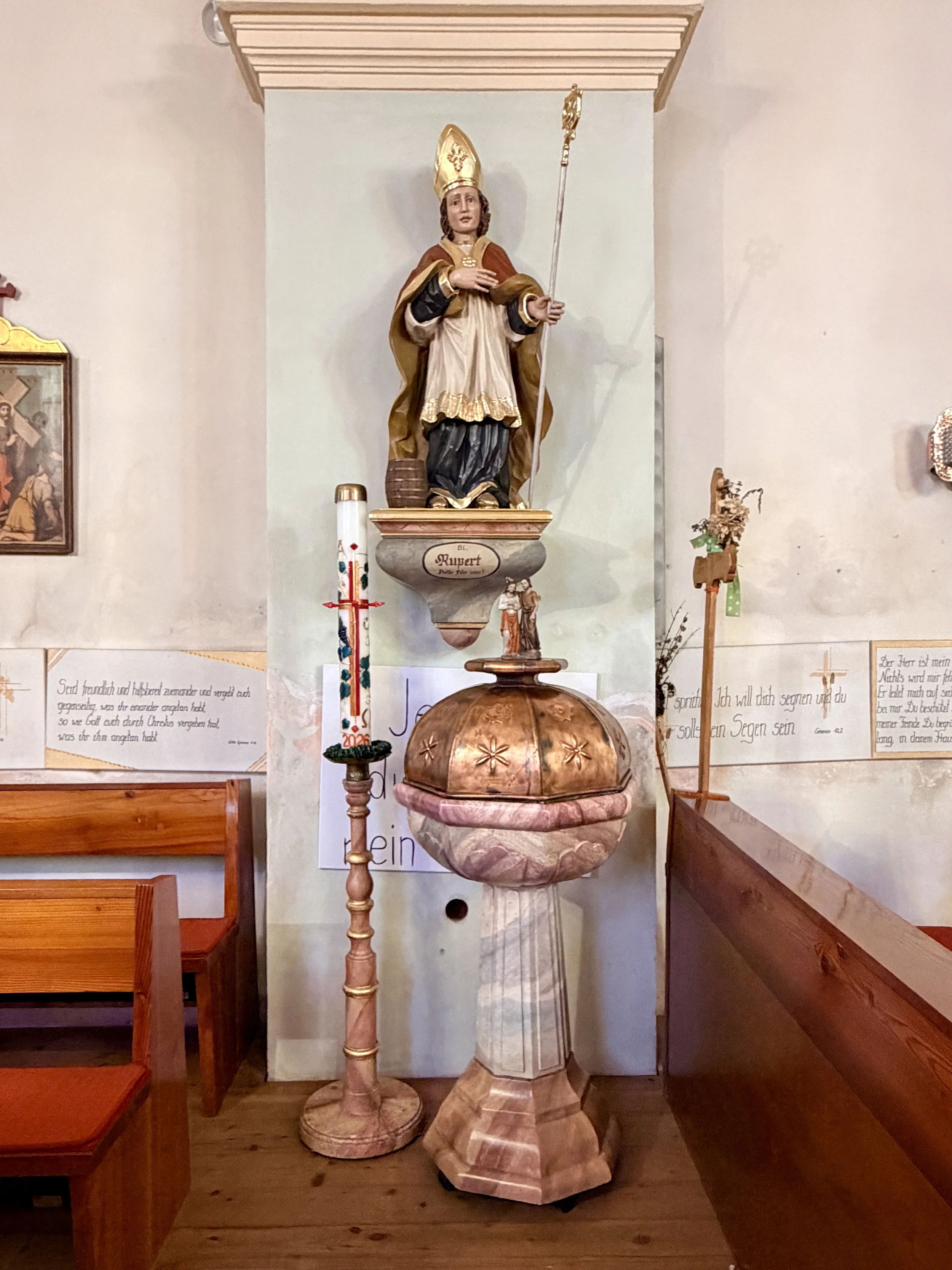
Here you can see a statue of St. Rupert behind the baptismal font, which is topped with a figurine of John the Baptist baptizing Jesus. Could it be the font in which my great grandmother was baptized?
The highlight for me, though, was getting to actually play the organ at the church. When Karl learned I played the piano, he asked if I wanted to give the pipe organ up in the loft a try. When I sat down on the bench, I initially just pulled out one of the stops and played a short bit from Beethoven’s Für Elise since it’s one of the few songs I know by memory, and it seemed appropriate for a church organ. When I stopped, both Karl and Ingrid told me I needed to “pull out all the stops” and play it again. Wow — did that make a difference! The sounds of the pipe organ filled the church and made my heart sing! I did not attempt to use the foot pedals. Here’s a LINK if you want to hear the video — be sure to listen for the fuller sound in the second half!
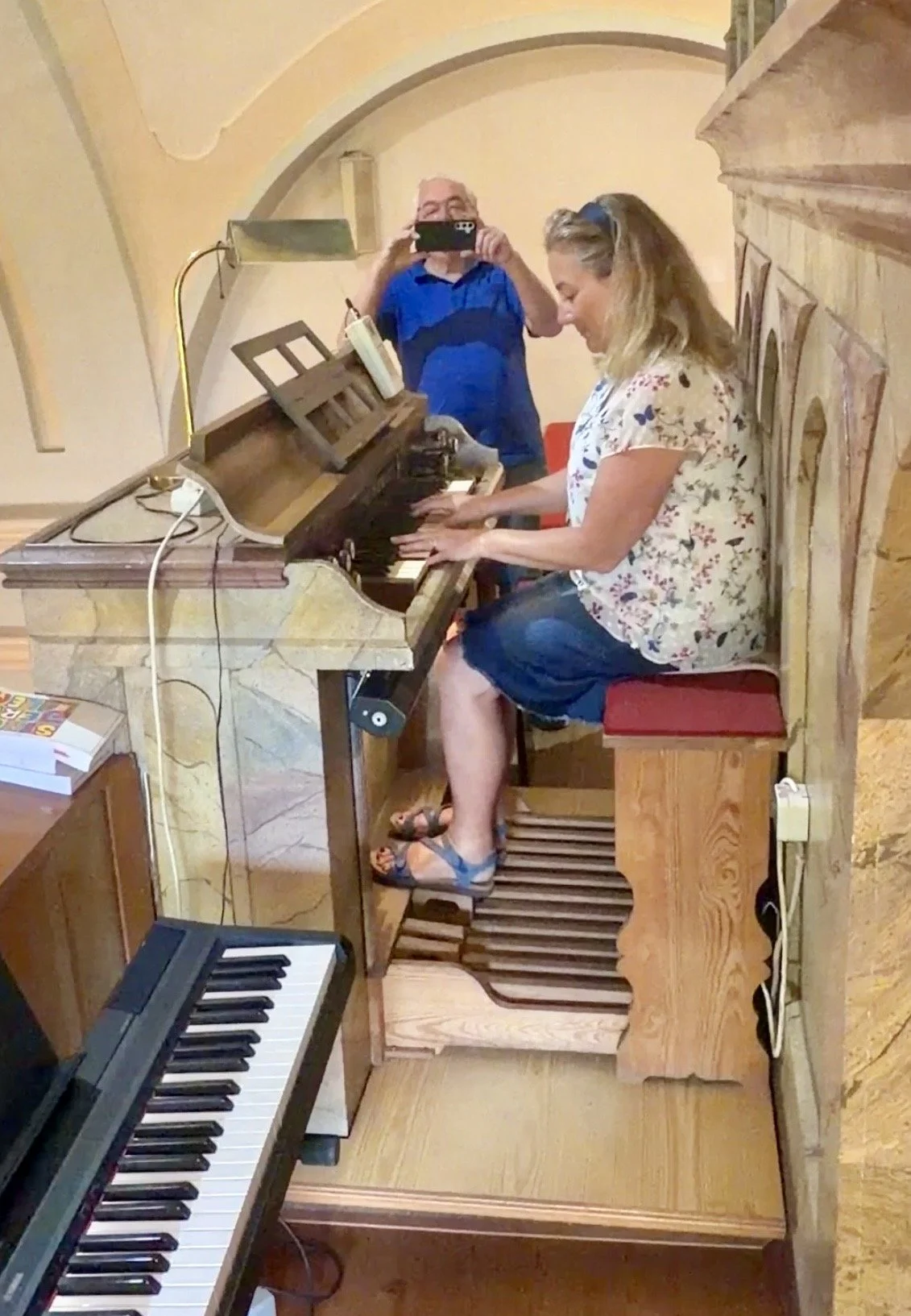
This mechanical pipe organ was built for the church in 1870 by the prominent Styrian organ builder Friedrich Werner from Graz; I was so thankful to be able to play it! That’s Karl in the background filming.
I also made sure to do light some candles at the church for both my mom, Dorothy Ann (Wagner) Graham, who passed away last December, and my great grandmother Anna Halper. I know my mom would have loved to have been able to see this church and the villages where her grandparents came from. She was certainly in my thoughts as we explored Unterwart and Oberdorf.
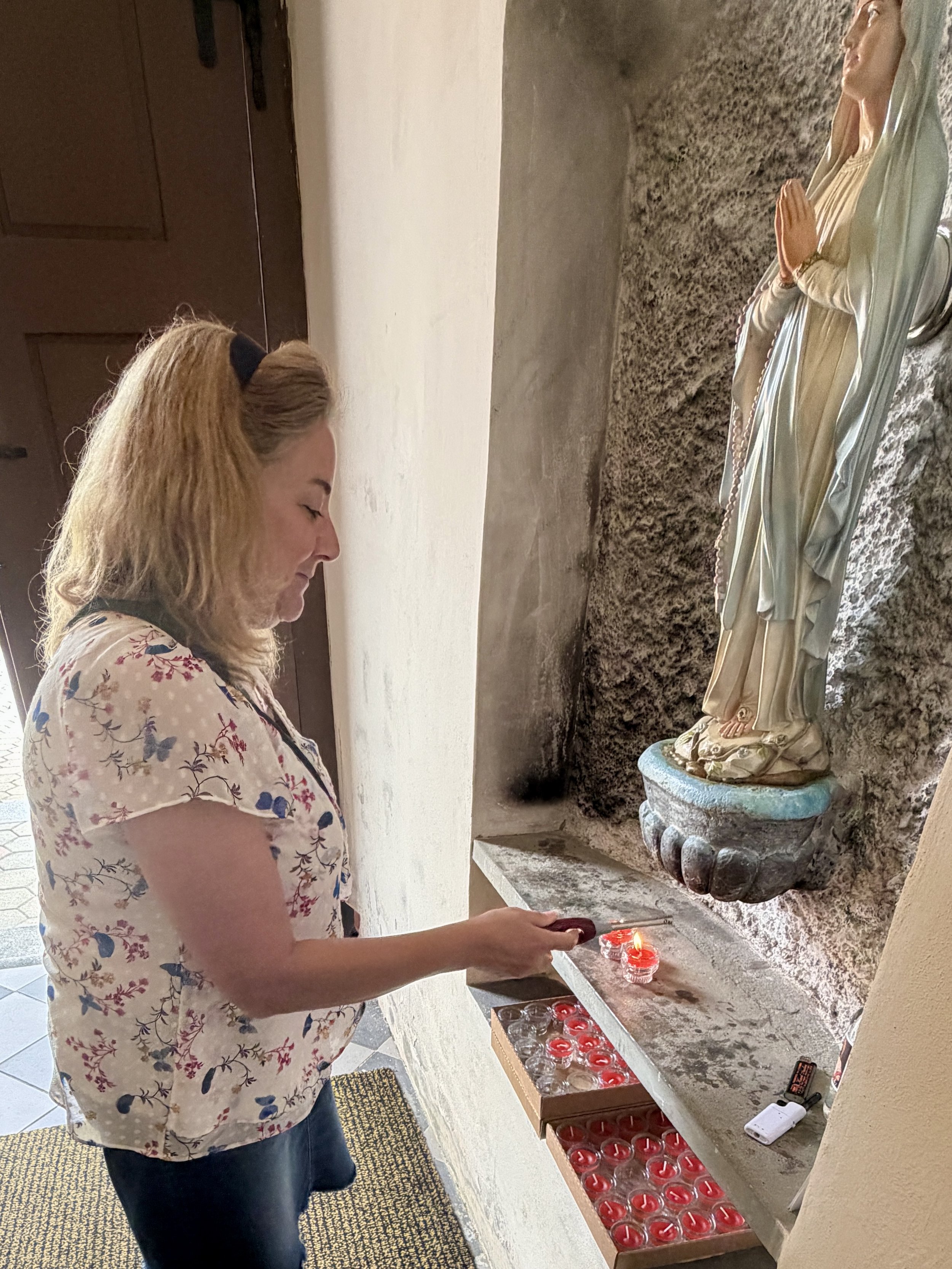
I lit two candles at the church — one for my mom and one for my great grandmother.
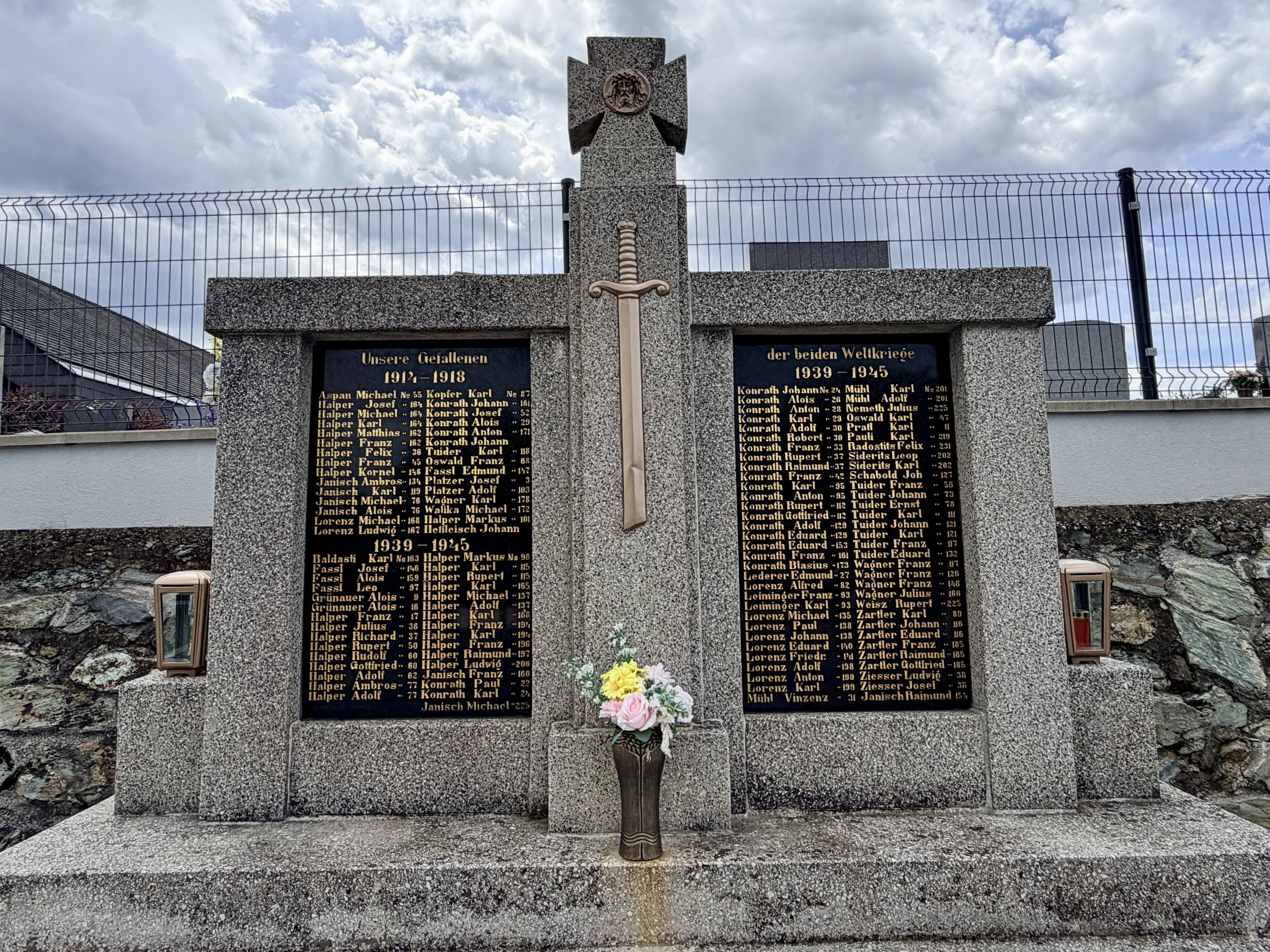
After exiting the church, we walked around the cemetery, marveling at how many Halpers there were. I didn’t see any names from my family tree, but I’m sure I was looking at the graves of many distant cousins. We also paused at the memorial to those from Oberdorf who died during WWI and WWII. I’m sure I had some relatives in that list as well.
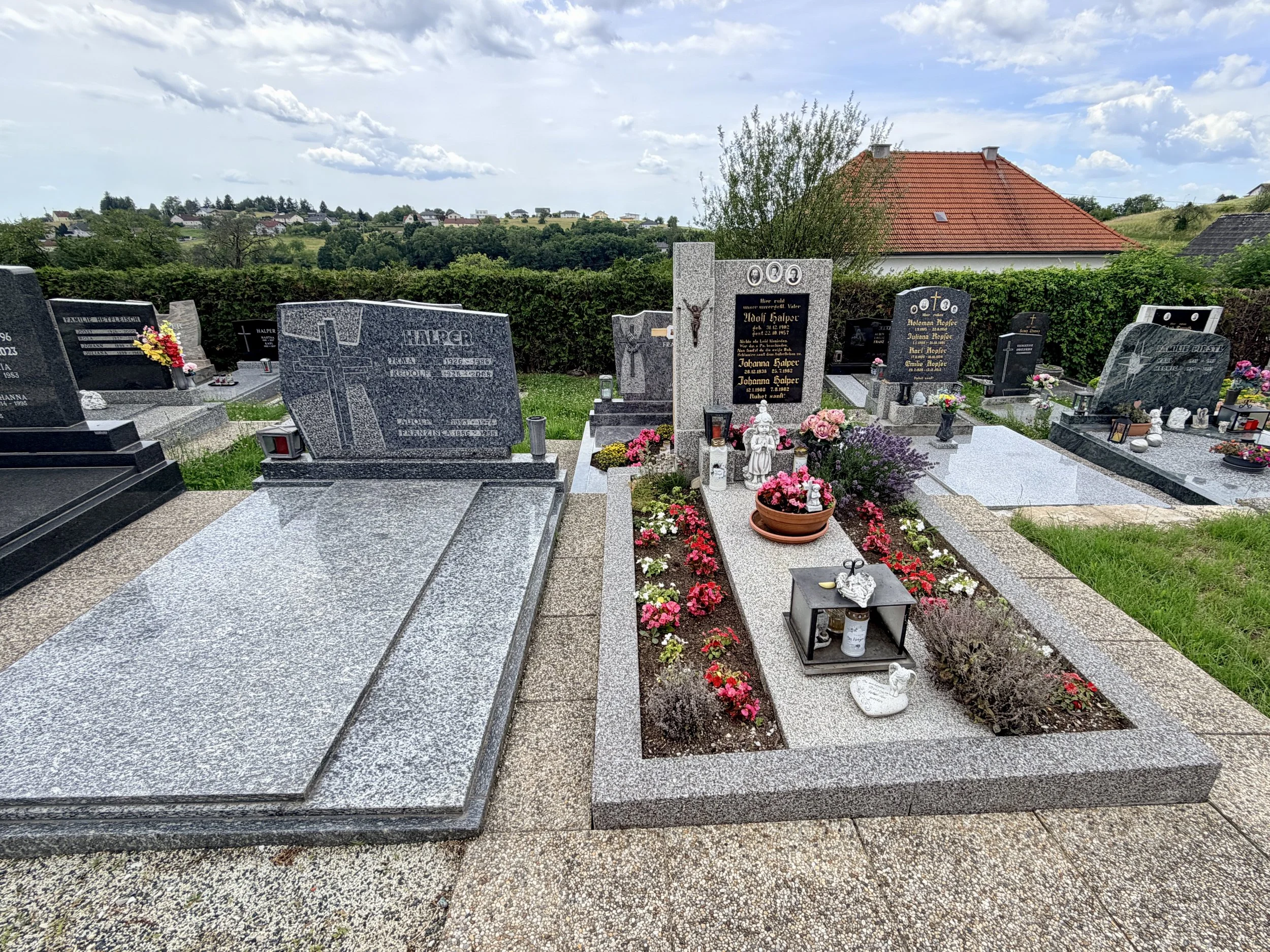
We saw many Halper graves in the cemetery, as well as this memorial to those who died in the World Wars.
The book about the church’s 150th anniversary also includes some history of Oberdorf, especially as it relates to the Erdődy family, and details from the 1782-85 military survey. The survey provides physical descriptions of Oberdorf that helped me to picture what my ancestors might have seen. It mentions the church built of stone on a high mountain; the Oreschbach stream that flows through the village and originates near the church; the “very poor wooden bridges” that cross the stream; the three good wells in the village; the woods surrounding the village that are mostly of fir and spruce, with birch scrub; the meadows that are mostly marshy and never dry out; and the muddy paths that are difficult to traverse due to their steep location and that are very overgrown with shrubs.
We did not experience any of those marshy meadows or muddy paths, nor did we cross a stream, but we did enjoy some beautiful views of the hills. Some of those came from our walk through the cemetery, and others from the drive Ingrid took us on after she fed us lunch at her house. (I told you she was a great host!) She drove us through the hills to her mother’s house so we could meet her and her friend Otto, and we also enjoyed some fresh cherries from her mother’s tree.
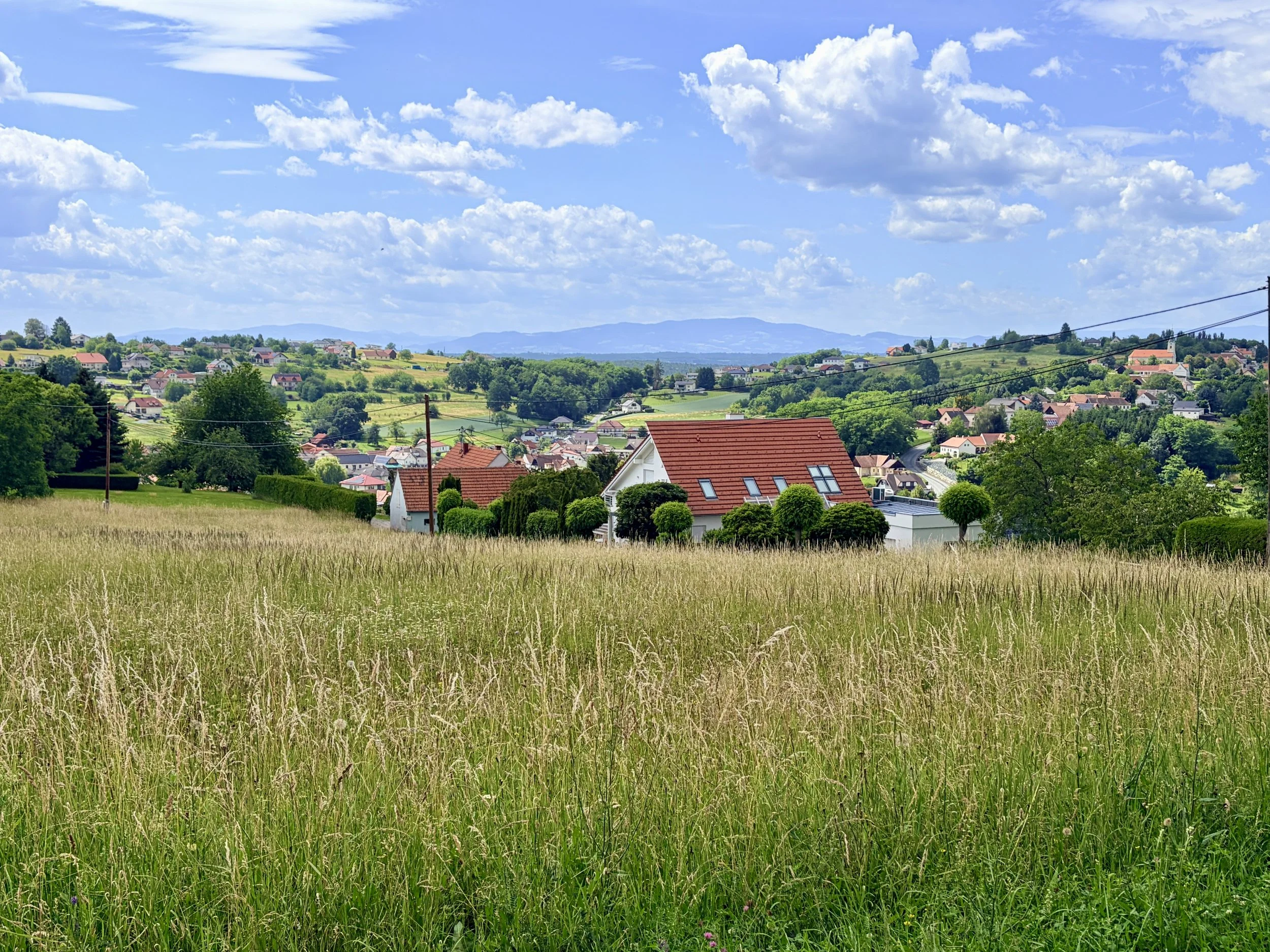
In this hillside view, taken from near Ingrid’s mom’s house, you can see St. Anne’s Church on the right; in the distance, you can see the Güns Mountain Range, which forms part of the border with Hungary.
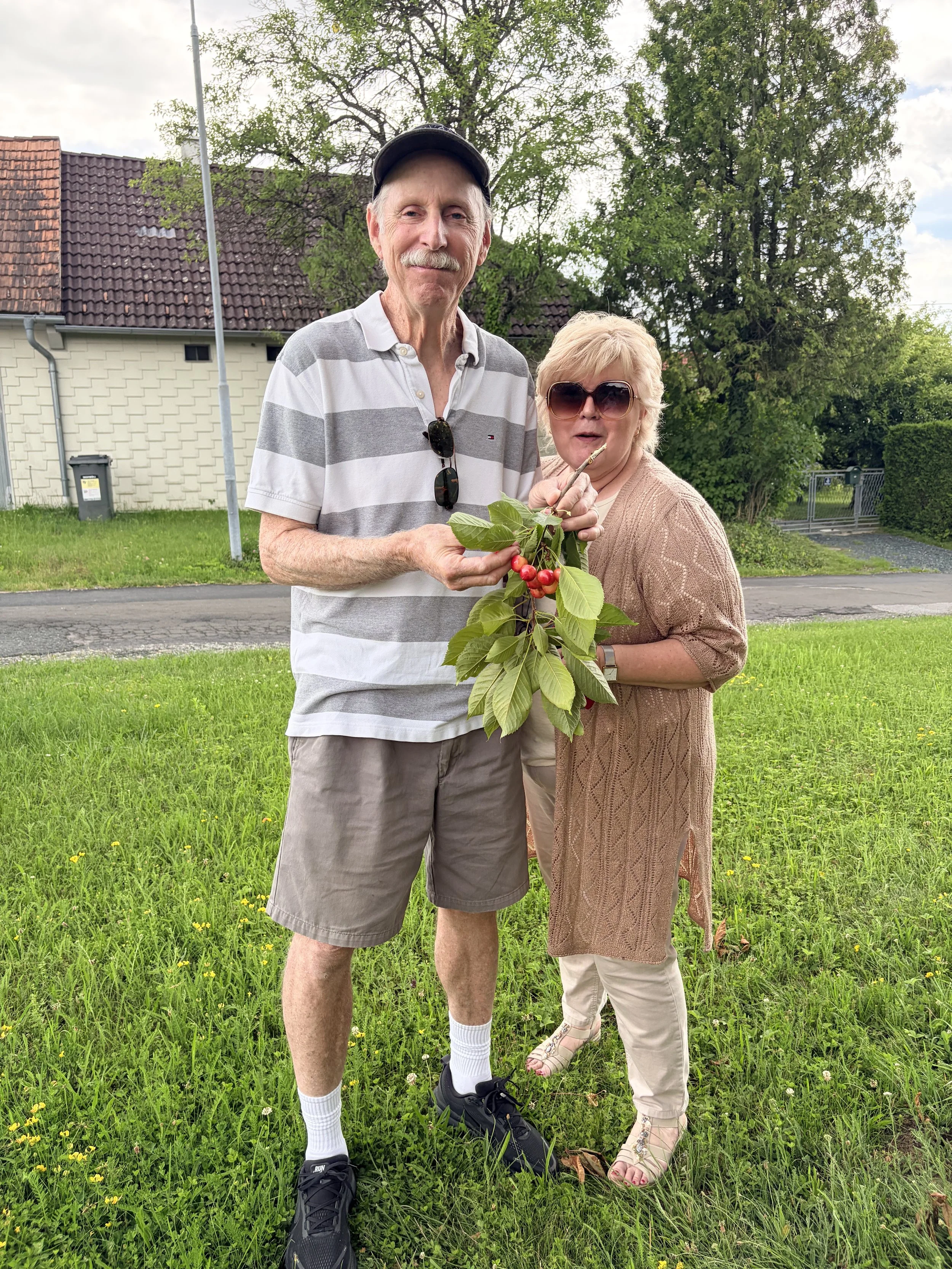
Here’s my husband Mike, enjoying some fresh cherries with Ingrid from Ingrid’s mom’s cherry tree. Yum!
From there, Ingrid took us back to the Town Center, where we said our goodbyes to both her and the village of Oberdorf. It was a memorable visit to a special place, and we’re so glad we had someone to help show us around and tell us about the people and places there. Our next stops were at Güssing Castle and the Freilichtmuseum Ensemble Gerersdorf — an open-air museum in Gerersford that features 30 historical Burgenland buildings. Stay tuned for Part IV!
Oberdorf’s Coat of Arms shows its agricultural heritage. [20]
Endnotes:
“Oralles.” Wikipedia, https://hu.wikipedia.org/wiki/%C5%90r%C3%A1ll%C3%A1s.
“Oberdorf im Burgenland.” Wikipedia, https://en.wikipedia.org/wiki/Oberdorf_im_Burgenland.
Fényes Elek. Geographical dictionary of Hungary, in which every city, village and plain is described in detail in alphabetical order. Pest: Fényes Elek. 1851.
“Oralles.” Wikipedia, https://hu.wikipedia.org/wiki/%C5%90r%C3%A1ll%C3%A1s.
K2. "Maria Theresa's Urbarium of 1767." Slovak Spot, 12 Dec. 2014, groups.google.com/g/slovak-spot/c/zLGawBUKRWA.
Tuider, Karl; Ferstl, Ruth (compilers). 150 Jahre Kirche Oberdorf 1869-2019. Roman Catholic Parish of Oberdorf, Oberdorf, Austria, pg. 101.
Kafkadesk Budapest Office. “On this Day, in 1848: the Hungarian Revolution broke out against Habsburg absolutism.” Hungarian Magazine, Kafkadesk, https://kafkadeskdotorg.wordpress.com/2021/03/15/on-this-day-in-1848-the-hungarian-revolution-broke-out-against-habsburg-absolutism/.
Keleher, Edward P.; Gordon, Nancy M. “Austrian Ausgleich.” EBSCO Information Services, Inc., 2026, https://www.ebsco.com/research-starters/politics-and-government/austrian-ausgleich.
Ibid.
“Nationalities and the Hungarian Parliament (1867-1918).” András Gerő's website, Institute of Habsburg History, https://www.geroandras.hu/en/nationalities-and-the-hungarian-parliament-1867-1918/.
Tuider, pg. 105.
Tuider, pg. 99.
Tuider, pgs. 13-14
“The Story of Anne and Joachim in Apocryphal Sources.” Carmelites, 25 July 2025, https://ocarm.org/en/item/6656-the-story-of-anne-and-joachim-in-apocryphal-sources.
Ibid.
Keltz, Dryw. “Saint Florian: The patron saint of firefighters.” FireRescue1, 28 Feb 2025, https://www.firerescue1.com/fire-service-culture/saint-florian-the-patron-saint-of-firefighters.
Ibid.
Tuider, pg. 33.
“Monument to the Nibelungs.” Tulln-Experience-Tourist Attractions, Stadtgemeinde Tulln, 2026, https://www.tulln.at/en/experience/tourist-attractions/monument-to-the-nibelungs-1.
“Community Oberdorf in Burgenland.” Mein Süd Burgenland, https://mein-suedburgenland.at/gemeinde/oberdorf-im-burgenland.