Exploring Dr. W. F. Traughber’s Rotary Club Connections and the History of the Los Angeles Rotary Club
Chasing History: Exploring My Ancestral Roots - Post #67
by Tonya Graham McQuade
One of the things I learned about my great grandfather, Dr. William Francis “Frank” Traughber, that made me especially happy is that back in 1909, he was a Charter Member of the Rotary Club of Los Angeles. Why did this make me happy, you ask? Because for 33 years - from January 1993 until I retired in June 2025 - I advised the Los Gatos High School Interact Club, which was sponsored by the Rotary Club of Los Gatos. Both clubs are committed to “Service Above Self” and the importance of giving back to the community - values I strongly believe in. What’s more, Los Gatos Rotary made me an “Honorary Member” as well as a Paul Harris Fellow - TWICE! (More on that later)
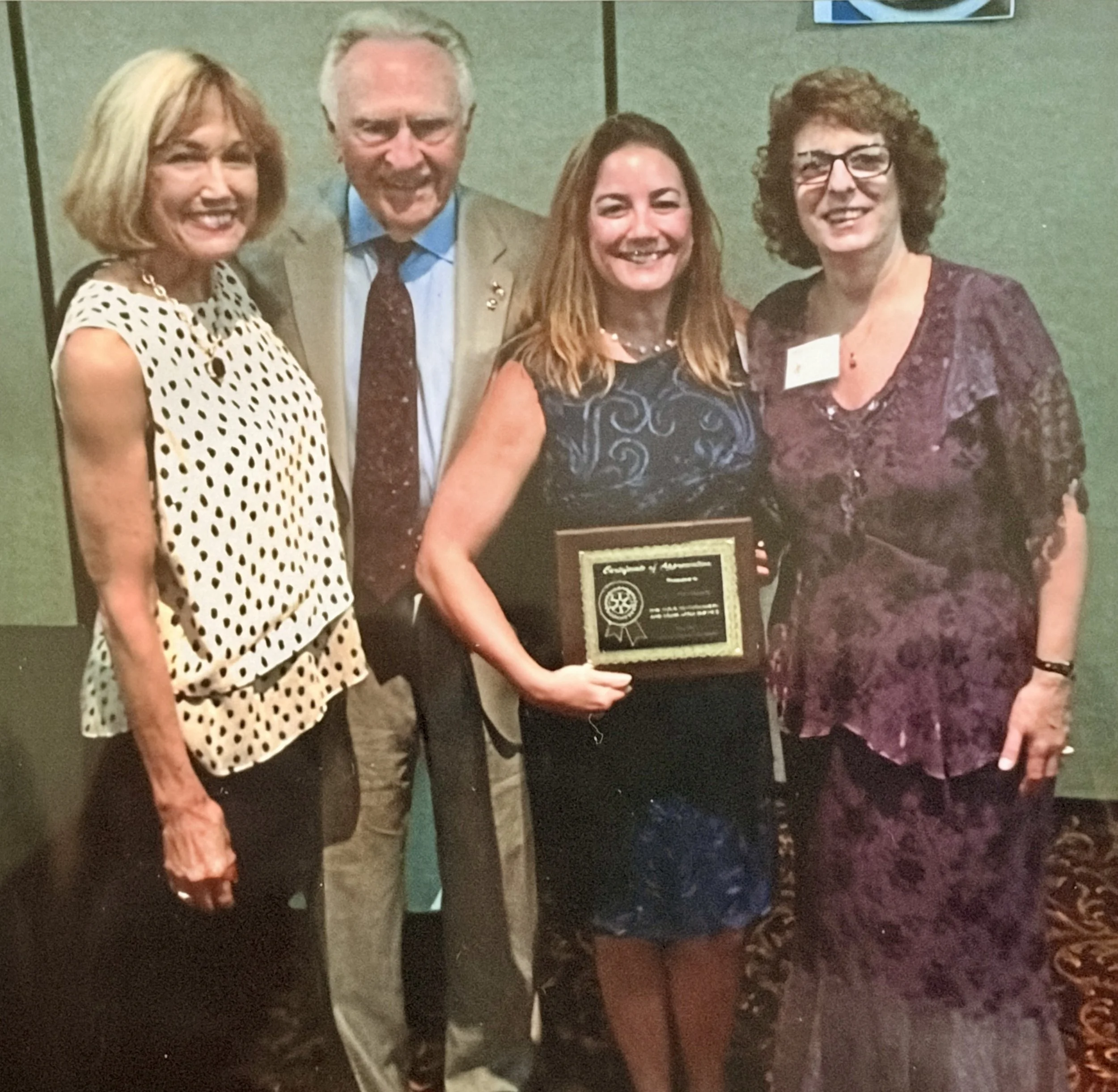
This photo, taken when I received an award of appreciation from Los Gatos Rotary for my work with the Interact Club, shows three of the Rotary Advisors I worked with over the years: Elizabeth Smith, Lloyd Grant, and Tina Orsi-Hartigan (who was my partner for MANY years and who is still serving as the Rotary Advisor to the Interact Club at Los Gatos High School, along with her sister Terri Trotter).
I first became aware of Dr. Traughber’s Rotary connection when I read in a news article from 1940 that he had been a member of the Los Angeles club for 31 years. However, it was only after finding and purchasing an old book on Ebay titled History of the Rotary Club of Los Angeles: Golden Anniversary Edition (1955) that I learned more about the club’s history and discovered specific details about Dr. Traughber’s involvement in it. I also learned some additional details from his wife Nora’s letters, which I recently transcribed. So, get ready for some Rotary history!
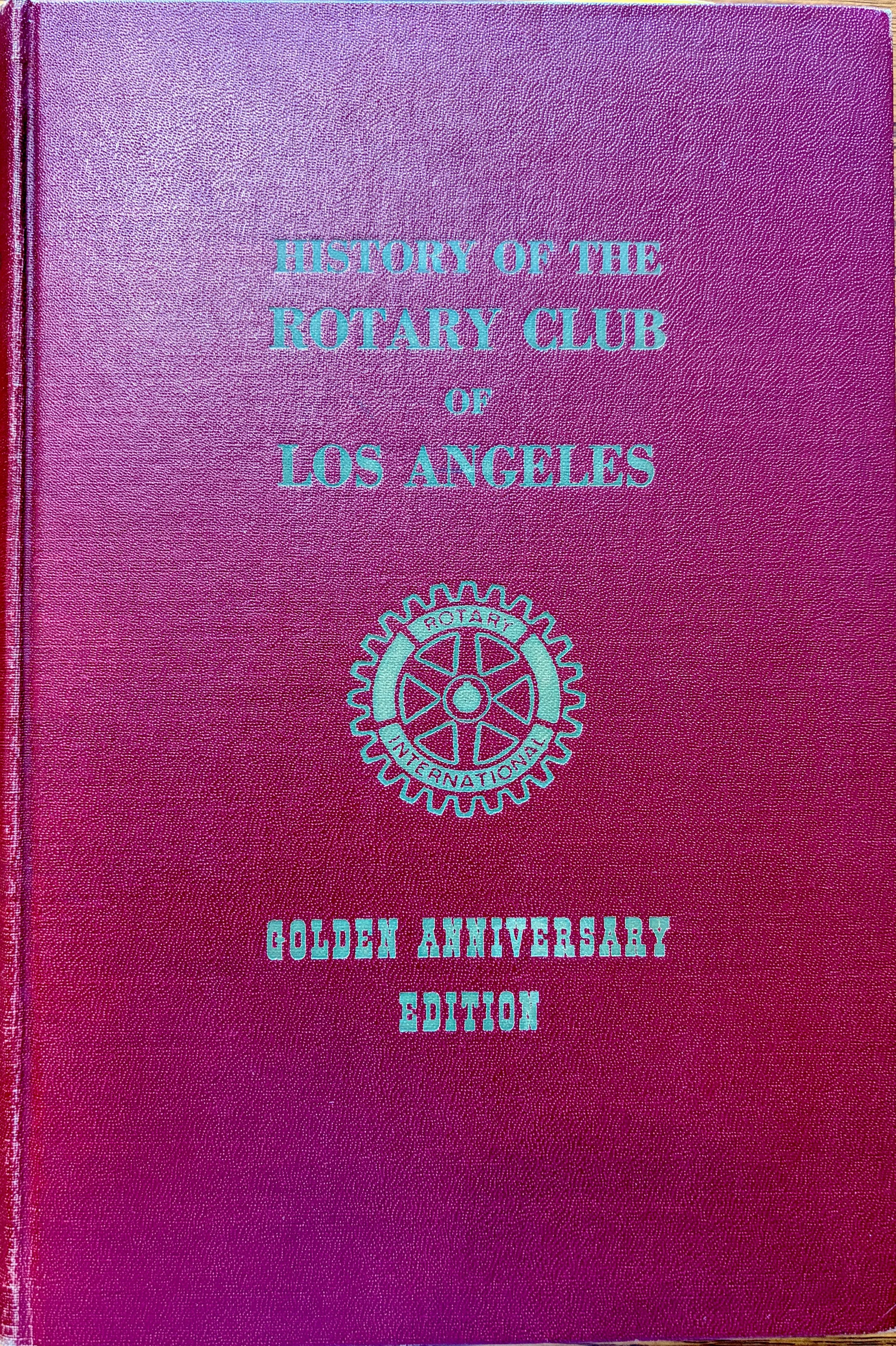
This is the book I bought on Ebay where I found much of the information included in this blog post.
The Golden Anniversary book opens with this passage in the Foreword: “This history is the story of the unfolding of a great adventure in service. It concerns many people and their relations to many events. It confirms the anonymous statement, ‘Rotary was conceived in Chicago but was born on the Pacific Coast,’ since Clubs No. 2, 3, 4 and 5 were established by the traditionally progressive civic leaders in four major cities on the Pacific.” [1]
It was Attorney Paul Harris who formed the first Rotary Club in Chicago in 1905. He also became the club’s first president and helped write its initial Constitution and By-Laws. Today, being named a “Paul Harris Fellow” is a significant achievement and comes with a commemorative certificate, a special lapel pin, and a medallion. It requires a contribution to The Rotary Foundation of $1,000, either by one’s own personal donations or by someone else donating money on your behalf (as was the case with me, both under the names “Tonya Silva” and “Tonya McQuade”).
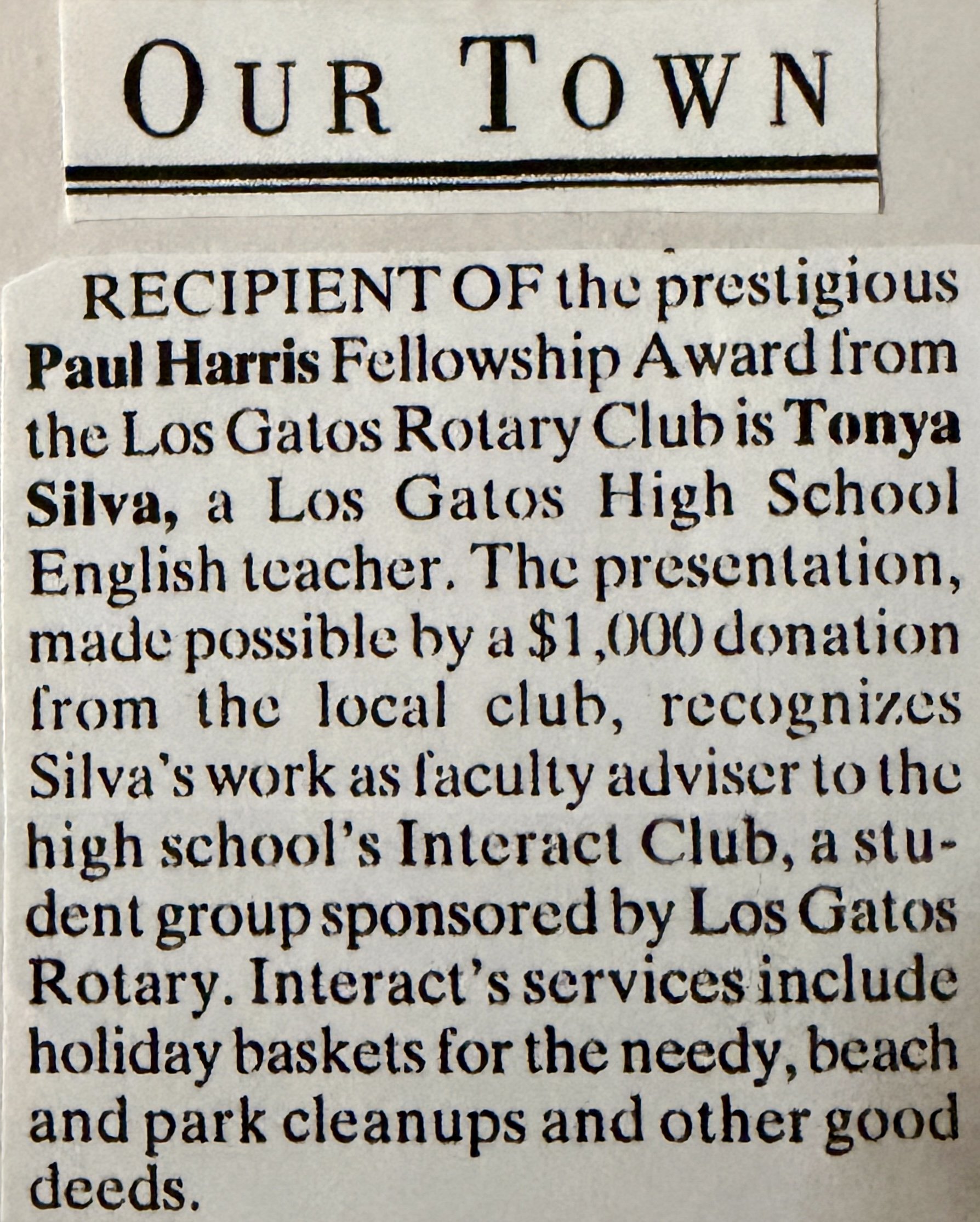
This article appeared in the Los Gatos Weekly when I received my first Paul Harris Award.
Three and a half years later, though, it was Homer Wood who became “the first real missionary of Rotary,” according to the book, helping to start four clubs in California in a short period of time. Wood, a young attorney living in San Francisco, met a man one day who told him about “a new kind of club they had at Chicago called the Rotary Club” and “explained its workings and that its membership was limited to one man from each line of business.” [2] Wood got in touch with Paul Harris, who sent him a copy of the Chicago club’s by-laws to help him get started.
Wood organized the San Francisco Club in November 1908, holding the first meeting at the St. Francis Hotel. Then, he worked with Arthur S. Holman, manager of the San Francisco office of the Travelers Insurance Company, to organize other Rotary Clubs on the Pacific Coast. The Tri-City Rotary Club (Oakland, Berkeley, and Alameda) followed in February 1909; Seattle on June 15, 1909; and Los Angeles on June 25, 1909 (making it Club No. 5).
It was Homer’s brother, Walton J. Wood, working with Travelers Insurance Company’s Los Angeles Manager Jerry Muma and shoe dealer C. H. Woodruff, who helped launch the Los Angeles club. The three men met for lunch in May 1909, following a meeting Muma had with Arthur Holman, to discuss founding a club in Los Angeles. Muma eventually became the club’s first president.
In a letter to the National Association of Rotary Clubs in Chicago dated Oct. 10, 1910, Muma wrote: “We decided at this luncheon to send invitations to fifty prominent business men representing different lines, inviting them to a meeting at the Hollenback Hotel, where luncheon would be served and we would discuss the organization of the Rotary Club. Out of the fifty invitations mailed, thirty-one responded and were present at the initial luncheon. At this first meeting a temporary organization was effected with thirty of the thirty-one businessmen as charter members. Regular meetings were held at 12 o’clock on Fridays.” [3]
One of those fifty invitations was sent to Dr. W. F. Traughber, and he soon became one of those thirty charter members. At the time, Dr. Traughber was 34 and working as an Osteopath in Los Angeles, where he was also attending the University of Southern California’s College of Physicians and Surgeons (from which he would graduate in June 1911). He and his wife Nora had moved to Los Angeles from Missouri in 1907 and already had two children - one being my grandmother, Margaret. You can read more about Dr. Traughber’s time at the College of Physicians and Surgeons in this earlier blog post.
From that auspicious beginning, the Rotary Club of Los Angeles quickly grew, with a campaign focused on gaining new members. According to Charter Member Charlie Bent, “The selling talk ran something like this, ‘Hello. Mr. Jones, this is Mr Quick, Secretary of the Rotary Club of Los Angeles. I am extending an invitation to you to become a member of our Club as the sole representative of your business in Los Angeles. By simply doing your trading with your fellow members, you will, within a few weeks, at our present rate of growth, have more than 200 men as your valued customers. It’s simply a case of you scratch their backs and they will scratch yours. Meet me next Friday at noon, with your check for $5 initiation fee, and you will be welcomed as a full-fledged member and start at once receiving the patronage of new customers.’” [4]
As can be surmised from this early conversation, Rotary’s initial focus was much more on self-promotion than service. Its November 1910 directory states these objectives:
The promotion of the business interests of its members;
To advance loyalty, good fellowship, and sociability among its members;
To further the best interest of Los Angeles and the Pacific Coast, and to spread civic pride.
A statement by Dr. Traughber that appears in History of the Rotary Club of Los Angeles: Golden Anniversary Edition provides a glimpse at what this “promotion of the business interests of its members” looked like:
Piled high at each plate at all of our luncheons was literature and advertising specialties of all kinds. These had to be cleared from the tables often before there was room for food. Members were urged to trade with fellow members. It was like a clearing house for business deals. Even the President of the Club not only urged that, with everything else being equal, we trade with our own members. He would often announce how many Rotarians he had patronized during the week and had others make similar announcements. On several occasions some one would announce that he had just completed a house and that all the material bought was from Rotarians and all the subcontracts were let to Rotarians.
Members were urged to visit the places of business of each other and to report at some future luncheon giving the man or his firm a boost. We often had our luncheons at the place of business of some firm and after lunch were shown through the plant. Special introductory contests were often held and the man voted making the best speech, and the man he introduced, would be given a week of free advertising; and every member was not only expected to visit the places of business of the two, but was urged to patronize them when possible. Much time each week was spent in getting acquainted, so that practically every member knew every other member and his business. When we had Ladies’ Day, we loaded down all the women present with prizes and gifts of all kinds. [5]
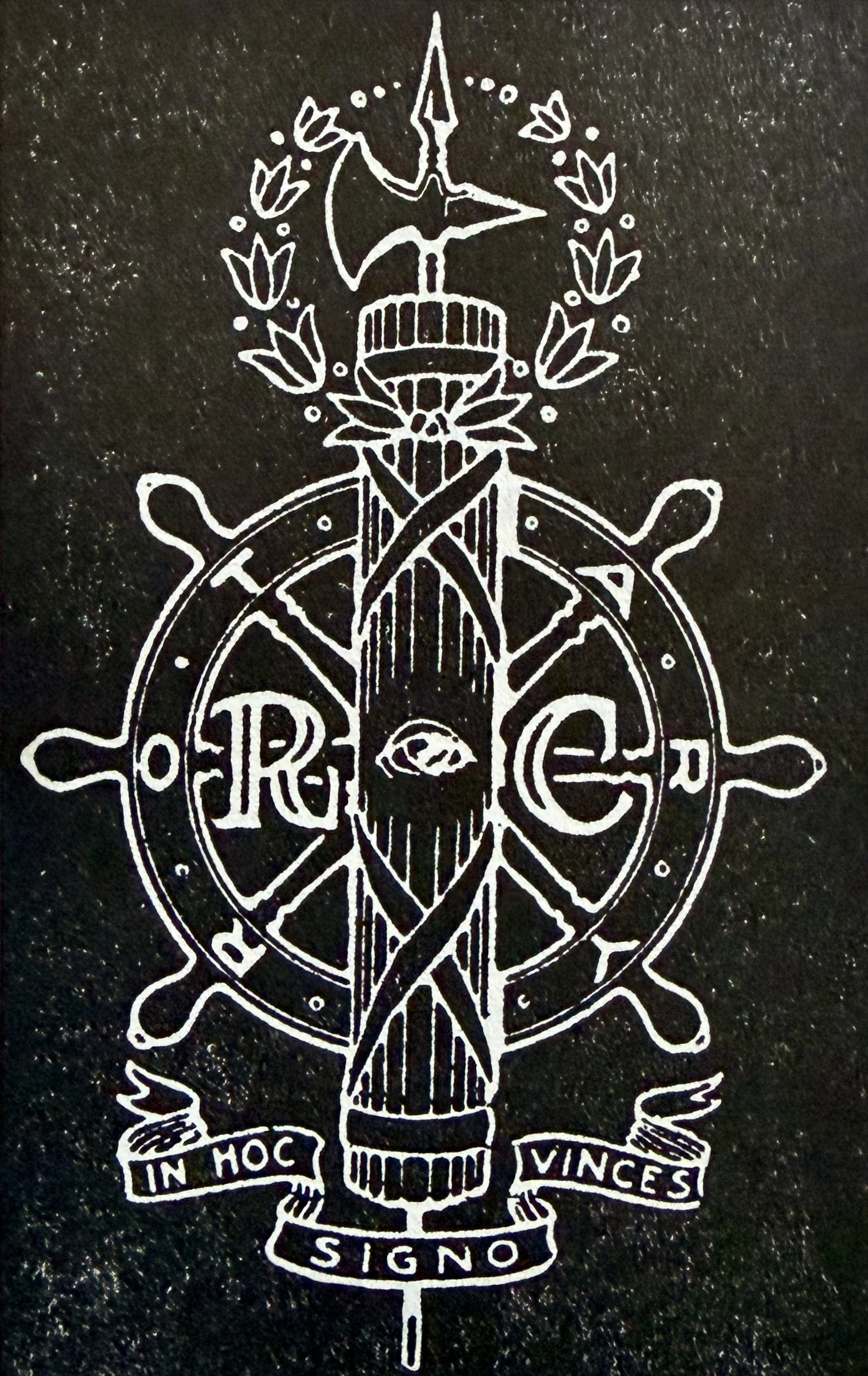
This early Los Angeles Rotary emblem was designed by Club Secretary H. C. Quick.
Within months of its formation, the Rotary Clubs of Los Angeles adopted an emblem designed by Secretary H. C. Quick. Like the earlier emblem designed in Chicago, it incorporated a wheel, which was said to illustrate civilization, movement and service work in action. The emblem was described as follows in an article dated Sept. 18, 1909 in the Los Angeles Herald:
Cooperation, business honor and progressive action — these are the guiding principles which actuate the members of the Rotary organization throughout the ever widening circle of its influence.
To the man who is infused with the spirit of genuine Rotary enthusiasm this emblem is eloquent with meaning. The pilot wheel stands for the wise guidance of profitable business into the hands of fellow members; the watchful eye typifies the mental alertness to seize opportunity, the laurel wreath surrounding the stern weapon of ancient warfare is expressive of peace reinforced by the power to execute, if necessary, the demands of justice and right; the staves firmly bound together, typifying the combined strength of a membership united in confidence, in ambition and in mutual helpfulness.
It is the fulfillment of these ideals that has ever made men and organizations and nations truly great. [6]
The Rotary emblem most people probably recognize today was formally adopted by the Rotary International Association in 1923. Its wheel has 24 cogs, six spokes, and a central keyway, and is traditionally depicted in royal blue and gold, symbolizing service, prestige, and stability.

This Rotary International emblem was adopted at the national convention in 1923.
One of the newly-formed club’s first projects was to help bring a “great International Aviation Tournament” to Los Angeles in January 1910. “That the Aviation Meet was a success is a matter of history,” the book states, “and many will remember that the world’s long distance flight for airplanes was broken when Louis Paulhan flew a Farnham plane from Dominguez Field, where the meet was held, to Pasadena and back, a distance of over twenty miles.” [7]
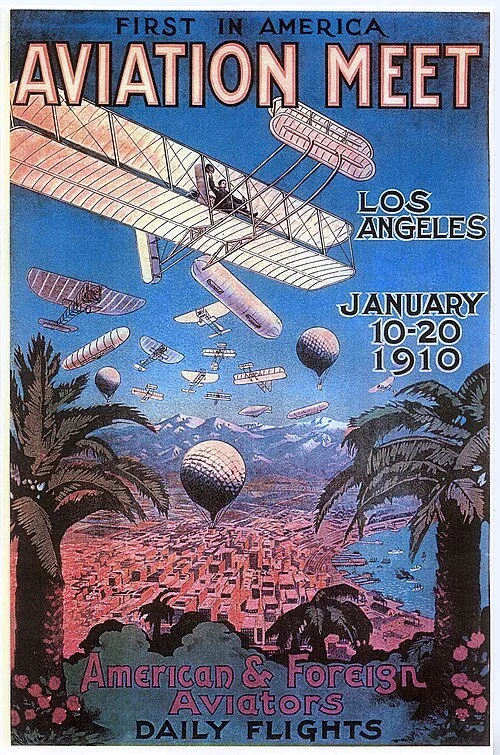
The Los Angeles International Air Meet was among the earliest airshows in the world and the first major airshow in the United States. [8]
Other early projects described in the book included a Ladies Day Luncheon at Angelus Hotel; contributions to the Rotary Relief Fund for the Omaha tornado and the Dayton flood sufferers; a contribution to the Great Ocean to Ocean highway fund; and the purchase of a Christmas tree with electric lights and gifts for the Children’s Hospital. Club members also helped form the Good Fellows movement to respond to “Dear Santa” letters and established a “depot where contributions of clothing, food, miscellaneous merchandise, toys, etc. could be sent as donations and from where such items could be distributed to the needy.” [9]
In its early years, the club held many of its meetings at the Hollenback Hotel and the Angelus Hotel. However, as the club grew, it became more difficult to find regular meeting places that could hold the large group. By 1914, the club boasted 314 members. They began rotating their meeting locations, sometimes to different members’ places of business. After one such meeting on Feb. 13, 1914, the entire club was taken on a tour of Barker Brothers store, at the invitation of Rotarian L.M. Barker.
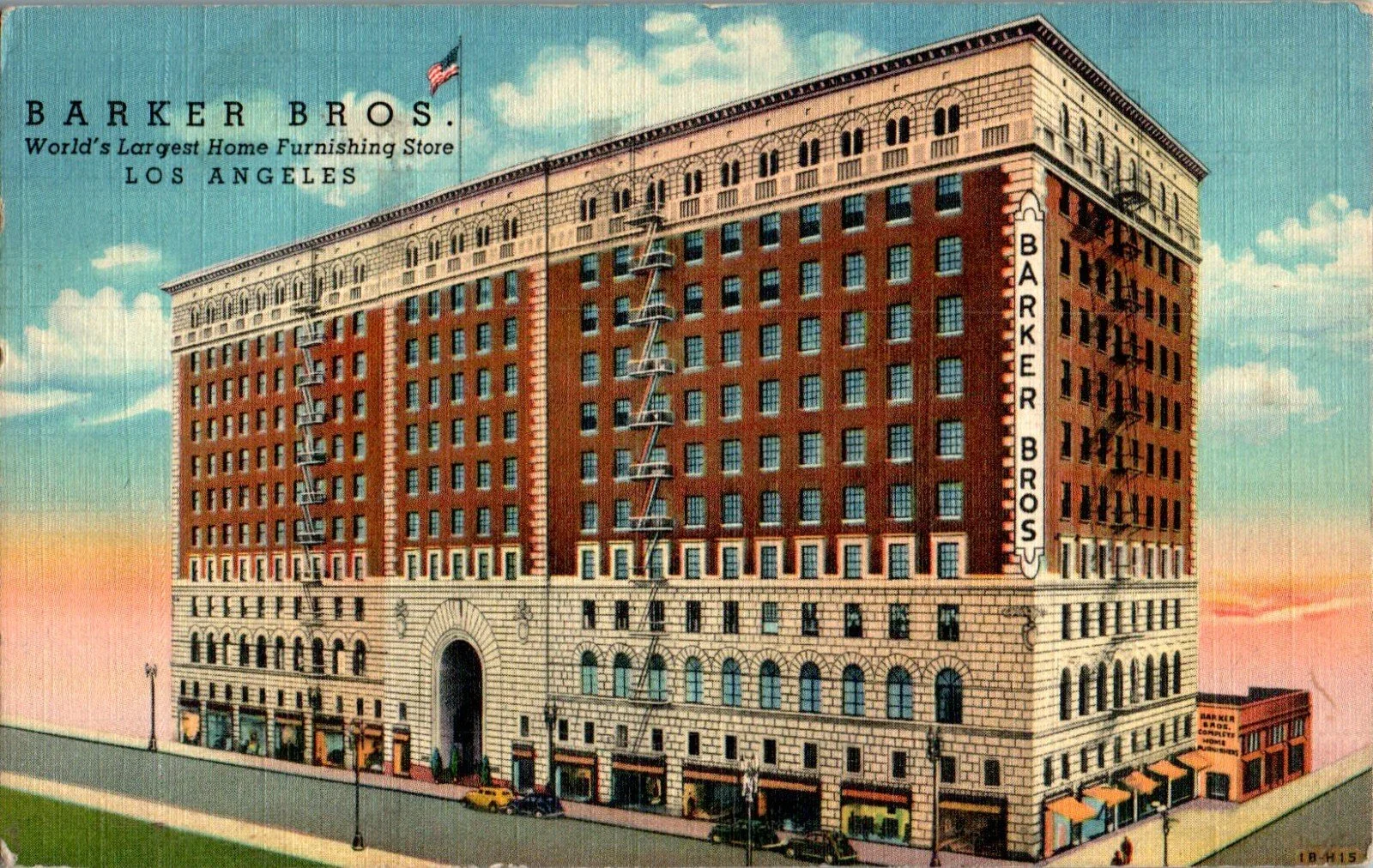
In the 1910s, Barker Brothers was Los Angeles' premier furniture and home furnishings retailer, with a massive seven-story building at 724-728 S. Broadway. [10]
I found that fact especially interesting because – though he could not know it at the time – Dr. Traughber’s nephew Neil Petree (the son of his wife Nora’s brother Louis Petree, at whose house in San Jose the couple had married in August 1905) would eventually become the president of Barker Brothers Furniture and a definite “bigwig” in Los Angeles. I’ll be writing more about him in a future post.
By 1914, the club’s focus had shifted significantly as it moved closer to its motto of “Service Above Self.” As the book explains, “The adoption by the membership of the new Constitution and By-laws gives May 8th, 1914, as the date on which the club officially departed from the ‘cash register’ days, and henceforth operated as a service organization.” [11]
The “objects” listed in their new directory highlighted this new focus:
To promote the recognition of the worthiness of all legitimate occupations, and to dignify each member’s occupation as affording him an opportunity to serve society.
To encourage high ethical standards in business and professions.
To increase the efficiency of each member by the exchange of ideas and business methods.
To promote the scientizing of acquaintance as an opportunity for service and an aid to success.
The advancement of the business interests of Los Angeles and spreading the spirit of civic pride and loyalty among its citizens and co-operation with others in civic development.
In his outgoing speech as club president on June 1, 1917, Clint Miller emphasized how profound this shift was in his thinking about the club and its importance. “Of one thing I am very certain and that is that there was a time when I did not care to advertise that I belonged to the Rotary Club, whereas today there is no one thing with which I am affiliated of which I am more proud,” he said.
“I want to state as emphatically as I can that a Rotary Club is not a mutual protective organization—not a jackpot where a man enters with $25.00 and sweetens it $2.00 per month in the hope that he will take out more than he puts in. That’s a selfish game and any organization of men founded for a purely selfish purpose will not endure for long. History proves that statement…. On the contrary, the activities of a group of men, each of whom is a leader, must be productive of great good if such activities represent unselfish service, because that will cause growth of character, which is the one thing that is needed to be coupled with ability in order to produce real greatness.” [12]
After his speech, Dr. Traughber presented outgoing president Clint Miller with a “victrola” on behalf of the membership in gratitude for his service.
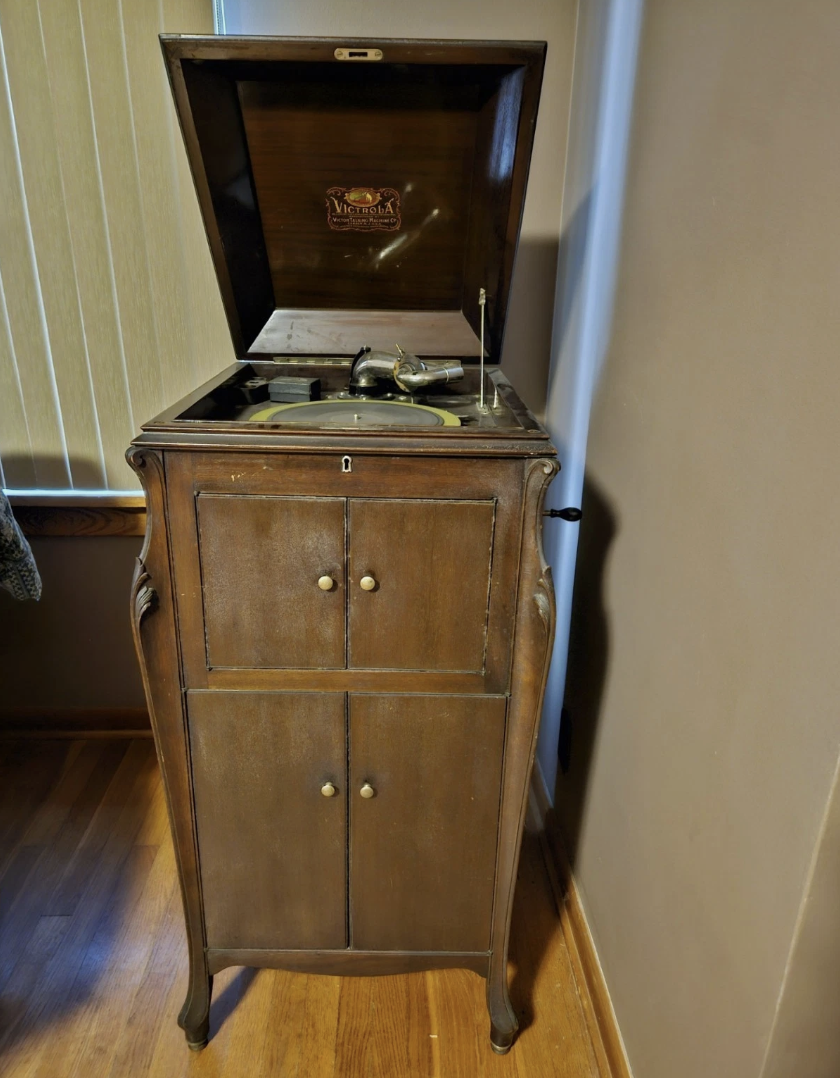
The above photo shows a 1917 Victrola RCA Talking Machine, as shown on Ebay.
During the WWI years, the Los Angeles club focused a lot on supporting the American Red Cross and the Nation’s campaign for the sale of Liberty Bonds. They also raised funds for twenty fully equipped automobiles for American field ambulance service, and they placed milk bottles in hotels, stores, and cigar stands for the gathering of pennies for the “starving Belgians,” as described in the book.
Around that time, Dr. Traughber played a significant role in bringing a project to Rotary’s attention that would become a big part of the club’s focus for the next seven years. As a doctor, he had for some time been donating his services on a fairly regular basis to clinics in impoverished, immigrant-heavy sections of Los Angeles. One of those clinics operated at the Coleman Settlement House, which was opened in 1912 by Matilda Coleman. By 1916, the Settlement House hosted a day nursery, a free clinic, sewing classes, music classes, and a library, but they were in desperate need of funding and expanded facilities.
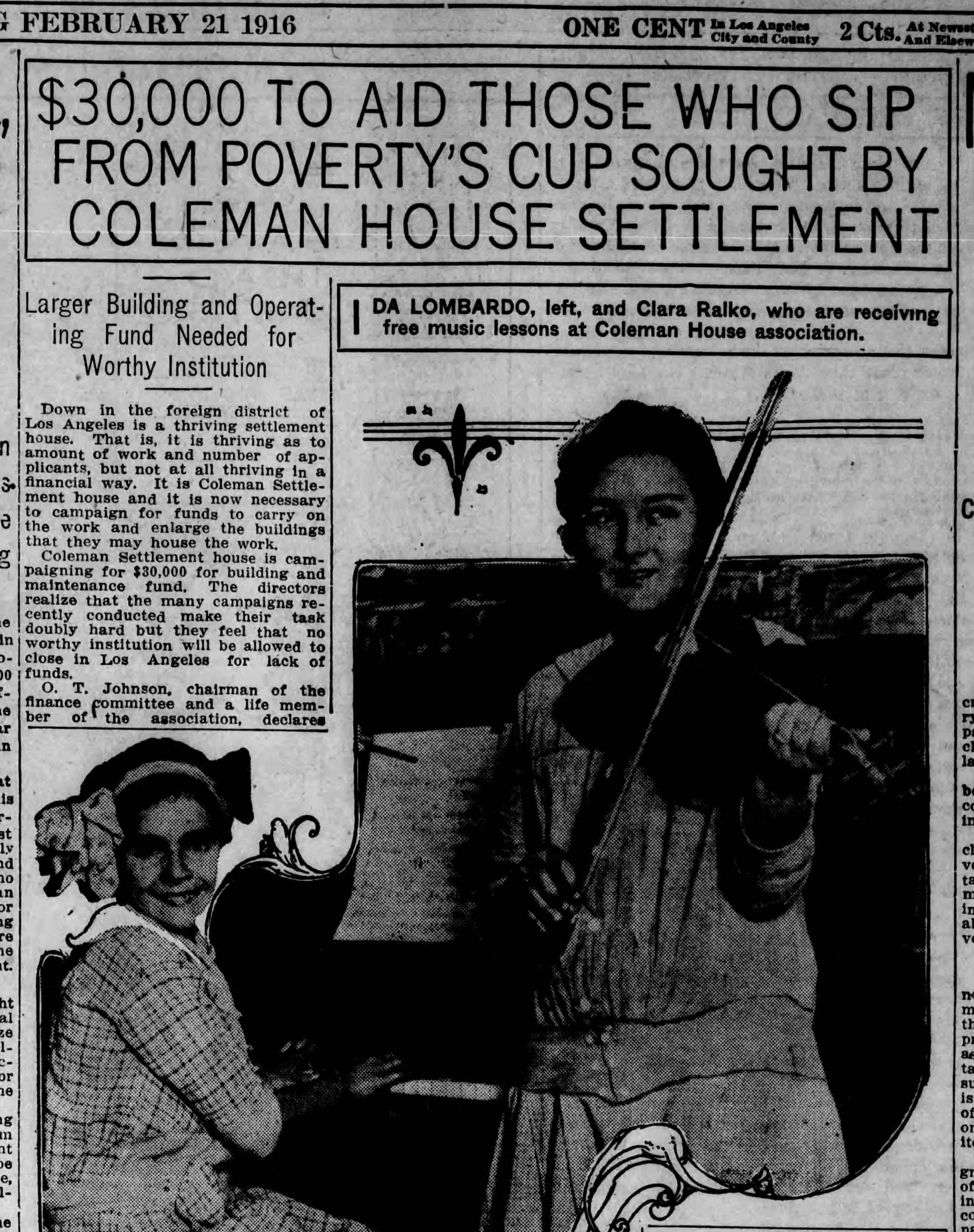
This Los Angeles Times article, dated Feb. 21, 1916, reported that the Coleman Settlement House needed $30,000 to continue its operations. Soon, the Rotary Club of Los Angeles would step in. [13]
Then, in stepped the Rotary Club of Los Angeles to finance and rescue the struggling settlement house. By mid-1919, Rotary had taken over operations, renamed it the Community Settlement House, expanded the facilities, and instituted a new Board of Directors, with Dr Traughber as one of its members. At the time, many settlement houses were taking on a new task: Americanization efforts. This was largely in response to the 1917 Communist Revolution and fears of the spread of Bolshevism, as well as 1918’s Spanish Flu epidemic, which had hit impoverished neighborhoods especially hard.
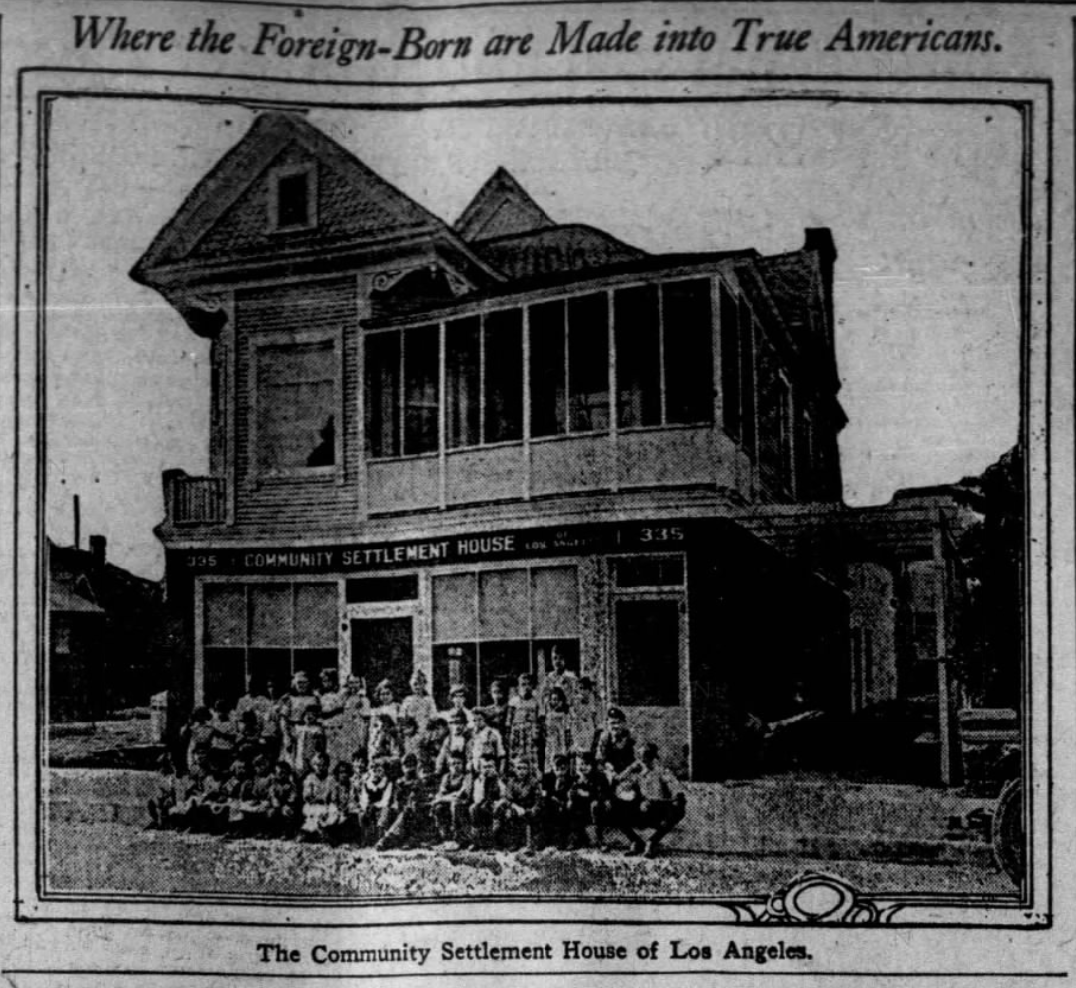
This photo from the following article depicts the Community Settlement House of Los Angeles, “where the foreign-born are made into true Americans,” according to the headline. [14]
The following article explains all this so well, I thought it best to include the whole thing here for anyone who might want to know more about the rationale behind settlement houses and the services they provided:
BATTLE MENACE OF BOLSHEVISM.
Settlement House Rejoices in City’s Donation.
Means Increased Efficiency in Important Work.
Rotary Club Lends Welcome Support to Efforts.
Battling the menace of Bolshevism, and successfully inculcating American ideas and ideals in the minds of the foreign-born residents of Los Angeles, the Community Settlement House of Los Angeles, 335 Bouchet street, in new and commodious quarters, is today rejoicing in a donation of $1000 from the city with which to carry on its work.
Also, its workers are happy over the fact they are in their new structure, into which they have just moved, made possible by the enthusiastic co-operation of the Rotary Club and its 8500 members.
The settlement house is the real melting pot of Los Angeles. Here men, women and children of 1000 families, including thirty-one nations, are learning American practices. The children come there in the afternoons and amid clean, healthful, sunny surroundings learn to play and to think the American way.
Their elders, likewise, are being taught the folly of the Bolshevik doctrine, and brought to a realization of the bountiful blessings that come to those who dwell in the shadow of the Stars and Stripes.
HAVE MANY PATIENTS.
Practical assistance of many kinds is given to old and young alike. Last month medical, surgical and dental attention was given to 1200 patients, and this in spite of the extremely limited clinical facilities. One-fourth of the $1000 appropriated by the city is to go for surgical instruments and supplies and for fitting up an operating-room.
The women are taught to knit and sew; thrift is encouraged, naturalization is urged. Boys' clubs are to be formed, an orchestra is to be organized, while the needy are given clothing for an infinitely small part of its real value, and in many other ways the settlement house is preaching the gospel of pure Americanism.
During the epidemic of a year ago trucks with big pots of steaming hot soup were sent through the streets and the workers saw that the kitchen utensils of scores of families were filled with the nourishing fluid. This sections was first hit by the epidemic, and the first to be rid of it.
The settlement house is in charge of Mrs. Bertha C. Baker, who is assisted by two workers. So greatly have they endeared themselves to the people that the residents of that section called it "the mother house."
Another feature of the work is that of bringing closer together the worker and the employer. Whenever there is a difficulty and the workers are asked to assist, they do all in their power to point out to these Americans-to-be the rights of both worker and employee and have been remarkably successful in adjusting differences without appeal to outside assistance, it is declared.
THRIFT TAUGHT.
They are encouraged to be thrifty and industrious; to think and act along American lines. They are advised to learn the fundamentals of American government and to become naturalized as soon as they have so familiarized themselves.
Practical assistance, moral training and a general betterment of the morale of the aliens is given by the settlement house workers.
Those in need are advised to their legal rights, they are taught the American view of the marriage tie and domestic relations, and generally to comport themselves as citizens of their adopted country. Stress is laid upon cleanliness in the homes, a branch of the Public Library furnishes the best kind of literature for young and old to read, and is liberally patronized, and so tactfully and carefully has the work been conducted that the workers enjoy to the utmost the confidence of those who come within the sphere of its influence.
The directors of the settlement house include the following: Carl Rosenberg, Dr. W. F. Traughber, John C. Bloesser, Fred E. Peterson, James Rothgab and N. R. Webster. [15]
As the Golden Anniversary book points out, not all Rotarians thought this was the work that Rotary should be doing. Taking on the ongoing financial responsibility for the settlement house was a huge responsibility. Others, though, saw the work as vitally important and continued to push for the club’s support. I’m guessing Dr. Traughber was among those.
Rotary’s increasingly energetic service efforts did not go unnoticed. “Of all the splendid organizations serving society,” President Warren G. Harding said, “none is more helpful than the Rotarians, with their high conceptions, their splendid spirit of helpfulness and their practical devotion of service to their fellowmen.” [16] Harding himself was an active member of the Washington, D.C. club.
In his first important speech after being elected president, Harding “called his hearers’ attention to the fact that service above self in business, predicated upon the idea that he profits most who serves best, is the only philosophy of business which, if universally adhered to, will eliminate the twin curses of greed and graft from the business and political life of the world.” [17]
The club’s work at the Community Settlement House also captured the attention of Sir Harry Lauder, who was a legendary Scottish singer, comedian, and songwriter and a member of the Edinburgh Rotary Club. Lauder “is widely recognized as the world's first global musical superstar and was once the highest-paid entertainer alive,” according to what I read online, and “Winston Churchill even famously referred to him as Scotland's greatest ever ambassador.” [18] Interesting - an early kilt-wearing “ambassador,” spreading good cheer, making people laugh, speaking with a heavy dialect, raising awareness of Scottish heritage, and sharing music and stories. Sounds a bit like the Tartan Army that has garnered so much attention during the World Cup!
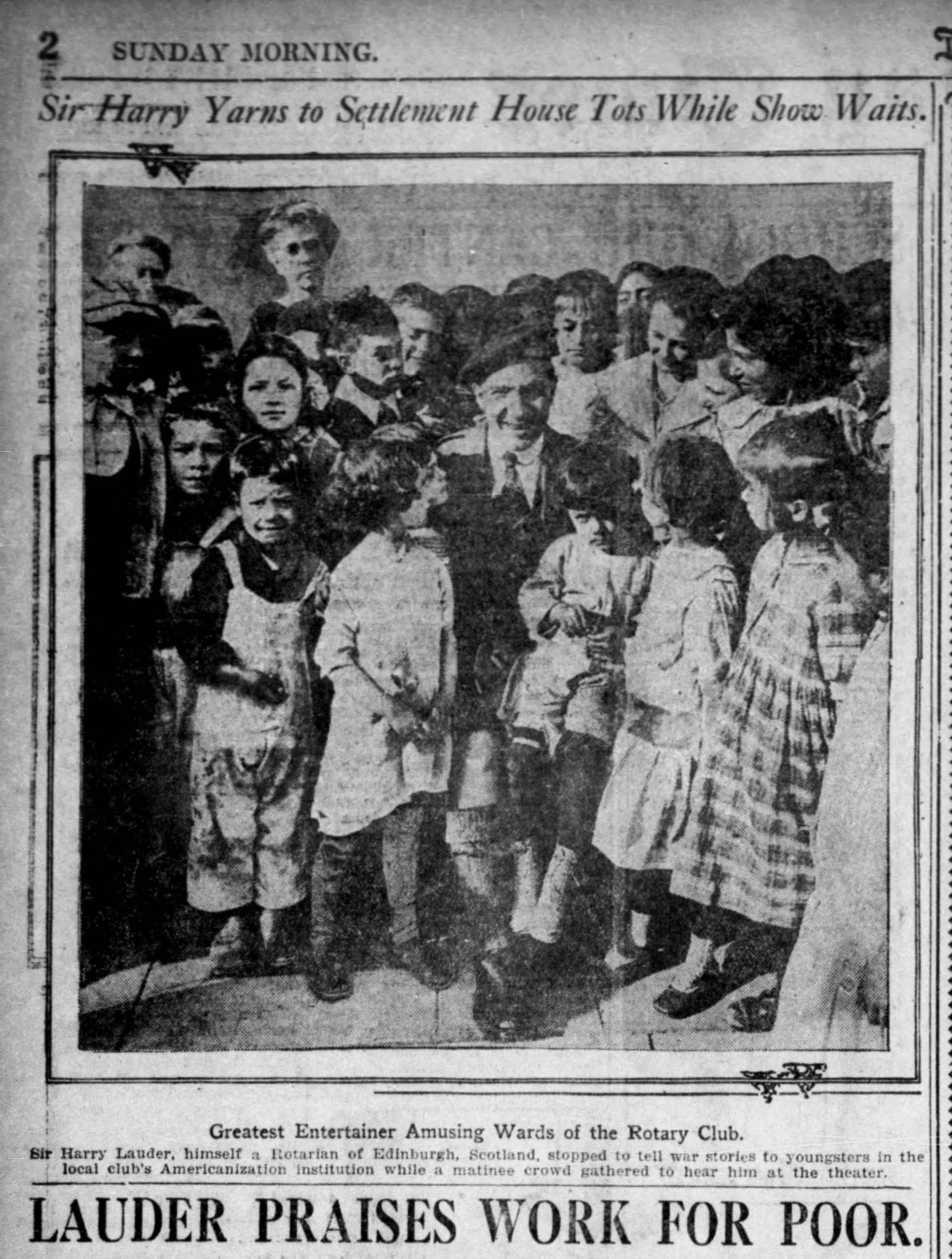
Entertainer Harry Lauder visited the Community Settlement House in November 1919 and praised the work the Los Angeles Rotary Club was doing there. [19]
When one of his tours brought him to Los Angeles, he expressed his desire to visit the Settlement House, and a visit was arranged. Sir Harry “expressed his hearty approbation” for the work the club was doing, saying, “I think the work undertaken by the Los Angeles Rotary Club is most praiseworthy. In these days of Bolshevism, syndicalism, radicalism, there is but one ’ism’ which should be constantly before the eyes of the people of the United States, and that is Americanism. Where is there a more fitting place than right here in the Community Settlement House to teach the young citizens of foreign-born parentage the tenets of Americanism? Implant the seeds of right living and right thinking in these embryonic Americans, and when they reach manhood and womanhood they will not only be better citizens, but will be able to appreciate the fallacies of false teachings.” [20]
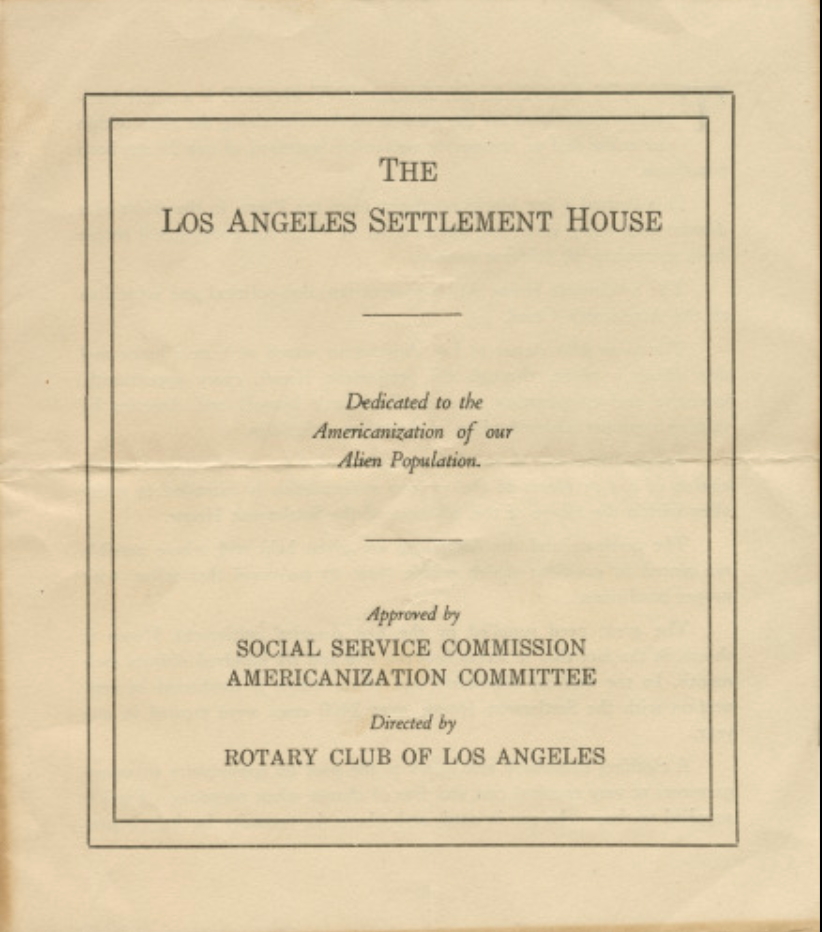
This four-page brochure laid out many of the club’s goals for the Settlement House and sought financial support through a membership drive. [21]
The above Rotary brochure, which sought members’ financial support for the Settlement House, expanded on these goals, stating: “The safety of our national ideals demands the education and enlightenment, according to American standards, of our Alien population The responsibility for this essential missionary work at home rests upon the citizens of the United States who have the welfare of their country seriously at heart. President Wilson has commented upon the Alien Americanization movement as one of the most vital problems before the people of this country. The loyalty of our Alien population to the Stars and Stripes in time of test; their desirability as American citizens depends upon their understanding of American ideals. It is to this work that the Los Angeles Settlement House is dedicated.” [22]
The Golden Anniversary book included four human interest stories Dr. Traughber relayed about the Settlement House. [23] I thought I’d include two of them here that I found especially interesting:
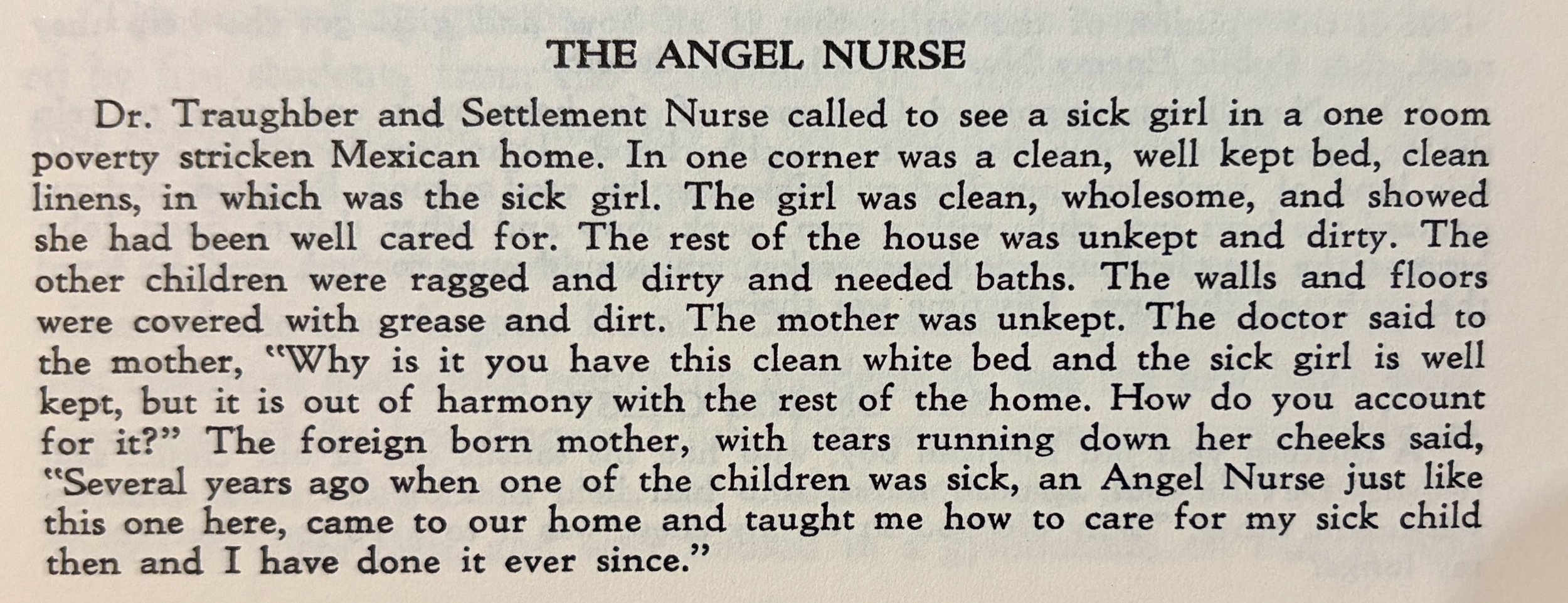
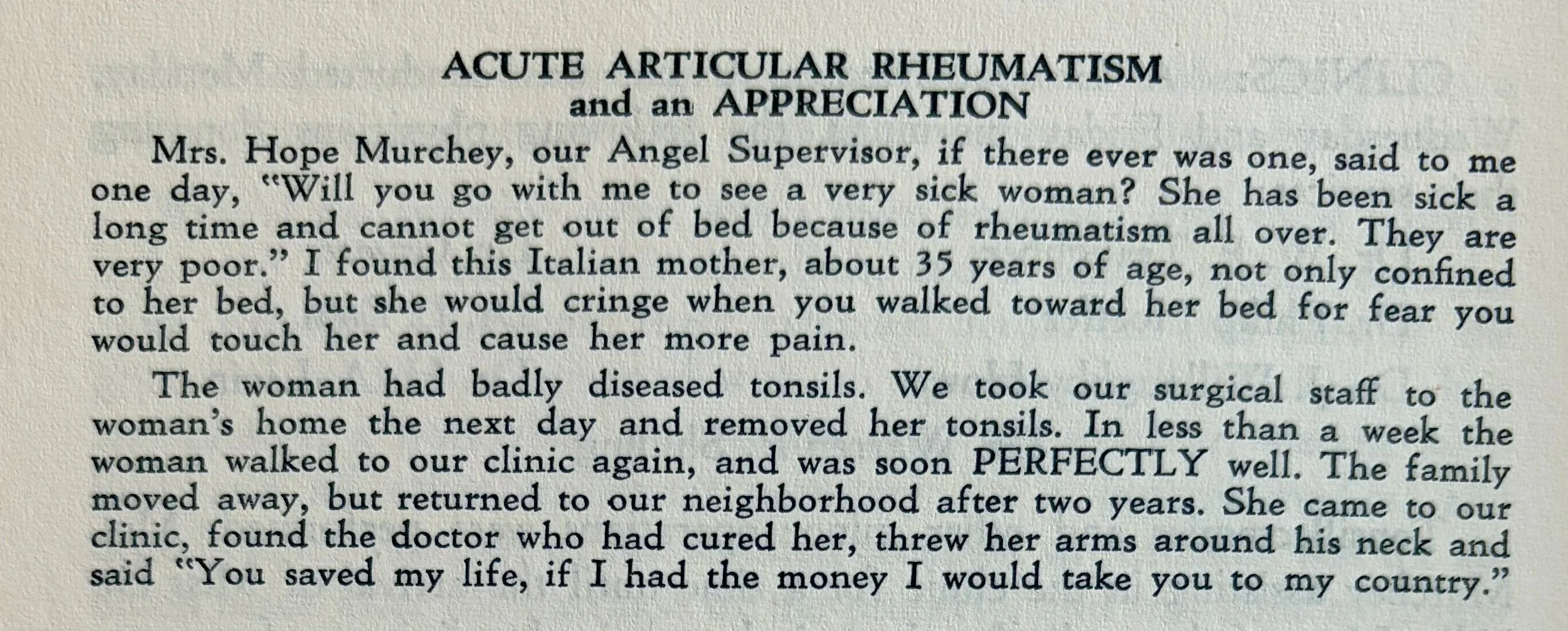
By April 1924, though, Los Angeles Rotarians voted to discontinue raising endowment funds and managing operations for the Settlement House after both the Salvation Army and the Associated Catholic Charities proposed taking over operations. [24] Members were ready to put their charitable efforts elsewhere. One big focus was on “Boys’ Work,” which included the All Nations Foundation, Boy Scouts of America, Community Boys’ Lodge, YMCA, Summer Camps, and International Boys’ Week. They also helped lodge international students, offered scholarships to students in need, hosted oratorical training classes and speech contests, supported programs to help crippled children, reached out to college students by inviting local university student body presidents to be honorary members, and plenty more.
On Jan. 7, 1921, the club did something else that would play a big role in Dr. Traughber’s life: it held its first Los Angeles Rotary Club Golf Tournament at the Hollywood Country Club on Ventura Blvd. In 1936, they would also begin hosting an Annual Honeymoon Golf Party at Catalina, and participants would compete for cups, trophies, and prizes. Dr. Traughber offered an unusual prize for one of these tournaments: a tonsillectomy! [25]
In a letter to her sister dated Oct. 11, 1939, Nora Traughber wrote: “Dr. T. is quite well and going strong though I can see that he is not so young as he once was but you could not tell him so. Bless his heart he teaches young people every Sunday in Sunday School, plays his golf (which is his salvation), enjoys his Rotary, Bridge, etc.” [26] I’m assuming he participated in many of these golf tournaments. And yes - she called him “Dr. T” in her letters!
On Sept. 25, 1942, she wrote: “Doctor … looks and is fine. He finds time to get out early for nine holes of golf and to office by 9 AM so you can see he rises early those two mornings each week. He leaves home by 6:30 and usually gets his own breakfast those days…. Once a month he plays with the Rotary Club and that day they meet about noon at the various Golf Clubs and they make a day of it, getting home about midnight. I am so glad he took up golf for it does much for him in many ways.” [27]
The Rotary Club of Los Angeles hosted its 300th Consecutive Monthly Golf Tournament Feb. 18, 1947. Five months after that “300th” celebration, Dr. Traughber passed away on July 25, 1947. I’m not sure if he was still playing golf in those final months, but he clearly enjoyed the business associations, charitable projects, and social connections he had through Rotary for many years of his life. I’m so glad I found the Golden Anniversary book to learn more about the Los Angeles club and the part Dr. Traughber played in it over the years.
As a member from its charter in 1909 until at least 1942 (when Nora mentions his continued involvement), he was certainly there to see a lot of growth. When Rotary held its first national convention in Chicago in August 1910, sixteen member clubs were in attendance. By 1914, 76 clubs had formed around the world. When the Rotary International Convention was held in Los Angeles in 1922, more than 6,000 Rotarians attended from 26 different nations. Today, there are over 46,000 Rotary clubs operating in more than 220 countries and geographical areas worldwide. These clubs represent a global network of over 1.4 million members and all operate under Rotary International.
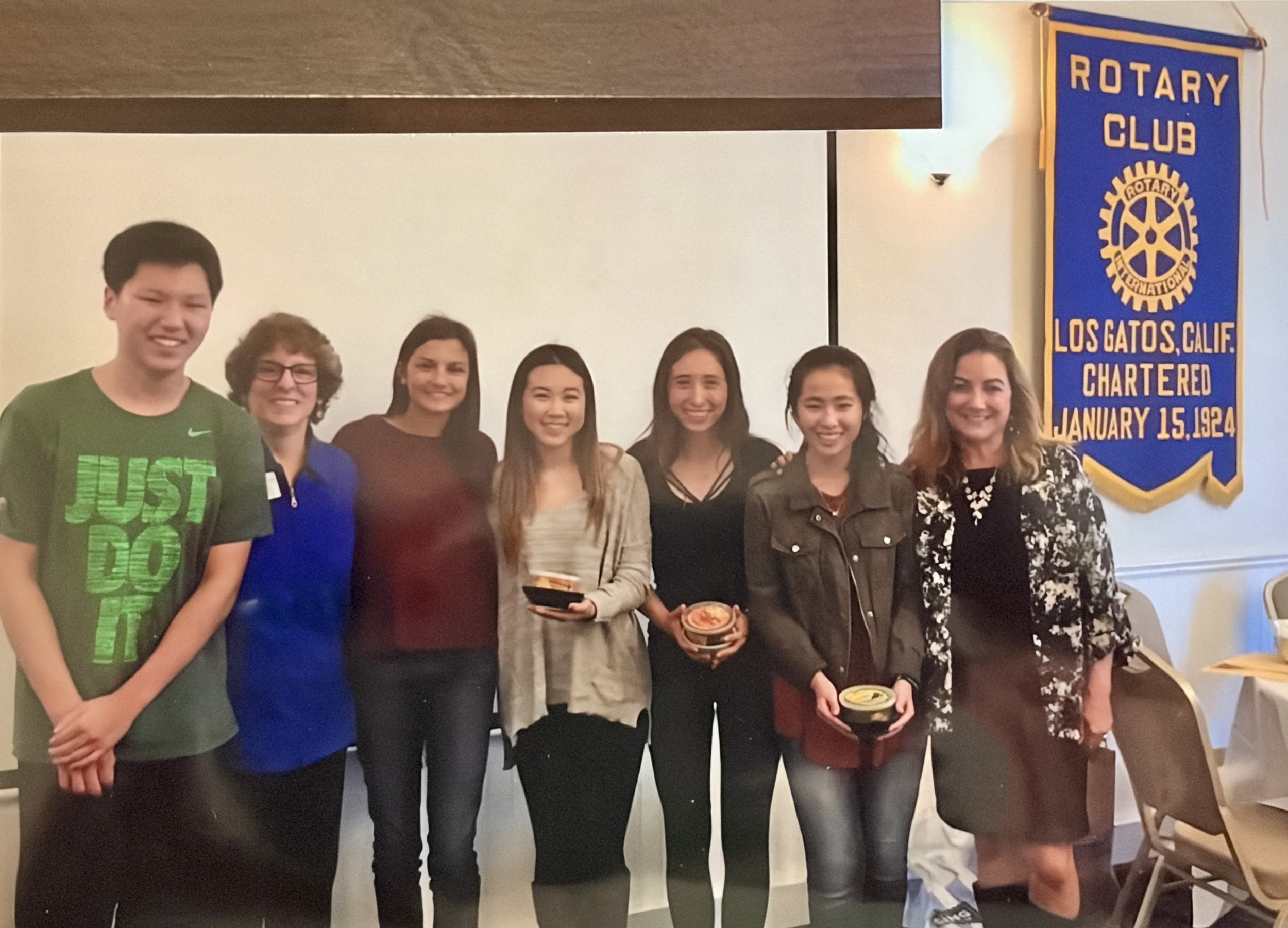
Here I am at a Rotary meeting with Tina Orsi-Hartigan and a group of our Interact students. You can see from the banner that the Los Gatos club was chartered Jan. 15, 1924.
The Los Gatos club with which I was involved celebrated its 100th anniversary in 2024. I’m glad I was able to be part of that celebration and am grateful for the many years I was able to work with LGHS’s Interact Club and be recognized as an honorary Rotarian. Who knows? Maybe someday I’ll get involved again. I know I will keep attending their fundraising Crabfest & Auction every year!
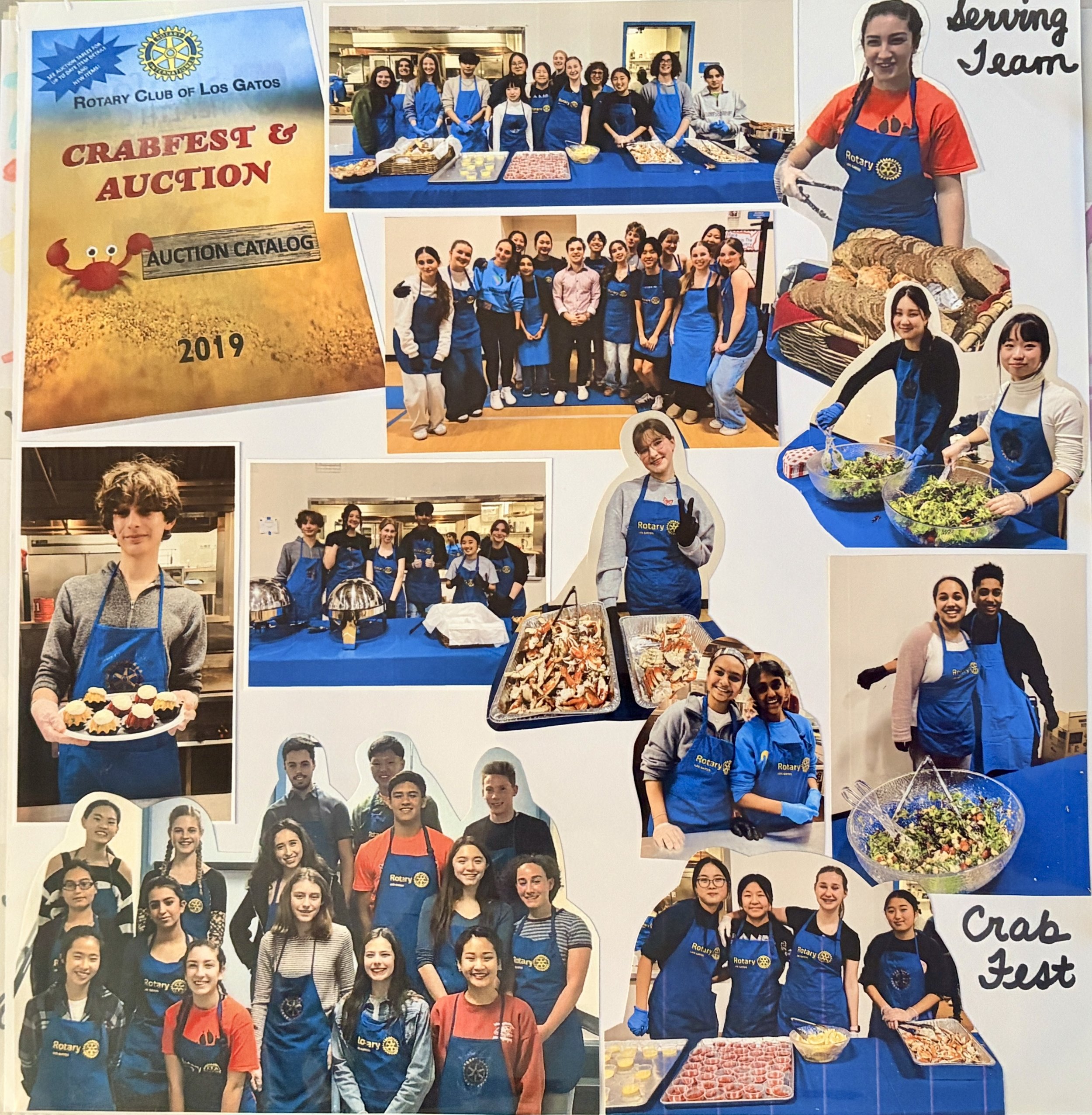
This page appears in my “Teaching Scrapbook” and includes many Interact Club members helping at Rotary Crab Fests over the years.
If you’ve enjoyed this blog post and want to stay updated on future posts, be sure to subscribe on my website, and I’ll add your name to my email list for future newsletters. Just scroll down to the bottom of the homepage to add your name and email. Don’t worry - I only send out newsletters four times a year, so your inbox will not be inundated. And if you want to learn more about Dr. William Francis “Frank” Traughber, I hope you’ll check out my newest book - Frank and Nora’s Historic Honeymoon Adventure: A Travelogue through the West with a “Time Travel” Twist. Thanks for reading!
Endnotes:
Rotary Club of Los Angeles. History of the Rotary Club of Los Angeles: Golden Anniversary Edition. Mock Printing, South Pasadena, California, 1955, p. VII.
Ibid, pp. 1, 4.
Ibid, p. 3.
Ibid, pp. 5-6.
Ibid, p. 8.
Ibid, p. 15.
Ibid, p. 13.
“1910 Los Angeles International Air Meet at Dominguez Field.” Wikipedia, https://en.wikipedia.org/wiki/1910_Los_Angeles_International_Air_Meet_at_Dominguez_Field.
Rotary Club of Los Angeles. History of the Rotary Club of Los Angeles: Golden Anniversary Edition. Mock Printing, Los Angeles, California, 1955, p. 41.
Barker Brothers Furniture Store, Los Angeles, CA 1942 Postcard. Ebay, https://www.ebay.com/itm/375556347904.
Rotary Club of Los Angeles. History of the Rotary Club of Los Angeles: Golden Anniversary Edition. Mock Printing, Los Angeles, California, 1955, p. 49.
Ibid, p. 57.
“$30,000 TO AID THOSE WHO SIP FROM POVERTY’S CUP SOUGHT BY COLEMAN HOUSE SETTLEMENT.” Morning Tribune, Los Angeles, CA, 21 Feb 1916, https://www.newspapers.com/image/1173198658/.
“BATTLE MENACE OF BOLSHEVISM. Settlement House Rejoices in City’s Donation. Means Increased Efficiency in Important Work. Rotary Club Lends Welcome Support to Efforts.” Los Angeles Times, Los Angeles, CA, 17 Oct 1919, https://www.newspapers.com/image/380528016/.
Ibid.
“President Eloquent in Praise of High Ideals of Rotary.” Pasadena Star News, Pasadena, CA, 5 June 1922, https://www.newspapers.com/image/1171908341/.
Ibid.
“Harry Lauder.” Wikipedia, https://en.wikipedia.org/wiki/Harry_Lauder.
“Lauder Praises Work for Poor.” Los Angeles Times, Los Angeles, CA, 16 Nov. 1919, https://www.newspapers.com/image/380517256/.
Ibid.
The Los Angeles Settlement House. “Dedicated to the Americanization of our Alien Population.” Loyola Marymount University Digital Collections, https://digitalcollections.lmu.edu/Documents/Detail/the-los-angeles-settlement-house-dedicated-to-the-americanization-of-our-alien-population/21003.
Ibid.
Rotary Club of Los Angeles. History of the Rotary Club of Los Angeles: Golden Anniversary Edition. Mock Printing, Los Angeles, California, 1955, pp. 65-66.
Ibid, p. 92.
Ibid, p. 282.
Traughber, Nora. Letter to Sister Lettie. Los Angeles, CA, 11 Oct 1939. Traughber Family Collection.
Traughber, Nora. Letter to Sister Lettie. Los Angeles, CA, 25 Sept 1942. Traughber Family Collection.