Exploring Burgenland, Part V: A Look at Burgenland Emigration — Why Did So Many Leave, and Where Did They Go?
Chasing History: Exploring My Ancestral Roots – Post #72
By Tonya Graham McQuade
For those of you who have been following along on this “Exploring Burgenland” blog series, you know that my husband and I truly enjoyed our journey through Eisenstadt, Forchtenstein, Unterwart, Oberdorf, Güssing, Burgauberg-Neudauberg, and Gerersdorf in June. We took in lots of beautiful sights, met some lovely people, enjoyed delicious food and wine, and learned a lot of history along the way (and even more through the research I’ve been doing as I write these posts).
Now, though, it’s time to turn the focus to a few very important questions: Why did so many people leave Burgenland? Why did so many move to Chicago, Illinois – leading it to become Burgenland’s biggest city? Why, in particular, did my great grandparents John Wagner and Anna Halper (and several of their other family members) leave their small villages for this big city? And finally, what were their lives like when they got there? Those are the questions I will be exploring in the final two posts of this blog series.
Two sources I will be relying on a lot as I dig into those questions are Walter Dujmovits’ book The Burgenländer Emigration to America and the Stadtvilla Eisenstadt’s museum displays. Other records that have proven helpful in piecing together my great grandparents’ unique story include some family history descriptions written down by my Great Aunt Hermina “Minnie” Wagner; various Ellis Island, U.S. Census, Draft Registration, and Naturalization records; some of John Wagner’s work and legal records I acquired from Minnie’s daughter Tracey; and a single family letter from Unterwart in 1952. More on all that later.
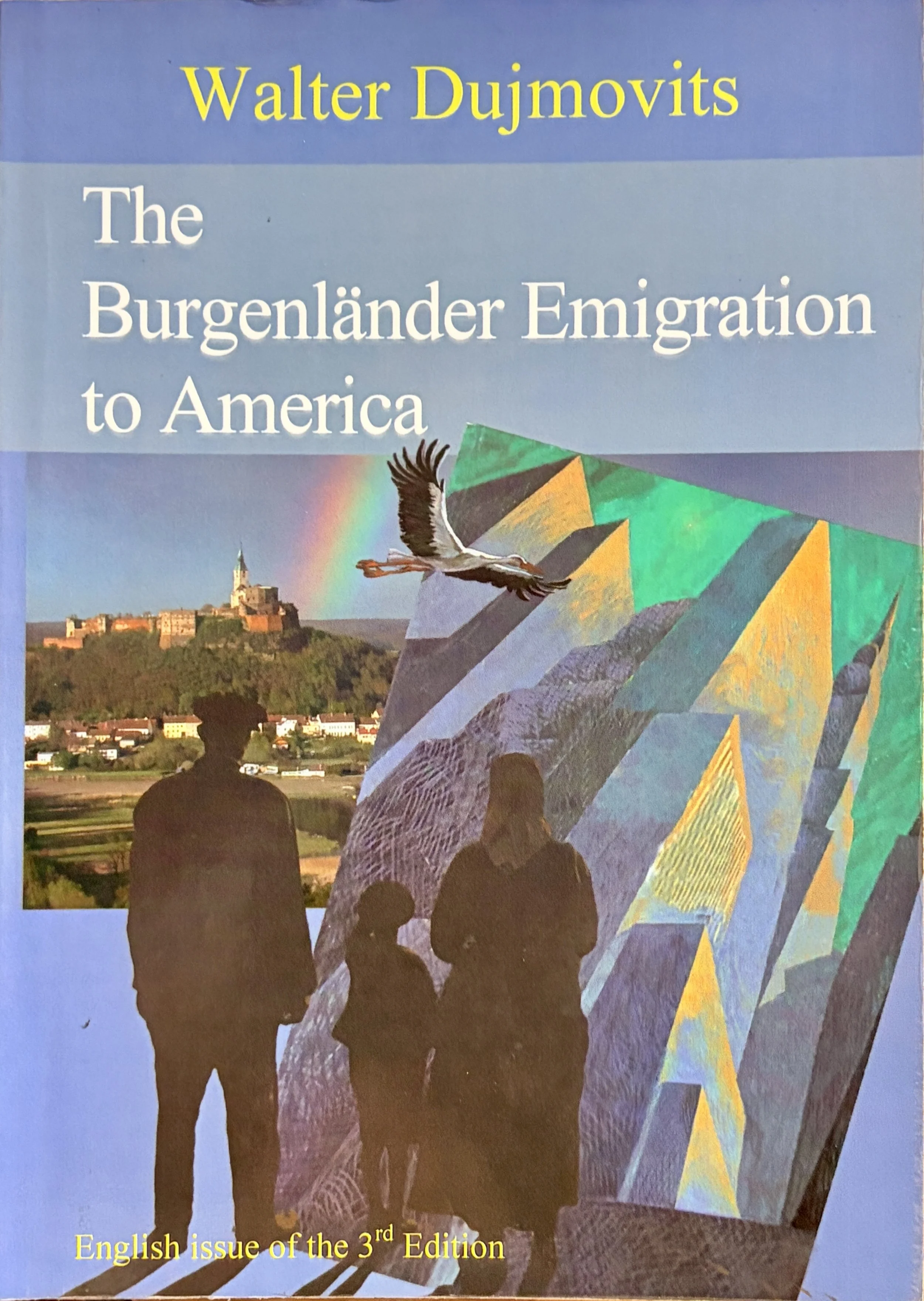
This book by Walter Dujmovits (2013) is a great resource for learning about Burgenländer emigration.
Perhaps it is best to start with some statistics. According to Walter Dujmovits, “Prior to World War I, 33,000 Burgenländers left their homeland; between the world wars, 24,000, and after World War II nearly 6,000. Less those emigrants that returned, the number who left for good was at least 52,000…. In the 1970’s, there were at least 100,000 Burgenländers and their descendants living in North and South America, with about 80% in the U.S.” [1] The largest number went to Chicago, followed by New York City and Allentown, Pennsylvania.
As both the book and the museum displays point out, Burgenland emigration ran in waves from 1875 onwards. It started primarily in the north but soon covered the whole of Burgenland, with the destination areas varying based on where people came from. It can also be separated into periods of Old Immigration (driven primarily by farming) and New Immigration (driven largely by the Industrial Revolution). Movement was interrupted by the two world wars and the Great Depression, and it was slowed by stricter U.S. immigration laws beginning in 1924. While there were unique cases of emigrants leaving Burgenland prior to 1875, and the book tells the story of several, I am going to focus on three main periods:
Beginning of the Emigration Movement (1875-1890) – period transitioning from Old Immigration to New Immigration; emigrants settled primarily in the Midwest and took up farming, but increasing industrialization began drawing people to the bigger cities
New Immigration Period (1890-1914) – period of New Immigration; emigrants settled primarily in the newly created industrial areas between New York and Chicago; male industrial workers in particular were needed, and many men initially came on their own, either with plans to earn money and return to their native villages or to send for their families to join them later
Inter-War Period (1919-1938) – period after Burgenland became a part of Austria during which the wave of emigration reached its peak in 1923, when 6,683 people left their home in Burgenland; the following year, more restrictive U.S. immigration laws slowed emigration down significantly, then it stopped completely after Germany annexed Austria in 1938 [2]
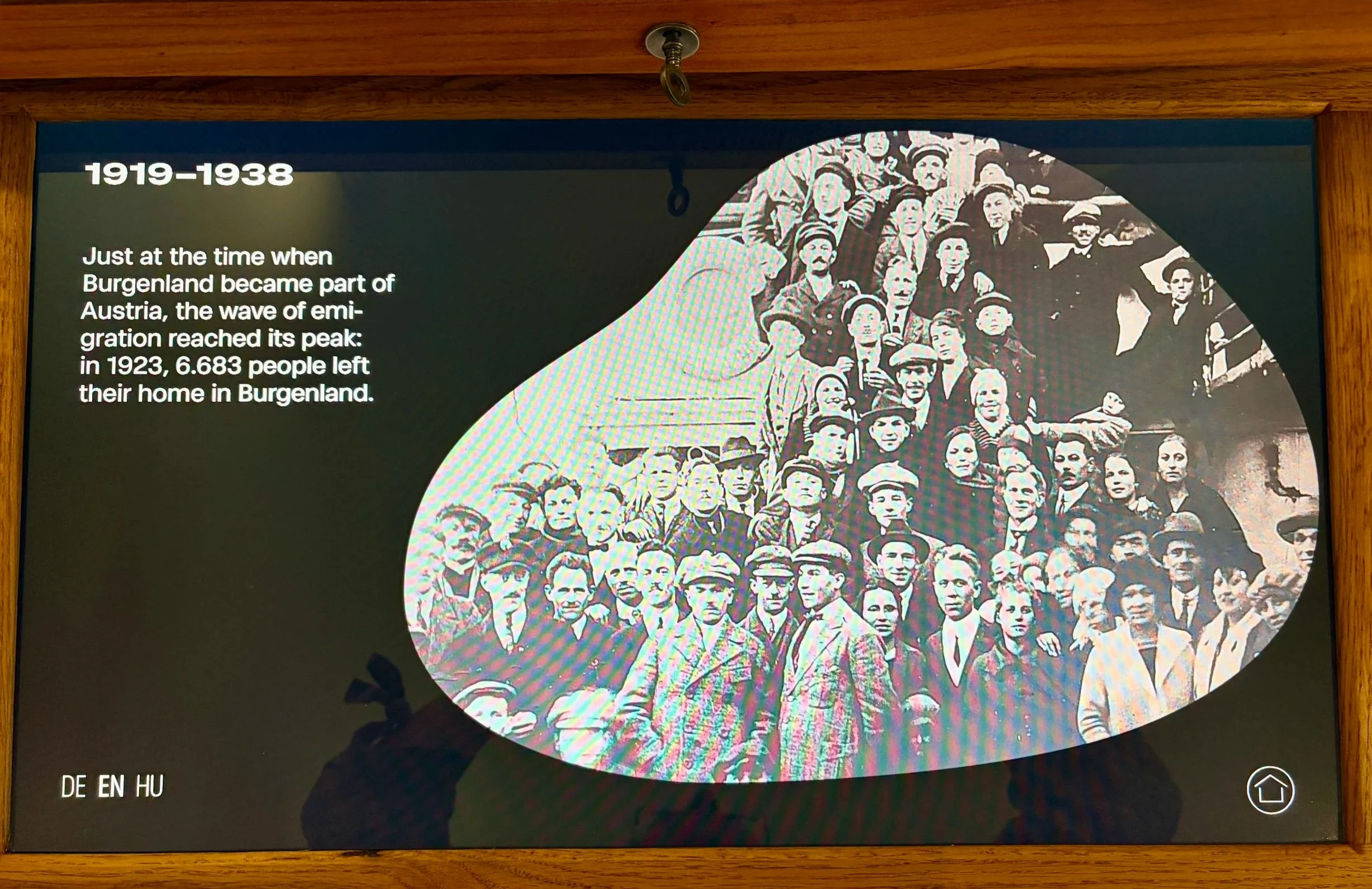
Many exhibit signs at Stadtvilla Eisenstadt museum in Burgenland’s capital, Eisenstadt, help tell the Burgenländer emigration story.
As Dujmovits explains, “As the emigration movement in Burgenland moved from north to south, the settlement pattern in the U.S. moved from west to east. The first emigrants from northern Burgenland went to the Midwest (Kansas City, St. Paul, St. Louis), those from central Burgenland to Chicago and South Bend, and those from southern Burgenland to Pennsylvania, New Jersey, and New York…. The industrialization of America began in the eastern United States during the period 1875-1890 and greatly changed the structure of emigration. The immigrants were no longer farmers and homesteaders; they became industrial workers, a change which took place not back home but in America. The Old Immigration was over and the New Immigration had begun.” [3]
According to Dujmovits, “Neither poverty, overpopulation, nor the ‘Wanderlust’ of Burgenlanders is sufficient to explain emigration.” [4] Yet, ALL of those played a role. Here I will briefly explain some of the main reasons Dujmovits suggests:
Unfavorable Agrarian Structure – This played a significant role because “a small number of large landowners existed alongside a large number of small farmers … (and) the unfair method of succession (which divided property among all surviving children) worsened conditions and resulted, not only in a reduction of property, but also the uneconomical division into small, numerous field units.” [5] In other words, because land was divided equally among all siblings, generational farms shrunk rapidly. A viable farm owned by a grandfather would be split into four pieces for his children, and those pieces would be split into smaller slivers for the grandchildren. By 1909, millions of Hungarians owned plots of land so tiny that they could no longer grow enough food to support a single family.
Poverty and Overpopulation - Burgenland’s population exploded from 1890-1914 as the birth rate continued to be high but medical care improved and death rates lowered. As Dujmovits explains, “It had all the symptoms that are exhibited by today’s developing countries; high birth rate, lower mortality rate, unproductive educational system, poor soil, lack of investment capital, stagnating economy – all of which led to poverty. The result was seasonal migration (based on agriculture), internal migration (within Austria-Hungary for various types of work), and emigration.” [6]
Need for Workers in America – While poverty and overpopulation created a “push effect” for emigration, the need for workers in America’s underpopulated, industrializing cities created a “pull effect.” [7] Some who left planned to stay in America permanently; others hoped to earn enough to come back and pay off family debts, purchase land, or start a business.
Decrease of Viniculture – Many in Burgenland depended on their vineyards for income, so when Phylloxera destroyed entire vineyards and shut down the wine making business in the 1890s, incomes were decimated. This was especially true in the district of Güssing, which had the highest emigration rates of any Burgenland district. In fact, of the 104,000 Austrians who immigrated to America, every twelfth came from the Güssing district. [8]
Mobile Population – Many workers in Burgenland were already quite mobile, leaving home to serve as seasonal agricultural workers to noble families or landowners; transporting their various crafts to markets throughout Austria and Hungary; working as deliverymen; or – as I learned was the case with my great grandfather – working on large construction projects in Vienna or other large cities; as a result, they did not feel especially tied to their villages, and the risks involved in moving across the sea were outweighed by the opportunities.
Improvements in the Transportation System – This would have been a big one for me. Unlike with sailing ships, which typically took a month or longer to cross the ocean, by 1904 (when my first ancestors made the journey), a steamship crossing from Le Havre to New York City typically took 6 to 8 days. In fact, by 1870, technological breakthroughs – specifically the highly efficient screw propeller and compound steam engines – made large-scale steam travel cheap enough for the masses. By 1880, old wind-powered sailing ships had been completely phased out of regular transatlantic passenger service. [9]
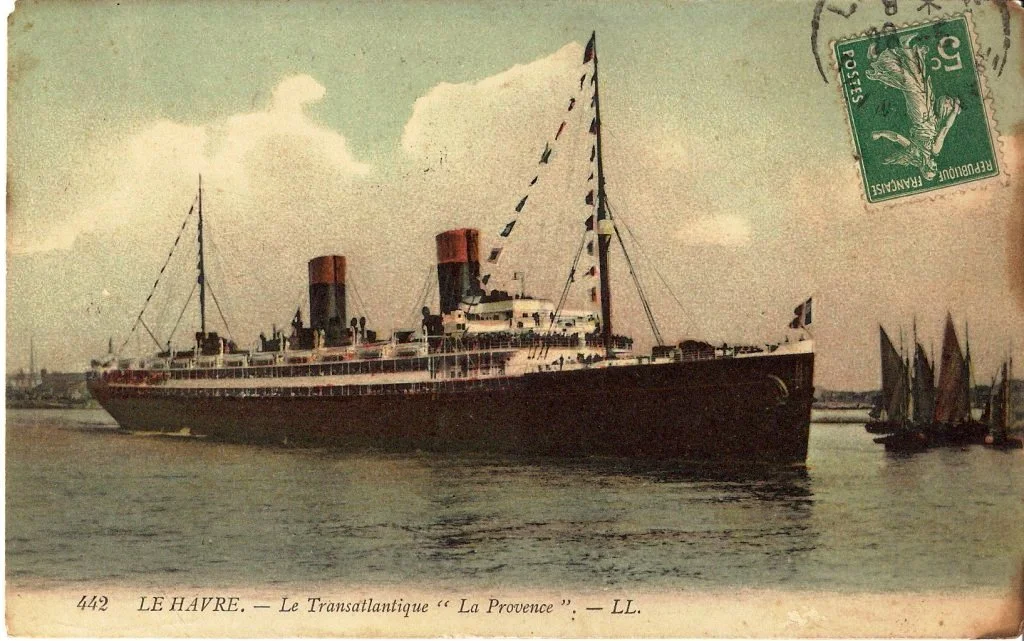
By the late 1800’s, a steamship crossing from Le Havre to New York City typically made the passage in 6 to 8 days, resulting in emigration being both faster and cheaper. [10]
Other reasons Dujmovits mentions include “epidemic waves of emigration” (spreading from country to country, village to village); “legendary success stories” (leading many to be willing to risk everything for the possibility of riches); “wanderlust” (Burgenland was a multicultural and multi-linguistic place, with little fear of foreigners, so its people were able to assimilate and adapt easily to new surroundings); and finally, “reasons that lie outside the realm of respectability” (such as avoiding military service, an arranged marriage, avoiding debt or child support payments, or criminal activity). [11]
I would also add Hungary’s Magyarization Policies, which began with the 1867 Austro-Hungarian Compromise (discussed in Part II) and grew progressively stricter over the next four decades. In the early years (1867-68), the state administration, judicial systems, and secondary schools shifted to speaking Hungarian almost exclusively. [12] Under Minister President Kálmán Tisza (1875-90), Magyarization became a weapon of the state. His government began shuttering minority schools, gerrymandering local voting districts to strip minorities of political representation, and mandating that Hungarian be taught in all primary classrooms. [13]
The policy reached its peak under Minister President Dezső Bánffy (1895-99). This era saw the aggressive, forced "Magyarization" of family surnames and geographic place names. Maps were rewritten, and traditional German, Slovak, or Slavic village names were legally swapped for entirely newly invented Hungarian equivalents. [14] Then, the 1907 Apponyi Education Laws mandated that Hungarian must be the primary language taught in all schools, even in predominantly German-speaking areas. Children in many of then-West Hungary’s German-speaking villages were forced to learn, pray, and speak in Hungarian at school, creating massive cultural friction for German families.
For those who want a fuller explanation of Burgenland emigration, I encourage you to read Dujmovits’s book. He provides a lot of statistics on individual villages and talks about the various places they settled. I am going to focus mainly on that second wave of immigration from 1890-1914, which is when most of my family members emigrated, and on Chicago as the endpoint since that is where my great grandparents settled.
This is not my first attempt to write about John Wagner and Anna Halper’s immigration stories. Four years ago, after a visit to Ellis Island, I wrote what I knew at the time. Part of this post will draw from those earlier blog posts, but now that I’ve traveled through Burgenland and done a lot more family history research, I definitely have some new information (and corrections) to add. If you want to read more about Ellis Island itself, though, check out this earlier post.
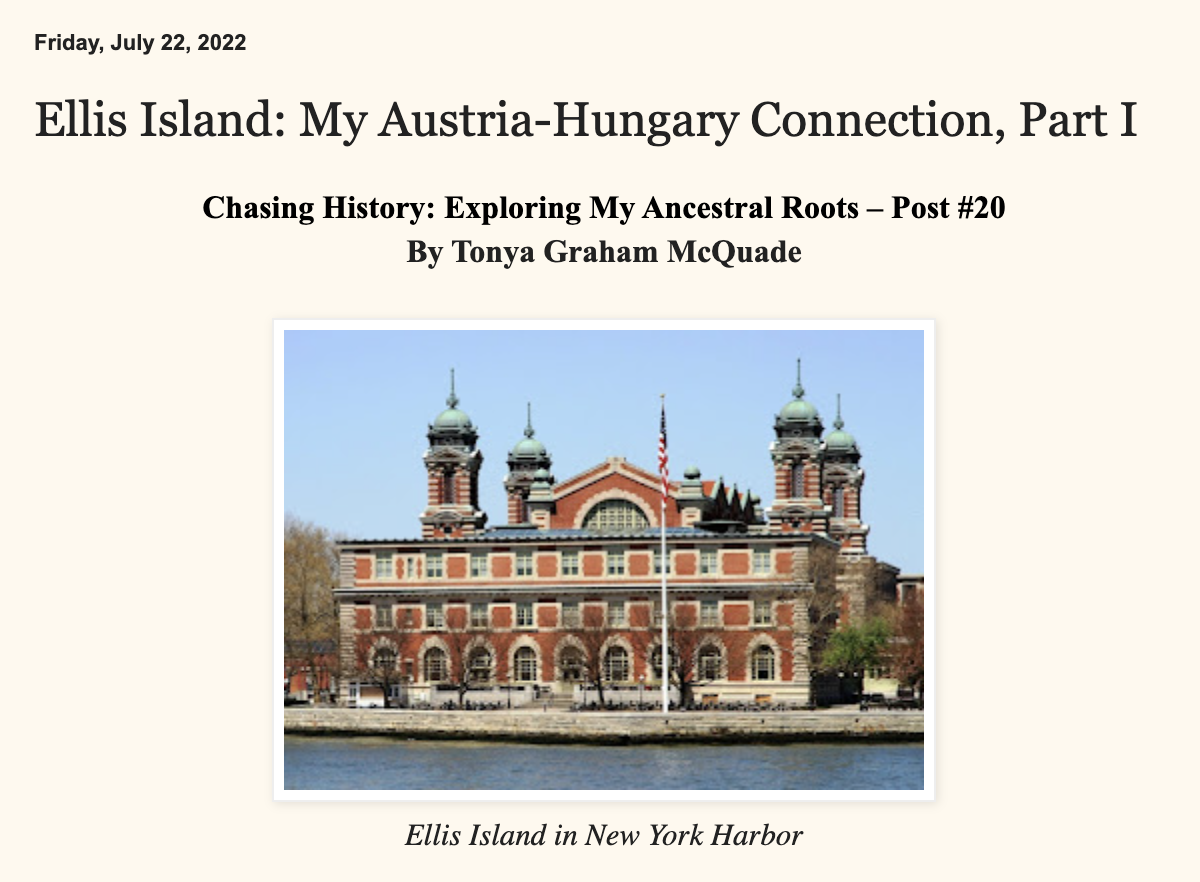
In this earlier blog post from 2022, I explored the immigrant experience — including that of John Wagner and Anna Halper — as they passed through Ellis Island.
Both John “János” (in Hungarian) Wagner and Anna Halper, as well as many other family members, passed through Ellis Island in the early 1900’s. Both from Hungary, they met and married in Chicago, Illinois, in 1917 and gave birth there to my mom’s father, John Paul Wagner, Jr., and his three younger siblings: Anna Rose, Hermina Marie, and Joseph Paul. For many years, I knew very little about them, though I do have some memories of my great grandmother, who died when I was five. Most of what I knew came from a description provided by my Great Aunt Hermina “Minnie” (Wagner) Dougherty. Minnie was my grandfather’s younger sister, and here’s what she wrote when my mom asked her to type something up for the Heritage Albums she was putting together for my brothers and me:
“My father (John Paul Wagner) told me he came to America from Hungary because of the war in Europe. He worked at the Pullman Company, 51st & Wentworth, in Chicago as a supply clerk. It was a company that served all the Rock Island trains as they entered into Chicago. He retired at age 72, with a wonderful retirement party from the Pullman Company, and was given a recliner as a retirement gift. He had one sister (Wilma Wagner) come from Hungary, and she settled in St. Louis. She spent years trying to find him, and finally a letter came to our house after years of searching. My dad and I took a train to visit her after about 40 years, and it was a great welcome party in St. Louis. They kept close contact until his death, and she died not too long after.
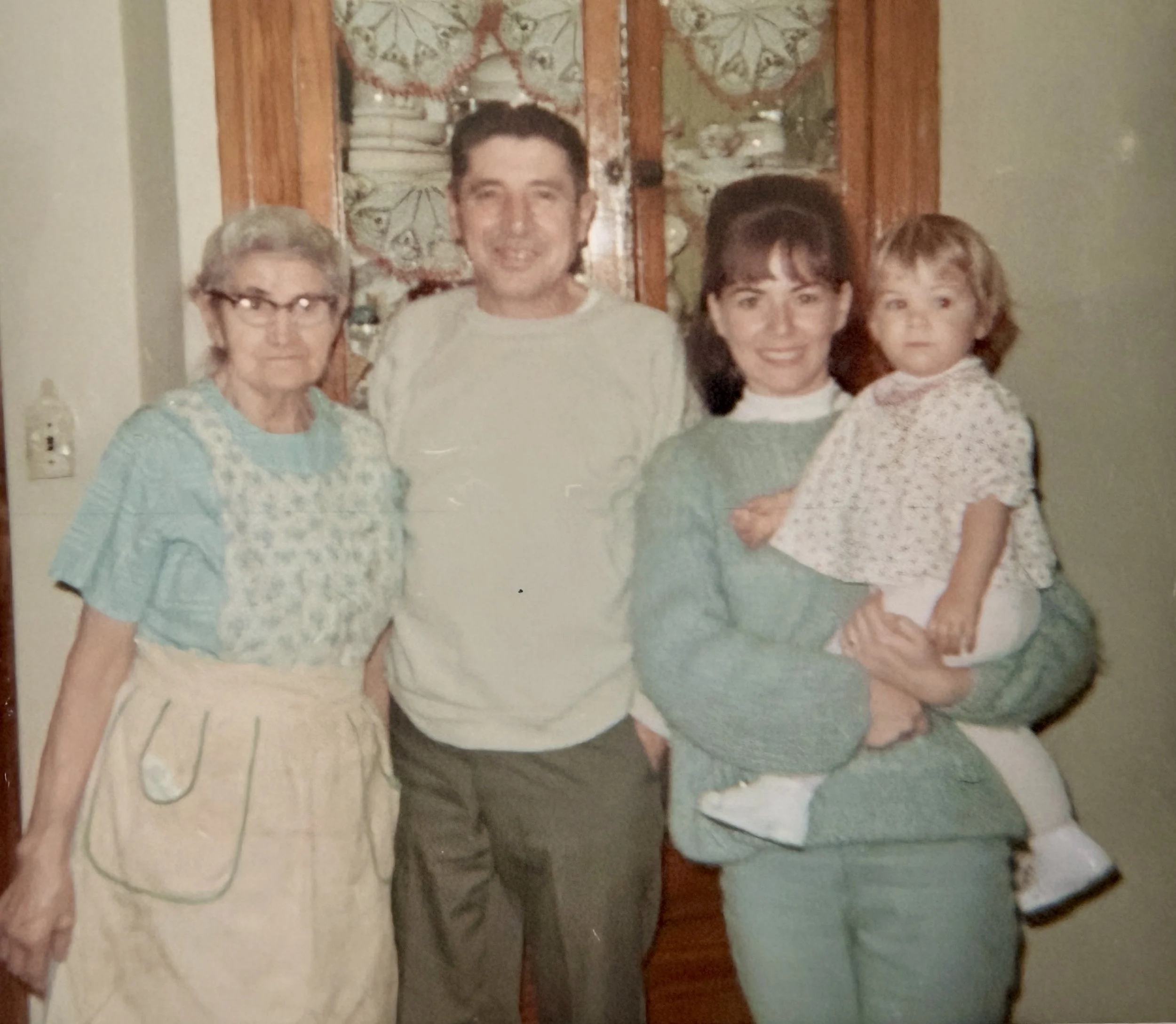
From left: My great grandmother Anna Halper; my grandfather John Paul Wagner, Jr.; my mother Dorothy Ann (Wagner) Graham; and me — Tonya Ann (Graham) McQuade — in 1968.
“My mother (Anna Halper) came to America from Austria because she heard the ‘money fell off trees.’ She learned that it was very hard to come to a new country and start anew. The language barrier was the worst obstacle. But whenever I asked her if she wanted to return, she always said she didn’t care to visit Austria. She was so proud to become a citizen, and we always had to have a replica of the Statue of Liberty at our house. She had two brothers, Paul and Frank, and a sister, Catherine, that came to America. They would visit us until their deaths, all before my mother’s death. She worked in a bakery in her younger days. I know because she told me she came home from work and a few hours later delivered me at home. We were all born at home in those days. When we grew older, she worked nights in the F.B.I. building in Chicago. She cleaned the offices there and retired at age 65.”
– written by daughter Hermina Wagner (2001)
While I am certainly grateful for the details Minnie provided, I now know that there are several holes and inaccuracies in her description. For one, her parents came from villages less than four miles apart. They BOTH came from Hungary, but the histories of their villages were quite different, with the Wagners of Unterwart being ethnically Hungarian and the Halpers of Oberdorf being ethnically Austrian-German. I wrote a lot about that in Parts I, II, and III, so if you missed those earlier posts, I hope you’ll check them out. When the borders shifted after WWI, both Unterwart and Oberdorf became part of the newly created state of Burgenland, Austria. Minnie also has some details wrong on Anna’s siblings – but more on that in my next post.
What I want to focus on here is her opening statement: “My father told me he came to America from Hungary because of the war in Europe.” For years, this explanation confused me. In 1909, Europe was technically at peace, and the catastrophic battles and trenches of World War I were still five years away. What war was he trying to escape?
As I looked more deeply into this “historical riddle,” I realized this statement was not an error or fabrication. John Wagner was likely referring to the Bosnian Annexation Crisis of 1908–1909. While it did not ultimately explode into a full-scale European war, “Austria’s annexation of Bosnia and Herzegovina created an international crisis that laid the groundwork for the start of World War I.” [15] To a young man of draft age living in the Austro-Hungarian Empire, it would have felt very much like an imminent war.
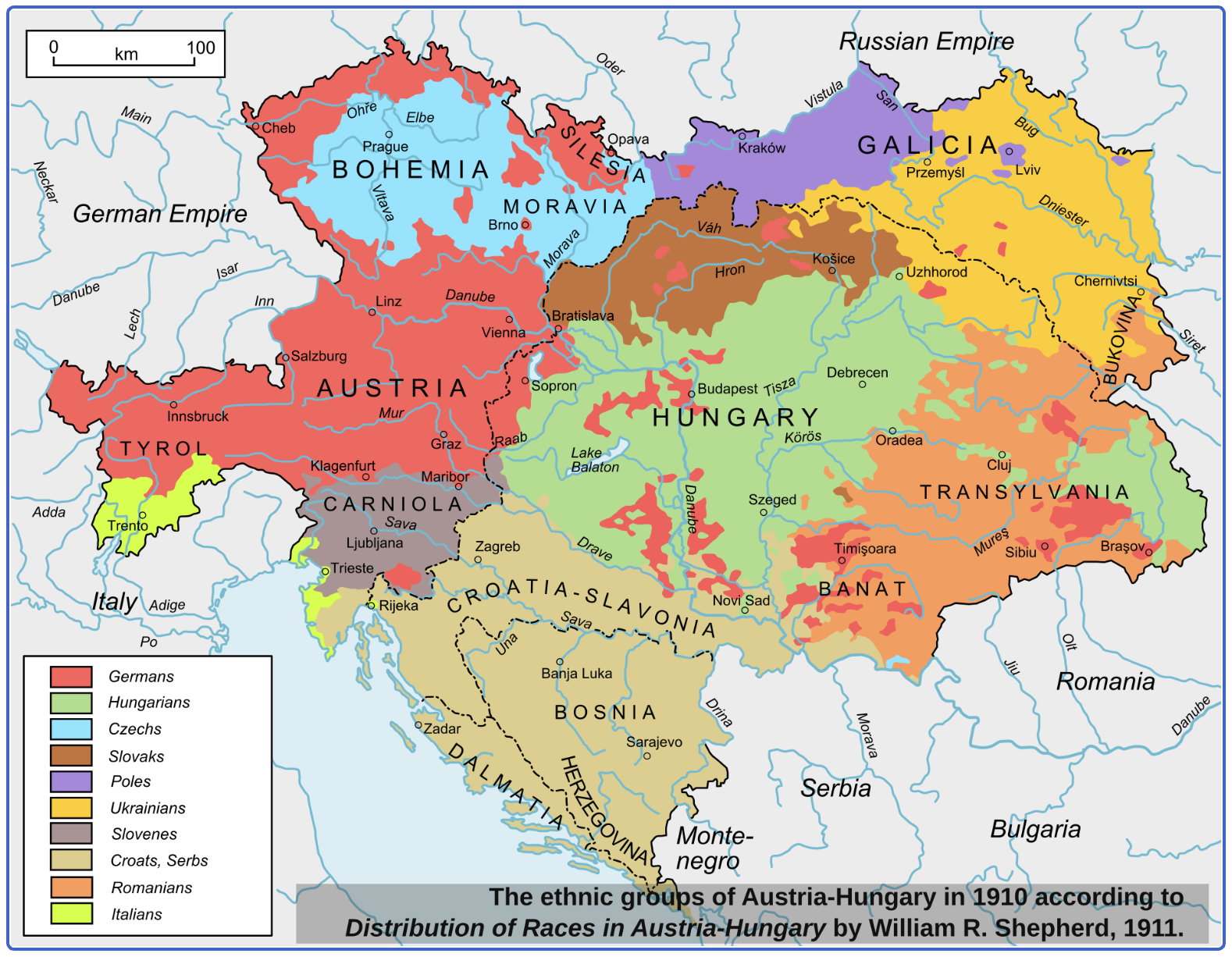
This map, which is based on William R. Shepherd’s 1911 "Distribution of Races in Austria-Hungary" map from his Historical Atlas, shows the annexed area of Bosnia and Herzegovina in the south; it also uses some updated city names. [16]
Here’s what happened: in October 1908, the Austro-Hungarian Empire officially annexed Bosnia-Herzegovina. This move deeply angered neighboring Serbia and its powerful ally, the Russian Empire. For several tense months stretching deep into the spring of 1909, Europe hovered on the edge of a massive, continent-wide conflict. To prepare for what looked like unavoidable combat, Austria-Hungary initiated partial mobilizations. This meant that thousands of young reservists and draft-age men suddenly received mobilization orders. At the time, mandatory conscription applied to nearly all healthy young men, so the shadow of the 1909 Hungarian military draft orders must have loomed large for men like János. While troops were sent to the tense southern frontiers in preparation for potential conflict, the crisis was defused in late March 1909 when Russia, not yet recovered from its 1905 war with Japan, backed down and forced Serbia to accept the annexation.
As explained online: “Despite the initial outrage and calls for international intervention, Austria's annexation was eventually accepted, albeit reluctantly, by Serbia and Russia after prolonged tensions. This decision did not resolve underlying ethnic and nationalistic conflicts; instead, it exacerbated relations between Austria and Serbia, culminating in further unrest in the Balkans. The annexation is often regarded as a precursor to the larger conflicts of the 20th century, highlighting the complexities of nationalism and imperialism in the region. Peace was thus restored to the Balkans, but it was a precarious one. Relations between Austria and Serbia steadily deteriorated until they culminated in the assassination of the Austrian archduke Francis Ferdinand, heir to the Austrian throne, in July of 1914 (by a Bosnian Serb nationalist). The uneasy truce that Austria and Russia had maintained in the Balkans from 1878 to 1908 was now shattered beyond repair.” [17]
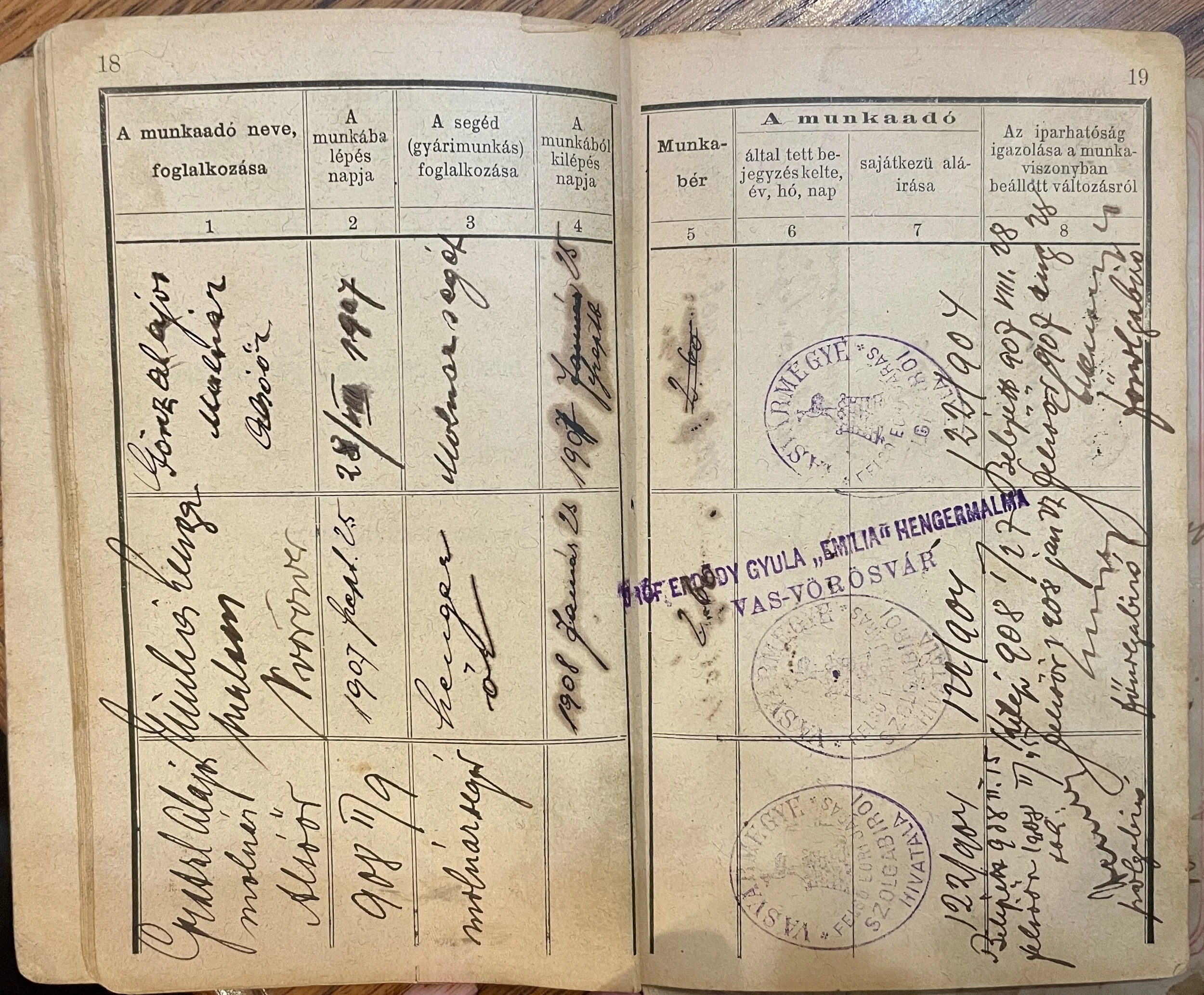
Was this crisis the motivation for János Wagner to leave his homeland? Possibly – and the timing works with his departure. His last day of work, according to his Munkakönyv (Worker's Record Book), was 18 Jan 1909. At that time, he left his job as a molnársegéd (miller’s journeyman) in Alsóőr (Unterwart), where he had been working for a master miller named Lajos Gáncs. Prior to that, he had worked for Count Gyula Erdődy, owner of the "Emilia" Hengermalma – a high-tech steam mill that used rollers instead of traditional millstones – in Vas-Vörösvár (Rotenturm an der Pinka). These were both good jobs for the time. So, why leave in the middle of winter?
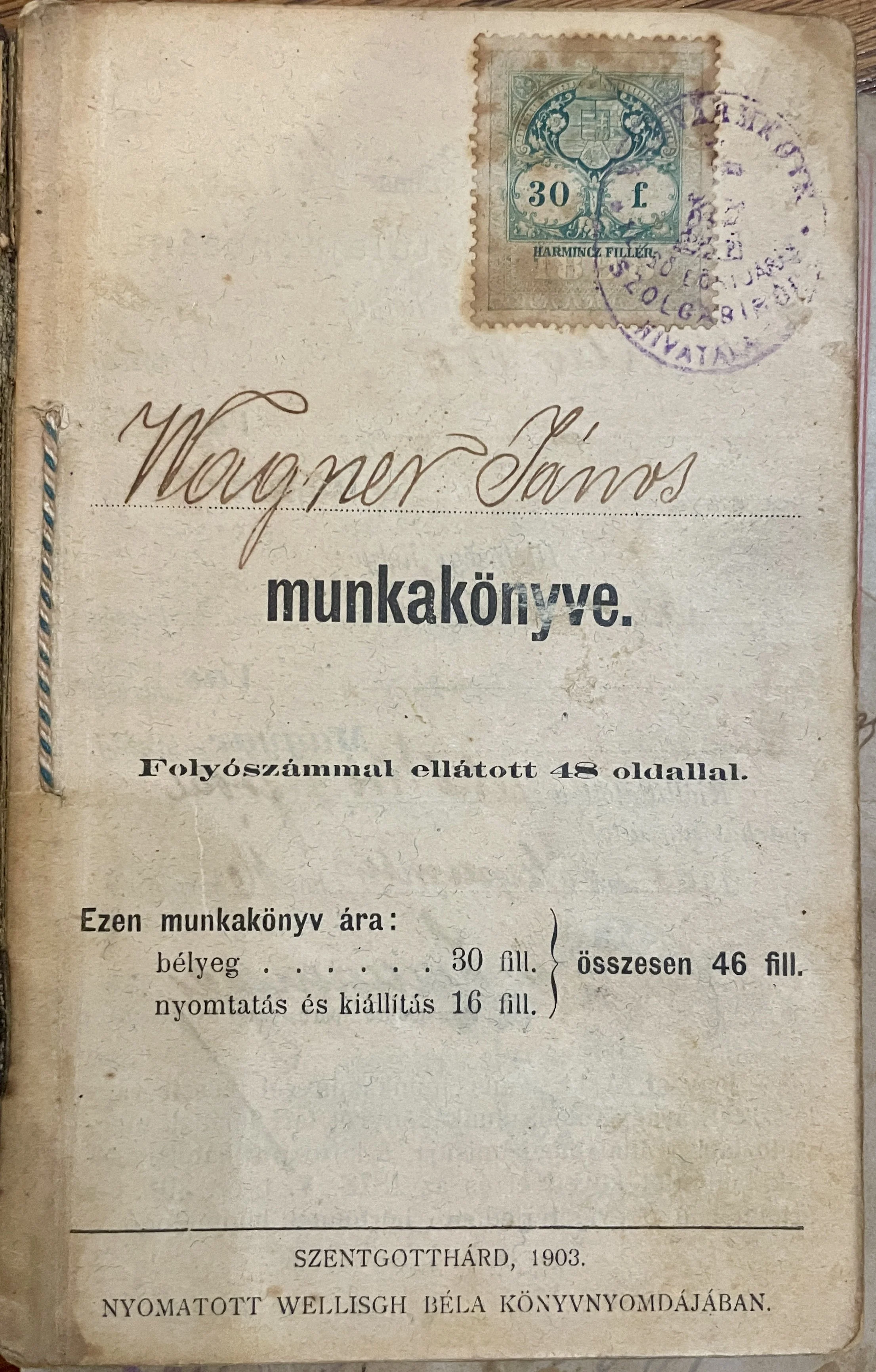
Above you can see the front cover of János Wagner’s Worker’s Record Book; below you can see the “check out date” from his last job in Hungary in January 1909, as well as a stamp showing that he worked for Graf/Count Gyula Erdody at his “Emilia” Hengermalma in Vas-Vorosvar (his roller steam mill in Rotenturm an der Pinka).
After leaving his job, János had to get the official signature required from the District Magistrate for anyone wanting to emigrate, which he did on 1 Feb 1909. The fact that he was able to get the signature proved that (1) he had either completed his mandatory military service or was officially exempt from it; (2) he had settled all of his outstanding local and state taxes and was not fleeing the county to escape legal debts, public fines, or child support obligations; and (3) he had a clean employment record and was not a vagrant. Many “illegal emigrants” skipped this step in an effort to avoid the required military service. Even for those who had fulfilled the basic requirement, though, a war would likely mean additional service would be required.
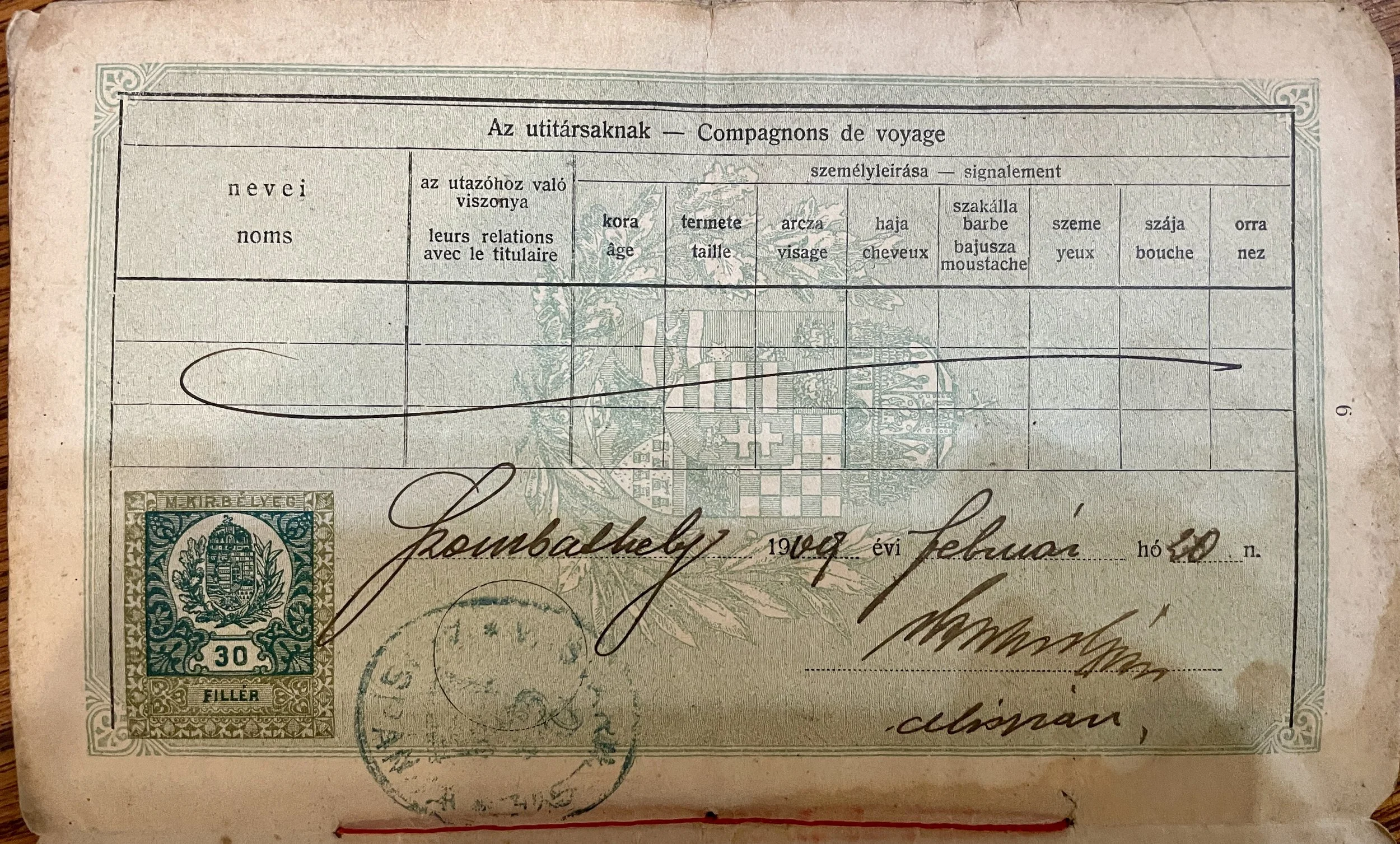
Finally, János traveled to Szombathely, the county seat of Vas County, Hungary (of which his home village of Unterwart was still a part in 1909), to get his Hungarian passport (útlevél). There, his passport was issued on 20 Feb 1909, in the name of "His Majesty Franz Joseph I" (Első Ferencz József), who was the Emperor of Austria and the King of Hungary from 1848-1916. Written in both Hungarian and French (the international language of diplomacy back then), the passport was issued to Wagner János / Jean Wagner and was valid for one year. It also mentioned that he planned to depart from Antwerp, but he actually set sail from the Port of Le Havre in France on the SS Louisiane, arriving at the Port of New York on 10 Sep 1909. He said he was going to his “Uncle Eduard Gaugl” (his step mother’s brother) on Otto Street in Chicago. He lists his last known address as Alsóőr, Hungary, and his father as János Wagner.
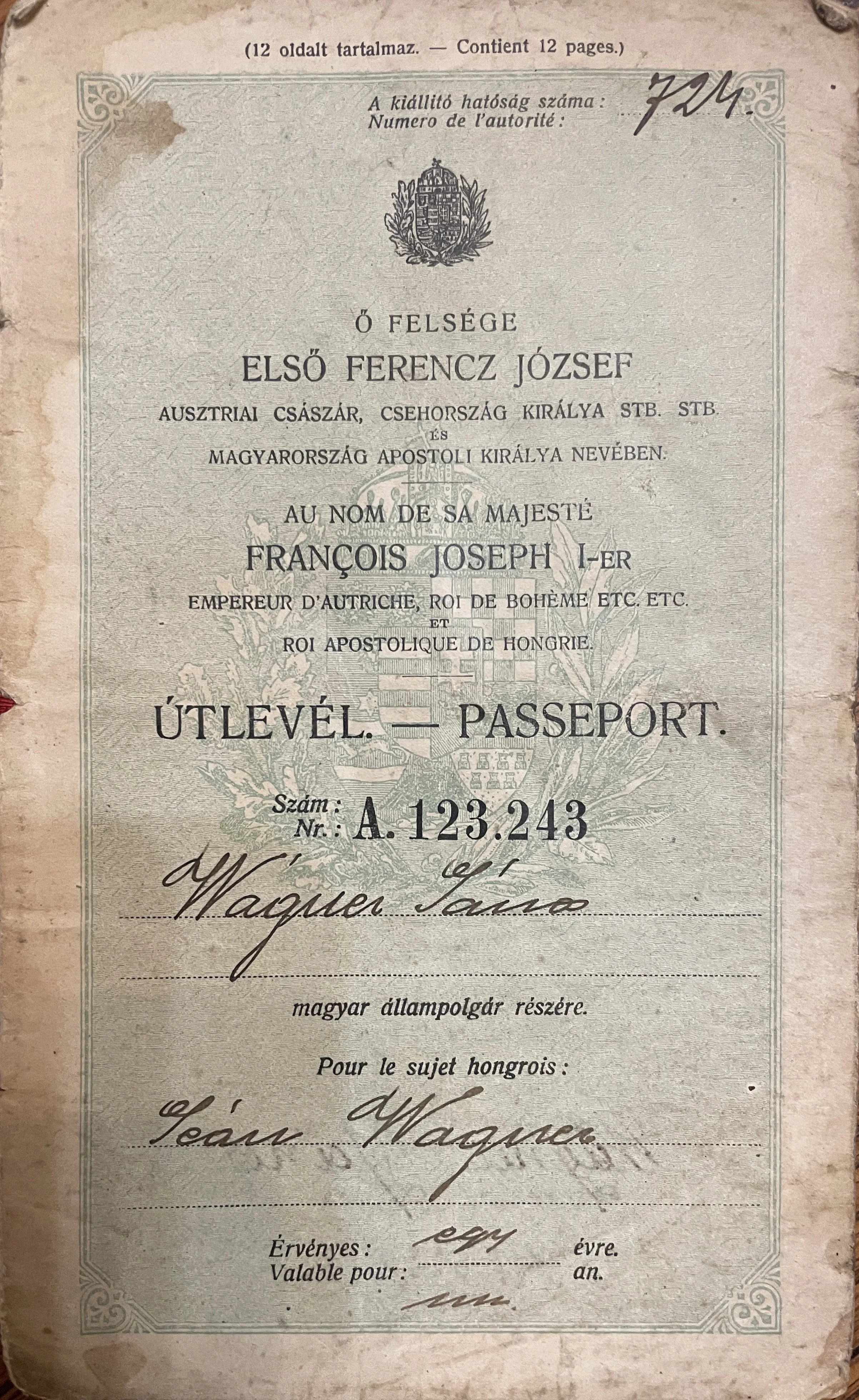
Here you can see the front cover of János Wagner’s passport, which was issued and stamped 20 Feb 1909 in Szombathely, the county seat of Vas, Hungary (as shown below).
So, what did János do during the seven-month gap between receiving his passport at the end of February and finally setting sail in early September? Because his Munkakönyv was permanently closed by the Magistrate on February 1st, he could no longer hold formal, contracted employment within the domestic Hungarian labor system. I thought he perhaps simply drifted during those gap months or worked entirely "under the table", but a secondary record – his Tagkönyv (Health Insurance Booklet) – provides a clearer answer. As a side note, all of these historical records were kept by my Aunt Minnie until her death in 2016 at age 88, at which time her daughter Tracey (my first cousin, 1x removed) took them over. Sadly, Tracey — who was my partner in doing family research on this side of the family — died unexpectedly in 2018, at which time I acquired them.
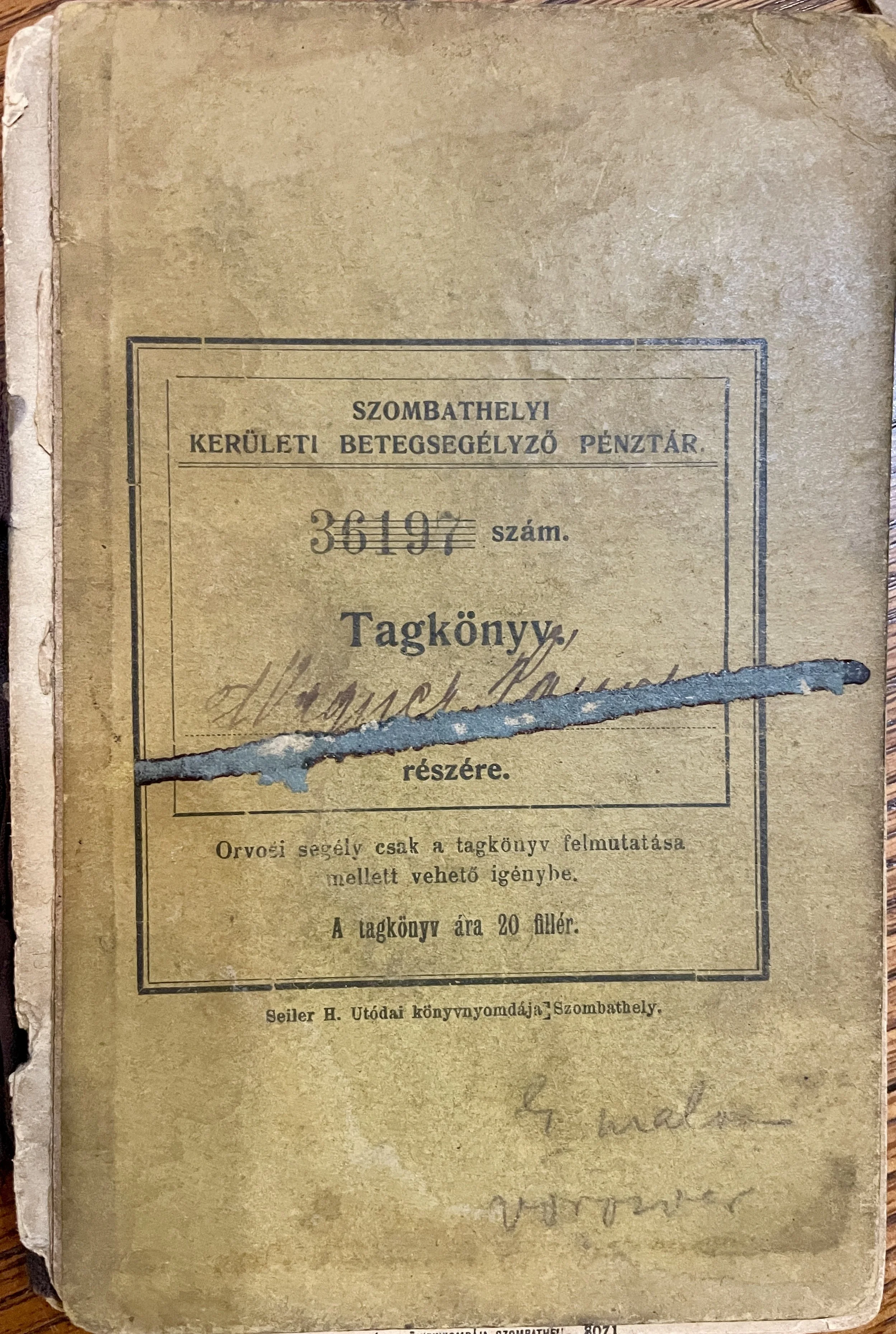
This is the cover of János Wagner’s Tagkönyv (Health Insurance Booklet), with his insurance remaining active through 18 Aug 1909.
János’s state-regulated health insurance file actually remained active and open throughout the spring and summer, showing a final administrative archive and settlement date of August 18, 1909. This suggests he spent those months wrapping up his institutional accounts, finalizing his insurance tallies, and ensuring his legal and financial profile was entirely clear before traveling across Europe. As for the sudden port change from Antwerp to Le Havre, the explanation likely lies in the fierce commercial competition of the era; aggressive emigration agents at major continental rail junctions frequently intercepted travelers, offering discounted train-and-sea bundles or quicker connection dates that could easily entice a budget-conscious traveler such as János.
While János/John Wagner’s story highlights why some might have left due to concerns about military mobilization, the reality of most emigration from South Burgenland was a mixture of deep-seated economic hardship and systemic political pressure. Known at the time as German West Hungary, this borderland was largely ignored by the industrializing governments in Vienna and Budapest. The region lacked factories, modern infrastructure, and reliable transportation networks, forcing the vast majority of residents to rely strictly on subsistence farming. Compounding this isolation was the local system of land inheritance, which splintered properties into tiny, economically unviable strips of land that could no longer feed a single family, leaving ambitious young men and women with no future on the farm.
For the residents of neighboring villages like Unterwart and Oberdorf, these struggles were further magnified by the region's complex ethnic dynamics and the looming shadow of the Austro-Hungarian military. Unterwart stood out as a historic, centuries-old enclave of ethnic Hungarians, while Oberdorf was deeply rooted in German language and culture. Despite these cultural differences, both communities struggled under Hungary’s heavy-handed "Magyarization" policies; and when the explosive Bosnian Annexation Crisis erupted in late 1908, the government’s sweeping partial mobilizations threatened to pull the young men of both villages into a brutal imperial war. Facing the dual realities of severe economic stagnation and immediate conscription into an army that did not represent their interests, thousands of South Burgenländers chose flight over the draft. János/John Wagner was likely one of them. So was Anna Halper’s brother Frank, who also emigrated in 1909.
No one made this daunting transatlantic journey blindly; instead, they relied on a powerful, deeply coordinated phenomenon known as chain migration. Families meticulously pooled resources to send one or two members ahead to secure a foothold in America, who would then sponsor the next wave of relatives. Anna Halper’s family perfectly illustrates this multi-tiered survival strategy. The initial family members – her mother Maria, brother Paul, and sister Maria/Mary – left Oberdorf in 1904, relying on a cousin (Michael Lorenz) who was already established in Chicago to provide their initial shelter and help them navigate the city's job market. Initially, mother Maria only stayed for a year, then headed back to Oberdorf; however, she returned to Chicago on her own in 1910, with plans to join her daughter Maria (who went by the name Mary in Chicago) and her new son-in-law, Franz Joseph Halper (yes, he was Mary’s cousin — the son of her mother’s brother Peter).
When sister (Katarina/Katherine) arrived in 1905 at age 16, she too headed to “sister Maria Halper” for a home base. Brother Frank, who arrived in 1909 at age 17, gave Mary a break and went to stay with his brother Paul, at least briefly; but he showed up living with Mary, her husband, and their two-year-old son in the 1910 U.S. Census. When Anna herself finally immigrated in 1913 at age 19, she headed to Chicago to meet up with her mother Maria. This generational “relay race” ensured that by the time Anna stepped off the train in Chicago, she wasn't entering an alien landscape, but rather a friendly, ready-made safety net, with not just her immediate family members but lots of aunts, uncles, cousins, in-laws, and even several nieces and nephews.
In my next post, I will explore what life looked like for the Burgenländers in Chicago. While some headed to Chicago’s north side, the majority settled in Chicago’s south side, crowded into apartments with immigrants from a wide variety of countries. For the most part, they found themselves living in the “back of the yards,” which meant their homes and apartments backed up to the Union Stock Yards — a 375-acre site that housed 2,300 separate livestock pens, with “room to accommodate 75,000 hogs, 21,000 cattle and 22,000 sheep at any one time…. By the start of the 20th century, the stockyards employed 25,000 people and produced 82 percent of the domestic meat consumed nationally.” [18]
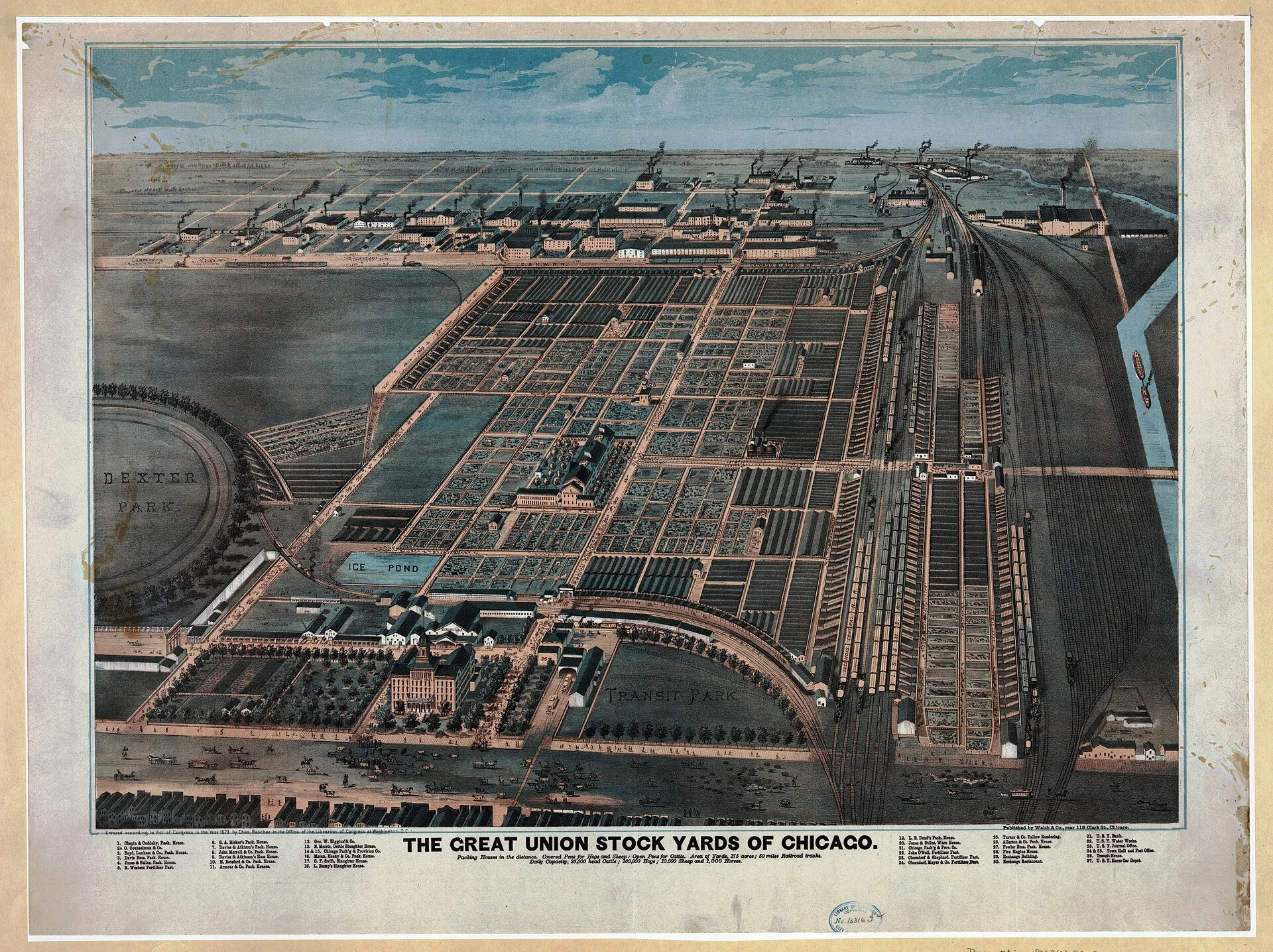
This old image provides an early view of the “Great Union Stock Yards of Chicago” from 1878; first built in 1864, the stock yards operated until 1971 and employed many immigrant laborers. [19]
Those same stock yards were described as “Packing Town” in Upton Sinclair’s muckraking book The Jungle, published in 1906. While Sinclair attempted to shine a light on how immigrant workers were being (mis)treated, his book instead got more attention for what it revealed about the meat packing industry. But more on that next time – stay tuned! And thanks for reading!
Endnotes:
Dujmovits, Walter (translation by Robert Strauch). The Burgenländer Emigration to America (English issue of the 3rd Edition). The Burgenland Bunch, Lulu Press, 2013, pg. 13.
Kroemer, Heike, and Tom Koch, curators. "Home, far away from home (1919-1938)." Stadtvilla Eisenstadt Permanent Exhibition, visited 17 June 2026, Stadtvilla Eisenstadt, Eisenstadt. Exhibit.
Dujmovits, pgs. 44-45
Dujmovits, pg. 27.
Ibid.
Dujmovits, pg. 28.
Ibid.
Winkler, Henry. Die Osterreicher im Ausland (Austrians Abroad). Vienna, 1955, pg. 15.
“Steamship.” Wikipedia, 2026, https://en.wikipedia.org/wiki/Steamship.
Léon & Lévy. “Le Havre – Le Transatlantique La Provence 1911.” Wikipedia Commons, 2026, https://commons.wikimedia.org/wiki/File:442_Le_Havre_Le_Transatlantique_La_Provence_LL1911_vers.jpg.
Dujmovits, pgs. 27-32.
“Magyarization.” Wikipedia, 2026, https://en.wikipedia.org/wiki/Magyarization.
Mutschlechner, Martin; translator Nick Somers. “Élyen a Magyar – long live the Magyars! Hungarian Magyarization policy.” The World of the Habsburgs, Schloss Schonbrunn Kultur, 2026, https://ww1.habsburger.net/en/chapters/elyen-magyar-long-live-magyars-hungarian-magyarization-policy.
Ibid.
Keleher, Edward P.; Gordon, Nancy M. “Research Starter: Austria Annexes Bosnia and Herzegovina.” EBSCO Information Services, 2021, https://www.ebsco.com/research-starters/history/austria-annexes-bosnia-and-herzegovina/.
“The ethnic groups of Austria-Hungary in 1910. Based on Distribution of Races in Austria-Hungary from the Historical Atlas by William R. Shepherd, 1911.” Wikipedia Commons, 22 Dec 2008, https://commons.wikimedia.org/wiki/File:Austria_Hungary_ethnic.svg.
Keleher, Edward P.; Gordon, Nancy M. “Research Starter: Austria Annexes Bosnia and Herzegovina.” EBSCO Information Services, 2021, https://www.ebsco.com/research-starters/history/austria-annexes-bosnia-and-herzegovina/.
“The Union Stock Yards in 1878.” Wikipedia, 11 May 2017, https://en.wikipedia.org/wiki/Union_Stock_Yards#/media/File:Union_stock_yards_chicago_1870s_loc.jpg.
“Union Stock Yards.” Wikipedia, 6 Aug 2026, https://en.wikipedia.org/wiki/Union_Stock_Yards.